
Quick Answer
File Form I-751 in the proper pre-expiration window to remove conditions on green card status, and submit evidence that your marriage was entered in good faith. Build your packet around high-value records like joint tax, housing, and financial documents, then add supporting context for any gaps. If you cannot file jointly, use the waiver route that matches your facts. After submission, track your case through the receipt notice, biometrics, possible evidence requests, and final decision.
The I-751 Project Kickoff: Managing Your Biggest Compliance Risk#
Start with the core rule: file Form I-751, Petition to Remove Conditions on Residence in the 90-day period before your 2-year card expires, and submit evidence that the marriage was entered into in good faith. If you miss the filing rules or send a defective package, this is not a routine renewal issue. USCIS says conditional residents who do not remove conditions can lose permanent resident status and become removable.
You are a conditional permanent resident if you got marriage-based residence when the marriage was less than 2 years old on the day status was granted. That comes with a Green Card valid for 2 years, and the status stays conditional until USCIS approves the I-751. Approval is not a renewal of the 2-year card. It removes the marriage-based conditions and moves you into regular permanent resident status.
If you are still married to the spouse through whom you got conditional status, you generally file jointly. USCIS also allows individual filing in specified situations, including some waiver paths, but the exact basis for filing alone depends on the current instructions and your facts. The practical point is simple: this is the required filing to remove conditions, and it has to show the marriage was real, not just legally valid on paper.
| Item | What it is | Why it matters |
|---|---|---|
| Conditional Green Card | Your 2-year proof of conditional permanent resident status | Sets the expiration date that controls your I-751 filing window |
| Form I-751 | The petition asking USCIS to remove marriage-based conditions | This is the core filing that must be properly completed, signed, and supported |
| Form I-797 receipt notice | USCIS notice showing receipt or approval of a case | After USCIS receives a properly filed I-751, status is automatically extended until adjudication, and this notice is a key pending-case record |
| Permanent Resident Card without conditions | The post-approval card | This is the end state you are trying to reach |
The real success standard is a bona fide marriage showing. The regulation gives you the main categories to think in: joint ownership of property, a joint lease, commingled financial resources, birth certificates of children born to the marriage, and third-party affidavits from people who know the relationship is genuine. A file built across multiple evidence categories is generally stronger than relying on any single evidence type.
Before you submit anything, do three checks on the official USCIS filing page: the accepted edition, the current fee using the Fee Calculator, and the direct filing address. USCIS specifically says it will reject I-751 filings sent more than 90 days early. It also rejects packages with incorrect or incomplete fees, the wrong edition date, missing fields, or missing signatures. One avoidable early failure mode is a rejection that costs time and can increase status risk if not fixed quickly.
If you want a deeper dive, read The 2026 Global Digital Nomad Visa Index for 50+ Countries.
Phase 1: Risk Assessment & Timeline Management#
Verify timing before anything else: confirm your card expiration date, confirm the live USCIS filing-window rule, and confirm your packet can be submitted inside that verified window.
Before setting a filing date, verify the current filing-window rule in the current USCIS I-751 instructions and any USCIS date tool or calculator shown there.
Build your timeline from the expiration date#
Your expiration date is the anchor for every filing decision. Calendar that date first, then map your filing plan only after you verify current USCIS timing rules.
| Timeline item | What to do | Why it matters |
|---|---|---|
| Expiration date | Calendar that date first. | It is the anchor for every filing decision. |
| Current filing-window rule | Verify current USCIS timing rules before mapping your filing plan. | Confirm dates using the current USCIS I-751 instructions and any USCIS date tool/calculator shown there. |
| USCIS receipt timing | Track when USCIS will receive your filing, not just when you finish it. | Keep objective proof of submission or delivery timing in case USCIS later questions when your case was filed. |
| Final same-day check | Do a final same-day check against the live instructions before submitting. | Timing alone will not protect you if your packet is incomplete under current USCIS requirements. |
Track when USCIS will receive your filing, not just when you finish it. Keep objective proof of submission or delivery timing in case USCIS later questions when your case was filed.
Readiness is part of timing risk. If your packet is incomplete under current USCIS requirements, timing alone will not protect you, so do a final same-day check against the live instructions before submitting.
Quick triage: too early, on-time window, or late#
| Timing posture | Practical outcome | Immediate next action |
|---|---|---|
| Too early | Filing may not be accepted under current USCIS timing rules. | Stop and re-verify the earliest valid filing date in the live USCIS instructions. |
| On-time window | Standard filing track if your packet matches current USCIS requirements. | Submit after a final completeness check and keep timestamp/delivery proof. |
| Late | Higher status and enforcement risk if the delay is not adequately explained and supported. | Verify the current USCIS late-filing standard, then submit with a dated explanation and supporting records. |
Eligibility checkpoint: joint filing or waiver branch#
Use filing posture as an early checkpoint. If your current facts match joint filing, confirm the live I-751 instructions for who must sign and how the filing must be submitted.
If your facts no longer match joint filing, do not force that route. Move to the waiver path and verify current eligibility language before filing.
If you missed the window, treat it as a legal-risk workflow#
A late filing needs a documented timeline, not a short apology. Your explanation should map key dates, explain why timely filing did not happen, and attach records that independently support that timeline.
Current late-filing standard and evidentiary language must be verified from USCIS instructions or official immigration-policy records before use.
The enforcement risk is real. USCIS policy references 8 CFR 216.6(a)(5) for termination of status for failure to file a required petition, and a Notice to Appear (Form I-862) is the charging document used to start removal proceedings in Immigration Court. The February 28, 2025 USCIS NTA policy also states USCIS will no longer exempt classes or categories of removable noncitizens from potential enforcement.
You can also read 183-Day Rule Explained: Stop the Tax Myths Before They Cost You.
Phase 2: Dossier Construction: Building an Undeniable Case File#
After timing, this phase is about one thing: building a record that makes a bona fide marriage more likely than not. Start with documents that show shared legal and financial responsibility, then use residence and relationship records to confirm the same story.
USCIS does not publish a points chart for I-751 evidence. Officers review each item for relevance, probative value, and credibility, then assess the file as a whole. So volume alone does not help if names, addresses, dates, or account ownership conflict. Before adding more exhibits, make sure your core timeline is internally consistent from the date conditional residence began.
What evidence does the most work?#
For a joint filing, you must show the marriage was entered into in good faith and not to evade immigration law. Prioritize evidence of commingled finances, joint property or tenancy, and shared residence history, then add supporting proof that matches those facts.
| Evidence type | Why USCIS weighs it | Common weaknesses | How to strengthen before filing |
|---|---|---|---|
| Joint tax returns | Shows you represented yourselves as a married household to a government agency | Missing years, separate filing without context, only one spouse documented | Include complete records for each relevant year and briefly explain any unusual filing posture |
| Joint bank or credit statements | Helps show ongoing commingling of financial resources | Account exists but limited shared use, one spouse appears to be the only user | Include statements across the conditional period and make regular shared household use easy to see |
| Lease, mortgage, deed, or joint tenancy records | Direct proof of shared residence or joint property | One spouse missing, unexplained address changes, gaps between residences | Add renewals, move-in records, or an address timeline that closes gaps |
| Insurance policies and beneficiary designations | Shows legal responsibility and future planning | Names appear but dates are unclear, outdated enrollment records | Include declarations, enrollment confirmations, and effective dates |
| Utility bills and official mail to same address | Corroborates cohabitation over time | Only one name appears, inconsistent service address | Pair with stronger residence and financial exhibits and include multiple months |
| Third-party affidavits and photos | Adds outside context to the relationship | Generic affidavits, undated photos, unclear context | Use specific affidavits and caption photos with names, place, and approximate date |
If you need to triage, spend effort first on documents tying both spouses to the same money, obligations, property, and address. Affidavits and photos are accepted, but they are usually supplemental.
Also include the history USCIS says should be covered since conditional status began: actual residences and both spouses' employer names and places. A simple internal timeline helps you catch inconsistencies before filing.
What digital evidence can USCIS actually verify?#
Digital evidence helps when it is identifiable and consistent with the rest of your file. Useful examples include shared phone plans, shared account pages, travel itineraries, and photo sets with clear dates and context.
Treat screenshots as support, not self-proving evidence. Show enough context to identify the platform, account holder, and timeframe, and label images so they fit your timeline. If a digital item is ambiguous, pair it with stronger records such as a bank charge, boarding pass, lease record, or insurance enrollment.
How should you assemble the packet?#
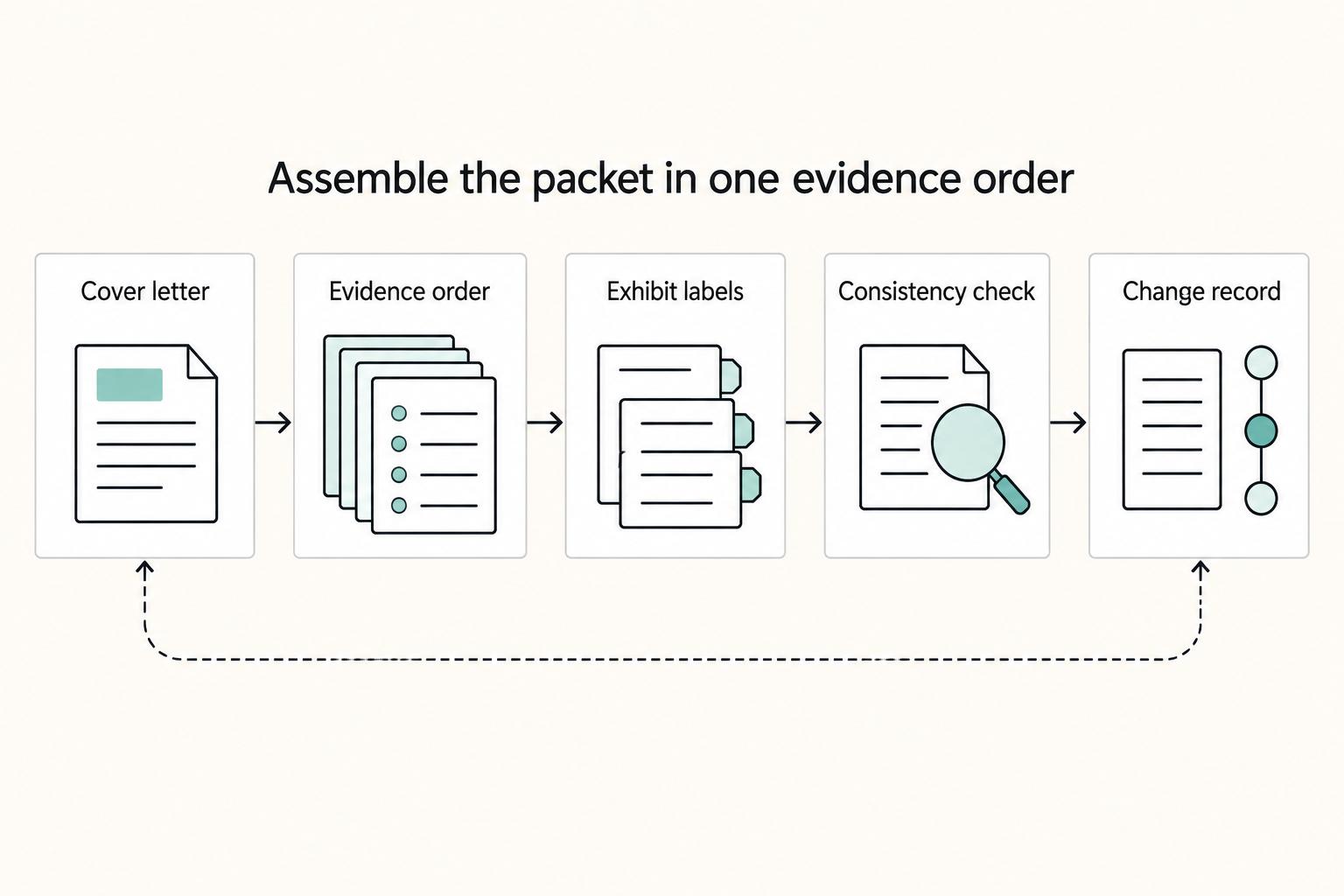
Organize the packet so an officer can follow it quickly and trust what they see. USCIS recommends assembling benefit requests in the order indicated for that benefit.
| Assembly item | What the article says |
|---|---|
| Initial evidence order | Put required initial evidence first, in the order shown in the current Form I-751 instructions. |
| Cover letter | Use a functional cover letter if helpful: filing basis, short timeline, exhibit index, and brief notes for unusual facts. |
| Exhibit labels | Index exhibits by category and date range, then label consistently (for example, A1, A2, B1). |
| Consistency check | Cross-check names, addresses, employer details, and dates across all exhibits so the timeline is coherent. |
| Name or address changes | If a spouse changed name or you moved during the 2-year conditional period, make that progression easy to trace. |
| Foreign-language documents | Include full English translation and translator certification for each foreign-language document. |
| Final reviewer pass | Identify thin periods and add corroboration before submission. |
We covered this in detail in How to Prepare for the US Citizenship Test (Naturalization Test).
Phase 3: Contingency Planning: Navigating Waivers and Complications#
If you cannot file jointly, your next decision is straightforward: choose the waiver basis that matches your facts, then build your Form I-751 record around that basis from day one. A waiver is a valid USCIS path, and where required, you still need to show the marriage is or was bona fide. Also, if you are still a conditional permanent resident, USCIS says you cannot use Form I-90 instead of Form I-751.
| Waiver basis | Required proof theme | Common documentation themes | Typical review risk |
|---|---|---|---|
| Divorce or annulment | You entered the marriage in good faith, but it ended through divorce or annulment | Final divorce or annulment record, plus marriage-period evidence of shared residence, shared property, and commingled finances | Evidence is thin for the actual marriage period, or the separation timeline is unclear |
| Widow or widower | Your qualifying spouse died, and you entered the marriage in good faith | Death record, plus good-faith marriage evidence similar to a joint filing | Heavy reliance on the death record without enough evidence of the marital relationship |
| Battery or extreme cruelty | You or your child were battered or subjected to extreme cruelty by the qualifying spouse | Records showing the relationship, plus available evidence of abuse or its effects | Statements are broad, with limited corroboration or weak connection to the qualifying spouse |
| Extreme hardship | Termination of status and removal would result in extreme hardship | Evidence tied to your specific hardship claim and personal circumstances | Hardship is described in general terms instead of a documented, case-specific claim |
How do you build a divorce or annulment waiver case?#
For this waiver, prioritize evidence from when the marriage was functioning as a real marriage. Start with joint tax records, bank statements, lease or mortgage records, insurance, and other records showing shared residence, property, and finances during that period. Your packet should read as a clear timeline from when conditional residence began through separation.
Keep your explanation chronological and direct: date of marriage, date conditional residence started, where you lived together, how finances were shared, when separation occurred, and when the divorce or annulment became final. If timing is close or proceedings are still active, verify the current filing-timing rule from USCIS instructions or legal records before finalizing the cover letter.
What risk flags should you clear before filing?#
| Risk flag | What it means | Action |
|---|---|---|
| Inconsistent records | Names, addresses, employer history, or dates do not line up. | Build a one-page timeline and resolve or explain each mismatch. |
| Missing civil documents | Your waiver basis depends on a divorce, annulment, or death record that is not ready. | Secure the formal record before filing. |
| Unresolved proceedings | Your basis depends on a matter that is not final. | Verify the current rule, then state case status clearly in the packet. |
| Prior filings or fraud issues | Prior immigration filings conflict with your current timeline, or there are paid-marriage concerns. | Address inconsistencies directly and avoid leaving gaps. |
Extreme hardship is a separate legal basis, not a fallback story. Build a structured narrative that ties each hardship point to your specific circumstances and supporting documents, instead of relying on general statements about disruption.
For a step-by-step walkthrough, see UAE Golden Visa for Freelancers and the Green Visa Decision Guide.
Phase 4: Project Execution & Monitoring: After You File#
After filing, your job is notice management. Track the case in this order: receipt notice, biometrics, possible RFE/RFI/RFO, possible interview, then written decision.
Your first checkpoint is the receipt notice. USCIS says you should generally receive it within 30 days after filing, and the 13-character receipt number is what you use to track status online. Keep the notice with your expired card as practical proof of pending status for work, travel, and ID processes where requested. Verify the current extension validity period in the receipt notice and current USCIS guidance before relying on it. If a notice seems missing, check Case Status Online before submitting a non-delivery request.
| USCIS notice | Do immediately | Prepare now | Deadline to verify |
|---|---|---|---|
| Receipt notice | Save and store it, confirm name/address, log receipt number | Expired card, filing copy, mailing proof | If no receipt notice by 30 days, check case status |
| Biometrics notice (typically Form I-797C) | Calendar the ASC appointment as soon as it arrives | Appointment notice, photo ID, travel timing plan | Appointment date/time; reschedule before the appointment time and show good cause |
| RFE, RFI, or RFO | Read line by line and map each request to one evidence item or explanation | One indexed response packet, consistent with your filed record | Exact due date printed on the notice |
| Interview notice | Review your full filing packet before preparing anything new | Timeline, core documents, originals if requested | Interview date, location, and notice-specific document list |
| Decision notice | Read outcome and instructions fully, then archive with your case file | Complete file set for records and next steps | Any follow-up date or instruction in the notice |
If you receive an RFE, run it like an operations checklist. Match every requested item to a labeled exhibit, send all requested materials together in one batch, and keep names, dates, addresses, and timeline details consistent with what you already filed. A partial response is treated as a request for a decision on the current record, so assume USCIS may decide on what is already in the file.
Use this interview checklist so your answers match your record:
- Full-file review: Re-read your filed form, supporting evidence, and any later notices.
- Timeline consistency: Confirm major dates and sequence are consistent across forms and documents.
- Joint filer prep: Align on shared address history, financial records, and household facts already documented.
- Waiver filer prep: Be ready to explain your filing basis and timeline exactly as documented in your packet.
- Contradiction check: Fix any mismatch between your form, evidence, and likely verbal answers before interview day.
This pairs well with our guide on Hungary's White Card for Digital Nomads: A Complete Guide.
Project Debrief: From Conditional Status to Your Next Strategic Move#
Approval is not the end of your USCIS record. Your next job is simple: keep your documentation consistent, complete, and easy to reuse in future filings.
Use this closeout checklist now:
- Archive your full case file: complete I-751 copy, approval notice, receipt notices, biometrics notices, and any RFE response.
- Keep one working record set for future filings: signed statements, interview-related records, notices, and supporting evidence you already submitted.
- Keep identity details aligned across your green card, passport, tax filings, and address history.
- Set reminders for ongoing maintenance: USCIS address updates after moves, green card renewal planning, and pre-trip travel document checks.
- Confirm the current travel-risk rule with USCIS or the official source before extended international travel.
This is more than admin hygiene. USCIS treats submitted evidence as part of the benefit request record, evaluates the totality of evidence, and can request more evidence or deny when the record is not sufficient. Treat consistency as your default: if your address, tax, marital, or travel history changes, document it clearly.
| Path | Goal | Key actions | Common mistakes | When to seek legal help |
|---|---|---|---|---|
| Stay a permanent resident | Keep status clean and usable | Maintain tax filing continuity, keep travel documentation, update USCIS address records, plan renewal steps early | Lost notices, inconsistent records, undocumented changes across filings | Long or frequent travel complications, criminal history issues, missing records, conflicts with prior filings |
| Prepare for naturalization | Build a filing-ready record for the next case | Confirm the current filing window rule from the official USCIS source; organize tax records, travel history, prior USCIS notices, and identity documents | Guessing timing, incomplete trip logs, unexplained inconsistencies from prior filings | Complex travel history, prior waiver/divorce complications, prior RFEs, arrests, or unclear eligibility |
If citizenship is your next move, do not file from memory. File from your record.
You might also find this useful: How to Adjust Status from a K-1 Visa to a Green Card.
Frequently Asked Questions
When should you file to remove conditions on green card?
If you are filing jointly, submit Form I-751 during the 90-day period immediately before your conditional residence expires. Filing before the first day of that window may lead to rejection, so count from the card expiration date, not from when you started gathering documents. After proper filing, keep the receipt notice with your expired card. USCIS has issued alerts that this notice can extend evidence of continued status beyond the card expiration date, but verify the current USCIS alert before relying on the exact period.
Which filing path fits your case?
The right path depends on whether you are still filing with the same spouse or need a waiver. Use this quick check: | Filing path | When you use it | Evidence priorities | Risk note | |---|---|---|---| | Joint filing | You are still filing with the same U.S. citizen or lawful permanent resident spouse | Records showing your shared life during the conditional period | Timing errors matter here because filing too early may be rejected | | Waiver after divorce or annulment | The marriage ended, but you entered it in good faith | Records supporting a good-faith marriage and the final divorce or annulment | More document-sensitive because you must show both the relationship and the ending | | Waiver after spouse death | Your spouse died after a good-faith marriage | Records of the spouse's death and the marriage history | Event records must match the rest of your file | | Waiver for battery, extreme cruelty, or extreme hardship | Your case fits one of the USCIS waiver grounds | Records tied to the waiver ground you are requesting | Get help early if the facts are sensitive or hard to document |
What proof should you send if your case is straightforward?
Send records that show how you actually lived together across the conditional period, not just a few recent papers. If a common document is missing, include substitute records and a short explanation instead of leaving the gap unexplained.
Can you file if you are divorced?
Yes. USCIS allows a waiver path if the marriage ended through divorce or annulment and you entered it in good faith. Include the final divorce or annulment record and focus your evidence on the period when you were together. If your story is hard to prove on paper, that is a sensible point to get legal help.
What if you never had a joint bank account?
The provided USCIS excerpts do not give a bright-line yes/no rule for this by itself. If a common proof is missing, include other records that show your shared life and add a brief written explanation for the gap. The failure mode here is silence.
What if you file late?
Treat late filing as a problem that needs immediate review, not as a minor delay. Check the current USCIS instructions right away, preserve proof that explains the delay, and consider professional advice before you submit anything. Also, do not try to use Form I-90 for this issue, because USCIS says conditional permanent residents cannot use that form.
Do you need a lawyer?
This guide does not set a bright-line rule for when a lawyer is required. If you are unsure about eligibility, timing, or documentation, legal advice can help you avoid filing mistakes.
Try a related tool
Researched and edited by the Gruv editorial team. Gruv builds cross-border billing, payouts, and finance-operations software for global businesses.
Sources
Educational content only. Not legal, tax, or financial advice.
Related Posts

The 2026 Global Digital Nomad Visa Index for 50+ Countries
Start with legal fit, not lifestyle filters. The practical order is simple: choose a route you can actually document, then decide where you want to live. That single change cuts a lot of wasted comparison work and stops you from falling in love with places that were never a real filing option.

183-Day Rule Tax Myths That Trigger Residency Filing Mistakes
If you are a mobile freelancer or consultant, start here: the "183 day rule tax" idea is not a single universal test. It is a shortcut phrase people use for different residency rules that do not ask the same question. If you mix federal and non-federal residency logic, you can create filing risk even when your travel calendar looks clean.
How to Adjust Status from a K-1 Visa to a Green Card
To adjust status from a K-1 to a green card, focus on four things: confirm eligibility, file the right forms, submit enough evidence, and avoid preventable filing or travel mistakes. This guide covers the U.S.-based adjustment process, the core forms, your evidence strategy, and the decisions that most affect how smoothly the case moves.