
Quick Answer
Start with structure and eligibility, not headline rates. For a US-based management consultant moving in 2026, the safer path is to test IFICI fit first, then decide whether to stay on US W-2 or shift to a Portuguese Unipessoal LDA, because that choice changes your evidence burden. Treat claims of automatic favorable treatment across all income as a warning. Before relocation or payroll changes, get written confirmation tied to current Autoridade Tributária e Aduaneira criteria and your planned US filing position.
What this guide helps you decide#
This guide helps you make an early go-or-no-go call. Is Portugal's post-NHR regime a realistic fit for your facts in 2026, and what needs to be verified before you change payroll, contracts, or residency timing?
The main reset is simple. The original Non-Habitual Resident regime is described in the source material as phased out and replaced by a narrower framework, often called IFICI and sometimes labeled differently in secondary sources. So the practical question is not whether the old NHR headlines looked attractive, but whether your profile is close enough on tax residence, activity type, and documentation to justify deeper work.
Decide if your fact pattern is in range. The replacement regime is described as targeting highly qualified professionals in innovation, research, and key economic sectors, not as a broad expat benefit. Your first screen is whether you can support the core checkpoints signposted in the source material: tax residence requirement, professional activity, employer or activity certification, and documentation.
Use this as your first filter:
- If your work is clearly outside those narrower themes, treat eligibility as uncertain until verified.
- If your work could fit, move forward only if you can support that with real documents, not just summaries.
- If someone tells you all income gets favorable treatment once you are Portuguese tax resident, treat that as a warning sign. The same secondary material notes that benefits are not universal across income categories.
If you cannot state, in one sentence, your likely qualifying activity and the document that supports it, pause before making structure changes.
Choose structure before tax assumptions. In practice, one early fork is your operating model, not the headline tax rate. Staying on a US W-2 versus moving to a Portuguese structure like a Portuguese Unipessoal LDA changes the facts you create, the paperwork you need, and the questions your advisors have to answer.
Secondary material does mention remote work for a foreign employer with no Portuguese presence as a practical scenario. But that does not make a W-2 setup automatically eligible, and this guide treats it as something to verify, not assume.
A Portuguese Unipessoal LDA is another structure option if your delivery, invoicing, or work base is moving to Portugal. It creates a different administration and evidence profile, and it is neither automatically required nor automatically sufficient for IFICI.
Follow a lower-risk sequence. Use a facts-first order. First, confirm whether and when you expect to become a Portuguese tax resident. Second, decide how you will actually work and be paid. Third, identify the certification and documentation needed for your intended position. Only then should you change invoicing, payroll, or entity setup.
One avoidable failure mode is expensive rework. You change structure first, then discover that your activity description, employer setup, or evidence file does not support the position you planned to take. The rest of this guide is built to help you make that structure decision early, test whether the regime is realistic, and move in a sequence you can defend later. For related visa context, see Portugal Digital Nomad (D8) Visa: A Complete Guide.
Get the terms straight before making decisions#
Treat these names as a terminology map before you make any tax or structure move. In most current guidance, NHR 2.0 is used as a common label for IFICI (the Tax Incentive for Scientific Research and Innovation).
| Term you'll see | How to read it in practice |
|---|---|
| NHR 2.0 | Common label used in guides for the current IFICI regime. |
| Tax Incentive for Scientific Research and Innovation | English name used for IFICI. |
| IFICI | Acronym used for the same current regime referenced above. |
| Old Non-Habitual Resident (NHR) | Earlier regime described as ending for new access after 31 December 2023, with possible grandfathering conditions. |
| TISRI / ITS | Confirm with official guidance. |
For 2026 planning, the practical split is straightforward: old NHR and current IFICI/NHR 2.0 are different paths. The current regime is described as narrower, aimed at highly qualified profiles, with a 20% fixed rate on qualifying employment or self-employment income for 10 years. Other Portuguese-source income stays on standard rates.
Expect drift across secondary sources. For example, one guide may refer to standard rates of up to 48% and another to up to 53%. Reporting duties and exceptions, including foreign pensions and some investment income from blacklisted jurisdictions, add important nuance. Before changing contracts, payroll, or entity setup, verify the key points with the Portuguese Tax Authorities, including activity-review requirements and filing timing, typically 15 January of the following year.
Compare old NHR and IFICI on the points that change outcomes#
For a consultant moving in 2026, the planning call is usually simple: legacy NHR is generally closed, and IFICI is the live route if you qualify. The costly mistake is assuming that "NHR 2.0" works like old NHR.
| Point that changes outcomes | Legacy Non-Habitual Resident (NHR) | IFICI (Incentivo Fiscal à Investigação Científica e à Inovação) |
|---|---|---|
| Access for a new mover in 2026 | Closed to new entrants at the end of 2023. Transition or grandfathering may still apply if conditions were met by 31 December 2023. | Current regime that replaced NHR and is the active path for new qualifying residents. |
| Eligibility logic | Legacy rules plus transition facts. Not the default path for someone starting now. | Narrower, more technical scope: highly qualified professionals in eligible jobs tied to approved scientific research and innovation activities in Portugal. |
| Headline supported benefit | Treating old NHR and IFICI as interchangeable is not supported here. | Flat 20% IRS rate on Category A employment income and Category B professional income obtained in Portuguese territory, for 10 calendar years from Portuguese tax residency. |
| What the benefit actually covers | Do not map old NHR outcomes onto current consulting income without checking legacy rules against your facts. | Not a blanket resident rate. It is tied to a qualifying role or activity plus Category A or B income in Portuguese territory. |
| Foreign income treatment | Often described as broader; verify the exact scope in official guidance. | Conditional, not automatic. Treaty and taxability tests apply, including whether the source country has taxing rights under a DTA. |
| Foreign pensions | Foreign pension income taxed at 10% under old NHR. | Foreign pension income is fully taxable in Portugal under IFICI. |
| Practical constraint | You need dated proof that you were registered, met conditions by 31 December 2023, or can support a transition argument with dated evidence. | You need to meet criteria and procedures under Ordinance 352/2024/1, which defines eligible jobs, activities, and process. |
Headline benefit and covered income. The headline is clear: 20% for 10 years. But under IFICI, that applies to Category A and Category B income obtained in Portuguese territory within a qualifying profile, not to all income by default.
In consultant scenarios, this is usually the first real filter. Portuguese-source employment income can be relevant, but only if the underlying role or activity fits the eligibility framework. Being paid through payroll or by invoice does not establish IFICI eligibility on its own.
Acronyms and transition noise. Treat NHR 2.0 as the common market label for the current IFICI path. TISRI is another label used in secondary guidance, so anchor your decision to primary legal and tax guidance rather than acronyms alone.
If your plan depends on a 2024 transition argument for old NHR, treat that as a higher-risk path and verify it before changing payroll, contracts, or residency timing. For a fresh 2026 mover, the real question is simpler: can you qualify for IFICI, or are you in ordinary Portuguese taxation?
Run a fast eligibility check before relocation spend#
Start with eligibility fit, not tax-rate math. If your facts do not clearly map to IFICI-style requirements, pause relocation spend until they do.
| Checkpoint | Question | Evidence mentioned |
|---|---|---|
| Portuguese tax residency | Will you become a Portuguese tax resident under the current regime timing and residency conditions? | Proof points for Portuguese tax residency timing |
| Activity profile | Does your work plausibly fit the narrower scientific research and innovation framework? | Basis for activity fit |
| Income fit | Is the income you want covered plausibly qualifying Portuguese-sourced employment or self-employment income, not all income by default? | Expected income classification, whether employment or self-employment |
| Certification path | Can your employer or activity setup support employer or activity certification? | Expected support for employer or activity certification |
| Documentation | Can you prove the above with clear documentation? | Draft contract or service description for work performed in Portugal |
If you prefer a quick yes-or-no screen, use the same five questions:
- Portuguese tax residency: Will you become a Portuguese tax resident under the current regime timing and residency conditions?
- Activity profile: Does your work plausibly fit the narrower scientific research and innovation framework?
- Income fit: Is the income you want covered plausibly qualifying Portuguese-sourced employment or self-employment income, not all income by default?
- Certification path: Can your employer or activity setup support employer or activity certification?
- Documentation: Can you prove the above with clear documentation?
Judgment rule 1: if you plan to remain purely on a US W-2, do not assume IFICI eligibility from that fact alone; have a qualified advisor confirm your exact facts.
Judgment rule 2: if your setup may support qualifying activity and employer or activity certification, move to a full eligibility review before you relocate.
What to verify before you spend money. Verify your assumptions against current official criteria, and ask your advisor to map their conclusion to those criteria in writing.
Before you commit, ask for a short evidence pack that covers:
- draft contract or service description for work performed in Portugal
- expected income classification, whether employment or self-employment
- basis for activity fit
- expected support for employer or activity certification
- proof points for Portuguese tax residency timing
Choose your operating model before you choose your tax strategy#
Pick your operating model first, because structure can determine whether an IFICI path is even plausible before rate planning starts. Lock the operating facts first: who contracts, who invoices, and who pays you once work is performed from Portugal.
| Operating model | Likely implication for Portuguese-source employment income | Documentation burden | Practical audit exposure | Main tradeoff |
|---|---|---|---|---|
| US W-2 | Weak fit in the cited guidance if you stay on US payroll without a Portuguese entity. | Low at first with existing payroll and contracts, but weak support for a local qualifying-work position. | IFICI claims are more exposed to challenge when payer, payroll, and structure remain US-only. | Payroll continuity now, less compliance flexibility later. |
| Independent consultant billing from the US | Unclear and fact-sensitive, especially without a Portuguese company or local employer setup. | Medium to high: contracts, invoices, work-location evidence, and income characterization need to be coherent. | IFICI claims are more exposed to challenge when income streams are mixed or structure is inconsistent. | Simpler US contracting now, more classification risk later. |
| Consultant through a Portuguese Unipessoal LDA | Stronger alignment in the cited consultant scenario, subject to full eligibility conditions. | Highest upfront: entity records, registrations, contract updates, and submission trail, including NIF registration and Portal das Finanças steps. | Challenge risk can still rise if operational facts, records, or income streams are inconsistent. | More setup now, more compliance flexibility later. |
Why this structure decision matters. A Portuguese Unipessoal LDA is not automatic qualification. You still need the rest of the eligibility conditions to fit, including Portuguese tax residency under the regime timing, no Portuguese tax residency in the prior five years, and a qualifying Portuguese company or activity setup.
The practical benefit is alignment. Contracts, invoicing, and payment flows match the tax position you plan to defend. The wrong structure, or mixed income streams, can undermine an application.
Where avoidable risk appears. A common risk pattern is the half-switch: not choosing one model cleanly. Risk patterns include running US W-2 payroll while similar work shifts to a Portuguese company, or splitting similar client work across US and Portuguese billing with no clear rationale or transition date.
Before changing revenue flows, write a one-page structure memo that states:
- who signs client contracts after the move
- who issues invoices after the move
- who pays you personally, and in what form
- what will be submitted after NIF registration through Portal das Finanças
If those answers change mid-year, treat that as a potential tax event and review before filing.
If-then rule for consultants. If client contracts and delivery are moving to Portugal, design the local structure first, then choose tax elections. Start with entity, payer, and contract reality. Only after that should you test whether the IFICI position is supportable.
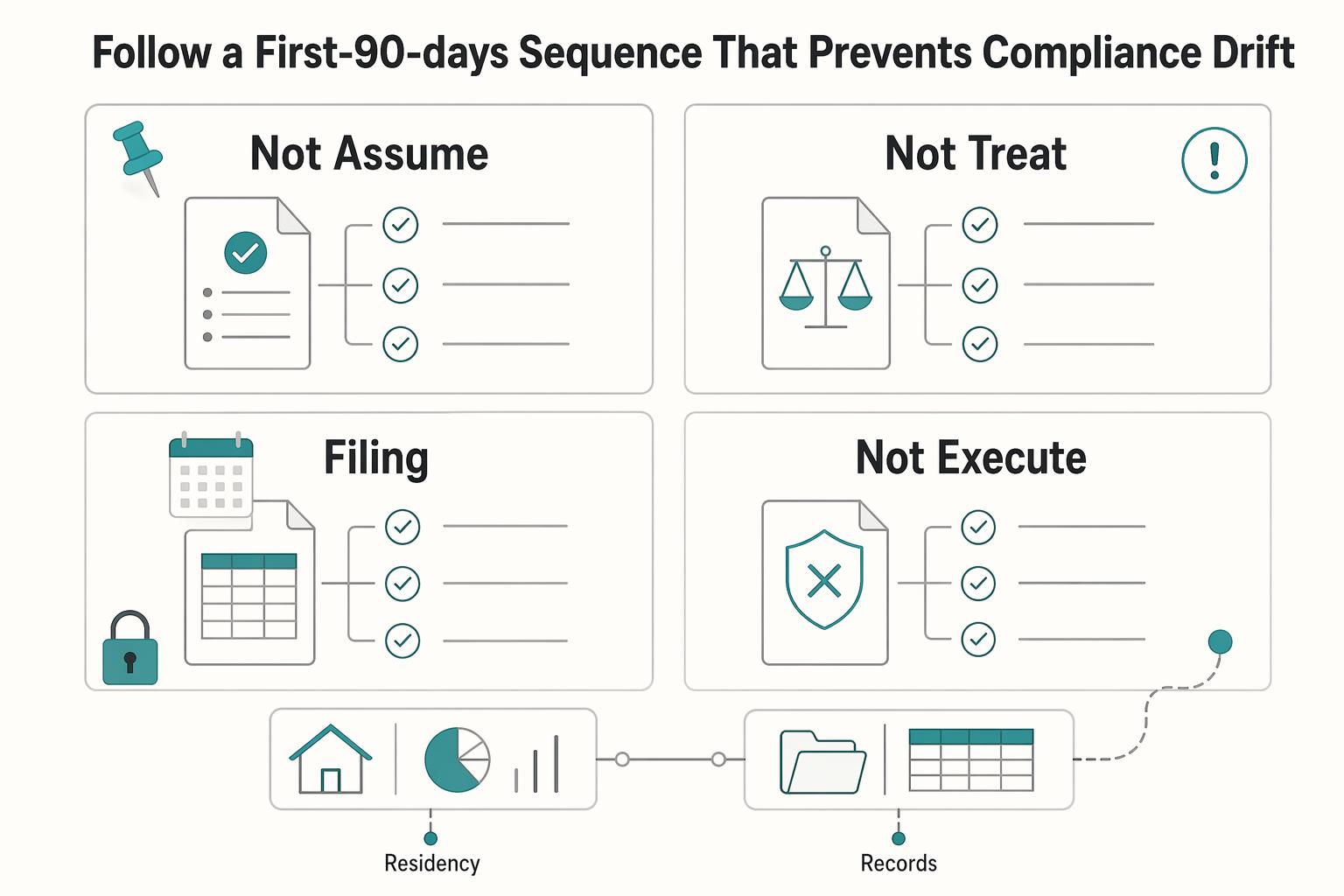
Follow a first-90-days sequence that prevents compliance drift#
This sequence is not a verified official first-90-days order for Portugal and US tax and mobility steps. Treat official process steps, deadlines, and filing windows as unconfirmed until you verify them directly.
Start with alignment, not activation. Treat your first-90-days sequence as a working draft until you confirm current official instructions, and execute only the version you have documented. Use one dated checklist so sequence changes and effective dates are captured as they evolve.
Set a checkpoint to lock filing ownership. No required checkpoint date is specified, so define an internal one and document who owns each jurisdiction and where records live.
If sequence instructions change, update the checklist first, then execute.
Do not do this first.
- Verify the official Portugal/US first-90-days sequence in official guidance before acting.
- Do not treat unresolved sequencing questions as settled requirements.
- Do not leave filing ownership implicit during transition.
- Do not execute sequence changes before you confirm current official instructions.
Build an evidence file you can defend in an audit#
Build your evidence file as facts happen, not at filing time. Residency and sourcing are fact-and-circumstances questions, and California does not pre-clear residency for a specific period, so your records need to carry the position.
| Record type | Included items | Specific note |
|---|---|---|
| Residency support | Records supporting your residency position and timeline | Keep one dated folder per tax year |
| Structure records | Business records tied to the structure you operate through | Organized by the positions you may need to defend |
| Contracts | Signed client contracts, statements of work, amendments, and invoices | Keep signed client contracts, statements of work, amendments, and invoices |
| Work-location log | Work-location logs by date showing where services were physically performed | Do not skip the work-location log |
| Payment trail | Payment records linking contract, invoice, and bank receipt | Link contract, invoice, and bank receipt |
Minimum pack. Keep one dated folder per tax year, organized by the positions you may need to defend. At minimum, keep:
- records supporting your residency position and timeline
- business records tied to the structure you operate through
- signed client contracts, statements of work, amendments, and invoices
- work-location logs by date showing where services were physically performed
- payment records linking contract, invoice, and bank receipt
Do not skip the work-location log. For US state sourcing, for example California, service income can depend on where work was physically performed. The allocation can use steps such as CA Workdays / Total Workdays = % Ratio and % Ratio x Total Income = CA Sourced Income. If your day counts are not documented, the allocation is hard to defend.
Keep filing artifacts, not just filed returns. If you file a return, keep the full artifact set, not only the return PDF. Include the signed return, extensions and payment confirmations if any, supporting schedules, and workpapers showing how residency and source-income positions were calculated.
If a state return applies, keep the same level of support there too. In a move year, a filing like California Form 540NR is part of your evidence trail, not just a submission copy.
Review before year-end. Use internal checkpoints to keep the file audit-ready:
- completeness review: confirm each paid invoice has matching contract, payment trail, and location support
- advisor review after major factual changes: confirm whether any factual change could affect classification, residency, or sourcing positions
Treat fast answers without file review as a risk signal. These positions depend on facts, so your documentation set should be reviewed before conclusions are finalized.
Map Portugal treatment to US filings before year-end pressure#
Map your US filing position before year-end, not during return prep. For this decision, treat FEIE and FTC as separate paths you test against your facts on Form 2555, Form 1116, and related reporting.
| Path | Standard in article | Form note |
|---|---|---|
| FEIE - physical presence test | 330 full days in a foreign country or countries during a 12-month period; a full day is 24 consecutive hours from midnight to midnight | Tested on Form 2555 |
| FEIE - bona fide residence test | Bona fide residence for an uninterrupted period that includes an entire tax year | Tested on Form 2555 |
| FTC | Prepared separately by income category; each Form 1116 can have only one category box checked | Claimed on Form 1116; decision point noted on Form 2555 |
FEIE and FTC are different tools, not default labels. Foreign Earned Income Exclusion (FEIE) applies only if you are a qualifying individual with foreign earned income and meet IRS requirements. You need to qualify under either the physical presence test or the bona fide residence test.
Under physical presence, you need 330 full days in a foreign country or countries during a 12-month period. A full day is 24 consecutive hours, from midnight to midnight. Days do not need to be consecutive, but missing the count fails the test regardless of reason.
Under bona fide residence, the standard is bona fide residence for an uninterrupted period that includes an entire tax year. Living abroad for one year does not automatically qualify you.
For FEIE limits, use the right year: $130,000 for 2025 and $132,900 per person for 2026. Also keep two operating rules in view:
- excluded foreign earned income is still reported on your US return
- income is applied to the year earned, even if paid later
FTC mechanics can make mixed income more complex. Form 2555 explicitly includes the foreign tax credit or deduction decision point. If you claim FTC, Form 1116 is prepared separately by income category, and each Form 1116 can have only one category box checked.
Use this working rule. If your income includes salary, consulting income, and investment income, consider a pre-year-end projection so you can test FEIE and FTC against the same fact set before filing pressure starts.
Keep scope clear on items not covered here. This section does not establish additional US reporting thresholds or filing triggers, so confirm those separately with current guidance.
Check self-employment and social-security items separately. This section does not establish self-employment tax or social-security coordination outcomes; review those questions separately if they apply to your facts.
In Q4, classify each income stream - salary, consulting, and investment - and confirm the documentation needed for your FEIE/FTC analysis before returns are prepared.
For a step-by-step walkthrough, see Portugal NHR vs Spain Beckham Law for High-Earning US Expats in 2026.
Know what this regime does not solve#
A regime label is not a coverage decision. By itself, a label does not tell you how each income stream is treated, so do not treat shorthand as proof that all your income fits one favorable outcome.
When the source material is thin or inconsistent, use this default:
- treat inconsistent regime-label references as unresolved until you confirm them in current primary materials
- treat edge-case eligibility as unresolved until you have current primary support for your exact facts
- if a conclusion is not clearly supported, mark it as uncertain instead of assuming coverage
US reporting can still be in scope even when local tax treatment looks favorable. Form 8938 is used to report specified foreign financial assets when thresholds are met, and it must be attached to your annual return by that return due date, including extensions. Thresholds are not one-size-fits-all. The IRS notes higher thresholds for joint filers and taxpayers residing abroad, with a baseline $50,000 trigger for certain taxpayers. If no income tax return is required for the year, Form 8938 is not required for that year. Filing Form 8938 also does not remove a separate FBAR (FinCEN Form 114) filing requirement when FBAR is otherwise required.
Escalation triggers when you should stop and get specialist advice#
Escalate immediately when any of these four triggers appear. This is where filing positions often stop tying out cleanly.
Trigger 1. Mid-year switch from US W-2 to a Portuguese Unipessoal LDA with overlap#
If contracts overlap, get specialist review before you lock in treatment. For FEIE, income is applied to the year it was earned, not when it was paid. Ask for a written month-by-month mapping of W-2 wages, contract end dates, first company invoices, and work location. If that mapping is inconsistent, your year-end reporting can become inconsistent across payroll and non-payroll treatment.
Trigger 2. You cannot clearly justify FEIE vs FTC for your exact facts#
Do not guess here. FEIE applies only if you qualify. Physical presence requires 330 full days in a 12-month period, with a full day equal to 24 consecutive hours. Bona fide residence must include an entire tax year and is determined by your specific facts. FTC also gets technical fast because Form 1116 is prepared separately by income category.
Trigger 3. Social-security treatment is unresolved (Schedule SE, SSA, Certificate of Coverage)#
If these issues come up and no one can walk you through the controlling authority for your case, pause before payroll or invoicing changes. This section does not establish the governing social-security rules for this fact pattern.
Trigger 4. Portugal conclusions are not tied to current Autoridade Tributária e Aduaneira guidance#
Treat any advisor conclusion as tentative if they cannot connect it to current Portuguese authority guidance. This section does not establish current Portuguese regime criteria, so pause major changes until that support is clear.
Set up payment and reporting operations that keep records clean#
Your operational goal is simple: keep one reconstructable trail from invoice to payout to filing support. If you cannot rebuild a transaction end to end quickly, treat that as a sign your setup is underbuilt.
Build one chain from earned income to reported income. Use one record chain every month: invoice issued, payment received, account statement evidence, reconciliation, then a direct link into your US tax return workpapers. This matters because claiming FEIE still requires filing a US return that reports the income.
Keep timing fields explicit in each invoice record: service period, invoice date, payer, payee entity, and receiving account. For exclusion calculations, income is tied to the year earned, while cash-basis reporting still tracks when income is received. This mapping prevents year-end guesswork.
If FEIE is in play, store work-location notes with the same records. The physical presence test is based on time abroad, including 330 full days in a 12-month period, and a full day is 24 consecutive hours from midnight to midnight.
Close the month with filing support in mind. Close each month as if you were preparing filing support now, not later.
- Match each invoice to the deposit that cleared.
- Match each deposit to the receiving account statement.
- Update your
US tax returnworkpaper with invoice ID, service period, date received, and receiving account. - Save account records in dedicated
FBARevidence folders.
Keep those folders complete and easy to review: statements, account ownership records, and an index of accounts open during the year. FinCEN maintains an FBAR due-date resource and can publish event-based extensions, so late document collection is avoidable operational risk.
Put controls around payouts and exports. Set a gate around payouts based on policy and reconciliation status. Do not release draws, contractor payments, or treasury transfers until support is attached and the month is reconciled.
Use exportable audit logs so cross-border review is sortable and traceable, not screenshot-based. Where supported, platforms like Gruv can help with invoicing records, payout traceability, and tax-document workflows tied to FEIE planning and FBAR tracking, but validate the actual exports before relying on the process.
What to do next with the lowest compliance risk#
Use this sequence: decide your operating model, validate residency and regime assumptions, then execute filings or payroll changes. If any core fact is still uncertain, pause before changing contracts, payroll, or tax positions.
Portuguese residency is the hinge point. Residency status determines tax scope and rates, and getting residency classification wrong is critical.
Lock residency facts before structural changes. Before you change invoicing, compensation, or entity setup, confirm these two grounded residency indicators:
- Will you spend 183 days or more in Portugal in the calendar year?
- Will you maintain a permanent home in Portugal on December 31?
If either could be true, treat Portuguese tax residency as a live issue to validate now. Residents file an annual Portuguese personal income tax return and report 100% of worldwide income, so assumptions made too early can create cross-border rework.
Use one checklist with owners and deadlines. Keep one written checklist with an owner, due date, and evidence field for each item. At minimum, include:
- operating model decision
- residency fact check, including the 183-day and December 31 indicators
- regime-label verification if terms like
NHR 2.0,IFICI, orITSare being used - Portugal annual return calendar
- cross-border compliance calendar
- evidence folder for contracts, location records, and residency proof
If you cannot point to proof quickly, treat the task as incomplete.
Treat naming confusion as a stop sign. Practitioner sources use inconsistent labels for the post-NHR framework, including NHR 2.0, IFICI, and ITS. Do not rely on label shorthand alone when making eligibility, structure, or payroll decisions.
If a core point is uncertain, stop and get specialist review before execution. One practitioner example says liabilities may be settled through the annual return without Portuguese payroll in some setups, but that is structure-dependent and not a universal rule.
Execute in the boring order. Run the move in this order:
- Choose operating model.
- Confirm residency facts.
- Verify the regime assumptions being applied.
- Execute filings, payroll, and documentation steps.
If self-employment payment checkpoints apply to your case, add them only after confirmation. A possible window is the 10th to 20th of the month following the relevant period.
Related reading: A Guide to Tax Residency in Malaysia for Digital Nomads.
If your case includes mid-year structure changes or mixed income, use Contact Gruv to confirm coverage for payouts, records, and tax-document workflows where supported.
Frequently Asked Questions
Can a US consultant still apply for Portugal NHR in 2026?
Confirm whether legacy Non-Habitual Resident (NHR) is open or closed to new applicants in 2026 by checking current official Portuguese tax guidance before making relocation or restructuring decisions.
What is the practical difference between old `Non-Habitual Resident (NHR)` and `IFICI (Incentivo Fiscal à Investigação Científica e à Inovação)`?
Treat them as potentially different legal regimes and confirm the exact regime name and current official rules before acting.
Are `NHR 2.0`, `TISRI`, and `ITS` the same thing or different programs?
Whether those labels are equivalent or distinct programs isn't confirmed. Require the underlying legal text or current tax-authority guidance for whichever label is being used.
Does staying on a `US W-2` usually qualify the same way as using a `Portuguese Unipessoal LDA`?
Treat this as case-specific and get fact-specific tax/legal review before relying on either structure.
Is the favorable rate automatic for all income once you are a Portuguese tax resident?
No. Residency alone is not enough to grant favorable treatment to all income. Validate treatment income by income.
What are the first five compliance steps to complete before and right after moving?
Confirm a full visa/residency/tax-registration order with a qualified adviser before acting on any prescribed sequence.
Which US forms are most often missed in this move, including `FBAR` and `Form 8938`?
There is no reliable ranking of which forms are missed most often. What is clear are key Form 8938 points: filing Form 8938 does not replace FBAR (FinCEN Form 114); Form 8938 is attached to your annual return (including returns such as Form 1040 and Form 1040-NR) and filed by that return’s due date, including extensions; and if you are not required to file an income tax return for the year, you do not need to file Form 8938. It covers specified foreign financial assets, includes some account exclusions, and the IRS notes higher thresholds for joint filers and taxpayers residing abroad than the baseline $50,000 figure cited for certain taxpayers.
Try a related tool
Researched and edited by the Gruv editorial team. Gruv builds cross-border billing, payouts, and finance-operations software for global businesses.
Sources
- fincen.gov/report-foreign-bank-and-financial-accountstrusted
- ftb.ca.gov/file/personal/residency-status/part-year-and...trusted
- ftb.ca.gov/forms/misc/1100.htmltrusted
- irs.gov/individuals/international-taxpayers/figuring...trusted
- irs.gov/individuals/international-taxpayers/foreign-...trusted
- mit.edu/~mkgray/jik/src/Attic/kerberos_password_hack...trusted
- oecd.org/content/dam/oecd/en/publications/reports/202...trusted
- oecd.org/en/publications/oecd-economic-surveys-portug...trusted
Educational content only. Not legal, tax, or financial advice.
Related Posts

Digital Nomad Taxes in 2026 With a Defensible Filing Plan
With digital nomad taxes, the first move is not optimization. It is figuring out where you may be taxable, where filings may be required, and what proof supports that position.

Portugal Digital Nomad Visa Decisions That Prevent D8 Delays
Start with verification, not paperwork. In this research set, some material is useful only as EU VAT context, not as D8 instruction, and mixing those categories is one of the fastest ways to build the wrong plan. We use the same separation rule in [Global Digital Nomad Visa Index](/blog/global-digital-nomad-visa-index) comparisons.
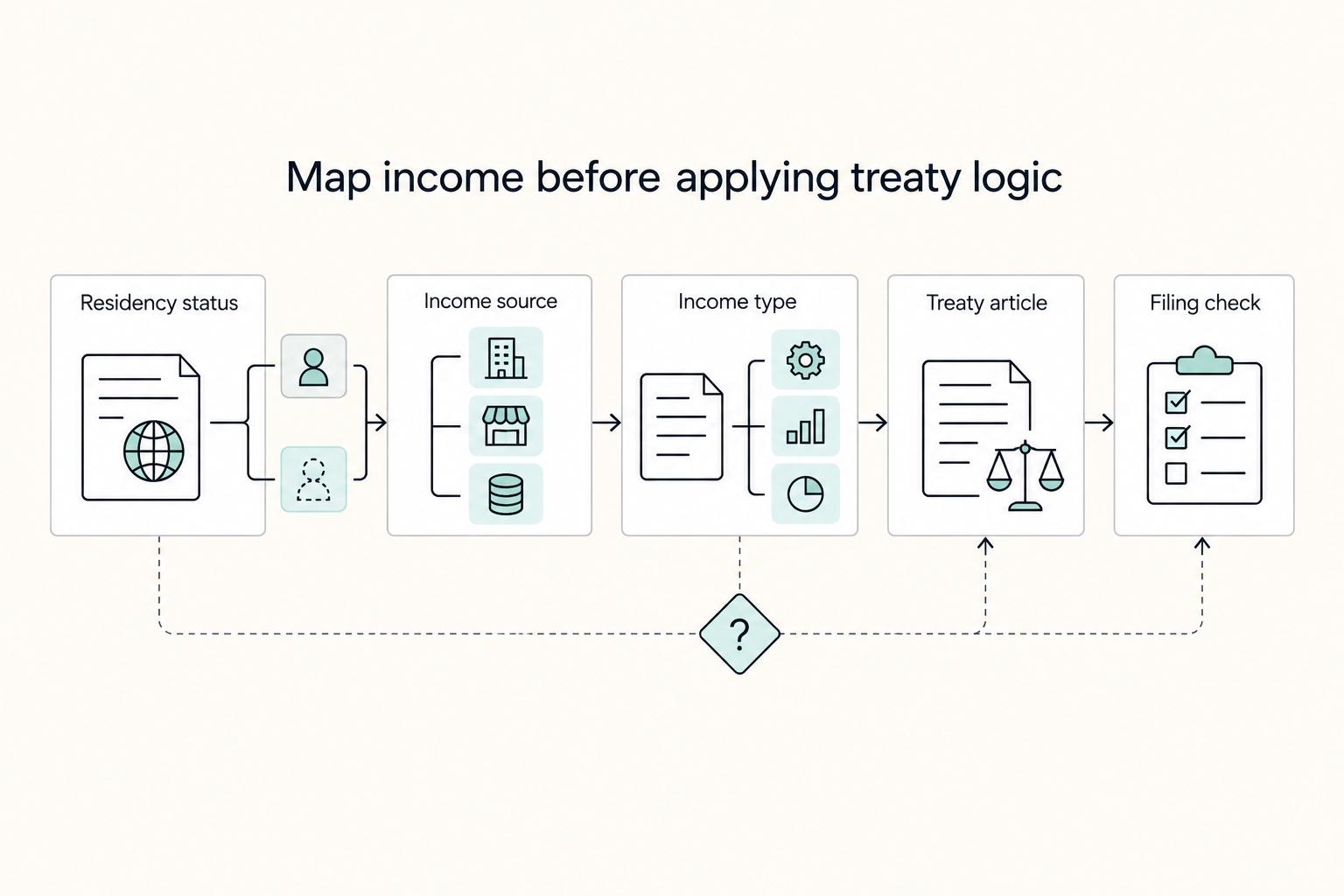
Portugal NHR Tax Regime Decisions for 2026 Freelancers
If you are planning around Portugal NHR in 2026, start by checking which legal path actually applies to you. Public pages still mix the legacy regime with newer labels, and that overlap is enough to push people into the wrong assumptions before they file a return, issue an invoice, or set pricing for the year.