
Quick Answer
P2P lending for investors can fit your plan only after you protect core cashflow with a strict two-bucket system: operating cash stays liquid, and P2P sits in capped risk capital. Use a written safety screen for protections, regulation claims, liquidity, fees, and failure modes, then size exposure conservatively. If documentation is vague or access terms conflict with your cash needs, treat it as a no-go.
You want yield - but you need a "don't break payroll" system first#
Build a cashflow-protection system that helps keep your business obligations current, then treat yield-seeking products as optional. Before we talk about P2P lending, get clear on what money must stay boring, liquid, and dependable. Once that base is solid, you can evaluate alternative investments without turning your operating budget into a risk experiment.
If you run a freelance practice or a small team, your "finance department" lives in your calendar and your bank balance. Client payments can arrive later than you planned, and your obligations still hit on time. Relay puts it plainly: "However, knowing how to pay freelancers can be tough." That gets harder when you are also managing taxes, software renewals, and vendor bills.
Your first job: protect the payment engine (not the return)#
Tipalti defines B2B payments as "the exchange of goods or services supplied for a determined value that is denominated in currency." In practice, your business runs on predictable inflows and outflows, not headline APY. Tipalti also notes that paper checks remain common, but "digital B2B payment solutions are a more effective form of financial services," and they can improve cash flow. The operator takeaway is simple: fix how money moves before you chase yield.
A simple "don't break payroll" system looks like this. Keep it practical, and make it something you can repeat every month.
- Separate operating obligations from investable money. Keep a dedicated pool for near-term bills and tax set-asides.
- Shorten your cash conversion cycle. Tighten invoicing, require clearer payment terms, and follow up on receivables fast.
- Choose payment rails that reduce friction. Digital options can speed issuing, receiving, and processing payments, especially compared to checks.
Where P2P lending fits (and where it doesn't)#
Peer-to-peer (P2P) lending is one example of a yield-seeking product. Where it fits depends on how much flexibility you have in your cashflow, and whether you can tolerate not accessing that money on your schedule.
Use this decision framing:
| Question | If "yes" | If "no" |
|---|---|---|
| Can you leave the money untouched without disrupting operations? | You may be able to evaluate P2P as an alternative investment | You may not have the flexibility for P2P right now |
| Do you already run clean invoicing and collections? | Yield is more likely to be additive | Yield can distract from fixing cashflow basics |
Hypothetical: you fund P2P, then a client pushes payment. If that delay forces you to juggle contractor payouts, you just found your answer. Stabilize operations first, then invest from true surplus.
Define the terms early: the mental model you'll use for every decision#
Keep your P2P decisions boring by using a simple working vocabulary and a two-bucket cash rule. Separate "don't break payroll" money from optional money, then treat P2P lending as something that can look tempting when you're hungry for yield, especially "in a world of zero percent interest rates," as Financial Mentor puts it.
The three terms you must not blur#
Peer-to-Peer (P2P) lending refers to the yield-focused "P2P" products being marketed to investors. Financial Mentor frames its own P2P lending piece as "Uncover the hidden dangers behind P2P lending," and even calls out how "P2P marketing tactics exploit both borrowers and lenders." Take that literally: treat marketing as a risk input, not as guidance.
| Term | Working meaning | Operator takeaway |
|---|---|---|
| Peer-to-Peer (P2P) lending | The yield-focused "P2P" products being marketed to investors | Treat marketing as a risk input, not as guidance |
| Platform risk | "Even if underlying borrowers pay, I can still get hurt by the platform." | Track this separately from borrower outcomes |
| Default risk | "Borrowers do not repay, and I take losses." | Decide in advance what you'll measure and what triggers a pause |
Platform risk (working shorthand) means: "Even if underlying borrowers pay, I can still get hurt by the platform." Think operational issues, policy changes, servicing changes, or access problems. The key move is to track this separately from borrower outcomes instead of mentally bundling everything into "defaults."
Default risk (working shorthand) means: "Borrowers do not repay, and I take losses." Don't stop at the word. Decide in advance what you'll measure and what triggers a pause.
| What can go wrong? | You call it (in this guide) | Your operator response |
|---|---|---|
| Borrowers don't repay | Default risk | Track outcomes, cap exposure, define a "pause funding if" trigger |
| You can't access funds or the platform rules change | Platform risk | Cap per-platform exposure, archive terms, plan for illiquidity |
The two-bucket model you run every month#
Run two buckets and stop negotiating with yourself. P2P lives in Bucket B, and your job is to keep Bucket A boring.
- Bucket A: Operating Cash. Invoice float, taxes, payroll buffer. Optimize for reliability and access, not yield.
- Bucket B: Risk Capital. Money you can lock up and potentially lose. P2P lending lives here.
Treat P2P like a project with a written decision record. Keep it to one page. Put your rules, your caps, your "pause funding if" triggers, and the exact platform name you approved.
Hypothetical: if a client pays late, you should not even feel it. If you feel it, you funded P2P out of Bucket A. Adjust immediately.
If you want a deeper dive, read the six-month Japan digital nomad visa runbook. If you need a quick practical step, try the free invoice generator.
Is P2P lending safe for investors? Verify protections, regulation, and failure modes in writing#
P2P lending is only "safe enough" when you treat it like an alternative investment and verify protections, regulation, and failure modes in writing. With your buckets set, you can evaluate P2P without letting passive-income positioning override basic controls. Use this as a repeatable safety screen on any platform.
1) Protections reality check (assume nothing, confirm everything)#
Start with the uncomfortable default: do not assume any Deposit Guarantee Scheme (or deposit-style insurance) applies. P2P products often do not behave like bank deposits operationally: withdrawals, liquidity, and legal claims can work differently. Only treat a protection as real after you confirm it applies to your exact product, entity, and jurisdiction.
Operator rule: If the platform cannot state protections and exclusions plainly, treat principal as fully at risk. Put that sentence in your decision record before you fund anything.
2) Five checks to run before you invest#
1) Regulatory posture (specifics, not badges). If a platform claims authorization or registration, verify that claim in the official register(s) for the relevant jurisdiction(s), and write down what the status actually applies to. Identify the legal entity name you contract with and the jurisdiction(s) involved in the product structure.
2) Borrower risk vs. platform risk (separate the mitigations). Borrower default creates credit losses. Platform failure creates operational and legal losses. You need defenses for both.
| Risk type | What breaks | What you do before investing |
|---|---|---|
| Borrower default | Repayment | Diversify across many loans, cap per-loan exposure, require default and recovery reporting |
| Platform risk | Access, servicing, contract enforceability | Cap per-platform exposure, download terms, confirm who services loans if the platform fails |
3) Failure-mode list (pre-mortem). Write your "how this goes wrong" list up front: liquidity freezes, withdrawal queues, sudden fee changes, loan servicing breakdown, data opacity, adverse tax treatment. Add a trigger next to each: pause funding, stop auto-invest, attempt exit when possible.
4) Cross-border complexity (trust anchor). Treat many P2P platforms as FinTech businesses that may need to handle multiple legal frameworks, including areas like AML/CFT, data storage, privacy, and IP. When they expand cross-border, they can take on new rules in each jurisdiction. That increases execution risk. Your mitigation is documentation: save disclosures, archive support answers, and keep screenshots of key terms.
5) A quick "walk-away" scenario. Hypothetical: you request a withdrawal, support responds vaguely, and the platform announces a new fee schedule. Do not rationalize it. Halt new funding, document the change, and reassess your platform cap immediately.
How risky is "up to X% APY" in P2P lending, really? Convert headline yield into decision math#
Treat "up to X% APY" as marketing and rebuild it into a net return range you can defend on paper. After you screen for protections, regulation, and failure modes, focus on the only question that matters operationally: what do you realistically earn after losses, fees, and friction, and what breaks your plan?
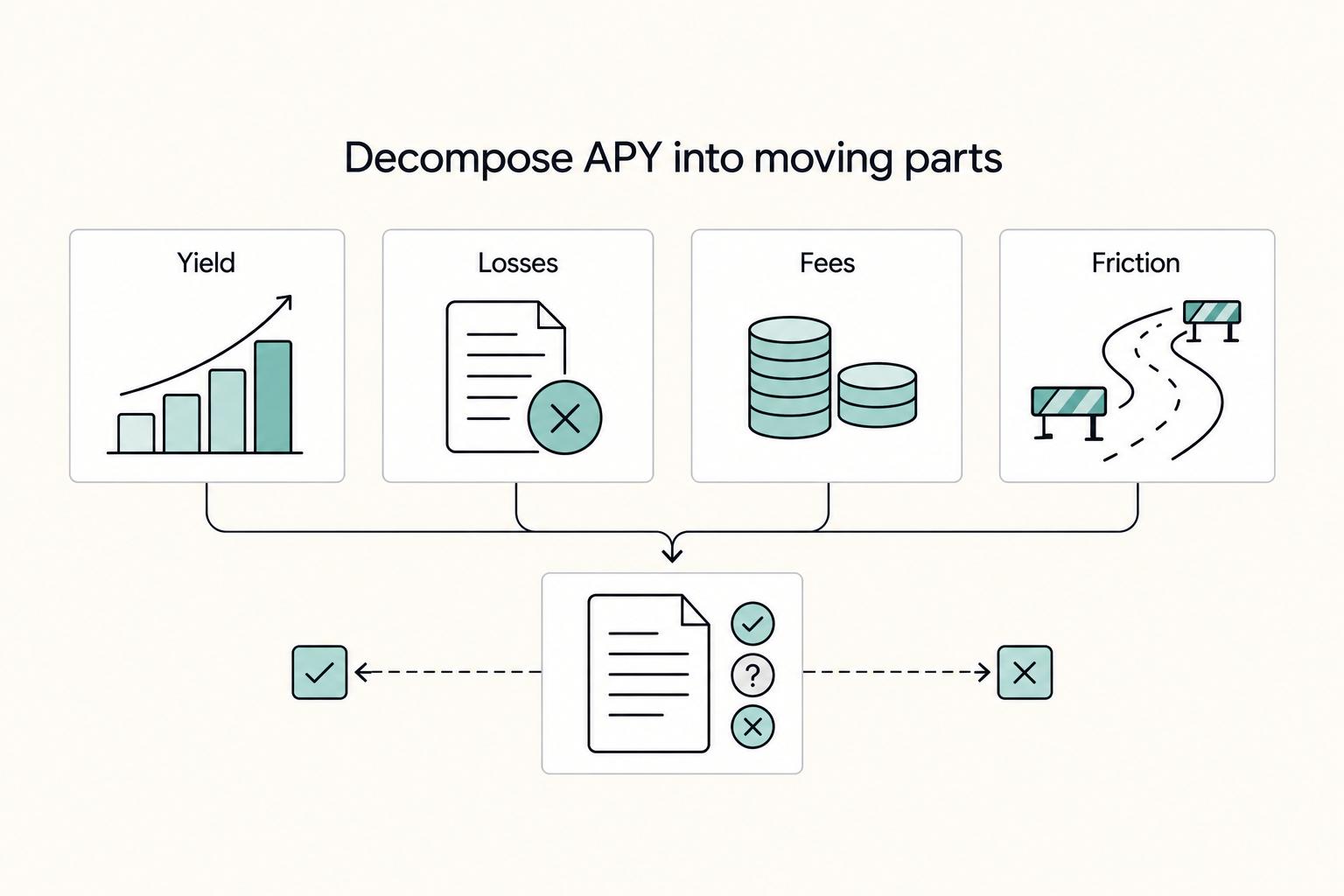
Step 1: Decompose APY into the parts that actually move#
Platforms market yield. You invest in a messy system. Before you fund anything, force the platform to show you the return components in plain language:
- Gross interest rate: what borrowers pay before anything goes wrong.
- Expected defaults: loans that stop paying and hit principal.
- Recoveries: what collections bring back and how long it takes.
- Platform fees and servicing fees: anything that skims interest or principal, including "management" style charges.
- Cash drag: idle cash that sits uninvested while you wait for allocation or withdrawals.
Operator rule: if you cannot list each component in one line, you cannot model it, and you should treat the APY as marketing. Here's the decision math template. Fill it in with the platform's disclosures, not gut feel.
| Component | What to request from the platform | What you record in your decision note |
|---|---|---|
| Yield | Gross interest terms | Gross yield assumptions |
| Losses | Default and recovery definitions | Loss assumptions and timing |
| Fees | Full fee schedule | Fee drag points |
| Friction | Allocation and withdrawal mechanics | Cash drag and exit constraints |
Step 2: Build a 3-scenario return range (then decide)#
Run three scenarios before you deposit funds, and rerun them any time terms change:
| Scenario | What it includes |
|---|---|
| Best case | Low defaults, normal servicing, smooth withdrawals |
| Base case | "Normal" defaults plus the full fee stack and some idle cash |
| Stress case | Higher defaults, delayed recoveries, and withdrawal friction (queues, secondary-market discounting, or limited liquidity) |
Hypothetical: you compare "up to X%" on Platform A vs Platform B. Do not pick the higher headline. Pick the platform that lets you model defaults, recoveries, and fees cleanly. Then size it to survive the stress case.
Demand loss metrics, not yield metrics. Ask for default rate definitions, recovery rate methodology, and net annualized return after fees. If a platform only shows yield charts and calls the product "stable," "passive," or "secured," treat that as risk-smoothing language.
Go one level deeper. Borrower concentration, collateral quality (if any), and collection effectiveness drive outcomes, not adjectives.
Academic finance journals study lending and returns too. For example, a ScienceDirect listing shows an article in International Review of Economics & Finance, Volume 77, January 2022, pages 359 to 377. Take that as your cue to operate like a professional allocator: document assumptions, model scenarios, and compare net outcomes across platforms, or choose none of the above.
The 10-minute go/no-go checklist: your must-pass criteria before you invest a dollar#
Before you fund any P2P lending, verify liquidity, protections, disclosures, fees, and concentration controls in terms you can actually read. You already know how to turn headline APY into decision math. Now you need a fast filter that keeps you out of products you cannot exit, explain, or control.
The checklist (copy into your notes and fill it in)#
Use the table as your operator script. If any row fails, you pause. If multiple rows are fuzzy, you walk.
| Must-pass criteria | What you must verify (in writing) | Go/no-go rule you can defend |
|---|---|---|
| #1 Liquidity fit | How and when you can access your money, and what limits or delays apply, including any conditions around "early" access if offered. Confirm that what you think you're buying matches the actual terms. | No-go if your cash planning requires access on a timeline that conflicts with the product's stated access terms. |
| #2 Protection clarity | What protections apply to you, if any, who you are contracting with, and what happens in the scenarios that matter: borrowers stop paying; the platform has operational issues. | No-go if you cannot state, in one sentence, what happens when borrowers stop paying or the platform can't operate as expected. |
| #3 Platform disclosure quality | Whether you can access and review the governing terms and risk information, not just marketing summaries. Treat third-party "overview" content as a prompt to find the underlying documents, not as proof of safety. | No-go if you cannot access and read the actual terms that govern your investment. |
| #4 Fee transparency | A clear schedule of all fees and other costs that could reduce net returns, in plain language you can map to your expected outcome. | No-go if you cannot list the cost categories that touch your return, even before you estimate amounts. |
| #5 Concentration controls | How you will avoid overexposure by loan, borrower type, or any other concentration. If the platform offers tools that help, understand them; if not, define your own limits you can follow. | No-go if you cannot implement a simple diversification rule without constant babysitting. |
Hypothetical: you consider a platform you found through a comparison post. Do not argue about who markets the highest "up to" rate. Ask, "Can I access my money on terms I understand, explain protections clearly, audit the docs, map all costs, and control concentration?" If you cannot, skip it. That discipline reduces investment risk more than any marketing yield ever will.
Platform due diligence worksheet: what to verify vs. what is unknowable (and how to handle both)#
Use a one-page decision record that separates what you can verify from what you cannot, then size your allocation so unknowns cannot break your cashflow. After your go/no-go filter, build a worksheet that captures what you can prove today and what you cannot. This is how the decision becomes an operator-grade file you can defend later.
Build your one-page "platform dossier" (save it with your tax records)#
Due diligence means "careful checks and assessments carried out before investing or funding a project, in order to reduce risks." Use that definition literally: capture only what you can check, and label the rest as assumptions.
Keep it to one page by sticking to two buckets:
- What you can verify today: what the platform puts in writing, for example in its terms, disclosures, and other materials you can save.
- What you cannot verify in advance: what depends on future behavior, changing policies, or how the operation performs under stress.
Also write down any regulatory claims only as claims, and quote them verbatim rather than treating them as certainty. Regulation can affect both safety and cost, and at least one (dated) academic article argues the SEC's approach to P2P lending made the industry less safe and more costly, while proposing a scheme involving the Consumer Financial Protection Bureau.
Verify what you can. Write down what you can't. Then price the risk.#
Peer-to-Peer (P2P) lending often involves unsecured lending to borrowers you do not know. You will never eliminate uncertainty. You can contain it.
Use this split:
| Category | What to verify (document it) | What stays unknowable (manage it) |
|---|---|---|
| What's written vs. what's implied | The exact language you can save and point to later | How that language is applied in edge cases |
| Operations under stress | Any concrete statements you can confirm in writing | What happens when systems, staffing, or counterparties are under pressure |
| Rules and oversight (where relevant) | Which regulator(s) the platform says it sits under, as stated | How enforcement, interpretations, and expectations may evolve over time |
Use a simple confirm workflow:
- Save key documents you rely on, and note the date you saved them.
- Capture the exact wording of any high-stakes claims you're using in your decision.
- Ask your core risk questions in writing and archive the responses.
How much of my portfolio should go into P2P lending? Use exposure caps built for irregular income#
Keep P2P inside a tightly capped "Risk Capital" sleeve. Even with due diligence documented, you still need a sizing rule that makes the unknowns survivable. The goal is not to predict the future. The goal is to cap the damage if something freezes, defaults spike, or reporting degrades.
Andrew Verstein (UC Davis Law Review, 2011) describes the core reality plainly. Retail investors have lent "a billion dollars over the Internet, on an unsecured basis, to total strangers." Treat that like high-risk credit exposure, not "passive income," and not a bond replacement. And remember that platform outcomes have been inconsistent and uneven over time and geography.
Set your caps (write them down before you fund)#
Generic summaries, think U.S. News & World Report style, rarely match freelancer cashflow. Consider using a few caps so one bad surprise cannot cascade into missed taxes or payroll.
| Cap you set | What it protects | What you write down |
|---|---|---|
| Max % of net worth | Prevents P2P from becoming a life event if it goes wrong | Your ceiling and the reason you chose it |
| Max % of Risk Capital (Bucket B) | Keeps Operating Cash (Bucket A) clean | Your Bucket B definition (what counts, what does not) |
| Max per platform (if you use more than one) | Limits single-platform blowups (support failures, liquidity freezes, servicing issues) | Platform name plus your ceiling |
Hypothetical: you fund two platforms. One starts delaying withdrawals. Your per-platform cap means you feel annoyed, not endangered. That is the point.
Avoid single-slice bets, then enforce position sizing#
"Buy more loans" is not a strategy. If you proceed, avoid concentrating your exposure into one slice of whatever risk labels the platform uses, for example borrower grades, loan terms, geographies, or originators when offered. Do it to avoid putting your outcome on a single concentrated bet, not because diversification guarantees better returns.
Position sizing turns intent into control:
- Per-loan or per-note limit (if applicable): pick a small, repeatable maximum you can stick to.
- Per-segment limit (optional): cap any single grade or term so it cannot dominate results.
- Enforcement method: use auto-invest controls when available, or run a simple spreadsheet that blocks you from oversizing.
Rebalance with rules, not feelings:
- If defaults rise by the platform's own definition, or withdrawals slow, decide in advance whether you will halt new funding.
- Route cashflows back to Operating Cash until the platform returns to what you consider "normal operations" per your dossier and your own observed experience.
Can freelancers rely on P2P income for cashflow? Only if you separate "income" from "withdrawable cash"#
Do not treat P2P returns as spendable until the money lands in Operating Cash. If you want P2P at all, you need a cashflow rule that prevents "passive income" optimism from leaking into payroll, taxes, and vendor payments. This is where small operators get hurt: they count earnings before they control access.
A clean mental model helps. One investing explainer defines passive income as "income that you earn without being directly involved in the day-to-day workings of the source of income." It contrasts that with "active income, where your time literally translates into dollars, like a full-time job or freelancing." P2P is often discussed on the passive side of that line. Your bills do not care. They demand withdrawable cash.
Build the cashflow firewall (Bucket A stays sacred)#
Treat anything inside a Peer-to-Peer (P2P) lending platform as Bucket B behavior until your bank shows the deposit cleared. Use this separation even if a dashboard shows interest earned.
| Layer | Job | What you do operationally |
|---|---|---|
| Bucket A: Operating Cash | Pay taxes, contractors, software, and survive invoice gaps | Keep it liquid, boring, and accessible. Do not count P2P performance here. |
| Bucket B: Risk Capital (P2P) | Seek yield as an alternative investments sleeve | Only recognize "income" when you actually transfer out and reconcile it. |
Operationalize it like an operator:
- Use dedicated accounts or labeled sub-accounts for Bucket A vs Bucket B. If your bank supports naming, name them exactly like the buckets.
- Track transfers like ledger entries: date, amount, reason (funding, withdrawal, fees). This turns "passive income" into audit-friendly cash movement.
- If you run a global business, be intentional about currency conversions. FX and transfer fees may apply, so factor them into your math.
Define a withdrawal policy before you invest (and enforce it)#
You cannot wing liquidity. Write a simple policy you can follow even when you feel tempted:
- A cadence you choose for your own budgeting rather than what a dashboard suggests.
- A minimum Operating Cash requirement that must stay true before you move money into P2P.
- A pause trigger: if a client payment runs late, you stop new funding and prioritize collections until Bucket A stabilizes.
Hypothetical: a client delays a big invoice, and your P2P dashboard shows you "earned" interest. Your policy blocks you from spending that number. Tighten collections, keep contractors paid, and only treat P2P as upside once cash actually clears.
Protect your "get paid" system first. Tight invoices, clear payment terms, and consistent follow-ups reduce operational risk more reliably than chasing yield ever will.
Rules vary by country and program: regulation, taxes, and protections you must confirm (without guessing)#
Verify the legal entity, protections, and tax treatment in writing for your jurisdiction before funding P2P. If you are going to move money into a platform, make sure the rules that govern it actually match your country, your residency, and the exact product you are buying. This is the difference between "alternative investments" done professionally and a paperwork surprise later.
Peer-to-Peer (P2P) Lending sits in a messy middle ground. One explainer describes it as "a major financial model that connects borrowers directly with investors, bypassing traditional intermediaries." That structure helps explain why protections and reporting can differ from bank accounts and broker-held securities.
Regulation and protections: verify the exact entity and the dispute venue#
Do not rely on a platform's marketing footer or homepage badges. Regulation varies by jurisdiction, and you need the contracting party, not the brand name. A compliance primer puts it plainly: "you need to overcome one key challenge before launching a peer-to-peer cryptocurrency exchange: regulatory compliance." The operator mindset carries over here: treat compliance and authorization as specific, documentable facts.
Use this confirmation table as your minimum standard:
| What to confirm | What you're looking for | What to save |
|---|---|---|
| Contracting entity | Exact legal name, address, and governing law for your agreement | Terms PDF, screenshots of account-opening flow |
| Where disputes land | The stated jurisdiction and process (courts, arbitration, complaints) | Support email reply, dispute policy page |
| Protections | Whether anything like a Deposit Guarantee Scheme applies (do not assume). Whether any Investor Compensation Scheme applies (do not assume) | Written statement from platform docs or support |
Hypothetical: you invest through a platform that "operates in the EU," but your contract points to a different entity outside your country. If a withdrawal freezes, you will argue your case where the contract says, not where the marketing implies.
Taxes: plan for reporting before you chase "passive income"#
Taxes can change your real return materially. Reporting obligations and the way returns and losses are treated can vary by country and sometimes by product structure. Operate like you expect an audit:
| Item | What to do | Detail |
|---|---|---|
| Monthly statements and full transaction history | Download and store them | Include funding, repayments, fees, and withdrawals |
| Annual tax statement | Request it if the platform offers one | Archive it with your "platform dossier" |
| Local filing requirements | Confirm them with a qualified tax professional | Especially if you invest cross-border |
Don't-guess rule: If you cannot verify jurisdiction, protections, and tax documentation in writing, classify the investment as "experimental," cap exposure hard, and prioritize liquidity over yield.
Conclusion: the operator's default - protect cashflow first, then earn yield with hard limits#
Treat Peer-to-Peer (P2P) Lending as a higher-uncertainty credit exposure, not a cashflow tool, and only fund it with money you can afford to have tied up and potentially lose. The finish here is operational: use a default that keeps your business solvent on a boring month, not just optimistic on a good month.
P2P lending sits inside the broader fintech credit world, which has been analyzed for market size, drivers, and policy issues. The BIS Quarterly Review published "Fintech credit markets around the world: size, drivers and policy issues" on 23 September 2018. Take the cue: you are not buying a savings product. You are stepping into a credit system where outcomes depend on borrower behavior, platform mechanics, and rules. Research has also examined how the expansion of P2P lending can affect bank risks, including insolvency and illiquidity risks.
The operator default: don't put essential cash at risk#
If you do one thing, do this: don't allocate money you might need soon to P2P. That one constraint blocks the most common failure mode in alternative investments and "passive income" plays: spending expected returns before they turn into dependable, usable cash.
If the money supports near-term obligations like taxes, rent, payroll, contractors, or closing invoice gaps, keep it accessible. If the money can take a hit without operational damage, you can consider P2P, but treat it as investment risk first.
Hypothetical: you have a lumpy client schedule and one late invoice would force you to float expenses. In that case, you do not "optimize" with yield. You optimize with access and reliability, then revisit P2P only after your operating position feels boring again.
If you proceed, keep your approach conservative: be clear about what you can afford to lose, understand the platform's disclosures and how changes get handled, and assume reality can diverge from expectations.
Frequently Asked Questions
Is P2P lending safe for investors?
Peer-to-peer (P2P) lending connects borrowers and investors directly, without traditional financial institutions in the middle. Whether it feels “safe” depends on the exact product and the platform’s setup, including how and when you can access your money. Treat it as a risk-bearing option, then decide if it fits your plan.
How risky is “up to X% APY” in P2P lending?
“Up to” describes a best-case outcome, not what you should budget for. Focus on what actually drives results and what can reduce them over time. If the platform cannot explain, in plain terms, what drives realized outcomes, you cannot responsibly treat that APY as forecastable.
What should I check before choosing a P2P platform?
Start with due diligence. One guide puts it bluntly: “blind trust in a financial platform is never a strategy.” Ask what could cause investors to lose money and how the platform handles problems when things do not go as planned, including what happens to access to funds. If the platform cannot answer those in writing, treat that as a no-go.
How much of my portfolio should go into P2P lending?
Size it based on what you can lock up and potentially lose without breaking your operating plan. If you run a business-of-one, decide your cash runway needs first, then invest only from true risk capital. Write your limits down before you deposit money so you are not renegotiating mid-drawdown.
Can freelancers rely on P2P income for cashflow?
Do not run payroll, taxes, or rent off expected P2P interest. Treat P2P returns as not-real until cash lands back in your primary operating account, because timing and access can change. If you use it at all, use a scheduled withdrawal habit and keep it behind your cashflow firewall.
What is unknown before investing in a P2P platform?
You will not know how the platform behaves under stress until stress shows up. You also cannot fully pre-verify how repayments and timelines play out in real conditions, especially if many investors want out at once. Your job is to assume unknowns exist, then size exposure so unknowns do not threaten stability.
Are P2P investments protected by any deposit insurance or compensation scheme?
Do not assume deposit insurance applies just because the product looks like “earning interest.” You need the platform to state, in writing, what protections apply and what does not. If you cannot verify that in plain language, plan conservatively and size exposure accordingly.
Try a related tool
Researched and edited by the Gruv editorial team. Gruv builds cross-border billing, payouts, and finance-operations software for global businesses.
Sources
Educational content only. Not legal, tax, or financial advice.
Related Posts

Japan Digital Nomad Visa 2026: Six-Month Planning Runbook
Treat this as your operating model: identify the right mission first, commit to one route, and keep dated records before you make irreversible plans. That is what keeps the rest of your timeline, paperwork, and decisions coherent.

How to Get an ITIN as a Non-Resident
**Approach an ITIN with an IRS-first sequence: verify your identifier path, prepare a complete Form W-7 package, then submit by mail or in person.** If you run a business of one, treat it like an operations workflow. Make one clear identifier decision, build one clean package, and skip the guessing.

The Freelance Payment Penalty: A Modeled Audit of Platform Fees, FX Spreads, and Payout Delays
The money rarely disappears through a single, easy-to-spot fee. The real loss is stacked. A marketplace takes its commission, a processor adds a charge for international cards, a bank or payment company converts the currency at a spread, a platform holds the funds before release, and a wire sheds a little to intermediaries on the way in. Each layer looks defensible on its own, but the worker feels the combined result as a smaller deposit and a later payday.