
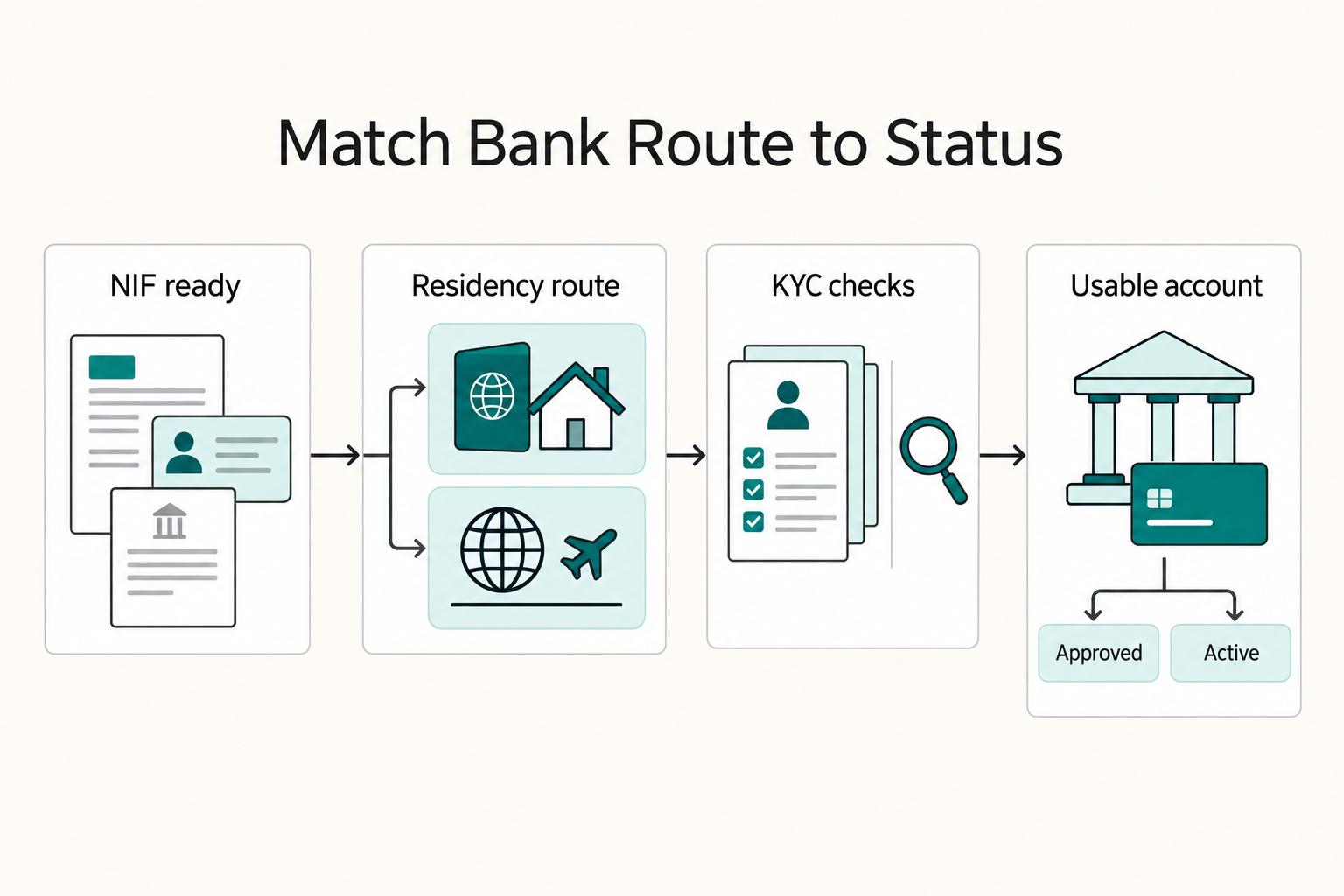
Quick Answer
Yes. Foreign applicants can often open a Portugal account, but only after matching the bank product to current status (resident or non-resident) and clearing NIF, KYC, and AML document checks. Submit a consistent file set (ID, address, income, source-of-funds) and verify channel eligibility before booking branch or remote onboarding. Keep your existing collection route live until the new account is confirmed for inbound transfers and withdrawals.
Start Here With a Cashflow-First Goal#
Start with cashflow, not paperwork. If you are setting up a Portuguese bank account as a foreigner, the real job is simple: keep invoices moving, keep payouts landing, and keep everyday access to cash workable while onboarding is still under review.
The safest way to plan is to split your notes into three evidence tiers so assumptions do not quietly turn into rules:
- Confirmed bank rules, meaning what a bank confirms for your profile right now, including status, channel, required documents, and activation conditions
- Common guide patterns, meaning friction points that are useful for preparation but are not the same as approval
- Bank-specific unknowns, meaning approval odds, timelines, and remote eligibility until the bank confirms them directly
That distinction matters because account setup usually breaks down in the gap between what people read and what their own file can prove. A guide may describe a path that exists in general, while your application still depends on current channel rules, document interpretation, or status classification. If you keep those evidence levels visible from the start, you make better decisions when the facts are incomplete.
The working assumptions here are straightforward: NIF setup comes early and works like a gate. Residency status shapes which account path is even open to you. KYC review can widen into much heavier due diligence than people expect. Those points should drive your sequence before you spend time comparing app polish or branch convenience.
| Decide now | Verify before applying |
|---|---|
| Starting status path, resident or non-resident | Whether this bank accepts that status right now |
| Minimum cash buffer during onboarding | When the account is actually usable for incoming transfers and withdrawals |
| Who prepares and checks documents | Exact file list, plus any in-person requirement |
Channel is an early checkpoint, not a detail to clean up later. One current expat banking guide presents branch-first steps for some non-resident cases. That is a useful reminder to test your channel assumption before you book anything. If that assumption is wrong, you lose time rescheduling and repackaging the same file.
Run the process with one simple tracker: what the bank confirmed, what you are inferring from general guidance, and what is still pending. Add a date to each note. That gives you a clear view when different staff members tell you slightly different things, or when you need to decide whether to keep waiting or switch lanes.
Keep that tracker plain and usable. If a staff member says your file "looks fine," that is not the same as confirmation that your status path, channel, and document types are accepted. Mark it as a useful signal, not a rule. If a bank confirms that your profile must apply in branch, or that a non-resident path is open to you, that belongs in the confirmed column. This habit keeps your planning grounded when the process starts to feel noisy.
Everything that follows assumes that sequence: choose status early, build a file that can survive KYC review, and keep your current receiving route active until the new account is genuinely ready for payments.
Know the Terms Before You Choose a Bank#
The terminology matters because a lot of avoidable delay starts with a language mismatch, not a document mismatch. If the product path does not match your status or compliance profile, everything else slows down fast.
Start with Numero de Identificacao Fiscal (NIF). Treat it as a practical prerequisite for opening in Portugal, and get it lined up before you commit to a submission date. Keep it paired with your ID and tax evidence in the same packet so you are not solving the same issue twice.
Then separate resident and non-resident routes early. Non-resident options can exist, but they may be narrower than resident products. Some non-resident products may also be aimed at Portuguese citizens abroad, so eligibility and feature fit still need direct confirmation.
| Term | Why it affects cashflow | What to verify before applying |
|---|---|---|
| Numero de Identificacao Fiscal (NIF) | Missing it can block onboarding before review even starts | Is your NIF evidence accepted with your current ID set today? |
| Non-resident bank account | Service scope may be narrower than resident routes | Which transfer and access features are active after approval? |
| Resident bank account | Access can differ from non-resident products | What status proof is required right now? |
| KYC/AML requirements | Compliance checks can extend onboarding timelines and affect eligibility | What extra checks apply to your residency or citizenship profile? |
Treat KYC and AML as the main timeline risk. Review can stretch into several weeks or months when checks tighten, and some banks may restrict non-EU applicants. Card delivery timing matters, but it is not the same as confirmed approval or full account usability.
It helps to keep three stages separate: application submitted, account approved, and account usable for your actual payment flow. Those are different checkpoints. A product page can make the process look continuous, but from a cashflow perspective the only stage that matters is when incoming funds can land and be used without guesswork.
If a product label is unfamiliar, ask the bank to map it to your real payment use case in writing. If the answer stays vague, stop there. A short written summary of what the account can actually do is often worth more than a polished product page.
This is especially useful when staff use the same word to mean different things. "Open," "active," and "ready" can sound interchangeable in conversation, but they do not solve the same operational problem. When you hear any of those terms, ask which stage the bank means and what still has to happen before the account can receive and release funds in the way you need.
Decide Your Account Status Before You Apply#
Pick the status your documents can support today, not the status you expect to have later. If you do not yet hold a Portuguese residence permit, starting as non-resident and updating later is often the practical sequence.
Foreigners can open accounts in Portugal, including before relocation in some cases, but limits can apply without local address proof. Non-resident routes can also come with narrower product access, so this is not just a labeling issue. It affects what you may actually be able to do once the account is open.
| Current position | Practical first path | Re-check trigger |
|---|---|---|
| No Portuguese residence permit yet | Usually apply as non-resident first | You receive resident documents and local address proof |
| Moving on a visa timeline | Use timeline for planning, not as approval proof | Legal status changes and bank requests updated evidence |
| Unsure how bank will classify your file | Ask for written classification before submission | Any mismatch between profile and product terms |
That is why forum mentions of specific providers should stay in your leads list, not your evidence list. The useful checkpoint is direct confirmation from the bank handling your file.
Before you submit anything, confirm the minimum file set for your status. Most banks ask for identity, address, and income evidence, and they verify source of funds under KYC and AML review, sometimes with follow-up requests. Ask which document types are accepted as substitutes so one missing format does not stop the whole application.
A common failure mode is applying through a resident path because that looks like the long-term answer, even though your current file only supports non-resident treatment. That mismatch creates rework you could have avoided. The better move is to choose the path your documents can prove now, then set a reminder to revisit classification when your status changes.
Resolve NIF timing early as well. Public guidance can conflict on process details, so verify what NIF evidence the bank accepts for your non-resident application before you schedule submission. If your residency status is likely to change soon, set a dated reminder to re-check account classification instead of assuming the bank will convert it automatically.
The key practical question is not "Which status will I probably have later?" It is "Which status can I prove without argument today?" If cashflow needs are immediate, that answer usually matters more than long-term neatness. Waiting for later documents may be reasonable if your current receiving setup is solid, but if invoices need a stable route sooner, the stronger first move is usually the status your file already supports.
Build a Document Pack That Survives KYC Review#
A tight, internally consistent file usually matters more than sending extra paperwork. The goal is not volume. The goal is a packet that answers the bank's basic questions without creating new ones.
For foreign applicants, a commonly requested base pack is:
- NIF (Numero de Identificacao Fiscal)
- Passport or Portuguese residence permit
- Proof of address in Portugal or abroad
- Proof of income
For income evidence, documents such as employment contracts, payslips, or recent bank statements are usually more useful than generic summaries. Treat that as baseline guidance, not a guarantee, because banks can ask for more depending on your profile.
| Document group | What to prepare | Common friction point |
|---|---|---|
| Identity | Passport or Portuguese residence permit | Personal details do not match across files |
| Tax ID | NIF evidence | NIF documentation is incomplete |
| Address | Current proof of address | Address format differs across documents |
| Income | Contract, payslips, or recent statements | Income narrative does not match file evidence |
| Source of funds | Clear origin evidence | Missing or vague origin trail |
KYC and AML checks go beyond confirming that you are who you say you are. If the source-of-funds story is incomplete or unclear, extra review is likely. In practice, the strongest packet is one coherent story told the same way across every file.
The easiest way to improve the packet is to review it like a checker would. Compare name spelling, name order, date format, and address format across every document. If one file uses a shortened address and another uses a full line, keep a note ready so you can explain the difference quickly if asked. If your income proof and bank statements cover different periods, organize them so the timing still makes sense when viewed together.
If documents were issued outside the EU, ask early whether translation or legalization is required. Use one naming style across the packet, including name format, address format, and date format, so avoidable mismatches do not slow you down. Keep everything in one dated folder with a short index. That makes follow-up requests much easier to answer quickly.
It also helps to prepare the packet in submission order, not just by document type. Put identity and NIF evidence first, then address proof, then income and source-of-funds material. If the bank asks for one missing item later, you can resend the exact section without rebuilding the whole file. That cuts response time and lowers the chance that a second version introduces a new inconsistency.
Before you send anything, do one final pass for narrative fit. Can a reviewer see who you are, where you live now, how you earn, and where the money comes from without guessing? If not, fix that before submission. Most delays start there.
One practical way to do that final pass is to imagine the reviewer sees your files out of order. Would the connection between them still be obvious? Your identity document should match the name on your NIF evidence. Your address proof should not point to a different reality than your application form. Your income proof should line up with the account activity or source-of-funds explanation you are relying on. If the story only makes sense because you know it already, the packet still needs work.
A short internal index can also help you stay consistent during follow-up. List each file, its date, and the category it proves. Then if the bank asks for an update, you can respond by category instead of resending everything. This matters because over-answering can create noise. A focused reply to the exact gap usually works better than sending a larger, looser pack that opens up new questions.
Choose Your Bank Lane With Explicit Tradeoffs#
Do not choose on reputation alone. Your best first option is the one that protects cashflow under your current profile and leaves the fewest unknowns around receiving funds.
A direct comparison between traditional banks and fintech options is usually the fastest way to narrow the field. Focus first on receiving details, supported incoming rails, and the conditions for funds to become usable after activation.
| Lane | Better fit when | What is confirmed | Must be confirmed in writing |
|---|---|---|---|
| Traditional banks, including Millennium BCP, ActivoBank, Santander, Novo Banco | You prioritize local banking depth in Portugal and can verify access first | No verified cross-bank matrix for foreigner acceptance | Profile-based eligibility, resident or non-resident access, onboarding conditions |
| Fintech options, including Wise, N26, Revolut | You handle more cross-border, multi-currency inflows | Wise is described with pay-per-use pricing, multi-currency receiving details, and rail-based fee variation | Which details you get in Portugal and which inbound rails are enabled at activation |
Start by confirming receiving details and inbound rails. Ask exactly which transfer types are enabled at activation and when funds become usable. That answer determines whether you can safely change the bank details on client invoices.
If cross-border inflows dominate your work, prioritize clear FX logic and written receiving terms. The draft includes Wise pricing examples such as mid-market conversion with separate fees, transfer pricing from 0.57 percent, and a volume discount after monthly sending above 25,000 USD equivalent. It also notes fixed fees for some received Swift or wire payments and free domestic non-Swift, non-wire receiving in that context. Keep the scope straight: the same section flags that example as U.S.-resident pricing context, so use it to validate the method, not as a Portugal quote.
If local banking depth matters more, shift the question. Ask which status path the bank will accept, whether branch presence is required, and when the account becomes usable for local transfers and withdrawals. A polished app or a familiar brand does not help if your profile cannot get through intake or if inbound use is still unclear after approval.
A simple way to narrow the field is to ask one question first: what must the first account do to protect near-term cashflow? For one freelancer, that may mean receiving local transfers cleanly from Portuguese clients. For another, it may mean handling cross-border invoice payments with clear FX treatment. Once that first use case is covered, branch convenience, cards, and app features can move to the second round.
The decision rule is straightforward. If multi-currency inflows drive your cashflow, start with the provider that gives the clearest documented receiving and FX terms for your routes. If local banking depth matters more, start with the provider that confirms profile eligibility and inbound readiness in writing. If you need both, run two lanes in parallel until one is fully usable.
A useful comparison trick is to ask every shortlisted provider the same short list of questions in the same order. That makes vague replies easier to spot. You are not just comparing features. You are comparing how clearly each provider can tell you whether your profile fits, how the account is classified, what documents it wants, and when inbound transfers actually work. The provider with the clearest operational answer is often the safer first move, even if another option looks broader on paper.
Open the Account in the Right Order#
Sequence matters more than speed. The safest order is channel, status, file, then signature.
Applications may be submitted online or in branch, but neither route guarantees quick approval. KYC and AML review can still push timelines into weeks or months, so use the channel that accepts your profile and confirm expected turnaround before you commit.
| Decision point | Remote opening | In-branch opening | Confirm first |
|---|---|---|---|
| Submission method | Submit online | Submit in branch | Whether your profile is accepted in that channel |
| Document handling | Provide required documents remotely | Provide required documents in person | Exact file list and accepted formats |
| Delay profile | KYC/AML review can delay processing | KYC/AML review can delay processing | Which evidence categories trigger re-review |
Before submission, lock the core file: passport, NIF, proof of foreign address, and proof of income. If local address proof is not available yet, expect non-resident classification risk and ask for written status classification before signing anything.
Do not treat submission as activation. Keep your current receiving route live until the bank confirms the account is ready for inbound transfers.
That makes pre-contract review worth slowing down for. Ask for the disclosure pack tied to your account type and review the terms before signing. Use this sign-off checklist before you accept:
- Confirm resident or non-resident status in your account documents
- Confirm missing items by evidence category, not generic pending labels
- Confirm inbound transfer readiness, not just account creation
- Confirm fee conditions in the disclosure pack before acceptance
If one item in the pre-contract language is unclear, pause and get it clarified in writing before you sign. That small pause can save a much larger dispute later.
Once the file is submitted, switch from filing mode to tracking mode. Save the submission date, channel used, any reference number, and the exact version of the file you sent. If follow-up questions arrive, answer against that version instead of improvising from memory. This is especially useful when more than one staff member touches the file, or when a branch conversation and a digital review do not use the same wording.
It helps to think of the process as a chain of separate approvals rather than one single yes. First the channel has to accept your profile. Then the status path has to match your documents. Then the file has to survive review. Then the signed account has to become usable. If you skip over one link because the form was submitted or a contract was signed, you can end up changing payment instructions before the account is really ready. That is the error to avoid.
Prevent the Delays That Hurt Freelance Cashflow#
Once the application is in, the risk shifts from filing to timing. The mistake is treating onboarding as if it were the same as being ready to get paid.
Until you have written confirmation that the new route works in your setup, keep onboarding and collections on separate tracks. That one discipline protects more cashflow than any product feature comparison.
Verified Portugal-wide onboarding timelines, bank-specific AML or KYC delay patterns, or exact account-activation criteria are not established. One provided State Department excerpt is cookie-consent interface text, not banking onboarding guidance. So keep timing assumptions conservative and confirm status at each handoff. If your billing cycle is tight, build in a buffer before changing payment instructions.
For Stripe specifically, the referenced payments page points to two paths: Start now for pay-as-you-go pricing, or Contact sales for a custom package.
| Decision point | What is confirmed | What is still unknown | Practical action |
|---|---|---|---|
| Interim receiving path | No provided excerpt identifies a single best fallback route for every profile | Which interim route fits your situation best | Keep your current collection route active until the new one is confirmed usable |
| Delay causes | Portugal-specific AML/KYC blocker categories are not defined here. | Exact triggers, thresholds, and timelines by institution | Request a written list of missing items and acceptable alternatives |
| Activation status | The exact moment all payment features become active in Portugal is not defined here. | When inbound and withdrawal features are fully active for your account | Verify active features directly with your provider before changing invoice instructions |
Operational red flag: treating an unverified status as payment-ready.
If checks stall, escalate with narrow written questions: what is missing, what format is accepted, and what the next review step is. Send the requested correction first, then add more only if asked. Extra files can help, but they can also create new inconsistencies if you start improvising.
A good escalation message is short and specific. State the status path you applied under, list the documents already submitted, ask which evidence category is still missing, and ask what substitute formats are acceptable. That structure is more useful than a general request for an update because it gives the reviewer a smaller problem to answer.
Until the new route is verified for your use case, prioritize collection continuity over consolidation. You can simplify later, once status is clear and the account is actually working.
One practical safeguard is to freeze changes to invoice instructions, payment portal details, and client billing notes until the new account passes the checks that matter to you. If you change those pieces early, you create a second moving part at the same time the application is still uncertain. Keeping collections stable while onboarding is unstable reduces avoidable payment mistakes.
Another useful discipline is to keep a pending-items log. Write down every follow-up request, when it was received, what category it relates to, and what you sent back. That gives you a clear escalation path if the case stalls, and it also helps you see whether the issue is one missing document or a deeper mismatch between your file and the route you chose.
If you want a deeper operations piece, read Automating Your Freelance Finances: A Zapier Workflow for Connecting Stripe.
Use a Fallback Path If Approval Is Slow or Restricted#
If the first route stalls, stop optimizing and start protecting continuity. The immediate job is to keep collections moving, not to force the perfect account setup.
If a resident path stalls, ask whether a non-resident lane is available for your profile and set a date to retry the resident path after the blocker is resolved. Move quickly, and ask what parts of your file can be reused before you restart. Reuse matters because the time cost is often in document preparation, not in the form itself.
A recent expat-oriented Portugal guide describes both traditional bank friction for some new arrivals and parallel use of digital alternatives. That supports a practical two-track approach: keep the local-bank application moving while a separate receiving lane stays live.
| Situation | Fallback move | Verify before acting | Risk if skipped |
|---|---|---|---|
| Resident route stalls | Request non-resident review | Whether provider offers that route for your profile | Lost time on a blocked path |
| One bank declines | Ask what from your file can be reused, then add bank-specific extras | Exact additional evidence required | Rebuilding from scratch each attempt |
| Local receiving not ready | Keep non-bank receiving lane active | Settlement timing, withdrawal access, reconciliation fit | Payment delays during onboarding |
Treat mentions of specific providers as leads to validate, not expected outcomes. The draft does not confirm approvals for any one provider, so ask directly for current acceptance criteria and channel availability.
If local receiving is still not reliable close to billing deadlines, keep your continuity measures in place. The guidance frames the tradeoff directionally: local acquiring can support stronger domestic authorization and fee outcomes, while cross-border routes can carry higher decline risk and more fee or FX pressure. Use that as prioritization guidance, not as a promise.
When escalation is needed, keep requests narrow:
- Ask whether a non-resident lane exists for your profile and what changes it requires
- Ask for the exact missing evidence category, not a generic pending status
- Ask what can be reused from your current file and what must be replaced
- Set a concrete date to reattempt the resident lane
If a bank says no without much detail, try to separate profile restrictions from document issues. If the problem is the route itself, switching provider makes sense sooner. If the problem is evidence quality, improving the packet may be enough for the next attempt. That distinction keeps you from wasting time solving the wrong problem.
Keep fallback instructions ready for clients before any deadline is at risk. That way, a delayed approval changes your routing details, not your ability to collect.
A fallback path works better when you decide in advance which flows stay where. If one route is already proven for invoices in flight, leave those invoices alone. Use the unproven route only for testing or for carefully chosen new payments after verification. That staged approach prevents one delayed approval from disrupting every client at once.
Turn the New Account Into a Reliable Get Paid System#
Approval is only the midpoint. What matters next is whether the account details are standardized, the route has been tested, and each incoming payment can be reconciled cleanly from day one.
The practical objective is simple: payments land in the right place, each credit is easy to match, and withdrawals are planned from cleared balances. In some cases, counterparties may require a Portuguese IBAN, so detail accuracy matters.
Use one invoice payment block every time, with details exactly as the bank records them:
- Account-holder legal name as registered
- Portuguese IBAN in exact format
- Bank country (Portugal) and expected payment currency
- Fixed remittance reference format, for example
INV-2026-014
Before you treat the account as fully ready, run a basic live checkpoint. Confirm any required initial deposit has posted, run one low-value SEPA transfer, and verify remittance reference handling. SEPA cross-border transfers in the EU are often priced like domestic transfers and can be €0, but pricing can still vary by bank and transfer type.
Then keep reconciliation disciplined from the start:
- Track invoice ID, client entity, expected amount, currency, IBAN used, and due date
- Match each incoming credit to invoice status and flag unmatched credits quickly
- Escalate with the exact missing remittance reference, not a generic payment query
- Plan withdrawals from cleared funds
A staged rollout is usually safer than a big-bang switch. Update invoice templates only after the test transfer clears and the details appear exactly as expected. For recurring clients, send the new payment instructions separately and keep older payment routes visible for any invoice that is already in flight until that invoice is settled. That lowers the chance of money going to the wrong place during transition.
Some friction can continue even after the account is opened. In some cases, KYC and AML review can stretch the broader onboarding period into several weeks or even months. Non-resident accounts may offer narrower services than resident accounts, and some customer profiles can face product restrictions at certain banks. Keep your interim receiving lane active until day-to-day collections are stable.
It is also worth setting a simple operating rule for your first month: every incoming payment must be easy to trace. If you cannot tell which client paid, which invoice it matches, or whether the funds are cleared, the setup is not finished yet. Fix that before you scale volume through the new route.
Another practical control is to keep a small change log for payment instructions. Note when you changed the invoice template, which clients received updated bank details, and when the first successful payment arrived through the new route. That gives you a clean record if a client uses old details or if a payment arrives without the reference you expected.
As volume grows, add infrastructure only where it solves a clear problem. For teams using Gruv where supported and enabled, Virtual Accounts can improve incoming-payment segregation for cleaner matching, and compliance-gated Payouts can strengthen outbound controls. If residency status is changing, align account upgrades with Portugal Digital Nomad (D8) Visa: A Complete Guide.
Confirm What Is True and What Is Still Unknown#
Before you rely on any guidance, separate what is confirmed from what is merely plausible. That habit prevents a lot of expensive mistakes.
| Evidence status | What is supported now | How to use it |
|---|---|---|
| Confirmed | One ECB page note says the page is not the most recent version and directs readers to the latest one. | Run a recency check before relying on any guidance. |
| Confirmed but contextual | A Portugal-focused banking guide says local counterparties often want a Portuguese IBAN and says residency applicants may need a Portuguese account to show financial stability. | Use these as planning signals, not universal rules. |
| Unknown and bank-variable | Remote onboarding availability, non-resident feature limits, and document interpretation. | Treat each item as unknown until you confirm directly with the provider. |
| Verify directly | No verified cross-bank matrix for approval timelines, fee structures, or minimum deposit rules. Nothing here settles Banco de Portugal or Portal do Cliente Bancario requirements for every decision point. | Keep these marked unknown until you get current criteria in writing. |
A common failure mode is turning probabilistic wording into a hard rule. Likely is not mandatory. Keep those labels visible in your notes so each decision reflects the strength of the evidence behind it.
Another useful habit is to mark each note with both source type and date. A direct email from a bank, a branch conversation, and a third-party guide do not carry the same weight. If you label them clearly, stale assumptions are much easier to spot before they shape your application strategy.
Before each application attempt, re-check current criteria for your exact profile and intended account use. If your status timeline is changing, line that review up with Portugal Digital Nomad (D8) Visa: A Complete Guide. Add a date stamp to each check so stale assumptions are easy to spot.
If two inputs conflict, do not average them. Put the guide in the planning column and the bank's current written answer in the decision column. That does not mean guides are useless. It means they help you prepare questions, while the provider's current criteria determine whether your file can move now.
Follow a 30-Day Setup Checklist#
Use the first 30 days to control risk, not to force a completion promise. Some applicants may complete branch onboarding in one visit with a complete file, but KYC and AML review can still stretch the overall process into several weeks or even months.
| Week | Core actions | Verification checkpoint | Fallback if unclear |
|---|---|---|---|
| Week 1 | Finalize resident or non-resident path. Secure NIF. Build a KYC-ready file with ID, tax evidence, address proof, and income evidence as requested. | Confirm the document set is complete before booking submission. | Keep current receiving setup active while closing gaps. |
| Week 2 | Shortlist banks and request written eligibility confirmation for your exact profile. | Confirm whether your profile can open online. Some banks accept online applications only from customers with a Portuguese citizen card or local digital ID. Confirm branch hours before visiting. | If eligibility is not confirmed in writing, do not rely on one bank as your only path. |
| Week 3 | Submit application, complete required forms, and make any required minimum deposit. Track follow-up evidence requests closely. | Verify what is still pending after submission. | Keep fallback receiving active until account usability is confirmed. |
| Week 4 | Confirm payment readiness, update invoice templates with final details, and run one low-risk transfer test. | Verify incoming funds and core payment functions before larger invoices. | Continue fallback receiving for active billing until tests clear. |
A practical way to run this checklist is to set one review point each week. Close open items, mark blockers by evidence category, and decide whether to continue, escalate, or switch lanes. That keeps momentum steady without pushing past unresolved risk.
You can make the checklist more useful by assigning one concrete output to each week. Week 1 should end with a clean document pack. Week 2 should end with a shortlist that has written status and channel confirmation. Week 3 should end with an application record and a pending-items log. Week 4 should end with a tested payment block and a decision on whether the old receiving route can be reduced or needs to stay live.
Afterward, keep a renewal folder with current identity, address, and income records, plus copies of submitted forms and dated responses. Cards and cheque books are usually mailed to your registered address, so log delivery and activation dates separately to speed up follow-up if something goes missing.
The point of the checklist is not to force every case into the same speed. It is to make sure each week ends with fewer unknowns than the week before. If a week closes and you still do not know your status path, channel, or missing evidence category, that is a signal to pause and clarify rather than rush into the next step.
Before sending your first Portugal invoice, generate a clean template with your final bank details using the free invoice generator.
Make Your First Account Choice Reversible#
Your first account does not have to be your final setup. Treat it as a payment bridge that protects continuity now, then upgrade features later when your status and options are clearer.
A practical setup is often a mix of local account access, day-to-day payment tools such as MBWay, and international transfer handling. That combination can make the transition smoother while your longer-term arrangement takes shape.
Because outcomes can vary by bank and by legal context, make each decision easy to unwind. Anecdotal reports also describe account-closure friction, so avoid tying collections to one pending approval or one unresolved path.
Prioritize continuity, then upgrade#
- Confirm in writing what is accepted now and what could be re-reviewed later
- Treat
payment-readyas the checkpoint, notapplication submitted - Keep dated notes on who confirmed each condition and through which channel
- Keep a fallback receiving route live until the new route works in a real transfer
A reversible setup also means changing payer instructions in stages. Move only the flows that the new account has already proven it can handle, and leave less urgent routes on the old setup until the new one has survived normal use. That way, a documentation issue or feature restriction affects only part of your collections instead of all of them at once.
You can apply the same rule to client communication. Update the payers who need the new details first, keep older details available for invoices already circulating, and retire the previous route only after the new one has handled normal payments without confusion. Reversible decisions are calmer decisions because they give you room to correct problems without interrupting cashflow.
Treat evidence quality as a control#
Use one clean evidence packet so follow-up requests can be answered quickly. If review stalls, ask what is missing and respond directly to that gap. Then reuse the improved packet for the next application instead of rebuilding from scratch.
That approach protects payment continuity and reduces stress. You keep options open while account status and product access catch up with what you actually need.
If your residency timeline may change soon, align upgrades with Portugal Digital Nomad (D8) Visa: A Complete Guide.
If you want a fallback receiving route while local banking access stabilizes, review how Virtual Accounts work where supported.
Frequently Asked Questions
Can a foreigner open a bank account in Portugal?
In some cases, yes, but approval is bank-specific. Non-resident opening can be possible, though the process is less simple and quick than before for some applicants.
Do I need a Numero de Identificacao Fiscal (NIF) before opening?
Often yes. One source says you need a NIF before opening, and another treats it as a common requirement in bank onboarding; timing at Financas offices can still affect how quickly you complete that step.
Do I need a Portuguese residence permit or can I open as a non-resident?
A residence permit is not a universal yes-or-no gate across all banks in this material. Non-resident opening can be possible, but acceptance is bank-specific and profile-specific.
What documents are usually required for AML and KYC checks?
There is no single cross-bank checklist in this material. Requirements can vary by bank and applicant, and follow-up requests may occur during stricter AML/KYC review.
Can I open a Portugal account remotely or do I need a branch visit?
Channel requirements are bank-specific. Broad remote availability is not something you can assume, so verify in advance whether your case requires a branch visit.
What is the practical difference between a resident and non-resident bank account?
Banks can apply different eligibility criteria by status. There is no verified cross-bank feature matrix to rely on, so compare each bank's written criteria directly.
What should I do if my application is delayed or rejected?
Timelines and outcomes can vary by bank, and there is no standard appeals path you can count on. Ask the bank to specify what is missing, provide only requested documents, and keep a fallback payment route active until the account is fully usable.
Try a related tool
Researched and edited by the Gruv editorial team. Gruv builds cross-border billing, payouts, and finance-operations software for global businesses.
Sources
Includes 1 external source outside the trusted-domain allowlist.
Educational content only. Not legal, tax, or financial advice.
Related Posts

Portugal Digital Nomad Visa Decisions That Prevent D8 Delays
Start with verification, not paperwork. In this research set, some material is useful only as EU VAT context, not as D8 instruction, and mixing those categories is one of the fastest ways to build the wrong plan. We use the same separation rule in [Global Digital Nomad Visa Index](/blog/global-digital-nomad-visa-index) comparisons.
Automating Your Freelance Finances: A Zapier Workflow for Connecting Stripe, QuickBooks, and Wise
Cleaner books and fewer month-end fire drills come from sequence, not software. Run this in the right order: structure, compliance, accounting architecture, then automation.

The Freelance Payment Penalty: A Modeled Audit of Platform Fees, FX Spreads, and Payout Delays
The money rarely disappears through a single, easy-to-spot fee. The real loss is stacked. A marketplace takes its commission, a processor adds a charge for international cards, a bank or payment company converts the currency at a spread, a platform holds the funds before release, and a wire sheds a little to intermediaries on the way in. Each layer looks defensible on its own, but the worker feels the combined result as a smaller deposit and a later payday.