
Quick Answer
Foreign nationals can apply for German accounts, subject to the chosen product’s residence, identity and use requirements. Check personal versus business eligibility first. A Sperrkonto serves visa financial proof, while eligible consumers may have a separate Basiskonto right under the ZKG.
Opening a Bank Account in Germany as a Foreigner Without Cashflow Surprises#
Choose an account for the job you need it to do: personal bills, freelance client receipts, a company’s payments or visa financial proof. Those are different applications. This guide focuses on an adult foreign applicant opening an everyday account and, where relevant, a separate account permitted for freelance business use.
If you depend on client payments, predictable incoming payments come first. In practice, a Girokonto supports day-to-day money movement, and the IBAN is central for getting paid and covering local bills. The linked debit card matters once the account is active for daily use.
Nationality, current residence, identity-document acceptance and intended account use all affect the application. A bank’s online signup page does not establish eligibility for every foreign applicant, and a personal account’s payment features do not establish permission to use it for business.
Decision checkpoints before any application#
Before comparing fees, check four things: whether the provider serves your current residence; whether its verification channel accepts your exact document; whether the account permits your intended use; and whether you can activate access and receive the payments you need. Keep the fee schedule for the specific account and country, including any conditions for a free tier.
Keep the existing permitted receiving account active while you apply. Update invoice details after you can access the new account and have checked an incoming transfer, rather than when you receive an application acknowledgement.
Build the Mental Model Before You Apply#
Treat readiness as four gates, not one form submission: profile fit, document fit, verification fit, and activation fit. If any gate is incomplete, processing can stall.
For this guide, your target is a usable account, not just a submitted application. The practical question is not only whether you can start an application, but when the account is fully usable.
Checklist requirements can vary by applicant track, so confirm the exact checklist before you apply. Even when a process starts online, verification may still include in-person steps.
Check the four gates before you apply#
- Profile gate: confirm your exact applicant track.
- Document gate: confirm required files, consistency, and whether certification is required.
- Verification gate: confirm whether in-person steps are still required.
- Activation gate: confirm when IBAN details are issued and what must happen before full use.
A Sperrkonto is a blocked account used as financial proof for certain visa categories. It limits monthly withdrawals and is separate from an ordinary Girokonto. The Federal Foreign Office directs applicants to the responsible mission for the required amount; its guidance is not a universal passport, embassy or parental-document checklist for everyday accounts.
A student may need both visa financial proof and an everyday account. Follow the blocked-account provider and visa authority for the first task, and the bank’s current account requirements for the second. Neither approval automatically completes the other.
A useful operating habit is to mark each gate as open or blocked before you submit. If profile fit is clear but document fit is not, pause and fix the pack first. If documents are ready but activation details are vague, ask the bank to define the exact step that unlocks full account use.
Map Your Eligibility Profile Before Choosing a Bank#
Map your profile first, then compare bank features so you can deprioritize options that may not match your case.
Build the applicant profile from facts the bank actually uses: current residence, nationality and ID document, age, intended personal or business use, and the account holder’s legal identity. A non-EU national lawfully resident in Germany is a different case from an applicant still living outside the provider’s supported countries.
For everyday personal payments, compare consumer current accounts. For freelance invoices, choose a product whose terms permit that business use in your legal name. For a company such as a GmbH, use a company-account application with its registration and ownership requirements; do not treat a sole trader’s account as a company account.
| Applicant and purpose | Suitable application | What to confirm first |
|---|---|---|
| Adult resident needing personal banking | Consumer Girokonto | Residence coverage, accepted ID and verification route |
| Self-employed individual receiving client fees | Freelancer/business account for an individual | Permitted business use, account-holder name and eligibility |
| Incorporated company | Company business account | Supported legal form, registration and beneficial-owner documents |
| Student needing visa financial proof | Sperrkonto for the applicable visa category | Mission’s required amount and provider’s release/withdrawal rules |
| Eligible consumer unable to obtain everyday banking | Basiskonto application under the ZKG | Eligibility, required application and identity evidence |
Save the provider’s requirements for your account and country before applying. Do not import VAT thresholds, registration schemes or a blocked-account checklist into a retail bank application.
Forum claims are weak evidence. If the bank policy page does not confirm the claim for your exact profile, do not use it as a decision input. A short profile map up front can save time compared with recovering from a failed first application.
Assemble the Document Pack That Prevents Rework#
Build one complete, provider-matched document pack before you apply. Incomplete or mismatched files can create avoidable back-and-forth, so prepare for one clean submission in your chosen lane.
Build a policy-matched pack#
Build the pack from the bank’s requested documents. Record the exact accepted passport or ID type, expiry date, residence/address evidence if requested, tax information and the verification method. Business applicants may need activity or company information that a personal applicant does not.
Anmeldung registers your residence; a Meldebescheinigung records that registration. Whether a particular bank requires that document is a separate question. Ask which address evidence is accepted for your application rather than assuming every bank demands the same certificate.
If the online identity check does not support your nationality/document combination, ask the bank about an available alternative. A branch or postal route is useful only if that bank offers it for the account; it cannot overcome an unsupported residence or account-holder type.
Evidence checkpoint before submit#
| Check | Requirement | Risk note |
|---|---|---|
| Name consistency | Same spelling and order across all documents and forms | Inconsistent files can create avoidable back-and-forth. |
| Date consistency | No conflicting issue or validity dates | Mismatches can create avoidable back-and-forth. |
| File consistency | One final version per document type with clear filenames | Do not mix old and new file versions during resubmission. |
| Channel consistency | Use the same final set across each submission channel you choose | Keep the same final versions in every submission channel your route uses. |
If timing is tight, submit only when one primary application is complete, then keep a fallback option ready with the same verified files. Do not mix old and new file versions during resubmission, because mismatches can cause avoidable back-and-forth.
Decide What to Start From Abroad and What to Defer#
Pre-arrival opening depends on your current eligibility. N26 requires residence in a supported country and a supported ID, so “from abroad” is not permission to apply from any country. If the selected bank requires evidence you cannot yet provide, keep your existing lawful receiving route and complete that application when the requirement is met.
| Task | Start abroad or defer | Practical reason |
|---|---|---|
| Shortlist banks and check profile fit (EU/Non-EU, permit purpose, student or self-employed path) | Start abroad | Avoid applying to options that do not match your profile. |
| Pre-fill application data and prepare passport plus address documents | Start abroad | This cleanup is high effort and does not require being in Germany. |
| Final checks that may require proof of address registration (Anmeldung) | Defer until local registration is complete | Some onboarding steps depend on proof of German address registration. |
| Card delivery and first activation that may depend on local delivery | Defer | Delivery can affect when full usability starts. |
| Core local payments through a Girokonto (rent, salary, routine debits) | Defer until fully active | A checking account is usually central to everyday local payment flows. |
Before moving, ask whether the bank accepts your current residence, which delivery address it needs, and which verification route is available for your document. Treat an unresolved answer as an application dependency, not a promised opening date.
Do not assume every provider follows the same pre-arrival sequence. Some foreigners can open an account shortly after address registration, but that does not mean every bank supports the same path. Ask each bank which exact step needs local proof and whether use is limited before that step clears.
If a client payment is due soon, choose certainty over convenience. A temporary receiving path may bridge the gap while local onboarding finishes. Confirm it works for your profile and payment type before using it on live invoices.
Use this rule for timing and cutover:
- Mark your next payment due date and latest safe receive date.
- If that window is tighter than your realistic registration and activation window, activate a temporary receiving path now.
- Continue the primary German account application in parallel and complete local proof steps as soon as registration is issued.
- Switch billing details only after you verify inbound payments are landing as expected.
This split keeps pressure off the wrong step. You can make progress before arrival without pretending activation risk has disappeared, and you avoid sending first invoices to an account path that is not fully live.
Choose Online Convenience or Branch Certainty on Purpose#
N26’s opening requirements include age 18 or over, supported residence and ID, a compatible smartphone and verification in a supported language. Its current Freelancer account is an additional account for eligible active Personal-account customers; existing Business-account holders are excluded. Opening Personal first does not guarantee Freelancer eligibility.
If your visa category requires proof of financial support, follow the responsible mission’s requirements. A blocked account can supply that proof with withdrawal limits; it is separate from everyday banking and is not required for every foreign applicant’s current account.
DKB’s consumer opening instructions describe an online application and identity verification through WebID. That describes the channel, not acceptance for every overseas resident or document. Check your profile in the current application. DKB separately lists business accounts, including products for specified self-employed and professional groups; use that path for business eligibility.
Do not select an online bank on the assumption that it can replace visa financial proof or accept an incorporated business. If the required product or identification route is unavailable, shortlist an account that actually serves the profile before submitting another application.
Plan for timing uncertainty between application, verification, and full activation. Keep any temporary receiving path active until your main account is confirmed as fully usable.
If the bank cannot explain the full activation path in plain language, treat that as a risk signal and move to your fallback route. Clarity before submission is often more useful than marketing claims about convenience.
Use a First-14-Days Sequence Instead of Random Applications#
Use an early sequence as guidance, not a guaranteed timeline. Clear dependencies first, then switch payment flows only after the account is actually usable.
Start with document consistency and any local prerequisites that apply to your case. Then run one clean primary application from start to finish: if your bank uses an online flow, open the form, complete it carefully, and use an email address you can access throughout setup.
After submission, complete the verification step the bank assigns without delay. Treat this as an activation gate, not a minor admin task.
Before moving invoices or bills, confirm account-holder details, usable account access and incoming-transfer capability. Check outgoing transfers and any card or direct-debit features you need separately; an issued IBAN is not proof that every service is active.
Use one decision rule: if verification is still incomplete, keep your temporary receiving route active. If verification is complete and the account is usable, switch payment details once and keep the rest of your setup stable.
Avoid random multi-bank submissions during this period. A cleaner path is one primary application, one fallback option, and one clear switch point once your main account is usable.
Catch Rejection Triggers Early and Reduce Them#
For an ordinary current-account rejection, ask what can be disclosed and whether missing or inconsistent evidence can be corrected. Banks may be unable to explain some compliance decisions. Do not submit the same application repeatedly or substitute a false address to bypass eligibility.
Consumers lawfully resident in the EU may have a different route: the German Basiskonto under the ZKG. The entitlement includes eligible people without a fixed address and asylum seekers; it is a consumer banking right, not a promise of a business account, credit card or overdraft. Existing usable payment-account coverage in Germany and statutory refusal grounds matter.
For a complete qualifying application, ZKG §31 sets a maximum of ten business days to offer the contract. §34 governs refusal, reasons and information about review routes, subject to its disclosure exceptions. Apply explicitly for the Basiskonto rather than assuming an ordinary premium-account rejection decides that entitlement.
Retain the application, acknowledgement and refusal notice. If a Basiskonto request is refused, use the review information supplied and BaFin’s guidance; do not treat another ordinary online application as the only remedy.
Build a Reliable Get-Paid Setup for Freelancers After Opening#
For freelancers, first confirm business use is permitted. Then connect each invoice to the receiving account and actual bank entries. A client’s transfer screenshot is a sending record, not confirmation that you have received spendable funds.
| Control | Record to keep | Decision |
|---|---|---|
| Invoice matching | Expected payer, invoice reference, currency and amount | Investigate missing or net amounts instead of marking the invoice paid from a screenshot |
| Incoming transfer | Bank booking and available balance | Plan outgoing obligations from available funds, allowing for holds and later corrections |
| SEPA direct-debit collection | Bank’s creditor service approval, creditor identifier and mandate | Receiving transfers does not itself enable you to collect direct debits |
| SDD Core refund exposure | Collection record, refund/return record and liquidity allowance | Booking is not irrevocable; maintain a reserve appropriate to exposure |
Start by separating account opening from payment operations. A Girokonto supports incoming transfers and routine outgoing payments, but approval alone does not prevent cashflow mistakes.
Record the expected amount, payer and invoice reference before payment is sent. Mark it received only after a matching bank entry, and reconcile fees or partial payments explicitly. Keep outgoing payment confirmations separate from incoming collection records.
A current account can support incoming transfers without offering you a direct-debit collection service as a creditor. Before collecting by direct debit, confirm the bank or collection provider supports your business and scheme, and complete its creditor onboarding and mandate requirements.
The EPC’s SDD Core rules allow a payer to request an authorised debit’s refund without justification within eight weeks; unauthorised debits can be challenged up to thirteen months. A short hold does not eliminate this exposure. Keep appropriate liquidity for refunds and returns before committing receipts to irreversible expenses. SDD B2B has different eligibility and refund rules; do not silently apply them to Core collections.
A bank booking confirms movement, while the available balance tells you what the bank currently lets you use. Neither makes every receipt irreversible. Reconcile returned collections and refunds as new events, preserving the original receipt and the later reversal.
Keep invoice, incoming booking, any fee or refund adjustment, and outgoing payment evidence together. If one receipt cannot be matched, investigate that amount without discarding the bank movement or implying every unrelated payment must stop.
When volume increases, keep the same logic instead of adding complexity. One intake path, one settlement check, and one payout release rule are often enough to reduce avoidable payout mistakes.
Related: Automating Your Freelance Finances: A Zapier Workflow for Connecting Stripe. Want a quick next step for "open bank account germany foreigner"? Try the free invoice generator.
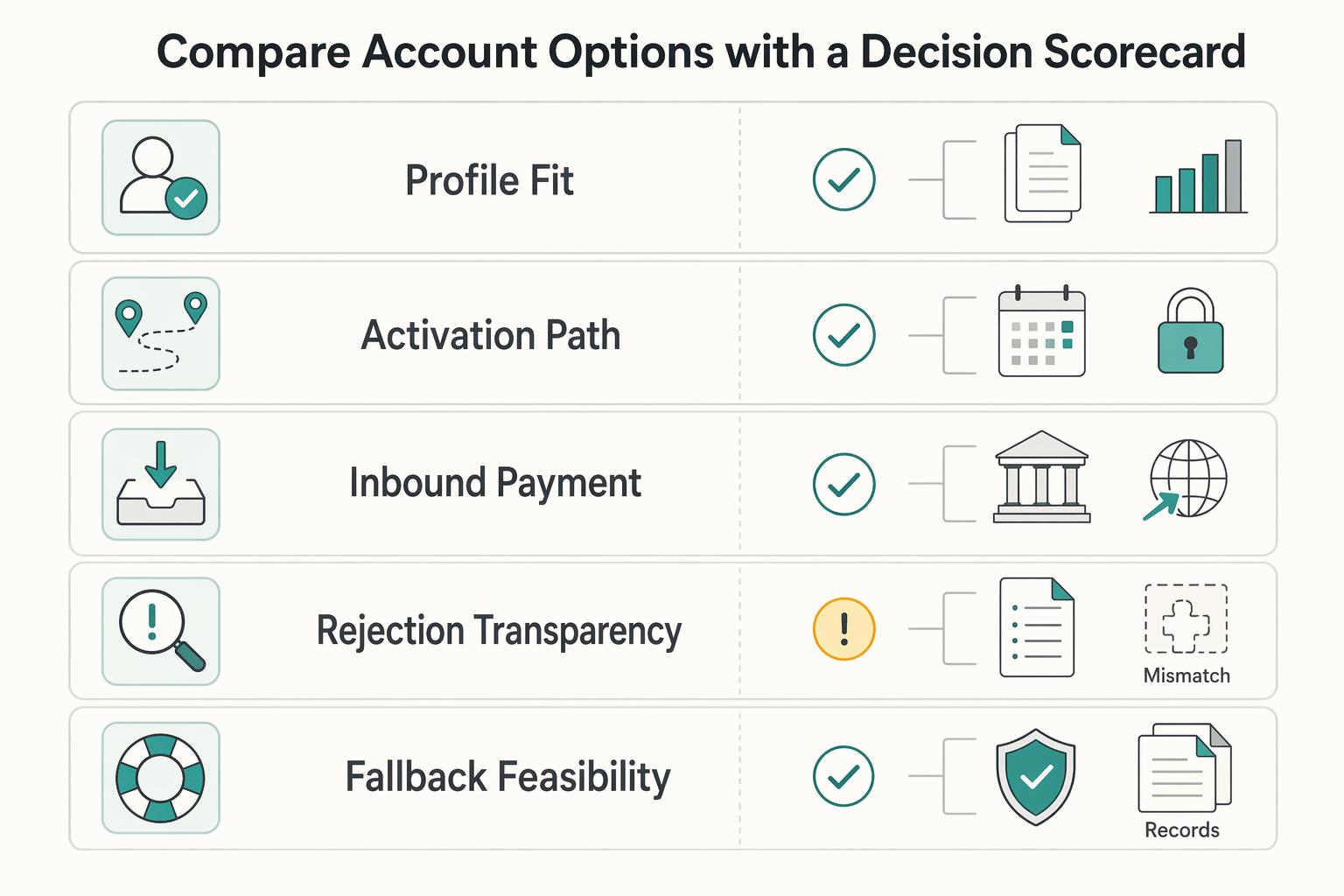
Compare Account Options With a Decision Scorecard#
Choose the account that minimizes payment interruption risk, not the one with the fastest-looking signup.
The scorecard below is an internal selection aid, not a bank approval model. Compare eligibility before activation convenience. Give unsupported residence, document or business use a failed prerequisite rather than averaging it away with a low fee.
Use a simple 0-2 scorecard and require written evidence for every 2.
| Criterion | What to verify | Score guidance | Red flag |
|---|---|---|---|
| Profile-fit clarity | Are document and profile conditions clearly stated for your case? | 2 = explicit criteria, 1 = partial guidance, 0 = vague copy | You are guessing from ads or forum posts |
| Activation path clarity | Is the verification and activation path clear before applying? | 2 = clear upfront, 1 = appears late, 0 = unclear | You cannot identify what blocks activation |
| Inbound payment readiness | Can you confirm a small live inbound transfer after opening? | 2 = tested and recorded, 1 = planned only, 0 = no test plan | First client invoice goes out before a live test |
| Rejection transparency | Are likely rejection categories and next steps explained? | 2 = clear reason categories, 1 = generic responses, 0 = no clarity | Reapplying with unchanged documents |
| Fallback feasibility | Is an existing permitted receiving route usable until the new account is tested? | 2 = usable and tested, 1 = available but untested, 0 = no usable route | One onboarding failure stops collections |
Keep a short decision file per option: criteria snapshot, verification-path notes, rejection-handling response, and inbound test result. Score all options in one sitting using the same evidence standard so the comparison stays fair.
Final rule: if a faster option has unclear rejection handling or no tested fallback, choose the one with clearer criteria and a verified intake path.
Plan Your Fallback Path Before You Need It#
Set your fallback path before you apply, so a rejection or delay is less likely to interrupt collections.
If onboarding is declined or paused, work from records, not memory:
- Request the reason in writing.
- Log exactly what you submitted and when.
- Fix one documented issue at a time.
- Avoid parallel retries with unchanged documents.
- Reapply once with a clear note of what changed.
Your fallback may be an existing account that permits the intended use. For covered euro SEPA payments within the EU, an account in another Member State cannot be rejected solely for its Member-State location: see the Commission’s IBAN-discrimination guidance. This does not require any provider to onboard an otherwise ineligible applicant, cover every foreign currency or supply creditor direct-debit collection.
If considering Wise or another receiving service, verify residence eligibility, personal versus business use, available account details, receipt types, fees and funds protection for the actual product before supplying details to clients. Compare the country-specific product terms, and handle any visa financial proof separately.
Correct a documented issue if the bank permits it, or choose a product that serves your profile. Keep the old receiving route usable through the transition, and avoid changing invoice instructions while the new account remains restricted.
The Practical Next Step for a Low-Risk Start#
Pick your profile lane first, then choose one primary bank path and one fallback before you submit anything. This is a lower-risk way to manage a process where requirements can vary by bank and applicant profile.
Separate everyday personal use, freelance business receipts and company payments. Confirm current residence and accepted identity documents for that specific product. If visa financial proof is needed, handle the Sperrkonto separately.
| Decision point | Primary path | Fallback path |
|---|---|---|
| Profile lane | Bank path aligned to your applicant profile | Path with clearer handling of extra document review |
| Residence evidence | Works with your current residence proof | Works after additional local proof is issued |
| Onboarding channel | Online when requirements are explicit | Non-online or mixed channel when online completion is unclear |
Build one bank-specific evidence pack with consistent legal name and address. Add business or company records only where the selected application requires them. Keep a dated copy of the requirements and your submitted files so later requests can be answered consistently.
Use a practical execution sequence:
- Keep legal name and address consistent across all documents and form fields.
- Submit the primary application with the full pack.
- Respond to verification requests in one complete update.
- Preserve or establish a usable permitted receiving route before payment is due. Start another bank application if a documented blocker makes the primary route unsuitable.
Use the bank’s stated fee schedule and activation process rather than a generic three-day promise. Keep the current receiving account until access and an incoming transfer are verified; update open invoices deliberately and reconcile receipts sent to either account during the transition.
If you need one final filter, use this: choose the path with the clearest activation requirements and the safest payment continuity plan. That can produce fewer surprises than choosing purely on speed or headline cost.
Frequently Asked Questions
Can a foreigner open a bank account in Germany, or only residents with local paperwork?
Yes, foreign nationals can apply, but ordinary account eligibility depends on residence, accepted ID, account use and the bank’s policy. Eligible consumers lawfully resident in the EU may also have a Basiskonto entitlement under the ZKG; that is separate from business-account approval.
Can I open a German account before moving, or do I need to wait for Anmeldung?
Only if the selected bank accepts your current residence and documents. N26 requires residence in a supported country. If your bank requires a registration certificate you cannot yet supply, complete that dependency first and keep an existing permitted account for interim receipts.
Do I always need Meldebescheinigung, or can some banks proceed without it?
No universal rule applies to ordinary accounts. Ask the selected bank which address or residence evidence it requires for your profile. Eligible people without a fixed address can still fall within the consumer Basiskonto entitlement, with its application and identification requirements.
Which documents are typically required besides a Passport?
Use the bank’s exact checklist: it may request address/residence evidence and tax information, with additional activity or company records for business accounts. Visa blocked-account documents are a separate checklist. Confirm the accepted ID and verification channel before submitting.
Is fully online opening realistic with N26 or DKB Bank, or should I expect branch steps?
Both describe online opening, but that does not guarantee eligibility for every resident or identity document. N26 publishes residence and supported-ID requirements; its Freelancer product requires an eligible active Personal account. DKB’s consumer instructions describe WebID verification, while business eligibility follows its separate product requirements.
Can I use a foreign account long-term instead of getting a German IBAN?
An eligible account in another EU Member State can serve covered euro SEPA payments; rejection solely because of that Member-State location is IBAN discrimination. Check permitted business use, payment features and currencies. This rule does not make every non-EU account suitable or replace visa financial proof.
What should I do first if my application is rejected or delayed?
Check the stated eligibility and document issue, ask what can be corrected, and preserve the application records. If you qualify as a consumer for a Basiskonto, consider that explicit application and its statutory review route. Do not repeatedly submit unchanged applications.
Try a related tool
Researched and edited by the Gruv editorial team. Gruv builds cross-border billing, payouts, and finance-operations software for global businesses.
Sources
Includes 7 external sources outside the trusted-domain allowlist.
- finance.ec.europa.eu/consumer-finance-and-payments/payment-servic...trusted
- auswaertiges-amt.de/en/visa-service/visabestimmungen-node/sperrk...external
- dkb.de/fragen-antworten/was-muss-ich-zum-girokonto-...external
- dkb.de/geschaeftskunden/kontoexternal
- europeanpaymentscouncil.eu/what-we-do/sepa-direct-debitexternal
- gesetze-im-internet.de/zkg/__31.htmlexternal
- gesetze-im-internet.de/zkg/__34.htmlexternal
- kontenvergleich.bafin.de/en/glossary/basic-payment-account-under-the-...external
Educational content only. Not legal, tax, or financial advice.
Related Posts
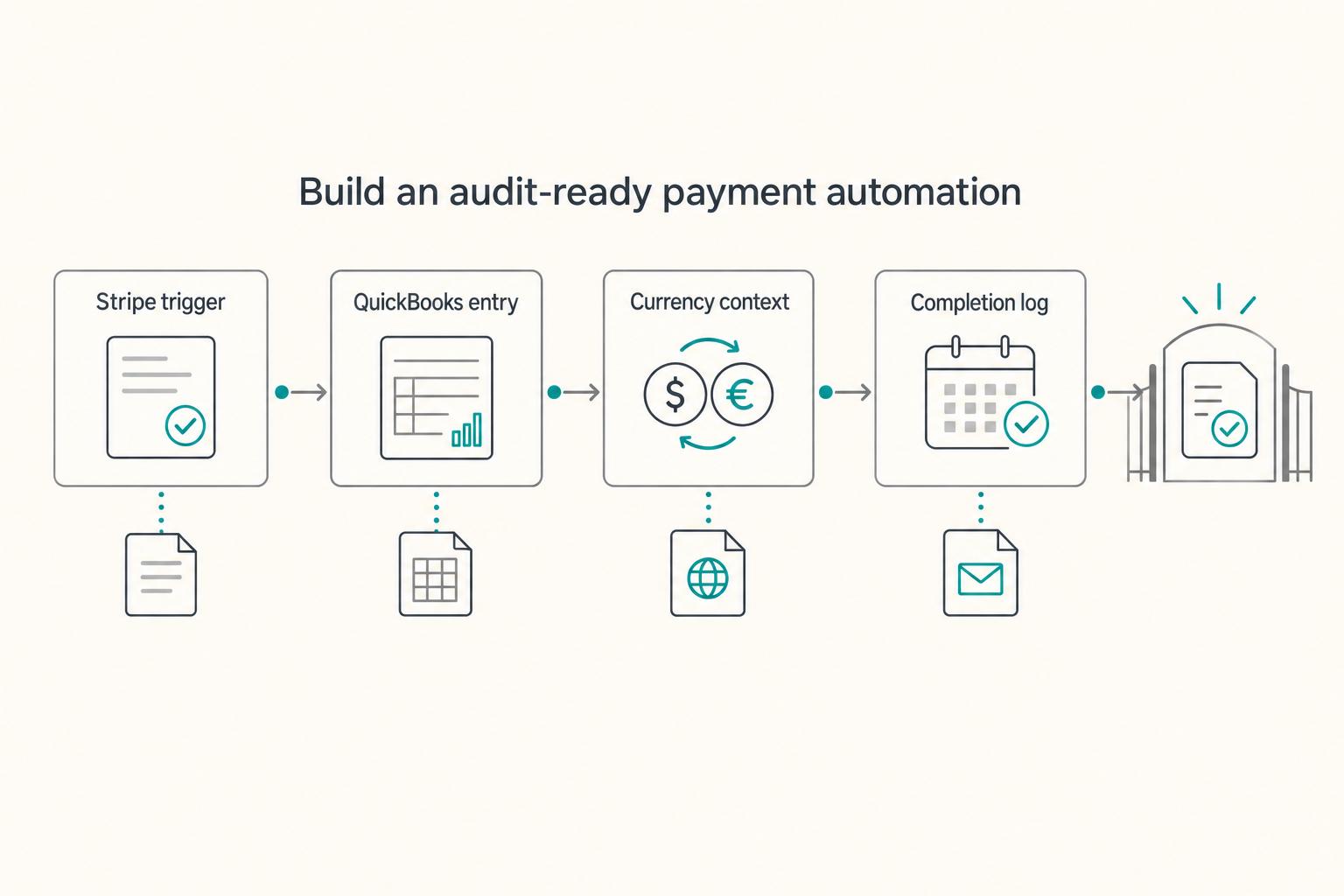
Automating Your Freelance Finances: A Zapier Workflow for Connecting Stripe, QuickBooks, and Wise
Start with one payment flow you understand, then automate its accounting record without losing the source reference. Stripe captures payments, QuickBooks holds the books, Zapier connects the selected steps, and Wise records any separate cross-border balance or conversion activity.

The Freelance Payment Penalty: A Modeled Audit of Platform Fees, FX Spreads, and Payout Delays
The money rarely disappears through a single, easy-to-spot fee. The real loss is stacked. A marketplace takes its commission, a processor adds a charge for international cards, a bank or payment company converts the currency at a spread, a platform holds the funds before release, and a wire sheds a little to intermediaries on the way in. Each layer looks defensible on its own, but the worker feels the combined result as a smaller deposit and a later payday.

How to Respond to a Subpoena for Business Records
Move fast, but do not produce records on instinct. If you need to **respond to a subpoena for business records**, your immediate job is to control deadlines, preserve records, and make any later production defensible.