
Quick Answer
Confirm the bank’s criteria for your real residence, legal holder and business activity. Prepare its identity, address and business evidence, then track review. If refused, check the relevant French right-to-account procedure. Before changing invoices, verify bank-issued details and reconcile a test receipt; keep a valid fallback while opening is pending.
Open a French account that can receive your client payments#
A foreign freelancer can apply for a French bank account, but the right route depends on where you live, who owns the business and whether the account permits professional receipts. Confirm those facts before choosing a bank or publishing new payment instructions.
Prepare identity and address evidence, then ask about business registration, tax residence, expected receipts and any representative verification. A complete file supports review; it does not guarantee ordinary commercial approval or a particular opening date. France also has a specific right-to-account procedure for eligible applicants refused an account.
Use this pre-submit checklist:
- Confirm who will own the account and whether it permits the intended professional activity.
- Ask which residence and verification channel the bank applies to your real profile.
- Prepare the bank’s actual identity, address, business and funds evidence list; retain an authorized receiving fallback.
Before submitting, compare your file with the bank’s requirements for the actual applicant and channel. Ask which missing item blocks review. Use a secure bank submission route and keep the submitted version plus acknowledgment.
This guide is for freelancers and small teams who need to invoice, receive transfers, and access funds without payout disruption. It is practical execution guidance, not relocation, immigration, or tax advice.
Keep banking eligibility, immigration permission and tax residence separate. An account does not establish permission to work or settle your tax residence; a provider’s resident or non-resident label is an onboarding classification to verify.
After account setup, Automating Your Freelance Finances: A Zapier Workflow for Connecting Stripe explains how to automate financial records.
Define the Banking Terms You Need Before You Apply#
Use the account holder’s legal identity consistently. A personal current account, a sole trader’s dedicated account and a company account are different arrangements even when each has an IBAN.
- Non-resident application: a provider-specific route for an applicant living outside France; it is not defined universally by a 183-day visa test.
- Compte courant: a current account for routine receipts and payments, subject to its permitted uses.
- RIB: the account identity document containing the beneficiary and account details used for transfers and direct debits; check it against the bank-issued record.
Before you submit, run this quick validation pass:
- Confirm which account path the bank applies to your profile.
- Check that your file includes identity proof, address proof when required, and visa-status evidence if requested.
- If documents are not in French, confirm early whether official translation or notarization is required.
Choose the Right Eligibility Path Before You Pick a Bank#
Start with your actual residence and business facts. Accepted French address proof can support a resident application, but address evidence alone does not determine tax residence or every provider’s eligibility. If you live abroad, ask whether the bank accepts your country and business profile through a non-resident route.
Ask what address evidence and identity verification the channel accepts. A hosted applicant may need the host’s signed declaration, ID and recent address evidence; a registered business may need its own domiciliation and registration records. Do not assume that one bank’s accepted format transfers to another.
For a non-resident application, confirm eligible countries, permitted business use, remote verification, required initial funding and ongoing fees or limits. Treat any advertised account option as a starting point, then confirm it fits your actual legal holder and activity.
If invoicing is urgent, keep an existing authorized receiving route available while applying. You can issue invoices with stable, verified details while a new account is pending; do not promise clients that approval will happen by an internal four-week target.
Run this checkpoint before your first submission:
- Confirm whether your profile will be processed as resident or
compte non-resident. - Verify that your address proof matches policy if you apply as a resident.
- Prepare status documents, including visa evidence when requested.
- Confirm translation or notarization rules for non-French documents.
- Ask directly about non-resident restrictions, including deposit and withdrawal conditions.
Keep a fallback branch ready. Submit the application that matches your current evidence first, then move to your next fallback option after re-checking current requirements. Repeating the same weak submission across multiple banks can create volume without progress.
Build a Document Pack That Survives Compliance Review#
Build your submission pack from each bank's written requirements, then keep alternates ready for follow-up. Outcomes can differ by institution even when applicants consider their file complete, so treat this as a precision task rather than a universal France checklist.
| Prep step | What to do | Control point |
|---|---|---|
| Get the list in writing | Request the required document list before upload | Use the bank's own requested categories and wording |
| Build the main pack | Create one primary set that matches that list exactly | Share only what the target bank asks for your profile and channel |
| Prepare alternates | Keep alternates ready | Follow-up can be faster |
| Control file versions | Use consistent file names and keep issue dates visible | Track what was sent and when |
| If declined | Ask for the reason in writing before reapplying | Update the pack against that specific gap |
A complete file can still fail an ordinary commercial bank’s eligibility policy. Ask whether the problem is an incomplete document, an unsupported applicant profile or a refusal after review. Those answers lead to different next steps.
Keep document control tight. Name files consistently, keep issue dates visible, and avoid sending mixed versions of the same record. If a bank asks for a re-upload, resend from the same master folder rather than pulling from email attachments. That lowers the chance of accidental mismatch.
Use this prep sequence:
- Request the required document list in writing before upload.
- Build one primary set that matches that list exactly.
- Keep alternates ready so follow-up is fast.
- Use consistent file names and track what was sent and when.
- If declined, ask for the reason in writing and update the pack against that specific gap before reapplying.
Another practical guardrail is response scope. If the bank asks for one missing item, send that item and only related context. Sending unrelated files may trigger extra questions and slow review.
Decide Between Remote Opening and In Person Based on Friction#
Choose remote onboarding when the provider offers it for your profile and you can satisfy its verification requirements. Use an appointment when the bank requires one or unresolved documents need discussion. An appointment can clarify a file; it does not waive missing evidence.
Confirm the remote process before starting: supported identity document, address country, electronic signature and any later original-document or branch step. Some routes may involve both online and in-person work, so ask for the complete sequence.
For a branch appointment, ask which originals, representative authority and translations to bring, and who must attend. For eligible right-to-account applicants unable to attend, Banque de France describes regulated alternative identity-verification methods. Arrange the method with the designated bank rather than assuming every application can be completed remotely.
Do not depend on a single bank. Build a shortlist and compare:
- Document strictness.
- Onboarding stages and review depth.
- Language support for compliance questions.
- Whether
compte non-residentapplications are accepted, and under what conditions.
Pick the Account Structure That Matches How You Get Paid#
Use an account that permits your business activity and keeps business receipts identifiable. The bank’s account terms matter even when the law does not require a premium “professional” package. A company’s receipts should use the company’s authorized account rather than a director’s personal account.
For a French micro-entrepreneur, Service Public distinguishes a dedicated account from a professional banking package. A dedicated account is required when annual turnover exceeds €10,000 for two consecutive years; commercial activity has a separate account obligation regardless of that threshold. A distinct personal account can be an option if its terms permit the activity. Check the required EI account designation as well as the service features.
Optimize for transfer handling first#
Standardize the bank-issued beneficiary name, IBAN and requested BIC across payment instructions. Obtain the details from the authenticated bank account or official RIB, not a forwarded amendment email. Verify any change through a previously established contact channel before asking a client to send money.
Use this checkpoint before rollout:
- Confirm the beneficiary name and identifiers match the bank-issued details; investigate any mismatch warning.
- Verify the test transfer arrives with a readable reference tied to an invoice.
- Lock one invoice template so every client receives identical payment instructions.
After the test lands, record its amount, bank reference and purpose. If it is a €1 part-payment of a €1,000 invoice, credit €1 and leave €999 due. If it is your own funds, label it as a test or owner transfer rather than client revenue. Resolve beneficiary-name warnings or missing references before wider rollout.
Use a controlled cutover for future invoices and track invoices already issued with old details. Keep the old authorized route monitored while outstanding payments settle, where the account remains usable. A client who paid valid prior instructions should not be asked to pay again merely because you changed accounts.
Choose primary and backup accounts by currency exposure#
Compare a French bank deposit account with an eligible Wise Business payment account by supported use, receiving details, fees and protection. Wise Europe SA says it is a Belgian-regulated payment institution, not a bank, and safeguards funds separately; its payment services are not covered by the Belgian Deposit Guarantee Scheme. See its EU safeguarding explanation.
| Setup | Best fit | Tradeoff to check |
|---|---|---|
| Local account primary, Wise backup | EUR receipts and expenses, with business use permitted | You may still need a second route for foreign-currency clients |
| Wise primary, local account backup | Selected supported foreign-currency receipts for an eligible business | Account eligibility, setup/receipt/conversion costs and safeguarding differ from a bank. |
| Hybrid with explicit routing rules | Mixed EUR and non-EUR client base | Requires tighter coordination so each client gets the right details |
The France Wise Business pricing page, checked October 5, 2026, lists a €60 setup fee for account details in 22 currencies. Supported domestic non-SWIFT/non-wire receipts are free; EUR SWIFT receipts have a €2.39 receiving fee. Sending and conversion fees vary by currency and start from 0.2%, which is not a quote for every transfer. Confirm the actual account and corridor before comparing costs.
A simple way to apply this is to decide your primary rail by where most invoices are issued and paid. Then keep the second rail for exceptions you can define in advance. Exceptions should be specific, such as client currency profile or payout destination, not ad hoc decisions made at invoice time.
Choose the primary route only after confirming eligibility, professional use, supported receipt method and access to statements. Keep a backup for defined exceptions, with clear instructions per invoice. For an invoice draft, use the free invoice generator after the receiving details are verified.
Execute the Application in an Order That Reduces Rework#
Confirm the applicant, account use and submission channel, then submit one consistent file and track follow-ups. If an appointment is required, book it before committing to a new receiving route. Keep a valid fallback for near-term invoices while the account is pending.
Follow a fixed submission sequence#
- Confirm the route with the target bank before submitting, resident or non-resident.
- Pre-verify the document list for that route, including passport, residence permit, and foreign tax ID where requested.
- Submit one complete packet through one channel, then wait for decision or clear follow-up.
- Reply to follow-up requests within the timeline the bank gives you.
Keep one versioned application folder so every upload and message uses the same files, which reduces avoidable mismatches across channels. You can also set an internal response rule. When a follow-up request arrives, acknowledge quickly, then answer with the exact requested item and a short confirmation note. This keeps communication clean and gives you a record of what was supplied and when.
Treat rejection notes as escalation evidence#
If refused, request the refusal certificate and ask for the stated reason or missing item. Save the application, delivery proof and responses. For an eligible right-to-account request, the certificate or the documented unanswered request can support a Banque de France application; repeatedly trying other banks is not a prerequisite.
If asked for foreign tax residence or identification, provide the actual information and resolve inconsistencies. Do not alter your citizenship, residence or beneficial-owner declaration to fit a channel. Ask the bank to explain what evidence is required for your real profile.
Correct a genuine document gap when appropriate, or assess the French right-to-account route. You do not need to keep cycling through commercial applications when the formal procedure applies. A designated bank still conducts required identity and compliance checks.
Define account-ready before you send invoices#
Confirm the RIB, permitted receipt methods, account access and tariff before changing payment instructions. Ordinary accounts can carry fees. Under the French right-to-account procedure, the specified basic services are free; optional services outside that scope can have separate conditions.
A practical readiness gate has three parts: payment details confirmed, first transfer tested, and billing templates updated in one pass. If one part is missing, delay full client rollout and fix the gap first.
Turn an Approved Account Into a Reliable Get Paid System#
Use one controlled rollout before full client billing:
- Confirm identical account details across invoices, contracts, and client portals.
- If practical, run a small payment test and match the reference to the correct invoice record.
- Use one collection account for incoming payments and define who can change payer instructions.
- Keep a clear receipt trail for each payment: invoice ID, expected amount, received amount, and posted date.
Set one switch date for new invoices and document how outstanding invoices will be handled. Notify each affected payer through the established channel and confirm receipt of the new instructions. Retire old templates without losing the ability to reconcile payments sent earlier.
After the switch date, run a short observation period where incoming transfers are checked against expected invoice details. This can surface early mismatches and help reduce carryover issues into month-end reconciliation. For multi-currency flows, define routing rules before invoices go out.
| Routing choice | When it fits | Tradeoff to watch |
|---|---|---|
| Local account primary, Wise secondary | Most billing and costs are in EUR | Cross-border receipts may add conversion steps |
| Wise primary for selected currencies | You invoice frequently outside EUR | Check permitted use, receiving method, pricing and protection, as well as currency. |
| Hybrid by client currency | You have a mixed client base | More coordination to keep payer instructions consistent |
For four €1,000 EUR receipts, the France Wise Business page’s free domestic non-SWIFT/non-wire receipt method gives €4,000 before other charges. Four EUR SWIFT receipts at €2.39 each leave €3,990.44 before intermediary fees or conversion. If the €60 setup fee applies in that period, it is a separate cost: €3,930.44 after those two stated costs. This compares receipt methods only, not an all-in bank quotation.
One practical control is ownership. Assign one person to maintain payer instructions and template updates. When too many people edit payment details, version drift can appear quickly.
Know the Rejection Route and Use It Without Delay#
Distinguish the EU consumer basic-account right from France’s professional right-to-account procedure. Ordinary commercial eligibility, refusal remedies and permitted business use are separate questions. Use the correct procedure for the actual person or entity.
| Screen | What guidance says | Limit |
|---|---|---|
| EU residence | If you are legally resident in an EU country, a bank cannot refuse only because you live in another country | Applies to basic payment accounts |
| Account type | The right applies to basic payment accounts | Not savings accounts |
| AML or CFT | Refusal can still happen when AML or CFT requirements are not met | Compliance gaps can still block opening |
| Existing similar account | In some EU countries, refusal is possible if you already hold a similar account in that country | Country-level rules can matter |
| Cross-border application | Some countries may ask you to show genuine interest in opening the account | Confirm local procedure |
Use Your Europe’s basic-account guidance for consumer context. It does not guarantee a particular premium product, company account or overdraft. For a business application, check the French professional procedure directly.
- Identify whether the applicant needs a consumer account or professional receiving account.
- Read the conditions and exceptions for the relevant official procedure.
- Record existing accounts and any closing notice accurately.
- Obtain refusal evidence and use the correct applicant form and document list.
- Check the designated services against the actual collection needs before relying on the account.
For the French personal procedure, Banque de France lists people domiciled in France regardless of nationality, French nationals abroad and foreign nationals legally resident elsewhere in the EU, with the applicable no-individual-account or closing-account condition. Check the exact eligibility and evidence rather than treating all foreign non-residents as covered.
The professional right-to-account guidance covers eligible France-domiciled entities and resident individual entrepreneurs after a bank refusal. Check the existing deposit-account conditions for that holder. It provides basic services through a designated bank, not automatic access to every business product. Use the individual-entrepreneur or company form and evidence list for your legal holder.
For an eligible individual’s application, the Banque de France procedure uses a signed form, refusal evidence, valid identity and address proof. If the bank has not answered a properly evidenced request within 15 days, the documented silence can serve as refusal. Submit through the listed channel; designation follows a complete file, rather than the first enquiry.
Banque de France describes a 24-hour designation after a complete formal file, a designation valid for six months and further document steps at the designated bank. For the professional procedure, Service Public states opening within three working days once the bank has a complete file. These are conditional procedural stages, not a three-day commercial onboarding promise; contact the bank promptly and retain delivery proof.
Avoid the Failure Modes That Cause Delays and Payment Risk#
Do not confuse a non-French IBAN with an unusable account. The European Commission explains IBAN discrimination for making or receiving SEPA transfers or paying SEPA direct debits through an account in another Member State. If a payer rejects details solely for their country prefix, retain the refusal and check the competent complaint route. Still confirm supported currency, transfer method and the account’s permitted use.
- Failure mode: Submitting mixed or drifting information across forms, uploads, and follow-up messages.
Use consistent, truthful facts across submissions. If an earlier entry was wrong or circumstances changed, explain the correction and supply the current evidence rather than repeating stale wording.
- Failure mode: Reapplying broadly instead of fixing one clearly identified gap.
Correct an identified gap or use an applicable formal route. Keep the submission and response history so the next reviewer can see what changed.
- Failure mode: Treating approval as payment-ready without an end-to-end check.
Safer move: Validate your incoming-payment flow before routing critical client transfers through the new account.
Two additional friction points can appear during handoffs. First, teams may forget to retire old invoice templates after account details change. Second, they may split responsibility for follow-up replies and lose track of which files were sent. Both issues are preventable with one owner and one master folder.
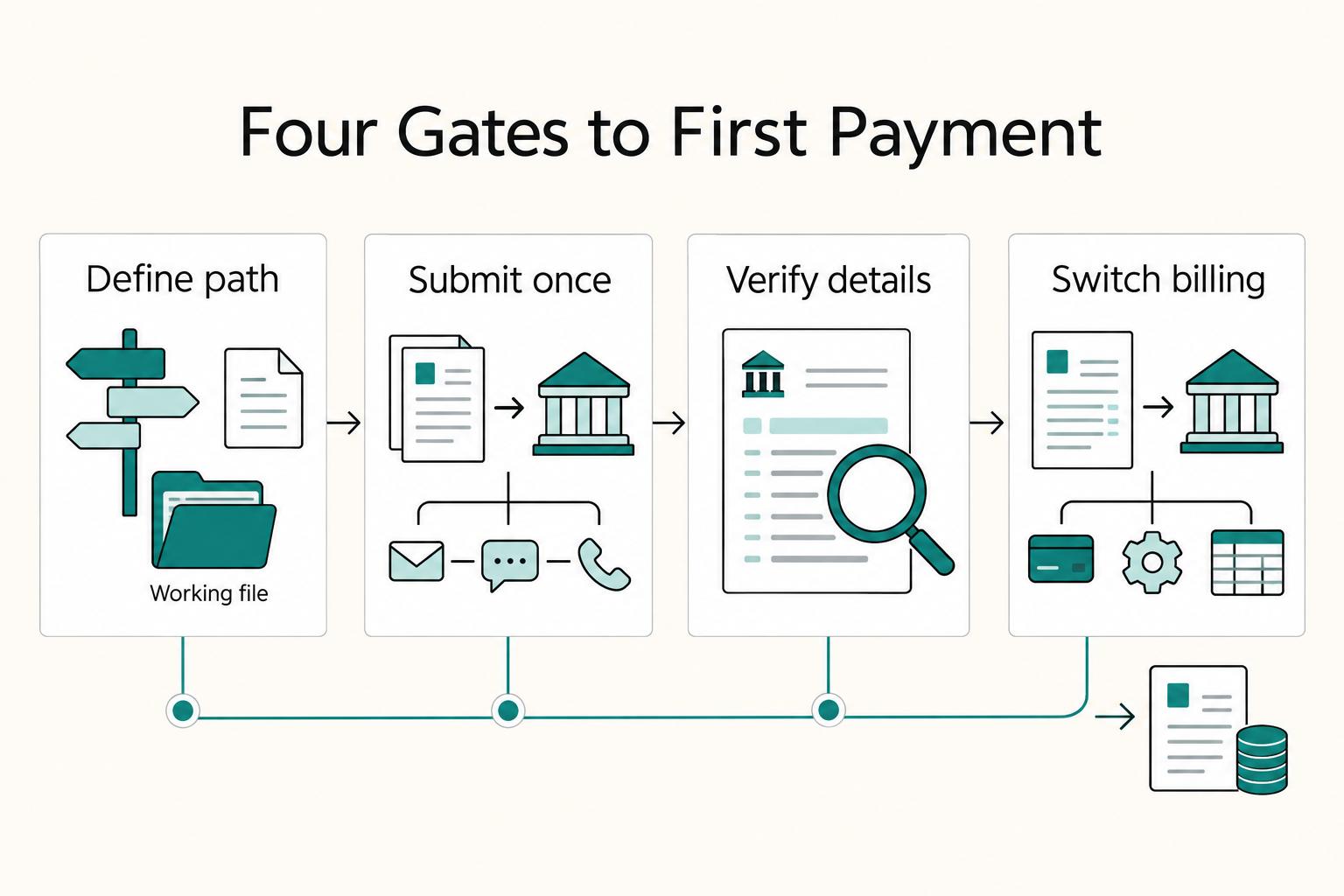
Use four planning stages from application to receiving payments#
The four-week layout below is an internal planning example. Commercial review and required evidence can take longer; a week ending does not establish approval or require you to change invoice details.
| Week | Focus | Main action |
|---|---|---|
| Week 1 | Define your path and lock one working file | Set your approach, keep one consistent narrative, and remove version drift before submission |
| Week 2 | Submit once and control follow-ups | Use one primary path, track responses, and keep all replies aligned to the same source file |
| Week 3 | Confirm readiness details before routing important payments | Make sure account information is consistent everywhere you plan to use it |
| Week 4 | Switch billing operations in one controlled pass | Update payment instructions and run tight reconciliation so mismatches are caught early |
Track stage completion by evidence, adapting the dates to the actual review:
- Week 1: Define your path and lock one working file. Set your approach, keep one consistent narrative, and remove version drift before submission.
- Week 2: Submit once and control follow-ups. Use one primary path, track responses, and keep all replies aligned to the same source file.
- Week 3: Confirm readiness details before routing important payments. Make sure account information is consistent everywhere you plan to use it.
- Week 4: Switch billing operations in one controlled pass. Update payment instructions and run tight reconciliation so mismatches are caught early.
If invoices are imminent, preserve the existing valid route while working through the same checks. Do not compress the bank’s compliance review or reroute a transfer that is already pending merely to meet your target date.
At the end of each week, write one short status note with three items: what was completed, what is blocked, and what evidence supports the next move. That keeps decisions explicit and makes handoffs easier if more than one person is involved. The practical objective is decision control: fewer conflicting records, fewer avoidable loops, and clearer next moves if review friction appears.
Leave the application with a traceable next step#
Track the actual status: submitted, further evidence requested, refused, designated under a formal procedure, opened or tested for receipts. Record the next action and owner. That prevents approval emails or calendar targets from being mistaken for a working collection route.
Use a compact evidence standard you can audit quickly:
- Log refusal or follow-up with its date, institution and exact wording.
- Keep the applicable policy or official procedure link and check date.
- Retain application versions, acknowledgments and any documented correction.
- Use the bank or competent authority’s actual application/support route for an unresolved requirement.
For each source you rely on, record its title, URL and check date, along with the applicable account type or procedure. Keep provider policy separate from official rules and check whether a page concerns personal accounts, professional accounts or a formal refusal procedure.
If you want one next action today, use this sequence: confirm route, verify requirements in writing, submit once with a controlled file, and test payment readiness before broad invoice rollout. That approach can help protect incoming cash while keeping compliance steps manageable.
Frequently Asked Questions
Can a foreigner open a bank account in France?
Yes, foreigners can apply. Confirm the bank’s criteria for your actual residence, legal holder and professional use. If an application is refused, assess the relevant French right-to-account procedure; a passport and a complete commercial application alone do not guarantee approval.
Can a non-resident open a French account?
Non-resident accounts may be available under a bank’s own eligibility rules. Confirm your country, legal holder, activity and verification channel. The French formal right-to-account procedure has specific eligibility conditions, so it is not an automatic remedy for every non-resident applicant.
Can I open from abroad without French proof of address?
Ask the bank whether it accepts your actual foreign address and remote verification for the intended account. Do not use a borrowed French address to imply residence. Eligible formal applicants should use the applicable official evidence list and arrange any required verification with the designated bank.
What documents are usually required?
Prepare accepted identity and address evidence, then check business registration, representative authority, tax residence, activity or funds information and translations where requested. The exact list depends on the applicant and route. Submit securely and keep the version and acknowledgment.
What if a bank rejects my file?
Keep the refusal certificate or appropriate proof of an unanswered request. Correct a genuine missing item if needed, and check whether you qualify for Banque de France’s personal or professional right-to-account procedure. One commercial refusal does not require indefinite resubmission.
Do I need a French account type for everyday payments?
A current account can support receipts and payments, but confirm that its terms permit your professional activity. A French IBAN is not automatically required for every SEPA payment. Check the legal holder, receipt method and actual service coverage before changing client instructions.
How should I plan if opening takes longer than expected?
Keep an existing authorized receiving route for invoices while the application is pending. Ask for the outstanding requirement and next update, track the response and assess an eligible refusal remedy when appropriate. Switch instructions only after the new account is operational; resolve pending transfers before rerouting.
Try a related tool
Researched and edited by the Gruv editorial team. Gruv builds cross-border billing, payouts, and finance-operations software for global businesses.
Sources
Includes 4 external sources outside the trusted-domain allowlist.
- europa.eu/youreurope/citizens/consumers/financial-prod...trusted
- finance.ec.europa.eu/consumer-finance-and-payments/payment-servic...trusted
- wise.com/fr/pricing/businesstrusted
- wise.com/help/articles/50VrYRVwHcsYeKzvWbjf3n/how-our...trusted
- banque-france.fr/fr/a-votre-service/particuliers/droit-au-com...external
- banque-france.fr/fr/a-votre-service/intervenants-sociaux/droi...external
- entreprendre.service-public.gouv.fr/vosdroits/F35991external
- entreprendre.service-public.gouv.fr/vosdroits/F21118external
Educational content only. Not legal, tax, or financial advice.
Related Posts
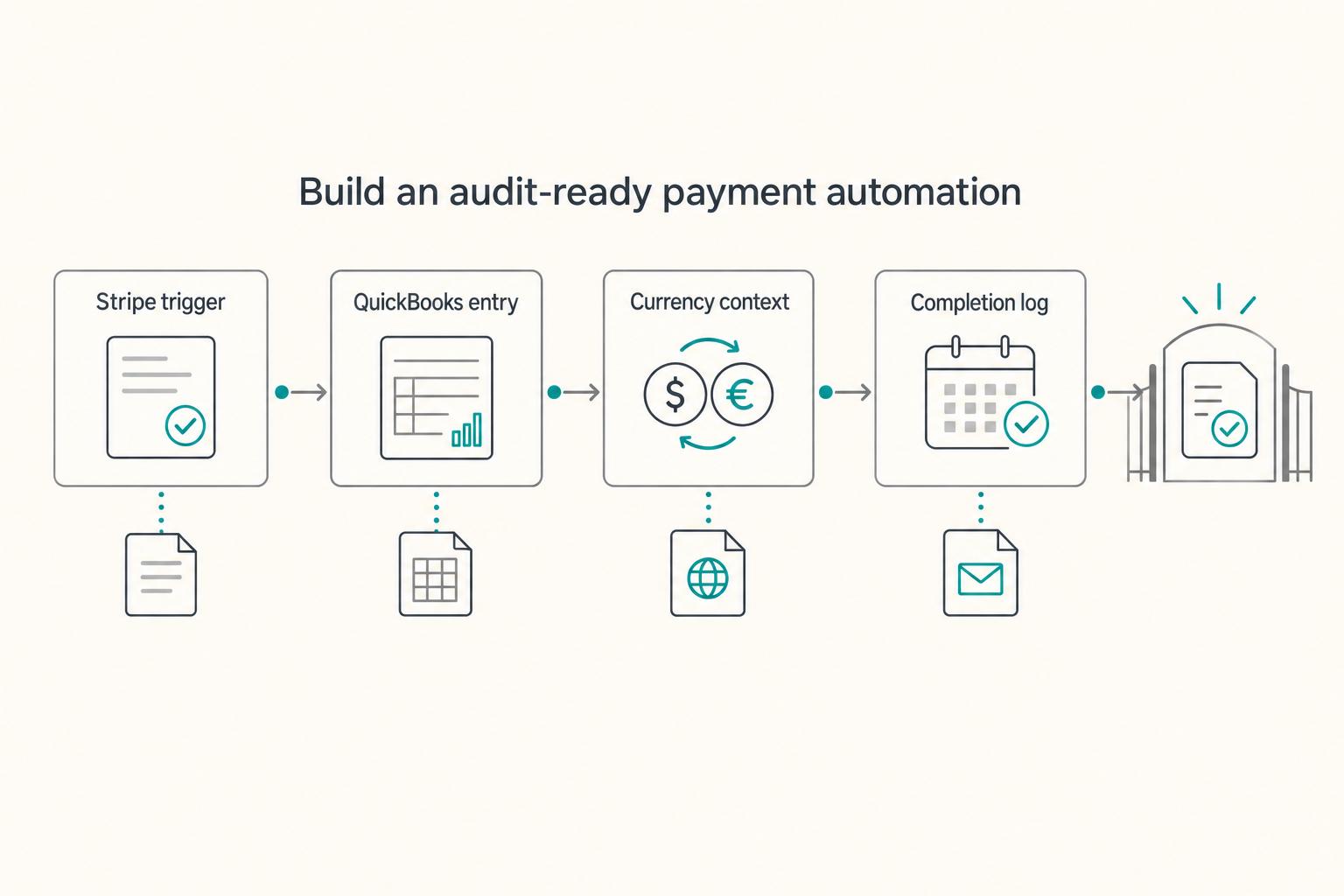
Automating Your Freelance Finances: A Zapier Workflow for Connecting Stripe, QuickBooks, and Wise
Start with one payment flow you understand, then automate its accounting record without losing the source reference. Stripe captures payments, QuickBooks holds the books, Zapier connects the selected steps, and Wise records any separate cross-border balance or conversion activity.

The Freelance Payment Penalty: A Modeled Audit of Platform Fees, FX Spreads, and Payout Delays
The money rarely disappears through a single, easy-to-spot fee. The real loss is stacked. A marketplace takes its commission, a processor adds a charge for international cards, a bank or payment company converts the currency at a spread, a platform holds the funds before release, and a wire sheds a little to intermediaries on the way in. Each layer looks defensible on its own, but the worker feels the combined result as a smaller deposit and a later payday.

How to Respond to a Subpoena for Business Records
Move fast, but do not produce records on instinct. If you need to **respond to a subpoena for business records**, your immediate job is to control deadlines, preserve records, and make any later production defensible.