
Quick Answer
Choose your broker model first, then confirm tradability before sending money. For a us citizen european brokerage account, the practical path is to verify your country eligibility, retail or professional status, and product access under PRIIPs/KID rules, then restrict holdings to structures you have classified for PFIC risk. After setup, treat FBAR and Form 8938 as separate annual checks with ongoing record capture so filing does not become a year-end scramble.
Confirm Access First, Then Investments, Then Reporting#
If you're setting up a workable brokerage account from Europe as a U.S. citizen, follow the order that reduces mistakes. Confirm access first, choose PFIC-aware investments second, and run annual reporting on schedule. This is an operating process, not a guessing game.
As a U.S. citizen abroad, you are still taxed on worldwide income, and foreign financial accounts can be reportable even when they produce no taxable income. That makes this both an investing decision and a compliance decision. From the start, your setup needs to fit three buckets: PFIC exposure, FBAR (FinCEN Form 114), and possible Form 8938 filing under FATCA.
Start with access, not products#
The first mistake is shopping for funds before you know what your account can actually trade. In Europe, retail access to some products is often tied to PRIIPs Key Information Documents (KIDs), and products without a required KID may be blocked. Interactive Brokers and Saxo both state that certain non-compliant products can be unavailable to retail clients in the EU/EEA/UK.
Use this checkpoint before you fund anything. Verify that the broker accepts U.S. citizens in your country, confirm your retail or professional classification, and validate that your intended instruments are tradable in that exact account setup.
Know the paperwork before you need it#
You can avoid much of the account-opening friction by preparing documents early: a valid passport or government ID, proof of residence, and your U.S. tax identifier details. One major international broker lists those items in its onboarding flow.
For ongoing compliance, keep two rules straight. FBAR applies if the aggregate value of your foreign financial accounts exceeds $10,000 at any time during the year. Form 8938 is separate and uses different thresholds based on filing status and residency. Filing one does not replace the other. If enforcement risk matters to your case, verify the current rules before relying on any summary.
What this guide helps you decide#
This guide walks through the decisions in the order that usually causes the fewest problems:
- your brokerage model options
- how to build a PFIC-safer portfolio
- how to run your annual reporting process without last-minute scrambling
Next comes the choice between the two brokerage paths, based on access, reporting load, and day-to-day tradability.
If you want a deeper dive, read Japan Digital Nomad Visa 2026: Six-Month Planning Runbook.
Your First Strategic Choice: US-Domiciled HQ vs. Global Forward Base#
Start by deciding where you want the complexity to live. A U.S.-domiciled model can reduce tax-reporting complexity and product-access surprises. A global or EU-entity model can improve multi-currency operations, but it requires stricter tradability checks before funding.
That is the core decision here: do you optimize first for U.S. workflow simplicity, or for cross-currency cashflow handling?
| Decision factor | US-domiciled account model | Global or EU-entity account model |
|---|---|---|
| Access to US-domiciled ETFs | Can be a cleaner path when your plan depends on U.S.-domiciled funds | Must be verified in your exact account setup; EEA/UK retail orders can be rejected when no KID is available |
| PRIIPs/KID friction | Often lower in practice for this use case | Higher for retail clients because a KID must be provided before the transaction is concluded |
| Tax-document workflow | Schwab describes U.S.-domiciled dollar accounts, online reporting, and a 1099 to support IRS filing | IBKR states U.S. persons receive consolidated Form 1099 reporting; multi-currency operations may still be more involved |
| Base-currency handling | Dollar-centered | More flexible; IBKR says you can fund in many currencies regardless of selected base currency |
| Transfer/funding friction | Can add conversion steps if income and spending are mostly in EUR | Often a better fit when you regularly receive and deploy multiple currencies |
| Best fit | You want simpler U.S.-centric administration | You want currency flexibility and will verify product access carefully |
Choose based on your operating reality#
If your priority is cleaner U.S. reporting and fewer access surprises, a U.S.-domiciled model can be the better first choice. Charles Schwab International is one example of this model type, not a universal recommendation.
If your day-to-day cashflow is genuinely multi-currency, a global model may be the better operational fit. Interactive Brokers is an example of that type. It supports funding in multiple currencies regardless of base currency and states that it reaches 170 markets, 40 countries, and 29 currencies.
Why PRIIPs can block your intended ETFs#
This is where many plans break. PRIIPs rules, in force since January 2018, require a KID for covered products sold to retail investors, and the KID must be provided before the transaction is completed. IBKR states EEA/UK retail orders can be rejected when the product manufacturer or issuer does not provide a KID.
| Instrument type | PRIIPs scope note |
|---|---|
| ETFs | Included in IBKR's PRIIPs scope |
| ETNs | Included in IBKR's PRIIPs scope |
| Funds | Included in IBKR's PRIIPs scope |
| Derivatives | Included in IBKR's PRIIPs scope |
| Stocks | Not in the scope described here |
| FX | Not in the scope described here |
| Standard bonds | Not in the scope described here |
For planning purposes, that matters because IBKR's PRIIPs scope includes ETFs, ETNs, funds, and derivatives. It does not apply to stocks, FX, and standard bonds. You can open an EU retail account expecting U.S. ETF access and still hit order rejections unless you confirm tradability in advance.
PFIC risk is the downstream consequence to manage#
Once access is clear, the next risk is what you actually hold. A foreign fund is not automatically a PFIC, and you should not assume every UCITS fund is one. But U.S. PFIC rules apply tests to foreign corporations, including the 75 percent passive income test and the 50 percent asset test. If a holding is a PFIC, Form 8621 filing may be required. IRS instructions also require a separate Form 8621 for each PFIC held directly or indirectly.
Broker due-diligence checklist before funding#
Before you move money, make the broker prove the setup works for your case:
- Confirm the broker accepts U.S. citizens resident in your specific country, not just "international clients"; Schwab onboarding is framed around living abroad in a qualifying country.
- Confirm whether your account will be retail or professional; reclassification may be possible, but it is not automatic.
- Test tradability for the exact instruments you plan to buy in that exact account setup.
- Save evidence: product-page screenshots, any KID-related rejection text, and support confirmations.
Once you choose the model and confirm tradability, the next job is building a portfolio that does not create avoidable PFIC problems.
For a step-by-step walkthrough, see A Canadian Freelancer's Guide to Setting Up a US Stripe Account.
Classify the Wrapper First, Then the Exposure#
Before every trade, classify the wrapper first and the exposure second. PFIC risk is tied to what the security legally is and where that entity is domiciled, not just to whether the underlying holdings are U.S., European, or global.
That is the key filter. A product can give you international exposure while still being U.S.-registered, so exposure and legal wrapper are separate decisions. Check them in that order.
Start with the safest core you can verify#
The safest core is the one you can classify quickly and document cleanly. In practice, that often means direct listed company shares and, where available, U.S.-domiciled pooled products that your broker permits for your residency and account type.
Do not rely on product branding. Confirm the instrument type and domicile in the product details, prospectus, factsheet, or issuer materials. Make sure you are actually buying common stock rather than an ETF, ETN, fund share class, or another packaged wrapper with a similar name.
Add diversification without changing wrapper risk#
Diversification only helps if the wrapper still works for your tax setup. A U.S.-domiciled ETF and a foreign-domiciled fund can track similar exposures but still produce different U.S. tax and reporting outcomes.
Then run a tradability check in your actual account. PRIIPs and KID requirements can block specific retail orders. Broker permissions can also block access by product, market, residency, or account classification.
| Generally usable for U.S. citizens abroad (after verification) | Items that may carry PFIC risk and need verification |
|---|---|
| Direct shares of listed operating companies, after confirming you are buying ordinary stock and not a packaged product | Foreign-domiciled pooled funds, including UCITS ETFs and mutual funds; confirm PFIC status at the instrument level before buying |
| U.S.-domiciled ETFs, if your broker and residency status allow the trade | Non-U.S.-domiciled ETFs tracking similar indexes or strategies; confirm PFIC status at the instrument level before buying |
| U.S.-registered mutual funds only where your broker still permits nonresident purchases | Local bank or platform pooled wrappers without verified U.S. tax treatment |
Broker policy is a separate gate from tax classification. One firm may restrict U.S. persons or nonresident account activity while another allows it, so treat broker rules as account-specific, not universal.
Use a pre-trade checklist every single time#
Use the same trade filter every time, especially when a product looks familiar but the wrapper may be different:
| Check | What to verify | Support to keep |
|---|---|---|
| Domicile | Where the issuing company or fund is legally organized | Product type and domicile screens |
| Product type | Whether it is common stock, ETF, mutual fund, ETN, derivative, or another packaged product | Instrument details |
| Tradability in your actual account | Trading permissions and the exact instrument in the account you will use | Any broker rejection or KID-related warning |
| Tax-form impact if uncertain | Whether Form 8621 filing could apply if PFIC status is possible | Notes on separate reporting by PFIC where required |
If any item is unclear, stop there. Save your evidence while you trade: instrument details, product-type and domicile screens, and any broker rejection or KID-related warning.
Keep your avoid list short and strict#
The practical rule is simple: treat UCITS funds, foreign-domiciled ETFs, foreign mutual funds, and other non-U.S. pooled wrappers as stop-sign items until you verify the structure and likely U.S. tax treatment.
Do not buy for exposure first and check wrapper risk later. Keep the sequence fixed: domicile, product type, tradability, then tax-form impact.
You might also find this useful: Opening a Bank Account in Europe as a Non-Resident.
Your Annual Compliance System: Turning Fear into a Checklist#
The easiest way to keep compliance under control is to treat it as a routine, not a once-a-year scramble. Capture monthly, review quarterly, and assemble at filing time. That structure can help keep FBAR and Form 8938 accurate without a last-minute rebuild.
FBAR (FinCEN Form 114) and FATCA Form 8938 can overlap, but they are separate filings, and one does not replace the other.
| Checkpoint | FBAR, FinCEN Form 114 | FATCA, Form 8938 |
|---|---|---|
| Trigger logic | Based on FBAR reporting rules for foreign financial accounts | Based on the applicable threshold for specified foreign financial assets |
| What to include | Foreign financial accounts in your full account inventory | Specified foreign financial assets, including financial accounts maintained by a foreign financial institution |
| Where it goes | Separate filing (FinCEN Form 114) | Attached to your annual U.S. income tax return and filed by that return's due date, including extensions |
| What to gather | Institution name, account number, ownership details, and account records | Tax return workpapers, year-end and maximum-value support, account records, tax forms, and notes on accounts closed during the year |
Your monthly and quarterly routine#
Your monthly job is simple: save records as they arrive so you are not rebuilding the year from memory. Download bank and brokerage statements, store tax forms, and keep notices tied to account openings, closures, transfers, or retitling.
| Cadence | Action | What to save or track |
|---|---|---|
| Monthly | Download bank and brokerage statements | Store tax forms and keep notices tied to account openings, closures, transfers, or retitling |
| Quarterly | Update one master account inventory | Track institution, country, account number, account type, ownership status, and highest value observed so far |
| In the same week changes happen | Record account changes | Keep closure records current because Form 8938 asks whether foreign deposit or custodial accounts were closed during the tax year |
Quarterly, update one master account inventory. Track institution, country, account number, account type, ownership status, and highest value observed so far. Keep that highest-value field current, because Form 8938 asks for maximum-value reporting and year-end snapshots alone may miss that.
Record account changes in the same week they happen. Because Form 8938 asks whether foreign deposit or custodial accounts were closed during the tax year, keep closure records current.
What you do at filing time#
At filing time, run two separate tests: FBAR applicability and Form 8938 applicability.
Run the FBAR test, then test Form 8938 using current IRS instructions. If you are not required to file an income tax return for the year, Form 8938 is not required. If you are filing, verify the current instructions each cycle because they are continuous-use and may change.
Use a tax-year folder your preparer can review quickly, with subfolders like:
01 Account Inventory02 Bank Statements03 Brokerage Statements04 Tax Forms05 Closures and Transfers06 Draft FBAR and Form 8938 Support
Common failure points (and how to prevent them)#
To reduce avoidable errors, focus on process discipline: keep one master inventory, run a quarterly reconciliation against each institution, and maintain a monthly document-capture habit.
If you work with a preparer, send the inventory first and statements second. That gives them a complete map of what exists, what changed, and what must be tested under both filings. Use the same checklist discipline for account disclosures by running a quick annual check in the FBAR Calculator.
Related: A Deep Dive into Form 5472 for Foreign-Owned US LLCs.
Two Jobs for Your Brokerage: Retirement Saving and a Long-Term Reserve#
Treat your brokerage setup as part of how you run your finances, not as a side account. In practice, it should do two separate jobs: retirement saving when you are eligible, and a long-term reserve that stays separate from day-to-day business cash.
Retirement contributions start with one tax question#
Start with tax treatment, not account selection. The first question is whether your filing approach leaves you with the taxable compensation or plan compensation needed for contributions.
The core fork is FEIE vs. FTC. FTC is claimed on Form 1116, and you cannot claim a foreign tax credit on income you excluded under FEIE. FEIE can reduce regular income tax, but it does not reduce self-employment tax. IRS Topic 451 requires taxable compensation for IRA contributions, and IRS international IRA guidance says excluded FEIE or foreign housing amounts are added back when determining IRA limits. So do not assume FEIE always blocks contributions or FTC always makes them better. Verify current contribution and eligibility rules for the specific account.
| Approach | Retirement contribution impact | Cash-flow and tax admin complexity | When it may be considered |
|---|---|---|---|
| FEIE-focused approach | Can complicate contribution eligibility and requires account-specific checks | May lower regular U.S. income tax, but self-employment tax still applies; also limits FTC use on excluded income | May be considered when the exclusion improves near-term U.S. income tax results |
| FTC-focused approach | May better preserve contribution planning flexibility, subject to plan rules | Requires Form 1116 and practical foreign-tax tracking | May be considered when you pay meaningful foreign tax and want to keep contribution options open |
Before you open or fund an IRA, SEP-IRA, or Solo 401(k), assemble a quick file. Include your prior-year return, self-employment records, foreign tax records, and your draft FEIE or FTC position. For self-employed plans, calculate plan compensation using the required adjustments to net self-employment earnings so you do not overcontribute. Verify current contribution and eligibility rules before funding.
Then run provider due diligence: account availability in your country, custody location, reporting documents, and cross-border servicing support after you are abroad. Confirm these details directly instead of assuming service terms will stay the same after an address change.
Your taxable brokerage as a long-term reserve#
Use your taxable brokerage for one job: a long-term reserve. Fund it on a repeatable cadence, for example a fixed monthly transfer after tax and operating allocations. Keep it fully separate from rent, payroll, VAT, and short-term tax cash.
Set a clear holdings policy: only assets you have already vetted for PFIC risk and classification, such as individual stocks and U.S.-domiciled holdings where available. Avoid convenience buys in foreign pooled funds without classification work, because PFIC treatment can trigger Form 8621 filing on a per-PFIC basis.
If the reserve is at a foreign broker, keep it in your foreign-account inventory. FBAR can apply if aggregate foreign account value exceeds $10,000 at any time during the year, and Form 8938 can also apply when thresholds are met. For FBAR, account location outside the U.S. is what matters, not whether the account produced taxable income.
How this improves business resilience#
This setup pays off because it simplifies both investing and reporting:
- It keeps long-term investing separate from short-term operating pressure.
- It lowers PFIC error risk by limiting what the reserve can hold.
- It makes FBAR and Form 8938 prep easier through one shared account inventory.
- It gives you a dedicated buffer for uneven client cash flow, planned time off, or business changes without forcing retirement-account decisions.
This pairs well with our guide on A Guide to the First Home Savings Account (FHSA) in Canada.
Make Three Core Decisions, Document Them, Repeat the Checks#
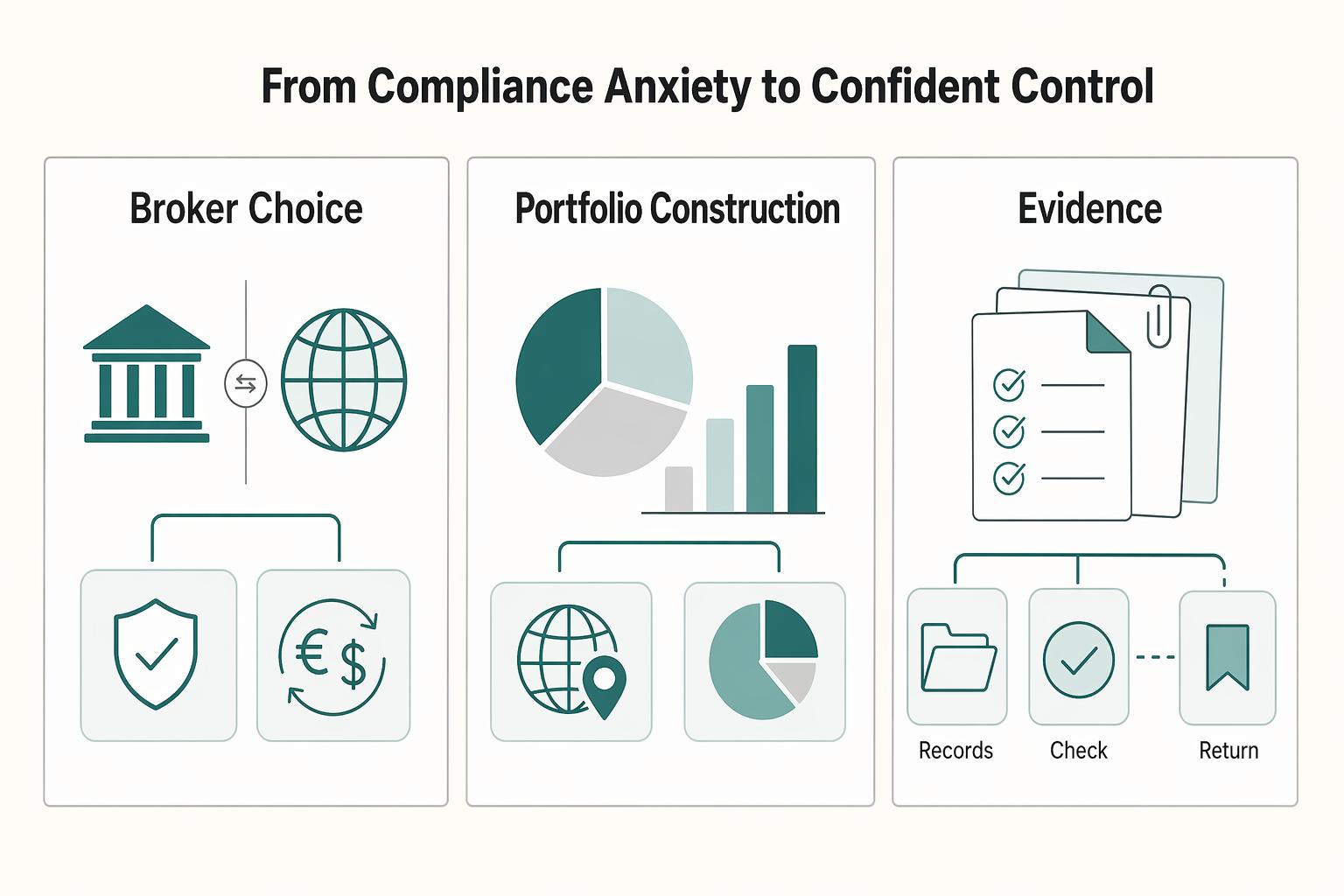
Control comes from running a stable process, not from re-deciding everything each time. You make three core decisions, document them, and repeat the same checks.
First, choose your broker model deliberately. Use a U.S.-domiciled platform if your priority is simplicity. Use a global broker model if you need more currency flexibility. Before you fund anything, confirm in writing that your country is eligible and that your target holdings are tradable after approval.
Second, enforce portfolio rules that are tighter than the broker's menu. Keep your default to PFIC-safe assets such as individual U.S. stocks and U.S.-domiciled ETFs where available. Treat European funds, including UCITS ETFs, as stop signs until tax treatment and exact product details are verified. Before placing any order, confirm domicile and identifier.
Third, run disclosure as an ongoing workflow. Store statements, trade confirmations, and balance records as you go, so reporting is not a year-end scramble. When checking rule updates or filing instructions, use web summaries only as a starting point. If a detail matters, verify it against an official edition or printed PDF before you act.
| Area | Before | After |
|---|---|---|
| Broker choice | Apply broadly and hope one works | Decide U.S.-domiciled vs. global model first, then confirm eligibility and tradable products |
| Portfolio construction | Buy what the local platform suggests | Restrict to PFIC-safe assets and pause any European fund purchase until verified |
| Compliance records | Search for documents at tax time | Save statements, confirmations, and balance records as they are created |
| Ongoing maintenance | React when deadlines or restrictions appear | Run a recurring review of broker access, holdings, and disclosure documents on a set schedule |
Next action: write down your broker model, your no-UCITS purchase rule, and your document checklist, then keep those three controls current as your account and country setup changes.
For a related multi-currency account setup walkthrough, see A Guide to Opening a Multi-Currency Bank Account with HSBC Expat.
Frequently Asked Questions
What kind of broker should you choose if you live in Europe?
Start with a verification-first approach: choose the broker that clearly supports your country of residence, account type, and U.S.-person status, and can provide the records you need for tax reporting. Before you open or fund the account, confirm in writing your country eligibility, the legal entity and custody location, what you can actually trade, and what statements you will get for year-end and maximum-value reporting. For a broader side-by-side review, see The Best Brokerage Accounts for US Expats.
How do you avoid PFIC problems in practice?
Use a simple pre-trade checklist: before buying any fund, confirm its U.S. tax treatment with reliable documentation and with your tax advisor if needed. Before buying, confirm the fund domicile and the exact security identifier (such as ISIN or CUSIP), and make sure the platform order ticket matches the instrument you intend to buy. If anything is unclear, pause the trade until you get a clear written answer from the broker.
Why can access to US ETFs be blocked when you live in Europe?
Access can depend on local regulations and each broker’s eligibility and product policies. Treatment can vary by country and platform, so confirm current eligibility criteria with the broker before assuming a U.S.-domiciled ETF will be available from your address.
Is Interactive Brokers a workable option for a US citizen in Europe?
Treat this as a verification question, not a brand shortcut. Confirm which legal entity will hold your account, whether that entity accepts U.S. citizens in your country, which tax and activity statements it provides, and whether your target holdings are tradable after approval. Do that before funding so you do not discover restrictions after money moves.
What does FATCA mean for account opening, and why do some firms turn away US citizens?
Under FATCA, certain U.S. taxpayers with foreign financial assets must report them to the IRS on Form 8938, and foreign financial institutions may ask about your citizenship during onboarding. Because onboarding requirements vary by institution, eligibility for U.S. persons can differ across firms. Ask about U.S.-person eligibility early, before moving cash or preparing transfer paperwork.
Do you have to report a European brokerage account to the IRS?
You may need to file Form 8938 if you are a specified individual or specified domestic entity with reportable specified foreign financial assets above the applicable threshold. If you are not required to file an income tax return for the year, Form 8938 is not required. If you are, attach it to your annual return and file by that return’s due date, including extensions. Form 8938 also does not replace FinCEN Form 114 (FBAR), so both reporting regimes can apply.
Try a related tool
Researched and edited by the Gruv editorial team. Gruv builds cross-border billing, payouts, and finance-operations software for global businesses.
Sources
Educational content only. Not legal, tax, or financial advice.
Related Posts

Japan Digital Nomad Visa 2026: Six-Month Planning Runbook
Treat this as your operating model: identify the right mission first, commit to one route, and keep dated records before you make irreversible plans. That is what keeps the rest of your timeline, paperwork, and decisions coherent.

The Best Brokerage Accounts for US Expats
**Choose your brokerage account as a U.S. expat by prioritizing account viability and day-to-day operability, not headline fees or fancy features.** If you live abroad and want a serious investing setup, the real constraint is simple: will a broker let you onboard cleanly, keep your account working as your address changes, and move money without operational freezes? As the CEO of a business-of-one, your job is to choose systems that keep running even when your location changes.

A Deep Dive into Form 5472 for Foreign-Owned US LLCs
**Treat Form 5472 as an IRS reporting workflow, not a tax guess, and you can cut avoidable penalty risk quickly.** If you run a globally mobile single-member LLC, most uncertainty comes from definitions, not effort. You can keep clean books and still miss a trigger because the IRS focuses on entity status, related parties, and reportable transactions.