
Quick Answer
No, Malta's old golden passport route is no longer available. The article explains that Malta moved from a fixed-payment model to merit-based naturalisation under S.L. 188.06, where applicants must prove exceptional service or contribution with independently verifiable evidence. Decisions are discretionary and case by case, so applicants should verify the live legal basis and current Community Malta Agency practice before filing.
The End of an Era: Why Malta's Golden Passport is Gone (And What Replaced It)#
If you are still planning around Malta citizenship by investment as a purchase route, stop and reset. That path is gone. Planning now has to shift toward merit-based eligibility, documented contribution, and evidence that your case deserves discretionary approval.
This is not a branding change. On 29 April 2025, in Case C-181/23, the Court of Justice of the European Union held Malta's investor citizenship scheme contrary to EU law. In plain English, the Court said Union citizenship cannot come from a commercial transaction.
The shift is from transaction to merit. After EU scrutiny, Malta moved away from a fixed-payment model. The current standard asks whether you can prove exceptional service or contribution, not just money.
Malta then amended its Citizenship Act on 24 July 2025 through Act No. XXI of 2025. Official notices also state that the definition of the individual investor programme was deleted and that programme terminated. What replaced it sits under the merit route, regulated through S.L. 188.06 for naturalisation on the basis of merit under Article 10(9), where decisions are discretionary and assessed case by case.
| Point of comparison | Old model | Current model |
|---|---|---|
| Proof type | Financial compliance and payment evidence | Evidence of exceptional service or contribution, backed by verifiable records |
| Decision basis | Predetermined conditions, mainly financial in nature | Discretionary review on the merits of the individual case |
| Applicant workload | Checklist-driven, document collection around funds and formal requirements | Narrative-heavy, evidence-heavy, and more dependent on how well your contribution is proven |
| Planning posture | Transaction first | Eligibility first, then evidence strategy |
One operational constant remains the Community Malta Agency. It remains the government body handling Maltese citizenship matters and says it runs due diligence on every application. That continuity matters because there is still an established intake and review authority.
The uncertainty is elsewhere. Merit review is discretionary, and agency messaging is not yet fully harmonized. Some pages still carry legacy wording linked to direct investment, while newer notices make clear that the old framework was repealed. Your checkpoint is simple: verify every rule, form, and guidance note against the latest legal text and current agency practice before you draft anything.
Before you build a full file, do three things. First, run a profile-fit check: can your background credibly support an exceptional service or contribution argument? Second, build an evidence inventory from verifiable records, not self-description. Third, make sure your advisor is working from the live rules, including S.L. 188.06 and current Agency intake practice. If your case depends more on assets than on documented impact, treat that as the first red flag. For a broader decision frame, see The Pros and Cons of Second Citizenship for US Nationals.
From Transaction to Value: Why the New Merit System is a Superior Fit#
This is a better fit only if you can prove real impact with evidence, not just show financial capacity. In practice, you are building a defensible case file, not working through a payment checklist.
For you, the change is mostly operational: a higher evidence burden, more subjective review, more prep time for verification, and tighter advisor coordination to keep dates, roles, and claims consistent.
| Applicant experience | Old transaction model | Current merit model |
|---|---|---|
| Eligibility signal | Transaction readiness | Contribution and impact readiness |
| Proof package | Financial and compliance documents | Narrative supported by independent records |
| Decision risk | More checklist-led | More case-by-case judgment |
| Operational workload | Collection of financial/formal documents | Cross-checking achievements, chronology, references, and proof quality |
Treat your career as the asset only if you can document it cleanly. Build your evidence by category: leadership outcomes (revenue growth records, headcount expansion, market entry results), recognized work (awards, peer reviewed publications, conference invitations, independent press coverage), and innovation record (patents, licensed IP, product adoption data, research implementation letters). A practical standard is that each major claim should map to an independent document and a clear third-party verifier.
The tradeoff is predictability: this path can be stronger on substance, but weaker on upfront certainty if your proof is thin or inconsistent. Coordination steps in government processes can also introduce delay risk, so treat document consistency as risk control, not admin cleanup.
If this profile fits, do this next before full merit-case construction:
- Pick your 3 to 5 strongest achievements with independent proof.
- Remove any claim you cannot verify cleanly.
- Assign one lead advisor to unify chronology, titles, and evidence before drafting.
If you are comparing Malta pathways more broadly, see A Guide to Malta's Nomad Residence Permit.
Deconstructing 'Exceptional Merit': Test Your Proof Before You Apply#
Use your top 3 to 5 achievements as a hard screen: if you cannot verify them with independent records and tie them to a clear Malta-facing contribution case, a full application is likely premature.
A working definition#
| Diagnostic | What to look for |
|---|---|
| Verified impact | Outcomes you can measure and attribute to your role |
| Independent recognition | Validation from credible third parties outside your own company or personal brand |
| Credible Malta link | A specific, evidence-backed explanation of how your expertise translates into value in Malta |
No exact legal definition of "exceptional merit" is established here, so verify the current official wording before you file.
In practice, treat exceptional merit as documented professional achievement that can be framed as a direct contribution to Malta, not just seniority, income, or a strong CV.
Since the payment-checklist route ended after the 29 April 2025 ECJ ruling, the core test is no longer whether you can meet preset financial conditions. It is whether your life's work is substantial, provable, and relevant enough for discretionary review.
Use the three-part diagnostic in the table above. The Community Malta Agency continues to process applications, and reviewers can only assess what is clear, checkable, and consistent.
Self-audit your proof#
Before you draft the narrative, check the proof itself.
| Claim type | Acceptable proof | Strength signal | Common weak proof |
|---|---|---|---|
| Leadership outcome | audited revenue records, board papers, signed employer letters, market-entry records | dated outcomes tied to your named role | CV bullets, unsigned decks, vague letters |
| Innovation or technical contribution | patent records, product adoption data, implementation letters, identity-linked repository history | third-party uptake in market or research settings | unsupported "built/invented X" claims, screenshots, private assertions only |
| Independent recognition | award letters, peer-reviewed publications, conference agendas, credible press coverage | known issuer and specific attribution to your work | paid placements, personal blog mentions, attendance-only events |
| Business-building or advisory impact | incorporation records, fundraising documents, job-growth records, client confirmations on letterhead | measurable outcomes personally attributable to you | generic testimonials, unverifiable valuation claims |
| Cultural or public-interest contribution | program/exhibition records, institutional partnership letters, documented reach or uptake | written confirmation of significance from the institution | portfolio samples without external validation |
Apply one strict checkpoint: each headline claim should have one primary document, one identifiable third-party verifier, and one clean date range.
Outcome checks by profile#
| Profile | Stronger when | Weaker when |
|---|---|---|
| Tech founder/product leader/researcher | Shipped work, adoption, patents or publications, and outside recognition naming your role | The case depends on stealth or NDA-heavy work with little external verification |
| Consultant/operator/entrepreneur | Business outcomes are measurable and your role is anchored in documents | Company success is clear but personal attribution is thin |
| Creative leader/public figure | Recognized work plus documented reach or value | Portfolio quality is high but external validation is limited |
| Philanthropic or mission-led leader | Leadership and durable outcomes are provable | The file relies mainly on donations rather than documented impact |
Red flags: unsupported superlatives, generic senior-level claims, self-published evidence only, close-associate references without independent standing, self-placed press, and records that are hard to authenticate. If your case depends more on explanation than verification, pause and strengthen evidence first.
The former MEIN checklist amounts (€600,000 or €750,000 contributions, property requirements, and a €10,000 donation) are historical context, not a current checklist.
If your evidence passes this merit screen, move to the next step: sequence the evidence, assemble the narrative, and package documents so claims and proof align exactly. For broader relocation comparisons, see the 2026 Global Digital Nomad Visa Index.
A 3-Step Framework for Building Your Merit Case#
Treat this as a verification exercise, not a storytelling exercise. Decisions are described as discretionary, case by case, and not guaranteed, so your file has to be easy to check and internally consistent.
| Step | What you produce | Verification focus |
|---|---|---|
| Step 1 Build a merit evidence inventory | One worksheet that lists each proposed claim, its best document, and a verification tag | Each headline claim should have one primary document, one identifiable third party, and one clear date range |
| Step 2 Map each credential to a Malta-relevant contribution | A contribution map using credential -> Malta link -> public-interest outcome -> proof -> open question | Mark unconfirmed priorities or criteria as pending official verification |
| Step 3 Assemble the dossier and run pre-submission QA | A dossier index, a claim-to-evidence matrix, and a final consistency log | Cross-check CV, letters, records, and supporting documents for names, dates, roles, and outcomes |
Step 1 Build a merit evidence inventory#
What you produce: one worksheet that lists each proposed claim, its best document, and a verification tag.
Use two tags for each claim:
- Evidence strength: Strong, Usable, Weak, Do not use yet
- Verification status: Verified, Partially verified, Needs independent corroboration, Inconsistent
| Claim | Primary proof | Evidence strength | Verification status | Next action |
|---|---|---|---|---|
| Patent or registered IP | Official registry record | Strong/Usable | Verified or pending | Confirm name, date, and record match |
| Publication or research output | Journal record or DOI page | Strong/Usable | Verified or partial | Add proof of your exact role |
| Partnership with a Maltese university | Signed partnership record | Strong if formal | Verified or pending | Confirm counterparty details and dates |
| Other measurable contribution | Independent third-party record | Usable/Weak | Partial or needs corroboration | Replace self-claims with external proof |
Why it matters: the core test is exceptional contribution supported by evidence, not a polished CV.
How to verify: each headline claim should have one primary document, one identifiable third party, and one clear date range. If you use EU legal materials, validate the source on europa.eu and check Official Journal authenticity where relevant.
Step 2 Map each credential to a Malta-relevant contribution#
What you produce: a contribution map for each strong credential using this line format: credential -> Malta link -> public-interest outcome -> proof -> open question.
Keep the outcome specific and realistic. For example, map patents, publications, or a Maltese university partnership to a concrete Malta-facing contribution you can document.
Why it matters: discretionary review focuses on measurable benefit and genuine connection, not broad ambition.
How to verify: mark any priority or criterion that is not confirmed yet as pending official verification, for example:
- Current sector priority pending official verification
- Current public-interest requirement pending official verification
Also check risk handling, not only upside. If you claim innovation benefit, show the governance, compliance, or safety controls behind it.
Step 3 Assemble the dossier and run pre-submission QA#
What you produce: a dossier index, a claim-to-evidence matrix, and a final consistency log.
Organize your files so integrity checks and merit checks are both easy to run, including records that support criminal-record, sanctions, and source-of-wealth review.
Why it matters: strong claims can still fail if the file is inconsistent or hard to audit.
How to verify: run a final cross-check across CV, letters, records, and supporting documents for names, dates, roles, and outcomes. Mark procedural details that still require official confirmation as pending official verification, for example:
- Current document requirement pending official verification
Readiness gate: proceed only when the evidence is complete, third-party verifiable, Malta-linked, and consistent. Otherwise, pause and fix the specific gaps before filing.
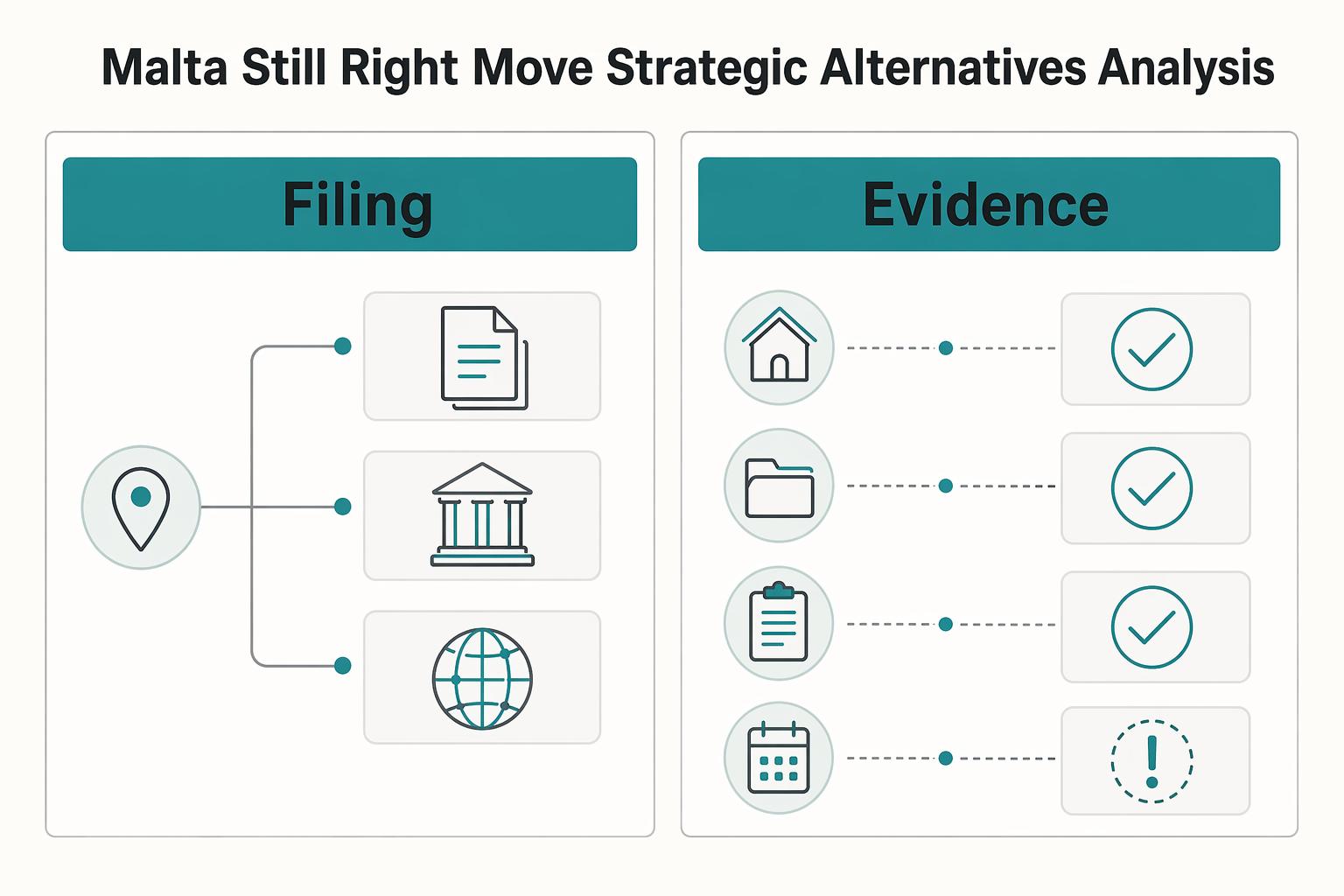
Is Malta Still the Right Move? A Strategic Alternatives Analysis#
Choose based on your real objective first: citizenship outcome, residency pathway, or tax-and-lifestyle base. These routes solve different problems, so you will get better results if you pick one route and build one route-specific checklist.
After the CJEU ruling on 29 April 2025 and Malta's 2025 legal amendment, Malta is no longer a transactional capital-for-passport option. It is framed as merit-based naturalisation under ministerial discretion, which is fundamentally different from Portugal's ARI residence route and the UAE Golden Visa residence route.
| Route | Best used for | Eligibility style | Documentation burden | Pathway certainty | Long-term mobility outcome |
|---|---|---|---|---|---|
| Malta merit naturalisation | Citizenship-first objective for a narrow, high-merit profile | Discretionary, case by case | High: independently verifiable merit and integrity file | Lowest predictability of the three; operational intake basis should be verified with the competent Malta authority before filing | If citizenship is granted, EU free movement follows from Member State nationality |
| Portugal ARI | Structured EU residency route, with possible later nationality | Rules-based residence by investment | Medium to high: investment, residence, and compliance records | More structured than Malta for residency; confirm the current residency-to-nationality timeline from the official source for nationality planning | Residence first, then potential EU citizenship outcome if nationality rules are met |
| UAE Golden Visa | Long-term residency base and tax-planning base | Category-based long-term residence | Medium: category-fit and supporting records | Clear residency framework if you match a listed category; no citizenship pathway in this route | Strong residence base; no EU citizenship outcome |
Quick fit check for remote professionals#
Malta fits best if your achievements are unusually strong, independently provable, and defensible as a real Malta contribution. You are likely to struggle if you need checklist predictability or a guaranteed outcome.
Portugal fits best if you want a rules-based residency structure and can treat nationality as a later-stage possibility. You are likely to struggle if your decision depends on one unverified nationality timeline.
The UAE fits best if your priority is a stable non-EU residence base with no individual income tax. You are likely to struggle if your actual goal is EU citizenship or EU free-movement rights.
Before spending on documents, verify the exact legal product currently in operation for your chosen route and avoid mixing assumptions across programs. For a step-by-step walkthrough, see The Best Citizenship by Investment Programs in the Caribbean.
The New Key to Malta: Your Merit is Your Investment#
If you are still thinking in terms of Malta citizenship by investment, reset. This is a merit case, not a fixed-spend transaction. Your core question is whether you can prove exceptional value to Malta in a file that can stand up to discretionary, case-by-case review.
Under the Granting of Citizenship by Naturalisation on the Basis of Merit Regulations (S.L. 188.06), the process starts with a detailed proposal letter to the Community Malta Agency. In plain terms, your file needs to do three things: explain your background and achievements, present a forward-looking contribution plan, and support both with evidence that is independently checkable.
| Point of comparison | Old transaction-led logic | Current merit-led logic |
|---|---|---|
| Evaluation basis | CJEU described the invalidated route as citizenship granted in direct exchange for predetermined investments or payments | Merit-based naturalisation under S.L. 188.06 |
| Evidence burden | Transaction structure was central | Proposal letter plus evidence of achievements and a credible contribution plan |
| Applicant role | Participant in a defined transaction | Author of a merit case for exceptional service or contribution |
| Risk and uncertainty | More structured as a named route | Discretionary and assessed strictly case by case |
Before you spend heavily, verify the current intake basis directly with the Community Malta Agency. Official statements say the Exceptional Services programme was discontinued and related programme, transaction, and agent references were removed, while some agency-facing wording remains mixed.
Before you proceed, check your readiness:
- Can you document your achievements with independent, verifiable evidence?
- Can you explain a specific, forward-looking contribution to Malta?
- Do your proposal letter and supporting documents tell one consistent story?
- Are you comfortable with a discretionary process and no guaranteed outcome?
If you want a rules-based comparator, see Turkey Citizenship by Investment Without the Guesswork. If you want to validate operational fit for your situation, talk to Gruv.
Frequently Asked Questions
Is Malta citizenship by investment still available?
No. The article says the old investor citizenship route ended after the CJEU ruled Malta's scheme contrary to EU law. Malta later discontinued the Exceptional Services programme and removed related programme, transaction, and agent references, so the current legal basis should be rechecked before filing.
What replaced the old route?
The article says the current official framing is citizenship by merit, not a continuation of the old investment framework. Community Malta Agency says it is neither a programme nor a scheme, and decisions are discretionary and strictly case by case. The focus is on proving exceptional value to Malta rather than meeting a published spend.
How is the old route different from the current one?
The old route was tied to a defined, transaction-linked framework. The current route is framed around exceptional service or contribution to Malta and requires a case built on added value and due diligence. That means a higher evidence burden and less predictability because decisions are discretionary and case by case.
How do you judge whether your profile is even plausible?
Start with three checks: an independently verifiable record of achievement, a concrete contribution to Malta, and documents that can survive due diligence. Wealth alone is not enough, and vague claims without public or institutional support are a red flag. If the case relies mostly on self-description, private metrics, or future promises, the article suggests strengthening the evidence first.
What should you verify first before spending real money?
Verify the live legal position and the live operating position together. The article says official legal materials reference Article 10(9) of Cap. 188, Act XXI of 2025, and that official pages have not been fully aligned in wording. Before spending money, confirm that the current authority, intake basis, and filing path are clear.
Try a related tool
Researched and edited by the Gruv editorial team. Gruv builds cross-border billing, payouts, and finance-operations software for global businesses.
Sources
- curia.europa.eu/juris/document/document.jsftrusted
- curia.europa.eu/jcms/upload/docs/application/pdf/2025-04/cp2...trusted
- eur-lex.europa.eu/legal-content/EN/TXT/HTMLtrusted
- eur-lex.europa.eu/eli/treaty/tfeu_2016/art_20/oj/engtrusted
- europarl.europa.eu/cmsdata/155728/EPRS_STUD_627128_Citizenship%...trusted
- finance.gov.mt/wp-content/uploads/2023/04/Table-3-2018.pdftrusted
- komunita.gov.mt/2026/02/05/malta-citizenship-by-merittrusted
- komunita.gov.mttrusted
Educational content only. Not legal, tax, or financial advice.
Related Posts

The 2026 Global Digital Nomad Visa Index for 50+ Countries
Start with legal fit, not lifestyle filters. The practical order is simple: choose a route you can actually document, then decide where you want to live. That single change cuts a lot of wasted comparison work and stops you from falling in love with places that were never a real filing option.
Second Citizenship for U.S. Citizens: Routes, Tradeoffs, and Ongoing Compliance
Pick one primary objective before you compare countries. For most people considering a second citizenship as a U.S. citizen, the first decision is not where to apply, but what that citizenship needs to do for you.

The Freelance Payment Penalty: A Modeled Audit of Platform Fees, FX Spreads, and Payout Delays
The money rarely disappears through a single, easy-to-spot fee. The real loss is stacked. A marketplace takes its commission, a processor adds a charge for international cards, a bank or payment company converts the currency at a spread, a platform holds the funds before release, and a wire sheds a little to intermediaries on the way in. Each layer looks defensible on its own, but the worker feels the combined result as a smaller deposit and a later payday.