
Quick Answer
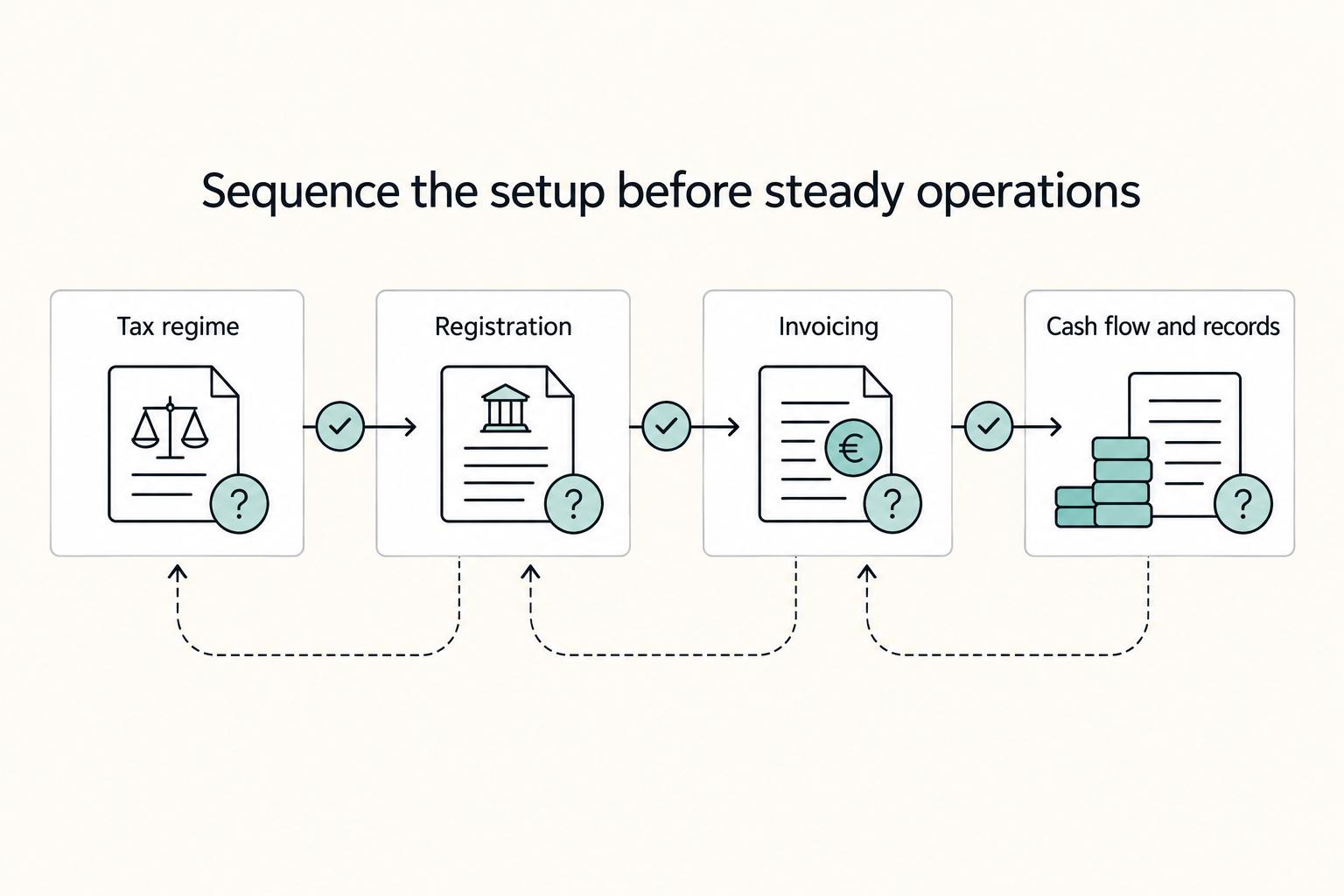
Start by deciding your tax path before relocation: italy digital nomad visa tax planning works best when you compare forfetario, impatriati, and ordinary rules against your real income and work pattern. Then execute arrivals in order, beginning with permesso di soggiorno timing, followed by Codice Fiscale and business setup steps. Once operating, classify invoices before issue, store compliance evidence in a digital file system, and transfer tax reserves immediately from incoming payments.
Before You Pack: Choosing Your Italian Tax Regime as a Solo Professional#
Choose your likely tax regime before you move, then have an advisor pressure-test it. For solo professionals, the main routes to evaluate are forfetario, impatriati, ordinary rules, and, in narrower cases, the neo-resident option under Art. 24-bis TUIR.
Timing matters more than most people expect. Make this decision before the move, not after. Once you meet Italian tax residence conditions for most of the year, including the 183-day test framework, a bad setup can be expensive to unwind. Keep visa approval and tax eligibility separate. A digital nomad visa does not automatically qualify you for impatriati.
A quick self-sort before advisor review#
Use this as a pre-move filter, not a final filing position. It helps you narrow the field before advisor review.
- Income band (year 1 and year 2): Are you safely below €85,000, close to it, or likely to exceed €100,000?
- Client and work geography: Where are clients based, and where is the work physically performed?
- Relocation horizon: Can you realistically commit to Italian tax residence for at least 4 years?
- Family setup: Do family facts change your residence profile, and are you considering neo-resident family extension?
- Cross-border tax exposure: Do you have ongoing tax ties elsewhere that require treaty coordination?
The four routes in one view#
| Regime | Best fit | Key eligibility checks | Tax treatment logic | INPS contribution base | Common disqualifiers or traps |
|---|---|---|---|---|---|
| Regime forfetario | Lower to mid-range solo income with straightforward operations | Prior-year revenue or compensation not above €85,000, plus concurrent conditions, including labor-cost conditions | Taxable income is calculated by applying the activity profitability coefficient to collected revenue or compensation, then a 15% substitute tax applies | For artigiani or commercianti, INPS provides an optional forfetario-related method based on forfetario income without the standard minimum taxable base, but confirm current tables before relying on it | Ignoring exit risk: above €100,000, the regime can cease in the same year, with VAT effects from the overflow transaction onward |
| Regime impatriati | Higher-earning worker or self-employed professional who can meet the post-2024 requirements | Prior non-residence, transfer of tax residence to Italy, commitment to remain tax resident for at least 4 years, mostly-in-Italy work performance, high qualification or specialization | Eligible employment and self-employment income is included only at 50%, up to €600,000 annually | Do not assume INPS follows the same reduction automatically; verify by INPS management and current circulars | Treating visa approval as tax-regime approval, or overlooking weak fit where work is not mostly performed in Italy or the relocation is short |
| Ordinary rules | Default route when special-regime conditions are not met or are lost | Applies when special-regime conditions are not met, or are lost | Standard personal income tax framework applies | Depends on activity and INPS management. Minimum bases can apply in some categories | Landing here unintentionally after poor planning or a forfetario breach |
| Neo-resident option (Art. 24-bis TUIR) | Niche path for people relocating with foreign-source income | Transfer of tax residence to Italy plus specific elective analysis | Optional substitute tax on foreign-source income. The Agenzia page shows both €300,000 (2026 notice) and legacy €200,000 text, so confirm by transfer date | Specialist-only modeling | Using it as a default freelancer route without source-of-income analysis |
Where INPS changes the math#
This is where quick comparisons often go wrong. Your income-tax regime and your social-contribution base may line up, but they are not interchangeable.
| Route | Income-tax note | INPS note |
|---|---|---|
| Forfetario | Taxable income is a deemed-profit amount based on the profitability coefficient | For artigiani and commercianti, INPS indicates an optional method tied to forfetario income without the standard minimum taxable base |
| Ordinary treatment | Standard treatment applies to declared business income | INPS links contributions to declared business income; for artisans, the law sets a minimum income base due in any case |
| Impatriati | Eligible employment and self-employment income is included only at 50%, up to €600,000 annually | Treat INPS as a separate checkpoint; identical treatment is not proven across INPS managements, so check the current circular for your category |
Under forfetario, taxable income is a deemed-profit amount based on the profitability coefficient. For artigiani and commercianti, INPS indicates an optional method tied to forfetario income without the standard minimum taxable base. Under ordinary treatment, INPS links contributions to declared business income, and for artisans the law sets a minimum income base due in any case.
For impatriati, treat INPS as a separate checkpoint. The tax rule, 50% inclusion up to €600,000, does not by itself prove identical treatment across INPS managements. Check the current circular for your category before you price the move. For 2026, one key checkpoint is INPS Circular n. 8, published 3 February 2026, for Gestione Separata parameters.
Before you leave, keep a compact evidence file: prior-year revenue summary, client contract list, travel calendar, and proof of pre-move tax residence. That gives your advisor what they need to test forfetario access, impatriati eligibility, and treaty positioning before your first invoice in Italy.
The First 90 Days: Your Compliance Sprint#
Treat your first 90 days as a dependency checklist. Start with residency evidence, then move through the admin steps that depend on it. The goal is to get from short-stay uncertainty to stable day-to-day operations.
Work in dependency order#
Use this as a planning sequence, not a legal filing order. Confirm current Italian windows, office practice, and required documents before you book appointments.
| Step | What it can unlock next | Working document pack to prepare before arrival | Timing note |
|---|---|---|---|
| Residency documentation (for example, permesso di soggiorno) | Residency proof can make later setup steps, including leasing and banking, more workable once accepted | Treat this as a placeholder checklist and verify the exact document list with the relevant office before you file | Verify the current filing deadline before you act |
| Codice Fiscale | A tax/identity number may be requested across later admin tasks | Verify the exact requirements with the issuing office and keep backup copies of key documents ready | Verify the current filing window with the issuing office or adviser before you act |
| Bank setup | Local banking access once identity and residency evidence are accepted | Confirm bank-specific requirements in advance; requirements vary by bank and case | Start when your identity and residency evidence are accepted |
| Partita IVA | Business and tax steps that follow in your case | Use this row as a planning placeholder and confirm the exact checklist with your advisor before filing | File after your tax setup is confirmed |
| INPS enrollment | Social-security steps that may apply in your case | Confirm category and required documents with your advisor before submission | Verify category and filing path before closing this step |
Build your digital shoebox on day one#
Do this on day one, not after the first missing document. Use one naming rule: YYYY-MM-DD_document_agency_reference. Keep six folders: 01 Immigration, 02 Tax, 03 Banking, 04 Contracts, 05 Receipts, 06 Travel. Store every appointment confirmation, submission receipt, protocol or tracking reference, payment confirmation, and stamped copy, both as a PDF and as a screenshot.
This file is your fallback when an office asks what you filed, when you filed it, or what was missing.
Risk control for this phase#
A common failure pattern in short-stay setups is operational instability: repeated entry pressure, changing timelines at the border, and admin steps that stall without accepted residency documentation. If your filing order, tax setup, or social-security category is unclear, escalate early to a commercialista before you submit anything.
Keep proof of timely action as you go. Save appointment emails, online or postal receipts, protocol numbers, and notes on any rejection. Note who rejected it, when, and what was missing. That lets you fix the issue once instead of starting over each time.
Before you submit paperwork, run through a practical step order with the Visa Cheatsheet for Digital Nomads.
Ongoing Operations: Keeping Invoicing, VAT, and Cash Reserves in Sync#
Once setup is over, the main risk is drift. The fix is not more complexity. It is a fixed weekly and monthly rhythm that keeps invoicing, VAT, cash reserves, and treaty records in sync.
Run your week and month on a fixed cadence#
Pick one repeatable cycle and stick to it.
| Cadence | Action | Key detail |
|---|---|---|
| When a payment arrives | Match it to the invoice, client country, and service type the same day | Save the invoice, contract or SOW, and payment proof together; move the estimated tax reserve out of the operating account immediately |
| End of each week | Reconcile invoices issued, money received, and bank movements | Catch errors early, like payment received before the invoice is finalized or incorrect VAT classification |
| Every month | Confirm whether you are on monthly VAT liquidation or, where your category allows, quarterly | Monthly deadline: day 16 of each month; for the first three quarters under quarterly timing: day 16 of the second month after the quarter |
| Each filing cycle | Have your commercialista confirm whether LIPE is due | VAT taxable persons are required to file it; keep every filing receipt and payment confirmation |
Italian VAT holders liquidate and pay VAT periodically on a monthly basis or, in some cases, quarterly.
If you are in Regime forfetario, do not assume this VAT cycle applies in the same way as it does for a standard VAT-taxable position. The regime is simplified, but invoicing discipline and clean records still matter.
Classify invoices before you send them#
The safest habit is to decide VAT treatment before you issue the invoice. In practice, that usually comes down to two checks: who the client is and where the client belongs for VAT purposes.
| Client scenario | Default invoicing direction | Required wording or ops note | Verify before issue |
|---|---|---|---|
| Client resident or established in Italy | Apply Italian domestic VAT treatment if the supply is taxable in Italy | Use the mandatory invoice data set. For Italian counterparties, VAT-registered persons resident or established in Italy are generally required to issue electronic invoices. Verify the current domestic VAT treatment with official or adviser records before you issue. | Confirm whether the service follows ordinary domestic treatment or a special rule |
| Business client in another EU Member State | For B2B services, place of supply generally follows the customer's Member State. VAT liability can shift to the customer under Article 196 if you are not established there | Include "Reverse charge" where the customer is liable for VAT | Confirm the customer is a taxable person and that you are not established in that EU country |
| Client outside the EU | Treatment depends on service type and customer status. There is no one default rule | For foreign invoices, e-invoicing can be optional. If you do not issue an e-invoice for those operations, invoice data must be sent via esterometro. Verify the current place-of-supply note from official or adviser records before you issue. | Confirm B2B versus B2C and the service-specific rule before assuming no Italian VAT |
Practical rule: if classification is unclear, pause and verify before you send the invoice. Fixing a bad invoice later is slower and riskier than checking it upfront.
Use the same four-step cash routine for every payment#
A simple cash routine beats a heroic clean-up at quarter-end. Use the same four-step flow for every payment: intake, reserve, allocate, reconcile.
Intake means matching the payment to the invoice and storing the support files. Reserve means transferring estimated income tax, social security, and any VAT collected into a separate account. Allocate means paying operating costs from what remains. Reconcile means checking that bank activity, invoices, and your filing calendar still match.
Use a treaty check, not a nationality shortcut#
If you may still have filing obligations elsewhere, run the treaty analysis early. Start with domestic residence tests. In Italy, the general individual test includes 183 days in the year, or 184 in a leap year.
If both countries can treat you as resident, apply tie-breakers in sequence, typically: permanent home, center of vital interests, habitual abode, nationality, then competent-authority negotiation. Then confirm the treaty relief method, credit or exemption, and the filing sequence in both countries, because treaty relief does not automatically remove domestic filing duties. Verify the current treaty-specific rule from official or adviser records before you rely on it.
For treaty benefits, request an Attestato di residenza fiscale. For refund or reduced-rate claims tied to foreign withholding, keep the residence certificate and proof of actual foreign tax withheld.
What to hand your commercialista each cycle#
Your advisor can only work as fast as your file allows. Give them the same package each cycle:
| Item | What to include | Note |
|---|---|---|
| Sales invoices | Invoices grouped as Italy, intra-EU B2B, and non-EU | Include VAT classification notes |
| Purchase records | Purchase invoices and receipts | Include payment proofs |
| Bank records | Bank statements or exports | Provide both operating and tax-reserve accounts |
| VAT filing records | Filing receipts and VAT payment confirmations | Include any LIPE acknowledgement or rejection messages |
| Foreign tax records | Foreign withholding statements and tax certificates | Include your residence certificate where treaty relief or credits apply |
Calendar this annual checkpoint now: the IVA/2026 annual VAT return filing window is 1 February to 30 April 2026.
From Newcomer to Steady Operator: Getting the Sequence Right#
The shift from anxious newcomer to steady operator is mostly about sequence. Pick the tax path early, hit the registration deadlines, invoice by client rules, and move tax cash out of your spending account as soon as you get paid.
| Area | Reactive | Early |
|---|---|---|
| Tax regime | You wait until year-end and accept whatever result appears. | You model both paths before you start: regime forfetario if your revenues/compensation stay within €85,000, and impatriati only if you can meet its conditions, including the 4-year tax-residence commitment and the current 50% taxable-base rule up to €600,000. |
| Registration | You learn deadlines after arrival and rush paperwork. | You set non-negotiable calendar reminders on day one: permesso di soggiorno within 8 working days of entry, and AA9/12 within 30 days of activity start if you need a Partita IVA. |
| Invoicing | You issue foreign invoices with one default template. | You check client type and location before each invoice: Italian clients may require ordinary 22% VAT; EU B2B services often use reverse charge; non-EU work is handled case by case. |
| Cash flow and records | You mix business and tax cash, then chase documents later. | You transfer a pre-set tax reserve from each payment into a separate account and file the invoice, payment proof, contract, and registration receipts the same day. |
Your system#
Keep this cycle simple and repeatable:
- Plan: choose your regime, map your deadlines, and keep a dated copy of the authority page you relied on.
- Execute: apply invoice rules by client location, file registrations on time, and save receipts immediately.
- Review: reconcile monthly, check whether you are approaching the €85,000 threshold or have gone over €100,000 for forfetario, and adjust your tax reserve to match real income.
If you want fewer surprises, run this every month and treat each checklist item as an operating control. When things start to drift, go back to the regime-choice, first-90-days, and ongoing-operations sections and use them as your working checklist.
As you settle in, keep your travel days and residency exposure organized with the Tax Residency Tracker.
Frequently Asked Questions
Which tax regime should you test first: Regime forfetario or impatriati?
Start with a side-by-side model using your expected income and costs, not a guess. If your projected receipts may stay under the current published Regime forfetario limit, Regime forfetario may fit because it is an eased regime for qualifying individuals with business or professional activity, while impatriati is temporary relief tied to transferring residence to Italy and should be tested under its current inclusion rule and cap. What to do next: ask your commercialista for a written comparison and keep it with your registration confirmations.
Do you always pay Italian social security if you work from Italy?
No, not always. Italy may be the main contribution country, but EU coordination and bilateral agreements can change the outcome, and in the EU the A1 certificate is key proof of which rules apply. What to do next: confirm coverage before your first invoice or payroll cycle, then store your A1, or equivalent, INPS registration proof, and any foreign contribution statements together.
What is the first thing you should do after arriving on a long stay visa?
Request your permesso di soggiorno within the legal deadline after entry. At the permit stage, you may need to show the same documents you used for the visa, so keep that file complete and ready. What to do next: calendar the deadline on arrival day, submit early, and save the postal receipt, appointment proof, and full visa-document copy.
If you already have the permit, can you sort tax and contributions out later?
Do not treat tax and immigration as separate tracks. Permit status can be affected if you do not comply with Italian fiscal and contribution obligations. What to do next: open your file with a commercialista early and keep filing proofs, payment confirmations, and INPS or VAT registration evidence ready if requested.
When do you become tax resident in Italy?
Do not rely only on day counting. Italy can treat you as resident if you meet at least one legal condition for most of the year, and there is also a day-count test under current rules. If two countries can both claim residence, treaty rules can affect the outcome. What to do next: keep a travel log, lease and registration records, and household evidence from day one, and review your position with this guide: Tax Residency in Italy: A Guide for Freelancers and Nomads.
Do you need a Partita IVA if all your clients are outside Italy?
If you are self-employed and running regular professional activity from Italy, foreign clients do not automatically remove the need for a Partita IVA. If you are an employee working remotely for a foreign company, your setup can be different, so classification comes first. What to do next: confirm employee versus freelancer status first, then if you are starting professional activity file AA9/12 within the required deadline from activity start and keep the submission receipt and VAT registration confirmation.
Will a tax treaty automatically stop double taxation for you?
Usually no. Treaties allocate taxing rights, but relief still depends on correct filings and evidence in both countries. What to do next: confirm which return to file first, request tax-residency documentation when needed, and keep foreign withholding certificates, payment proofs, and filing receipts.
If you are a U.S. taxpayer, should you prioritize the foreign tax credit or the exclusion method?
In many cases, test the Foreign Tax Credit first when the same income is taxed in Italy, because IRS guidance says a credit is often advantageous and you cannot claim a credit for income you exclude. The Foreign Earned Income Exclusion is voluntary, so this is a modeled choice, not an automatic default. What to do next: complete your Italian figures first, collect proof of Italian tax paid, then compare Form 1116 against an FEIE scenario before filing your U.S. return.
Is the Italy digital nomad visa available to any remote worker who wants to move?
No. Current consular guidance frames this visa for non-EU people working remotely from Italy and limits it to highly specialized workers. What to do next: check the consulate page for your place of residence, verify the current eligibility and document list, and save a dated copy of what you relied on.
Try a related tool
Researched and edited by the Gruv editorial team. Gruv builds cross-border billing, payouts, and finance-operations software for global businesses.
Sources
- academia.edu/25998283/Structures_of_deep_time_in_the_Anth...trusted
- agenziaentrate.gov.it/portale/regime-forfetario-le-regole-2020-/in...trusted
- agenziaentrate.gov.it/portale/lavoratori-impatriati-209-2023/infog...trusted
- europa.eu/youreurope/business/taxation/vat/cross-borde...trusted
- irs.gov/individuals/international-taxpayers/foreign-...trusted
- irs.gov/individuals/international-taxpayers/choosing...trusted
- taxation-customs.ec.europa.eu/taxation/vat/vat-businesses/invoicing_entrusted
- taxation-customs.ec.europa.eu/taxation/vat/vat-businesses_entrusted
Educational content only. Not legal, tax, or financial advice.
Related Posts

The 2026 Global Digital Nomad Visa Index for 50+ Countries
Start with legal fit, not lifestyle filters. The practical order is simple: choose a route you can actually document, then decide where you want to live. That single change cuts a lot of wasted comparison work and stops you from falling in love with places that were never a real filing option.

The Best Cookie Consent Tools for GDPR Compliance
Choosing among cookie consent tools is a compliance control decision, not just a design choice. You are deciding how consent is collected, managed, and documented while client work keeps moving.

Tax Residency in Italy for Freelancers and Nomads
You can usually reach a defensible first view in one focused sitting: based on your facts, are you more likely tax resident in Italy right now or not. This draft is for freelancers and consultants who want a practical first pass on whether Italy tax residency is likely, then a low-stress routine to keep records aligned with that position.