
Quick Answer
Yes, you can incorporate in india as a foreigner through the MCA filing path, including SPICe+, even when operating remotely. The practical requirements are a verified resident director position, clean subscriber and director documents, and governance terms in your MoA and AoA that match your control plan. Before submission, check that names, addresses, and attachments are consistent across the section 7 filing set and your registered-office proof pack, because sequence and document quality drive approvals.
What to settle before you pay a provider or file#
If you want to incorporate in India as a foreigner, your first job is not collecting forms. It is deciding how much control you need, how much compliance you can carry, how quickly you need to operate, and how easy it should be to unwind if India is still a market test. Most expensive mistakes come from sequence, not effort.
The real failure point is usually sequencing. Before you pay a provider or circulate documents, map who owns FDI classification, subscriber and director documents, registered-office evidence, and the first post-incorporation filings. Start with the official MCA incorporation guidance and a written responsibilities list so the launch does not drift into consultant-led guesswork.
Use this playbook as a decision and execution framework, not as a substitute for live legal text. Where this article references Companies Act sections such as 7, 12, 92, 137, 149, and 173, confirm the current wording on India Code or with Indian counsel before you file.
What each phase covers#
- Phase 1 asks whether incorporation is the right move now, or whether a lighter entry path fits a market test better.
- Phase 2 sets a sequence-first operating plan: what must be prepared and filed before external sharing.
- Phase 3 tests execution readiness across owners, document flow, and approval order.
- Phase 4 turns ongoing compliance work into a budget and management choice, not a surprise.
If you want a deeper dive, read Sole Proprietorship vs. LLC: The Definitive Guide for Global Freelancers.
Phase 1: The Strategic Decision - Is Incorporation Your Smartest Move?#
Use this phase to make a clear go/no-go call on setting up a local entity now. If you still cannot define who will own compliance work, signing authority, and record-keeping, pause incorporation discussions and keep evaluating your entry path.
Before you engage any incorporation vendor, answer these five questions:
- Are you hiring employees, using independent contractors, or still testing delivery?
- Will India be a revenue center, a delivery center, or both?
- Do you expect outside investors, equity planning, or a future sale process?
- How much filing and governance responsibility can your team realistically own?
- What footprint do you expect in 12 to 24 months: one operator, a small team, or a larger operating unit?
| Path | Control priorities | Compliance ownership | Best fit | Verify first |
|---|---|---|---|---|
| Private Limited Company | Define who signs, who approves reserved matters, and how governance is documented in the MoA, AoA, and shareholder documents. | Map what sits with the company, directors, and advisors before incorporation. | Best when you want a long-term operating vehicle that can hold value, contracts, and future financing. | Foreign-investment route, subscriber/director document requirements, and governance documents for your exact activity. |
| EOR arrangement | Decide which operating decisions remain with you and which sit with the provider. | Separate provider-managed employment compliance from what the contract still pushes back to you. | Best when you need a fast market-entry bridge without building the entity yet. | Service scope, IP and confidentiality terms, exit rights, and the migration path into your own entity. |
| Direct contracting | Define who contracts, supervises delivery, and owns outputs. | Leave no ambiguity on tax, classification, and documentation responsibility. | Best for narrow, short-term delivery where you do not need a local employer or entity. | Worker classification, tax handling, IP assignment, and the record-keeping trail. |
Control and liability allocation should be written, not assumed. In practice, that means naming who signs, who files, and whose records must hold up if decisions are reviewed later.
Private Limited or LLP#
Do not choose on setup cost alone. Choose based on governance fit, ownership design, and how much change you expect later.
LLPs can look lighter on day one, but partner-detail administration still becomes harder as ownership gets more complex. If you expect multiple foreign owners, staged contributions, or frequent changes, build a single source of truth for partner data before your advisor touches the forms.
If you expect capital raises, stock options, or layered governance, a private limited company is usually easier to position for those outcomes. If you expect a tightly held operating business with simpler governance, an LLP can still be worth evaluating with counsel.
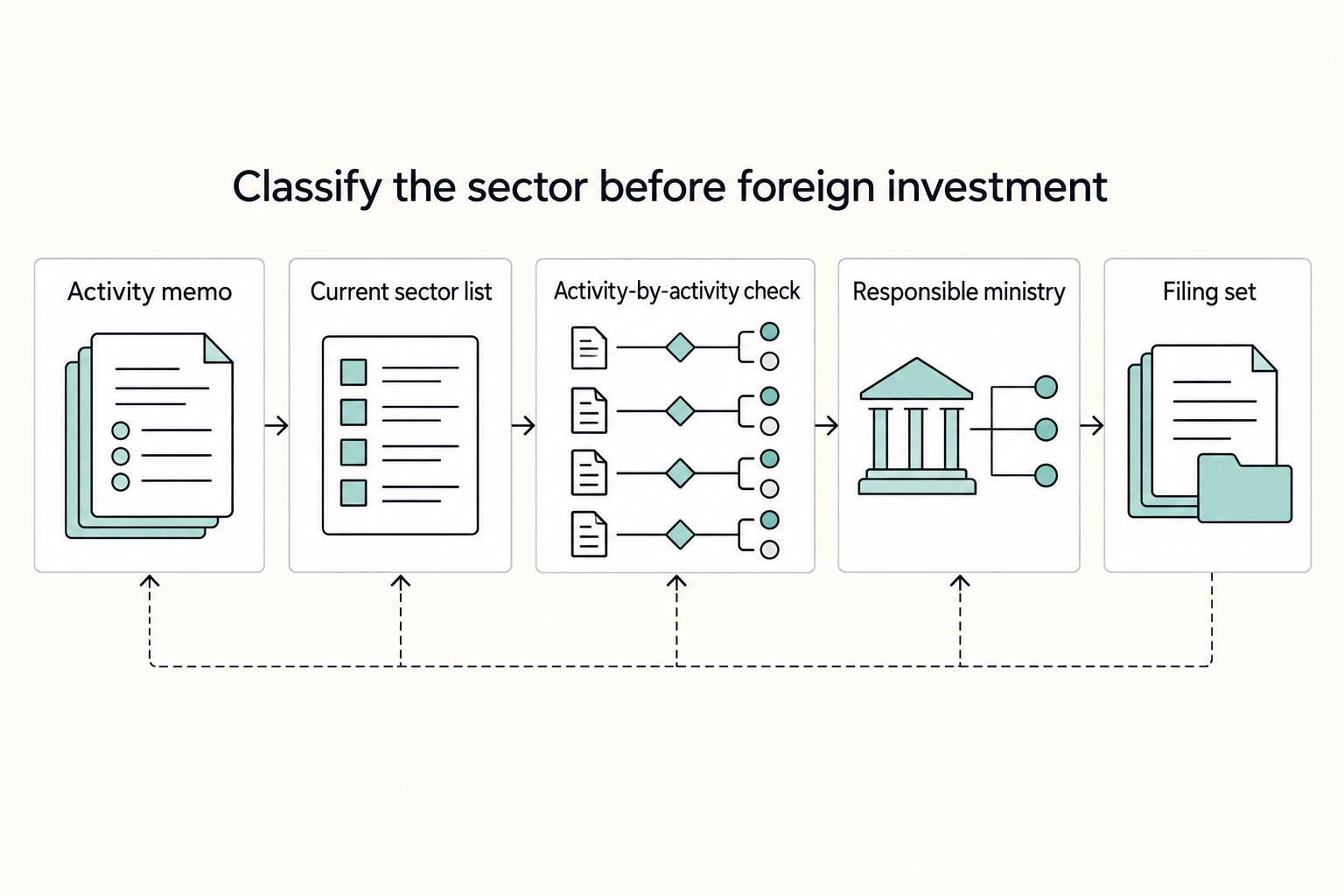
How to classify your sector for foreign investment#
Classify actual activities first, then map legal path. Do not classify from a marketing label alone.
- Write a short activity memo: what the India operation will do, contract for, and get paid for.
- Map each activity against the current FDI policy compendium and flag mixed activities early.
- For each activity, record the route, sector conditions, and any approval triggers that apply.
- Note which ministry, regulator, or approval channel your advisor says will control the final decision.
- List the filing set, reporting obligations, and post-approval deadlines that still apply even when prior approval is not required.
If classification is still unclear, stop and resolve that before committing to structure or launch sequencing.
Related: How to Choose a Jurisdiction for Your European Subsidiary.
Phase 2: Solving the Toughest Hurdle - The Resident Director#
This decision is about control design first, speed second. Before you appoint anyone, confirm the current resident-director test under section 149 with Indian counsel and write the exact rule into your board memo, not into a vague task list.
Choose your pathway based on three filters: control sensitivity, execution speed, and relationship risk.
| Path | Best fit | Control sensitivity | Execution speed | Relationship risk | Lock down first |
|---|---|---|---|---|---|
| Trusted person already in India | You have a proven working relationship and clear incentives. | Medium to high, but only if your governance documents are already tight. | Fast | Can be high if roles blur. | Role scope, signing boundaries, availability, conflicts, and exit terms. |
| Professional nominee arrangement | You want a formal service relationship and cleaner replacement options. | High | Medium | Usually lower when the contract is clear. | Authority limits, disclosures, replacement mechanics, indemnity or insurance terms, and document custody. |
| Your own relocation | You want direct operational control on the ground. | Highest | Slowest at setup | Lowest third-party dependency. | Personal timeline, immigration and tax planning, and whether you will meet the verified resident condition. |
If you are highly control-sensitive, avoid informal appointments made only for speed. If speed is critical and trust is already tested, a known local person can work. If relationship risk is your main concern, a professional arrangement is usually easier to document and replace.
The nominee checklist that actually matters#
If you use a nominee, treat the appointment pack as the control system. Confirm these points in writing before appointment:
- Authority limits, including what needs your prior written approval
- Signing rights across bank, tax, contracts, and people operations
- Conflict disclosures at onboarding and on an ongoing basis
- Replacement mechanics: triggers, timeline, fees, and signing flow for removal
- Indemnity terms and any insurance evidence you can inspect
- Document custody: originals, statutory records, credentials, and signed resolutions
The common failure mode is unclear boundaries, not dramatic misconduct. Vague terms create bottlenecks when signatures, records, or replacements are needed under time pressure.
Where control actually sits#
Control is enforced by document alignment, not job titles. Your Articles of Association, shareholder agreement, and board/shareholder approval matrix should work together to ring-fence reserved matters.
Use the Articles of Association to set core internal governance rules. Use the shareholder agreement to define owner consent rights and protections. Use the approval matrix to convert both into daily operating rules so everyone knows what needs board approval, shareholder approval, or your explicit sign-off.
Make reserved matters explicit in your documents, including share issuance, borrowing, bank-signatory changes, senior hires, related-party deals, material contracts above your internal threshold, IP transfers, and scope changes. Build this full pack before appointment so a compliance step does not become an operational-control problem.
For a step-by-step walkthrough, see How to Incorporate a Company in Singapore.
Phase 3: Keep control of documents, approvals, and access#
If you are incorporating remotely, control is won or lost in execution handoffs, not in a single filing. Run this phase as a checklist with clear owners so documents, approvals, and access stay in your hands from start to finish.
Start with a document-readiness gate#
Do not file until your document set is complete, internally consistent, and reviewed. Most remote delays come from mismatch across names, IDs, addresses, signatures, or attachment versions.
Use these as working labels for a counsel review checklist. Current legal requirements for each item remain pending statutory, official-source, and counsel verification:
- DSC: confirm who needs one, the issuance lead time, and how signing control will be handled.
- DIN: confirm which directors need it and how the application will be sequenced.
- SPICe+: confirm the filing stages, data fields, and who signs off before submission.
- MoA: confirm the business objects, subscriber details, and capital language before filing.
- AoA: confirm reserved matters, approval thresholds, and transfer mechanics before you approve the final draft.
Pre-flight gate:
| Owner | What must be ready before filing |
|---|---|
| You | Final identity and address documents, exact name spellings for every promoter and director, final business description, and final MoA or AoA drafts aligned to your control terms. |
| Advisor | Written confirmation on whether any document must be notarized, legalized, apostilled, translated, or certified for your case. |
| You + advisor | A line-by-line consistency check across all attachments, including names, IDs, addresses, shareholding, director details, signatures, and version dates. |
Review the filing pack before submission#
Treat the filing pack as an approval packet. Your advisor can prepare it; you should approve only after a full internal check.
| Filing item | Working purpose | Common failure point | Your reviewer check |
|---|---|---|---|
| Proposed name | Name selection for filing. | Name conflict risk or weak fit to the business description. | Request backup options and a short rationale for each. |
| SPICe+ core data | Central company, shareholder, and director data entry. | Inconsistent personal or entity data across forms and IDs. | Match every field to source documents before sign-off. |
| MoA and AoA attachments | Business-purpose and governance text. | Mismatch between the business description and governance intent. | Confirm scope text and authority protections remain intact. |
| Supporting attachments | Completion of the submission set. | Missing, outdated, or mismatched files. | Require one indexed final pack with clear version control. |
These are practical quality checks, not a substitute for current statutory rules. Any requirement or filing rule must be verified against statutory, official-source, or counsel records before use.
Lock the post-incorporation handoff#
After approval, remote control usually fails when credentials and records stay scattered. Close the file only after this handoff is complete.
- Advisor: deliver the complete incorporation pack, signed PDFs, acknowledgements, and a custody log for credentials, originals, and filing access.
- Bank: provide current onboarding requirements in writing, named point of contact, and any pending KYC/document requests; reconfirm before account submission.
- You: place final records in a controlled repository, restrict credential use, and document who can file, instruct the bank, and access statutory records.
If a provider asks you to “enter your details to receive a full quote and consultation,” use that as a screening step while comparing support options. Also note that some forms request consent to service updates, so include privacy and lead-routing in your shortlist criteria.
We covered this in detail in How to Incorporate a Company in the British Virgin Islands (BVI).
Phase 4: The "Zero Surprise" Budget - The True Annual Cost of Compliance#
Treat compliance as an operating system, not a once-a-year payment. For a foreign-owned private limited company, your workable budget should always separate recurring statutory costs, advisor-managed execution, and event-driven one-offs.
| Cost bucket | Core line items | Trigger or cadence | Budget assumption |
|---|---|---|---|
| Recurring statutory costs | Annual return under section 92, financial statements filing under section 137, board-governance process under section 173, registered-office continuity, resident-director continuity under section 149(3), and the FLA return in FLAIR if foreign liabilities or assets exist at end-March. | Quarterly plus annual cycle | Get a current fee quote for filings and secretarial support before you budget year one. |
| Advisor-managed execution | Bookkeeping close support, board and AGM documentation, filing preparation and submission, compliance tracking, and records retention. | Monthly, quarterly, or annual depending on scope | Scope and pricing vary most by document complexity and response-time expectations. |
| Event-driven one-offs | Registered-office change filings, director or KMP appointment and change filings, resident-director replacement support, legalization or certification tasks, and FEMA-linked reporting support where applicable. | Only when a change occurs | Price these separately so a restructuring or director change does not break your operating budget. |
Trigger-based sequence (owner + audit evidence)#
| Trigger | Required action | Owner | Evidence to retain |
|---|---|---|---|
| Incorporation date | Complete registered-office verification filing within 30 days if it is still pending. | Advisor prepares; directors approve | Address-proof set, occupancy or utility records, filing acknowledgement, and approval records. |
| Within 30 days of incorporation | Hold the first board meeting. | Board with advisor support | Notice, agenda, attendance record, and signed minutes. |
| Ongoing governance cycle | Maintain at least 4 board meetings each year, with no gap above 120 days and at least 7 days' written notice. | Board and company-secretarial support | Notices, agenda packs, minutes, and attendance records. |
| Financial year close plus AGM cycle | Hold the first AGM within 9 months of the first financial-year close; later AGMs within 6 months of year-end and within 15 months of the prior AGM. | Board, finance, and advisor | AGM notice, adopted accounts, minutes, and signed resolutions. |
| Post-AGM filings | File financial statements within 30 days of the AGM and the annual return within 60 days. | Advisor files; directors review | Filed forms or PDFs, challans, and acknowledgements. |
| Change event | File a registered-office change within 15 days and a director or KMP appointment or change within 30 days. | Advisor files; board authorizes | Change approvals, supporting documents, and filing receipts. |
| End-March foreign exposure | Assess and file the FLA return in FLAIR where FDI or ODI exposure exists. | Finance plus advisor | FLA working papers, portal submission proof, and the review memo. |
Operational compliance cadence#
| Lane | What to run | Timing anchor |
|---|---|---|
| Board governance | First board meeting, then recurring board meetings, notices, minutes, and action tracking. | First meeting within 30 days of incorporation; then at least 4 meetings a year with no gap above 120 days. |
| Financial filings | AGM preparation, accounts adoption, and post-AGM ROC filings. | AGM windows as above, with the main filings tied to 30-day and 60-day post-AGM deadlines. |
| Director and KYC maintenance | Resident-director continuity, director or KMP changes, director KYC, and FLA applicability review. | Ongoing monitoring, event-based filings within 30 days, and annual deadline checks with your advisor. |
Late filing is a budget risk, not just an admin delay. Section 403 permits delayed filing with additional fees, but legal exposure can continue; Section 137 includes ₹10,000 plus ₹100 per day for continuing default, and Section 12 defaults can run at ₹1,000 per day up to ₹1 lakh. Keep a dedicated compliance reserve for one full annual filing cycle plus one unplanned change event, and do not treat that reserve as operating cash.
This pairs well with our guide on How Foreign Companies Can Comply With India’s DPDP Act.
Conclusion: From Compliant Entity to Strategic Asset#
The goal is not merely to get through MCA registration. You want a private limited company that gives you enforceable control rights, predictable compliance operations, and a structure that is ready when you need to issue equity or take investment.
That readiness is concrete. Your Articles of Association should do real governance work, not sit as boilerplate. The AoA can contain management rules and entrenchment provisions, and once the MoA and AoA are registered, they bind the company and its members. Pair that with active resident-director oversight, because the legal wording around the 182-day test appears differently across sources. If your advisor is relying on older "previous calendar year" wording, get that reconciled before you depend on it.
You also are not fully operational just because incorporation is complete. A share-capital company cannot commence business or borrow unless the Section 10A commencement conditions are filed, and that deadline sits at 180 days from incorporation. Your early evidence pack should include registered office verification filing within 30 days and first Board meeting papers within 30 days. It should also include first-auditor appointment records and a dated calendar for AGM, AOC filing within 30 days of AGM, and annual return filing within 60 days.
| Pillar | Practical proof point |
|---|---|
| Control | Registered AoA includes management rules and tighter amendment mechanics where needed. |
| Risk | Named plan for resident-director continuity and a board composition of at least 2 directors. |
| Operations | Compliance calendar covering board meetings, AGM, section 92 filings, and section 137 filings. |
| Growth readiness | FDI route checked for your activity, including whether the automatic route applies and whether Press Note 3 (2020) affects entry. |
If you are ready to operate, confirm those four proofs now. Bring in a CS or legal counsel for constitutional documents, director-position risk, and filing interpretation, especially where annual return certification is required. Pause and fix gaps before commencing business, borrowing, or accepting foreign investment if your AoA is weak, your resident-director position is unstable, or your commencement and registered-office filings are not evidenced.
You might also find this useful: How to Set Up a Liaison Office in India.
Frequently Asked Questions
Can you complete incorporation remotely if you are outside India?
You can often complete most of the incorporation workflow through MCA filings without being physically present. SPICe+ and the SPICe incorporation set with eMoA and eAoA are the standard MCA path for most companies. What matters most is document quality, because the ROC reviews filings based on your proposed registered-office jurisdiction and the section 7 filing set for subscribers and directors. Ask your advisor for the current DSC requirements, then build a clean document pack before filing anything on MCA.
How do you handle the resident-director rule if you do not live in India?
Your company needs at least one resident director, and the current India Code wording for section 149 measures residence during the financial year, while some older reproductions still show previous calendar year language. That is an easy place for advisors to rely on stale wording, which can leave you with the wrong person or the wrong timing assumption. Get the current rule confirmed in writing against the live section text, appoint the person early, and make sure your AoA and board papers define authority instead of assuming the title alone protects you.
What should you expect on timing and cost?
Both depend on variables you can control, including document readiness, DSC setup, ROC queries, and how complete your registered-office proof pack is. Delays can come from mismatched names, weak address proof, or incomplete document sets. Ask for the current processing timeline and cost range, broken into government fees, professional fees, and post-incorporation compliance work.
How do you decide between a private limited company and an LLP?
This is not a generic “better structure” question. It turns on your FDI route classification, ownership plan, and how you expect the business to scale. Use the table below as a filter, then have counsel test your actual activity against current FDI rules before you file. | Decision criterion | Private Limited usually fits better if... | LLP may fit better if... | | --- | --- | --- | | FDI route classification | Your activity is being assessed for foreign investment through the company route and you want the standard MCA company-law path checked first. | Your counsel confirms the LLP can receive foreign investment under the automatic route for that activity, meaning 100% FDI is allowed and no linked performance conditions apply. | | Fundraising plans | You expect outside investors, structured governance rights, or future diligence around company constitutional documents. | You expect owner-funded operations and no near-term need for company-style capital structuring. | | Compliance burden | You are prepared for Companies Act requirements, ROC filings, board records, and constitutional-document discipline. | You want to test whether the LLP compliance profile is acceptable for your model and your advisors confirm it will not create FDI or contracting friction. | | Long-term scalability | You want a structure that is easier to position for expansion, governance layering, and formal ownership changes. | Your model is likely to remain tightly held and operationally simple for the foreseeable future. |
What FDI check matters most before you accept money?
You need route classification for your exact activity, not a broad label, because Indian foreign investment rules distinguish Automatic Route and Government Route. “Most sectors” being open does not answer whether your business, ownership, or conditions fit your case. Get a written note that states the activity, the route, and whether any sector conditions apply before you receive funds or promise equity.
What do you need for the registered office?
Your company must maintain a registered office and furnish verification to the Registrar under section 12 within the statutory timeline (within 30 days of incorporation). A weak office pack can trigger objections and create trouble right after incorporation if you cannot evidence your right to use the address. Prepare the address proof pack your advisor asks for, confirm the ROC jurisdiction, and keep the signed occupancy or permission documents in your permanent records.
Before you file
Use this quick check before you submit anything to MCA or the ROC: Resident-director position confirmed against current section 149 wording, with authority limits reflected in constitutional and board documents. Foreign subscriber and director documents prepared in the format your advisor confirms, with names and addresses matching identity proofs exactly. Registered office proof pack complete for the chosen ROC jurisdiction, including permission and address evidence your advisor can defend. CA, CS, or legal counsel assigned by task, so filing, FDI classification, and post-incorporation compliance do not sit in one vague handoff
Try a related tool
Researched and edited by the Gruv editorial team. Gruv builds cross-border billing, payouts, and finance-operations software for global businesses.
Sources
Includes 5 external sources outside the trusted-domain allowlist.
- master-dpiit.digifootprint.gov.in/documents/acts-and-policies/foreign-direct-i...trusted
- mca.gov.in/MinistryV2/incorporation_company.htmltrusted
- india-briefing.com/news/appointing-foreign-nationals-as-company...external
- indiacode.nic.in/show-dataexternal
- indiacode.nic.in/show-dataexternal
- rbi.org.in/Scripts/FAQView.aspxexternal
- rbi.org.in/scripts/bs_viewmasdirections.aspxexternal
Educational content only. Not legal, tax, or financial advice.
Related Posts

Sole Proprietorship vs LLC for Global Freelancers in 2026
For most freelancers in 2026, the practical default is still simple: use the simplest structure you can run cleanly, then formalize when risk actually rises. If your work is still in validation mode and the downside is contained, a sole proprietorship is often the practical starting point. When contract exposure, delivery stakes, or dispute risk starts climbing, forming an LLC deserves earlier attention.

How to Choose a Jurisdiction for Your European Subsidiary
Pick your European subsidiary jurisdiction as an operating decision first, then map VAT administration around that choice. The aim is simple: one primary incorporation country and one fallback you can activate without restarting discovery. If your fallback depends on Estonia setup speed, map banking steps in [How to Open a Business Bank Account for Your Estonian Company](/blog/estonian-company-bank-account).
When a Liaison Office in India Fits and When It Doesn’t
For a solo operator, this is only a go if your plan is clearly documented and backed by current primary materials from India, plus written confirmation from the professionals you rely on. If your day-to-day work may include selling, delivery, contracting, or payment handling, treat this route as high-risk until those points are explicitly confirmed in writing. Re-scope the model before you go further if you cannot verify those boundaries.