
Quick Answer
Impact investing for freelancers works best as a cashflow-first system, not a one-time product pick. Build your baseline and buffer, then invest only from verified surplus cash rather than expected invoices. Choose account containers carefully, verify labels with real fund documents, and use a simple monthly checklist for fees, liquidity, evidence, and concentration risk. Pause contributions in slow months instead of forcing sales.
You want to invest with values - without wrecking your cashflow#
Protect your cash buffer and payment reliability first, then build a values-based investing plan you can sustain through slow months and late invoices. You're the CEO of a business-of-one, so your investing system has to respect operations first and ideals second.
If you invoice clients, the constraint usually is not motivation. It is timing. Freelancermap notes that fluctuating income ranks as a major challenge for freelancers (38% in a 2025 study), and it also calls out how common late payments are in freelancing. That combination breaks any plan built for smooth payroll. A system that assumes steady paychecks will eventually pressure you into selling assets or missing obligations when cash arrives late.
So treat impact investing for freelancers as a cashflow problem first and an investment strategy second. You can absolutely pursue values-based investing approaches. You just need to run them on top of a financial plan that can absorb surprise timing.
The operator mindset: cashflow safety beats good intentions#
Financial planning for freelancers means "planning out how your money, investments and other assets can help you reach your personal and professional goals." In practice, the point is to "cover costs and mitigate the impacts of unforeseen changes and circumstances." The safe default is simple:
- Do not invest money you might need for near-term bills or taxes. Invest from surplus only.
- Base decisions on cash you actually have, not money you expect from an invoice.
- Start small, then scale once you prove the process survives a bad month.
Hypothetical: a client drags payment out longer than promised. You pause investing temporarily. You keep bills paid. You avoid panic selling. You preserve control.
A simple decision filter (so you don't buy "good vibes")#
The lines between for-profit and nonprofit activity keep blurring. Kind Wealth points to "new fields like impact investing, social enterprise, and blended finance" as they emerge. Translation: marketing will get louder, and your filtering needs to get stricter. Use this quick table to stay grounded:
| Question | If "No" | If "Yes" |
|---|---|---|
| Can I afford to lock this money up without stressing operations? | Wait. Build buffer first. | Proceed cautiously. |
| Can I explain the goal of this holding in one sentence? | You bought a story, not a plan. | You have a clear intent. |
| Can I track what I own and why it fits my values-based investing priorities? | You risk drift and regret. | Document it and review regularly. |
Define the terms early (so you don't buy the wrong thing)#
Define each label in plain language, then verify how the provider uses it before you invest. Once you commit to protecting cashflow first, the next common failure mode is simple: you buy the wrong "values" product because marketing and terminology blur together.
Start with what you can actually anchor. ESG stands for environmental, social and governance, and ESG investing means investors analyze public companies based on the impact a business has on the environment, society, and corporate governance. That gives you a framework, but it does not automatically tell you what a fund will hold, avoid, or prioritize. You still need to read the methodology.
The next complication is that people use terms interchangeably. Bankrate notes that ESG investing may also be called social responsibility investing or social impact investing. Translation for operators: you cannot assume the label tells the truth. You have to confirm the definition inside the fund documentation, not the headline.
A practical "label translation" table (use it before you click Buy)#
| Term you'll see | What it commonly points to (grounded) | What you must verify yourself |
|---|---|---|
| ESG | "Environmental, social and governance" | How they interpret ESG, and whether that changes holdings |
| ESG investing | Analyzing public companies based on a business's impact on the environment, society, and corporate governance | The screening rules, portfolio holdings, and how often they update the approach |
| Social responsibility investing / social impact investing | Names people may use for ESG investing | The fund's actual definition (do not rely on the label alone) |
| Sin stocks (vice stocks) | Companies in industries some investors consider morally or ethically questionable | Whether the product excludes them, and which industries it treats as "sin" |
The operator's due diligence script (keep it boring and repeatable)#
Run the same dull script every time:
| Check | What to do | If it fails |
|---|---|---|
| Definitions | Open the fund's page and find their definitions | Treat missing definitions as a warning sign |
| Holdings | Scan holdings | Pause if you would feel weird owning a top holding |
| Document consistency | Check for consistency across documents | If they drift, assume the stricter document wins |
Hypothetical: you want values-based investing exposure, so you buy a "social impact" fund. Ten minutes later, you realize they use "social impact" as a synonym for ESG investing, and the holdings conflict with your priorities. You did not fail at morality. You skipped the definition step.
One more anchor: values-based investing principles have been around since the 1960s, so you do not need to chase novelty to do this well. And investors aligning values with where they put money have fueled a significant rise in "impact investing," as the International Bar Association notes.
Public narratives can influence demand too. The IBA also quotes Larry Fink writing, "Climate risk is investment risk" in his annual letter to CEOs at the beginning of 2020. Treat that as context, not a buy signal. Your job stays the same: separate the story from the actual product.
Can freelancers do impact investing with irregular income - safely?#
Yes, freelancers can do impact investing safely if they invest from a stable baseline and keep contributions flexible. Once you can translate labels like ESG investing, socially responsible investing, and values-based investing into something concrete, the work becomes operational. You need a system that survives late payments, uneven months, and the gap between "earned" and "available."
Start with a Cashflow Gate (the "no-drama buffer")#
Define your floor first. Baseline is the minimum monthly amount you need for essentials, and you should calculate it explicitly so you can budget with confidence. A practical stress-reducer is to base your budget on your lowest expected income so slow months do not force emergency decisions.
Then build your buffer. An emergency fund acts as the shock absorber for irregular income, and one grounded rule of thumb suggests saving enough to cover at least one to three months of expenses to cushion income gaps. Treat this as your "no-drama buffer" before you add new investing complexity.
Operator add-on (optional): consider keeping a separate tax set-aside habit alongside your buffer, depending on your tax situation, and avoid mixing it into "spendable" cash.
A repeatable contribution rule (and the separation that keeps you safe)#
Freelancers often face uncertainty in budgeting, saving, and investing because they lack a predictable steady paycheck. Solve that with a rule you can run in any month:
- Contribute as a percentage of income you can verify you have (not invoices you sent). Pick a percentage you can maintain in slow months.
- Use automation carefully. Automatic transfers can help you grow savings consistently. If automation ever strains your baseline or buffer, dial it back.
- Keep business cash and investing cash separate. Make transfers traceable so you can answer, "Can I pay my obligations?" before you answer, "Should I buy this fund?"
| Ledger | Purpose | Simple rule |
|---|---|---|
| Operating cash | Essentials, tools, contractors, taxes | Protect baseline first. Refill buffer before investing. |
| Investing cash | Long-term portfolio, including impact funds | Fund it only after you meet baseline and buffer targets. |
Hypothetical: a client payment shows up later than you planned. You do not sell investments to cover the gap. You pause contributions, keep operating cash intact, and resume next month.
Finally, keep one plain reality check in view: do not assume an "impact investing" label reduces market risk. If a single theme fund concentrates your exposure, treat it like any other risk asset, even if it matches your values.
Which accounts should a freelancer use first (and what changes by country)?#
Pick the account container first, because its rules shape access, reporting, and what you can buy. Once your Cashflow Gate is real (baseline plus buffer), move to the Suitability Gate. This is where you choose the account type before debating which fund deserves your money.
Start with the container (account type), not the fund#
An account container is the legal and tax wrapper that holds your investments. You cannot evaluate this cleanly if you skip it. The container drives constraints like access, reporting, and what your broker will even let you buy.
Account rules can get specific fast, and they vary by jurisdiction and situation. Rather than copying a TikTok summary and assuming you got it right, confirm the current rules from official government guidance and a qualified tax professional who can see your full picture.
Here is the operator approach: when you review any rule, start with an official source. A .gov website belongs to an official government organization in the United States. That single filter cuts out a lot of expensive misinformation.
Decision criteria that fit freelancer reality (not payroll life)#
Use these criteria to choose an account type before you pick a values-based investing product:
- Liquidity and access rules: Can you access funds if a client pays late, without triggering restrictions you did not anticipate? You built a buffer so you avoid touching investments, but you still need to understand access rules.
- Contribution flexibility: Can you pause contributions during slow months without breaking your plan or creating admin chaos?
- Cross-border complexity: If you live in one country and work with clients in another, confirm how your account and holdings get treated. Do this before you contribute, not after you file. If this describes you, start with Japan Digital Nomad Visa: A Guide and then validate tax specifics locally.
| What you're deciding | What to read first | Safe default behavior |
|---|---|---|
| Account eligibility and limits | Official guidance for your jurisdiction | Screenshot or save the page you relied on. |
| Broker-specific constraints | Your broker's disclosures and program rules | Assume "not supported" until you see it in writing. |
| Cross-border reporting | Local guidance plus a tax pro | Do not open or fund based on influencer interpretations. |
Hypothetical: you split the year between two countries and invoice globally. You pick an account because an online creator said it "works anywhere." A safer move is to ask your broker for written program rules, then confirm with local guidance before you fund it.
How do you tell real impact from marketing - without institutional tools?#
Use a fast, evidence-first rubric that checks intent, measurement, transparency, and consistency before you trust an "impact" label. Once your account container is set, run an Impact-Evidence Gate. This helps you avoid buying an ESG investing story when you actually want impact investing you can defend with documents.
The 10-minute Impact-Evidence Gate (score /8)#
Treat this as a solo-operator scoring system, not a global standard. You want a repeatable way to separate values-based investing narratives from evidence you can save, re-check, and explain later.
| Dimension (0-2 each) | 0 points | 1 point | 2 points |
|---|---|---|---|
| Intentionality | They market "sustainable" vibes. No stated outcome. | They state an outcome, but they blur it with broad ESG scoring. | They clearly state a targeted outcome and explain the "impact thesis" (why this investment should create that outcome). |
| Measurability | No KPIs. No cadence. | They mention metrics, but you cannot find definitions or a schedule. | They define KPIs (outputs and/or outcomes) and commit to a reporting cadence you can track. |
| Transparency | You cannot review holdings, methodology, or impact docs. | You can see some info, but it feels partial or outdated. | They publish holdings and methodology plus impact reporting you can actually read and archive. |
| Consistency | They change the story when results look inconvenient. | They keep some metrics stable, but they quietly swap others. | They keep the measurement approach stable year-to-year and explain any changes plainly. |
Decision rule: if your score is low, treat it as socially responsible investing or ESG tilting at best, and do not pay "impact" premiums (fees, complexity, illiquidity) for it.
Hypothetical: you find a climate "impact" fund with beautiful design and big-name partnerships. You run the rubric and discover no defined KPIs and no impact reports you can download. You log it as "ESG-themed marketing," then move on without regret.
Evidence sources and red flags (mission drift)#
Start with primary documents from the manager, then sanity-check with independent references.
- Look for: an explicit impact thesis, clear KPIs, impact reports, and holdings. If you want a structured introduction to how organizations plan impact investing programs, skim the Grantmakers In Health Guide to Impact Investing (May 2011) and mirror its seriousness about implementation and options.
- Use tools carefully: directories and list-style resources can help you discover candidates, but you still need to verify claims in the fund's own documents.
Red flags you should treat as "marketing until proven otherwise":
- "Sustainability" language with no metrics, which shows up often in broad ESG products.
- "Stakeholder capitalism" claims without measurement, especially in glossy thought leadership and conference-style reporting. If they cannot measure it, you cannot manage it.
Want a practical next step? Try the free invoice generator.
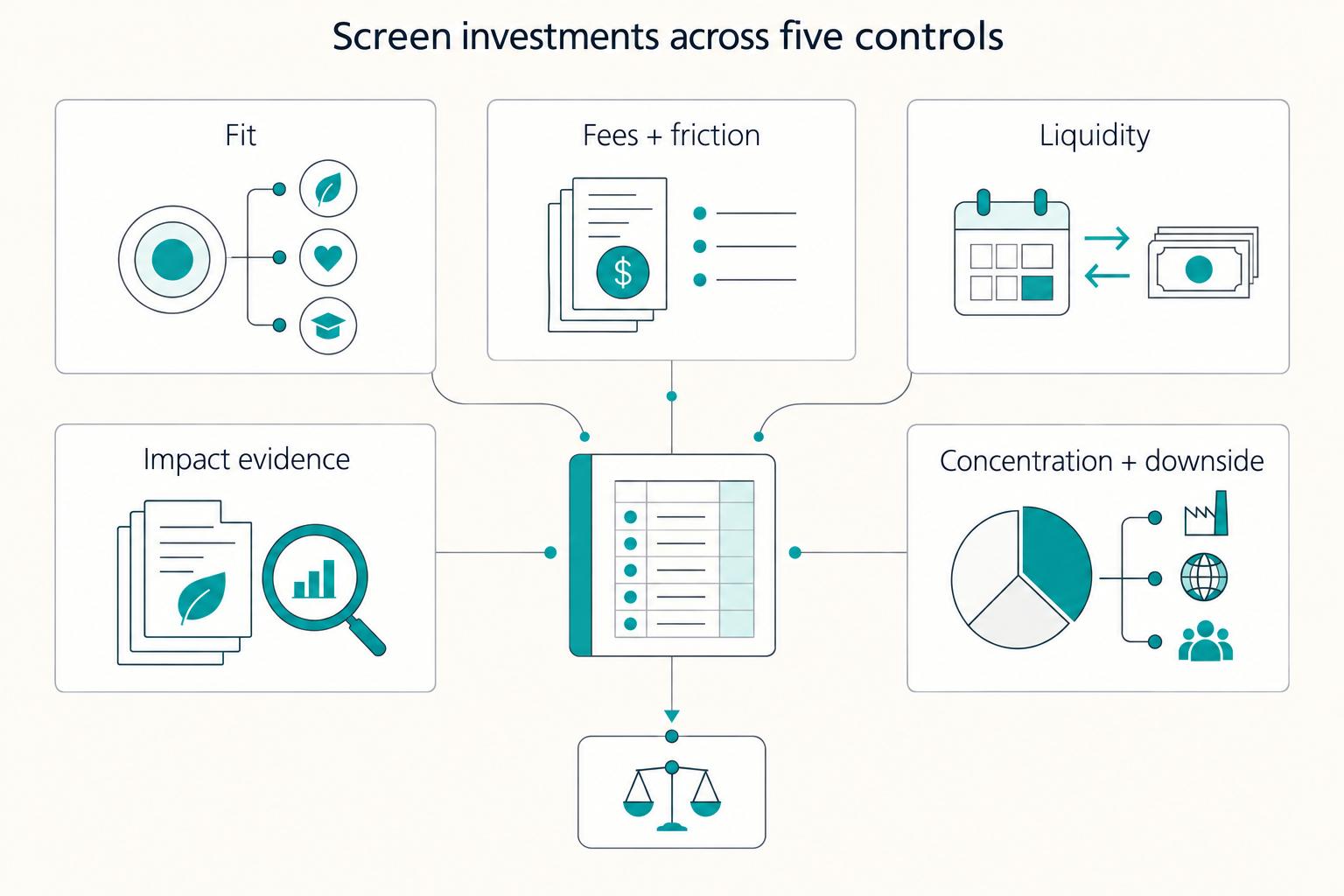
The 10-minute screening checklist (fit, fees, liquidity, impact evidence, concentration risk)#
Run a quick pre-buy audit on fit, total costs, exit options, impact evidence, and concentration risk before you place any order. Once you can separate real impact from marketing using the Impact-Evidence Gate, you need an Execution Gate that protects cashflow and downside. This is what keeps the plan from turning into an expensive, illiquid story position you regret in a slow month.
Copy/paste: the pre-buy audit (answer these before you click "buy")#
Use this as a repeatable operator checklist for any impact investing, ESG investing, or socially responsible investing product. Save the answers in a note so future you can re-check them.
| Screen | What you must decide | Your "safe default" if unclear |
|---|---|---|
| Fit | Which priority does this serve (climate, health, education, etc.)? Does it belong in your core plan or as a satellite tilt? | Treat anything thematic as satellite until you can explain why it deserves core status. |
| Fees + friction | What are all-in costs you will pay to own and transact (fund-level, platform-level, and any terms that add friction)? | If you cannot list the costs plainly, skip it. Complexity can hide cost, especially in story-first "impact-themed" content. |
| Liquidity | How easily can you exit when you need cash, and what rules apply when you do? | Favor instruments you can exit cleanly. If your income runs irregular, do not lock up money you may need to cover taxes and fixed bills. |
| Impact evidence | Can you download and archive impact reporting, holdings, and methodology? Does it score well on the rubric above? | If you cannot archive primary documents, treat it as marketing and move on. |
| Concentration + downside | What exactly drives returns here? Could one theme, sector, or region dominate outcomes? | Cap thematic exposure. Your freelance business already concentrates risk in a few clients and a few invoices. |
Hypothetical: you find a "clean water impact" product that matches your values-based investing goals. You pass the impact rubric, but you realize the position would duplicate a narrow sector bet you already carry through your client base. You keep it as a small satellite (or skip it), then choose a broader option for the core.
Operator note: don't let "perceived costs" push you into bad complexity#
A qualitative study revisiting low stock market participation (based on in-depth interviews with investors and non-investors in Germany, and validated with a representative survey) found a misconception that investing requires picking "safe" stocks, avoiding "bad" ones, and timing the market. It also found that this "inflates perceived costs and deters participation." Apply that lesson here: you do not need a complicated impact narrative to act professionally. You need a clear investment strategy you can maintain, plus documents you can re-check.
If tracking costs and cashflow already feels messy, clean up your bookkeeping first so you evaluate investments from a stable baseline: How to Handle Billable Expenses in QuickBooks.
What can you actually buy? A freelancer-friendly comparison of impact vehicles#
Buy the simplest investment product you can explain, exit, and maintain inside the account you actually use. Once you can screen fit, fees, liquidity, and what the product actually does quickly, the next decision is the vehicle.
The "vehicle paths" you will run into (and how to treat them)#
Use this as a framework to pick something that matches your values-based goal without breaking your cashflow rules. What is available, and the rules around it, can vary by platform and jurisdiction.
| Vehicle path | What it looks like in practice | When it fits | Operator caution (what you verify before buying) |
|---|---|---|---|
| Easy-to-trade, publicly priced holdings | Products with prices you can see and track, and that you can usually buy or sell through a standard investing platform | Often the simplest starting point when you want repeatability and fewer surprises | Require holdings transparency and a clear, written approach for what's included and why. Be precise in your own notes about what the product claims, and what evidence it provides. |
| More concentrated or "theme-forward" holdings | A product that leans hard into a specific idea or theme | Best used deliberately, after your core plan is stable | Concentration can raise volatility. Set your own position-size rule ahead of time so you do not improvise under stress. |
| Harder-to-exit or harder-to-price offerings | Anything that makes it difficult to value, redeem, or understand what you actually own at any given time | Only when you can tolerate complexity and limited flexibility | Do not let a good mission substitute for deal terms. Confirm redemption rules, pricing transparency, and every layer of fees. If you cannot explain the exit path in one paragraph, pause. |
Depending on where you invest, you may also see common investment headings like REITs, bonds and bond funds, dividend-paying stocks, and peer-to-peer lending. The label matters less than the terms and what you can verify.
Practical due diligence (copy/paste before any order)#
Run this checklist on any product marketed as impact, socially responsible, or ESG:
- Holdings transparency + reporting cadence: Can you download holdings and any impact-related reporting on a consistent schedule?
- Minimum investment + redemption terms: What is the smallest position you can open, and what rules control when you can exit?
- Fees and spread costs: List fund-level fees, platform fees, and any transaction spreads or redemption fees you will pay.
- Measurable impact mapping: Do the claims map to KPIs you can track year over year, and does the product explain how those KPIs are measured?
Reality check: if you see brand-forward marketing, treat it like any other financial product. Read the disclosures end-to-end, then verify structure, liquidity, and fees without relying on the brand halo.
Your monthly operating workflow (so this survives busy seasons and slow months)#
Keep your workflow simple and repeatable so busy seasons and slow months do not knock you off course. Freelancers win by staying adaptable because, as one recession-survival guide puts it, "There's no office lease to pay, no team to maintain on payroll." Use that lean advantage to run a lightweight routine you can stick with.
A template you can actually execute#
Treat this as a template, not gospel. You want fewer decisions, not more.
- Set a recurring check-in you will actually do. Keep it short: look at what cash you have on hand, what you owe soon, and what you can comfortably set aside.
- When cash feels tight or uncertain, pause new commitments. Keeping operations boring is a feature, not a failure.
- Make changes on purpose, not on vibes. If you decide to adjust your holdings or add something new, do it as part of your check-in, not mid-week in a rush.
Two operator notes: you do not need a complicated stack, and your workflow should assume invoice timing differences, not fight them.
Documentation and automation (without fragility)#
You avoid drift by writing decisions down. Keep a brief note per position (or per strategy) in a notes app or folder, and refresh it during your recurring review. Make it easy to trace:
| Note field | What to record |
|---|---|
| Why you bought it | What values or goals it supports |
| What you expected it to do | The role it plays in your overall plan |
| What you reviewed | The key information you used to decide |
| When you will review next | Pick a time, not a mood |
If you capture those four fields consistently, your notes stay useful instead of turning into a pile of screenshots.
Automate only after your routine feels stable for a while. Start with reminders, then add small, reversible automations. You want automation you can pause quickly.
Hypothetical: a key client pays late. You pause this cycle's contribution, keep your plan intact, and restart when your cash situation is back to normal.
Cross-border caution: if you live or work internationally, confirm local tax and account rules with local guidance. Do not assume concepts from one country map cleanly to another.
Keep cashflow protected while investing: the "two-ledger" mindset (and where Gruv fits)#
Treat your money like two separate buckets so investing never competes with taxes, payroll-for-one, or next month's rent. Once you have a monthly workflow, this split helps you stay honest about what you can invest versus what you still need to operate. Most values-based investing plans break here, not because the ESG investing fund was "wrong," but because cash got blurry.
The two buckets you manage (even if you use one bank)#
Operating bucket is everything that keeps the business alive: client receipts, taxes you set aside, software, contractors, and your buffer. Investing bucket is long-term allocation: the money you can lock into your investment strategy without creating short-term stress.
Use this comparison as a safe default:
| Bucket | What goes here | Success metric | Mistake to avoid |
|---|---|---|---|
| Operating | Invoices, tax set-asides, recurring expenses, buffer | You can pay obligations on time, every time | "Borrowing" from taxes or buffer to keep contributions going |
| Investing | Long-term buys (impact investing, socially responsible investing tilts, ESG allocations) | You follow your rule consistently across seasons | Investing based on money you "expect" to arrive |
Hypothetical: a client pays you from overseas and the transfer shows "sent," but you cannot spend it yet. If you invest off that "sent" status, you risk forcing a sell later to cover operating needs. Keep the investing bucket boring until the operating bucket shows the money as actually usable.
Where Gruv fits (and what to verify before you rely on it)#
Cash collection and payout operations matter as much as fund selection. If you get paid globally, status visibility and clean records help you avoid investing money that is still in transit.
| Area | What to verify | Why it matters |
|---|---|---|
| Separation | Can you segment client receipts from other funds? | So reconciliation stays clean |
| Status visibility | Can you see clear states and timestamps for money moving in and out? | So you know what is actually settled versus still processing |
| Records | Can you export transaction history? | So you can support your own "cleared income" rule before you invest |
| Contribution trigger | Use credited and usable funds, not messages like "initiated" or "sent" | Avoid investing money that is still in transit |
Gruv positions itself as global financial infrastructure for money movement, modular by design. When you evaluate a platform like that, treat it like an ops layer. Coverage and programs vary, so verify the basics above before you build your workflow around it.
Also plan around operational gates. Many financial platforms run compliance programs (for example, teams talk about building "a reliable AML framework"), and timelines do not always match your calendar. Make your contribution rule trigger on credited and usable funds, not on messages like "initiated" or "sent."
If you operate internationally, confirm program details for your country before you design the workflow around them: the six-month Japan digital nomad visa runbook.
The checks to run each month and before any new buy#
Use a repeatable, boring checklist before you buy anything, and pause when cashflow feels tight. The goal is not more information. The goal is a workflow you can still execute when a client pays late or you hit a slow month. Wave puts the day-to-day risk plainly: "Otherwise, the reality looks a lot more like working around the clock and chasing down unpaid invoices." Build your investing system to survive that reality.
Here are a few checks to run each month, and before any new buy:
- Cashflow reality check: If a payment arrives late, can you still cover near-term obligations without stress?
- Rules and fit check: Rules vary by jurisdiction, and your tax situation matters. If you are not sure, confirm with official guidance or a qualified pro.
- Clarity check: Can you clearly understand what you are buying from primary materials, not just marketing?
- Evidence check (values-based): If you care about outcomes, look for information you can actually read and understand, not just broad claims.
- Execution check: Do not buy out of urgency. If you cannot explain the position in one sentence, wait.
The quick pre-buy checklist (copy/paste)#
- Cashflow check: If payments arrive late, I can still cover upcoming obligations.
- Rules check: I verified the relevant rules for my country and situation (no guessing).
- Terms check: I reviewed the official documents so I understand how buying and selling works.
- Values check: I can point to clear, readable information that supports why this fits my values-based investing goals.
- Notes check: I wrote what I bought and why, in plain language.
Keep it "operator clean" (so you can defend decisions later)#
You do not need institutional tooling. You do need consistency. One description frames the goal well: "Help freelancers, solopreneurs, and creators develop strong, sustainable personal finance systems using modern tools, especially AI, to thrive in a new economy." Aim for that standard.
Hypothetical scenario: you finish a strong month and feel tempted to buy a trendy impact fund immediately. Run your checks. If you cannot clearly explain what it is, how it works, or why it fits your values, skip it and revisit later. That restraint counts as an investment skill.
Frequently Asked Questions
What is impact investing for freelancers?
The label varies, so focus on a process you can repeat, not a one-time "feel good" purchase. Protect operating cash first, then allocate. If you cannot repeat the process in a slow month, it is too fragile.
Can freelancers do impact investing if income is irregular?
Yes, but you need a buffer and a rule you can follow in both good and slow months. Inter recommends you aim for at least 3-6 months of living expenses set aside before you start putting money into investments, which gives you room to keep working without panic-selling. Impactfolio also notes that freelancers often face fluctuating income, so build a system that lets you pause contributions without drama.
How is impact investing different from ESG or socially responsible investing?
Labels vary, and marketing often blurs them, so do not rely on the name alone. Read the fund’s objective and reporting to see whether it matches what you want. If the fund cannot clearly explain what it measures and why, treat the label as a hint, not proof.
What should freelancers check before choosing an impact fund?
Start with freelancer constraints before you analyze the story. Check (1) fees you can live with, (2) liquidity (how easily you can sell if life happens), and (3) whether you can understand and archive what the fund reports. If you run expenses through your business, keep records clean so investing decisions never collide with tax and cashflow ops (see How to Handle Billable Expenses in QuickBooks).
How do you measure impact quality without institutional tools?
Without institutional tools, it can be hard to evaluate impact quality with confidence. What you can do is read what the fund discloses: what outcomes it says it targets, what it reports, how often it reports, and whether past reports are easy to access. If the reporting is inconsistent or hard to find, treat the impact story as harder to verify later.
Will impact investing hurt my near-term cashflow for invoicing-based work?
It depends on your cashflow timing, liquidity needs, and how much buffer you keep. A conservative approach is to invest only after you meet your emergency-fund target and to pause contributions in slow or late-payment periods instead of forcing a sell.
Which account should I use first for impact investing (Roth IRA vs Traditional IRA), and what changes outside the U.S.?
Pick the account container based on tax rules and access rules in your jurisdiction, then pick the impact product inside it. This guide cannot tell you "Roth first" or "Traditional first" without your eligibility details, and the rules change by country. Scotiabank notes that once you do not have "the luxury of an employer taking care of certain aspects of your finances," you may want a pro to add structure, so confirm account rules with your tax authority, broker disclosures, or a qualified advisor.
Try a related tool
Researched and edited by the Gruv editorial team. Gruv builds cross-border billing, payouts, and finance-operations software for global businesses.
Sources
- assets.mcc.gov/content/uploads/pub-2023001276701-ag-toolkit...trusted
- business.louisiana.edu/sites/business/files/Personal%20Financial%20...trusted
- govinfo.gov/content/pkg/CHRG-117shrg47971/html/CHRG-117s...trusted
- scholarlycommons.law.emory.edu/cgi/viewcontent.cgitrusted
- sec.gov/rules-regulations/staff-guidance/compliance-...trusted
Educational content only. Not legal, tax, or financial advice.
Related Posts

Japan Digital Nomad Visa 2026: Six-Month Planning Runbook
Treat this as your operating model: identify the right mission first, commit to one route, and keep dated records before you make irreversible plans. That is what keeps the rest of your timeline, paperwork, and decisions coherent.
How to Handle Billable Expenses in QuickBooks
**Treat QuickBooks billable expenses as a reimbursement system, not just a bookkeeping feature, so you recover client project costs through invoices instead of absorbing them.**

The Freelance Payment Penalty: A Modeled Audit of Platform Fees, FX Spreads, and Payout Delays
The money rarely disappears through a single, easy-to-spot fee. The real loss is stacked. A marketplace takes its commission, a processor adds a charge for international cards, a bank or payment company converts the currency at a spread, a platform holds the funds before release, and a wire sheds a little to intermediaries on the way in. Each layer looks defensible on its own, but the worker feels the combined result as a smaller deposit and a later payday.