
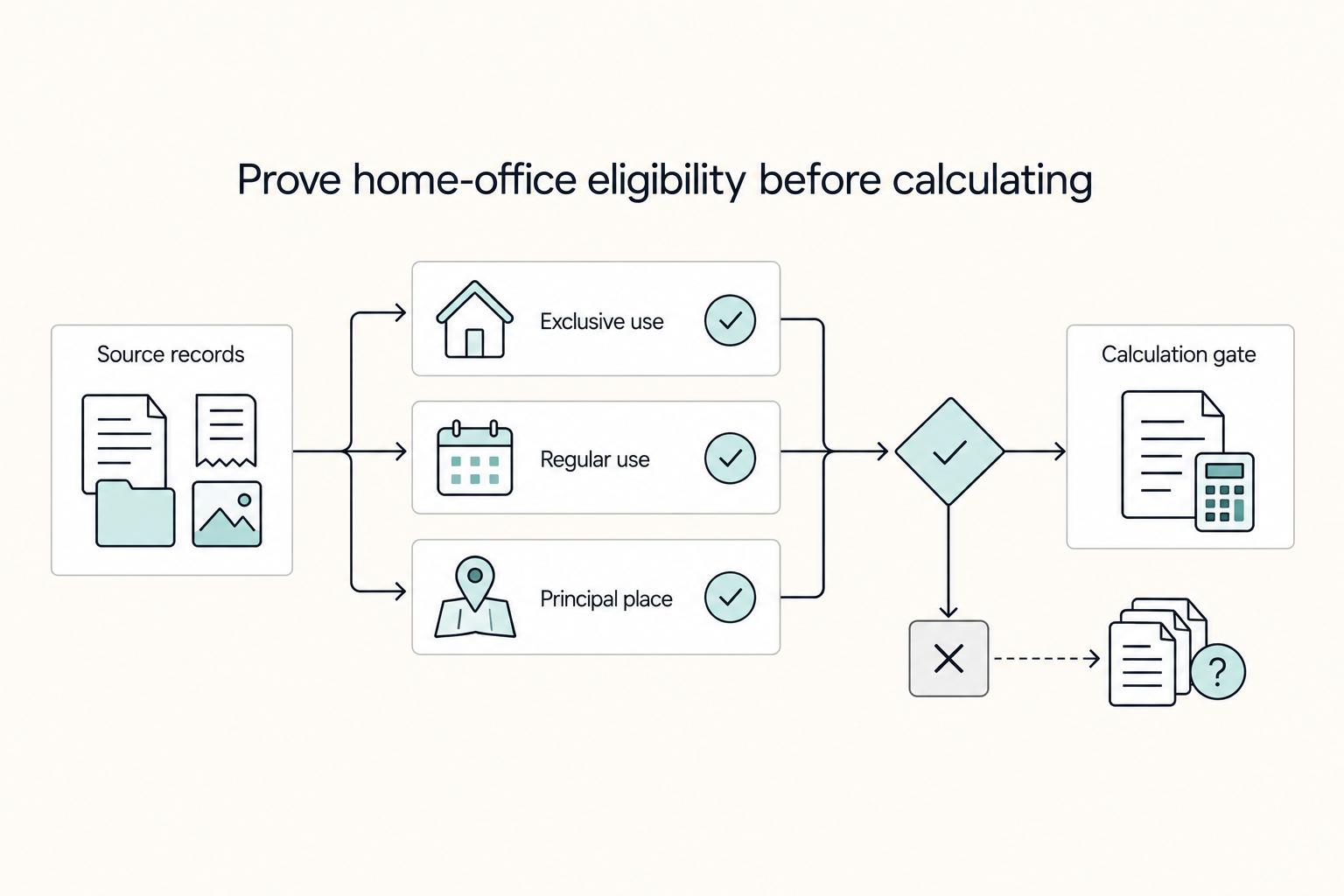
Quick Answer
Use a strict pre-file decision flow before claiming the home office deduction across multiple homes. Confirm qualifying use by period, lock one method on the original return filed on time, and keep one master worksheet that transfers cleanly from Form 8829 into Schedule C. Treat foreign-asset duties as separate checks, since Form 8938 and FBAR are not resolved by your workspace position. If your setup changed during the year, pause and get targeted review before filing.
How to Build a Defensible Home Office Deduction Claim#
For globally mobile freelancers, this deduction is a compliance decision before it becomes a tax-saving tactic. The practical rule is simple: claim it only when your facts clearly pass the IRS tests and your records can support that position from worksheet to filed return. If the facts are mixed, stop before you calculate and get a focused review.
Multiple homes in one year do not create an automatic yes or no. The same federal gates still apply: exclusive and regular business use, plus a qualifying business-use purpose such as your main place of business. Many errors start when people skip those gates, jump into the math, and then try to retrofit a story to make the numbers work.
Use this sequence before you calculate anything:
- Confirm eligibility first: exclusive use, regular use, and a qualifying business-use purpose.
- Choose one method for that tax year: simplified or regular.
- Calculate under the chosen method, and apply the gross-income limitation where it applies.
- File in a consistent order, using Form 8829 when you are calculating allowable home-use expenses on Schedule C.
- Keep records that tie each number to business use.
- Escalate quickly when facts are borderline, your living setup changed, or method choice is unclear.
Before you pick a method, document the business-use area and square footage you can defend. That helps reduce late edits that can create contradictions across forms, worksheets, and notes. It matters for timing too. Method election is made on a timely filed original return, and you cannot switch methods for that same tax year after filing.
Keep the tradeoff visible from the start. The simplified route reduces calculation and recordkeeping burden, but it does not relax eligibility rules. It uses a fixed amount tied to business square footage up to 300 square feet and replaces actual home-office expense deductions for that year. Under the simplified method, amounts above the gross-income limitation cannot be carried forward. The regular route uses actual expenses and requires maintained records.
Think of this as a sequencing problem, not just a math problem. Eligibility decides whether the claim exists. Method choice decides how much evidence you need. Filing order decides whether your numbers stay consistent from start to finish.
That is the thread through the rest of the piece: define the space first, pass the eligibility gate honestly, choose the method your records can support, and file only what you can explain cleanly later.
Related: How to Write Off a Home Office as a Renter.
Define The Deduction Before You Calculate Anything#
Treat the home office deduction as a federal eligibility decision first, not a savings estimate. If you cannot state a clear pass or fail case for the space and its business use, stop before you calculate.
Keep scope tight: this section is US federal only and focused on self-employed filing workflows. Employees are not eligible to claim this deduction. State treatment and partnership-specific treatment are outside this section.
Put the three tests in plain English#
| Test | Meaning | Key condition |
|---|---|---|
| Exclusive use | The area is used only for business | If it is used for personal purposes, it does not meet this test |
| Regular use | Business use is recurring and normal for how you operate | It is not occasional overflow |
| Principal place of business | Home is generally where the business is mainly run | It can qualify for administrative or management work only when you have no other location for those duties |
In practice, that means:
- Exclusive use: the area is used only for business. If it is used for personal purposes, it does not meet this test.
- Regular use: business use is recurring and normal for how you operate, not occasional overflow.
- Principal place of business: home is generally where the business is mainly run, or where you perform administrative or management work and have no other location for those duties.
Run this pre-calculation sequence#
- Define the claimable space and defensible square footage.
- Define the business activity performed there in plain language.
- Confirm the home qualifies as your principal place of business, including administrative or management duties with no other location for those duties.
- Then choose your method for that tax year.
Method choice is locked by the method used on a timely filed original federal return, and you cannot switch methods later for that same year. Choose the method after eligibility is clear, not before.
Keep a short eligibility memo#
Use a simple working memo so your definitions do not drift across worksheets and filing:
- Space definition: address, area claimed, square footage, dated measurement note.
- Use pattern: tasks performed there and why use is exclusive and regular.
- Period timeline: dates when the setup starts, changes, or ends.
- Supporting records: what you would show to support measurement and business use.
If your living setup changes midyear or you use multiple homes, treat it as an edge case and get a separate federal review instead of blending facts into one continuous office story. For those edge cases, see Can Digital Nomads Claim the Home Office Deduction?.
Once scope is locked, keep it locked, then move into the eligibility gate. If you are timing cash flow and filings together, use A Freelancer's Guide to Paying Quarterly Estimated Taxes as the next step.
If you want a deeper dive, read Home Office Deduction for Real Estate Agents: Qualify, Choose a Method, and Keep Records.
Pass The Eligibility Gate With A Binary Checklist#
Use a binary checklist only if each gate is tied to verified IRS authority. Confirm eligibility requirements with official IRS guidance before making any home-office deduction claims.
The point of the checklist is to force a clean pass, fail, or escalate decision before you touch the numbers.
Use one status per gate, per period#
For each claimed space and time period, classify each gate as:
- Pass: verified IRS-scope rule text is in file, and your records support the facts.
- Fail: your facts do not meet the verified rule, or records conflict.
- Escalate: rule text is unverified, facts are incomplete, or records are too thin.
With the current evidence pack, do not move into calculations yet.
Stop-point decision flow#
- Define the exact area claimed and the dates it applies.
- Attach verified IRS-scope rule text for each gate.
- Map your facts to each gate in writing.
- If any gate cannot be supported, stop for that space and period.
- Only then move to method selection and expense mapping.
Build the evidence pack first#
| Record | Keep | Purpose |
|---|---|---|
| Space record | Address, claimed area, dated measurement note, boundary sketch/photo | Prevents scope drift |
| Use log | Dated notes of business activity in the space | Supports period-by-period use claims |
| Period timeline | Start, move, change, and stop dates by location | Prevents blending facts across homes |
| Expense boundary notes | What is in or out of the claimed area and why | Keeps household costs from leaking into the claim |
This same boundary discipline improves decisions across freelance deductions, but it does not replace verified IRS-scope rule text.
Keep unresolved items explicit#
Keep these items open until verified IRS-scope excerpts are in file:
- Exclusive-use, regular-use, and principal-place eligibility tests.
- Form 8829 and Schedule C eligibility criteria.
- Simplified-method square-footage or dollar limits.
- Gross-income limitation and carryover treatment.
- Same-year method-switching rules.
- Multi-home or midyear-change treatment.
For mobile edge cases, keep the claim in escalate even if you reference Can Digital Nomads Claim the Home Office Deduction?, until verified IRS excerpts are attached.
If a current-year limit has not been verified, leave the amount unresolved in the workpaper and do not use it in the draft calculation.
Handle Exceptions Without Overreaching#
Exception-based claims need a stricter standard than routine claims. If you rely on daycare-facility or inventory-storage exceptions, prove first and claim second.
Use authority that matches the exact question in front of you, then work in order:
- Verify the IRS exception language that applies to your filing year.
- Match your facts line by line in a short dated memo.
- Tie each claimed amount to the specific space and business purpose.
- Separate personal and business use at draft time. Do not claim mixed-use space when the exclusive-use rule applies.
- Mark unresolved items as not claimed until professional review is complete.
For exception work, confirm the exact boundary: exclusive use is generally required, with limited exceptions such as qualifying daycare or inventory storage, and separate unattached structures qualify only when used exclusively and regularly for business.
If support is partial, do not stretch the wording to fit. Take the conservative position and preserve options. Where your qualification path is unclear, treat the item as not yet claimable until you can document it cleanly.
A useful operator rule helps here: if you cannot explain the exception in three plain sentences with records attached, treat the issue as not ready to file.
Another good control is to separate unresolved exceptions from the rest of the return package. Do not let one uncertain line item delay completion of items you can support today. Mark it clearly, route it for review, and keep the rest of the file moving.
Once the qualification path is clear, choose your method deliberately on the timely original return, because you cannot switch methods later for that same tax year.
Choose Your Method Using Decision Rules#
Choose your method based on the file, not the hoped-for result. If your records are thin, mixed, or hard to trace to one workspace, the simplified method is usually the better fit. If your records are complete, allocation is clean, and you can reproduce the math from source documents, the regular method is the stronger choice.
Method choice is an evidence and operations decision, not a personality test or a race to the largest estimate. The better option is the one you can defend with fewer contradictions if the file is reviewed later.
Start with what each method requires#
The simplified method uses $5 per square foot of qualifying business space, up to 300 square feet. It reduces calculation and recordkeeping burden, but it does not change who qualifies. It is also in lieu of deducting actual home-office expenses for that year.
| Attribute | Simplified | Regular |
|---|---|---|
| Calculation | $5 per square foot of qualifying business space, up to 300 square feet | Business-use share of eligible home costs |
| Actual expenses | In lieu of deducting actual home-office expenses for that year | Actual-expense route |
| Records | Reduces calculation and recordkeeping burden | Maintain records; higher calculation, allocation, and substantiation burden |
| More than one home | Can be used for qualified business use of one home for that tax year | If another home also qualifies, that home must use the regular method |
The regular method is the actual-expense route. You calculate the business-use share of eligible home costs, maintain records, and handle depreciation treatment for the business-use portion. The calculation, allocation, and substantiation burden is higher, so choose it only when your records support it.
If you used more than one home in the year, simplified can be used for qualified business use of one home for that tax year. If another home also qualifies, that home must use the regular method, so keep your address-level records precise.
Use a file-based rule, not a bigger-number rule#
Run a side-by-side draft if regular might produce a larger deduction, but treat that draft as a stress test. If the larger result depends on reconstructed totals, missing statements, or weak allocation support, it is not the stronger filing position.
| Decision point | Rule | Action | Minimum proof artifact |
|---|---|---|---|
| Record quality | Incomplete or partly reconstructed actual-expense support points to simplified. Fully traceable costs keep regular open. | Weak records: simplified. Complete records: regular. | Simplified: square-footage note + business-use memo. Regular: expense ledger tied to source docs. |
| Allocation readiness | If business-use percentage cannot be reproduced cleanly, do not use regular. | No clean allocation: simplified. Clean allocation: regular. | Dated measurements + allocation worksheet. |
| Depreciation implications | Simplified avoids depreciation for years it is used. Regular includes depreciation and possible recapture on sale gain. | Avoid depreciation complexity: simplified. Accept it: regular. | Short note acknowledging depreciation treatment. |
| Gross-income limitation | Carryover treatment differs by method. | If carryover potential matters, regular may be the better fit. If carryover does not matter, simplified can still work. | Draft limitation worksheet showing both outcomes. |
| Workflow burden | Simplified is usually lighter operationally. Regular needs more classification and substantiation work. | Lower burden needed: simplified. Higher burden manageable: regular. | Pre-filing checklist of records reviewed and gaps. |
Lock the method before form entry#
Document your method choice before entering forms, with one sentence on why it fits this year's records.
Use this checkpoint:
- Record the chosen method and reason in a dated memo.
- Confirm your support matches the chosen method.
- Escalate if square footage, address history, gross-income limitation effects, or depreciation assumptions are unresolved.
This step matters because the method is elected on your timely original federal return for that year, and you cannot switch methods later for the same year. If two draft outcomes are close, pick the one with the stronger audit trail and lower contradiction risk, not the slightly larger projection.
After you lock the method, move into expense classification. If you want to review the rest of your deductions or update cash-flow planning, use freelance deductions and this quarterly tax guide.
For a step-by-step walkthrough, see How to Write Off a Home Office ('Arbeitszimmer') in Germany.
Want a fast side-by-side check before you lock a method? Run your assumptions in the Home Office Deduction Calculator.
Build The Expense Map For The Regular Method#
Under the regular method, weak classification creates weak returns. Your job is to map each expense to the correct Form 8829 treatment, or leave it out until you can support it.
On Form 8829 Part II, expenses are entered as column (a) direct expenses or column (b) indirect expenses. A conservative working rule is simple: if you can support that a cost applies only to the business-use area, treat it as direct. If it relates to the home generally, treat it as indirect and allocate it by business percentage. If classification is unclear, exclude it until documented. The same discipline used for other freelance deductions matters here because mixed-use costs create contradictions quickly.
Tighten the classification rule#
Start with Part I: Form 8829 has you divide line 1 by line 2 to get the business percentage on line 7. That percentage drives indirect-cost math, including the checkpoint line 24 = line 23, column (b) x line 7. If line 1 or line 2 is weak, downstream indirect amounts are weak too.
Use this mapping table before form entry:
| Expense category | How to classify | Support to keep | Allocation logic |
|---|---|---|---|
| Cost clearly limited to the business-use area | Start in direct | Keep records that explain why the cost is business-area-only | No line 7 allocation when it is treated as direct |
| Cost that benefits the home generally | Start in indirect | Keep records tying the full amount to the business percentage | Apply the Part I percentage; line 24 is the control checkpoint |
| Mixed or unclear cost | Exclude until documented | Note what is missing or uncertain | Do not force an allocation you cannot reproduce |
| Prior-year operating expense carryover | Validate separately before use | Confirm the prior-year amount from your records | Keep unresolved until the prior-year amount and current form instructions are verified |
Use this as a decision aid, not as permission to estimate loosely.
Keep Part I and Part II aligned#
Keep the Part I inputs used for line 7 tied to the same expense set you allocate in Part II. Recheck line 7 before applying it to indirect totals so line 24 remains reproducible.
Run the pre-file line test#
Before moving any amount into Form 8829 or Schedule C, each line should pass all three checks:
- Document support: a source record is in the file.
- Business rationale: direct, indirect, or excluded is explained in one sentence.
- Reproducible math: the claimed amount can be recalculated from the source amount and worksheet.
If a line fails any check, stop and fix it first. Form 8829 includes a checkpoint that can force an amount to -0- if the calculation is zero or less, so mapped costs are not automatically allowed amounts.
Once the map is final, move to filing order: transfer checked amounts through Form 8829 first, then carry the allowed result to Schedule C.
File In The Right Order So Numbers Stay Consistent#
Lock assumptions first, then propagate approved values once across the return. This is the simplest way to prevent a good calculation from turning into a contradictory filing.
Run the workflow in this order:
- Eligibility facts: Confirm exclusive, regular business use unless you are in the IRS storage or daycare exceptions. If you are using the principal-place route, confirm the space is used for administrative or management work and that you have no other fixed location for substantial administrative or management activities.
- Method lock: Choose simplified or regular on a timely filed original return for that tax year, then keep that choice for the year. Simplified changes calculation and recordkeeping, not eligibility.
- Worksheet finalization: Keep one canonical worksheet for square footage, business-use percentage, method choice, and expense classification. Under regular, treat direct expenses as business-area-only costs and indirect expenses as whole-home costs allocated by business-use percentage. Keep this mapping as strict as you would for other freelance deductions.
- Form transfer and downstream check: Transfer from the finalized worksheet into the return, then recheck downstream calculations and related planning assumptions in quarterly taxes.
Before filing, verify that you are using the current IRS forms and instructions. If a year-specific correction applies, document it only after verification and rerun affected calculations.
Freeze and package only after all four checks are binary and complete:
- Books tie out to claimed totals: Yes/No
- Each claimed amount maps to source support: Yes/No
- The business-use percentage is consistent everywhere it appears: Yes/No
- Any upstream change triggered a fresh downstream recalculation: Yes/No
Assemble An Audit-Ready Evidence Pack#
An audit-ready file is about traceability, not volume. Each amount should connect from source record to calculation to the amount reported on your return without guesswork.
Anchor the file to the same logic used in your computation. Under the regular method, direct business expenses may be deducted in full, and indirect home costs are allocated by business-use floor-space percentage. If your file follows that same path, later review is usually simpler.
| Claim area | What your file can show | Where it connects |
|---|---|---|
| Eligibility position | Why the space fits a qualifying business-use category, how exclusive use applies (including storage/daycare exceptions), and principal-place-of-business reasoning based on where key activities and business time occur | Business-use-of-home position supporting the deduction |
| Expense support | Records for each claimed home-expense category, for example the business portion of rent, mortgage interest, or real estate taxes | Amounts included in the calculation |
| Method and allocation logic | Direct versus indirect split and business-use percentage used | Regular-method computation |
| Final transfer | Tie-out from computed allowable amounts to filed totals | Amounts reported on your return |
If you use Gruv tax tools where enabled, keep exported artifacts aligned with your books so each figure traces back to one source of truth.
Run this final evidence check before filing:
- Every claimed amount has source support.
- Every amount has a clear business-use rationale.
- Every amount has reproducible math.
- Support still matches the eligibility narrative.
If one line cannot be traced cleanly, fix it before submission instead of hoping context will fill the gap later.
A clean evidence pack can also reduce future rework. If questions come up later or you are preparing a future return, organized traceability makes review more straightforward.
Cover Global Mobility Constraints Most Competitors Skip#
Do not let the home-office question bleed into foreign-reporting decisions. Schedule C, Form 8938, and FBAR (FinCEN Form 114) are separate lanes, and each lane needs its own test before filing.
| Lane | Independent test | Filing destination | Keep in your file |
|---|---|---|---|
| Schedule C home office lane | Whether your business-use-of-home position is supportable | Your income tax return workflow | Eligibility support, method choice, and return tie-out |
| Form 8938 lane | Whether you are a specified person, have an interest in specified foreign financial assets, and exceed the applicable reporting threshold | Attached to your annual return | Threshold category used, plus saved threshold worksheet |
| FBAR (FinCEN Form 114) lane | Whether your foreign financial accounts meet the FBAR filing test | Filed with FinCEN, not the IRS | Account list, value support, and filing conclusion |
Run the lane tests in order#
Classify the lane first, then test it.
If the issue is home office eligibility, stay in the Schedule C lane. If the issue is foreign accounts or specified foreign financial assets, run Form 8938 and FBAR separately.
For Form 8938, do the gates in order: specified person status, interest in reportable assets, then threshold test for your category. Record which threshold category applies, then add the current threshold only after checking the latest IRS instructions.
For FBAR, run its test on its own terms. Filing Form 8938 does not replace or satisfy FBAR; you may need one, the other, or both.
Use a pass/fail pre-file checkpoint#
Specified person status confirmed?Yes/No.Form 8938 threshold worksheet saved for the correct category?Yes/No.Form-by-form determination completed for Schedule C, Form 8938, and FBAR?Yes/No.Income tax return required for the year?Yes/No. If No, note that Form 8938 is not required for that year.Any foreign deposit or custodial accounts closed during the tax year identified in your records?Yes/No.
Any Not sure is a fail until verified. For mobility edge cases, use Can Digital Nomads Claim the Home Office Deduction? to frame the facts before filing.
Final contradiction-control check: make sure entity names, account lists, and filing status are consistent across your return, Form 8938 workpapers, and FBAR support.
Spot Red Flags Before They Become Audit Problems#
A common risk is not the claim itself. It is a file that tells two different stories. Claiming this deduction is not an automatic audit trigger, but unresolved inconsistencies can create review friction, so fix contradictions before you file.
Run a binary pre-file evidence check#
Use two statuses only: issue found or resolved with evidence. A resolved item must point to a saved record, a dated note, or a reconciled worksheet.
| Pre-file check | Issue found | Resolved with evidence |
|---|---|---|
| Narrative overstates facts | You use absolute wording like "exclusive," "always," or "all year," but records are mixed or incomplete. | Dated note that narrows the statement to the supported period and facts. |
| Forms and support file conflict | Return entries, workpapers, calendar, lease, expense records, or office description do not align. | Reconciled worksheet tying facts and figures across the file. |
| Key numbers are not traceable | A claimed amount appears with no clear math trail or source record. | Saved calculation worksheet plus linked backup records. |
| Material facts changed with no explanation | A move, workspace change, method change, or business-use change appears but is undocumented. | Dated note stating what changed, when it changed, and what supports it. |
If any row stays in issue found, treat the return as not ready.
Draft so the file can be read cold#
Write to a strict standard: be specific, keep statements period-bound, and match wording to your records. Lead with the concrete question, then the legally significant facts your conclusion depends on.
Avoid absolute claims unless they are fully documented. If facts support only part of the year, say part of the year. If records are mixed, use narrower language and drop broader claims.
Keep narrative, numbers, and support files aligned. Do not let wording imply a broader fact pattern than your evidence can carry.
Drop the myth and focus on support#
Myth: claiming this deduction automatically causes an audit. Fact: it does not automatically trigger one.
The durable rule is practical: supported claims are easier to defend, and contradictory files are harder to review. Do not assume a reviewer will fill in missing context. If a conclusion depends on a move date, workspace change, or business-use shift, document it now in a dated note. If a reasonable counterargument exists, address it in the file before submission.
The same discipline can improve the rest of your filing process. If timing and records are recurring weak points, use A Freelancer's Guide to Paying Quarterly Estimated Taxes as a companion process: reconcile first, file second.
Use final triage before submission#
| Triage | Use when |
|---|---|
| Fix now | Wording issues, traceability gaps, or undocumented changes can be resolved with saved records, dated notes, or reconciled worksheets |
| Stop and review | Facts are mixed, internal contradictions are present, or material statements rely on memory instead of records |
| Escalate | Material contradictions or missing evidence affect your position or claimed amounts and cannot be resolved before filing |
If two core records point in different directions, or your position depends on facts you cannot prove, stop and get professional review before filing.
You might also find this useful: Home Office Permanent Establishment Risk for Consultants in 2026.
Know When To Escalate To A Tax Professional#
Escalate when the filing position depends more on interpretation than on records. If your facts are clean and the calculations are straightforward, file. If you find yourself arguing with the facts to make the claim fit, pause and get targeted review before submission.
In practice, escalation is most useful around two pressure points: eligibility interpretation under Topic no. 509 and technical handling on Form 8829. These are high-impact areas where small errors can change the deduction result and, under the regular method, affect carryover treatment. Method choice is another lock point: you choose simplified or regular on a timely filed original return, and you cannot switch methods later for that same year.
Escalation triggers before filing#
| Trigger | Why it merits review | What to prepare first |
|---|---|---|
| Home or work-location changes during the year | Changes can make it harder to document when and where business-use tests were met. | Build a dated occupancy and work-location timeline and map each period to one address. |
| Exception-based claim or uncertain principal-place-of-business test result | Topic no. 509 is fact driven, and borderline cases need careful framing. | Summarize where core work happened, where admin tasks were completed, and whether another fixed location existed for substantial administrative or management activities. |
| Method-choice uncertainty (simplified vs. regular) | The annual choice is made on the timely filed original return and cannot be changed later for that same year. | Prepare a side-by-side comparison: simplified ($5 per square foot, up to 300 square feet) versus regular (direct and indirect expenses, depreciation, and carryover treatment). |
| Regular method with depreciation | This adds downstream complexity, including potential depreciation recapture if the home is sold. | Separate direct and indirect expenses, keep allocation worksheets, and document why the method was chosen. |
| Prior-year carryover under the regular method | Carryover can affect current and future deductions and is easy to misstate. | Bring prior return workpapers and a clear carryover roll-forward. |
| Unclear exclusive-use or administrative-location facts | Mixed personal and business use can be disqualifying where exclusive use applies, and admin-use paths require careful support. | Document actual space use and keep records showing where substantial administrative or management work occurred. |
If one trigger appears, do not wait until final review day. Early escalation gives you time to correct classification and documentation before filing. That is usually the cheapest point in the process to fix the problem.
Immediate review events#
Stop and get review before filing if any of these apply:
- You cannot clearly show that your home use fits a qualifying Topic no. 509 path.
- Your exclusive-use facts are mixed in a way that may disqualify the claim where exclusive use applies.
- You are deciding between simplified and regular and are not confident in the tradeoffs for this year.
- You are using regular but cannot support direct versus indirect allocations, carryover inputs, or depreciation inputs.
These are not cleanup items. They signal that the current file may be difficult to defend without expert support.
What to bring to the meeting#
Bring an organized packet so the advisor can decide quickly instead of rebuilding your year from scratch. Include draft Form 8829 inputs, your method comparison notes, and the records behind your space-use and expense calculations.
A narrow pre-file review is usually the best tradeoff when uncertainty sits in a few high-impact areas. It is often faster than filing with weak support and then defending the position later.
If the advisor asks for additional records, respond in the same structure you used for the evidence pack. Consistent organization reduces back-and-forth and shortens review time. It also makes it easier to implement the advice cleanly once you get it.
Conclusion#
A defensible claim follows a strict order: qualify first, choose one method, calculate with discipline, then file only what your records can prove.
The first gate is eligibility. Exclusive and regular business use is required, and the simplified option does not change who qualifies. Mixed or occasional use can disqualify the claim, so tighten the facts before you choose a method.
The second gate is method fit. Simplified is easier to administer because it reduces calculation and recordkeeping burden. Regular uses actual expenses with records maintained. Under regular, amounts above the gross income limitation may be carried over; under simplified, they may not. Regular also includes depreciation recapture on gain when the home is sold, unlike years you use simplified.
The third gate is timing and consistency. You choose simplified or regular on a timely filed original federal return, and you cannot change methods later for that same year. Once chosen, apply that method consistently and keep one clear trail from source document to filed return.
Use this final pre-file checklist:
- Decide: Confirm eligibility facts and business-use support.
- Calculate: Apply one method consistently and test the gross income limitation impact.
- Document: Keep source records, rationale notes, and reproducible worksheets.
- Verify: Check that your method choice and calculations align before filing.
- File: File on time using the chosen method, and resolve open judgment calls first.
If your facts are complex or changed during the year, a focused pre-file review can reduce downstream risk.
If your year was messy, keep your timeline and evidence organized with the Tax Residency Tracker.
Frequently Asked Questions
Who qualifies for the home office deduction?
It depends on your business-use facts. Under Topic no. 509, you need regular use of part of your home, exclusive use where that rule applies, and a qualifying business-use path based on where your most important activities happen and where you spend most business time. Next step: rerun the checklist in Pass The Eligibility Gate With A Binary Checklist and keep dated proof for each period you plan to claim.
Can W-2 employees claim a home office deduction?
This guide is for self-employed filing situations, not wage income. Employee cases follow a different rule set, and IRS guidance includes a convenience-of-employer condition when employees claim this deduction. Next step: separate income types first, then confirm the current employee-specific rules or get targeted review before filing.
Which is safer for most freelancers, the simplified method or the regular method?
It depends, but stronger evidence is safer than chasing a larger deduction. The simplified method is the easier option, while the regular method requires complete records to classify direct expenses and allocate indirect home costs by business-use percentage. Method election is made on a timely filed original federal return and cannot be changed for that same year. Next step: draft both methods, choose the one with the stronger file, then align it with your broader deductions in Top 10 Tax Deductions for Freelancers and your filing cadence in A Freelancer's Guide to Paying Quarterly Estimated Taxes.
What expenses count under the actual expense method?
Actual home costs can count under the regular method if classification and allocation are correct. Topic no. 509 states direct business expenses may be deducted in full, while indirect home expenses are allocated by business-use percentage, and you cannot use simplified in the same year and also deduct actual qualified home-office expenses. Next step: follow Build The Expense Map For The Regular Method and only claim lines with a source record, a business rationale, and reproducible math.
Does the exclusive use requirement always apply?
No. Where exclusive use applies, mixed personal and business use of the same area disqualifies that area. Next step: if your space is not clearly business-only, return to Handle Exceptions Without Overreaching and verify the exact exception before claiming.
Do digital nomads with multiple homes in one year qualify?
It depends on your facts and method choice. Under IRS simplified-method rules, you cannot use simplified for more than one home in the same taxable year, but you may use simplified for one home and regular for another in that year. Next step: build a dated address-and-work timeline, then review Can Digital Nomads Claim the Home Office Deduction? for edge-case planning.
If I moved during the year, can I claim the deduction for both places?
It depends on your facts and method choice. A move can complicate your records, and IRS simplified-method rules still limit simplified to one home per taxable year, though simplified may be used for one home and regular for another. Next step: create a period-by-period timeline mapped to one address at a time, and escalate early if your timeline and records do not align.
If I claim this deduction, does that settle my FBAR or FATCA questions too?
No. This checklist addresses home-office deduction decisions only. Next step: keep a separate checklist and review FBAR and FATCA obligations independently under current rules.
Try a related tool
Researched and edited by the Gruv editorial team. Gruv builds cross-border billing, payouts, and finance-operations software for global businesses.
Sources
Educational content only. Not legal, tax, or financial advice.
Related Posts

Top 10 Tax Deductions for Freelancers
If you report business income on Schedule C (Form 1040) for work you do with continuity, regularity, and a real profit motive, these ten categories are the right place to start. The practical rule is simple: claim only what you can prove quickly with records created near the time you spent the money. When the paper trail is thin, the deduction is weak, even if the expense felt business related.
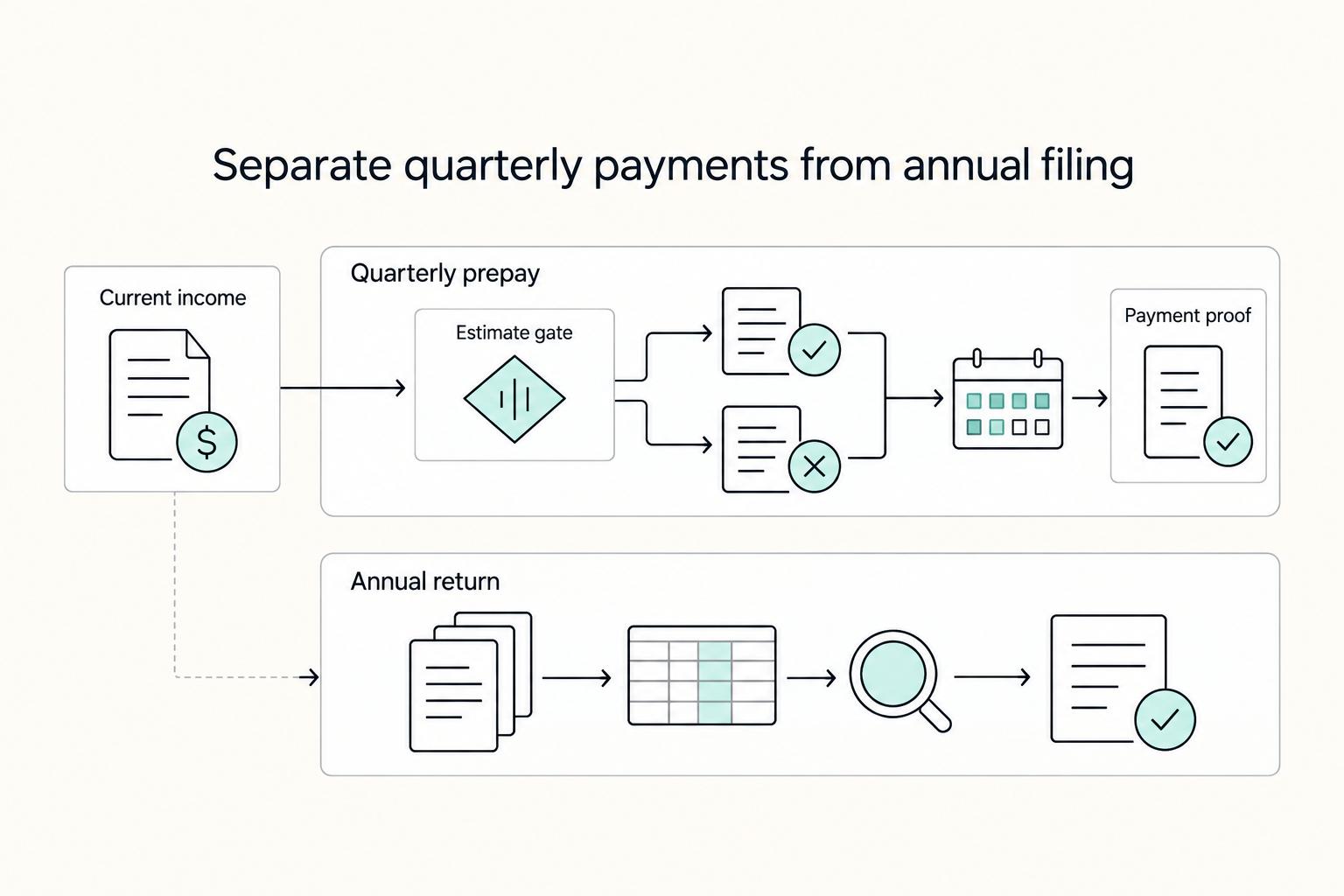
Quarterly Estimated Taxes for Freelancers Without Guesswork
Use this as your start-of-quarter routine: separate the tax tracks, verify the facts, then calculate and pay. That replaces stale assumptions with a routine that cuts surprise balances. At the start of each quarter, define two things first:

Can Digital Nomads Claim the Home Office Deduction?
Claim the deduction only when your facts and records can carry it. With the home office deduction for digital nomads, the real decision is usually a three-way call: claim it, do not claim it, or pause and get help because your file is not ready.