
Quick Answer
For ordinary Australian freelance businesses, GST registration generally becomes required at $75,000 current or projected GST turnover, subject to exclusions and exceptions. Register within 21 days of becoming required, then apply the correct sale treatment and report through your assigned BAS cycle.
GST Registration, Invoices and BAS for Australian Freelancers#
Australian freelancers generally need GST registration when current or projected GST turnover reaches $75,000. Check both rolling periods, classify overseas work, and keep invoices and eligible purchase records ready for your assigned BAS cycle. An ABN or a marketplace tax setting alone does not establish GST registration.
Start with your business-wide numbers, then decide the treatment of each sale. Registration, GST charged to clients, GST on platform fees, and reporting are separate questions. This guide covers ordinary Australian freelance businesses; special non-resident registration, taxi and ride-sourcing activities require their own checks.
Record the facts before reusing a treatment#
- Capture the customer, actual recipient, service, delivery location and any Australian goods or real property connection.
- Reuse a documented treatment only when the material facts and current rule still match.
- Flag missing facts for review; do not treat a pause as an extension of a statutory deadline.
- Apply confirmed treatment to each invoice tool and platform, while keeping business-wide registration and reporting records.
- Log changed facts, the primary guidance checked, your decision and the next review date.
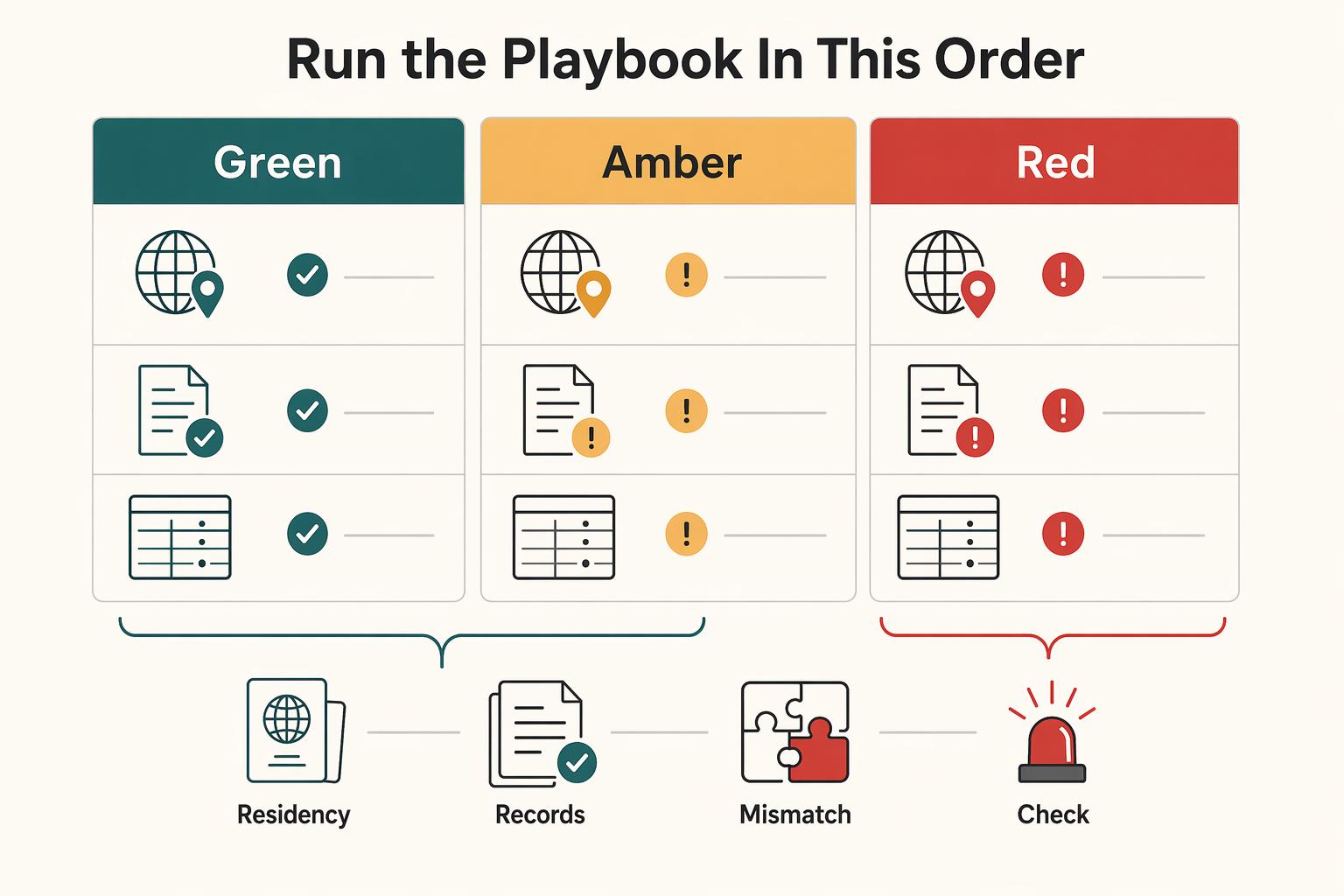
| Risk tier | What it looks like | Action |
|---|---|---|
| Green | Facts match a documented treatment under current guidance | Use the checklist and retain the evidence |
| Amber | New recipient, location or service facts | Obtain missing evidence and arrange timely review |
| Red | Required registration may be late, or deadline and treatment are unresolved | Seek prompt qualified help; address the external deadline separately |
For a local client billed directly and a foreign client billed through a marketplace in the same week, use separate treatment notes. The channel is not the deciding tax fact. Identify the contracting customer, who actually receives the service, where they are when it is supplied, and any Australian property or goods involved.
Income-tax residency and GST treatment are separate tests. If you move countries, also review Australian tax residency; residency alone does not determine whether a particular freelance invoice is GST-free.
What Counts as GST Turnover?#
GST turnover is business sales measured under GST rules, rather than profit or the net amount deposited by a platform. Start from sales and apply the required exclusions. For example, exclude GST in prices, input-taxed sales and sales not connected with Australia; some other exclusions also apply. Projected turnover additionally excludes specified capital-asset disposals and sales from ceasing or permanently reducing an enterprise.
Keep a classification column beside each revenue stream so you can explain exclusions. GST-free sales connected with Australia can still count toward registration. Do not remove overseas invoices merely because no GST was charged, or deduct platform fees as though they reduced sales turnover.
Three terms to keep separate#
| Term | What it means for operations | What to do now |
|---|---|---|
| GST turnover | Sales under GST rules, before expenses but with specific exclusions | Classify sales and calculate current and projected rolling periods |
| Registration requirement | $75,000 threshold for an ordinary freelance business; special rules can override it | Check the applicable test and exception, then record the required date |
| BAS | The statement for assigned business tax reporting and payment | Confirm cycle, method, labels and due date; prepare supporting records |
Review both turnover periods each month#
Current turnover covers this month and the previous 11 months. Projected turnover covers this month and the next 11 months. Keep signed work, recurring contracts and reasonable forward estimates with the forecast; a sudden new contract can create a registration requirement before cash receipts reach $75,000.
Use this monthly review:
- Reconcile sales across all channels and apply the relevant turnover exclusions.
- Recalculate current and projected turnover; retain evidence for a changed forecast.
- Review new client or service facts and prepare invoices, credits and BAS records.
When Must You Register?#
For an ordinary freelance business, the threshold is $75,000. The ATO registration guide explains the current and projected tests. If current turnover is above the threshold but projected turnover is below it, check the exception rather than assuming current turnover alone settles the requirement.
Register within 21 days of becoming required to do so. Obtain an ABN first, then use the applicable ATO registration channel or a registered tax or BAS agent. Save the confirmed effective date and update invoices from that date. Late registration can leave you owing GST on earlier taxable sales even when you did not charge clients GST; seek help promptly rather than waiting for your next BAS.
Apply the registration gate#
| Operating state | Decision rule | Immediate action |
|---|---|---|
| Current and projected turnover below $75,000; no special rule | Registration may be voluntary | Keep both tests current; do not charge GST while unregistered |
| Projected turnover at least $75,000 | Ordinary registration requirement can arise before actual receipts reach the threshold | Determine the required date and register within 21 days |
| Current turnover at least $75,000 but projected below | Check the current-above/projected-below exception with supporting facts | Confirm whether the ATO can be satisfied that projected turnover is below |
| Taxi, limousine or ride-sourcing activity | Registration is required regardless of ordinary turnover threshold | Check the special rule before starting that activity |
Prepare the records and settings#
| Safe default | Details |
|---|---|
| One sales ledger | Include direct and marketplace sales; classify exclusions separately from expenses. |
| Current primary guidance | Use the ATO for tax rules and the relevant platform for its own setup. |
| Community commentary | Treat it as a question to verify, not a binding answer. |
| Consistent business details | Keep the ABN, legal name and GST status accurate across tools. |
| Assigned BAS cycle | Prepare for your actual reporting method and due date; do not assume quarterly. |
| Registered invoicing and records | Charge GST on taxable sales, document GST-free sales and retain required records. |
Hypothetical example: current turnover is $62,000, but signed projects and a reasonable forecast put projected turnover at $80,000. Do not wait for deposits to reach $75,000. Check the forecast and registration date now. Conversely, a large capital-asset sale can distort a forward view; document the applicable exclusions and any current-above/projected-below exception before concluding registration is unnecessary.
How Do You Treat Overseas Client Work?#
An overseas billing address or foreign currency does not automatically make an invoice GST-free. Professional services can qualify under the export rules, but recipient location, actual use and statutory exclusions matter. A service connected with Australia can be GST-free while still counting toward GST turnover.
For a non-resident customer outside Australia when the service is performed, check the applicable export rules, including Australian goods or real-property connections. If the service is provided to another entity in Australia, additional restrictions and business-recipient exceptions can apply. Do not assume every Australian beneficiary makes the sale taxable or every foreign payer makes it GST-free.
Record three decisions for each stream#
| Step | What you record | Decision use |
|---|---|---|
| Supply facts | Customer and actual recipient, where they are, service use, goods/property connections | Check the applicable taxable or GST-free rule |
| Turnover inclusion | Whether the sale is connected with Australia and whether an exclusion applies | Do not confuse GST-free status with turnover exclusion |
| Review needed | Uncertain facts, another Australian recipient or conflicting evidence | Record the question, owner and deadline for professional review |
For example, an Australian consultant may supply strategy work to an overseas branch for use there, with no relevant Australian property or physical-goods connection. Establish that the applicable export conditions are met before coding it GST-free. Keep the contract and recipient/use evidence, rather than relying on a foreign payment reference.
Keep the evidence beside the transaction#
| Evidence step | Details |
|---|---|
| Invoice and location evidence | Retain the contract, recipient/use facts and service description; payment location alone is insufficient. |
| Decision note | Link the treatment, primary rule and review date to the transaction. |
| BAS mapping | Map sales, GST and eligible credits to the assigned labels and attribution period. |
| Purchase records | Retain valid tax invoices, eligible business-use allocation and any exclusions. |
| Mixed cases | Flag missing facts and get timely review rather than copying one code to every invoice. |
A local campaign and overseas strategy engagement need separate treatment notes even if delivered in one week. Hypothetical turnover example: $40,000 of local sales plus $20,000 of qualifying GST-free exports connected with Australia gives $60,000 before any other applicable exclusions. GST-free does not mean invisible in the registration ledger.
Keep Platform GST Separate from Client GST#
Upwork describes GST on services it supplies to Australian freelancers, such as service fees, memberships and Connects. That charge is separate from your own client invoices. Its current guidance says a valid ABN plus confirmation that you are GST-registered changes its collection of that platform GST; merely holding an ABN is not enough.
The Upwork help page illustrates a USD100 platform fee plus USD10 GST, for USD110 total. This is a platform-service example, not an Australian-dollar sales calculation or proof that your client fee is taxable. Retain the platform tax invoice and check any credit entitlement separately.
Choose a source for the question you are answering#
| Authority level | What it should decide | What it should not decide |
|---|---|---|
| ATO and applicable tax law | Registration, supply treatment, credits and reporting | A platform interface workflow |
| Government business guidance | Practical setup and links to tax requirements | Resolution of every special statutory case |
| Platform documentation | Its fee GST, validation and entry steps | Your own business-wide registration or client-sale treatment |
| Forums and commercial commentary | Questions worth verifying | A binding filing position |
A platform can validate profile details without registering your business with the ATO. Keep a separate registration record, effective date and ledger. If details change, update the platform and business records, then check that later invoices and fee statements reflect the change.
Apply the decision to every channel#
- Enter accurate ABN and GST-status details using the current platform instructions.
- Track direct and platform sales together, with fees and payouts separately.
- Link invoices, client receipts, fee statements and bank settlements without double counting.
- Verify conflicting advice against the ATO and seek qualified help where the fact pattern remains unclear.
If the marketplace profile is updated but your direct-client invoice template still uses the old status, correct both workflows. Do not charge GST while unregistered merely because a platform charged GST on its fee. If you voluntarily register below the threshold, registration carries reporting and record obligations too.
Prepare Tax Invoices, Credits and BAS Records#
For an ordinary taxable service, a GST-registered freelancer charging $1,000 before GST adds $100, making $1,100 payable. For an entirely taxable GST-inclusive price, GST is one-eleventh of the total. GST-free sales carry no GST; an unregistered business must not charge GST or call its bill a tax invoice.
A tax invoice identifies the seller and ABN, issue date, goods or services and price, GST amount and taxable extent, and is clearly intended as a tax invoice. At $1,000 or more it must also identify the buyer or show their ABN. For taxable sales over $82.50, provide a requested tax invoice within 28 days. Add practical fields such as invoice ID, due date and payment reference; those do not replace the statutory details.
Reconcile weekly and prepare monthly#
| Control loop | What you check | What you produce |
|---|---|---|
| Weekly | Match invoices, client receipts, fees and payouts; review new client facts and tax codes. | Reconciled ledger and an exception list with owners. |
| Monthly | Recalculate both turnover tests, confirm business details and assemble period-specific BAS inputs. | Forecast evidence, updated treatment notes and a BAS pack ahead of the assigned deadline. |
If the client pays the $1,100 invoice and the provider settles $1,080 after a $20 fee, reconcile $1,100 received against the invoice and the $20 expense separately. The fee does not leave a $20 client debt or reduce the GST component of the sale. A pending provider payout also does not mean the client must pay again. Use consistent currency and retain the conversion record where relevant.
Check credits and the reporting period#
GST credits require eligibility, not simply a business-looking receipt. Check registration, GST actually included in the purchase, business use, relevant exclusions and the required tax invoice. Do not claim the private portion or assume every foreign platform fee includes Australian GST. For material changes, keep a dated decision log:
- What changed in client facts, coding, registration or accounting method.
- Which primary guidance was checked and what supports the proposed treatment.
- Action, responsible person, external deadline and internal review date.
Hypothetical purchase: $330 includes $30 GST and is 60% used for eligible business purposes. A proportionate credit is $18, assuming the other credit and attribution requirements are met. If $100 GST on sales and that $18 credit belong to the same period, the net GST component is $82. Other BAS liabilities, adjustments or credits can change the total payable.
Check your accounting method before mapping invoice or payment dates to a BAS. Eligible businesses using cash accounting generally report GST as payment is received or made. For example, a wholly taxable $1,100 invoice issued on 30 June but first paid $550 in July contributes $50 sales GST to the July–September period on a cash basis. Non-cash attribution generally follows the earlier invoice or payment trigger; do not apply the cash example to that method.
BAS Deadlines and Cases Needing Advice#
Use the actual reporting cycle and due date assigned to you. Standard quarterly BAS deadlines are 28 October, 28 February, 28 April and 28 July. Monthly BAS is generally due on the 21st of the following month. Eligible online or agent arrangements can have different dates, and non-business-day rules apply; check the statement and current ATO guidance.
For businesses using Simpler BAS, the GST labels are G1 total sales, 1A GST on sales and 1B GST on purchases; keep the underlying classifications and any other assigned BAS obligations. Lodge and pay by the applicable deadline. An internal review gate or an unresolved adviser question does not extend it. Contact the ATO before the deadline if you cannot meet an obligation.
Use these as internal escalation signals#
| Tier | Typical signal | Decision |
|---|---|---|
| Green | Stable facts, valid evidence and a documented current treatment | Continue records and scheduled checks |
| Amber | Unclear recipient/use facts, forecast exclusion or purchase eligibility | Arrange review before the decision is due |
| Red | Possible late registration, missing material records or imminent unmet deadline | Get prompt professional help and contact the ATO as needed; review does not pause the deadline |
Send an adviser a focused brief#
Give a registered tax or BAS agent the facts, proposed treatment and deadline, not just a screenshot of a platform setting:
| Brief item | What to send |
|---|---|
| Transaction pattern | Contract, customer/recipient facts, delivery/use details, invoices and fee/payment records |
| Proposed position | Treatment, turnover inclusion, period, amount and accounting method |
| Guidance checked | Relevant rule or ATO page and the exact unanswered question |
| Deadline and decision | Assigned due date, amount at issue, decision needed and owner |
If similar transactions have conflicting treatment, compare the actual recipient, use, property connection and timing. Resolve the difference and update the documented pattern. General business records are commonly kept for at least five years; confirm any longer requirement for your records and retain readable exports, not just access to a live account.
Set Up Your Next Monthly Review#
Keep a single register of turnover tests, client treatment notes, registration status and BAS dates. The checklists below are operating controls; they are not extra tax rules or permission to delay required registration, lodgement or payment.
Before using the next invoice template, confirm the effective GST registration status, supply classification and price basis. Then check both turnover periods and your BAS cycle. A new client, renewed retainer or location change should reopen the relevant decision rather than copy a previous answer blindly.
Keep four controls visible#
| Control point | Safe default | Why it protects tax compliance |
|---|---|---|
| Rule source | Current ATO rule and relevant facts | Keeps platform configuration separate from the tax decision |
| Turnover | Current and projected tests, with documented exclusions | Flags registration before a receipts-only threshold would |
| ABN and GST status | Confirmed registration and effective date | Prevents unsupported tax-invoice or platform declarations |
| Reconciliation | Sales, client receipts, provider fees, payouts and BAS references | Avoids treating net settlement as sales or collecting twice |
Test an accounting export before filing: preserve invoice IDs, customer and recipient facts, tax codes, payment references, currency/conversion records and timestamps. Keep a copy of the filed BAS, submission acknowledgement and actual tax-payment reference. A prepared draft is not lodged, and a lodged statement is not necessarily paid.
When the facts change#
For a new foreign customer or accelerating local retainer, run this sequence:
- Document the changed fact and affected transactions.
- Check the current primary rule and update both turnover periods where needed.
- Seek timely qualified review if unresolved; track the real deadline and required action separately.
Assign the unresolved issue to a named person with a review date before the external deadline. Keep the ordinary record and invoice workflow moving where treatment is settled; seek advice on the disputed part and contact the ATO if the deadline cannot be met.
For a location change, review Australian income-tax residency alongside these GST checks. Keep the two analyses separate.
Frequently Asked Questions
Do Australian freelancers need to register for GST before or after crossing the GST turnover trigger?
An ordinary freelance business can need registration based on projected turnover before actual receipts reach $75,000. Check current and projected tests, relevant exclusions and the current-above/projected-below exception. Register within 21 days of becoming required; special activities can require registration regardless of turnover.
Is GST always 10% for every freelance service scenario in Australia?
The standard rate is 10% on taxable supplies. GST-free and input-taxed supplies have different treatment, and an unregistered business must not charge GST. For an entirely taxable GST-inclusive $1,100 price, the GST component is $100.
How does GST treatment change when my clients are overseas?
Some exported services qualify as GST-free, but a foreign address or payment currency is insufficient. Check the customer and actual recipient, location and use, Australian goods/property connections and applicable exceptions. GST-free exports connected with Australia can still count toward turnover.
Does entering my ABN on Upwork cover all of my GST obligations?
No. Upwork GST on its own fees and services is separate from your client sales. Its current collection settings require a valid ABN and confirmation of GST registration; entering an ABN does not register your business or complete your BAS.
What should I do first if I think I am close to the GST turnover trigger?
Reconcile all sales and calculate this month plus the previous 11 months and this month plus the next 11 months, using the required exclusions. Save your forecast evidence and check whether registration is already required rather than waiting for a year-end total.
When should I stop self-managing and talk to a tax professional?
Get timely help for disputed overseas treatment, uncertain turnover exclusions, possible late registration, incomplete records or an approaching deadline you cannot meet. Give a registered tax or BAS agent the facts, amounts, proposed treatment and actual deadline.
Which source should I trust first when ATO, platform docs, and forum advice seem inconsistent?
Use current ATO guidance and applicable tax law for the rule. Use platform documentation for its own fee and settings workflow. Treat forum advice as a prompt to verify, and seek qualified review when your facts do not fit the guidance.
Try a related tool
Researched and edited by the Gruv editorial team. Gruv builds cross-border billing, payouts, and finance-operations software for global businesses.
Sources
Includes 1 external source outside the trusted-domain allowlist.
- ato.gov.au/businesses-and-organisations/gst-excise-and-...trusted
- ato.gov.au/api/public/content/0-1e92db95-a75c-4f4e-a3d4...trusted
- business.gov.au/registrations/register-for-taxes/register-fo...trusted
- business.gov.au/finance/payments-and-invoicing/how-to-invoicetrusted
- smallbusiness.taxsuperandyou.gov.au/goods-and-services-tax/what-are-gst-creditstrusted
- support.upwork.com/hc/en-us/articles/115008309168-How-GST-works...external
Educational content only. Not legal, tax, or financial advice.
Related Posts

Digital Nomad Taxes in 2026 With a Defensible Filing Plan
With digital nomad taxes, the first move is not optimization. It is figuring out where you may be taxable, where filings may be required, and what proof supports that position.
Australia Tax Residency for Digital Nomads With GST and ABN Checkpoints
The goal is a defensible, low-drama position the Australian Taxation Office (ATO) can follow from your records, not a clever workaround. For a digital nomad, that usually means keeping two tracks straight: residency and GST/ABN admin. Consistency is what holds up over time: use real facts, take steps in a clear order, and keep documents that still match months later.

The Freelance Payment Penalty: A Modeled Audit of Platform Fees, FX Spreads, and Payout Delays
The money rarely disappears through a single, easy-to-spot fee. The real loss is stacked. A marketplace takes its commission, a processor adds a charge for international cards, a bank or payment company converts the currency at a spread, a platform holds the funds before release, and a wire sheds a little to intermediaries on the way in. Each layer looks defensible on its own, but the worker feels the combined result as a smaller deposit and a later payday.