
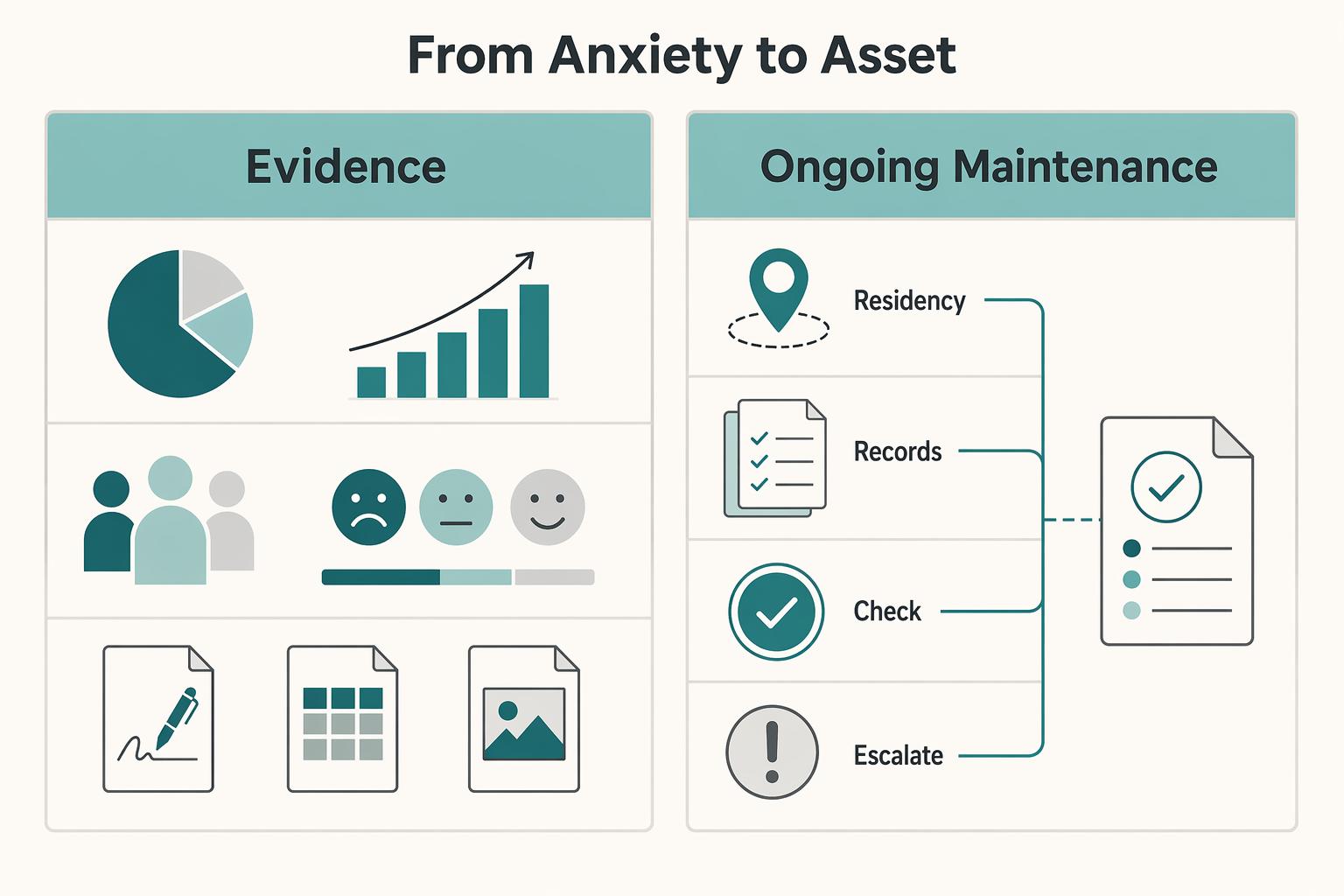
Quick Answer
Start by treating ksk for freelance artists germany as a verification workflow, not a one-time filing task. Confirm profession fit, main self-employed activity, income viability, and documentation readiness before submission. Build your case around the Fragebogen zur Prüfung der Versicherungspflicht (KSVG), then align contracts, invoices, and payment proof so they describe the same work. For first registration, plan for a signed packet returned by post and keep an attachment-to-evidence map for follow-ups.
What to Validate Before You Rely on KSK Status#
Treat KSK as one part of your Germany compliance setup, not as a shortcut that solves everything else. For a freelance operator, the real risk is building pricing, cash flow, and admin assumptions around a status you have not fully validated.
That broader context matters. At EU level, the European Parliament's EAVA reviewed legal frameworks and identified gaps in working and social conditions for artists and other CCS workers. It supports initiative 2023/2051(INL) and is published as PE747.426, with the manuscript completed in October 2023. The assessment also identifies four policy options and notes that the feasibility of a new sector-specific directive depends on scope and purpose. It is framed as background material for European Parliament members and staff.
| Working assumptions to validate | What not to assume |
|---|---|
| KSK may be one part of your Germany social-protection planning | KSK status alone resolves tax, residence, contract, or operational requirements |
| Your professional activity should be described consistently across public and client-facing materials | Inconsistent positioning will fix itself during review |
| Ongoing records and periodic review are prudent as your work evolves | One early outcome removes the need for documentation or expert input in edge cases |
This guide is operational education, not legal advice. If your case involves mixed activities, cross-border facts, or unclear classification, treat that as a trigger for professional review. The later stages show where those triggers usually appear.
Stage 1 gives you a go/no-go decision#
Stage 1 is where you decide whether the case looks workable before you prepare formal next steps. You map what you actually sell and check whether your role description stays consistent across your public profile and client-facing materials.
Stage 2 gives you one coherent evidence story#
Stage 2 turns that initial view into one coherent file for review. You align your service language so a reviewer does not have to guess what you do from conflicting labels.
Stage 3 gives you a defensible long-term operating record#
Stage 3 is about staying review-ready over time. You keep dated records, track meaningful shifts in your service mix, and revisit your assumptions instead of treating any early outcome as permanent proof. If you want a deeper dive, read our guide to a defensible 2026 filing plan.
Stage 1: The Pre-Flight Check - Bulletproofing Your Eligibility#
Start with a hard go/no-go check before you touch the application: profession fit -> primary self-employed activity -> income viability -> documentation readiness. If one link is weak, the overall case may be weak.
| Checkpoint | What to confirm | Grounded detail |
|---|---|---|
| Profession fit | Classify the work you actually sell and invoice | KSK scope definitions say artists create, perform, or teach music, performing arts, or visual arts; publicists work as writers, journalists, or in similar roles |
| Primary self-employed activity | The work is self-employed and your main professional activity | Dependent employment does not count as self-employed artistic/publicistic activity; in harder cases, the DRV Clearingstelle status procedure is free and takes an average of about three months |
| Income viability | Income from self-employed artistic or publicistic activity reaches the cited floor | 2026 KSK materials: 3,900.00 EUR yearly / 325.00 EUR monthly; the beginner period is the first 3 years after first taking up that self-employed activity |
| Documentation readiness | Evidence is good enough to support the story | KSK assesses eligibility through a questionnaire plus supporting evidence, and initial return of application documents is currently by post only |
Under the KSVG, compulsory insurance can be established only if qualifying artistic or publicistic work is done on a gainful, ongoing basis. KSK's scope definitions are the practical baseline: artists create, perform, or teach music, performing arts, or visual arts. Publicists work as writers, journalists, or in similar roles.
Profession fit first#
Classify the work you actually sell and invoice, not the title you would rather use.
| Common service description | Stage 1 classification | Why |
|---|---|---|
| Graphic design for client projects | Likely in scope | KSK materials treat graphic designers as artists in this context. |
| Music teaching or private music lessons | Likely in scope | Music teaching is explicitly included. |
| Editorial writing or journalism | Likely in scope | Publicistic work includes writers, journalists, and similar activity. |
| Brand strategy + copy + SEO + marketing consulting | Borderline or mixed activity | Borderline cases are assessed case by case and can depend on recognition in relevant professional circles. |
| Visual art plus substantial merch/fulfillment/e-commerce operations | Borderline or mixed activity | Case by case; KSK distinguishes artistic/publicistic activity from other self-employed activity. |
| Furniture carpentry / custom furniture making | Likely out of scope | KSK materials contrast this as a craft trade, not artistic status. |
If you are in a borderline category, do not jump straight to rejection. The bigger risk is unclear positioning. KSK notes that borderline cases depend on recognition in relevant professional circles.
Primary self-employed activity#
The next checkpoint is whether the work is truly self-employed and whether it is your main professional activity. Dependent employment does not count as self-employed artistic/publicistic activity, even if it is labeled freelance. Side-activity framing also matters because KSK treats artistic or publicistic work as the main profession.
That makes contract design part of the eligibility check, not a later detail. If the real setup looks employment-like, get advice early. In harder cases, the DRV Clearingstelle can run a formal Statusfeststellungsverfahren that is free and takes an average of about three months.
Income viability#
From the cited 2026 KSK materials, the floor is 3,900.00 EUR yearly / 325.00 EUR monthly from self-employed artistic or publicistic activity. The beginner period is the first 3 years after first taking up that self-employed activity. It can be extended where compulsory-insurance periods were interrupted for listed reasons.
If you are currently below the floor, take the lower-risk path. Confirm whether you are still in the beginner period and can document your true start date. If not, wait until qualifying income is real, or get professional review for mixed or interrupted cases.
Documentation readiness#
Before you think about forms, check whether your evidence is good enough to support the story. KSK assesses eligibility through a questionnaire plus supporting evidence, and initial return of application documents is currently by post only.
For globally mobile freelancers, a practical readiness check is:
- Keep your contracts and invoices internally consistent with the artistic/publicistic activity you report.
- Keep an ID copy ready. If you are a non-EU national, include the required residence-permit attachment.
- Keep dated records in one place so ongoing, income-oriented activity is easier to verify.
Talk to a professional now if any of these apply: mixed income where non-qualifying work may dominate, unclear residence or work authorization status, or one-client dependence with employment-like terms. For a step-by-step walkthrough, see A Deep Dive into the US-France Tax Treaty for Freelance Performers.
Stage 2: The Application System - A Project Plan for Your KSK Submission#
Once Stage 1 is solid, Stage 2 is mostly execution: prepare documents -> align narrative -> quality-check German -> for first registration, submit a signed packet by post with a clear evidence map.
The anchor document is the Fragebogen zur Prüfung der Versicherungspflicht (KSVG). KSK assesses insurance duty through this questionnaire and the requested supporting evidence. For first registration, completed and signed Anmeldeunterlagen must be returned by post. KSK states that new-registration documents sent by email are not processed.
Build the packet before you fill the form#
Build the evidence packet first, then complete the questionnaire from that packet. This makes inconsistencies easier to catch before they are on the form.
| Document or attachment (as requested in your questionnaire flow) | Purpose in review | Common failure mode |
|---|---|---|
| Signed Fragebogen zur Prüfung der Versicherungspflicht (KSVG) | Formal request and activity description | Unsigned packet or form narrative conflicts with attachments |
| Copy of passport or ID | Identity verification | Missing ID copy or mismatched personal details |
| Residence authorization (if not German/EU national) | Required attachment in that case | Permit included, but activity scope is unclear |
| Tätigkeitsnachweise (for example invoices with proof of payment) | Evidence of real, paid professional activity | Invoices without matching payment proof, or vague service labels |
| Contract copies or order confirmations | Service scope and self-employed setup | Wording reads as non-qualifying or general work, or as an employee-like setup |
| Separate activity sheet (if listed occupation groups do not fit) | Clear classification of actual work | Forced category fit instead of plain activity description |
| Any requested certificates / additional applications | Completeness of submission | Packet-referenced add-ons omitted, for example around Ziffer 24/27 where applicable |
Before mailing, keep a simple evidence map for yourself: attachment -> date -> client -> amount -> what it proves. It is an easy way to spot gaps before someone else does.
Keep one narrative across every document#
A common source of avoidable friction is inconsistent labels, not just lack of detail. Use one role narrative across your CV, portfolio, contracts, invoices, and questionnaire.
| Area | What to align | Reason |
|---|---|---|
| Role label | CV, portfolio, contracts, invoices, questionnaire | A reviewer does not have to guess what you do from conflicting labels |
| Service names | Portfolio captions, contract scopes, invoice lines, form wording | Keep service names aligned |
| Mixed activity | Separate it clearly on paper | Qualifying activity stays visible |
| Chronology | Claimed start date, contracts, invoices, payments | Make chronology consistent |
In practice, that means picking one core role label, keeping service names aligned across portfolio captions, contract scopes, invoice lines, and form wording, separating mixed activity clearly on paper, and making the chronology match across your claimed start date, contracts, invoices, and payments.
If the listed occupation groups do not fit, KSK asks for a separate activity description. Use that space to describe the actual work plainly instead of forcing it into a category that does not match.
Review the German as a compliance document#
The main risk here is meaning drift, not grammar. Treat the language review as part of the compliance check, and use a simple 3-step process:
- Draft in plain, concrete language first.
- Use translation support to produce workable German.
- Run a native-level legal or compliance review before submission.
Whatever appears in the German version should still match what your contracts, invoices, and activity evidence actually show. Some issues are easier to fix before submission than after a reviewer starts asking questions.
Fix risk signals before mailing#
| Risk signal | Why assessors flag it | Preventive fix |
|---|---|---|
| Mixed activity with substantial non-artistic/non-publicistic side | A non-qualifying main economic activity can exclude coverage unless minor | Split income or profit by activity. If the non-qualifying self-employed side may exceed 7.236,00 EUR annual profit (2026), get advice before filing |
| Employee-like setup presented as freelance | KSK treats qualifying self-employment as incompatible with abhängige Beschäftigung | Review control-heavy contract terms, document independent delivery, and pressure-test one-client dependence |
| Thin or disconnected income evidence | Weak linkage between work, invoicing, and payment can weaken the file | Pair invoices with contracts or order confirmations and payment proof. Keep evidence clear if your projected artistic/publicistic income is near the 3.900,00 EUR (2026) minor-activity threshold |
| Category mismatch across documents | Inconsistent role or service labels weaken classification | Standardize labels so the form, portfolio, contracts, and invoices describe the same activity |
If any of those risk signals are present, escalate before submission:
- Mixed income model where classification is unclear.
- Residence permit scope does not clearly match the described freelance activity.
- Borderline profession classification.
- Contract setup may be interpreted as dependent employment.
In exception scenarios, KSK advises contacting the responsible health insurer or KSK directly. Related: A Deep Dive into Germany's Tax System for Freelancers. To keep your KSK evidence pack consistent, draft client-ready invoices with the Free Invoice Generator.
Stage 3: The Maintenance Protocol - Securing Your KSK Status for the Long Term#
Acceptance is the start of operations, not the finish line. The long-term goal is to keep your file aligned with independent artistic or publicistic work that supports your livelihood.
A workable maintenance routine can use three pillars: forecasting, bookkeeping, and communication. You do not need perfect prediction. You need a record that stays consistent, reviewable, and defensible as your business changes.
1) Forecasting with a regular control loop#
A short, consistent check helps you catch drift early, before it becomes a filing problem.
Use a loop you can repeat:
- Baseline from actuals: update year-to-date profit from qualifying self-employed activity, using the same activity split you used in your application.
- Project from pipeline: separate signed work, recurring work, and probable work, and estimate profit rather than just revenue.
- Check variance: compare current actuals plus pipeline against the estimate on file and ask whether the filed estimate still looks reasonable.
- Trigger formal update: set your own material-variance trigger only after you verify the current KSK update process and requirements.
Keep one risk checkpoint visible in your tracker. The cited KSK overview states a €3.900 minimum income limit and says earnings can fall below that on two occasions within six years without losing protection. Treat this as a risk signal to monitor, not as a planning buffer, and verify current figures before acting.
2) Bookkeeping that tells one story#
Audit readiness usually comes down to whether your records tell the same story month after month. This format is not a mandated KSK template. It is simply an operator-friendly way to stay ready.
| Checkpoint | Evidence to retain | Common audit failure |
|---|---|---|
| Qualifying activity remains your livelihood source | Monthly profit split by qualifying vs non-qualifying activity, client list by activity type | Mixed activity is pooled, so the qualifying main activity is unclear |
| Work is genuinely self-employed | Contracts, orders, invoices, and delivery records showing independent execution | Records look employee-like, with control over time or place or an instruction-heavy setup |
| Records stay consistent across documents | Role label, contract scope, invoice line items, and portfolio or service descriptions | Labels shift across documents and weaken classification |
If your work sits near an art-versus-craft boundary, keep professional-recognition evidence current. Association membership or exhibition participation can matter, since the cited KSK material treats these as relevant in borderline cases.
3) Communication through an evidence workflow#
When a clarification request arrives, consistency matters more than speed. Handle it in a fixed order so your reply matches the file you already built.
- Triage the request: classify the issue as income, activity classification, or independence.
- Map questions to evidence: pair each question with the exact document or documents that answer it.
- Draft to match the file: keep wording aligned with your existing contracts, invoices, and activity descriptions.
- Final quality check: verify names, dates, amounts, attachment labels, and chronology before sending.
Repeated inconsistencies usually create more risk than one missing document.
Escalation guardrails#
Use these as early warning signs, not last-minute crisis markers. Consider bringing in a tax advisor or legal specialist early if any of these appear:
| Warning sign | What it points to | Next step |
|---|---|---|
| Reclassification risk | Records no longer clearly support independent artistic or publicistic activity | Consider bringing in a tax advisor or legal specialist early |
| Conflicting records | Contracts, invoices, and books describe different work | Consider bringing in a tax advisor or legal specialist early |
| Independence risk | The client setup starts to look instruction-driven on time or place of work | Consider bringing in a tax advisor or legal specialist early |
| Employer-role edge case | Hiring plans may conflict with the cited limits, with an exception reference tied to €603 monthly gross salary | Verify current figures before decisions |
| Repeated clarification requests | They point to unresolved inconsistencies | Consider bringing in a tax advisor or legal specialist early |
Long-term stability is mostly a documentation discipline. Keep your forecast reviewable, your books clear on activity boundaries, and each response mapped directly to evidence. That keeps you in control of the parts you can actually control. You might also find this useful: Freiberufler vs. Gewerbetreibender: A Critical Distinction for German Freelancers.
Document What You Verified, Submitted, and Updated#
The evidence here is clear about market pressure, not administrative rules: in Germany's 2023 streaming market, the study reports strong revenue concentration and broad income dissatisfaction among surveyed creators. That makes one practical habit useful: treat compliance-related admin as an ongoing process, and document what you verified, what you submitted, and what you updated as facts changed.
Your eligibility check should end with one verifiable output: a dated summary of your main self-employed activity, the records you relied on, and any open points still pending verification. In practice, your contracts, invoices, portfolio samples, and public descriptions should use the same plain-language description of your work. If those labels drift, your own file gets harder to defend.
If you submit an application, your application phase should leave a complete submission trail so you are not forced into a memory-based reconstruction later. Keep one folder with the version you sent, supporting documents, submission proof, and a log of follow-up questions and replies. That makes later clarification easier and keeps your answers consistent.
Your maintenance phase should feel like normal business-of-one administration. Keep notices, decision letters, and income-estimate history together, and add a dated note when your client mix, work type, address, or status changes. The check is simple: if your current facts do not match your latest submitted information, pause and re-check current requirements before acting.
| Area | Before | After |
|---|---|---|
| Eligibility check | You rely on memory and broad labels. | You keep a dated activity summary backed by matching records. |
| Application execution | You send documents and piece the timeline together later. | You keep one submission file with the exact version sent, attachments, and correspondence. |
| Ongoing maintenance | You react only when a notice arrives. | You maintain an update trail showing what changed, when, and what action you took. |
The practical gain is better documentation, more consistent answers, and fewer avoidable contradictions. Re-check current requirements and escalate to a qualified advisor instead of improvising.
We covered this in detail in Choosing Between GKV and PKV as a Freelancer in Germany.
If your work pattern changes across countries, keep your compliance decisions documented in one place with the Tax Residency Tracker.
Frequently Asked Questions
Is KSK membership mandatory if you qualify?
Treat it as a verify-now item and confirm current KSK enrollment rules, eligibility criteria, and any minimum-income exceptions in official KSK guidance before acting.
How is KSK different from your insurer?
Verify roles directly with both parties and keep separate records of what each one confirms. | Party | What to verify directly | What you should keep | |---|---|---| | KSK | Current eligibility and application requirements (verify from official KSK guidance) | Copies of submissions and official replies | | Your insurer | Enrollment and coverage details they confirm in writing | Membership/policy documents and notices | | You | That both sets of records are consistent | Contracts, invoices, and payment records |
Can you apply as a non-EU citizen?
Verify residence and work-authorization requirements with current official guidance before applying, and get legal advice if wording is unclear.
How do you prove income from international clients?
As a conservative file-prep baseline, keep complete records for each project (contract or written order, invoice, payment proof, and currency-conversion notes when needed) and keep descriptions consistent across documents.
How long does the application take?
No verified KSK processing timeline is provided here. Check current official guidance, then plan conservatively by logging submission dates, tracking follow-ups, and keeping clarification documents ready.
Try a related tool
Researched and edited by the Gruv editorial team. Gruv builds cross-border billing, payouts, and finance-operations software for global businesses.
Sources
Includes 3 external sources outside the trusted-domain allowlist.
- ec.europa.eu/assets/eac/culture/docs/eenc/eenc-2020-statu...trusted
- taxation-customs.ec.europa.eu/archives/taxable-persons/vat-cross-border-ru...trusted
- vat-one-stop-shop.ec.europa.eu/guides_entrusted
- vat-one-stop-shop.ec.europa.eu/index_entrusted
- deutsche-rentenversicherung.de/DRV/DE/Rente/Arbeitnehmer-und-Selbststaendig...external
- kuenstlersozialkasse.de/fileadmin/Dokumente/Mediencenter_K%C3%BCnstl...external
- kuenstlersozialkasse.de/kuenstler-und-publizisten/anmeldungexternal
Educational content only. Not legal, tax, or financial advice.
Related Posts

Digital Nomad Taxes in 2026 With a Defensible Filing Plan
With digital nomad taxes, the first move is not optimization. It is figuring out where you may be taxable, where filings may be required, and what proof supports that position.
Germany Freelance Tax Decisions for Globally Mobile Consultants
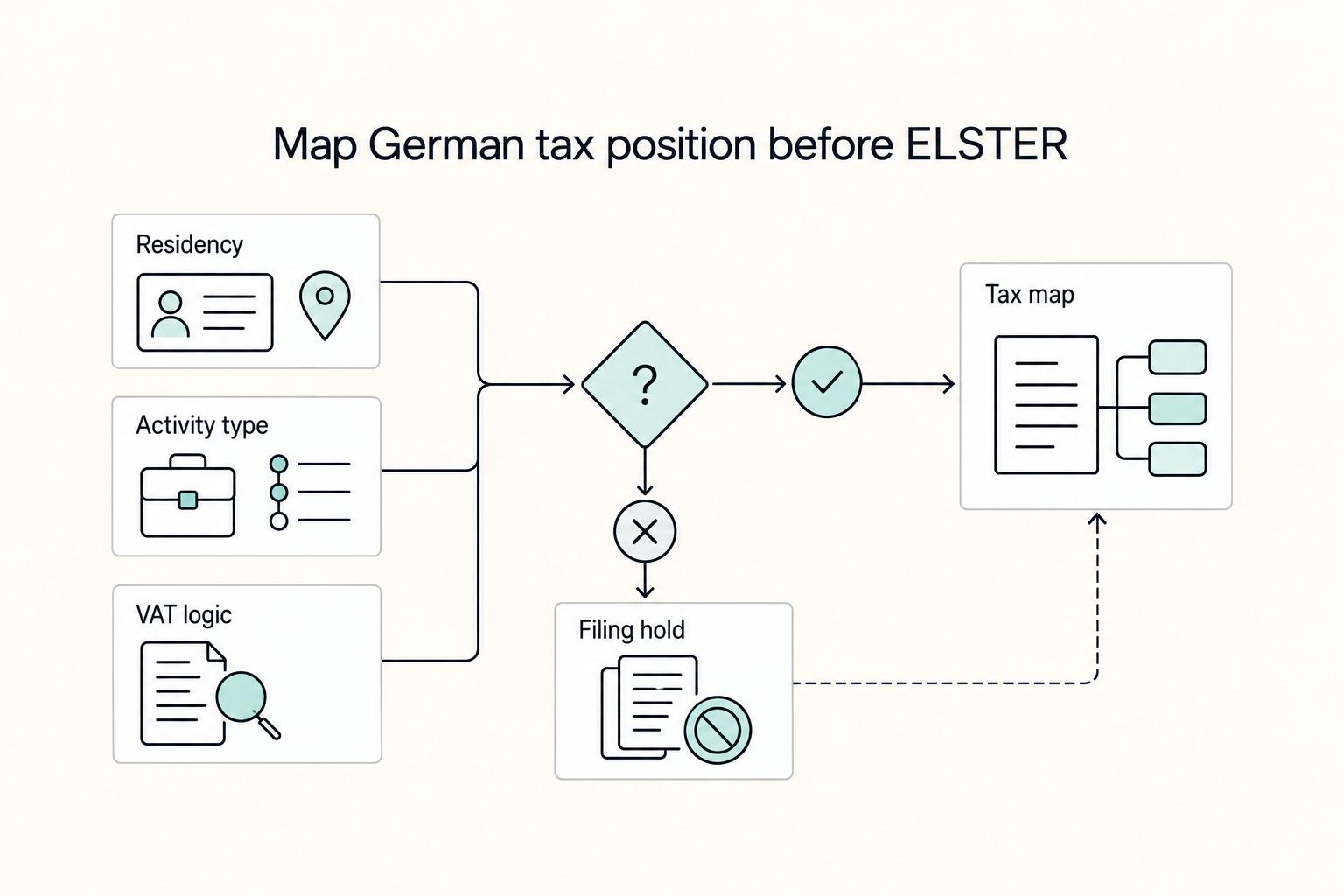
Set your German tax position first, then register and file. If you are a globally mobile consultant, a lower-risk approach is a clear decision order, not a tax shortcut.

Freiberufler vs Gewerbetreibender for German Freelancers
**Classify first, then file and invoice from the same description.** The safer path is the one that matches your real services, not the one that looks easier on admin.