
Quick Answer
Yes, start by confirming an annual income tax return is required, because Form 8938 is attached to that return rather than filed on its own. Then classify your specified foreign financial assets, apply the threshold tied to your filing status and residence facts, and run a separate FinCEN Form 114 review. Before submission, do a dated check of current instructions at IRS.gov/Form8938 and escalate unresolved trust, entity, or indirect-ownership issues.
Start Here and Lower the Risk Before You File#
Start with one decision: are you filing an income tax return for the year? Form 8938 attaches to that return, and this guide is meant to help you handle Statement of Specified Foreign Financial Assets reporting under FATCA without guesswork. Treat current IRS instructions as something you check live, not as a one-time read, because the Form 8938 materials are updated as needed.
Write that first decision in a dated filing note before you gather documents. A short record of the return requirement, your filer-category assumption, and the date checked keeps the later steps anchored once the facts start to sprawl.
- Set the filing path first.
Confirm whether an income tax return is required for the year before you assess assets. If no return is required, Form 8938 is not required for that year.
- Keep the scope narrow.
Use Form 8938 for specified foreign financial assets when your total crosses the threshold that applies to your filer context. Do not treat it as a catchall for every cross-border filing.
- Run a separate FBAR check.
Form 8938 and FinCEN Form 114 are separate filing tracks. Filing one does not satisfy the other.
- Match the threshold to your facts.
IRS materials reference a $50,000 trigger for certain taxpayers and higher thresholds for some joint filers and taxpayers residing abroad. Use the threshold that matches your filing status and residence facts.
- Do a final instructions check before submission.
Right before filing, confirm you are using the current Form 8938 materials at IRS.gov/Form8938 and note the date in your records. Then move straight into scope and classification.
Understand What Form 8938 Actually Covers#
Form 8938 is an information-reporting requirement under Internal Revenue Code section 6038D, not a general foreign tax checklist. The form is titled Statement of Specified Foreign Financial Assets, and that phrase should drive your classification decisions from the start.
It is filed by attaching it to an income tax return, not as a standalone submission. Review scope, valuation, and threshold decisions as part of one return package, not as an isolated task done later.
Keep filer categories separate before you apply thresholds. Specified individuals and specified domestic entities are different paths, and a result from one does not automatically carry over to the other. Keep Form 8938 and FBAR separate as well: FBAR is filed with FinCEN, not the IRS, and neither filing replaces the other.
A lot of filing trouble starts here: teams treat Form 8938 as a late add-on after the return is mostly done. That creates rushed classification calls and thin support notes. Treat this form as part of the return build from day one so later review is faster and cleaner.
Prepare Your Filing Pack Before You Touch the Form#
Build the records first, then decide what belongs on the form. That keeps you from making memory-based calls once totals or ownership details get messy.
| Step | Focus | What to keep |
|---|---|---|
| 1 | Confirm filing context | Expected return such as Form 1040 or Form 1040-NR, plus a dated note with your tax-status assumptions for the year |
| 2 | Evidence folder per potential asset | Statements, ownership records, and issuer documentation in one place, with consistent file names |
| 3 | Valuation and currency logs | A valuation folder, a currency conversion log, and the conversion details relied on if conversions are needed |
| 4 | Platform payout records | If you use Gruv where supported, export payout and transaction records to a dated folder; keep raw exports unchanged and sort in working copies |
| 5 | Final instructions check | The latest Form 8938 materials at IRS.gov/Form8938 and a separate FBAR assessment before finalizing |
- Step 1: Confirm filing context.
Identify the return you expect to file, such as Form 1040 or Form 1040-NR, and add a dated note with your tax-status assumptions for the year.
- Step 2: Build one evidence folder per potential asset.
For each specified foreign financial asset you might report, collect statements, ownership records, and issuer documentation in one place. Use consistent file names so review is fast.
- Step 3: Set valuation and currency logs before calculations.
Create a valuation folder and a currency conversion log before you total anything. If conversions are needed, use the U.S. Treasury Fiscal Data Currency Exchange Rates Converter Tool as your reference and record the conversion details you relied on.
- Step 4: Save platform payout records in a dated folder.
If you use Gruv where supported, export payout and transaction records to a dated folder. Keep raw exports unchanged and do your sorting in working copies.
- Step 5: Recheck current instructions before final prep.
Before finalizing, confirm the latest Form 8938 materials at IRS.gov/Form8938. At that same checkpoint, separately assess whether an FBAR filing is also required.
Before you move on, scan each folder for three basics: evidence of value, evidence of ownership, and a note explaining any uncertainty. If any one of those is missing, stop there instead of pushing ahead. If a required record is missing, fix that gap before threshold analysis.
Confirm Whether You Are a Likely Filer#
If your facts are mixed, keep the case potentially in scope until the records support a clear no. That helps you avoid a late reversal when residency, ownership, or return requirements get reviewed again.
Start by confirming return type and filing requirement. Form 8938 is attached to an income tax return, so no required return means no Form 8938 filing for that year. Then separate filer category before threshold testing. A specified individual analysis is not a substitute for a specified domestic entity analysis.
Use threshold figures as a screen, not a shortcut. IRS materials include a $50,000 trigger for certain U.S. taxpayers and also reference higher thresholds for some joint filers and taxpayers residing abroad. If filing status, residency, or ownership is unclear, keep the case open until documents resolve the uncertainty.
To keep your file auditable, use simple status labels in your worksheet: yes, no, and pending evidence. The pending evidence bucket helps block premature conclusions.
Before you move forward, log how each eligibility answer was verified: the question, your answer, the IRS instruction or page used, and the date checked. That record makes your yes or no easier to defend later.
Build a Complete Asset Inventory and Avoid Blind Spots#
A complete inventory lowers filing risk because missed items and undocumented exclusions tend to create trouble later.
| Inventory area | What to record | Note |
|---|---|---|
| Master table | Asset name, legal owner, country, account or instrument type, likely status as specified foreign financial asset, evidence file name, and status | Use in scope, out of scope, or needs review |
| Form structure | Foreign deposit or custodial accounts and other foreign assets | Do not stop at bank accounts |
| Tax-year activity | Accounts closed during the year and assets acquired or sold during the year | Each row shows no activity or a brief activity note linked to records |
| Trust-connected items | Any item that touches a trust | Mark for extra review; Forms 3520 and 3520-A may also be relevant; Rev. Proc. 2020-17 does not affect section 6038D reporting obligations |
| Exclusions and indirect ownership | Certain accounts maintained by a U.S. payer, jointly held items, or indirectly held items | If removed, keep rows visible, mark for review when needed, and attach the supporting document |
- Build one master table before classifying.
Track asset name, legal owner, country, account or instrument type, likely status as specified foreign financial asset, evidence file name, and status (in scope, out of scope, or needs review).
- Mirror Form 8938 structure from day one.
Split entries into foreign deposit or custodial accounts and other foreign assets. Do not stop at bank accounts.
- Track tax-year activity, not just current holdings.
Flag accounts closed during the year and assets acquired or sold during the year. Each row should show either no activity or a brief activity note linked to records.
- Flag trust-connected items early.
If an item touches a trust, mark it for extra review. Forms 3520 and 3520-A may also be relevant. Rev. Proc. 2020-17 exempts some reporting on those forms for certain tax-favored trusts, but it does not affect section 6038D reporting obligations.
- Document exclusions, especially shared or indirect ownership.
Some accounts are not required to be reported on Form 8938, including certain accounts maintained by a U.S. payer. If you remove jointly held or indirectly held items, keep those rows visible, mark them for review when needed, and attach the document that supports the final call.
When ownership is indirect, add a plain-language note tracing the chain from the taxpayer to the asset. That often speeds final review because it shows why a line is included, excluded, or escalated. Before the next step, freeze a dated copy of this table so later edits do not erase your reasoning trail.
Apply Threshold Logic Without Taking Aggressive Shortcuts#
Apply thresholds only after classification is stable. If classification is still unclear, take the conservative view and document why under section 6038D.
- Step 1: Use current IRS Form 8938 instructions first.
Start with the most recent Form 8938 materials before you run any threshold test, and log when you checked them. Checkpoint: Your notes identify the instruction set and date used.
- Step 2: Map filer type and residence before selecting a threshold.
Confirm specified person status, then apply filing status and residence assumptions. If no income tax return is required for the year, Form 8938 is not required for that year. Checkpoint: Your file shows return requirement, filing status, and residence assumption.
- Step 3: Resolve ambiguity conservatively.
If the facts do not clearly support a higher-threshold position, use the stricter interpretation and record what evidence would change the result. Red flag: A higher-threshold choice based on memory rather than records.
- Step 4: Put the case in a triage box before filing.
| Outcome | Use when | Immediate action |
|---|---|---|
| File | Totals appear above the threshold you can support, or facts are mixed | Prepare Form 8938 and keep support records |
| Likely not required | Totals appear below threshold and classification records are clean | Keep worksheet and records in case the position is reviewed |
| Ask a pro now | Residence, entity status, or ownership facts remain uncertain | Escalate with inventory, assumptions, and open questions |
After triage, freeze the assumption set used for that result. If facts later change, update the assumption note before changing the outcome so your file shows why the decision moved.
- Step 5: Test one mobile-consultant scenario before finalizing.
If you are dealing with a consultant who changed countries mid-year and closed one account near year-end, thin residence records are a reason to use the conservative threshold path and document the reasoning. Run a separate FBAR review, since Form 8938 does not replace FBAR filing when FBAR is otherwise required.
Value Assets and Convert Currency in a Defensible Way#
Consistency matters more than perfection here. Pick one valuation and conversion approach, apply it line by line, and reconcile before you attach the form to your return.
- Step 1: Lock valuation dates before calculations.
Use the current Form 8938 instructions for valuation-date rules, and note the instruction version in your worksheet.
- Step 2: Capture source documents for local-currency values.
Save the statement or account record that supports each line value on the selected date. If you cannot tie a number to a dated record, mark it unresolved.
- Step 3: Use one posted exchange-rate source consistently.
The IRS states that it has no official exchange rate and generally accepts any posted rate used consistently. Choose one posted source and apply it consistently.
- Step 4: Convert each line to U.S. dollars and log the rate.
Amounts on U.S. tax returns must be in U.S. dollars. If an amount is tied to a specific receipt, payment, or accrual date, use the prevailing spot rate for that date and keep the source reference.
- Step 5: Reconcile before final review.
Tie out each line across source value, exchange rate, and USD amount, then confirm section totals match your worksheet. Verification checkpoint: Form 8938 working totals reconcile to statements and conversion notes.
Keep an unresolved queue for lines that fail reconciliation. Clearing that queue before final sign-off is often the difference between a clean submission and a stressful last-minute rewrite. If a material line still lacks a defensible valuation date or documented conversion rate, escalate before filing.
Attach Form 8938 to the Right Return and File on Time#
The timing rule is simple: attach Form 8938 to the income tax return you are required to file, and set internal deadlines early enough to clear open issues.
- Step 1: Confirm return requirement and filer category.
Confirm whether an income tax return is required, then confirm whether you are filing as a specified individual or a specified domestic entity. If no income tax return is required for the year, Form 8938 is not required. Expected outcome: Your notes show return requirement and filer category.
- Step 2: Attach Form 8938 to that return package.
Treat Form 8938 as part of the same annual filing set, not a standalone submission. Checkpoint: Form 8938 is present in the final return package.
- Step 3: Build a filing calendar tied to the return timeline.
Set internal cutoffs for document readiness and final attachment review. Red flag: Open ownership, valuation, or classification questions at final sign-off.
- Step 4: Use Publication 519 and Publication 570 for residency context only.
If residency affects your filing path, use these publications to clarify context while keeping current Form 8938 instructions as primary.
- Step 5: Keep one submission packet.
Store the filed return, Form 8938, and evidence records together, including your instruction-version note.
Use your calendar as a decision control, not just a reminder list. If you miss the document-readiness cutoff, escalate early so classification and valuation decisions are still made carefully.
Compare Form 8938 and FBAR So You Do Not Miss Either#
Treat Form 8938 and FBAR as two separate decisions from start to finish. Problems usually show up when one result is assumed to cover both.
- Step 1: Build a side-by-side map first.
| Check | Form 8938 | FinCEN Form 114, Report of Foreign Bank and Financial Accounts (FBAR) |
|---|---|---|
| Purpose | Report specified foreign financial assets when the applicable threshold is met | Report foreign bank and financial accounts under FBAR rules |
| Filing channel | Attach to the return filed with the Internal Revenue Service (IRS) | File directly with FinCEN, not with the IRS |
| Trigger concept | Threshold-based and tied to filer category | Separate FBAR test under its own rules |
Treat these as distinct filing tracks with separate conclusions. A practical sign-off method is to keep two completion checkboxes for every overlap account: one for Form 8938 analysis and one for FBAR analysis. If either box is blank, filing is not complete.
- Step 2: Run Form 8938 thresholds on their own terms.
Use thresholds that match filer category and residence facts. For specified individuals living in the U.S., examples include $50,000 year-end or $75,000 any time for unmarried or married filing separately, and $100,000 year-end or $150,000 any time for married filing jointly. Checkpoint: Workpapers show the threshold set used and why.
- Step 3: Run a separate FBAR determination.
Filing Form 8938 does not relieve a separate FBAR filing duty when FBAR rules apply. Decision rule: If an asset may fall under both regimes, complete both analyses separately.
- Step 4: Keep matching support for overlap assets.
If one account appears in both regimes, keep two review lines tied to the same account ID and retain matching statements for each determination.
- Step 5: Manually verify output before filing.
A completed status in your system does not prove both filing obligations were resolved correctly. Red flag: A system shows both complete, but workpapers do not show separate determinations.
Know the Escalation Triggers and Bring the Right Questions#
Escalate when the structure is complex, not when the arithmetic is tedious. Early escalation reduces late rewrites and filing risk.
- Step 1: Flag structural complexity early.
Escalate when facts involve trusts, entity layering, or unclear ownership or classification details. That includes cases that may touch Form 3520, Form 3520-A, or specified domestic entity rules for certain domestic corporations, partnerships, and trusts. Verification checkpoint: Inventory includes a complex structure flag for each trust- or entity-held line item.
- Step 2: Escalate classification uncertainty before filing.
If you cannot clearly classify whether an item is a specified foreign financial asset, stop and escalate. Form 8938 is a continuous-use form, so confirm current instructions before final classification calls. Decision rule: If you cannot defend a classification in one sentence tied to current instructions, move it to an unresolved list.
- Step 3: Keep trust-reporting exceptions separate from section 6038D duties.
Rev. Proc. 2020-17 can exempt certain foreign trust information reporting on Forms 3520 and 3520-A, but it does not remove section 6038D reporting obligations.
- Step 4: Bring a tight escalation packet.
Send the return type, full asset inventory, valuation log, and unresolved points tied to section 6038D. For each unresolved item, include tentative classification and what fact would change the outcome. Expected outcome: Practical answers that map directly into filing workpapers.
When you draft escalation questions, ask for a direct yes, no, or conditional answer per item. That format can cut down on back-and-forth and makes it easier to map advice to the exact line item that needs a decision.
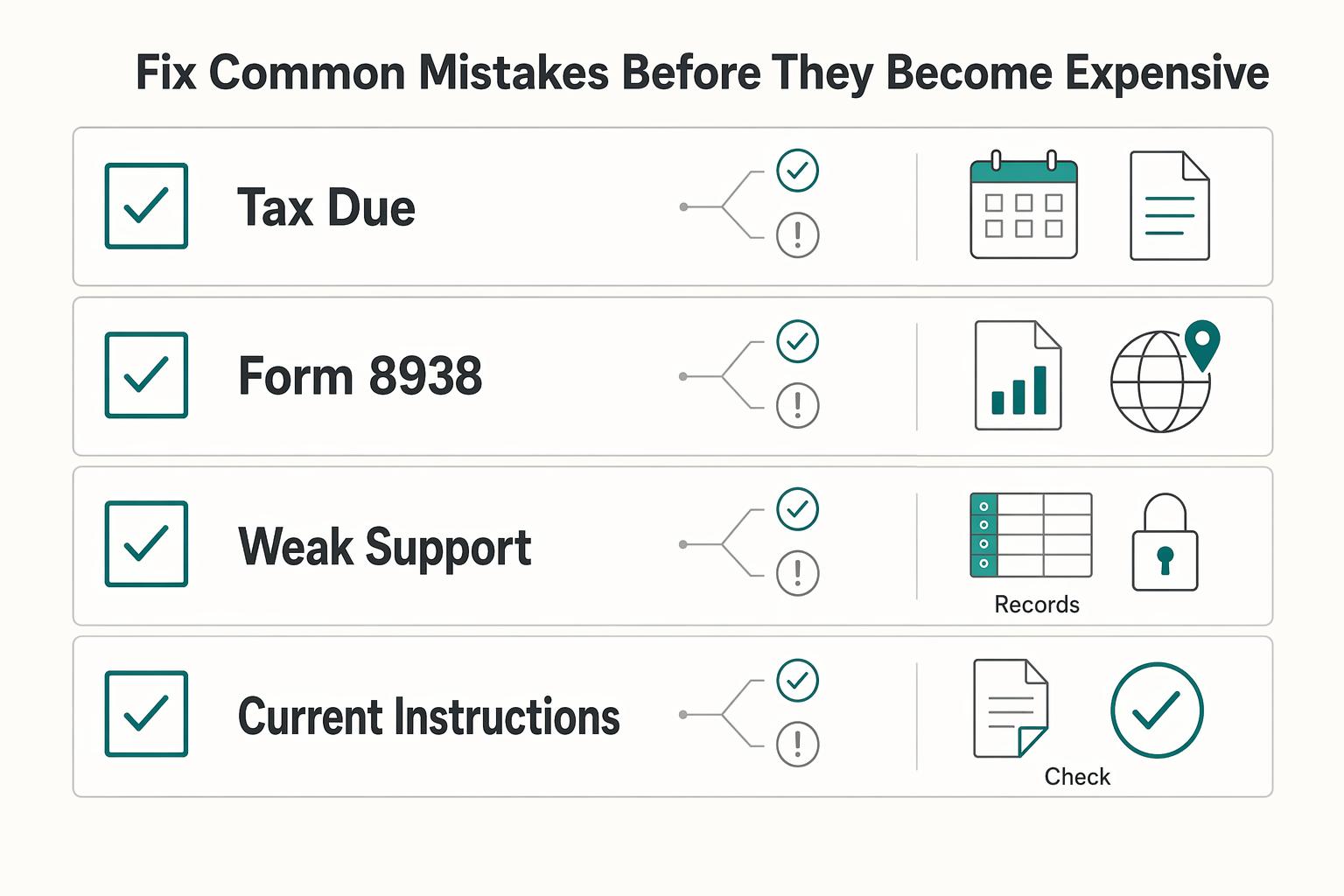
Fix Common Mistakes Before They Become Expensive#
The costly mistakes usually come from mixed obligations or weak records.
| Issue | What to verify | Recovery |
|---|---|---|
| Tax due vs. reporting duty | Record both decisions before filing: income tax return required and threshold met | If no income tax return is required, Form 8938 is not required |
| Form 8938 vs. FBAR | Keep Form 8938 and FinCEN Form 114 as separate obligations with separate filing channels | Keep independent statuses with separate sign-off |
| Weak support | Rebuild asset-value support and related records before final filing calls | Every include or exclude decision links to a document and brief rationale |
| Current instructions | Use a final pre-submit check to confirm the latest Form 8938 materials and rerun any affected decisions | Log the review date and what changed, if anything |
- Step 1: Separate tax liability from reporting duty.
Start with filing requirements, not just whether tax is due. Form 8938 is a reporting form for specified foreign financial assets above the applicable threshold and is attached to the return. For some specified individuals living in the U.S., examples include more than $50,000 at year-end or more than $75,000 at any time. If no income tax return is required, Form 8938 is not required. Verification checkpoint: Record both decisions before filing: income tax return required and threshold met.
- Step 2: Run Form 8938 and FBAR checks separately.
Form 8938 and FinCEN Form 114 are separate obligations, and filing one does not replace the other. FBAR is not filed with the IRS. Recovery: Keep independent statuses with separate filing channels and separate sign-off.
- Step 3: Rebuild weak support before final decisions.
If your documentation is thin, rebuild asset-value support and related records before final filing calls. Expected outcome: Every include or exclude decision links to a document and brief rationale.
- Step 4: Recheck current instructions right before submission.
Use a final pre-submit check to confirm the latest Form 8938 materials and rerun any affected decisions. Final check: Log the review date and what changed, if anything.
If your team can spare it, use a short pre-submit freeze where no new assumptions are allowed without written support. That control helps catch avoidable errors before filing.
Copy and Paste Filing Checklist#
Use this as a final pre-submit control: confirm guidance, filing path, scope, evidence, and escalation before anything is sent.
- Confirm current guidance.
Review the latest Form 8938 instructions and updates at IRS.gov/Form8938 right before filing, and save what you reviewed in your tax folder. Checkpoint: You have a dated note showing when you checked and whether anything changed.
- Confirm return path and attachment.
Confirm the annual income tax return you are filing and verify that Form 8938 is attached to that return, not filed by itself. Red flag: Form 8938 is prepared but not confirmed in the final return package.
- Confirm scope for specified foreign financial assets.
Review your asset inventory line by line and record why each item was included or excluded. Apply threshold rules for your filer context, not from another case. If unclear: Move the item to unresolved and escalate before filing.
- Confirm FBAR was checked separately.
Run a separate FinCEN Form 114 (FBAR) check and record that outcome independently from Form 8938; filing Form 8938 does not replace FBAR when FBAR is otherwise required. Failure mode: One note says foreign reporting done with no distinct FBAR result.
- Confirm valuation and conversion evidence.
For each reportable item, keep the source statement, valuation note, and currency conversion record together. If you used the U.S. Treasury Fiscal Data Currency Exchange Rates Converter Tool, save the conversion reference and date used. Checkpoint: Totals reconcile to statements and conversion logs.
- Confirm unresolved issues were escalated.
List open edge cases, what is unclear, and what depends on professional judgment. Send that packet to a qualified tax professional and log the response and final decision for each item.
- Confirm the final eligibility gate.
Recheck whether an income tax return was required for the year. If no return is required, Form 8938 is not required. If a return is required, keep the completed form and evidence packet together.
Mark each checklist line with date, initials, and status in your filing notes. Need a quick next step? Browse Gruv tools.
Take the Low-Stress Route and Stay Consistent#
Low-stress filing comes from repeatable behavior, not aggressive interpretation: make clear decisions, keep complete records, and escalate ambiguity early.
- Lock your filing position before submit.
Decide whether Form 8938 applies to your return and record that decision in plain language. If the facts are mixed, escalate instead of guessing.
- Anchor every line to evidence.
For each reportable item, keep supporting records that tie back to what you filed. Your support packet should reconcile to your return package.
- Keep Form 8938 and FBAR as separate decisions.
Form 8938 and FinCEN Form 114 are separate obligations, and one does not replace the other. Maintain distinct completion notes for each filing path.
- Recheck current IRS guidance right before filing.
Because Form 8938 instructions are continuous-use, do a final check at IRS.gov/Form8938 before transmission. Save a dated note of that check.
- Escalate unclear issues early and keep the answer.
When classification or threshold treatment remains unclear, escalate before filing and save the final guidance with your evidence records. Conservative, documented decisions are easier to defend than aggressive calls based on memory.
What lowers stress over time is consistency across years. Keep this year's decision notes, evidence folders, and final-check records together so next year starts from a documented baseline instead of memory.
For broader planning, continue with Digital Nomad Taxes in 2026 With a Defensible Filing Plan. Then review How to Set Up a US LLC as an Indian Citizen.
Frequently Asked Questions
What is Form 8938 and who is it for?
Form 8938 is the Statement of Specified Foreign Financial Assets. It applies to specified persons, including specified individuals and specified domestic entities, when the applicable threshold is exceeded. For most individual taxpayers, filing began with the 2011 return for tax years starting after March 18, 2010.
Who must file Statement of Specified Foreign Financial Assets?
You generally file when you are a specified person, you are required to file an annual income tax return, and your total specified foreign financial assets exceed the threshold for your profile. For specified individuals living in the U.S., examples include more than $50,000 at year-end or more than $75,000 at any time for unmarried or married filing separately, and more than $100,000 at year-end or more than $150,000 at any time for married filing jointly. If no income tax return is required for that year, Form 8938 is not required.
Does filing FinCEN Form 114 mean I can skip Form 8938?
No. FinCEN Form 114 and Form 8938 are separate filing obligations. Your result can be Form 8938 only, FBAR only, or both.
When is Form 8938 filed, and where does it get submitted?
Form 8938 is filed with your annual income tax return, not as a standalone filing. FBAR follows a separate channel and is filed directly with FinCEN, not with the IRS. Keep those determinations separate from start to finish.
What should I do first if I am not sure I meet the filing threshold?
Confirm filer category and whether an income tax return is required for the year. Then total specified foreign financial assets using year-end and any-time values and compare against the threshold for that profile. If still unclear, verify against current IRS Form 8938 instructions before deciding not to file.
Which return types can include Form 8938?
Form 8938 is included by attaching it to the annual income tax return you are required to file. It is not filed separately. Before submission, confirm you are using the most recent IRS Form 8938 instructions.
What documents should I keep in case the IRS asks for support?
Do not assume there is a detailed document checklist. Use the filed return with attached Form 8938 and any separate FBAR filing record as your core reference, then follow the most recent IRS Form 8938 instructions for current documentation details.
Try a related tool
Researched and edited by the Gruv editorial team. Gruv builds cross-border billing, payouts, and finance-operations software for global businesses.
Sources
Educational content only. Not legal, tax, or financial advice.
Related Posts

Digital Nomad Taxes in 2026 With a Defensible Filing Plan
With digital nomad taxes, the first move is not optimization. It is figuring out where you may be taxable, where filings may be required, and what proof supports that position.
How to Set Up a US LLC as an Indian Citizen
Avoiding rework is mostly about sequence. In many states, foreign entities can be LLC members, but costly mistakes can happen when formation, tax setup, and recordkeeping are treated as one task.

The Freelance Payment Penalty: A Modeled Audit of Platform Fees, FX Spreads, and Payout Delays
The money rarely disappears through a single, easy-to-spot fee. The real loss is stacked. A marketplace takes its commission, a processor adds a charge for international cards, a bank or payment company converts the currency at a spread, a platform holds the funds before release, and a wire sheds a little to intermediaries on the way in. Each layer looks defensible on its own, but the worker feels the combined result as a smaller deposit and a later payday.