
Quick Answer
What is financial therapy? It is support that helps you understand how thoughts, feelings, and behaviors affect money decisions, especially under stress. For freelancers, its value is practical: translate emotional patterns like avoidance or people-pleasing into repeatable controls such as signed SOW gates, same-day invoicing, clear follow-up cadence, and escalation rules so you execute consistently when pressure rises.
Treat money emotions as an operational risk in your invoicing#
Treat money emotions as an operational risk, then install default rails that keep your invoicing and terms clean even when you feel pressure. If invoicing feels heavier than it should, you might not be looking at an accounting problem. You might be looking at a pattern that shows up inside your ops.
If you invoice clients, you may recognize pieces of this loop. You price conservatively "to be safe." You wait to send the invoice until you feel confident. You check your balance too often, then you agree to fuzzy payment terms to preserve the relationship. That does not make you weak. It means your money mindset is grabbing the steering wheel at the exact moment you need consistency.
Here's the practical bridge without getting abstract: use money-pattern awareness (the thoughts, feelings, and urges that show up around money) as a cue to tighten operations (the documents, gates, and follow-ups that reduce downside). Pair them and you can reduce delays, cut disputes, and lower the odds of painful payment surprises.
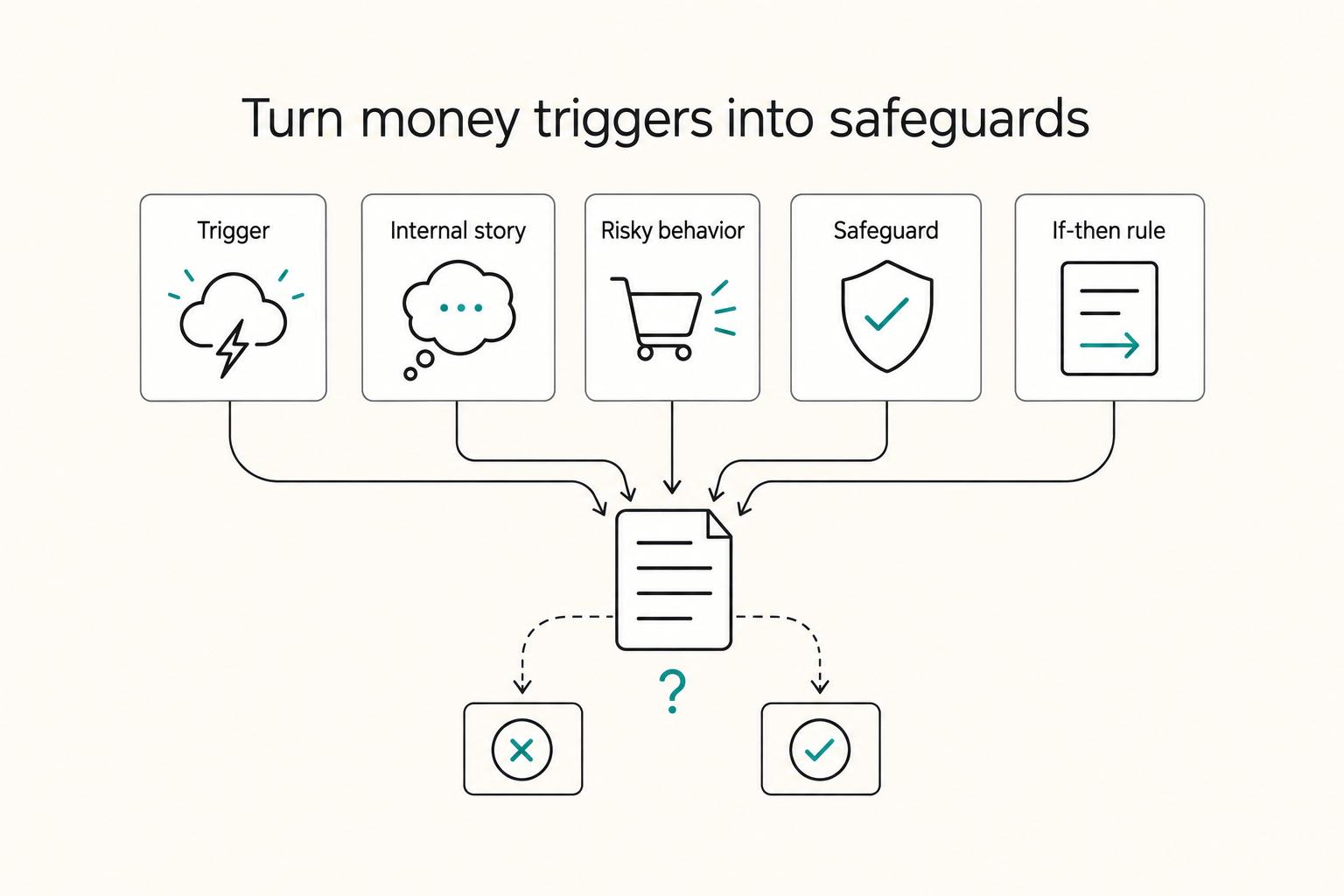
The Pattern → Safeguard mapping (quick, reusable)#
Run this in a notes doc before you send your next proposal.
| Step | What to name | Article example |
|---|---|---|
| Name the trigger | What moment spikes financial anxiety? | Rate pushback; deposit request; silence after delivery |
| Name the story | The sentence your brain offers | "If I enforce terms, I lose them." |
| Name the risky behavior | What you do next | Delay invoice; start work without a signed SOW; accept vague milestones |
| Install one safeguard | A control you can point to | A clause; a gate; a checklist step |
| Write an if/then | What rule you follow next | "If I feel X, then I do Y." |
- Name the trigger: What moment spikes financial anxiety? (Rate pushback, deposit request, silence after delivery.)
- Name the story: The sentence your brain offers. ("If I enforce terms, I lose them.")
- Name the risky behavior: What you do next. (Delay invoice, start work without a signed SOW, accept vague milestones.)
- Install one safeguard: A control you can point to (a clause, a gate, a checklist step).
- Write an if/then: "If I feel X, then I do Y."
Hypothetical: A client asks you to start "this week" and promises they will sign later. If your pattern leans toward people-pleasing, your safeguard is simple: no signed SOW, no start. Stay kind. Stay firm. Keep your financial wellness intact.
Quick translator: emotions to controls#
| Pattern under stress | What breaks in ops | Risk-first safeguard to install |
|---|---|---|
| Avoidance | You delay sending the invoice | "Invoice goes out the same day the milestone completes" rule plus a scheduled follow-up |
| Boundary collapse | You accept messy payment terms | A baseline SOW template you do not edit under pressure, including a Termination clause |
| Scarcity thinking | You start work too early | A "deposit paid before kickoff" gate tied to kickoff scheduling |
If pricing insecurity is driving your terms, tighten your scope and value language next: Value-Based Pricing for Strategic Consultants: A How-To Guide. And if you decide to get help, choose support that matches what you're working on and confirm qualifications and fit.
What is financial therapy (and why freelancers should care)?#
Financial therapy is a concept that's become more mainstream as people try to understand how thoughts and feelings may shape financial choices. It's less about "perfecting the plan" and more about noticing what's getting in the way of following through.
When people ask what is financial therapy, keep it simple. It explores why you do what you do with money, especially when emotions override plans. HerMoney frames the rise of financial therapy around exactly that: "how our thoughts and feelings may shape our financial choices." In other words, your numbers can look fine and you can still get stuck.
A financial therapist (in the plain-English sense) helps you identify and change patterns that derail a healthier relationship with money. In the description of HerMoney Podcast Episode 183, financial therapist Amanda Clayman works with clients so "they can positively change their overall approach to their finances." For freelancers, that matters because your approach drives your follow-through, not your intentions.
A simple working model: Trigger → Story → Behavior → Outcome → Reinforcement#
Use this as a working model, not a diagnosis. Run it quickly, then choose one safer default.
| Step | What it can look like in freelancing | What to do next |
|---|---|---|
| Trigger | "Client might reject my rate." | Name it without arguing with it. |
| Story | "I'm overpriced." | Write the story down verbatim. |
| Behavior | Delay the next money step. | Pick one small default action you'll do anyway. |
| Outcome | More stress, more avoidance. | Use a clear process, not vibes. |
| Reinforcement | More financial anxiety, more hesitation. | Treat it as a loop you can break. |
Why this exists (and why a budget won't fix it)#
A spreadsheet can't negotiate with your nervous system. A perfect pricing model won't help if you cannot take the next step when you feel exposed, behind, or afraid of conflict.
Hypothetical: you finish a project and then go quiet instead of doing the practical follow-through. Financial therapy zooms in on the thoughts and feelings shaping that choice. And as Clayman puts it: "You can't change your financial circumstances overnight. It takes sustained effort and application."
Can financial therapy actually help you get paid faster?#
Not directly. Financial therapy can help you understand how stress, emotions, and beliefs shape money decisions, and that can make it easier to stick to consistent invoicing and follow-up habits. The move here is translation: you take pattern work (internal) and convert it into operational controls (external) that protect cashflow.
Financial therapy, as one clinician-written explainer puts it, "combines traditional therapy with financial counseling to explore how emotions, beliefs, and behaviors shape your financial decisions." That matters because getting paid rarely fails on math. It fails at the moment you need to act. Send the invoice, restate the boundary, follow your process, or say no to risky terms.
The translation rule (use this so you don't expect magic)#
Pattern work changes decisions. Ops changes outcomes. Keep that split clean and you set realistic expectations for your own financial wellness.
| Layer | What it changes | What you can actually control this week | What you should not expect |
|---|---|---|---|
| Financial therapy (pattern layer) | How you relate to money under stress (thoughts, feelings, behaviors) | How you respond when money pressure spikes (for example: the urge to delay, discount, or over-accommodate) | A therapist "fixing" late-paying clients for you |
| Operations (systems layer) | The paper trail and enforcement path | SOW clarity, invoicing timing, follow-up cadence, payment rails, escalation triggers | Instant compliance from every client |
RBC Wealth Management frames the macro trend simply: "The interplay of finance and psychology is changing the way people approach money decisions." Operator translation: fewer heated decisions, more default decisions.
Freelancer friction points where pattern work converts into cleaner ops#
Here's where the therapy-to-ops mapping usually hits in real life.
| Friction point | What happens under stress | Ops consequence |
|---|---|---|
| Pricing hesitation | Scope-softening to "win" | Statement of Work (SOW) under-specifies deliverables, scope creep grows, and disputes become easier to trigger |
| Fear of confrontation | You avoid the follow-up | Net terms drift into net-never |
| Scarcity thinking ("I need this client") | You accept weak contract defaults and unclear terms | Resolution can get more complicated if things go sideways |
- Pricing hesitation: Money stress can show up as scope-softening to "win." Then your Statement of Work (SOW) under-specifies deliverables, scope creep grows, and disputes become easier to trigger.
- Fear of confrontation: You avoid the follow-up, so net terms drift into net-never. Therapy can help you work through the emotions and beliefs driving the freeze. Ops gives you the script and cadence so you do not renegotiate with your nervous system each time.
- Scarcity thinking ("I need this client"): You accept weak contract defaults and unclear terms, which can complicate resolution if things go sideways.
Hypothetical: a client goes quiet after delivery, and you keep refreshing your bank app instead of sending the invoice. Therapy targets the reaction. Ops gives you the rule and follow-up cadence.
Safe expectation: aim for repeatable behaviors, not guaranteed speed. Your win looks like consistent execution under stress, even when your cash situation feels tight (as one freelancer quoted in Fidelity Canada put it, "Sometimes your Visa bill is just as much if not more than your rent."). If you also need to tighten how you quote and defend value, pair this with Value-Based Pricing for Strategic Consultants: A How-To Guide.
Financial therapist vs financial advisor vs psychotherapist - who does what?#
Use someone's title as a starting point, then confirm training, credentials, and scope in writing before you rely on them. Choosing help is an ops decision. Scope it like you would any vendor: deliverables, exclusions, and escalation paths.
Here's the practical reality for a business-of-one: your "get paid" system can touch behavioral finance, financial wellness, and sometimes mental health support. What a given professional can offer (and what they're allowed to offer) can vary by jurisdiction and credentialing.
Even the phrase "what is financial therapy" shows up in higher-education career content (for example, Maryville University hosts a page titled "What Is Financial Therapy? Financial Therapist Overview"), but a page title alone does not tell you what a specific practitioner can legally and ethically do.
A plain-English decision filter (use needs, not job titles)#
Start with the outcomes you need and ask who can deliver them under their credential.
| If you need help with... | Ask directly about... | Artifact you want to leave with |
|---|---|---|
| Stopping avoidance (sending invoices, following up, holding boundaries when you feel financial anxiety) | Their approach (education, coaching, counseling, therapy), and how they handle "money mindset" spirals | A written plan for your triggers and your follow-through rules |
| Decisions that could be regulated financial advice where you live | Whether they provide advice, and what credential, registration, or rules govern that work (if any) | A documented scope of work and any disclosures they provide |
| Mental health symptoms that feel primary and pervasive | Whether they're a licensed mental health clinician in your jurisdiction, and what their referral pathways look like | A plan for next steps (which may include a referral) |
| Contract and clause decisions (SOW, Termination clause, Arbitration clause) | Whether they provide legal advice, and how they recommend legal review | A list of questions for your attorney |
Hypothetical: you freeze every time you need to enforce your Termination clause in a Statement of Work (SOW). You do not need motivation. You need a professional who can help you rehearse the money conversation, pressure-test your scripts, and tighten your personal decision rules while staying inside their scope.
Safer hiring script (copy/paste)#
- "What training and credentials do you hold, and what governing body or board (if any) oversees your work?"
- "What services do you provide in sessions (behavior change, education, counseling, psychotherapy)? What do you explicitly not provide?"
- "If I describe financial anxiety or compulsive money behaviors, how do you screen for mental health needs and refer out?"
- "Do you give financial recommendations that could qualify as investment or tax advice here? If yes, under what credential or registration?"
- "How do you document scope so I can use the work to follow my invoicing policies consistently?"
The "Pattern → Control" framework: turn money feelings into payment safeguards#
Turn recurring money-related behavior patterns into explicit controls you can run repeatedly and review when stress spikes. In the spirit of financial coaching, the goal is to translate what you do under pressure into support, accountability, information, and tools you can actually follow.
In ops language, you build internal controls for your solo business. That matters because inadequate internal controls can contribute to serious financial failure modes. One Walden University doctoral study abstract puts it bluntly: "The failure of leaders in NPOs to implement adequate internal controls results in insolvency, the inability to pay off debts." You do not run an NPO, but the lesson still holds. Feelings do not sink you. Uncontrolled decisions do.
A one-page worksheet you can run on any client situation#
Keep it simple and concrete. Capture the situation where you tend to wobble, the story you tell yourself, the risky move you make next, and the control you want in place going forward. The point is not to write a manifesto. It is to turn a repeatable scenario into a repeatable safeguard.
Most importantly: define what you will keep as evidence that the control actually ran (for example, the agreement version you relied on, a dated approval, or a retrievable record of the decision).
Common freelancer patterns → controls (and what to file)#
Use these as starting points, then adapt with your counsel and your actual workflow.
| Pattern | Control | What to file |
|---|---|---|
| Avoid conflict when payment gets tense | Pick a written follow-up cadence, an escalation path, and a clear "what happens next" process | The communication trail and the agreement you are operating under |
| People-please in negotiations | Decide what you will standardize and what you will review carefully | The decision record: what changed, what did not, and which version is in force |
| Catastrophize when cash runs tight | Set a review routine for your pipeline and cash plan | The live document you actually update and use |
Control quality test: if you cannot show the exact evidence, you built a hope, not a control. Data discipline matters here too. As one data-quality practitioner notes, "Data lineage aligns directly with control evidence and model-risk documentation."
Make it measurable without pretending metrics solve emotions. Pick one observable check per control so you can verify it ran.
Want a quick next step for "what is financial coaching"? Try the free invoice generator.
Build your client-ready "Get Paid" system: terms, gates, and safe defaults#
Build a repeatable intake and documentation system that screens for risk, locks scope in writing, and creates clean evidence when money stress shows up. Your controls need a home. This is where you standardize how you onboard, contract, and collect.
Start with a baseline workflow (then deviate on purpose)#
Operators reduce financial anxiety by removing choices at the worst moments. One practical suggestion for dealing with late payers focuses on the front door: improve lead generation, segmentation, and customer screening so you accept better customers. In plain terms, you prevent the chase by choosing more carefully.
Define your baseline package as a simple, written workflow and set of documents you actually use. Treat it as a menu of artifacts to review with qualified counsel, not a universal legal template.
Hypothetical: a client asks for "flexible scope" and "we'll true-up later." Your old financial wellness pattern says yes to avoid tension. Your system says: "Happy to iterate, but we'll write the scope and what 'done' means first, then start."
If you need help pricing that scope cleanly, keep this nearby: Value-Based Pricing for Strategic Consultants: A How-To Guide.
Clauses, documentation, and decisions: set expectations, don't improvise#
Service agreements can get complicated fast. Treat the contract as a place to set expectations and reduce ambiguity, not something you negotiate from scratch under pressure. Do not wing it. Ask counsel what the language means for your work, and keep the final signed version easy to retrieve.
Keep your claims grounded, too. Follow the same discipline researchers use: prefer the primary (original) source when you rely on guidance.
What should you do this week? A 7-day implementation sprint (with artifacts you can reuse)#
Run a 7-day sprint that turns insight into repeatable cash-collection behavior, backed by written artifacts you can reuse under stress. You are not trying to become a different person in a week. You are building a process you can run when you are not at your best.
The 7-day plan (ship one artifact per day)#
Treat this like sprint execution: small, shippable outputs, then a sliver of time looking ahead. In Scrum guidance, teams often reserve 5 to 10% of sprint time to prepare upcoming work, typically 1 to 2 sprints ahead. Apply that operator logic here: ship today, prep tomorrow.
| Day | Outcome you ship | Artifact you keep |
|---|---|---|
| 1 | A "one-page policy" you follow when stressed | Policy doc (PDF or doc link) |
| 2 | Default templates with version control | SOW + core contract/email templates |
| 3 | Invoice discipline you can execute fast | Invoice rule + email scripts |
| 4 | Payment risk controls you enforce consistently | Rail policy + payment-hold playbook |
| 5 | Tooling with traceable records | A checklist of required logs/artifacts |
| 6 | A stress-tested process | A test script + failure notes |
| 7 | One financial-therapy action that reduces avoidance | Money script + booking link/task |
Day 1 (policy): Write three non-negotiables: your deposit rule, net terms rule, and stop work rule, and tie them to what your written agreement and scope documents already say. Add an escalation ladder you will follow every time: friendly reminder, firm reminder, pause work, formal notice per your agreement.
Day 2 (templates): Create version-controlled templates for your SOW and your standard communications (intro email, change request, acceptance request, late-payment follow-up). Version control matters because you want to know exactly what you sent and what the client agreed to.
Day 3 (invoicing): Adopt "invoice sent immediately after the milestone" as a behavior rule (discipline, not a promise of faster payment). Pre-write follow-ups that always include invoice ID, due date, and a single next step.
Day 4 (rails and holds): Decide when you accept card vs bank transfer based on your risk tolerance and dispute mechanics in your workflow. Write a "payment hold contingency" that says what you pause, what you ship, what you communicate, and when you switch rails.
Day 5 (traceability): Require traceable records: invoice status, payment confirmation, and a history you can reconcile. Map each step to the exact artifact you can export, screenshot, or store consistently.
Day 6 (stress test): Simulate a client who disputes scope, delays payment, and asks to change what was agreed. Confirm you can point to the signed SOW, written acceptance, and your escalation trigger without improvising.
Day 7 (therapy action): Write one money script you will use verbatim: "To start work, we require the deposit payment per the SOW." If panic or avoidance still drives decisions, consider booking a consult with a financial therapist. You build financial wellness by building follow-through, not by white-knuckling.
Cross-border and compliance reality: where rules vary - and how to confirm safely#
Treat cross-border payments as a different operating environment, because requirements and capabilities can vary by jurisdiction. This is where uncertainty spikes financial anxiety and tempts you into improvisation. Do the opposite. Verify.
Cross-border fintech creates real governance challenges. Research flags fragmented regulatory frameworks, legal uncertainty, and escalating cyber threats, plus tension between divergent data privacy laws. That means you should not assume your usual rail, terms, or documentation flow will work unchanged just because the client "can pay."
Confirm safely with a two-layer approach (ops first, then legal/tax)#
Use this as an operator pattern: verify what the system can do, then verify what you must do.
| Layer | What you confirm | What you keep as proof |
|---|---|---|
| Layer 1: Operational (provider reality) | Supported payment rails and payout routes in the relevant markets (availability can vary by program). Any identity verification or account gating your provider may require before funds move (often described as KYC/KYB, depending on the provider and market). | Screenshots or exports of provider docs, onboarding status, transaction logs, and reconciliation reports. |
| Layer 2: Legal/tax (your obligations) | Whether your Governing Law clause and Jurisdiction clause match the cross-border risk. What your contract requires around invoicing, disputes, and data handling (NDA/DPA where relevant). | Signed SOW and addenda, counsel guidance, and a document list you can produce under stress. |
Hypothetical scenario: you onboard a new overseas client, they ask to "just wire it," and your usual link-based method does not support their country. You do not improvise. You switch to the rail your provider documents for that corridor, then you confirm with counsel whether your jurisdiction and dispute path still protects you.
Plan tax and reporting artifacts now (and reduce PII risk)#
Do not wait for year-end to assemble chaos. Build a secure, minimal-data workflow that can support tax and reporting needs where applicable, including collecting tax forms or other documentation when a client, vendor, or program requests it. Store only what you need, lock access, and avoid scattering PII across email threads and shared drives.
Risk controls that prevent "mystery delays":
- Build buffer into payment timelines, especially early in new cross-border relationships.
- Write a "payment hold" policy you follow every time: what you pause, what you ship, what you communicate, and when you escalate.
- When immigration or residency status complicates your setup, use a separate checklist like Japan Digital Nomad Visa: A guide to avoid mixing legal ambiguity into your cashflow operations.
Where Gruv's posture fits: aim for compliance-first, audit-ready operations: policy gates, traceable records, and reconciliation exports. Treat feature availability as market and program specific, and confirm coverage directly through documentation or sales engineering before you promise a client a specific rail or payout path.
The bottom line: treat "money mindset" as a control layer in your payment operations#
Treat your money mindset like a system you can pair with simple routines, not like vague wellness. Notice the pattern, then choose a default that protects your focus and follow-through when you are not at your best.
This kind of work earns its keep when you name a specific pattern (avoidance, people pleasing, catastrophizing) and then pick a deliberate default you can run on a bad day. Think of it as taking the stuff you already know and making it executable in your actual week.
A practical "Pattern → Default" decision rule (keep it boring)#
Run this quick check anytime your financial wellness wobbles around a client:
- Pattern: What do you do when you feel stress (delay, discount, overdeliver, go silent)?
- Trigger: What moment sets it off (pushback, ambiguity, uncomfortable follow-up)?
- Default: What rule do you follow next, every time?
Here are examples of defaults you can keep on the shelf. Use counsel for legal review where needed.
| Where you feel stuck | Default you can implement | What it looks like in the real world |
|---|---|---|
| Avoidance after delivery | A "same-day admin" rule | You do the one follow-up or next-step message before you close your laptop. |
| People pleasing in negotiations | A written scope recap before work starts | You summarize what's in and out, and ask for a simple confirmation. |
| Panic about enforcement | An escalation rule | You stop debating in the moment and route the situation to review. |
| Fear of conflict | A short script + cooldown | You use your script, then wait a set amount of time before changing terms. |
Hypothetical scenario: you notice you keep "waiting to be polite" with one client. Your default is simple: send the next message today, put the next step on your calendar, and stick to your boundary.
Do one thing today, then lock it in#
Pick one client you feel stressed about. Run the three prompts above. Implement one safeguard today (send the follow-up, write the recap, or formalize what needs review). Then schedule a calendar reminder so Future You does not renegotiate with anxiety.
Finally, remember this operator truth from Futurpreneur: "AI works best as a partner, not a replacement for your thinking." Use tools to support your system, not to outsource your judgment.
If you need infrastructure to run the money lifecycle (collect, hold/track, convert when needed, and pay out) with audit-ready records and compliance gates where required, request access or talk to the Gruv team to confirm what's supported in your market or program.
Frequently Asked Questions
What is financial therapy in one sentence?
Financial therapy combines finance and emotional support to help you manage financial stress and make informed decisions. Investopedia puts it plainly: “Financial therapy combines finance and emotional support to help clients manage financial stress and make informed decisions.” Use it when your money mindset and your actions keep misaligning, even when you “know what to do.”
How is financial therapy different from financial advising and psychotherapy?
Financial therapy brings emotional support into money decisions, while financial advising centers on financial guidance and psychotherapy centers on mental health treatment. One practitioner-focused explainer calls financial therapy “a bridge between mental health and financial professional services like Financial Planning.” The practical question is scope: who helps you work with money stress and behavior, who helps you make financial decisions, and who treats mental health.
Who is financial therapy for, does it make sense for freelancers and creators?
Financial therapy can fit anyone who feels stuck in money behaviors, not just people with “big” money problems. If you have irregular income, client-driven cash flow, or payment uncertainty, it may be especially relevant because those situations can be stressful. If invoices trigger avoidance or people pleasing, financial therapy can help you bring more awareness and steadiness to what you do next.
Can financial therapy help if I have a financial plan but still feel money anxiety?
Yes. You can have a plan on paper and still feel overwhelmed or avoidant in the moment. Financial therapy is designed to pair financial work with emotional support, so you can explore what is driving the anxiety and how it affects follow-through. Example: you already have a budget, but you still cannot hit “send” on the invoice.
How does financial therapy apply to freelancers who invoice clients and deal with late payments?
It can help you work with the emotional and behavioral loops that show up around invoicing, follow-ups, and boundaries. Hypothetical scenario: a client drifts past due, you feel shame, and you avoid a direct follow-up even though you know you need to. As one practitioner description (attributed to Bari Tessler) frames it, a financial therapist may support “money healing (past), money practices (present), and money maps (future),” which can translate into noticing patterns and practicing a different default.
What should I do first: therapy, a financial plan, or both?
It depends on your bottleneck, and doing both can make sense for some people. If emotions and stress keep derailing your money decisions, starting with financial therapy may help you get steadier before you rebuild the plan. If you mostly need clarity on your numbers and next steps, starting with a simple plan can be useful, and you can add financial therapy if anxiety keeps disrupting execution.
How do I find a qualified financial therapist and verify credentials safely?
Start by asking about training, scope, and referral practices in a consult, and verify any stated credentials directly. One practitioner source notes Financial Therapy Association (FTA) certification applicants currently come from two home disciplines: financial planning or mental health. Ask direct operator questions about background, coordination with other professionals when needed, and what they do not do. Credentials and licensing can vary, so do not assume there is one universal “financial therapist” license.
Try a related tool
Researched and edited by the Gruv editorial team. Gruv builds cross-border billing, payouts, and finance-operations software for global businesses.
Sources
Educational content only. Not legal, tax, or financial advice.
Related Posts

Japan Digital Nomad Visa 2026: Six-Month Planning Runbook
Treat this as your operating model: identify the right mission first, commit to one route, and keep dated records before you make irreversible plans. That is what keeps the rest of your timeline, paperwork, and decisions coherent.

Value-Based Pricing for Strategic Consultants Under Real Payment Risk
Undercharging usually starts before the invoice: when you send one attractive number without clear pricing logic, ownership, or controls for scope or rate changes. In value-based consulting, your price and payment structure are one decision, so you need to build them that way.

The Freelance Payment Penalty: A Modeled Audit of Platform Fees, FX Spreads, and Payout Delays
The money rarely disappears through a single, easy-to-spot fee. The real loss is stacked. A marketplace takes its commission, a processor adds a charge for international cards, a bank or payment company converts the currency at a spread, a platform holds the funds before release, and a wire sheds a little to intermediaries on the way in. Each layer looks defensible on its own, but the worker feels the combined result as a smaller deposit and a later payday.