
Quick Answer
Digital nomads should treat estate planning as a two-layer system: legal documents that assign authority and an operational runbook that keeps cashflow and digital assets moving if you die or lose capacity. A will alone may not let someone collect invoices, access payout tools, or manage online accounts. Build a digital asset inventory, map money in motion, and have counsel confirm the jurisdiction-specific pieces.
You don't just need an estate plan - you need a "get paid even if I can't work" continuity system#
Treat estate planning for digital nomads as a two-part continuity system: legal intent plus operational execution, so your business keeps moving when you cannot. The common trap is thinking, "I have a will, so I'm covered." If you run a business-of-one, cashflow, logins, and process often live in your head until you deliberately externalize them.
Here's the operator reality: your income rarely arrives as a single paycheck. It comes in as open invoices, platform payouts, retainers, disputes, renewals, and account-to-account transfers. Traditional estate planning often focuses on the will-or-trust decision and skips the operations layer that determines whether anyone can actually collect, reconcile, or even identify what is owed.
The two-layer system (safe default)#
Layer 1: Legal intent sets authority and decision rights.
- Name the right people, such as an executor or equivalent role, plus any other roles your jurisdiction recognizes.
- Document who should receive what.
- Use instruments your counsel recommends, such as a will, possibly a trust, and, where appropriate, a power of attorney for incapacity planning.
- Common failure without it: people hesitate, argue, or cannot act confidently.
Layer 2: Operational continuity turns intent into cashflow.
- Create a digital asset inventory covering banking, invoicing, platforms, domains, cloud storage, and crypto wallets.
- Map "money in motion" so someone can see where invoices originate, where payouts land, and how you withdraw.
- Write a short runbook your representative can follow without improvising.
- Common failure without it: cashflow stalls because nobody knows what to do next.
Risk-first defaults (then flag jurisdiction items)#
Use these defaults across countries, then confirm the details locally. The rules still turn on your facts and circumstances:
- Assume cross-border complexity when you hold assets across jurisdictions.
- Centralize your source of truth. One secure folder beats ten scattered notes.
- Design for a non-technical executor. Write steps as checklists, not narratives.
Say you get hospitalized abroad mid-project. A client wants delivery proof for payment. A platform requests verification to release a payout. Subscriptions keep charging. If you already wrote the runbook and inventory, your trusted person can stabilize money movement quickly instead of hunting through inboxes.
The goal is simple: protect your people, your money movement, and your digital assets with a reusable workflow, then bring counsel in to validate the jurisdiction-specific pieces. Want a quick next step? Try the free invoice generator.
The two-layer mental model (and the terms you must get right before tactics)#
A useful two-layer model is legal intent to assign authority, plus operational continuity so your executor (or equivalent) can actually collect money and manage digital assets.
If you and your advisor mean different things by "will," "trust," or "fiduciary," you can build the wrong system even with good intentions.
A June 2025 academic article describes digital nomads as people combining location-independent work with ongoing travel. The same research notes that many may want a more residentially stable future. Either way, the travel layer creates the extra "what court, what country" reality you have to plan for, especially when your income pipeline lives in platforms and online bank accounts spread across borders.
The terms (plain-language alignment, not legal advice)#
Use these as working labels to communicate clearly with counsel and with your designated people. Then ask a licensed professional to map them to your jurisdiction.
| Term | What you should mean in practice (for this guide) | Common failure mode for nomads |
|---|---|---|
| Estate planning | Your overall plan for who can act, and what should happen to your stuff, if you die or lose capacity | You document intent, but ignore where your accounts "live" operationally |
| Will | A legal document that may be used to express who should receive property and who should administer the estate (terminology and effect vary) | It looks valid on paper, but nobody can access payment tools or receivables evidence |
| Trust | A legal arrangement that may be used to have someone manage assets for others (structure and rules vary) | You copy a template, then local rules and admin overhead create friction |
| Fiduciary | A person appointed to act for you (exact roles, powers, and titles vary) | Authority on paper still doesn't automatically translate into practical access and handoffs |
Say you lose capacity mid-trip. Your fiduciary knows they "have authority," but they still need the invoice list, the payout destinations, and the folder that proves delivery. Without that, clients stall, disputes time out, and subscriptions keep draining cash.
The winning model and the safe default#
Layer 1, Legal intent: pick the will or trust route with counsel, appoint the right fiduciaries, and identify the jurisdictions that matter, including where you have enduring ties and where key assets and accounts sit.
Layer 2, Operational continuity: build a runbook your fiduciary can execute without improvising:
- Digital asset inventory: online bank accounts, invoicing tools, domains, cloud storage, crypto wallets, and every place you receive payouts.
- Money-in-motion map: open invoices, platform balances, upcoming renewals, and disputes.
- Evidence and audit trail: where contracts, delivery proof, and client communication templates live.
Safe default for nomads: make the conservative assumption that legal documents alone may not unlock your digital life in practice. Treat legal documents plus executor-ready operations as the minimum viable system.
Related: A Guide to Superannuation for Australian Freelancers.
Do you need a will in every country you live in?#
It depends. If your assets and life span multiple legal jurisdictions, some legal sources recommend country-specific wills so your assets are distributed under local laws and you avoid disputes or invalidation.
Treat "where I am this month" as a weak signal. Focus on the stronger signals: which legal systems could touch your estate, and where your money and digital assets actually sit.
Here's the tension you need to hold. Some legal commentary pushes toward local coverage, arguing that country-specific wills can help align distribution with local laws and reduce disputes or invalidation. Other practitioners focus on the underlying issue: when assets, currencies, and legal jurisdictions spread across countries, professional guidance becomes essential. Without proper planning, digital assets, international bank accounts, and global investments can get pulled into complex proceedings that span multiple countries.
So do not count countries. Reduce conflicting jurisdictions.
Triage: when to stick with a primary plan vs when to consider country-specific documents#
Use this operator-grade decision filter:
-
If most of what you own is online bank accounts, subscription tools, client receivables, and a laptop, with no real estate abroad: cross-border complexity can still show up through digital assets and accounts, even without property. Start with professional legal guidance in your primary jurisdiction and ask whether a single core will is appropriate or whether you need additional country-specific documents.
-
If you have property, dependents, business equity, or meaningful holdings spread across countries: your assets may span multiple countries, currencies, and legal jurisdictions, and different systems may touch different pieces. Escalate to qualified legal counsel and specifically ask whether any country-specific wills are recommended for the countries where you hold assets.
Hypothetical: you rent month-to-month in several countries, but you keep your main banking relationship and platform payouts tied to one place. Use that asset reality as a starting point for the questions you take to counsel, not just the passport stamp.
Jurisdiction checks (and how to confirm without guessing)#
Run these checks after any major move or new asset, then confirm them with counsel:
- Home base: The place you treat as your core planning jurisdiction, often different from travel.
- Asset location: Where your high-value accounts live contractually and regulatorily, such as the bank country, platform entity, or exchange jurisdiction.
Then ask an estate attorney in your core jurisdiction:
- "How will my will interact with assets held abroad?"
- "Do you recommend a separate local instrument for any specific country where I hold assets?"
- "What should I do to help my fiduciary access my digital assets and online accounts, given provider policies?"
Will vs trust for digital nomads - what's the decision architecture?#
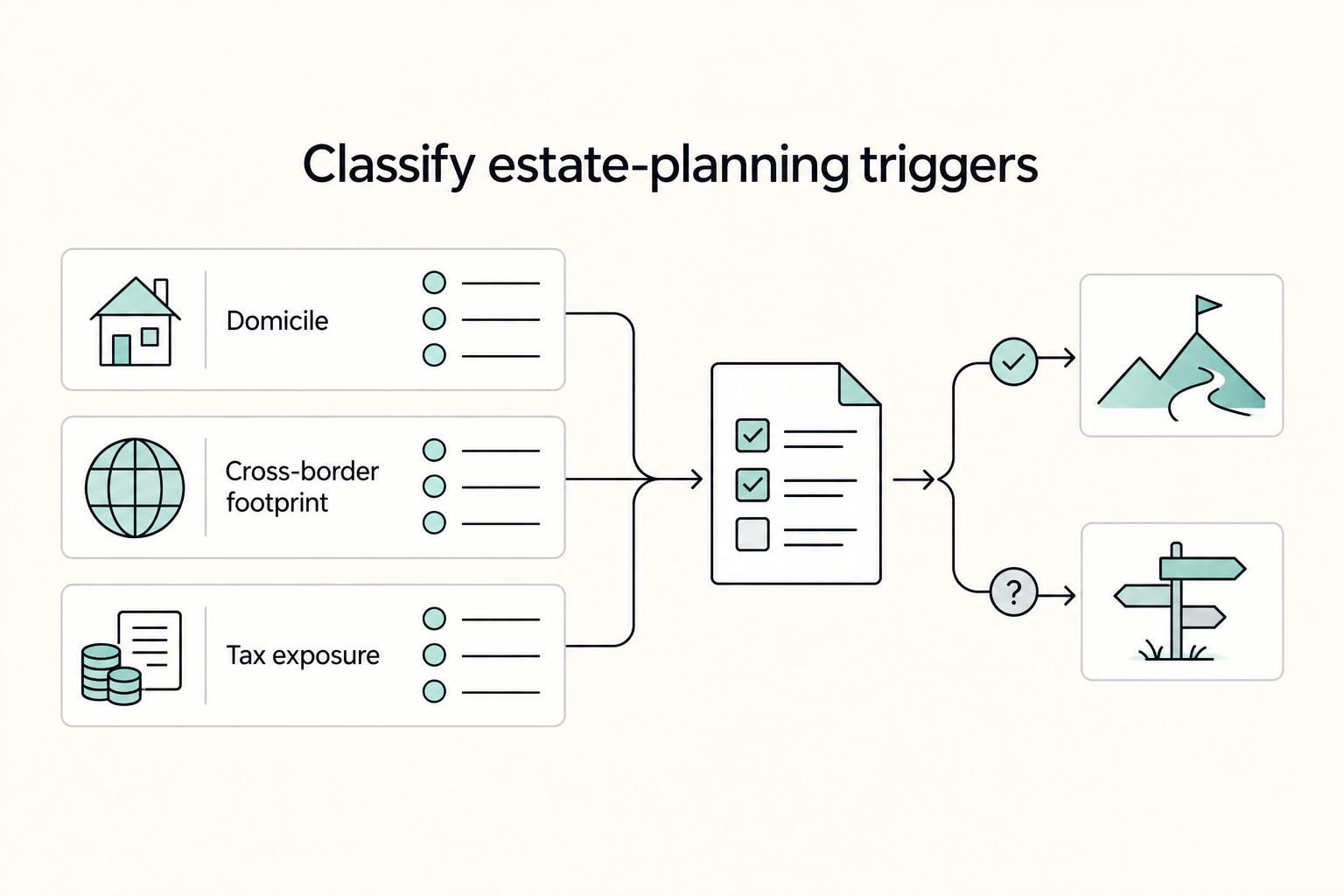
Start with complexity triggers - domicile, cross-border laws, and tax exposure, then pick the simplest plan that holds up in the jurisdictions you touch.
Once you stop counting countries and start following domicile and where assets sit, you can make decisions without guessing.
Domicile is generally the place you consider your permanent home. Many practitioners treat it as the first question, because the tax obligations that follow can shape the rest of the will-versus-trust conversation.
Step 1: Classify yourself with triggers (not vibes)#
Use this matrix to decide whether you're in lower-complexity territory, where you keep it simple and current, or higher-complexity territory, where you escalate and get qualified, jurisdiction-specific advice.
| Trigger | Lower-complexity signal | Higher-complexity signal (escalate) |
|---|---|---|
| Domicile | One clear domicile you can articulate | Multiple plausible home bases, or unresolved domicile questions |
| Cross-border footprint | Fewer cross-border legal touchpoints | More cross-border legal touchpoints, including assets, accounts, or obligations across countries |
| Tax exposure | Straightforward | If you are a U.S. citizen or long-term resident, you face U.S. income tax on worldwide income and U.S. estate and gift taxes on worldwide assets. Double taxation can occur if both the U.S. and your country of residence impose estate or inheritance taxes. |
Step 2: Choose instruments by what you need them to accomplish#
Treat "will vs trust" as a jurisdiction-specific design choice, not a status purchase.
- Bring your trigger profile - domicile, cross-border footprint, and tax exposure - to qualified counsel and ask what instruments, such as a will, a trust, or a combination, actually fit the jurisdictions involved.
- Build the human layer: appoint trusted executors and digital executors who can manage international assets and digital accounts as part of executing your plan.
- If double taxation is a concern on income earned across different countries, ask about tools like Double Taxation Agreements (DTA), where relevant.
Operational default: review the plan every 3 to 5 years or after major life changes.
If you want a deeper dive, read Japan Digital Nomad Visa 2026 Planning Runbook.
What happens to unpaid client invoices, payouts, and disputes if you're incapacitated?#
If you're incapacitated, what happens next depends on whether someone has legal authority to act for you. One of the most effective ways to make sure your wishes are carried out is to establish a power of attorney.
This is where Layer 2 either exists or it doesn't. Incapacity means the inability to make decisions for yourself due to physical or mental impairments. A power of attorney is a legal document that designates someone to make decisions on your behalf if you are unable to do so, and it can be financial or medical. A financial power of attorney can grant someone authority to manage your finances and pay bills.
Operator reality: receivables often live inside tools, dashboards, and email threads. If you do not map where things are and how you run them, the person acting on your behalf may be stuck piecing it together under pressure.
Build a "cashflow continuity map" your fiduciary can run#
Create a single page that lists every place money can sit in flight and where the related records live. Keep it readable, then link out to the detailed folder.
| Money surface | Examples | What to record (minimum) |
|---|---|---|
| Invoicing tool | Client invoices, reminders | Account name, where invoice records or exports live, who owns the client list |
| Card processor | Card payments, refunds | Account name, where transaction and refund records live, which notifications go to which inbox |
| Virtual Accounts | Local receiving details | Which clients pay here, where deposits and statuses are visible (where enabled) |
| Marketplaces, affiliates | Earnings dashboards | Account name, where payout records live, how support is reached |
| Bank transfers | Incoming wires, ACH equivalents | Receiving details you share with clients, how you match incoming payments to invoices |
Also capture any approval or policy gates you rely on, and who receives status notifications. Shared email aliases beat personal inboxes.
Put operator controls in writing (so nobody improvises with your money)#
Write a one-page receivables policy your fiduciary can follow under pressure:
- Invoice rules: what they're allowed to resend or follow up on, and what adjustments you're comfortable with.
- Dispute rules: what you consider "settle quickly" versus "escalate," and where supporting materials are kept.
- Evidence location: store contracts, delivery proof, and key email threads in cloud storage using a consistent folder standard, such as Client > Project > Invoices, Disputes, Deliverables.
Continuity principle: choose workflows with traceable records and clear status surfaces, for example Payouts tracking and Virtual Accounts deposit status where enabled. That gives a trusted person a cleaner reconciliation path instead of a scavenger hunt.
Will your executor actually be able to access online accounts and digital assets?#
Assume your executor cannot act on what they cannot find, identify, or prove you owned.
You need an executor-ready digital asset inventory that turns your digital life into a runnable checklist. Receivables mapping helps, but access and ownership clarity are the upstream bottlenecks. If your fiduciary cannot locate the right accounts, or the right source of truth for what exists, cashflow continuity and legacy planning both stall.
Modern planning for nomads should include digital assets, not just physical paperwork. That category can include online accounts such as email and social media. Treat that as your boundary. If you log into it, publish through it, get paid through it, or store value in it, it belongs in the inventory.
Build a Layer 2 digital asset inventory (executor-ready)#
Your goal is one document that a trusted person can use under stress without guessing. Keep it practical, and structure it around "what is it," "where is it," and "what does it control."
| Category | Examples to list | What your executor needs to know (minimum) |
|---|---|---|
| Money tools | Online bank accounts, card processors, invoicing apps, marketplaces | Provider name, account identifier, which email or phone ties to login, where payouts land |
| Digital property | Cloud storage, domains, newsletters, social media profiles | What revenue or reputation depends on it, renewal or billing owner, where key files live |
| Security-critical access | Any account or device that controls logins and recovery | Storage location, recovery prerequisites you require them to follow, who to contact for help |
Hypothetical: you run client work from cloud storage, collect payments through a processor, and route income into a separate payout account before moving it to your main bank. If your inventory names those systems and ties each one to its payout destination and billing owner, your executor can keep the lights on while they handle the legal steps.
Assign the right person, and reduce credential risk without improvising#
Pick someone who can follow process, not just someone you trust emotionally. On the human side of the system, you want trusted executors and digital executors who can manage international assets and digital accounts.
For credential handoff, do not improvise with screenshots and message threads. Use a dedicated, secure method you already operate. Document the minimum recovery path: what device holds multi-factor access, what happens if the phone goes missing, and who has the legal documents.
Operator's safe default: separate the account list from the access path. Put the inventory where your fiduciary can find it quickly. Keep the access mechanism controlled so you do not create new takeover risk while trying to solve continuity.
Give your executor a sequenced runbook for containment, collections, and documentation#
Give your executor a simple, sequenced runbook that prioritizes containment first, then collections, then clean documentation for legal and tax follow-through.
Your fiduciary needs an order of operations they can run without guessing, especially when they face locked accounts, anxious clients, and ongoing auto-charges.
Think of this as legacy planning for a business-of-one. The same way you would handle incident response at work, you stabilize first. Then you execute.
The runbook structure your executor can actually follow#
Build one page with a clear sequence, owners - primary executor, backup fiduciary, accountant, attorney - and links into your digital assets inventory. Keep it practical and scannable.
| Runbook section | What to include |
|---|---|
| Access and recovery | Where devices are; how to recover primary email or phone; how to use any password-manager emergency access (if enabled) |
| Money map | Where money comes in and goes out, including banks, marketplaces, payout dashboards, and recurring charges |
| Receivables and client comms | What is outstanding; who to contact; a pre-approved client message that clarifies who can communicate and where to pay |
| Documentation | Where your statements, transaction histories, contracts, and key emails live, plus a simple action log template with date, system, what changed, and why |
| Tax folder | The documents your tax pro will ask for, plus your own notes on edge cases |
Hypothetical: your executor can access your email but not your invoicing tool. If your runbook points them to payout status emails, your receivables list, and the exact client template to send, they can keep collections moving while your attorney handles formal authority.
Tax notes to include (especially for U.S. nomads)#
If you rely on FEIE, document the facts your tax pro will need so nobody has to reconstruct your travel history later.
| FEIE item | Article detail |
|---|---|
| Physical presence test | Physically present in a foreign country or countries 330 full days during any period of 12 consecutive months |
| Qualifying days | The 330 qualifying days do not have to be consecutive |
| Tax home | Your tax home must be in a foreign country |
| Filing requirement | FEIE applies only if you are a qualifying individual and you file a tax return reporting the income |
| 2026 maximum FEIE | $132,900 per person |
Also document your tax home position. For the physical presence path, the 330 full days can fall within any 12 consecutive months, and they do not have to be consecutive. FEIE applies only if you are a qualifying individual and you file a tax return reporting the income. For 2026, the maximum FEIE is $132,900 per person.
Operator's safe default: treat every executor action like it might face scrutiny later. If they pause a charge, resend an invoice, or export statements, have them record what they did and why. That audit trail can help reduce beneficiary conflict and make advisor follow-through easier.
The 90-minute implementation plan (owners, artifacts, and a review cadence you'll actually follow)#
Run one focused working session to produce executor-ready artifacts, not vague estate-planning intentions.
In one session: build the artifacts your fiduciary can actually use#
Treat this like ops work: one doc, one folder, clear owners. The goal is a small set of executor-usable artifacts, such as:
- A single inventory doc that maps your assets and money flows, for example where invoices get issued, where funds land, and how withdrawals happen.
- A basic executor packet - contact sheet plus continuity notes - that makes it clear who does what and where key info lives.
- A secure vault folder for legal and tax documents, with a plain-language README and a simple habit of revisiting it periodically and after major life or platform changes.
Hypothetical: you add a new marketplace with rolling holds. If you update the inventory the same day - payout destination, access method, and where status emails land - your executor avoids the classic failure mode: money exists, but nobody knows where to prove it or how to release it.
Operator note for U.S. nomads: if you track FEIE, store your qualifying notes. The IRS ties the physical presence path to 330 full days in a 12-month period, and the exclusion applies only if you file a return reporting the income. You do not need to solve taxes in this session. You need to preserve the evidence trail.
Minimum viable set of artifacts (copy/paste)#
| Artifact | What to include |
|---|---|
| Will/trust documents | As applicable |
| Executor + backup contact sheet | Stored securely |
| Digital asset inventory | Banks, platforms, cloud storage, cryptocurrency wallets |
| Access notes per account | Password manager access, legal process, or 2FA dependency |
| Client continuity notes | Key clients, contracts, renewal timing, invoicing rhythm, where templates live |
| Tax documents folder | Including FEIE notes where relevant |
| Review reminder + jurisdiction notes | Attorney and bar jurisdiction, date last reviewed, and what assumptions were confirmed |
The point of estate planning as a nomad: fewer legal surprises, fewer payment freezes, and a runbook someone can execute#
Estate planning as a nomad is most useful when it protects continuity: clear legal direction plus practical financial ops that someone else can follow. The goal is not perfect paperwork. It is reducing avoidable surprises when you can't act, especially around where money sits, how it moves, and what records prove what happened. Details can vary based on your specific facts and circumstances.
Layer 1 vs Layer 2 (what actually prevents chaos)#
One practical way to think about it is two layers that support each other.
Layer 1: Legal direction establishes authority and intent, so someone can act without guessing. The output you want is clear direction on who can do what. The failure mode it helps reduce is delay because no one can confidently act.
Layer 2: Operational continuity makes money and records findable, explainable, and usable across borders. The output you want is a checklist someone can execute. The failure mode it helps reduce is cashflow stalling because information is missing or unclear.
If you do only one thing this week: build the 90-minute packet#
Build a simple packet that someone you trust could use to keep the basics moving:
- Money map: where funds are held and received, including accounts or platforms, and what currencies you rely on.
- Access + process notes: how key accounts get handled if you're unavailable, using high-level steps rather than improvisation.
- Records map: where invoices, contracts, and proof-of-work live so someone can respond to routine requests.
Because rules vary by situation, confirm the jurisdiction-specific pieces with qualified counsel. Treat this as operational guidance, not legal advice.
Finally, think in money-movement risk, not just documents. Offshore bank accounts may simplify cross-border management and may help manage multiple currencies, reduce conversion fees, and access faster international payments. They can also offer privacy and asset protection. If you're a U.S. citizen abroad, tools like FEIE and tax treaties can reduce tax burden when used legally and responsibly, but specifics depend on your facts.
If you want a payments-ops-first way to reduce "money stuck in transit" risk, prioritize workflows with traceability, policy gates, and clear status surfaces for Payouts and receiving accounts, where enabled.
Frequently Asked Questions
Do digital nomads need a will in every country they live in?
No. You generally do not need a new will for every country you pass through. A safer default is one core will tied to your home base, plus an inventory of where your assets actually sit. If you buy property abroad, gain dependents, or build meaningful holdings in another jurisdiction, escalate to local counsel.
How should digital assets be included in an estate plan (passwords, crypto, domains, cloud files)?
Include digital assets in two layers: legal intent over who should control them, and operational access over how they can actually reach them. Put account lists and instructions in your executor packet, but keep credentials in a password manager with emergency access, not in your will. For crypto, document the wallet type, where recovery information lives, and any do-not-act instructions until legal authority is confirmed.
Will my executor be able to access online accounts and payment tools, or will providers block them?
Providers may block access when they see unusual logins or receive notice of death or incapacity. Your executor reduces friction with a clean asset inventory, a clear access method for each account, and a read-only drill completed while you are alive. Treat account access like operations: documented, tested, and permissioned.
What’s the difference between a will and an international trust for nomads?
In general, a will states who should receive property and who should administer the estate. A trust can change how assets are managed and transferred, but it can also add setup and ongoing administration that varies by jurisdiction. A practical rule is to start with a will for clarity, then explore trust structures when you have multi-country assets, dependents, business equity, or high downside risk.
What happens to unpaid client invoices if a freelancer dies or becomes incapacitated?
Unpaid invoices are often part of the estate, but collections can stall if no one knows what to send, where records live, or how to handle disputes. Your executor needs a receivables runbook with open invoices, contract links, client contacts, and rules for reminders, settlements, and chargebacks. A pre-built cloud folder with contracts and delivery proof helps them respond quickly.
How often should a digital nomad update their estate plan - and what events force an update?
Review the operational packet regularly, such as quarterly, and update it immediately after major jurisdiction or cashflow changes. Forced updates include changes to residency or domicile assumptions, new banks or major platforms, new high-value clients or contract models, marriage or divorce, a new child, or a major crypto custody change. If it changes where money lands or who can act, update the packet that same week.
If I’m a U.S. citizen abroad, do **UFADAA**, **FEIE**, or **FBAR** change what I should document for my executor?
FEIE can affect what you should document, and UFADAA and FBAR can also be relevant, but the details vary and should be confirmed with a qualified professional. For FEIE, the physical presence test is 330 full days in a 12-month period, the days do not have to be consecutive, your tax home must be in a foreign country, and you must file a return reporting the income to claim the exclusion. Store travel-day evidence, filed returns, FEIE workpapers, account details, and where statements live so your executor can find them quickly.
Try a related tool
Researched and edited by the Gruv editorial team. Gruv builds cross-border billing, payouts, and finance-operations software for global businesses.
Sources
Educational content only. Not legal, tax, or financial advice.
Related Posts

Japan Digital Nomad Visa 2026: Six-Month Planning Runbook
Treat this as your operating model: identify the right mission first, commit to one route, and keep dated records before you make irreversible plans. That is what keeps the rest of your timeline, paperwork, and decisions coherent.

A Guide to Superannuation for Australian Freelancers
**For Australian freelancers, separate voluntary retirement savings from super a client must pay.** Sole traders and partners generally do not owe SG on their own business earnings. A client can still owe super for a qualifying engagement with you as an individual, even if you invoice with an ABN. Establish who pays before agreeing the rate, then keep the contract and fund details together.

The Freelance Payment Penalty: A Modeled Audit of Platform Fees, FX Spreads, and Payout Delays
The money rarely disappears through a single, easy-to-spot fee. The real loss is stacked. A marketplace takes its commission, a processor adds a charge for international cards, a bank or payment company converts the currency at a spread, a platform holds the funds before release, and a wire sheds a little to intermediaries on the way in. Each layer looks defensible on its own, but the worker feels the combined result as a smaller deposit and a later payday.