
Quick Answer
Treat a dao for freelancers gig as unconfirmed income until you can name the approver, the payout executor, and the record that proves funds moved. A Snapshot vote can document acceptance, but settlement may still depend on a separate multisig transaction. Start with one small paid cycle, then scale only after your task file shows scope, approval evidence, payout request details, and final wallet settlement.
Build a Reliable Approval-to-Payout Flow#
Treat any dao for freelancers opportunity as unconfirmed income until you verify who releases funds and how that release happens. A passed vote, active Discord, or busy forum thread may look encouraging, but none of it guarantees payment.
A DAO is a digital organization run by rules on a blockchain, with decisions made by member votes instead of a central authority. For you as a contributor, the practical question is simple: is payout authority documented, reachable, and tied to a release step you can verify?
Approval and payment can be separate actions. A DAO can use Snapshot for offchain voting and still require a multisig transaction before funds move. So even when work is accepted publicly, payout may still depend on enough signers meeting the confirmation threshold. If nobody can clearly tell you who signs, what threshold applies, and where execution is recorded, you do not have payment certainty yet.
Use the right comparison standard#
Centralized freelance platforms like Upwork and Fiverr publish the payment path. DAO payout mechanics and economics vary by setup, so treat any fee or timing claim as model-specific until you verify current terms.
| Platform | What is stated publicly |
|---|---|
| Upwork (fixed-price) | Milestones/projects must be funded upfront; if the client does not respond, funds auto-release after 14 days; then a five-day security hold applies before withdrawal. |
| Fiverr | Freelancers receive 80% of the client's cleared payment; funds are subject to a 14-day clearing period before withdrawal. |
Your baseline checks before you accept real scope#
Before you start meaningful work, put three controls in writing. These checks are designed to catch one failure mode early: visible approval with no accountable release owner.
- Lock scope and acceptance criteria. Define the exact deliverable, who reviews it, what counts as complete, and the event that marks acceptance.
- Name the payment executor and release path. Confirm who initiates payout, whether a vote is advisory or release-triggering, and where release is recorded.
- Capture task-level evidence from day one. Keep one file per task with scope, submission, approval proof, payout wallet details, and the final transaction record.
Verify the mechanics, not the momentum#
Do not read community momentum as a payment signal. If someone points to a Snapshot result, ask the next question immediately: who turns that result into a payout transaction? If the answer is vague or inconsistent, treat the release path as immature.
Use one go or no-go pre-check before you start: If this task is accepted today, who can execute payment, and where will that action be recorded? If you cannot get a clear written answer, do not scale. Run a small paid pilot first. Close one full acceptance-to-payout cycle, then decide whether this is a reliable client channel. For a related handoff system, see Calendly for Freelancers Who Want Reliable Booking-to-Payment Handoffs.
What a DAO means for freelance contributors#
If you cannot identify who accepts your work and who actually releases funds, treat the opportunity as high risk no matter how active the community looks. Forum activity or a posted bounty can signal momentum, but it does not equal payment certainty.
For day-to-day decisions, define a DAO in operational terms: how the task is governed, how completion is confirmed, and how payout is executed. When those steps are unclear, work can still stall before payment.
A practical example appears in a 2023 NEAR forum post on a Freelancer DAO. Earnings were described as dependent on completed tasks, each task had a specific bounty, and the governance framework was still being built. The takeaway is straightforward: a posted bounty can exist before the approval and payout process is mature.
Map authority before you start#
Do not ask whether the DAO is "real." Ask who owns each step. If any role has no clear owner, your risk rises immediately.
| Control point | What to identify |
|---|---|
| Task proposal | Who proposes the task: the person posting the bounty, request, or proposal |
| Completion approval | Who approves completion: the reviewer, committee, or vote that confirms acceptance |
| Payout execution | Who executes payout: the signer, treasury operator, or authorized party that moves funds |
| Disputes | How disputes are handled (if documented): any stated path for scope, acceptance, or payment conflicts |
Use that map before you accept the work. If any box stays blank, stop and get the missing owner in writing.
Use a pre-engagement control list#
Before you accept meaningful scope, capture these five controls in writing, or save screenshots and links.
- Task definition: exact deliverable, version, due date, and completion standard.
- Approver: named reviewer, working group, or decision venue that can accept the work.
- Payout executor: named person or group that sends funds after approval.
- Payout trigger: documented event that moves payment from approval to execution.
- Evidence artifacts: task post or proposal ID, submission, approval proof, payout wallet details, and final transaction record.
Also verify eligibility upfront. In that same NEAR discussion, some bounties required an active NEAR Social profile and certain DeFi-related requisites. Do not assume that applies everywhere, but do confirm qualification rules before you invest effort.
Pilot before you scale#
Start with one small paid task. Expand only after you document one full approval-to-settlement cycle in your records: scoped task, named approver, acceptance proof, payout action, and settled transaction. If any link is missing, pause and fix that gap before you take on larger scope.
How DAO freelance work differs from Upwork and Fiverr#
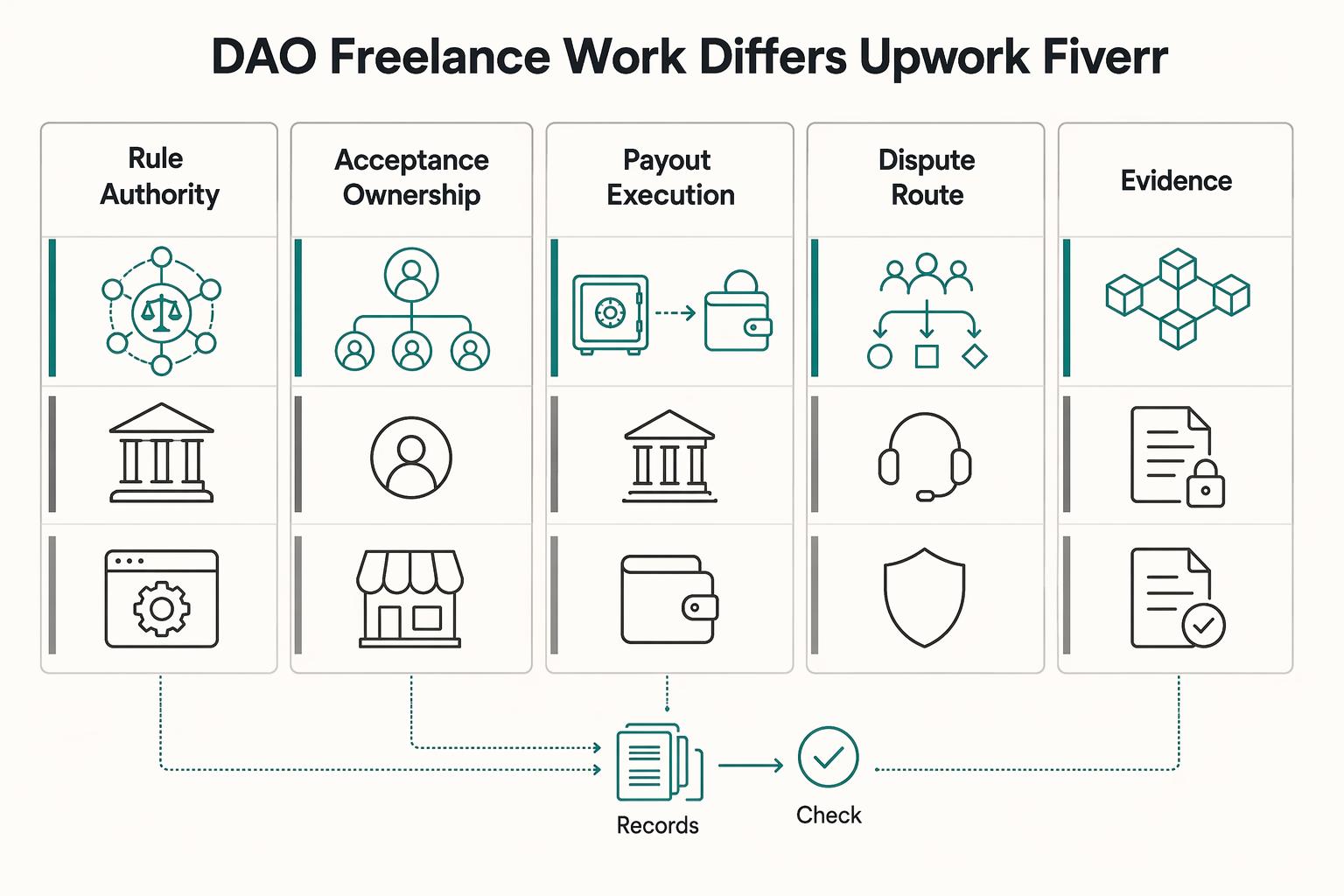
If you want payment certainty, compare each venue by control, not the headline rate. Upwork and Fiverr centralize rules and dispute handling inside platform terms and internal processes. In DAO work, approval and payout can sit in different places, so you need to verify the full path before you commit.
| Control point | Upwork | Fiverr | DAO work |
|---|---|---|---|
| Rule authority | You agree to platform Terms of Service. | Platform Terms of Service govern use. | Rules may be split across governance docs and live contracts; after deployment, rule changes can require a vote. |
| Acceptance ownership | In fixed-price work, the client reviews delivery. | The buyer reviews delivery and accepts completion. | A reviewer, working group, or vote may confirm completion. |
| Payout execution path | Fixed-price funds are deposited in escrow; the client has a 14-day review window, then funds can auto-release if no action is taken. | Orders can auto-complete after 3 days of client inactivity; revenue availability can still follow clearance, commonly 14 days, and 7 days for specified tiers. | Approval and payout may be separate; treasury execution can require group approval or multiple signatures. |
| Dispute route | Non-binding dispute handling is available for fixed-price work, and arbitration outcomes can be final on-platform. | Resolution Center provides an in-platform dispute path. | Dispute handling depends on the DAO's documented process, so verify the route before you start. |
| Evidence for close/reconciliation | Terms, contract page, escrow status, submission trail, dispute record. | Order page, delivery trail, Resolution Center record, payout status. | Proposal ID, vote record, acceptance proof, payout wallet details, treasury transaction hash, signer status when visible. |
That comparison only matters if you check the live mechanics. On marketplaces, confirm current terms and the exact payout conditions on the day you accept. In DAO work, confirm the governance and treasury artifacts tied to your task, especially when approval happens in one system and payment is executed in another.
Ask one direct question per venue:
- Upwork: Is this fixed-price milestone funded in escrow now?
- Fiverr: What event completes the order, and when does revenue become available after completion?
- DAO: What exact event moves status from approved to executed, and who can perform that step?
If a DAO uses Snapshot, treat the vote record as approval evidence, not settlement proof. If treasury execution is multisig, confirm whether the required owner signatures are still pending.
Price the true cost, not the posted rate#
Compare what you actually receive and how long it takes, not just the listed amount. Model four inputs:
- expected payout under current terms or the agreed DAO amount
- transfer and conversion friction
- delay risk between acceptance and settlement
- time spent handling disputes, missing approvals, or payout follow-up
Fiverr's published 80% share gives you a baseline for marketplace modeling. A DAO may show a higher nominal amount, but your net result can still drop if execution requires extra transfers, conversion steps, or repeated follow-up.
Run one paid cycle before you scale#
Pilot one small paid task first, then compare promised terms with actual settlement. Check who accepted the work, how long payout took, whether the dispute or support path was usable, and what evidence you could save for reconciliation.
A key failure mode is a broken handoff between acceptance and treasury execution. If that shows up in the pilot, pause larger scope until the venue can show a clean, documented approval-to-payment path. For a related comparison, see A Freelancer's Guide to Angel Investing and Venture Capital.
The payment path from bounty approval to payout#
Treat payout as a control plan, not an assumption. In DAO freelance work, keep approval and settlement as separate checkpoints in your own process, and map both in writing before you expand scope. If nobody can clearly name the record for payment, pause.
The cited guidance does not establish one standard bounty payout workflow. Use it to verify what is documented and what is still unknown before you proceed.
The Gitcoin thread sits in the Proposals area, which gives you a public record location for governance discussion. Activity counters like 6.6k views, 34 likes, 3 links, 8 users show logged discussion, not payment reliability.
So if a DAO gives you only a payout label, ask them to document the missing control details before you proceed.
| Checkpoint | What is documented | What is not established |
|---|---|---|
| Governance record | Proposal is posted in Proposals | A standard bounty payout workflow |
| Discussion activity | 6.6k views, 34 likes, 3 links, 8 users are displayed | Any guarantee of payment reliability |
| Security guidance | Rules of Engagement include "No user should ever ask you to send them money" and "Never share API or secret keys." | Who approves work, releases funds, or expected payout timing |
Missing documentation is not a minor admin detail. If payout ownership or records are unclear, request written clarification of the process and record location, then hold scope. Keep basic security checks in the same process.
Run this documentation checklist per task before close:
- governance record link is captured
- any stated payout process details are written down
- no one asked you to send money directly
- no API or secret keys were requested or shared
Should you take this DAO gig#
Take the gig only if payment authority and proof are clearer than community buzz. In DAO work, your decision should turn on five checks in writing: scope definition, approver identity, payout executor, payout-trigger evidence, and dispute ownership.
Vague answers are not admin noise. They are risk signals. Some sources describe payment triggering after approval, but that helps only if this specific gig defines what "approved" means and shows where that record lives.
Use a simple decision rule#
| Decision | Role clarity | Payout-path proof | Handoff accountability |
|---|---|---|---|
| Go now | Scope, approver, payout executor, and dispute owner are each named in writing | The payout trigger is defined, and the proof-record location is identified | If approver and payer are different, a named handoff owner is documented |
| Pilot first | One or two roles are clear, but one control point is still informal | Trigger is described, but execution or settlement proof is not yet shown | A likely owner exists, but no written handoff commitment |
| Decline | Roles are vague, "community-owned," or keep changing | Approval is discussed, but no one can show what moves payment or where it is logged | Approval and payment are split, and no one owns delays, exceptions, or disputes |
Focus most on payout-path proof. The practical check is simple: what artifact proves approval happened, and who converts that into funds received? If those two answers are missing, you do not have a reliable payment process.
Test the handoff before you expand scope#
Before you accept broader scope, run one contained paid cycle:
- Take a small task with written completion criteria.
- Confirm the approver and payout executor before work starts.
- Confirm where approval will be recorded and what payout confirmation you will receive.
- Deliver, collect the approval artifact, then confirm the payment record and settlement confirmation.
- Expand only after one full cycle closes cleanly.
One anecdotal DAO payment story includes a full sequence from contact and interview through hire, deposit, and final payment. Treat that as a reminder to verify complete handoffs, not as proof your engagement will behave the same way.
Governance participation still needs the same discipline. Voting rights or tokens can matter, but they do not automatically protect payout timing, payment outcomes, or dispute resolution.
Hard rule: if payment authority is unclear, do not accept open-ended scope. Ask for the five checks in writing, propose one small paid test, and decline if ownership of approval, payout execution, and disputes stays unclear. For the full breakdown, read Bullet Journaling for Freelancers Who Need a Reliable Weekly System.
Choose your business setup before first payout#
Before you accept payout, decide who is getting paid and keep that same identity through one full payment cycle where possible. Waiting until after funds arrive can create mismatches across contracts, invoices, payout destinations, and records.
In DAO work, do not optimize for a perfect structure first. Choose one receiving identity you can document now, and avoid changing it mid-cycle unless a qualified advisor tells you to.
Pick one receiving identity, not a maybe#
Answer this before work starts: what exact legal or professional identity will appear on the agreement, invoice, and final receiving or conversion account? If those do not line up, reconciliation gets harder later.
Use filing-office or government material for process guidance, then confirm legal and tax treatment with qualified local advisors in the jurisdiction that governs your business.
If you review U.S. federal guidance during that process, verify authenticity before relying on it or sharing sensitive data. Federal sites often end in .gov or .mil, and https:// indicates a secure connection.
Use a simple setup decision table#
Use this as a documentation-consistency check only; legal and tax treatment depends on jurisdiction and advisor guidance.
| Setup direction | Decision trigger | Payout-traceability impact | Compliance/admin burden | Escalate to advisor review when |
|---|---|---|---|---|
| Use your current individual/professional identity | You already use this identity for agreements and billing | Can reduce mismatch risk when agreement, invoice, payout, and records use the same identity | Varies by jurisdiction and current obligations | Payee-name mismatch, cross-border complexity, or unclear legal/tax treatment |
| Use an existing registered business you already run | You already contract and bill through that business | Can improve continuity if agreement, invoice, payout records, and conversion account use that business identity | Varies based on account setup and recordkeeping readiness | Any blocker documenting payout or conversion account ownership under that business name |
| Pause payout until a new structure is ready | You are changing structure and cannot yet keep one identity across records | Can avoid mixed records by waiting until the new identity is usable | Higher upfront coordination and timing risk | Sanctions/licensing status is unclear, or advisor guidance is still pending |
Practical rule: if the setup cannot support the agreement, invoice, payout ownership proof, and conversion reconciliation now, treat it as not ready for this engagement.
Collect these proof checks before first payout#
| Proof check | What must match |
|---|---|
| Contract name check | Agreement or SOW names the same payee identity you will report |
| Invoice identity check | Invoice name and remittance details match that same identity |
| Payout ownership check | Wallet or payout destination ownership can be shown for that identity, or clearly linked to you with retained proof |
| Conversion account match check | Conversion account holder matches the invoicing identity, or you keep a documented bridge |
| Approval-to-payout link check | Approval record, invoice reference, payout record, and settlement record share the same job or scope reference |
If one line does not match, fix it before funds move.
Watch for identity mismatch and licensing surprises#
A common failure mode is invoicing under one name while payout settles under another. Another avoidable issue is changing structure after approval but before payout, then trying to explain why approval and settlement identities differ.
Finish one clean payout cycle under one identity. If you need to change structure, do it between engagements with new paperwork, then plan jurisdiction details in Sole Proprietorship vs. LLC: The Definitive Guide for Global Freelancers.
Contract terms to lock down before work starts#
Do not start substantial work until acceptance and payout terms are written and agreed. In DAO work, visible activity does not solve the invoice dilemma. If release conditions are unclear, you can deliver and still end up disputing who approves, what counts as done, or when funds move.
Use this risk lens before kickoff:
- If you are paid before work starts, the client carries more delivery risk.
- If payment happens only after completion, you carry more non-payment risk.
- A milestone-based release can balance that risk by tying each completed milestone to a defined payment event.
| Clause to lock down | What to state in writing | Failure it prevents |
|---|---|---|
| Acceptance ownership | Who can approve, what evidence counts as acceptance, and whether approval is per milestone or final delivery | Work is finished, but no one with clear authority signs off |
| Revision boundaries | What is a revision vs new scope, and how changes affect price or timing | Extra work expands without agreed pay or timeline updates |
| Payout trigger | The exact event that releases funds, for example accepted milestone delivery or escrow release | Approved work stays unpaid because release conditions were never defined |
| Review and payout timing | When review happens after submission and when payout is expected after acceptance | Waiting drifts with no agreed checkpoint |
| Dispute handling | Where disputes are raised, what evidence each side provides, and whether a neutral third party or onchain arbitration is used | Conflict escalates without a decision path |
If escrow is part of the deal, verify deposit status before you begin material delivery. Keep that proof with the matching scope version, invoice, acceptance record, and payout evidence trail. If you use a smart-invoice style setup that combines escrow and arbitration, store the transaction or confirmation record in the same file set.
When scope changes, consider pausing for written re-approval of scope, price, and timeline before continuing. If acceptance ownership or the payout trigger is still missing, consider limiting work to a small paid pilot until one full delivery and payment cycle closes.
Before you draft clauses from scratch, use the freelance contract generator to build a baseline you can adapt to DAO approval and payout terms.
Build your records pack from day one#
Open a cycle pack as soon as scope and payout terms are agreed. It is the simplest way to avoid the usual mess later: unclear approval proof, unclear payout status, and rushed tax reconstruction from chat history.
Use one pack per work-and-payment cycle so your trail stays complete from scope to approval to settlement. That structure aligns with HMRC and IRS guidance to keep transaction and disposition records.
| Core cycle artifacts | Conditional artifacts |
|---|---|
| Scope history: original scope, dated revisions, final accepted version | Wallet-ownership acknowledgement note when you need to link a public address to your business records |
| Approval evidence: approver and dated message, vote, or signed confirmation | Pending-transaction evidence when a Safe transaction still requires confirmations |
| Payout proof: transaction hash and block-explorer link showing transfer details | Fiat conversion or exchange records when funds move offchain |
| Invoice record, if you invoice for that cycle | Valuation support when you need value at receipt or disposal |
| Payout-status confirmation: paid, pending, failed, disputed, or partially settled | Treasury execution evidence when a Safe multisig path is used |
Use a consistent naming pattern so retrieval is fast, for example 2026-03_client_bounty-14_cycle-01_v1. Keep a shareable folder for scope, approval, invoice, and public transaction links, and a restricted folder for sensitive files. Apply least-privilege access and data minimisation so only necessary people see sensitive records and you do not store extra personal data.
Close each cycle with a short repeatable note that captures:
Approval owner:Payout trigger event:Settlement status:Open exceptions:
If the treasury uses Safe, treat the onchain payout step as complete only after confirmations reach threshold and the transaction executes. If there is an offchain or fiat leg, track that as a separate settlement status. If anything is missing, request it immediately. Log the exception as open, note who owes the evidence, and append the recovery artifact to the same cycle pack so your audit trail stays intact.
Tax and compliance checkpoints that vary by country#
Your cycle pack helps show what happened, but it does not by itself determine tax treatment. Verify local rules before you scale recurring payouts. Start with applicability before close: confirm which jurisdiction applies to you, your entity, if any, and the payer relationship. Scope mismatch is a real failure mode here, where a well-documented cycle is attached to the wrong person, entity, or payment path.
| Payout stage | Keep this evidence | Close check |
|---|---|---|
| Work approved | Dated approval message, vote link, approver identity, final accepted scope | Can you show who accepted the work and which version was accepted? |
| Funds received | Transaction hash, block explorer link, receiving wallet label, payout status note | Can you connect the transfer to the approved cycle without assumptions? |
| Funds converted or moved | Exchange record, offchain receipt, wallet-to-account mapping, settlement note | Can you show what moved, where it went, and which cycle it belongs to? |
| Reporting prep | Invoice copy, if used, valuation support, if needed, reconciliation note, unresolved-items log | Can you trace approval to settlement to the reporting line you expect to use? |
Use this country-close check on every cycle:
- Confirm the applicable jurisdiction for you and, separately, for your entity and payer when they differ.
- Map the payout to the actual records: approval proof, wallet movement, invoice, and settlement evidence.
- Record the reporting position you believe applies and the basis you relied on.
- Reconcile identity details across legal name, entity name, invoice issuer, and wallet labels.
- Mark unresolved interpretation as provisional instead of treating it as settled.
If you, your entity, and the payer are in different jurisdictions, escalate to local advisor review before more cycles accumulate. Do not assume one interpretation will carry across the full payment chain.
When interpretation is unclear, use the conservative fallback: over-document, keep assumptions visible, and leave the cycle open. If approval-to-settlement-to-reporting traceability is incomplete, treat the cycle as open until the evidence is reconciled.
Platform and tooling choices for daily operations#
Use one intake rule for daily operations: if approval authority, payout trigger, or dispute routing is not documented, keep the work small and contained. Convenience matters less than whether you can prove who approved the work, how funds moved, and how disagreements are handled.
A DAO can look active in public and still break your evidence chain. Snapshot is offchain and gasless, so vote history can sit in one system while treasury execution sits in another. If execution runs through Safe, you may have multiple records to reconcile before a cycle is close-ready.
Use directories for discovery, not proof#
Directories help you find options, not validate controls. SourceForge listings and Alchemy's catalog of 77 DAO tools are useful starting points, but they do not prove payout reliability, dispute quality, or export readiness.
Treat listings and vendor claims as research inputs. Then verify the control points in primary docs: where votes happen, whether voting is onchain or offchain, what event triggers execution, and what records you can export. This matters because onchain and offchain governance rely on different trust models. Onchain votes can execute trustlessly, while offchain flows require social trust.
Where evidence continuity usually breaks#
| Setup type | Governance history | Approval and payout record | Dispute path | Evidence continuity risk |
|---|---|---|---|---|
| Offchain stack (Snapshot + Safe) | Vote history in Snapshot | Executed transactions and confirmations in Safe Transaction Service | Can be separate, manual, or custom | Higher: approval and payment proof are split and must be matched |
| Onchain governance with automated execution | Vote and execution can be linked onchain | Stronger vote-to-execution connection | May still sit outside core governance tooling | Medium: treasury evidence improves, but deliverable acceptance may still fragment |
| Managed marketplace (Upwork/Fiverr) | Platform-side activity records | More of the approval and payment state is in-platform | Formal built-in routing | Lower: fewer gaps between acceptance, payment state, and dispute handling |
Your benchmark is simple: can you reconstruct one full cycle without guesswork?
Run these verification tests before you commit#
Before you commit, test the parts that usually fail in practice:
| Verification test | What to confirm |
|---|---|
| Payout transparency | The exact event that moves funds, then status after submission and after execution |
| Approval traceability | Who had approval authority, where approval is recorded, and whether it is offchain or onchain |
| Dispute routing | A documented process with named steps and timing; Fiverr's Resolution Center, for example, uses a 48-hour response window |
| Onboarding consistency | The same intake requirements for wallet, identity details, scope, and acceptance method |
| Export readiness | Whether you can export usable records now; for Safe, CSV exports can be scope-limited, and help guidance has varied across pages |
If you cannot pass those tests with live docs and a sample export, keep the engagement small.
Prefer communities with a repeatable review cadence if payment certainty matters to you. Use community chatter as an early warning signal, then confirm the actual control mechanics in official docs before you scale recurring work. For a step-by-step walkthrough, see Best No-Code Tools for Freelancers Who Need Clean Handoffs.
Common failure modes and what to do when they happen#
When DAO payment issues show up, the gap is usually execution clarity, not intent. Your job is to turn each gap into a documented next step before you keep working.
| Failure mode | What it usually means | Your next move | Proof to save | Resolution owner |
|---|---|---|---|---|
| Informal acceptance without release | Work was approved socially, but no payment trigger was started | Convert approval into a written payout request with owner, amount, wallet, and trigger step | Approval message, deliverable ID, payout request or invoice reference, receiving wallet | Reviewer first, then treasury or payment operator |
| Governance-driven scope change without updated terms | Priorities moved, but your deal terms stayed frozen | Pause extra work and issue a written change note before continuing | Original scope, proposal or discussion link, change-order text, updated acceptance criteria | Change requester first, then payment approver |
| "Sent" payout not settled on-chain | Transfer may be queued or pending, but not executed or confirmed | Request tx hash and verify chain, token, amount, wallet, and confirmation status | Payout request record, Safe reference if used, tx hash, explorer status, wallet receipt | Treasury signer or payment operator |
Informal acceptance without release#
Early warning signal: You get a "looks good" message, but nobody can name the exact step that releases funds. A similar acceptance-versus-release split appears on Upwork: payout timing starts only after formal submission, then enters a review window of up to 14 days.
Immediate action: Reply the same day with a written release request that lists the deliverable, acceptance proof, amount due, receiving wallet, and named release owner. If approval came through Snapshot, keep the signed vote record as evidence, but do not treat it as payment execution because Snapshot is offchain.
- Evidence to collect: Original scope, timestamped acceptance message, payout request or invoice reference, and receiving wallet.
- Escalation path: Reviewer who accepted the work, then the treasury or signer who can execute payment.
- Pause-work condition: No named owner, no documented trigger, or payment is deferred to an undefined future step.
Governance-driven scope change without updated terms#
Early warning signal: A proposal passes or priorities shift, and you are asked to add work without updated scope, amount, or acceptance rules.
Immediate action: Do not start extra work until terms are updated in writing: what changed, what remains out of scope, updated amount, approval owner, and payout trigger. In Aragon token voting flows, even a passed proposal still needs the plugin execute step.
- Evidence to collect: Original brief, proposal or discussion that changed scope, and written updated acceptance and payment terms.
- Escalation path: Person requesting the change, then whoever has payment authority.
- Pause-work condition: New scope changes timeline, amount, or review standards and nobody will confirm revised terms in writing.
"Sent" payout not settled on-chain#
Early warning signal: You are told payment was sent, but you only have a screenshot, a queued Safe item, or no transaction reference.
Immediate action: Ask for tx hash, chain, token, amount, and recipient wallet. Verify status in a block explorer and match it to your payout request. If using Safe, remember creation, signature collection, and execution are separate, and pending transactions still need confirmations before execution. On Ethereum, treat a broadcast transaction and a finalized transaction as different states.
- Evidence to collect: Payout request, Safe transaction reference (if used), tx hash, explorer confirmation status, and wallet settlement confirmation.
- Escalation path: Treasury signer or payment operator with a single mismatch note, expected wallet, token, and amount versus actual status.
- Pause-work condition: No tx hash is provided, or the transaction details do not match your request.
Conclusion#
Keep the takeaway simple: payment certainty in this setup depends on documented approval, payout triggers, and record controls before you scale effort. A bounty post or active community may signal opportunity, but it does not by itself confirm who can approve completion or what releases funds.
Treat governance clarity as a live risk check, not background detail. DAOs are a smart contract-based governance model, and platform selection is described as challenging. When approver authority or payout triggers are unclear, treat that as a risk signal and keep scope limited until those controls are written down.
Close the loop in a fixed order#
- Confirm approver authority before delivery. Record the named person, role, or group that can accept completion.
- Lock task terms before meaningful delivery. Save scope, acceptance criteria, named reviewer, payout trigger, and bounty terms where posted. In one Freelancer DAO WG forum example (Apr 17, 2023), earnings were described as task-based bounties while the governance framework was still being built, so treat each community's controls as engagement-specific until confirmed.
- Capture evidence as work progresses. Keep approval proof, payout request or reference details, transaction records when relevant, and payment confirmation in one task file.
- Reconcile immediately after payout. Match agreed terms, approval, and received payment while context is fresh, and resolve gaps before closing the task.
Proceed now vs pause and clarify#
| Decision point | Proceed now | Pause and clarify |
|---|---|---|
| Approver authority | A named person, role, or group can accept completion | Reviewer authority is vague or implied |
| Payout trigger | The release event is documented | Payment is described without a clear trigger |
| Documentation consistency | Scope and acceptance details are stable and written | Terms conflict across channels or keep changing |
| Evidence trail | You can produce a complete task file from acceptance to payment | You would rely on memory or informal messages |
| Platform confidence | Popularity, developer availability, governance, and documentation checks are acceptable | Activity is high, but governance or documentation is weak |
A practical close: proceed when the control trail is clear enough to verify what was delivered, who approved it, and how funds were released. If you evaluate any platform or service, including Gruv, confirm country and program coverage before relying on it for contracts, payouts, or compliance workflows.
If you want a payout workflow with compliance gates and traceable status updates, talk to Gruv to confirm coverage for your market and program.
Frequently Asked Questions
What is a dao for freelancers in one paragraph?
A dao for freelancers is client-style work inside an internet-native organization run by its community, not a standard employer setup. In at least one DAO working-group example, pay was tied to completing specific tasks with a defined bounty. Start by confirming the task and how completion and payout are expected to work in that specific DAO. Save the task brief and your proof of work from day one.
How do freelancer payments usually move from approval to release in a DAO?
There is no single default flow, so treat each DAO’s process as engagement-specific until it is clearly documented. Before delivering more work, ask how task completion is reviewed and when bounty payment is released. Keep the agreed process in writing. If the payment path is still unclear, pause or limit scope.
What is the difference between DAO freelance platforms and DAO management software?
Discovery and payment control are different jobs. A platform can help you find bounties, but that alone does not prove how your specific engagement gets approved or paid. Claims like escrow or milestone release are platform-specific until you verify them in your actual engagement path. If a tool gives visibility but no clear payment path, use it as a lead source, not as payout certainty.
What should I verify before accepting DAO work?
Verify the task scope, what “done” looks like, and how payout is expected to happen before you commit to meaningful delivery. Read the welcome channels and docs, then join a community call to identify who is active and what is currently being debated. Keep notes on the agreed task and payout process in one place before work starts. If those controls stay unclear, keep the engagement small or decline it.
What records should I keep for taxes and compliance when paid by a DAO?
This guide does not define a universal tax/compliance checklist for DAO payments. Keep your proof of work and payout communications organized per task, and align your records with your local bookkeeping and tax requirements. If key payout information is missing, resolve that gap before taking on more scope.
Are low-fee and high-payout claims in DAO marketing independently verified?
Treat marketing claims as unverified until you confirm real task terms and completed payout evidence in your own engagement. A platform can advertise features like escrow or milestone release, but that does not prove your bounty has a clear payment process. Ask for concrete process details before you price the work. If the upside is clear but controls are vague, price in risk or walk away.
What does a bounty board help with versus what actually controls approval and payout?
A bounty board helps with discovery: finding opportunities, reading task descriptions, and seeing posted reward amounts. Approval and payout control come from the DAO’s actual governance and payment process, not from listing visibility alone. Keep the listing and your work history as separate records, including clear proof of work. If you only have the listing and no clear payment path, treat the engagement as high risk.
Try a related tool
Researched and edited by the Gruv editorial team. Gruv builds cross-border billing, payouts, and finance-operations software for global businesses.
Sources
- bscc.ca.gov/wp-content/uploads/June-11-2020-Board-Meetin...trusted
- cftc.gov/PressRoom/PressReleases/8590-22trusted
- commerce.gov/sites/default/files/2025-01/T24%20DOC%20BRIE...trusted
- cppa.ca.gov/regulations/pdf/comments_103_128.pdftrusted
- csrc.nist.gov/glossary/term/least_privilegetrusted
- daodas.sc.gov/wp-content/uploads/2025/09/South-Carolina-FY...trusted
- govinfo.gov/content/pkg/FR-2026-03-06/pdf/FR-2026-03-06.pdftrusted
- govinfo.gov/content/pkg/FR-2026-03-06/xml/FR-2026-03-06.xmltrusted
Educational content only. Not legal, tax, or financial advice.
Related Posts

Sole Proprietorship vs LLC for Global Freelancers in 2026
For most freelancers in 2026, the practical default is still simple: use the simplest structure you can run cleanly, then formalize when risk actually rises. If your work is still in validation mode and the downside is contained, a sole proprietorship is often the practical starting point. When contract exposure, delivery stakes, or dispute risk starts climbing, forming an LLC deserves earlier attention.

Using a Data Processing Agreement with Subcontractors
Put your data processing agreement in place before a processor or sub-processor gets access to personal data. If you use a processor, UK GDPR guidance requires a [written contract or other legal act](https://ico.org.uk/for-organisations/uk-gdpr-guidance-and-resources/accountability-and-governance/contracts-and-liabilities-between-controllers-and-processors-multi/when-is-a-contract-needed-and-why-is-it-important). Set that contract boundary before support logins, shared folders, or troubleshooting access turn into live processing.
A Freelancer's Guide to Angel Investing and Venture Capital
**Build a decision system that protects your operating cash first, then treat angel investing as an optional use of true surplus.** If you are considering angel investing as part of broader wealth building, you need controls that keep "startup investing" from quietly raiding rent, taxes, or payroll. Knowledge feels productive, but constraints keep you solvent. As the CEO of a business-of-one, your job is to protect the operating cash that keeps the machine running.