
Quick Answer
A conflict of interest for consultants exists when another duty, incentive, or relationship can pull your advice away from independent judgment. The safest approach is a repeatable system: classify the risk, disclose early, decide whether to mitigate, recuse, or decline, and lock controls in your SOW, NDA, and related terms. For cross-border work, confirm where rules vary and keep written evidence throughout delivery.
You can close deals fast without gambling your reputation#
You can move fast and still stay defensible when you treat conflict checks as a system, not a legal ritual. If you sell consulting work, you will feel pressure to close quickly. As a business-of-one, you need a system that keeps onboarding moving without turning every deal into a judgment call.
You are building a business, not playing regulator. Start each engagement by clarifying the goal, scope, and decision rights before you send a proposal. Clear goals reduce ethical mistakes. Vague goals create avoidable pitfalls and can damage your professional reputation when expectations drift mid-project. Use one framework from intake through close, because conflict issues can surface at any point.
Use one decision loop on every deal#
A practical starting point is two conflict buckets so you and your clients share the same language: Consultant Conflicts of Interest and Organizational Conflicts of Interest. Then run this loop:
| Step | Core question | Fast action | Output |
|---|---|---|---|
| Disclose | Could a reasonable client see a material independence risk? | Raise it in plain language before signature. | Written disclosure note |
| Mitigate | Can you control the risk without harming advice quality? | Add role boundaries, access limits, and review checks. | Updated SOW terms |
| Recuse | Is part of the work too sensitive for your current position? | Remove yourself from that decision lane. | Scope and ownership update |
| Walk away | Would trust still break even after controls? | Decline early and protect long-term trust. | Clear no-go record |
Example: a new client asks for strategy support in a market where you already advise a nearby competitor. Disclose the overlap, propose strict boundaries, and narrow scope. If trust still feels fragile, walk away before contract lock. You protect trust while staying defensible without pretending risk can be reduced to zero.
What is a conflict of interest for an independent consultant?#
A conflict of interest for consultants exists when your advice can shift because another duty, incentive, or relationship pulls you in a different direction. Before you apply the decision loop under deadline pressure, make sure you can name what you are looking at. This keeps consulting ethics practical and makes decisions easier to repeat.
Consultant Conflicts of Interest happen at the individual level. You, as the advisor, carry a tie that a client could view as material, such as a financial incentive, a personal benefit, or a competing duty.
Organizational Conflicts of Interest happen at the firm level. Your business structure, parallel client work, or vendor relationships can bias outcomes even when intent stays clean.
Use federal language as a reference, not a shortcut#
The Federal Acquisition Regulation gives useful vocabulary for conflict analysis. FAR Subpart 9.5 lays out a framework to identify, evaluate, and resolve organizational conflict risk, and it applies to contracts with both profit and nonprofit organizations in federal acquisition. Section 9.501 also defines a marketing consultant in a federal offer context, which can help you tighten language when roles blur.
| Reference | What it does | How to use it here |
|---|---|---|
| FAR Subpart 9.5 | Lays out a framework to identify, evaluate, and resolve organizational conflict risk and applies to contracts with both profit and nonprofit organizations in federal acquisition | Use it to sharpen thinking, not to govern private contracts by default |
| Section 9.501 | Defines a marketing consultant in a federal offer context | Use it to tighten language when roles blur |
| Office of Government Ethics guidance | Can improve your risk lens | It is intended for federal ethics officials and does not provide legal advice for private consulting |
| Statement of Work (SOW) | Describes the actual work and performance requirements, plus negotiated terms | Treat it as the enforceable baseline in private consulting |
Use that framework to sharpen your thinking, not to govern private contracts by default. Office of Government Ethics guidance can improve your risk lens, but it is intended for federal ethics officials and does not provide legal advice for private consulting. In private consulting, your enforceable baseline comes from your contract stack, especially your Statement of Work (SOW), which should describe the actual work and performance requirements, plus negotiated terms.
Apply a simple definition test before every proposal#
| Test question | Likely type | What you do next |
|---|---|---|
| Could my personal gain influence this recommendation? | Consultant Conflicts of Interest | Disclose the tie and propose limits in writing. |
| Could my firm relationships bias delivery even if I stay objective? | Organizational Conflicts of Interest | Add structural safeguards and role boundaries. |
| Does this term sit in federal language but not in my private SOW? | Scope gap | Translate it into clear contract obligations. |
Operator move: if a client asks for advice in a market where your firm already supports a related player, pause and classify the risk first. Then update the SOW to describe the actual work, performance requirements, and limits, and use separate confidentiality, disclosure, and mitigation terms where needed so legal risk controls stay explicit.
Can you work with competing clients without crossing the line?#
Serving competing clients requires more than consent. Check applicable professional rules, existing exclusivity and confidentiality obligations, and whether the work can preserve independent advice. Disclose relevant overlap without revealing another client’s protected information, and decline work you cannot control.
Start with one hard question: would a reasonable client view this engagement as impairing your independence under your current Governing Law and Jurisdiction terms? If the answer feels uncertain, treat that as a warning, not a detail to clean up later. You protect trust when you make the call before delivery starts.
Run the four step decision framework#
| Step | Decision test | What to document |
|---|---|---|
| Disclose | Could a client reasonably view an actual, potential, or perceived conflict? | Add a plain language disclosure in your proposal file, then mirror it in the SOW and NDA. |
| Mitigate | Can you neutralize risk with clear operational controls? | Define ring-fencing in written controls (for example, your DPA), limit access by least privilege, and set need-to-know boundaries. |
| Recuse | Does one person or workstream create the conflict even if the project can continue? | Remove that person from the assignment and record new ownership and decision rights. |
| Decline | Do material risks remain after controls? | Decline early and log why, so the decision is formally documented. |
Use federal vocabulary like FAR Subpart 9.5 as a thinking aid, not a private-sector rulebook. The transferable idea is the discipline: identify the risk early, document the decision, and enforce controls through contract language and operating practices.
Example: a prospect asks you for strategy work while you are already supporting another player in the same space. Disclose the overlap, propose strict data boundaries, and limit who can access what through written least-privilege and need-to-know controls. If either side cannot accept the ring-fence, decline quickly. It is cleaner to lose a deal than to inherit a trust problem you cannot fix.
What should you disclose and when should you disclose it?#
You protect deals and trust when you disclose conflicts early, refresh disclosures before signature, and tie each disclosure to written controls. Exact disclosure requirements vary by jurisdiction and sector, but late disclosure still creates avoidable risk once scope is locked.
Give full and fair disclosure so the client can make an informed decision. State actual or potential conflict issues in plain language, including vendor incentives, referral economics, overlapping mandates, and relationships that could affect independent judgment. Map confidentiality risks to the NDA and access controls. Use a DPA where the engagement involves personal-data processing that requires one.
Use a two stage disclosure cadence#
| Stage | What to disclose | Where to record it | Why it matters |
|---|---|---|---|
| Pre proposal | Obvious conflicts, material relationships, and any interest that could reasonably be viewed as a conflict | Discovery notes, proposal draft, and a short written disclosure statement | Gives potential clients decision clarity before they commit time and budget |
| Pre signature refresh | Past, present, and currently planned interests, plus any scope or team changes since proposal | Final SOW, NDA, and conflict certification in the deal file | Aligns disclosure with final terms, jurisdiction, and execution reality |
Conflict handling is not a one-time checkbox. Treat disclosure as an ongoing process tied to loyalty and independent judgment, and refresh it when scope, team, incentives, or data handling changes.
Use clear language across clients#
Use the same basic script at each stage:
| Stage | Focus | Sample line |
|---|---|---|
| Discovery call | Disclose relationships or incentives that could affect perceived independence | "Before we discuss scope, I want to disclose any relationships or incentives that could affect perceived independence. Then we can decide what mitigation terms you want in writing." |
| Proposal email | Restate potential conflicts, mitigation steps, and any data overlap tied to DPA controls | "We disclosed potential conflicts, listed mitigation steps, and mapped any data overlap to DPA controls so you can review before signature." |
| Pre-signature | Confirm the final SOW and NDA reflect current disclosures, access boundaries, and update obligations | "Please confirm the final SOW and NDA reflect current conflict disclosures, access boundaries, and any update obligations." |
Example: a referral partner sends a new cross-border engagement while you still advise a nearby competitor. Disclose that tie in the first call, restate it in the proposal, and refresh it at signature with confidentiality and access limits. You protect professionalism, speed decisions, and reduce downstream termination disputes.
Build a contract that enforces independence when pressure rises#
Build your contract so independence obligations trigger action automatically when pressure rises. Disclosures are only half the system. The other half is making sure your documents force the right behavior when scope changes and timelines tighten.
Treat your SOW as a control system, not boilerplate. Define what counts as a conflict trigger, who must report it, when updates are due, and who can approve continued work. Add recusal mechanics where appropriate so you can move a conflicted contributor off sensitive tasks without stalling delivery. Require evidence, such as written disclosures, approval logs, and role reassignment records, so you can show process quality if a dispute starts.
Turn conflict language into enforceable controls#
| Control area | What to define in writing | Why it reduces legal risk |
|---|---|---|
| Trigger definitions | Actual, potential, and perceived conflict events tied to project activities | Teams spot issues early instead of arguing over labels late |
| Update obligations | Timebound notice and refresh duties tied to SOW changes | Clients get informed decisions before risk grows |
| Recusal mechanics | Where needed, who steps out, who steps in, and how handoff occurs | You preserve independence and keep execution stable |
| Evidence requirements | What records you keep and where you store them | You can defend decisions in Dispute Resolution |
Use FAR Subpart 9.5 as vocabulary for identifying and resolving organizational conflict risk, then translate that discipline into private contract language. In U.S. federal procurement contexts, conflict analysis is handled early and significant risks are addressed formally before award, including solicitation-level provisions when potential conflicts are significant. In private deals, you get similar protection by making conflict handling an explicit contract choice.
Keep remedies and data terms aligned#
Align Termination, Limitation of Liability, and Indemnification so enforcement stays predictable. State what happens if someone withholds a material conflict, whether conflict-related losses sit inside or outside liability caps, and which party covers third-party harm tied to conflict misstatements.
Set Governing Law, Jurisdiction, and Dispute Resolution terms that match how you actually operate cross-border. Then align NDA and DPA terms so conflict controls and data controls do not contradict each other. Your NDA protects client confidentiality at a high level. Your DPA should lock processing to documented instructions and confidentiality obligations, with additional processor controls defined where applicable.
Example: a client expands scope into sensitive data after kickoff. Your conflict trigger fires, your DPA instruction limits activate, and your recusal path reassigns one advisor. You keep momentum without gambling independence.
How do cross-border rules change your conflict checks and terms?#
Cross-border conflict expectations vary, so your playbook has to adapt to each deal before signature. A default template can still be your baseline, but you need a fast way to localize it so you do not discover mismatches after work starts.
Run a pre-signature rule check#
Use a short intake pass for every new market, sector, and client program. You need one page that states which conflict rules apply, who can approve mitigation, and when you must escalate. This keeps conflict decisions consistent and protects professionalism when timelines tighten.
| Engagement type | Confirm before signature | Operating decision |
|---|---|---|
| U.S. federal prime or subcontract touchpoint | Whether FAR Subpart 9.5 applies, how OCI will be identified and evaluated early, how it will be avoided, neutralized, or mitigated before award, and whether any waiver needs written conflict detail plus high-level agency approval | Accept only after you assign an internal owner for disclosures and escalation |
| Private cross-border consulting | Market-specific professional-rule overlays and how they affect Dispute Resolution and Termination terms | Update contract language by market, then log deviations from your baseline |
| Regulated advisory work | Whether sector-specific independence, disclosure or professional conduct rules apply | Route relevant conflicts to a qualified sector specialist before expanding the mandate |
Keep a variance log with specialist triggers#
Treat your variance log as an operating control, not admin paperwork. Record where terms change by country or client program and how that shifts remedies, notice duties, and approval flow.
| Variance log item | What to record |
|---|---|
| Market and client program | Track market and client program context |
| Conflict triggers | Note conflict trigger differences and escalation owner |
| Dispute Resolution | Capture Dispute Resolution forum and process changes |
| Termination | Capture Termination rights tied to conflict events |
| Client confidentiality | Record client confidentiality boundaries for each market |
| Approvals | Store approval evidence and update dates |
Example: a client expands your mandate into cross-border treasury workflows after kickoff. You update the variance log, trigger specialist review, refresh disclosures, and continue delivery with controlled legal risk.
If an unresolved conflict requires changing an advisor, see How to Fire Your Accountant or Lawyer. Use the SOW generator to document scope and escalation responsibilities.
Run an ongoing conflict monitoring checklist during delivery#
Treat conflict monitoring as a live delivery control, not a one-time contract step. Intake catches what you know on day one. Monitoring catches what changes on day thirty.
Run a recurring attestation loop#
Use recurring check-ins as your default operating cadence, then increase frequency when risk rises. Tie each check-in to the current SOW and active NDA where relevant, and keep the attestation short enough that your team can complete it in minutes.
| Checkpoint | What you confirm | What you record |
|---|---|---|
| Scope and role integrity | No new task creates Consultant Conflicts of Interest or Organizational Conflicts of Interest | Decision owner, date, and any mitigation action |
| Confidentiality controls | Access still matches NDA duties and client confidentiality limits | Access changes, approvals, and rationale |
| Economic neutrality | Vendor fees, referral terms, and payout structures do not impair, or appear to impair, objectivity | Compensation review notes and client acknowledgment status |
| Escalation readiness | You can explain who approves, who discloses, and who pauses work | Updated escalation path and response deadline |
This rhythm keeps independence visible to the client. It helps surface issues before they turn into delivery disputes.
Re-test vendor economics and preserve an audit trail#
When a vendor enters the workflow, re-check neutrality. If vendors are part of the risk event, re-examine the vendor selection process. If economics change and an applicable clause requires disclosure, make that disclosure in writing and document the mitigation path.
Keep records audit-ready:
- Store conflict decisions, approvals, and scope changes in one searchable log.
- Review system audit records on a set cadence, report findings, and adjust controls when risk patterns repeat.
- Retain records for invoices, payouts, approvals, and role changes in an audit-ready format where your systems support it.
If federal work touches your engagement, align your process with Federal Acquisition Regulation (FAR) expectations, including FAR Subpart 9.5 documentation discipline. When an applicable clause triggers post-award disclosure, notify the Contracting Officer in writing and document your mitigation steps in the file.
Example: a client adds a new implementation partner mid-project. You re-test compensation neutrality, log the decision, issue a written disclosure update when required, and keep delivery moving without compromising independence.
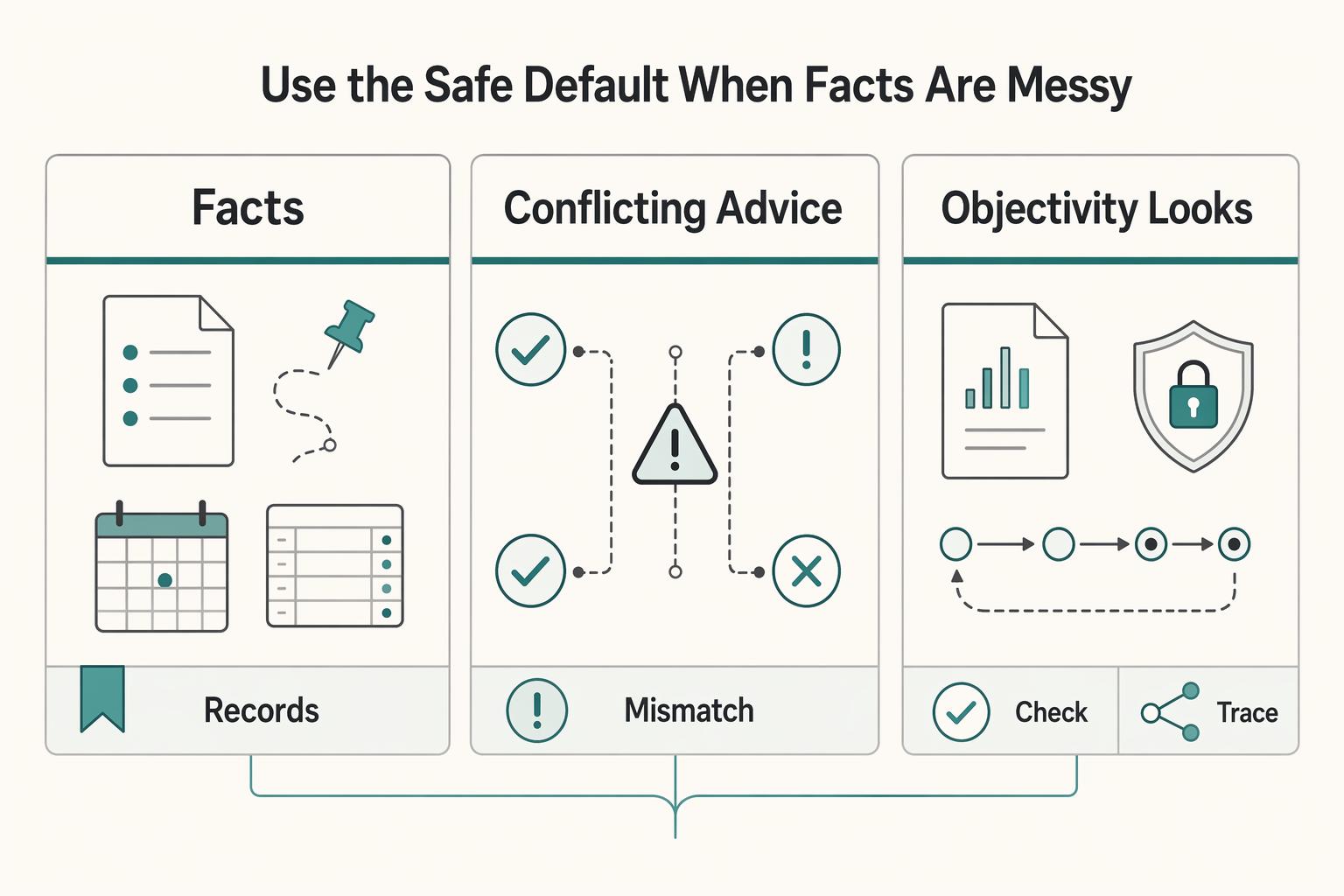
Use the safe default when facts are messy#
Take only risk you disclose, document, and control, then walk away from the rest. When pressure rises, use one rule you can execute fast. Your goal is not to eliminate all risk. Your goal is to run a defensible business where you can explain each conflict decision.
If you want a fast safety check, use this quick operator grid:
| Situation | Safe default action | Evidence to keep |
|---|---|---|
| Facts remain unclear across jurisdictions | Pause, clarify governing rules in writing, then decide | Written assumptions, client confirmations, final decision note |
| Conflict looks manageable | Disclose, mitigate or neutralize, and continue only under written controls | Disclosure copy, approvals, mitigation steps, updated SOW/NDA terms |
| Objectivity looks impaired | Recuse or decline the workstream | Withdrawal note, handoff record, client acknowledgment |
Your practical stack stays simple:
- Define Consultant Conflicts of Interest and Organizational Conflicts of Interest in plain language.
- Run a go or no-go check before scope changes, not after damage starts.
- Use short disclosure scripts so you state risks consistently.
- Put enforceable controls in the contract, including recusal paths and escalation owners.
- Keep records that prove process quality, including approvals, logs, and scope-change history.
When rules vary by market, say so early and confirm the variance in writing. Countries do not implement identical measures, so use a risk-based approach instead of a one-size template. In federal contexts, FAR Subpart 9.5 treats conflict handling as an early process to identify, evaluate, and resolve risk before award. If a substantive issue appears, document your judgment and action path in writing.
Example: a client asks you to add a partner that pays referral economics mid-engagement. You stop, disclose the change, test independence, and either lock mitigation controls or step out. You reduce avoidable risk and keep a defensible record of your decision.
If you need cross-border payment and record workflows, ask for tools that support policy gates, traceable logs, and exportable evidence where available.
Frequently Asked Questions
What is a conflict of interest for consultants in plain language?
A consultant conflict is any tie that can impair your independence and objectivity, or make a reasonable client question it. Treat it as an operating risk, not a character judgment. Disclose it, decide on a control (mitigate, recuse, or decline), and keep a record.
What should an independent consultant disclose to clients before signing?
Disclose anything that could make a reasonable person doubt your impartial judgment. That includes relationships, incentives, overlapping mandates, and roles that could affect your independence or objectivity. Then connect each disclosure to a specific control inside your SOW, NDA, or delivery plan so it is enforceable, not just informational.
How do I write a conflict of interest clause in a consulting contract?
Write it like a workflow. State the nature of the potential conflict and the proposed restraint on future activities, then define disclosure timing, who approves continued work, recusal mechanics, and what evidence you will keep. Make sure those mechanics do not conflict with your dispute, termination, and data terms, or you will create enforcement gaps when pressure rises.
Can I work with competing clients if both clients agree?
Sometimes. Check applicable rules and existing contract restrictions first. Consent cannot make prohibited work permissible or fix a conflict you cannot control in practice. If you cannot protect confidentiality and independent judgment with effective controls, decline the work.
Do OGE and FAR rules apply to private-sector independent consultants?
Office of Government Ethics (OGE) rules govern executive branch ethics programs, and Federal Acquisition Regulation (FAR) conflict frameworks apply in federal contracting contexts such as FAR Subpart 9.5 scenarios. They do not automatically govern purely private consulting with no federal nexus. In private work, scope varies by jurisdiction and contract terms.
What are the top red flags that a consultant is conflicted?
Look for patterns, not promises. Red flags include unequal access to information, biased ground rules, and impaired objectivity, plus any facts a reasonable person would view as compromising impartiality. When you see those patterns, force the decision loop: disclose, mitigate, recuse, or decline.
How do conflict checks work for cross-border consulting engagements?
Run checks at intake and throughout delivery, not just at signature. Confirm how geography, the regulatory market, and client or partner relationships change risk. Update disclosures in writing when scope changes, and keep a log of decisions, approvals, and mitigations so your process stays defensible across jurisdictions.
Try a related tool
Researched and edited by the Gruv editorial team. Gruv builds cross-border billing, payouts, and finance-operations software for global businesses.
Sources
Educational content only. Not legal, tax, or financial advice.
Related Posts

Germany Freelance Visa Application Path for Freiberufler and Gewerbe
Choose your track before you collect documents. That first decision determines what your file needs to prove and which label should appear everywhere: `Freiberufler` for liberal-profession services, or `Selbständiger/Gewerbetreibender` for business and trade activity.

How to Fire Your Accountant or Lawyer
You can change an accountant or lawyer while protecting the work already in progress. The practical priorities are active deadlines, usable records, authority to act and final billing. An accountant transition and a lawyer transition share those priorities, but their professional and court procedures can differ.

The Freelance Payment Penalty: A Modeled Audit of Platform Fees, FX Spreads, and Payout Delays
The money rarely disappears through a single, easy-to-spot fee. The real loss is stacked. A marketplace takes its commission, a processor adds a charge for international cards, a bank or payment company converts the currency at a spread, a platform holds the funds before release, and a wire sheds a little to intermediaries on the way in. Each layer looks defensible on its own, but the worker feels the combined result as a smaller deposit and a later payday.