
Quick Answer
Start with day counting, not visa labels. In colombia digital nomad visa tax planning, the core trigger is approaching or crossing 183 days within any 365-day period, including split stays with exits and re-entries. Pick the immigration route that fits your real timeline, then review your records each month. If your stay can drift longer, move into resident-readiness early with organized travel history, payer geography, and documentation for possible RUT and filing obligations.
Separate visa choice from tax exposure#
The key point in colombia digital nomad visa tax planning is simple: your immigration route and your tax exposure are separate decisions. You can choose the right visa for entry and still create tax risk if your day count drifts.
Start with the threshold that drives the analysis. Spending more than 183 days in Colombia within any 365-day period can change your legal classification. That shift can mean tax resident under DIAN rules or exchange resident under Banco de la República rules, so your timeline matters as much as your visa choice.
Treat visa selection as the second step. The Colombia Digital Nomad Visa is commonly described for remote workers, freelancers, and digital entrepreneurs with foreign income. Some third-party guides cite parameters such as up to 2 years, roughly 2 to 6 weeks processing, and an income benchmark around COP 4,270,500 per month. A tourist visa is a different immigration route. Neither route, by itself, decides your tax status.
Use this sequence:
- Estimate how long you are realistically likely to stay.
- Check how close that puts you to 183 days in a rolling 365-day period.
- Choose the visa route that fits that timeline.
If your plan could move toward six months or more, treat that as a live tax-planning checkpoint from day one. Compliance risk rises when a short stay turns into something longer than planned.
Before you move, build a simple day-count calendar and review it monthly against your actual presence. If you start approaching the 183-day threshold, shift into resident-readiness early. Keep clear entry and exit records and maintain consistent income-source documentation. Even if you stay below the line, those records make your position easier to support.
Need a regional comparison? Read A Deep Dive into Uruguay's Digital Nomad Visa and Tax Benefits.
Anchor your plan on tax residency not visa labels#
For tax planning, your visa label is secondary. What drives exposure is your day-count residency status. In Colombia, visa category is not presented as the deciding tax factor; tax residency is.
The core rule is 183 days or more within a 365-day period, consecutive or not. Days still accumulate across exits and re-entries, so a short trip out does not reset your count.
| Your status (source framing) | Day count | Tax treatment in the source |
|---|---|---|
| Typical non-resident scenario | Less than 183 days | Foreign income is described as not taxed in Colombia |
| Resident treatment | 183+ days in 365 days | Worldwide income must be declared, including income paid from abroad |
That is why two people doing the same remote work can end up with different outcomes under this day-count test. If your stay may approach six months, plan around the residency test first, then choose the visa route. Do not assume the visa name creates an exemption.
Use a monthly checkpoint. Reconcile your running day count, and if you are closing in on 183 days, move early into resident-readiness, including reviewing RUT registration and possible filing obligations if thresholds are exceeded.
If you want a deeper dive, read The 2026 Global Digital Nomad Visa Index: 50+ Countries Compared.
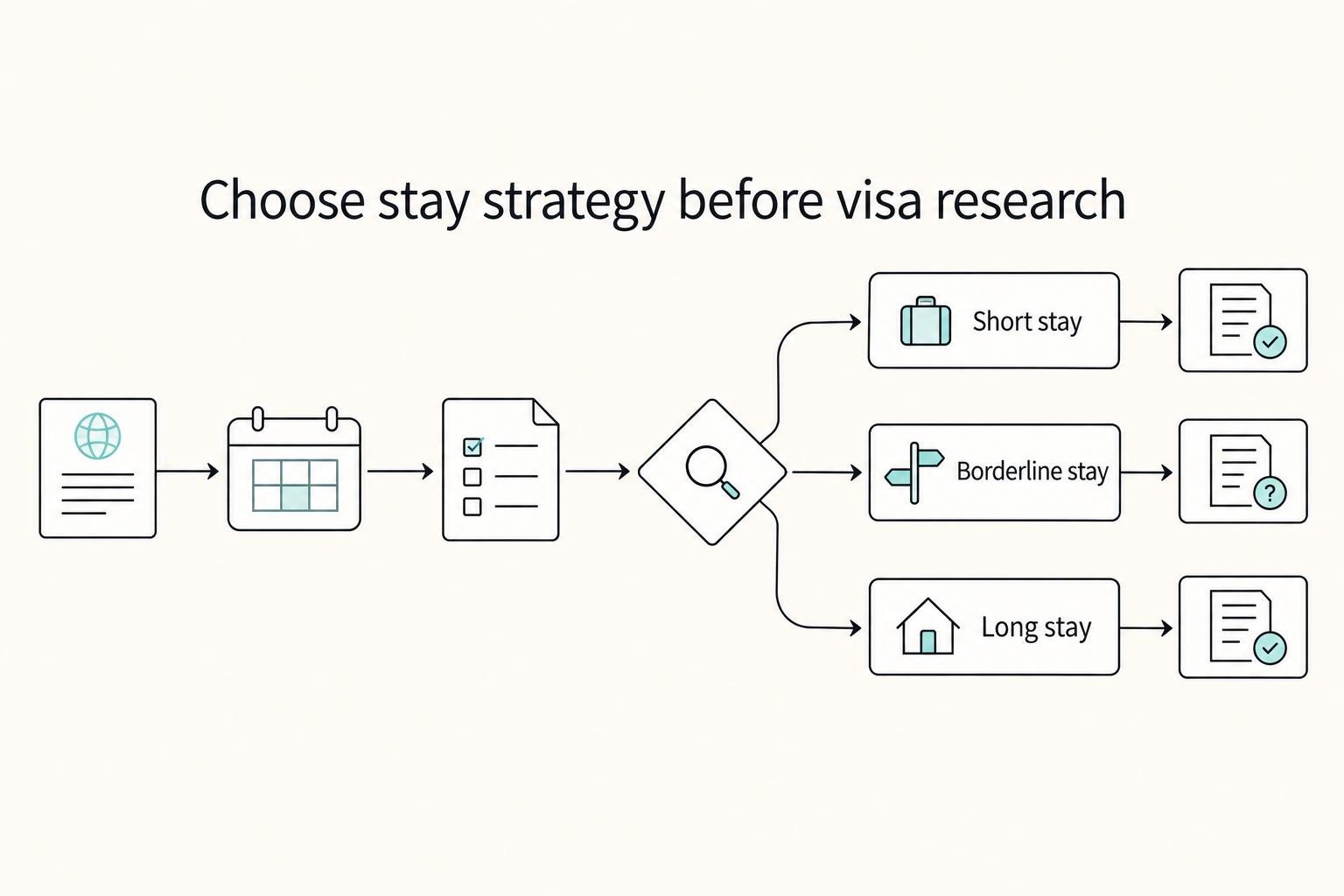
Choose your stay strategy before you choose your visa#
Decide how long you may actually stay and who will pay you, then pick the visa.
| Stay branch | What your facts look like | Visa choice that usually fits | Main tax move |
|---|---|---|---|
| Short stay | Clearly short plan and genuinely tourism or cultural activity | Visa V Turismo if this is truly tourism. That route is for leisure or cultural activity, not work. For visa-exempt nationalities, remote/nomad entry may be 90 days, extendable up to 180 continuous or discontinuous days in the calendar year. | Start day counting immediately. |
| Borderline stay | Plan could stretch toward 90 to 180 days, with possible extensions or return trips | If you will work remotely from Colombia for foreign companies, Visa V Nómadas digitales is the activity-matched route. | Treat day one as resident-readiness day one. |
| Long stay | Open-ended plan or likely drift near or over 183 days in a rolling 365-day period | For foreign remote work, the nomad visa aligns with the activity and can be issued up to two years. A tourism route is for leisure or cultural activity, not ongoing work. | Assume resident-readiness from the start. |
If your plan can drift anywhere near the 183-day / 365-day test, act as if resident treatment may apply later. Track every entry and exit because both days count, and keep clean records showing who paid you and from where.
Foreign clients only or local work#
This is a real dividing line, not a paperwork detail. If you are paid only by foreign clients, the nomad route is built for that pattern. Tax scope also changes with residency status: DIAN describes non-residents as taxed on national-source income, while residents are taxed on national- and foreign-source income.
If you may take local work, invoice a Colombian company, or receive payments from a Colombian business, treat that as a stop sign for the nomad and visa-free remote routes. The digital nomad visa does not allow paid activity with Colombian-domiciled persons or companies, and the visa-free remote route is also conditioned on not generating payments from Colombian companies.
Your go or no-go check before booking six months in Medellín or Bogotá#
Before you commit to a long lease, answer these in writing:
- How many days are you realistically planning in Colombia over the next 365 days?
- Who will pay you while you are in Colombia?
- Are you relying on a visa-free 90-day entry plus extension, and is your nationality currently covered?
- Can you document your payer and income-source facts if asked later?
If any answer is unclear, pause the housing commitment and fix visa fit plus day-count planning first. For a comparable planning framework, see Hungary's White Card for Digital Nomads: A Complete Guide.
Track your days with a method that survives an audit#
If your stay can stretch, treat day counting as a tax control from day one. Colombia tax residency can apply at 183 days or more within a 365-day period, consecutive or not, and exits plus re-entries still add to the total.
Your visa label and your tax status are not the same question. The visa covers immigration status, while tax treatment turns on residency status and the 365-day count. A quick trip out of Colombia or a calendar-year reset does not automatically remove residency risk.
Understand the rolling window#
Use a moving 365-day view, not only a January-to-December view. On any given date, total your physical-presence days in Colombia across the relevant 365-day period. If that total reaches 183 days or more, resident treatment can be triggered.
| Sample travel pattern | Counted days in Colombia within one 365-day window | Likely result under the 183-day rule | Why it matters |
|---|---|---|---|
| Three separate stays: 62 days, 58 days, 67 days | 187 | Likely triggers residency risk | Non-consecutive days still count in the same 365-day period |
| Year-end plus new-year stay: 98 days, then 90 days | 188 | Likely triggers residency risk | Crossing a calendar year does not reset the rolling count |
| Two medium stays: 74 days, then 81 days | 155 | Likely does not trigger on these facts alone | Still below 183, but added time can change this quickly |
| Six shorter visits of about 31 days each | 186 | Likely triggers residency risk | Repeated short trips can add up past the threshold |
Use a counting method you can reproduce later#
Use a process you can explain and prove later:
- Log every entry and exit on the day it happens. Keep one master record with arrival date, departure date, and running total.
- Reconcile monthly. Check your running total against your own travel records, not memory.
- Flag any approach to 183 early. If an extension or return trip may push you near the threshold, switch to resident-readiness planning.
Crossing the threshold is a major status change. It can mean preparing to declare worldwide income and handling resident-side actions such as RUT (Registro Único Tributario) registration. It is also worth remembering that declaring does not always mean paying.
Where people get caught out#
People usually get caught out by relying on memory alone. Split stays and short exits are easy to miss, which can lead to bad counts and late compliance decisions.
Keep the method simple and repeatable. Update your count monthly, and treat each new trip as part of the same 365-day picture.
Keep a rolling 365-day log now so your 183-day exposure is visible before it becomes a filing problem: Tax Residency Tracker.
Handle your first 30 days in Colombia#
Your first 30 days set the tone for everything that follows. Build your records as if you may later need to show entry and exit history, address history, and foreign-company remote income. If you do that from day one, immigration and DIAN-related steps are much easier to support later.
Lock down migration and identity records early#
Start with the records that are hardest to reconstruct later:
- Save your CheckMig submission and confirmation for every entry and exit, because submitted information may be verified by Migración Colombia.
- If your visa validity is more than tres (3) meses, complete Registro de Extranjeros within quince (15) días calendario and keep proof of completion.
- Store your visa and migration confirmations in one folder so they are easy to retrieve if requested.
Keep one consistent address record, especially if you move#
If you may move between cities, keep a dated address log from the start. Use one exact version of your details everywhere: País, Departamento, Ciudad/Municipio, Dirección Principal, Correo Electrónico, Teléfonos.
Build one foreign-income evidence folder for remote work#
For Visa V Nómadas digitales, your file should clearly show remote work for foreign companies and no remunerated activity for Colombia-domiciled persons. Keep these documents current in one folder:
| Document | What it should show | Note in text |
|---|---|---|
| Employer or client letters | Relationship and remuneration | Spanish or English |
| Contracts with foreign companies | Foreign-company relationship | Or proof you are a partner or co-owner of a foreign company |
| Payment records | Income from foreign companies or clients | Keep current |
| Bank statements | Support the income stream | Include the published threshold of tres (3) SMLMV durante los últimos 3 meses where relevant |
Store RUT-ready data now so you do not rebuild it later#
If you later need RUT (Registro Único Tributario), DIAN uses it to identify, locate, and classify people with tax-administered obligations. Keep the core RUT fields clean and current, including Actividad Económica and Responsabilidades alongside your contact and address data. If you later hold a RUT and any of these facts change, DIAN states updates are your responsibility within one month of the change event.
We covered a similar documentation approach in A Guide to Greece's Digital Nomad Visa and its 50% Tax Break.
Operate cleanly from day 31 to day 182#
From day 31 onward, this is mostly a facts-and-timeline issue, not just a visa issue. Your visa status alone does not determine tax treatment. What matters is your accumulated days and whether your work facts still match foreign remote work for foreign clients.
Keep one monthly control routine#
A simple monthly routine does most of the heavy lifting. Run the same three checks every month:
- Update your day count using your travel records, and measure it against the 183 days in a 365-day period test.
- Confirm client geography for each active payer, and keep current proof that clients or employers are outside Colombia.
- Track Colombia-linked invoicing and flag any invoice tied to a Colombian company.
The under-183-day position is a typical scenario, not a blanket guarantee. If your facts change mid-year, your risk profile can change with them.
Treat the 183-day rule as a moving line#
Do not wait for day 183 to react. If an extension, re-entry, or travel change makes crossing the threshold plausible, move to resident-prep right away.
Prepare a resident-grade file with income records and entry-and-exit history. If you exceed 183 days, resident treatment can apply, which can bring worldwide income declaration and RUT registration into scope.
What "typically no filing" misses#
"Typically no filing" is only useful if the underlying facts stay clean. Staying below 183 days can still depend on your facts staying consistent.
A border exit does not reset the count in the 365-day test. Also, declaring and paying are not always the same thing, so treat filing risk and payment outcome as separate questions.
Review residency triggers, not just visa validity#
Each month, answer four direct questions:
- your accumulated days in the current 365-day window
- whether all current payers are still foreign
- whether you invoiced any Colombian companies
- whether any extension or travel change moved your threshold timeline
Keep a dated snapshot each month so you can support your position if your status changes.
Prepare for day 183 and resident obligations#
If crossing the threshold looks likely, act now as if resident compliance may apply. Once Colombian tax residency applies, DIAN moves from Colombian-source scope to national and foreign-source income, plus assets inside and outside Colombia.
The trigger is more than 183 days in any consecutive 365-day period, counting entry and exit days. If your stay spans more than one tax year, DIAN says residency is considered from the second tax year or period. Keep a dated file that shows both total days and the tax period those days fall into.
| Duty area | Before residency typically applies | After residency applies |
|---|---|---|
| Tax scope | Non-resident treatment: Colombian-source income and assets in Colombia | Resident treatment: national and foreign-source income, and assets inside and outside Colombia |
| Return form (if filing is required) | Formulario 110 | Formulario 210 |
| RUT | Check whether you are a filer, then register if required | Check early; once you are a filer, DIAN says registration in RUT is due by the return deadline |
| Records | Day count, entry and exit history, payer geography, Colombia-linked invoices | Pre-residency records plus foreign income records, payment confirmations, and asset records inside and outside Colombia |
| Main risk | Assuming "temporary stay" means no filing analysis | Waiting too long and then scrambling to support resident reporting |
Recheck the residency trigger first#
Before you think about forms, confirm whether the trigger applies and when. Use your day log and travel records to verify the 183-in-365 test, and flag separately if the window crosses tax years because the second-year rule can affect the filing period.
Keep immigration and tax as separate tracks. The Digital Nomad Visa is migration permission and should not be treated as a tax exemption, and it does not allow remunerated work with Colombia-domiciled individuals or companies.
Resolve the RUT path early#
If you become obligated to file, DIAN says you have until the return due date to register in RUT (Registro Único Tributario). Even so, do not wait for the deadline window.
As soon as crossing looks plausible, open a resident-grade file with identification data, dated proof of presence, and organized income records for the relevant period.
Assess the return on resident terms#
If filing as a resident individual, DIAN points to Formulario 210. Non-resident filing points to Formulario 110. Build your resident analysis around three buckets:
- income from Colombian sources
- income from foreign sources
- assets held in and outside Colombia
Collect contracts, invoices, payment confirmations, and asset records early so your filing position is supportable.
DIAN's 2025 doctrine says a resident with worldwide income must meet formal and substantive obligations. But filing and paying are not the same thing. If your facts suggest you may cross the threshold, prepare as a likely resident now rather than waiting for year-end.
You might also find this useful: Tax Residency in Colombia: Rules for Digital Nomads and Expats.
Avoid the mistakes that create expensive surprises#
The biggest avoidable mistake is treating immigration permission and tax status as the same thing. Visa status and tax residency are separate questions, and tax residency is a day-count question.
- Do not assume the visa decides your tax outcome.
Tax residency is tied to time in country. If you spend more than 183 days in Colombia within a 12-month period, you can be treated as a tax resident.
- Do not assume short exits erase day accumulation.
Quick trips out can create false confidence. Track your running total across the relevant 12-month window with a dated log, so you can verify your position with records instead of guesswork.
- Do not wait until filing time to organize records.
Late organization is where manageable compliance turns into a scramble. Build your file early so your income, foreign-asset, and stay records are ready if DIAN review happens.
- Do not mix local and foreign-source income facts in one pile.
Keep your documentation clearly separated and supportable. If resident treatment applies, obligations can include worldwide income and foreign assets, and poor records can increase exposure to penalties, DIAN audits, and issues around items such as Form 160.
Related reading: A Guide to Mauritius' Digital Nomad Visa.
Compare common relocation scenarios before you commit#
Before you lock in flights or housing, compare the likely tax path as carefully as the visa path. The right route depends on stay length and drift risk, not visa label alone.
| Scenario | Stay pattern | Route in text | Decision rule |
|---|---|---|---|
| A | Six-month plan with foreign-sourced remote income | Tourist route: typically a 90-day stamp on arrival, with a 90-day extension requested before that stamp expires, up to 180 days per calendar year | Continue only if you can hold a firm departure date, keep a strict day count, and maintain consistent foreign-income evidence; if the timeline starts stretching, cap the stay |
| B | Open-ended stay in Medellín or Bogotá | Digital nomad option may fit the immigration side better because it can cover up to 2 years | Move to full compliance preparation now |
| C | Testing the city, your routine, or client stability on a tourist route first | Reasonable at first, but risky if treated as a placeholder with assumed guaranteed switching later | Continue only if the stay remains short and exploratory; if the plan expands, move to full compliance preparation and reassess visa strategy early |
Scenario A#
A six-month plan with foreign-sourced remote income works only if you treat day limits as a hard rule. The tourist route can fit this profile because it is typically a 90-day stamp on arrival, with a 90-day extension requested before that stamp expires, up to 180 days per calendar year.
Before you commit to flights or housing, make sure your evidence file is consistent and, where required, clearly foreign-sourced. For remote-work applications, evidence can include an employment contract plus payslips or freelance invoices plus bank statements. Rejections often come from inconsistent evidence across documents.
Decision rule: continue only if you can hold a firm departure date, keep a strict day count, and maintain consistent foreign-income evidence. If your timeline starts stretching, cap the stay.
Scenario B#
If your stay in Medellín or Bogotá is open-ended, treat tax-residency risk as likely to become a live issue. The digital nomad option may fit the immigration side better because it can cover up to 2 years. But visa fit does not remove tax filing exposure if your facts move into resident territory.
Start recordkeeping from day one: keep entry records and income documents organized. For the digital nomad path, keep proof that remote income is earned outside the host country. Applicants are also described as needing to show about $900 per month.
Decision rule: move to full compliance preparation now.
Scenario C#
Starting on a tourist route first is reasonable if you are testing the city, your routine, or client stability. It becomes risky when treated as a placeholder with assumed guaranteed switching later.
Your checkpoint is before the initial 90-day stamp expires. Decide whether this is still a short trial or becoming a longer stay. If work volume, housing, or timeline expands, do not wait to align your visa and tax planning or to organize documents.
Decision rule: continue only if the stay remains short and exploratory. If the plan expands, move to full compliance preparation and reassess visa strategy early.
For a step-by-step walkthrough, see Colombia Digital Nomad Visa Guide for Remote Workers in 2026.
Add the US reporting layer if you are a US person#
If you are a US person, treat US reporting as a parallel track, not a later step. Even with a clean non-US file, assess US filings separately.
The core items are distinct and should be reviewed with counsel: FATCA, Form 8938, and FinCEN Form 114 (FBAR). Form 8938 is the IRS "Statement of Specified Foreign Financial Assets," and those assets can include foreign financial accounts. IRS instructions are explicit that filing Form 8938 does not replace FBAR when FBAR is otherwise required.
What matters most in practice#
The practical issue is keeping the US review on schedule while your non-US file stays organized. For Form 8938, get the fundamentals right: attach it to your annual US return and file by that return's due date, including extensions. Set the correct calendar year or tax year, and keep records that support account-level details such as maximum values.
IRS materials state that certain US taxpayers file Form 8938 when aggregate specified foreign financial assets exceed $50,000, with higher thresholds for some taxpayers. Use that as a review trigger, not a one-size-fits-all rule. If you are not required to file a US income tax return for the year, IRS guidance says you do not need to file Form 8938.
Keep one evidence trail#
Keep one evidence trail that supports both non-US and US filings. Maintain foreign account statements, transfer confirmations, and the account and income records used in your filings.
This helps when you need records to show maximum balances or trace transfers back to the same income records used elsewhere in your file.
Confirm what is still uncertain and escalate early#
If your facts are close to the line, escalate early. Public guidance is useful for baseline rules, but not for your exact outcome. The high-confidence points are these: Colombian tax residency is defined under Article 10 of the Estatuto Tributario, not by visa label, and the core presence test is more than 183 calendar days in any 365 consecutive days, including entry and exit days.
A Visa V Nómadas digitales addresses immigration status but does not, by itself, determine tax status. Official visa guidance also limits this visa to work done exclusively for foreign companies and does not authorize paid activity for Colombian-domiciled persons or entities. On tax scope, DIAN guidance distinguishes residents, who report national and foreign-source income plus assets inside and outside Colombia, from non-residents, who are subject only to Colombian-source income/gains and assets held in Colombia.
What is solid and what needs escalation#
You can generally rely on these points:
- the 183-day test runs on a rolling 365-day window
- days do not need to be consecutive
- entry and exit days count
- if presence spans more than one taxable year, DIAN indicates residency applies from the second year or taxable period
Escalate instead of guessing when facts are messy or sources conflict. DIAN states its doctrinal responses are general and that each taxpayer must determine obligations based on their own case. That matters most when income characterization is unclear, timing is close to thresholds, or advice from blogs and advisors does not line up.
Also treat older visa summaries cautiously. Resolution 5477 was modified on 28 de diciembre de 2023, and official visa income proof is stated in SMLMV terms, while secondary sources may show fixed COP figures.
Escalation triggers#
Get a pre-threshold review with a Colombia-qualified advisor if any of these apply:
| Trigger | Why escalate |
|---|---|
| Stay may approach or exceed 183 days in a rolling 365-day period | The 183-day threshold is the core residency line in the article |
| Day count crosses two taxable years and timing is unclear | DIAN indicates residency can apply from the second year or taxable period |
| Income pattern is mixed or hard to classify from your records | The article says each taxpayer must determine obligations based on their own case |
| You are receiving conflicting guidance from public sources or advisors | The article says to escalate instead of guessing when sources conflict |
| You are unsure whether paid activity could be treated as work for a Colombian-domiciled person or entity | Official visa guidance does not authorize paid activity for Colombian-domiciled persons or entities |
Do not wait until after day 183. Review when your calendar, contracts, and payments suggest you could cross the line.
Bring evidence, not assumptions#
Bring a reconciled day log, passport stamps, flight records, address history, contracts, invoices, and payment records. If key days are disputed, resolve them before the review. If your position depends on foreign clients, be ready to show who paid you, from where, and for what work.
Practical standard: if you cannot prove your day count and income facts with documents, assume your position is weak and escalate early.
This pairs well with our guide on A Guide to Italy's Digital Nomad Visa and Tax Regime.
Conclusion#
Treat your Colombia plan as a timeline, not a one-time visa application. Your tax exposure turns on residency status, not the visa label, so focus on the 183-day / 365-day window, your work setup, and whether your income stays tied to clients or employers outside Colombia.
From your first entry, keep a rolling day count you can prove. Leaving and re-entering does not reset the count, so if a short stay starts stretching, change your compliance posture early instead of waiting until year end.
- If you are clearly below the threshold, working only for foreign clients or employers, and not invoicing Colombian companies, keep your day count and records current.
- If you are approaching the threshold, build a resident-grade compliance file before you need it.
- If your facts are mixed or unclear, get Colombia-qualified advice before you cross into harder-to-unwind obligations.
That resident-grade file is your evidence trail: keep your travel records and core work and payment documentation organized from the start. If residency becomes likely, those records help you move faster on RUT registration and assess whether resident-side declaration steps are now part of the picture.
Once you are treated as a resident, the scope shifts to worldwide income declaration. Declaring is not always the same as paying, but that is a reason to prepare early, not to delay.
One final caution. The source wording is not fully aligned on the cutoff, with references to both "183 days or more" and "more than 183 days." If your count is close, verify the applicable standard with primary legal guidance or qualified local advice before relying on a borderline day count.
If your move plan includes cross-border invoicing and payouts, confirm what workflows and coverage are available for your setup: Talk to Gruv.
Frequently Asked Questions
Do digital nomad visa holders automatically pay tax in Colombia?
No. In this context, your tax outcome depends on whether you are a Colombian tax resident, not on your visa label. A digital nomad visa, tourist visa, or another temporary visa does not automatically determine tax treatment.
How does the 183-day rule work if my days are non-consecutive?
The test is 183 days or more within a 365-day period, and the days do not need to be continuous. Leaving and re-entering does not reset the count, because those days are still added within that window.
If I stay under the threshold, do I usually file a Colombian income tax return?
In the typical under-183-day scenario described in the source, you do not file a Colombian income tax return. In that same typical scenario, you also do not pay tax on foreign income. This is not a blanket rule for every case, so outcomes can still depend on your specific facts.
What changes the moment I become a Colombian tax resident?
The main change is scope: you must declare worldwide income. In the resident scenario described, compliance steps include registering in the RUT and filing a return if you exceed applicable thresholds.
Can I avoid tax residency by leaving Colombia and coming back later?
No, not if your total still reaches the threshold within the same 365-day period. The days are accumulated even when your stays are split across multiple entries and exits.
What is the difference between declaring worldwide income and actually paying tax?
They are related but not identical. Declaring does not always mean paying. In practice, residency can create a reporting obligation even when the final tax payable is a separate determination.
Try a related tool
Researched and edited by the Gruv editorial team. Gruv builds cross-border billing, payouts, and finance-operations software for global businesses.
Sources
Includes 1 external source outside the trusted-domain allowlist.
- cancilleria.gov.co/v/nomadadigitaltrusted
- cancilleria.gov.co/visas-0trusted
- dian.gov.co/impuestos/personas/Renta-Personas-Naturales-...trusted
- dian.gov.co/impuestos/personas/Renta-Personas-Naturales-...trusted
- fincen.gov/report-foreign-bank-and-financial-accountstrusted
- irs.gov/businesses/corporations/do-i-need-to-file-fo...trusted
- irs.gov/forms-pubs/about-form-8938trusted
- 4solgroup.com/2025/12/24/top-legal-tax-mistakes-expats-mak...external
Educational content only. Not legal, tax, or financial advice.
Related Posts

The 2026 Global Digital Nomad Visa Index for 50+ Countries
Start with legal fit, not lifestyle filters. The practical order is simple: choose a route you can actually document, then decide where you want to live. That single change cuts a lot of wasted comparison work and stops you from falling in love with places that were never a real filing option.

Hungary White Card Guide for Digital Nomads: Eligibility, Documents, Fees, and Timeline
Treat this like an audit, not a hope-and-pray submission. Your job is to decide whether your real-world setup fits the permit logic, pick the right filing route, then build one evidence pack that stays coherent even if someone reviews it line by line.
Tax Residency in Colombia for Digital Nomads and Expats
Living in Colombia is manageable when you treat tax residency as a classification decision early, then maintain it as facts change. The biggest failures rarely come from one dramatic event. They come from avoidable shortcuts: estimating days from memory, using visa language as a tax answer, or waiting until filing season to map cross-border income.