
Quick Answer
Yes. You can claim AOTC abroad without a Form 1098-T when the school is an eligible educational institution, the student meets status rules, and your records tie charges to payments. For expats, the main decision point is FEIE add-back in MAGI, not just taxable income on the return. If those checks pass, complete Form 8863, keep your exchange-rate support and calculation worksheet, and store the full file for later review.
Claiming the AOTC Abroad: The Expat's Audit-Proof Framework#
For an expat, an AOTC claim stays low-stress if you handle it in order: confirm eligibility, build your proof, then file Form 8863. In practice, substantiation is usually the hard part, not the form.
The easiest way to create problems is to start with the software. Only later do you ask whether the school qualified, whether the student actually met the AOTC rules, or whether the payment records really support the number on the return. A cleaner approach is to treat the claim like a short file review. If the school clears, the student clears, the MAGI check clears, and the records tie out, filing is usually uneventful. If one piece is weak, you want to find that out before you submit the return.
Phase 1. Is the claim even live?#
Start with the school. To claim AOTC, it must be an eligible educational institution, meaning one that can participate in a U.S. Department of Education student aid program. Some non-U.S. schools qualify, so verify the school in the Federal School Code list and save dated proof of what you found. Do not rely on DAPIP alone for foreign schools.
| Gate | Requirement | Verification |
|---|---|---|
| School eligibility | Eligible educational institution that can participate in a U.S. Department of Education student aid program | Verify the school in the Federal School Code list and save dated proof; do not rely on DAPIP alone for foreign schools |
| Student enrollment/status | Degree or recognized credential program; at least half-time for at least one academic period | Use an enrollment document, transcript, registrar letter, or portal record |
| Student stage / conviction | Within the first four years of higher education; without a felony drug conviction at year-end | Check the student's education stage before you compute the credit and confirm the conviction rule before filing |
| MAGI | Verify the current-year Form 8863 instructions | 2025 instructions show $180,000 (MFJ) and $90,000 (single/HOH/QSS) |
| Stop-sign checks | Education credits generally cannot be claimed with married filing separately or if you or your spouse were nonresident alien during the year and no resident election was made | Check these early before spending time on tuition math |
Do not just check once and move on. Save what you saw in a way that another person could review later without recreating your search. A dated screenshot or PDF is better than a note saying "looked it up." Make sure the saved proof shows the school name clearly. If the school uses one name locally and another in English, keep whatever school document you already have that connects those names. That way, your file does not depend on memory a year later. If the result is unclear, do not paper over it with a guess. Resolve the school issue first, because everything else depends on it.
Then check the student's status. The student must be in a degree or recognized credential program. They must be enrolled at least half-time for at least one academic period, within the first four years of higher education, and without a felony drug conviction at year-end. If any of those fail, test LLC rather than trying to force AOTC.
Work through those points one by one instead of treating them as one broad "student qualifies" question. Pull the enrollment document, transcript, registrar letter, or portal record and confirm that it actually shows what you need it to show. Your file should support all of the following without inference:
- the student's identity
- the school's identity
- the degree or recognized credential program
- at least half-time enrollment
- at least one academic period
The "first four years" point is where people often get sloppy, especially if the student has prior attendance, transfers, or a mixed academic history. Do not assume the answer from a billing screen. Check the student's education stage before you compute the credit. The same goes for the year-end felony drug conviction rule. Confirm it before filing, not after.
If any one of those student-status items fails, stop trying to rescue AOTC with explanation. The cleaner move is to shift immediately to LLC and see whether that credit fits better. That keeps the analysis honest and prevents you from building a big documentation file around a credit that was never available.
Next, run the expat MAGI check. If you use the Foreign Earned Income Exclusion, do not assume low taxable income means you qualify. Excluded income can be added back for education-credit MAGI. Verify the current-year Form 8863 instructions before filing. As a reference point, 2025 instructions show $180,000 (MFJ) and $90,000 (single/HOH/QSS).
This is the place to slow down if your return involves FEIE. A return can look comfortably low on taxable income and still miss the education-credit MAGI test once the right add-back is applied. So do not let the credit decision ride on a quick glance at the taxable-income line. Build the MAGI check deliberately, using the current-year Form 8863 instructions before you lock in the claim. If you are near the limit, treat that as a warning sign rather than a close-enough call. Near-limit cases are exactly where a small input error or a wrong assumption about FEIE can flip the result.
Before you DIY the return, run two stop-sign checks. They can end the analysis before you spend time on the tuition math:
- Education credits generally cannot be claimed with
married filing separately. - Education credits generally cannot be claimed if you or your spouse were nonresident alien during the year and no resident election was made.
These are worth checking early because they can end the analysis regardless of how good the school records are. If either stop sign applies, do not spend time refining the tuition calculation until you know the filing position is compatible with the credit. This is one of the simplest ways to save yourself work. Kill the claim early if the return posture does not allow it.
Phase 2. Build the evidence file before you file#
If you do not have a clean 1098-T path, your records need to carry the claim. IRS instructions allow a claim without Form 1098-T if you otherwise qualify and can prove enrollment plus payment of qualified tuition and related expenses.
| File component | What it should show | Examples |
|---|---|---|
| Enrollment proof | Degree or credential status and at least half-time enrollment for an academic period | Registrar letter, enrollment certificate, transcript, or portal records |
| Qualified expense proof | Qualified charges, with non-qualified items removed | Itemized tuition statements, mandatory fee invoices, and receipts for required books or course materials |
| Payment trail | Each payment connected to a specific qualified charge | Bank, wire, or card records and school ledger entries |
| Currency conversion method | One consistent method from foreign amount to USD | Exchange-rate source plus a log by payment date, foreign amount, rate, and USD value |
| Calculation sheet | How the raw documents were turned into the amount claimed | Date, document reference, nature of the charge, whether it is qualified, foreign-currency amount, USD amount, and notes |
Build a file that a third party could review without asking you to explain every page. The strongest evidence file is not the largest one. It is the one where each document has a job and the documents line up in a way that makes the claim easy to follow. Build one folder and group the records like this:
- Enrollment proof
Registrar letter, enrollment certificate, transcript, or portal records showing degree or credential status and at least half-time enrollment for an academic period.
- Qualified expense proof
Itemized tuition statements, mandatory fee invoices, and receipts for required books or course materials. Required books bought off campus can still qualify for AOTC.
- Payment trail
Bank, wire, or card records and school ledger entries that connect each payment to a specific qualified charge.
- Currency conversion method
Keep the exchange-rate source and apply one consistent method. A simple log by payment date, foreign amount, rate, and USD value is enough for review.
For enrollment proof, the goal is to show status, not just attendance in a loose sense. A general student portal screenshot can help, but only if it actually shows the program and enrollment level. If your portal records are split across several screens, save each relevant screen and note the retrieval date so the file still makes sense later. You want the reviewer to see, in one pass, that the student was in the right program and met the half-time requirement for an academic period.
For qualified expense proof, resist relying on a single total. Itemized records are better because they let you separate qualified charges from everything else. If the invoice includes both tuition and non-qualified items, mark the qualified pieces in your own worksheet rather than hoping the total is obvious. For books or course materials bought off campus, keep the purchase receipt and the school or course record that shows the material was required. The point is not to collect extra paper for its own sake. It is to make the connection between the requirement and the purchase clear.
For the payment trail, build a straight line from charge to payment. If the school ledger shows the charge and the bank or card record shows the payment, match them. If the payment amount does not exactly mirror one line on the invoice because several charges were paid together, note that on your worksheet so the numbers still reconcile. A payment record by itself is weak. An invoice by itself is also weak. What supports the claim is the bridge between the two.
For currency conversion, consistency matters more than complexity. Pick one method and apply it the same way across the file. The simple log described above is usually enough if it is complete and readable. Avoid mixing methods from document to document. If one page uses a bank-converted amount, another uses a school ledger conversion, and a third uses a separate exchange-rate source, your file becomes harder to review than it needs to be. A consistent log turns a messy foreign-currency record into something the return can actually support.
It also helps to keep a short calculation sheet in the same folder. That sheet does not replace the underlying records. It simply shows how you moved from the raw documents to the amount claimed. A good worksheet lists the date, the document reference, and the nature of the charge. It can also show whether it is qualified, the foreign-currency amount, the USD amount, and any note needed to explain a match. When the documentation is spread across invoices, portal pages, and bank records, that worksheet becomes the map.
Just as important, strip out non-qualified costs before you calculate anything: room and board, insurance, medical expenses, including student health fees, and transportation.
Do that filtering at the start, not after you already have a credit number in mind. Many school statements bundle qualified and non-qualified items into a single balance, especially when the student account is used for housing, health charges, and tuition at the same time. If you start from the grand total, you are more likely to overstate the claim and then rationalize it later. A better sequence is:
- identify every charge on the statement,
- mark whether it is qualified or non-qualified,
- remove room and board, insurance, medical expenses, including student health fees, and transportation,
- then tie the remaining qualified charges to payments and currency conversion.
That order matters. It keeps non-qualified costs from leaking into the final number just because they sat on the same invoice as tuition.
A clean file usually answers three questions without effort: Was the school eligible? Did the student meet the AOTC student rules? What exact qualified amounts were paid and how were they converted? If your folder cannot answer those three questions clearly, keep working on the file before you file the return.
AOTC or LLC?#
Test AOTC first when the student qualifies, especially if refund potential matters. Use LLC as the fallback when the AOTC rules are not met.
| Decision point | AOTC | LLC |
|---|---|---|
| Refund potential | Up to $2,500 per eligible student; up to 40% of remaining credit (max $1,000) may be refundable | Up to $2,000 per return; nonrefundable |
| Student stage | First 4 years of higher education | No year limit |
| Need tax liability to benefit | Not fully, because part may be refundable | Yes, it only offsets tax owed |
| Typical fallback fit | Student meets undergraduate AOTC rules and you want refund potential | Student is beyond year 4, below half-time, or otherwise misses AOTC student rules |
You can claim AOTC and LLC on the same return only if they are not for the same student and the same expenses.
In practice, this is less about theory and more about disciplined sorting. Run the student through the AOTC checklist first. If the school qualifies, the student is within the first four years, the half-time requirement is met for an academic period, and the other student rules clear, AOTC is the first credit to test. If one of those student-specific rules fails, do not keep massaging the facts. Move to LLC and test it on its own terms.
This matters most when you have more than one student or more than one set of education expenses on the same return. Keep a separate line or worksheet for each student. Mark which credit you tested first, why it fit or failed, and which expenses you assigned to that student. That way you do not accidentally slide into double use of the same expenses.
The same-return rule is straightforward, but easy to mishandle in a rushed filing. AOTC and LLC can coexist on one return only when they are not for the same student and the same expenses. So if you are splitting credits across multiple students, make the separation explicit in your file. Do not rely on memory, especially if several invoices and payment records are involved.
A simple way to avoid mistakes is to decide the credit path before entering anything into the return. Choose the student, confirm the rules, assign the expenses, and only then complete the form. That reduces the risk of using software to explore both credits and then carrying over a number that no longer fits the final decision.
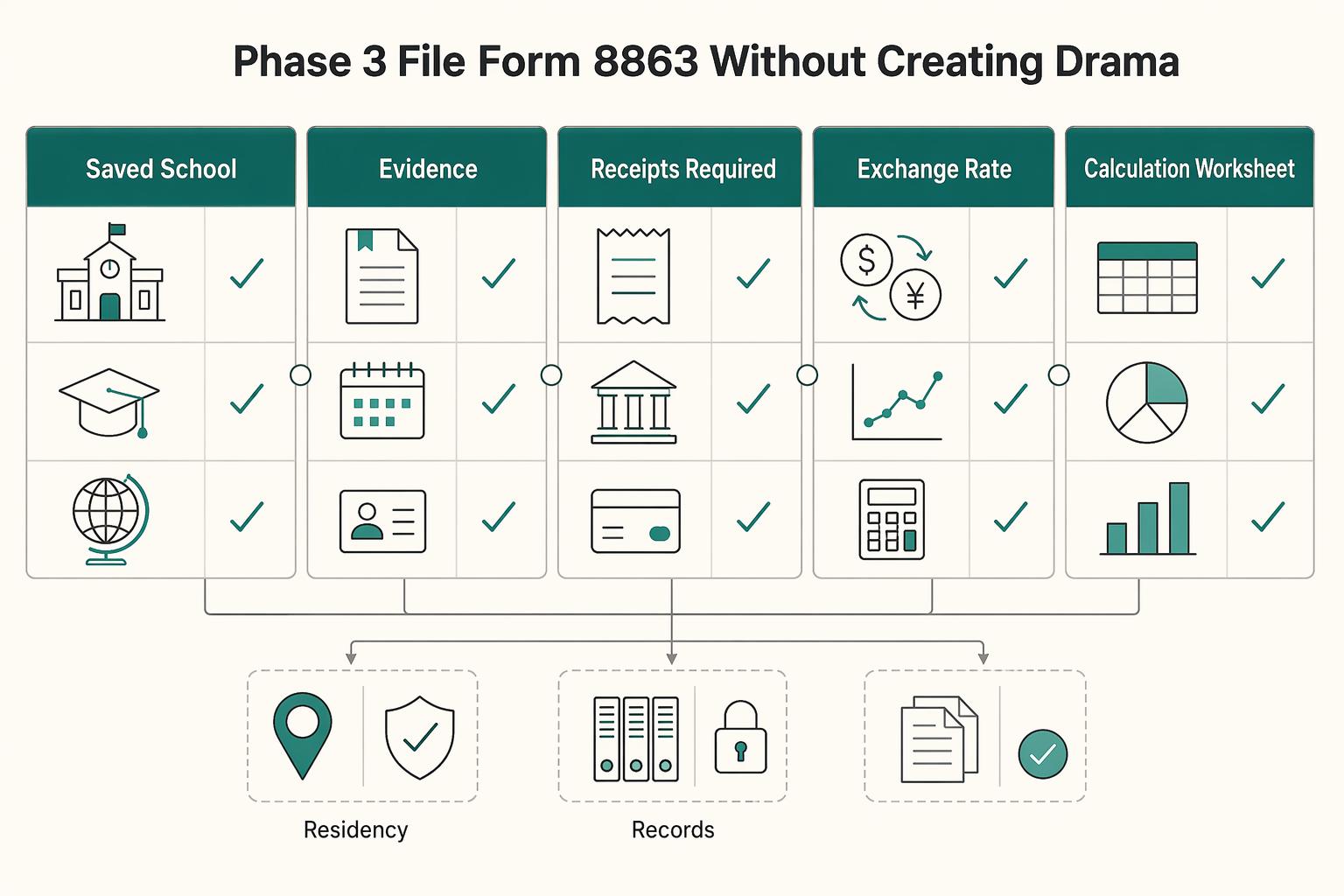
Phase 3. File Form 8863 without creating drama#
Once eligibility and documentation are in place, filing should be the straightforward part. Use Form 8863 to claim the credit. At this stage, do not improvise. Transfer a claim you have already proved. If you have done Phase 1 and Phase 2 well, Form 8863 should feel like the administrative step, not the investigative step. Before you file, make sure your calculation worksheet, school-eligibility proof, enrollment records, and payment records all agree on the same student and the same tax year. Small mismatches here create unnecessary friction later.
If the school was not required to furnish 1098-T, you may still claim the credit if you can prove enrollment and qualified payments. If a required 1098-T is missing, the 2025 Form 8863 instructions require a request after January 31, 2026 and before filing.
The practical takeaway is simple: a missing 1098-T does not automatically end the claim, but it does increase the importance of your own file. If the school was not required to furnish it, your documents need to stand on their own. If a required 1098-T is missing, request it before filing and keep a record of that request with the rest of the file. That way, if the return is later reviewed, the absence of the form is not the first thing anyone sees. The file will already show that you addressed it.
Keep records for at least 3 years as a baseline, and longer when IRS longer-retention rules apply. Store the school-eligibility proof, enrollment records, itemized expenses, payment records, exchange-rate support, and your filed return together.
Do not scatter those records across email, a banking app, and a school portal you may lose access to later. Download and store them now, while access is easy. A good final folder usually includes:
- the saved school-eligibility proof
- the enrollment document set
- the itemized tuition and fee records
- the receipts for required books or course materials, where relevant
- the payment records matched to charges
- the exchange-rate log
- the calculation worksheet
- the filed return and Form 8863
That pack makes later review much easier because the support is assembled in the same order as the claim.
Bring in a tax professional if any of these apply. The risk is not that the form is hard to complete. It is that a rule or record issue could change the answer:
- MAGI is near the current-year limit and FEIE add-back may change eligibility.
- School eligibility under Department of Education rules is unclear.
- Filing position is mixed or high-risk, especially MFS or nonresident-alien issues.
- Payment records exist but do not clearly tie to qualified expenses.
- You plan to split AOTC and LLC across multiple students.
Near-limit MAGI cases can swing on the FEIE add-back. Unclear school eligibility can wipe out the claim regardless of the tuition amount. Mixed filing-position issues can block the credit before you even reach the education analysis. Weak payment matching can undercut otherwise valid expenses. Multi-student returns are where allocation mistakes happen.
That is the audit-resistant path: verify early, document for third-party review, and file only what you can support. If you want a deeper dive, read the digital nomad tax guide. Before you finalize the file, keep your travel and residency timeline in one place with the Tax Residency Tracker. If you want to confirm which compliance and tax-document workflows are enabled for your use case, contact Gruv.
Frequently Asked Questions
Phase 1. Is the claim even live?
Start with the school. To claim AOTC, it must be an eligible educational institution, meaning one that can participate in a U.S. Department of Education student aid program. Some non-U.S. schools qualify, so verify the school in the Federal School Code list and save dated proof of what you found. Do not rely on DAPIP alone for foreign schools. Gate; Requirement; Verification Gate: School eligibility; Requirement: Eligible educational institution that can participate in a U.S. Department of Education student aid program; Verification: Verify the school in the Federal School Code list and save dated proof; do not rely on DAPIP alone for foreign schools Gate: Student enrollment/status; Requirement: Degree or recognized credential program; at least half-time for at least one academic period; Verification: Use an enrollment document, transcript, registrar letter, or portal record Gate: Student stage / conviction; Requirement: Within the first four years of higher education; without a felony drug conviction at year-end; Verification: Check the student's education stage before you compute the credit and confirm the conviction rule before filing Gate: MAGI; Requirement: Verify the current-year Form 8863 instructions; Verification: 2025 instructions show $180,000 (MFJ) and $90,000 (single/HOH/QSS) Gate: Stop-sign checks; Requirement: Education credits generally cannot be claimed with married filing separately or if you or your spouse were nonresident alien during the year and no resident election was made; Verification: Check these early before spending time on tuition math Do not just check once and move on. Save what you saw in a way that another person could review later without recreating your search. A dated screenshot or PDF is better than a note saying "looked it up." Make sure the saved proof shows the school name clearly. If the school uses one name locally and another in English, keep whatever school document you already have that connects those names. That way, your file does not depend on memory a year later. If the result is unclear, do not paper over it with a guess. Resolve the school issue first, because everything else depends on it. Then check the student's status. The student must be in a degree or recognized credential program. They must be enrolled at least half-time for at least one academic period, within the first four years of higher education, and without a felony drug conviction at year-end. If any of those fail, test LLC rather than trying to force AOTC. Work through those points one by one instead of treating them as one broad "student qualifies" question. Pull the enrollment document, transcript, registrar letter, or portal record and confirm that it actually shows what you need it to show. Your file should support all of the following without inference: the student's identity the school's identity the degree or recognized credential program at least half-time enrollment at least one academic period The "first four years" point is where people often get sloppy, especially if the student has prior attendance, transfers, or a mixed academic history. Do not assume the answer from a billing screen. Check the student's education stage before you compute the credit. The same goes for the year-end felony drug conviction rule. Confirm it before filing, not after. If any one of those student-status items fails, stop trying to rescue AOTC with explanation. The cleaner move is to shift immediately to LLC and see whether that credit fits better. That keeps the analysis honest and prevents you from building a big documentation file around a credit that was never available. Next, run the expat MAGI check. If you use the Foreign Earned Income Exclusion, do not assume low taxable income means you qualify. Excluded income can be added back for education-credit MAGI. Verify the current-year Form 8863 instructions before filing. As a reference point, 2025 instructions show $180,000 (MFJ) and $90,000 (single/HOH/QSS). This is the place to slow down if your return involves FEIE. A return can look comfortably low on taxable income and still miss the education-credit MAGI test once the right add-back is applied. So do not let the credit decision ride on a quick glance at the taxable-income line. Build the MAGI check deliberately, using the current-year Form 8863 instructions before you lock in the claim. If you are near the limit, treat that as a warning sign rather than a close-enough call. Near-limit cases are exactly where a small input error or a wrong assumption about FEIE can flip the result. Before you DIY the return, run two stop-sign checks. They can end the analysis before you spend time on the tuition math: Education credits generally cannot be claimed with married filing separately. Education credits generally cannot be claimed if you or your spouse were nonresident alien during the year and no resident election was made. These are worth checking early because they can end the analysis regardless of how good the school records are. If either stop sign applies, do not spend time refining the tuition calculation until you know the filing position is compatible with the credit. This is one of the simplest ways to save yourself work. Kill the claim early if the return posture does not allow it.
AOTC or LLC?
Test AOTC first when the student qualifies, especially if refund potential matters. Use LLC as the fallback when the AOTC rules are not met. Decision point; AOTC; LLC Decision point: Refund potential; AOTC: Up to $2,500 per eligible student; up to 40% of remaining credit (max $1,000) may be refundable; LLC: Up to $2,000 per return; nonrefundable Decision point: Student stage; AOTC: First 4 years of higher education; LLC: No year limit Decision point: Need tax liability to benefit; AOTC: Not fully, because part may be refundable; LLC: Yes, it only offsets tax owed Decision point: Typical fallback fit; AOTC: Student meets undergraduate AOTC rules and you want refund potential; LLC: Student is beyond year 4, below half-time, or otherwise misses AOTC student rules You can claim AOTC and LLC on the same return only if they are not for the same student and the same expenses. In practice, this is less about theory and more about disciplined sorting. Run the student through the AOTC checklist first. If the school qualifies, the student is within the first four years, the half-time requirement is met for an academic period, and the other student rules clear, AOTC is the first credit to test. If one of those student-specific rules fails, do not keep massaging the facts. Move to LLC and test it on its own terms. This matters most when you have more than one student or more than one set of education expenses on the same return. Keep a separate line or worksheet for each student. Mark which credit you tested first, why it fit or failed, and which expenses you assigned to that student. That way you do not accidentally slide into double use of the same expenses. The same-return rule is straightforward, but easy to mishandle in a rushed filing. AOTC and LLC can coexist on one return only when they are not for the same student and the same expenses. So if you are splitting credits across multiple students, make the separation explicit in your file. Do not rely on memory, especially if several invoices and payment records are involved. A simple way to avoid mistakes is to decide the credit path before entering anything into the return. Choose the student, confirm the rules, assign the expenses, and only then complete the form. That reduces the risk of using software to explore both credits and then carrying over a number that no longer fits the final decision.
Try a related tool
Researched and edited by the Gruv editorial team. Gruv builds cross-border billing, payouts, and finance-operations software for global businesses.
Sources
Educational content only. Not legal, tax, or financial advice.
Related Posts

Digital Nomad Taxes in 2026 With a Defensible Filing Plan
With digital nomad taxes, the first move is not optimization. It is figuring out where you may be taxable, where filings may be required, and what proof supports that position.

183-Day Rule Tax Myths That Trigger Residency Filing Mistakes
If you are a mobile freelancer or consultant, start here: the "183 day rule tax" idea is not a single universal test. It is a shortcut phrase people use for different residency rules that do not ask the same question. If you mix federal and non-federal residency logic, you can create filing risk even when your travel calendar looks clean.

Child Tax Credit for U.S. Expats: Eligibility, FEIE, and Filing Checks
Claiming the Child Tax Credit from abroad is manageable when you treat filing as a sequence of gates, not a refund chase. Prove eligibility first, build support documents second, file third, and escalate as soon as one gate is unclear.