
Quick Answer
Pick one primary airline account and one primary hotel account, then test them in live searches for your actual airport pair and likely first neighborhood. Keep flights as your hard commitment, leave lodging cancellable when possible, and attach membership numbers before you book. After your first trip, reconcile confirmation IDs, receipts, and posted activity so missing credit gets fixed before more spend lands in the wrong place.
You're relocating - stop picking loyalty programs like it's a hobby and start treating it like infrastructure#
For a move, loyalty should reduce friction, not become a side project. You are not choosing airline and hotel programs for bragging rights or theoretical value. You are choosing them because relocation exposes weak coverage, weak flexibility, and outdated assumptions faster than almost any normal trip.
A practical starting point is simple: choose a primary airline program and a primary hotel program for the move, then keep everything else in backup status until it proves useful in real searches. If either primary option fails your booking checks on your likely routes or around your first-stay area, stop forcing it and switch the spend. A move is exactly when plans change, promotions disappear, and rules shift, so you need something you can verify, not something that looked good in a ranking.
Do not overweight status promises. Entry-level elite status usually offers limited benefits, and even higher-tier upgrade outcomes are often described as weaker than they used to be. That matters because the real relocation win is not the occasional upgrade. It is getting the flight or room you actually need, in the place you need it, with terms you can live with if dates move.
| Decision area | Hobby mindset | Infrastructure mindset | Relocation outcome | What to check before committing |
|---|---|---|---|---|
| Airline choice | Chase aspirational redemptions | Choose route options you can repeatedly book | Fewer painful rebookings when plans shift | Search your likely dates, airports, and backup airport pairings |
| Hotel choice | Chase brand prestige or status perks | Choose usable options near target neighborhoods | Less time commuting from bad temporary lodging | Check map-based availability near where you may actually live |
| Flexibility | Assume you can fix it later | Read current fare and rate rules at booking | Lower change-risk cost when dates slip | Save screenshots of cancellation and change terms because current policy details vary |
| Earning and redemption | Focus on points totals | Compare cash, points, and miles each time | Better use of concentrated move spend | Only transfer flexible points for a specific booking |
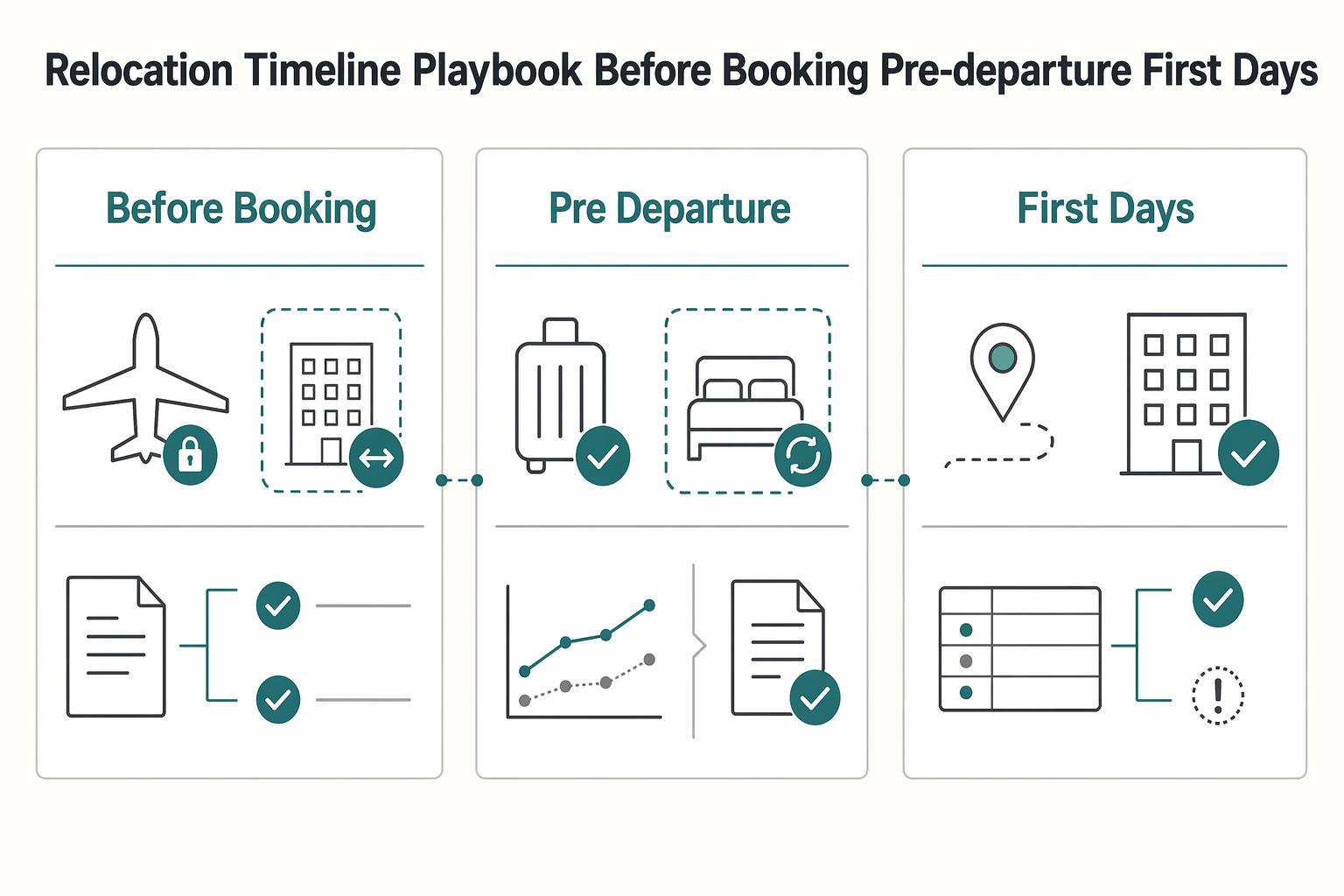
A short timeline you can act on#
Before booking, run live searches on the routes and neighborhoods that matter to your move, not dream itineraries. If a program cannot serve your actual airport pair or your likely temporary-stay area, it is not your primary.
| Timing | What to do | Decision use |
|---|---|---|
| Before booking | Run live searches on the routes and neighborhoods that matter to your move. | If a program cannot serve your actual airport pair or your likely temporary-stay area, it is not your primary. |
| Before departure | Create the accounts, attach membership numbers to every reservation, and save confirmation emails, fare rules, and hotel rate terms. | Keep a clear record in case plans change and you need to revisit booked terms. |
| Soon after arrival | Audit the first flight and first stay against your account activity and booking confirmations. | If outcomes are weaker than expected, or hotel options around your new base are thinner than expected, demote that program quickly. |
Before departure, create the accounts, attach membership numbers to every reservation, and save your confirmation emails, fare rules, and hotel rate terms. This gives you a clear record if plans change and you need to revisit booked terms.
Soon after arrival, audit the first flight and first stay against your account activity and booking confirmations. If outcomes are weaker than expected, or if the hotel options around your new base are thinner than expected, demote that program quickly before more spend gets trapped there.
That is the right starting point. From there, it helps to understand how these programs actually work so your choices are based on mechanics, not guesswork. This pairs well with our guide on A Guide to Waste Separation and Recycling in Germany.
The mental model: how airline + hotel loyalty programs actually work (so you can plan, not guess)#
Treat airline and hotel loyalty programs as two ledgers you manage in order: currency first, status second. If you follow that order, you avoid optimizing perks before confirming you can actually book what your move requires.
Your currency ledger tracks points or frequent flyer miles from eligible flights, hotel stays, and partner/card activity. For each booking, log four things: the earning event, booking confirmation, posting check date, and your redemption options. If inventory is missing when you need it, use a fallback: book the usable cash option, keep credit in your primary program where possible, and wait to transfer flexible currencies until a specific redemption is available.
Your status ledger tracks qualifying activity toward tier perks. Keep this separate from currency so you can see whether status chasing is helping or just adding cost. Rules can change by program and year, so confirm current terms before relying on elite status, upgrade priority, or late checkout.
| Lever | Main goal | What triggers it | Main risk | Ignore it when |
|---|---|---|---|---|
| Points or miles | Future flight booking power | Eligible travel/spend posts correctly | You collect a currency that is hard to use on your real routes; some programs may also have tighter award access | Award access is thin on your likely dates |
| Hotel points | Lower temporary-stay cost | Paid stays and partner/card earning | You cannot redeem where you need to stay because local presence is weak | Neighborhood coverage or commute fit is poor |
| Status | Better treatment on paid travel | Qualifying activity, sometimes card-based acceleration | You spend extra for perks you may not get when properties are busy | Repeat usage during the move is limited |
Use this decision order every time:
- Verify usable inventory first. Coverage and local availability come before all optimization, especially across multiple regions.
- Check earning fit second. Confirm your expected flights, stays, and everyday spend actually feed your chosen accounts.
- Evaluate perks last. Status acceleration can help, but it should not rescue weak footprint.
Network size can still be a useful proxy for hotels, with recent comparisons citing chains near 10,000 and over 9,000 properties. But raw count is only useful if inventory exists near your real first neighborhood, office, or temporary base.
With this model in place, you can now choose programs using move-fit criteria instead of brand familiarity. Related: A Guide to Staying Fit in a Hotel Room.
Which loyalty program should you choose for a move (not a vacation)?#
Choose for relocation utility, not ranking wins. Your primary program should reliably serve your real routes or likely temporary-stay areas, and your backup should cover the other side of the move.
Rankings can help you build a shortlist, but they are not your decision rule. Different publishers can name different winners, and those lists are time-bound (for example, 2025-2026 cycles or pages published on Dec. 30, 2025). Use them as inputs, then validate your own use case.
| Relocation filter | What to verify now | Pass if | Red flag |
|---|---|---|---|
| Route coverage | Your actual departure/arrival airports and expected repeat flights | You can find flights you would realistically book | You pick by reputation first, then find weak coverage on your routes |
| Neighborhood lodging fit | Property map near your target neighborhood, office, school, or temporary base | You see usable options where you may actually stay | The chain is broad overall but thin where you need to be |
| Flexibility rules | Change, cancellation, minimum-stay, and award conditions | You understand what happens if timing changes | You rely on a benefit or rate before checking caveats |
| Posting reliability | Eligible booking channel, member number attached, and post-stay verification steps | You know how credit should post and how you will confirm it | You book through a channel that may not earn and cannot resolve missing credit cleanly |
Start with candidates, then test against your move#
Shortlist two airline programs and two hotel programs, then test each against your planned routes and temporary-housing pattern. Programs differ in network reach, property mix, transfer-partner setup, and redemption mechanics, so a strong generic ranking is not enough on its own.
Use a quick validation pass: check a couple of realistic travel windows and likely neighborhoods, then save the flight options, property map results, cancellation terms, and rate types in one note. If usable inventory is unclear, treat that as a decision blocker.
Pick a primary and a backup#
Use this gate:
| Move type | Primary | Backup |
|---|---|---|
| Flights-led move | Airline program tied to your repeat route | One hotel program with acceptable local coverage |
| Housing-led move | Hotel program with the best local fit | One airline program that covers your unavoidable flights |
| Mixed move | The category you expect to use more in your early move period | The strongest option in the other category |
If a specific rule is important, verify the current policy detail from official provider or source records before using it. Rewards can be useful, but value often depends on conditions. After your program choice is final, you can optimize earning tools with The Best Business Credit Cards for Freelancers.
You might also find this useful: How to Maximize Credit Card Rewards for Free Travel.
How do I compare airline hotel loyalty programs quickly (without spreadsheets you'll abandon)?#
Run this in one sitting: test usable inventory first, redemption reliability second, perks last. If a candidate fails early, stop and move on.
| Candidate | Coverage (check first) | Earning fit | Redemption usability | Flexibility | Operational risk | Go / no-go |
|---|---|---|---|---|---|---|
| Option A | Search your real airport pair or target neighborhood on 2 live dates | Confirm your actual booking path earns | Run 1 award search you would realistically use in the next 30 to 60 days | Open fare/rate rules before checkout | Record member number, booking channel, and posting-check method | Go only if all five checks are usable |
| Option B | Same test | Same test | Same test | Same test | Same test | Same rule |
| Option C | Same test | Same test | Same test | Same test | Same test | Same rule |
Use live booking flows, not rankings, to decide. For flights, test the route you expect to repeat. For hotels, search by neighborhood (not just city), open the map, then save cancellation terms and fare/rate type so you know whether the option is still usable if plans slip.
Apply a hard stop rule: if usable inventory fails, do not spend time on perks. If two options both pass, pick the one with lower maintenance overhead: fewer accounts, fewer exceptions, and cleaner tracking.
Also check earning assumptions before you commit. United said non-cardholders earn fewer miles than cardholders, and that non-cardholders earn 0 miles on basic economy, so log fare class and expected posting path, not just the program name.
After you pick your default pair, document it in one place. A simple note or Notion setup is enough: screenshots, confirmation numbers, member IDs, and expected earn so missing credit is easier to reconcile.
If you want a deeper implementation workflow, use How to Create a Client Portal in Notion.
Should you optimize for airline miles or hotel points first?#
Optimize the currency you will use repeatedly first, then keep the other as secondary until your real booking pattern is clear.
In practice, that is usually hotel-first for temporary stays, airline-first for repeat flight corridors, and a strict one-hotel plus one-airline setup if your usage is mixed. The goal is not to collect more programs. The goal is to build one hotel backbone and one airline backbone you can actually earn and redeem.
| Your near-term pattern | Prioritize first | Decision criteria that matter most | Main risk to check |
|---|---|---|---|
| Temporary housing, apartment hunting, shifting neighborhoods | Hotel points | Stay frequency, cancellation flexibility, usable chain footprint where you will actually stay, and near-term room spend | Big-brand rewards are often easier to use in major cities than in boutique-heavy or small-town markets |
| Repeated flights on the same airport pair | Airline miles | Repeatable route usage, fares you would actually buy, and redemption reliability on that corridor | You split flights across carriers and never build a usable balance in one program |
| Mixed usage, no clear winner yet | The side with the first repeatable expense | Which expense repeats sooner, which rules are clearer, and which path reduces cash pressure sooner | You open too many accounts and end up with scattered balances and weak redemption options |
If you lean hotel-first, run one check before committing: search the neighborhoods you are likely to use, open the property map, and confirm chain options you would genuinely book. Hotel rewards are tied to big brands like Marriott, Hyatt, or Hilton, so usability is often stronger in major cities than in smaller boutique markets.
If you lean airline-first, optimize for a route you expect to repeat, not a dream redemption. If one carrier or program is likely to capture most paid flights, concentrate there. If not, keep flights secondary and use a hybrid approach: use points where reward inventory works, and pay cash where it does not.
Primary first, secondary second#
Pick one primary now and one secondary second. Expand only after you can point to one real earn path and one real redemption path that already worked. If you cannot name both, do not add another program yet.
Cards come after the sequence#
A co-branded card or a card with transferable rewards can help, but only after your sequence is set. Treat card rankings as inputs, not decision-makers. If you add a card, do it only when planned spending already fits the welcome-bonus window and you can pay in full. If not, skip the card and keep execution simple. For that step, see The Best Business Credit Cards for Freelancers.
Need the full breakdown? Read A Guide to Worldschooling and Unschooling for Nomad Families.
What to decide before booking, pre-departure, and in the first 30 days#
Treat relocation bookings like an system: lock the flight decision first, keep lodging flexible, and track terms you may need to use later.
| Phase | Decision to make | Minimum actions | Failure to avoid | Evidence to confirm |
|---|---|---|---|---|
| Before booking | Which flight corridor is real enough to commit to | Check workable airports, likely route coverage, and whether your chosen carrier serves the path at usable times | Choosing a program before confirming the route is actually usable | Airline route coverage, current schedules, official fare rules |
| Pre-departure | Which bookings must stay flexible | Book flights first. For lodging, choose cancellation terms you can live with and record the cutoff date | Locking nonrefundable rooms before your arrival area, commute, or move-in timing is clear | Property cancellation terms, booked rate type, official booking policy link |
| First 30 days | Whether your first pattern is stable enough to standardize | Review actual spend, commute friction, and booking ease. Test one alternative stay or route before repeating the same choice | Turning your first workable option into a default without comparison | Receipts, trip history, travel-time notes, updated cost comparison |
Use a flights-first, lodging-flexible sequence. Flights are usually the hard constraint, while lodging flexibility protects repricing options and reduces early commitment risk.
Avoid timing shortcuts you cannot verify. Seasonal fare-window and route-launch promo-pattern details must be verified from official airline or source records before use. New routes may lag in search tools for days or weeks, so check airline sites directly when a corridor matters. Promo inventory can also disappear quickly, so do not base your move plan on a thin promotional fare alone.
The first 30 days stabilization loop#
Use month one to test, not to optimize. After each stay or flight, log what you paid, commute time, and whether booked terms were actually useful. Then test one alternative option and compare outcomes against your real routine.
Lock a default only after repeatable results. If an option lowers cost but adds major commute friction, treat it as a tradeoff, not an automatic win.
Your tracker checklist#
Keep one live tracker with these required fields:
- confirmation IDs
- rate flexibility
- cancellation cutoff
- repricing status
- last review timestamp
- official policy link
If you plan to use a transfer bonus, verify the live end date before moving points and record proof with a timestamp.
Before any nonrefundable booking, confirm current terms on the official airline, hotel, or issuer page, then log that proof in your tracker.
We covered this in detail in The Pros and Cons of Work-Study Programs.
Execution system: set up accounts, tracking, and controls (so points don't leak)#
Treat this as an ops system, not a travel hobby: one tracker, one document folder, and a fixed reconciliation cadence. The biggest losses usually come from weak process, especially when earning rules are complex and redemption value is hard to read in real time.
Use a three-pass cadence on every trip:
Booking: log IDs, confirmation, expected earn, and proof links.Check-in/check-out: confirm the loyalty number is attached and capture final receipt/folio.Post-trip: reconcile posted activity and open missing-credit tasks until closed.
Build one tracker you will actually run#
If a row has no recent status timestamp, treat it as unowned.
| Tracker field | Where it comes from | Update cadence | Control action if missing or wrong |
|---|---|---|---|
| Program name + member ID | Loyalty account profile | Account setup; verify again before booking | Add ID to reservation before travel; if still missing, assign owner to fix at check-in/check-out and log timestamp |
| Booking confirmation | Airline/hotel app, account page, confirmation email | Same day as booking | Pull from account page; if unavailable, contact carrier/property, assign escalation owner, log timestamp |
| Expected earn | Fare/rate terms in booking details | At booking | Mark estimate pending when qualification is unclear; do not assume credit will post |
| Receipt/folio amount | Airline receipt, hotel folio, card statement | Check-out and after charge posts | Save both records if mismatch appears; request corrected document; keep item open with owner + timestamp |
| Posted activity + missing-credit status | Loyalty activity page | Weekly reconciliation until closed | Open missing-credit workflow with confirmation + receipt + travel proof; track latest update timestamp and owner |
Redemption controls you can apply in under a minute#
Use this quick decision framework before any redemption:
| Test | What to ask | If it fails |
|---|---|---|
| Cash replacement test | Are you replacing a cost you were already going to pay? | Pay cash and keep points for a better-fit use case. |
| Flexibility test | Does this redemption improve your ability to change or cancel during a volatile period? | Pay cash and keep points for a better-fit use case. |
| Timing/availability test | Is inventory available on your actual dates right now? | Pay cash and keep points for a better-fit use case. |
- Cash replacement test: are you replacing a cost you were already going to pay?
- Flexibility test: does this redemption improve your ability to change/cancel during a volatile period?
- Timing/availability test: is inventory available on your actual dates right now?
If one test fails, pay cash and keep points for a better-fit use case.
Minimum viable vs mature system#
- Minimum viable system: one sheet, one folder, every reservation logged, weekly reconciliation.
- Mature system: separate views for missing credits, receipt mismatches, and redemptions, plus a monthly balance-vs-trips audit.
Security and records protocol#
Keep account hygiene simple and strict: use unique credentials for loyalty accounts and the inbox that receives confirmations, and enable account-change alerts where available. Store confirmations, screenshots, boarding passes, and folios in one exportable folder for audit and dispute support. Any record-retention rule must be verified from official provider or source records before use. Related reading: Best Airline Alliances for Global Travelers Who Need Reliable Routes.
Wrap-up: your "one-pass" loyalty setup for a smoother move (plus a short checklist)#
Use a small, destination-tested backbone: one airline program, one hotel program, and a short watchlist.
Keep a program active only if it passes all four checks in your real move context: route fit, neighborhood property fit, redemption usability on your dates, and operational simplicity. If it fails one check, do not keep it active just because a perk looks good.
Keep everything else on a watchlist. Promote a program only after real booking evidence in your relocation flow, such as a completed flight, a stayed reservation, or a redemption you could actually ticket. This helps control sprawl, especially when enrollment is required for eligibility and promo-led app activity increases tracking.
| Step | What you do this week | Output to capture in your tracker |
|---|---|---|
| 1 | Choose one airline and one hotel program using route fit, neighborhood fit, redemption usability, and operational simplicity | Chosen programs and selection reason |
| 2 | Confirm login, profile details, and membership numbers before booking | Account access status and credential location |
| 3 | Make your first flight or stay booking with the member number attached | First bookings, confirmation numbers, expected earn |
| 4 | Check posted activity against receipts after travel | Posted-vs-expected result and missing-credit follow-up |
| 5 | Prune inactive programs and keep them on watchlist status | Cleanup decision: active, watchlist, or archive |
Final safety rule: verify before you trust. For any policy or booking-rule note, save the official terms page and, where relevant, the official PDF checkpoint instead of relying on a summary or unofficial display. Offer-validity details must be verified from official provider or source records before use.
Run one monthly reconciliation pass, then log any policy or booking-rule changes before new nonrefundable bookings. For a step-by-step walkthrough, see The Best Tools for Tracking Your Credit Card Points and Miles.
Frequently Asked Questions
How do I choose without turning this into a research project?
Pick one airline program and one hotel program based on the trips and stays you will actually book in the first 60 to 90 days. Check your real routes, your likely neighborhoods, and your budgeted room rates first. If a program looks great in rankings but does not show usable flights or qualifying stays on your dates, drop it.
Should I optimize airline miles or hotel points first?
Optimize the currency you will spend first, not the one that looks smartest on paper. If your move starts with temporary housing, put your energy into hotel points and any benefits that reduce friction at check-in or checkout. If it starts with repeat flights, focus on miles first and keep one hotel option as your lodging backup.
How can I compare options quickly without building a giant sheet?
Use the same five checks every time, then stop comparing. If a program fails coverage or redemption usability, it is usually not worth rescuing with better earn rates. | Check | What you verify now | Pass signal | |---|---|---| | Coverage | Your real routes and likely hotel areas | Flights and properties appear on your dates and budget | | Earning reliability | Official earning rules, exclusions, booking-channel limits | You can tell which fares or rates qualify before booking | | Redemption usability | Award availability on actual move dates | You can find bookable options, not just aspirational examples | | Flexibility | Change, cancellation, and status conditions | The program is workable if plans shift mid-move | | Admin burden | Registration steps, partner rules, tracking effort | You can manage it with the tracker you already built |
Are ranking lists enough to choose a program?
No. Use them to create a shortlist, then verify the official terms yourself. Your next checks are simple: earning exclusions, booking-channel rules, any stated posting terms, and whether award space or reward nights actually show up on your dates.
Do airline-hotel partnerships make the choice easier?
Sometimes, but only if you qualify and register correctly. A concrete example is RewardsPlus between Marriott Bonvoy and United MileagePlus. Its FAQ says the summary is qualified by the full terms, complimentary Marriott Gold Elite is open to MileagePlus Premier Gold and above with registration required, and complimentary United Premier Silver is open to Marriott Titanium Elite and above with registration required at getrewardsplus.com.
What is the catch with cross-program perks and transfers?
Read the eligibility rules before you count on the perk. In RewardsPlus, matched complimentary status lasts only for the remainder of the calendar year in which it is granted, and some trial or challenge statuses are excluded. Listed hotel benefits can also vary by property and availability. If you are comparing transfer options, do not assume another partnership works like this one just because RewardsPlus states a 1:1 conversion from MileagePlus award miles to Marriott Bonvoy points for eligible members. It also states a 10% MileagePlus bonus when converting Marriott Bonvoy points to MileagePlus miles, with an added 10,000 miles per 60,000 points converted.
What usually stays uncertain even after I pick my programs?
Award pricing can change, availability can disappear, and partner booking paths can follow different rules than direct bookings. Treat any important assumption as unproven until you confirm it in the official terms and on a live search. A good checkpoint is to save the terms page, the booking page, and your eligibility proof in the same folder as the reservation.
Do rules or eligibility vary by country or site version?
Assume they can until you confirm otherwise on the official site for your market, residence, and booking channel. If you are relying on regulatory text or policy language for a dispute, follow the same principle the Federal Register states for legal research: verify against the official edition or PDF, not just a summary page.
What is the last check before I make a nonrefundable booking or move points?
Open the official program rules and confirm eligibility, earning exclusions, posting terms, redemption conditions, and any required registration. Then log the decision, link, and timestamp in your tracking system before you finalize the nonrefundable booking or points transfer.
Try a related tool
Researched and edited by the Gruv editorial team. Gruv builds cross-border billing, payouts, and finance-operations software for global businesses.
Sources
- cdn.vanderbilt.edu/vu-URL/wp-content/uploads/sites/412/2025/10/...trusted
- congress.gov/118/chrg/CHRG-118shrg57391/CHRG-118shrg57391...trusted
- dls.maryland.gov/pubs/prod/RecurRpt/24rs_90_Day_Report.pdftrusted
- fcic-static.law.stanford.edu/cdn_media/fcic-reports/fcic_final_report_ful...trusted
- federalregister.gov/documents/2025/12/08/2025-22289/federal-trav...trusted
- federalregister.gov/documents/2024/04/30/2024-08609/enhancing-tr...trusted
- imls.gov/sites/default/files/legacy/assets/1/AssetMan...trusted
- mtc.ca.gov/sites/default/files/Transit_Connectiviy_Plan...trusted
Educational content only. Not legal, tax, or financial advice.
Related Posts
The Best Business Credit Cards for Freelancers
Pick for reliability first. For a freelancer, the right business card is usually the one that keeps recurring bills moving, keeps records clean, and avoids extra costs when income swings from month to month. Rewards still matter, but they sit on top of those basics. They do not replace them.

A Guide to Notion for Freelance Business Management
If your workspace feels busy but fragile, you do not need more pages. You need one connected system. Treat your freelance business like a business-of-one and use Notion as the control layer that connects client decisions, delivery, and billing in one place.
How to Create a Client Portal in Notion
Start with control rules before you design anything. A polished portal helps, but the real win is client confidence without giving up operator control. The main risks are simple: permission drift, unclear ownership, and internal material leaking into a shared view.