
Quick Answer
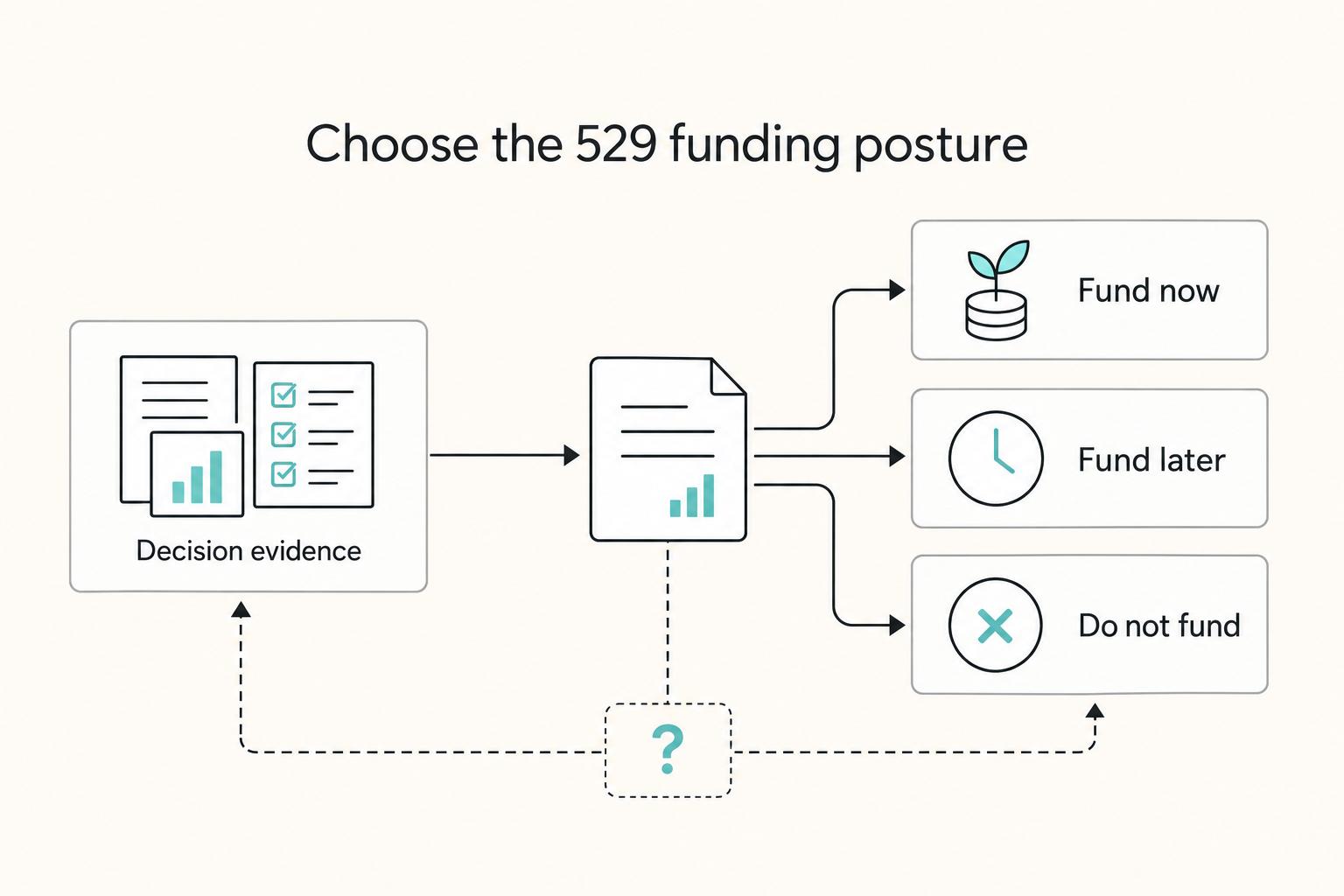
For US expats, a 529 can be a strong option only when it passes a risk-first check. Use a 4-gate workflow: verify you can open and operate the specific state plan, confirm who controls the account, protect cashflow before contributing, and validate cross-border tax/reporting treatment in writing. If any gate is unclear, fund minimally or wait until verified.
The 10-Minute 529 Decision Workflow for US Expats (So You Don't Trade Cashflow Safety for "Tax Savings")#
Run a risk-first workflow that protects liquidity, clarifies control, and prices in tax uncertainty before you fund a 529 account. The goal is simple: choose a safe default you can defend later, and avoid "helpful" moves that create admin chaos when your situation changes.
You are doing two jobs at once: keeping freelance cashflow stable so invoices and taxes do not ambush you, and building education savings with the right vehicle.
A 529 account can make sense because of the tax benefits when the goal is to pay for a child's education, but treat it as a rules-based account, not just another investment account. Even the underlying investments vary by plan. That matters because you are evaluating taxes, operational friction, and the investment menu, not just the account label.
The reusable workflow (eligibility → control → cashflow → compliance)#
Use this in one sitting, then file your notes in a folder called "Education Planning." You are aiming for a simple record you can re-check later, not a perfect plan.
-
Eligibility (can you actually open and run it?)
-
Confirm the provider's rules for opening and maintaining the account. - If anything reads as ambiguous, ask support and save the written response.
-
Control (who holds the steering wheel?)
-
Write down exactly who the plan lists as the account holder. Do not assume family intent equals legal control. - Decide your governance default: one person should be accountable for decisions, with a backup plan if that person cannot act.
-
Cashflow (protect the business-of-one first)
-
Set a cashflow floor that covers taxes, invoices arriving late, and true emergencies. - Only fund education savings above that floor. If you cannot defend the number, you cannot afford the contribution.
-
Compliance (price uncertainty like a cost)
-
Confirm how your tax and reporting situation treats this type of account. Do not guess. - If you cannot confirm, cap contributions at a level you can unwind emotionally and financially.
Decision output: fund now / fund later / don't fund#
| If your situation looks like this | Do this | Why this is the safe operator move |
|---|---|---|
| You can open the account cleanly, you control governance, and your cash buffer feels boring | Fund now (small, repeatable cadence) | You prioritize consistency over heroic deposits. |
| You face unclear setup rules or you cannot confidently explain the tax/reporting treatment that applies to you | Fund later (pause or minimal funding) | You avoid scaling into uncertainty. |
| Your cashflow already feels tight or volatile month to month | Don't fund (yet) | You protect invoice stability and tax set-asides first. |
Hypothetical scenario: you land a new retainer and feel tempted to "catch up" with a big transfer. Run the workflow first. If your cash buffer still depends on that retainer not canceling, you fund later, not now.
Your next step: create a one-page decision record with (1) what you verified, (2) who controls the account, (3) your funding rule, and (4) the date you will re-run this workflow.
Want a quick next step while you sort out education planning? Try the free invoice generator.
529 Plans for Expats: The Mental Model (Before You Touch a Dollar)#
A 529 plan is an education-specific account with a rulebook attached, not a generic investment account you can "set and forget." That mental model helps you avoid a common mistake: optimizing for a tax headline while ignoring paperwork friction and cross-border uncertainty.
What a 529 is (and what it is not)#
A 529 college savings plan works like a tax wrapper plus a rulebook. You put money in. The money can grow inside the account. You take money out later if you can map the withdrawal to qualified expenses. That "if" drives the risk profile.
Do not assume the rules stay static. 529s have real complexities, and the rules have changed over time. Translation for a business-of-one: treat education planning like policy, not vibes. Re-check it.
Key labels you'll see (details and rights vary by plan and provider):
- Account holder (or owner): the person listed on the account.
- Beneficiary: the person the funds are intended to help with education costs.
| Dimension | 529 plan | Regular investment accounts (general model) |
|---|---|---|
| Primary purpose | Education spending with qualified-use constraints | Broad wealth building with flexible use |
| Rule intensity | High. Withdrawals need to match qualified use | Lower. Fewer purpose-based restrictions |
| Admin workload | Often involves provider steps and tracking how withdrawals are categorized | Typically simpler account operations |
| Failure mode | You fund first, then discover the qualified-use details later | You usually control timing and use more freely |
The expat layer: add a second rulebook#
When you live abroad, you may be operating under two sets of rules: the 529's rulebook and your country of residence tax and reporting system. You cannot assume they line up. Rules vary by jurisdiction.
Operator move: before you scale contributions, write a one-line verification target: "How does my current country treat gains and distributions from a 529-style education account?" Then confirm that, in writing, with a qualified cross-border tax professional.
Hypothetical: you fund a 529 because you want disciplined college savings, then you move countries. Do not guess. Pause scaling, re-run your compliance gate, and only then decide whether to keep funding, cap it, or switch to a simpler education-planning approach.
Four Gates to Decide Whether to Open, Fund, or Scale a 529#
You should scale a 529 only after you pass four gates in order: eligibility, control, cashflow, and compliance. These gates prevent the most expensive sequence: funding first, then discovering you cannot operate the account cleanly from abroad, or that the tax and reporting posture is not what you assumed.
The 4 gates (with safe operator defaults)#
| Gate | The question you must answer | "Pass" looks like | If you can't pass, do this |
|---|---|---|---|
| 1. Eligibility & setup | Can you actually open and operate a state-sponsored 529 plan from abroad under the plan's current requirements (address, ID checks, access)? | The plan accepts your profile and you can log in, link funding, and maintain access while abroad. | Pause. Pick a different plan, or delay opening until you can confirm requirements in writing from the plan administrator. |
| 2. Control & governance | Who holds control (account holder), and who takes over (successor owner) if something happens? | You name the right account holder and a successor owner. You keep decision authority aligned with who pays for education. | Do not let "helpful" family own it by default. If they insist, document distribution expectations like a mini policy. |
| 3. Cashflow reliability | Should you fund now, or protect liquidity because invoices do not land on schedule? | You fund only after you protect your emergency buffer and tax set-asides. | Fund small and flexible, or wait. Protect runway before you optimize for tax outcomes you have not verified. |
| 4. Compliance & verification | What do you not know about your country's tax and reporting treatment, and what gift reporting admin might you trigger? | You can state what you verified and where (plan disclosures, written responses, advisor memo). | Cap contributions at a "won't hurt us" level until you verify. Unknowns count as risk. |
A grounded compliance note: distributions from qualified education savings accounts, including a 529 plan and Coverdell ESA, can be reported on Form 1099-Q. Do not guess how that applies to your situation. Confirm your process with your tax pro, especially with cross-border layers. FATCA and citizenship-based taxation can add reporting complexity.
Hypothetical: your parents offer to open the account "to help." You thank them, then route them to contribute to the account you own instead, because governance beats good intentions when education planning gets real.
Deliverable: a one-page decision record (audit trail)#
Treat this like finance ops. Capture it in one page so you have an audit trail you can actually use later.
- Decision: Open, Fund, Scale, or Hold.
- Plan + access proof: plan name, login works abroad, support email screenshot saved.
- Governance: account holder, beneficiary, successor owner.
- Cashflow rule: "We only increase contributions after our buffer and tax set-asides stay intact."
- Compliance notes: what you verified about local taxation and reporting, and what remains unknown, with a review date.
Can You Open a 529 Plan as a US Expat (and Do You Need a US Address)?#
It may be possible for some US expats to open a 529 plan, but plan rules vary and you should not assume you can establish one from abroad. Generally, the account holder must have a US residence to establish a 529 plan, so the safer default is often to create the account before moving overseas.
Eligibility starts with a practical distinction: 529 plans are established under a particular US state's rules plus federal rules, so you cannot treat "a 529" like a single product. Depending on the state-sponsored plan's requirements, opening and maintaining access from overseas may be simpler or more complicated than doing it while you're in the US.
Timing: the safer default if you're still stateside#
If you are still in the US, open the account before you move. It is often simpler to meet a plan's setup requirements while you are still stateside, and that usually gives you fewer moving parts to manage later.
| Decision | Upside | Downside | Safe operator move |
|---|---|---|---|
| Open while still in the US | Fewer setup unknowns | You still must maintain access after you relocate | Open, fund lightly, then confirm you can still operate it after you move |
| Wait until after you move | Avoid opening an account you later cannot operate | Higher chance you may not meet the plan's setup requirements from abroad | Only wait if you cannot confidently meet plan requirements now |
Hypothetical: you have a move coming up and a child on the way. Open a 529 plan now, set a minimal recurring contribution you can pause, and store the plan's disclosures plus support emails in your "finance ops" folder. Treat it like any other system you may need to defend later.
Who can open vs who can benefit (do not assume)#
Account holder is the controller. They handle distributions, beneficiary changes, and naming a successor owner. Beneficiary is the person you intend to support. Beneficiary rules can vary by plan, so verify your specific state-sponsored 529 plan's rules in its program disclosure.
| Setup item | What to verify |
|---|---|
| Account holder requirements | Residency or mailing address expectations |
| Identity/verification steps | What is required to establish the account, and what happens if something can't be verified |
| Funding method | How contributions are made and what accounts are eligible to fund it |
| Contact info requirements | Phone or login recovery methods |
| Ongoing access | Security settings and login recovery process from abroad |
Minimum viable setup checklist (verify each item on the plan's site):
- Account holder requirements: residency or mailing address expectations.
- Any identity/verification steps required to establish the account, and what happens if something cannot be verified.
- How contributions are made and what accounts are eligible to fund it, including any bank-link expectations.
- Contact info requirements, such as phone or login recovery methods.
- Ongoing access, including security settings and the login recovery process from abroad.
Safe confirmation path: read the plan's official FAQs and program disclosure statement first. If anything is unclear, email plan support with one tight question, such as: "Can an account holder living abroad open and maintain access with the contact information I have available?" Save the response. Here, screenshots beat forum rumors.
Ownership Is the Hidden Risk: Who Should Be the Account Holder (and What If Family Opens It)?#
The name on the account shapes who the plan provider treats as the point person, so 529 ownership is really a governance decision. If you want fewer surprises later, get clear on roles and decision rights before money goes in. When family is spread across countries, mismatched expectations can turn into admin friction fast.
Operator mindset: beneficiary is intent, account holder is usually the operator. The details can vary by plan, so confirm them in the disclosure and account terms. If your aunt, your co-parent, or relatives abroad open the account "to help," they may end up running the day-to-day workflow and initiating requests, whether or not that matches your expectations.
You do not need bad people for this to go sideways. You only need time, stress, and different priorities.
Governance defaults that reduce regret#
Use these defaults unless you can defend a different choice in writing. If you cannot explain why your setup is different, stick to the boring option.
- Pick the account holder who actually runs education planning: applications, tuition timing, reimbursement paperwork, and school communication. That person will carry the operational load.
- If your plan allows it, set up continuity: use any successor, backup, or authorized-person option the plan provides. You want a clear path if the original holder cannot manage the account later.
- Document what you verified: what the plan says about ownership roles, who can initiate account actions, and any available backup designations. Save PDFs and screenshots in your finance ops folder.
Use this decision table to keep it simple:
| Setup | What you gain | What you risk | Safe default |
|---|---|---|---|
| You open the account, others contribute | You keep one operator, one system | You must coordinate contributions and recordkeeping | Best for clarity and continuity |
| Family opens the account | They feel ownership and commitment | You may end up coordinating through someone else's process and priorities | Only if you trust the setup and document it |
If a family member insists on opening it: write it down#
Treat the arrangement like a lightweight financial contract. A simple letter of intent can reduce ambiguity.
| Topic | What to document |
|---|---|
| Purpose | What the funds are meant to support, and a note that you intend to follow applicable rules |
| Decision rights | Who decides school types, timing, and how reimbursements work |
| Process | Who requests actions, who approves, and where funds are meant to go |
| Exit plan | What happens if you disagree, move countries, or need to change the intended student |
Include:
- Purpose: what the funds are meant to support, plus a note that you intend to follow applicable rules.
- Decision rights: who decides school types, timing, and how reimbursements work.
- Process: who requests actions, who approves, and where funds are meant to go.
- Exit plan: what happens if you disagree, move countries, or need to change the intended student.
Hypothetical: a grandparent wants to "surprise fund" college savings. You thank them, agree upfront on who will be the account holder, then put the plan for contributions, distributions, and recordkeeping in a one-page note. You get generosity and governance.
Should You Fund a 529 While Your Income Is Volatile (Freelance Cashflow Gate)?#
If your income is volatile, treat 529 contributions as optional until your near-term cash needs are reliably covered. Funding too aggressively can turn college savings into short-term stress, especially when client payments are unpredictable.
Liquidity-first, without pretending you can forecast invoices#
When your income swings, treat every long-term contribution like a mini contract with your future self. You want a contribution level you can sustain through late payments, client churn, and admin spikes like tax prep, renewals, and travel.
Use this checklist before you add to, or increase contributions to, a 529 plan:
- Runway check: Would a single delayed invoice force you to borrow, sell investments, or miss a core bill? If yes, your buffer may be too thin for a higher "set it and forget it" contribution.
- Near-term obligations check: Do you have upcoming obligations you cannot miss? Protect those first so you are not forced to unwind long-term savings at the wrong time.
- Stress test: Ask, "Could I keep this contribution going during my next slow stretch?" If you cannot say yes without squinting, lower it.
Here is the practical tradeoff:
| Funding approach | When it fits | Operational risk you avoid | Operational risk you take |
|---|---|---|---|
| Larger, infrequent transfers | You have stable surplus and predictable billing | Fewer transactions to track | One transfer can drain cash right before a late-paying client cycle |
| Smaller, steady contributions | You need flexibility and consistency | You limit the chance you starve operations | Slower progress toward college savings |
Hypothetical: you invoice a few large clients and one often pays late. Instead of front-loading the 529 plan, set a modest contribution you can keep even when that client drags. When cash stacks up after collections clear, add extra deliberately.
Tie it back to your "get paid" system (this is the real gate)#
A college savings plan that pressures you into weak client terms will cost more than it saves. If funding the 529 makes you accept net-60, skip deposits, or stop following up on receivables, reconsider the size and timing of the contribution.
Stronger collections make consistent saving easier. Document why your current contribution level fits your reality and your education-planning goals.
Contributions, Gift Rules, and Non-US Relatives: How to Avoid Accidental Tax Admin#
When relatives contribute to a U.S.-based education savings setup, the big risk is sloppy records and surprise tax paperwork later. Things usually go sideways not because of the account itself, but because multiple contributors create admin ambiguity across borders.
Instead of trying to optimize from memory, treat family contributions as a tracked workflow: who sent what, when, how, and why.
Separate "who pays" from "who controls" (or you will lose the plot)#
When family wants to help, run two separate lanes so you do not mix intent with authority:
- Contribution lane: Third-party contributions may be possible depending on the plan or provider's deposit mechanics, such as whether it allows gift links, checks, or third-party transfers. If the contributor is outside the U.S., add an extra step: confirm the mechanics first.
- Ownership/control lane: The account holder retains authority. They decide investments, beneficiary changes, and when distributions happen.
Use this operator table to keep conversations clean:
| Question | Contribution lane | Control lane |
|---|---|---|
| "Can they send money?" | Maybe, depends on plan deposit methods | Not relevant |
| "Who decides how it gets used?" | Not the contributor by default | The account holder |
| "What causes admin work?" | Multiple contributors and unclear labels | Ownership changes and missing successor planning |
Hypothetical: a relative offers to "just open the account for you." You decline, open it yourself to keep control, then give them a contribution method your plan supports, with a simple labeling rule for your log.
Gift-tax concepts you must respect (without guessing thresholds)#
Do not freestyle gift rules. Gift tax and gift tax filing questions get complicated fast, especially when the giver is a nonresident not a citizen of the United States.
| Admin item | Article guidance |
|---|---|
| Form 709-NA | U.S. Gift (and Generation-Skipping Transfer) Tax Return for a nonresident not a citizen of the United States |
| IRS instructions | The IRS also provides instructions |
| E-file note | E-file for Form 709-NA is available for tax year 2024 / processing year 2025, with additional information available via the IRS's Modernized e-File (MeF) gift-tax guidance |
| Contribution log | Maintain a contribution log: date, amount, contributor name, relationship, transfer method, and stated purpose |
| Quarterly check | Reconcile it quarterly against the account transaction history |
Two practical anchors you can act on:
- The IRS provides Form 709-NA, "U.S. Gift (and Generation-Skipping Transfer) Tax Return for a nonresident not a citizen of the United States," and it also provides instructions.
- The IRS notes that e-file for Form 709-NA is available for tax year 2024 / processing year 2025, with additional information available via the IRS's Modernized e-File (MeF) gift-tax guidance.
Default to this documentation habit: simple, boring, protective.
- Maintain a contribution log with date, amount, contributor name, relationship, transfer method, and stated purpose.
- Reconcile it quarterly against the account transaction history.
- If you cannot find your answer in the IRS materials, follow the IRS's own guidance and consult a tax practitioner.
Separate but useful: How to Create a 'Hire Me' Page That Converts.
The Compliance & Verification Gate: Where Expats Get Burned (and How to Confirm Safely)#
If you live outside the U.S., treat any 529 "tax advantage" as U.S.-context only until you confirm how your country of residence treats the account. Expats get burned when they fund confidently, then discover their country of residence treats that college-savings wrapper like a normal investment account with different tax and reporting rules.
What you must assume (until proven otherwise)#
A 529 plan may be tax-favored under U.S. rules, but your resident country does not automatically adopt U.S. tax outcomes, labels, or documentation logic. In operator language: you can run a "perfect" 529 workflow in the U.S. and still create surprise complexity abroad.
Also expect the compliance surface area to change over time. Cross-border reporting frameworks and interpretations evolve. You do not need to memorize every development, but you do need to respect the pattern: rules and guidance move.
Hypothetical: you live abroad, fund a 529 for years, then your local tax preparer flags the account for reporting or taxes it differently than you modeled. Now you are unwinding assumptions under time pressure. Avoid that by running a verification gate before you go big.
Operator-grade verification steps (save proof, not vibes)#
Run this like procurement. Ask the questions, get answers in writing, and store them with your 529 records.
| What to verify | Who should answer | What to save |
|---|---|---|
| What the plan treats as eligible expenses under its U.S. framing, and what documentation it expects | Plan documents, and support if unclear | Relevant plan excerpts and any written support response |
| Whether the plan will open and operate smoothly with your current address and identity profile | Plan administrator | Written confirmation, such as an email or ticket transcript |
| How your country of residence taxes and reports your interest in a U.S. 529 plan | Cross-border CPA in your resident-country context | A short memo or email summary you can file and revisit |
Red flag rule: if you cannot clearly confirm tax and reporting treatment where you live, cap contributions at a "won't hurt us" level until you verify. That single constraint keeps education planning moving while protecting you from the most expensive kind of surprise: compliance you never priced in.
Execution: Your Setup Checklist + Annual Review Workflow (Audit-Ready, Not Vibes)#
This works best when you document setup once, keep funding sustainable, and re-check your assumptions every year. The goal is boring clarity: clean control, findable records, and cashflow that does not put you in a bind.
One-time setup (do this once, then stop thinking about it)#
Treat the initial setup like onboarding a new financial vendor. Your goal is to eliminate ambiguity around access, authority, and documentation.
- Pick the plan and platform you can reliably access and operate from where you live. Use the provider's own instructions and account-opening requirements. If anything feels unclear, such as address formats, phone verification, or bank linking, get it clarified before you fund.
- Confirm roles in the portal: who owns or controls the account, who the beneficiary is, and who can take over if you cannot. Make sure those settings match real life, not just what was convenient on signup day.
- Centralize key account records: keep a simple, consistent place for whatever you would need to explain what you set up later, including account details, role settings, and any important notices you relied on.
Ongoing workflow (funding, reviews, and exception handling)#
Keep this simple enough that you will actually do it. You want repeatable habits, not a complex system you abandon in three months.
- Funding routine: choose an amount that respects your cash buffers first. If you automate, make sure you can pause or change it easily. Track contributions in a basic ledger with date, amount, and source so you can reconcile without digging.
- If family contributes: record who contributed and when. That keeps the history clean and makes it easier to have an informed conversation with a tax professional if questions come up.
- Annual review: once a year, re-check (1) what changed about where you live and file, (2) whether the beneficiary timeline still matches the strategy, and (3) whether your backup decision-maker still matches your real-world family plan.
Exception rules you can actually follow:
| Situation | Default action | Why it's safe |
|---|---|---|
| You move countries | Re-check how the account is treated where you live before changing your plan | Treatment can vary and surprises are expensive |
| Cash gets tight | Reduce optional funding before you jeopardize core bills | You protect liquidity first |
Hypothetical: you relocate mid-year and your new preparer treats the account differently than your old one did. If you kept a simple decision note and a contribution ledger, you can adapt quickly instead of guessing.
Practical next step: write a short decision note in plain English describing what you chose and when you plan to revisit it.
The Confident Default: Use a 529 Only When It Passes the 4 Gates (and Protect Liquidity First)#
If you're considering a 529 while living abroad, default to clarity before commitment: verify identity and access, document who can act, and map the cross-border compliance questions in writing. This is the conservative operating rule you can run quickly, then repeat when your situation changes.
The core idea: treat a 529 decision like any other cross-border financial workflow. Identity checks and tax administration realities collide across borders, which is why ambiguity here is more than annoying paperwork. It can become operational risk and cleanup work later.
A simple "gates" decision record (operator version, not vibes)#
Use this table as your decision record. If any gate stays yellow, do not pretend it is green.
| Gate | What you verify (fast) | Safe default when unclear |
|---|---|---|
| 1) Identity and access | You can complete identity and access steps reliably, especially while abroad. You can consistently log in and maintain access. | Pause and get clarity before you add complexity. |
| 2) Governance | You know who can make decisions and act, and you have a written plan for what happens if that person cannot. | Fix decision authority and contingency planning first. |
| 3) Cross-border compliance surface area | You can describe the cross-border tax and administrative questions your setup could trigger, and you have documentation you can defend later. | Treat unknowns as risk until you confirm them. |
Hypothetical: a grandparent offers to "set it up for you" while you live abroad. That may feel helpful, but if the wrong person ends up with access and decision authority, you have created a governance problem that no investment choice fixes quickly.
Your next action (10 minutes)#
- Write "Green, Yellow, Red" next to each gate above for your situation.
- If any gate is Yellow or Red, pause and list what document or confirmation would turn it Green.
- Re-run the gates whenever you change countries or materially change your financial setup. If you are actively moving, start with logistics like visas and residency so your finance stack stays coherent. You may find this useful: Japan Digital Nomad Visa 2026 Planning Runbook.
Frequently Asked Questions
Can U.S. expats open a 529 plan?
Often, yes, but it depends on the specific state-sponsored plan and whether you can meet its setup requirements. Since 529 plans are established in a particular U.S. state and follow both state and federal rules, treat “can I open it?” as a plan-by-plan verification step. Save proof (disclosures, support emails) so you are not re-checking the same basics every year.
Do I need a U.S. address or U.S. residency to open one?
Often, yes, but not always. Greenback Tax Services says that, generally, the account holder must have a U.S. residence to establish a 529 plan, and they recommend opening before moving overseas. Your safe default is to confirm the specific plan’s address and identity-verification requirements in the plan’s program disclosure statement or in writing from support.
Can non-U.S. relatives (like foreign grandparents) contribute to a 529?
Sometimes, yes, depending on the plan’s contribution process. Separate who can contribute from who controls the account. Log every third-party contribution so you can evaluate any potential U.S. gift-tax considerations later.
Who controls the account if someone else opens the 529 plan?
The account holder controls it, not the beneficiary. As Greenback Tax Services puts it, “the account holder can change the beneficiary or move the account.” If you let a relative open the account “for convenience,” you are accepting a governance risk that can surface later.
How do contributions and gift-tax rules generally work (annual gift tax exclusion, gift tax reporting)?
Contributions go in as after-tax dollars, and account growth and income are exempt from federal and state income tax when used for qualified higher education expenses. Separate from income tax, family contributions can raise U.S. federal gift-tax considerations, so keep a contribution ledger and ask a tax pro when family funding ramps up.
Is a 529 plan always the best option for expats, or should I consider a Coverdell ESA?
No single account type wins by default for every education planning setup. A 529 plan functions as a state-sponsored rulebook plus a tax wrapper, while alternatives like a Coverdell ESA come with their own rules and constraints. Use the same gates: verify eligibility, control, cashflow impact, and cross-border tax treatment before you commit.
What should I verify in my country of residence before funding a 529 heavily?
Verify how your country treats a 529 plan for tax purposes, including whether it treats it like a tax-advantaged wrapper or like a normal investment account. Also confirm how your local system treats U.S. qualified education expenses (examples include tuition, room and board, and textbooks at eligible institutions). If your local preparer treats the 529 like a taxable brokerage account, you may cap contributions until you get a clear, written position you can defend later.
Try a related tool
Researched and edited by the Gruv editorial team. Gruv builds cross-border billing, payouts, and finance-operations software for global businesses.
Sources
- irs.gov/businesses/small-businesses-self-employed/fr...trusted
- irs.gov/pub/irs-prior/i1040gi--2022.pdftrusted
- sec.gov/Archives/edgar/data/1039765/0001193125170850...trusted
- sec.gov/Archives/edgar/data/1112996/0001680359220002...trusted
- taxpayeradvocate.irs.gov/wp-content/uploads/2024/01/ARC23_MSP.pdftrusted
Educational content only. Not legal, tax, or financial advice.
Related Posts

Japan Digital Nomad Visa 2026: Six-Month Planning Runbook
Treat this as your operating model: identify the right mission first, commit to one route, and keep dated records before you make irreversible plans. That is what keeps the rest of your timeline, paperwork, and decisions coherent.
Create a Freelance Hire Me Page That Qualifies Better Clients
More inquiries are not the goal. You want better inquiries, routed through terms you can actually deliver on. A strong hire me page does two jobs at once: it helps the right buyer raise a hand, and it prevents loose intake, payment confusion, and overpromising once they do. Keep this model in mind:

The Freelance Payment Penalty: A Modeled Audit of Platform Fees, FX Spreads, and Payout Delays
The money rarely disappears through a single, easy-to-spot fee. The real loss is stacked. A marketplace takes its commission, a processor adds a charge for international cards, a bank or payment company converts the currency at a spread, a platform holds the funds before release, and a wire sheds a little to intermediaries on the way in. Each layer looks defensible on its own, but the worker feels the combined result as a smaller deposit and a later payday.