
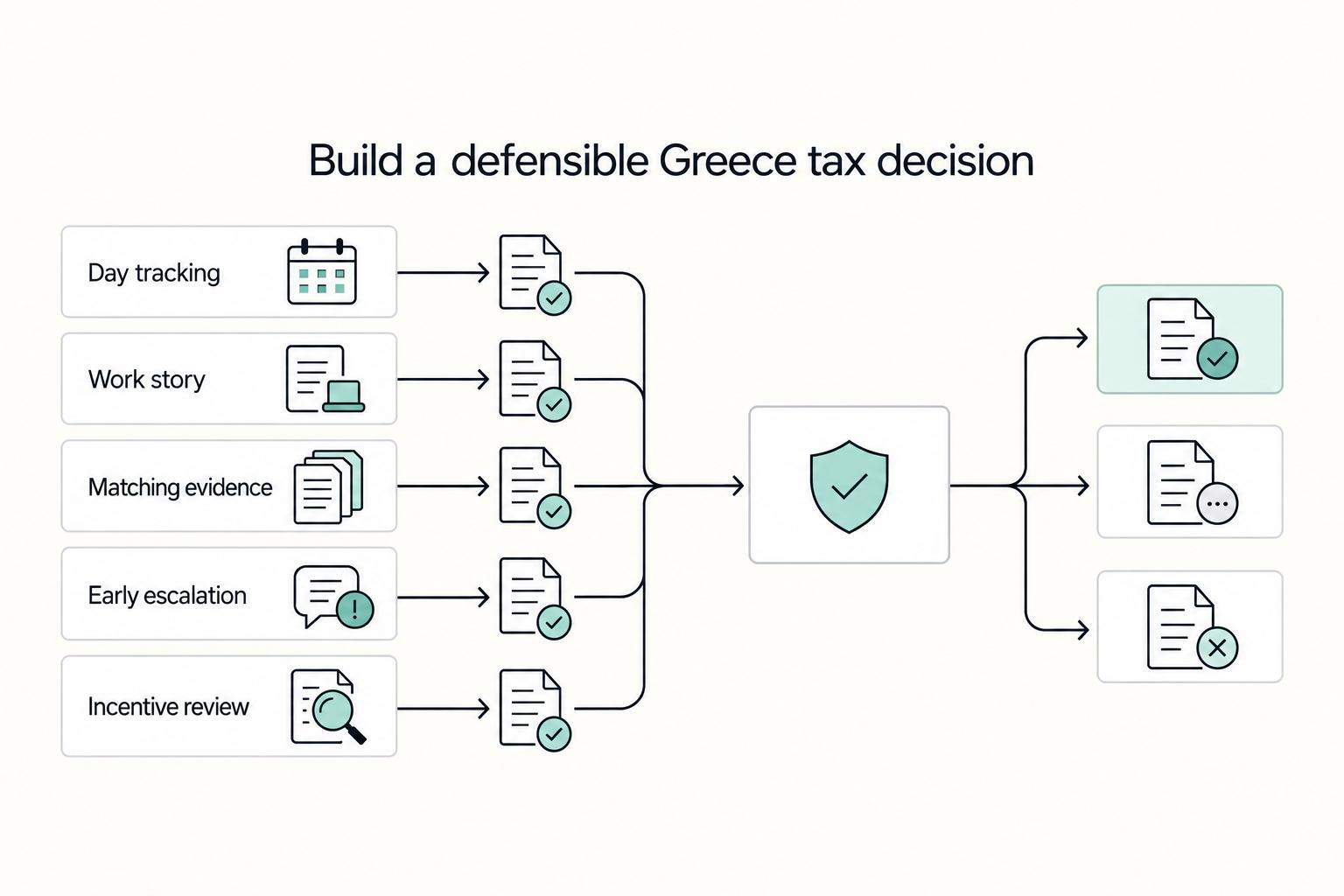
Quick Answer
Yes, greece tax incentives nomads may help, but only after your baseline is defensible. The article frames Articles 5A, 5B, and 5C as items to confirm in writing, not assumptions. Start by stabilizing day tracking, payer facts, and work structure, then test treaty and social-security implications. For U.S. filers, FEIE and Form 1116 planning still runs on its own track.
You don't need "a list of incentives" - you need a defensible decision#
If you searched greece tax incentives nomads, take that search as a warning, not a plan. Your real job is to choose a tax position you can explain with evidence, then run your operations so that position stays consistent. The goal is not to find one attractive rule. It is to avoid a year-end scramble where your days, contracts, and filings all point in different directions.
You cannot defensibly claim current Greek nomad incentive mechanics, eligibility, or residency thresholds here. Use this as an operating framework, not as a substitute for current primary tax guidance.
As a business-of-one, you are the owner, operator, and compliance lead. A useful working model is to reduce ambiguity across four moving parts: where you are resident, where your income is sourced, how your work is structured, and which authority handles which piece. When those four parts line up, incentive regimes become optional optimization. When they do not, incentives are a distraction.
One practical order is: stay length, income reality, work structure, residency risk, then incentive fit. Use that as your sequence. It forces you to lock the basics first, which is what makes your position defensible if someone reviews your facts later.
The two residency questions to verify first#
Start with the two variables most likely to change your baseline.
Question one is day count. Confirm the current Greek threshold and any start-date trigger with the relevant authority before relying on any figure. The practical point is simple: day tracking is not a year-end task. It is a weekly control, like cash flow.
Question two is personal and economic ties. Current Greek criteria for how ties are assessed are not defined here, so if your facts can be read two ways, assume scrutiny and tighten documentation first.
Separate the three systems competitors blur#
Most bad planning starts by mixing three separate systems into one mental bucket. Keep them distinct in your notes, your calendar, and your advisor calls. Then verify each lane against current official guidance.
| System | What to verify |
|---|---|
| Immigration status (including visas) | Permission and conditions to stay |
| Domestic tax administration | Residency treatment and filing expectations |
| Tax treaty / Double Tax Convention | Whether treaty analysis is needed for a cross-border case |
Treat visa, domestic tax, and treaty questions as separate checks rather than a single answer. You do not need a complicated strategy to remove most of the risk. You need a repeatable baseline.
Track days, write the work story, then weigh incentives#
| Step | Action | Key note |
|---|---|---|
| 1 | Track days continuously | Not just by calendar-year habit |
| 2 | Write a one-paragraph work story | Explain where you work, who pays you, where clients sit, and which entity invoices |
| 3 | Keep evidence that matches the story | Travel records, agreements, invoice trails, and payment logs |
| 4 | Escalate early | Do this if ties split across countries or residency facts become ambiguous |
| 5 | Do not evaluate incentives yet | Wait until the first four items are stable |
Use the same order every time.
Related reading: Malaysia Tax Residency for Digital Nomads.
First, build the mental model (and kill the most common confusion)#
The first mistake to kill is simple: a digital nomad visa is not a tax outcome. It is immigration permission for non-EU citizens to live in Greece while working remotely for employers or clients outside Greece. Longer stays can still raise separate tax-residency and U.S. tax-compliance questions.
That distinction matters because vague labels are expensive. If you let terms like "digital nomad," "remote worker," or "non-resident" float without definition, you end up optimizing a label instead of managing facts. Define each system once, then make decisions against those definitions.
Four terms you need cleanly separated#
Greece digital nomad visa is a pathway for non-EU citizens working remotely for non-Greek employers or clients. The source frames this as up to 12 months in Greece, with an option to apply for a renewable 2-year residence permit.
Visa eligibility is described as depending on citizenship, income level, and the nature of the applicant's work. Passing this screen does not automatically settle tax outcomes. Family member status means family can accompany the main applicant, but they are not permitted to work locally under this program.
Tax-residency and compliance risk becomes more important with longer stays. The source also warns that moving abroad can change tax obligations even when employment does not change.
The confusion matrix you should use throughout#
When advice conflicts, two people are often answering different questions. Force every answer into the right box.
| Concept | What it answers | What it does not answer |
|---|---|---|
| Immigration status (Digital Nomad Visa) | Can I legally stay in Greece under this program while working remotely for non-Greek employers/clients? | Are tax residency and filing outcomes automatically resolved? |
| Visa eligibility | Do my citizenship, income level, and work type match program requirements? | Does eligibility lock in tax treatment for longer stays? |
| Residence permit extension | Can I apply for the renewable 2-year residence permit? | Does that extension remove tax-residency or U.S. compliance questions? |
| Tax-residency and compliance review | What tax questions become important as my stay gets longer? | Does keeping the same job mean tax obligations stay unchanged? |
Use this matrix in every advisor call. Ask the advisor to label which box they are speaking to. If an answer crosses boxes without explaining the bridge, ask for written clarification before you act on it.
The safe default when you're not sure#
If your stay gets longer, treat that as a compliance trigger, not a detail to ignore. Do not anchor your plan to visa labels alone. Immigration permission and tax outcomes are separate systems.
When uncertainty remains, default to defensibility: one coherent story, one coherent evidence trail, no aggressive assumptions. That can feel conservative in the moment, but it helps reduce rework and contradictory filings over time.
For the full breakdown, read Hungary Tax Residency for Nomads and the White Card.
The 10-minute decision system: should Greece's incentives even be on your radar?#
Short answer: only if your baseline is already defensible. If you cannot clear the first four steps with consistent facts and documents, incentives are not your next move.
| Step | Go forward only if | Stop or escalate if |
|---|---|---|
| 1. Presence | A day log is maintained in real time; planned and actual travel records match; there is a clear explanation of the intended stay pattern | Days are estimated from memory; records conflict; the plan only works if every border day is interpreted in your favor |
| 2. Income facts | You can document who pays you, where each payer is based, where you physically perform the work, and that the setup matches the visa lane | Documents and operations tell different stories |
| 3. Work structure | The structure is fully documentable and consistent with the immigration lane | You are changing structure only to chase a tax outcome; you cannot clearly explain who contracts with whom; a family member plans to work locally under the same visa setup |
| 4. Cross-border issues | The file is coherent without aggressive assumptions | Split-country ties or longer stays are central to the outcome |
| 5. Special regime eligibility | Residency trigger is verified; immigration lane is consistent with the facts; income and work structure are documented; cross-border issues are not carrying the whole plan | Any one of those items is still unresolved |
Start with immigration fit if you are using the visa lane. The visa is framed for non-EU citizens working remotely for non-Greek employers or clients, without joining the Greek labor market or setting up a Greek business. Family members are not permitted to work locally under that program. If you need a quick refresher, use Greece Digital Nomad Visa: Your Gateway to the Greek Isles.
Step 1. Start with presence, not perks. Tax residency status can affect whether Greece treats you as a tax resident under current rules. Before using that status in your plan, verify the current residency trigger from official or legal/tax records.
Go forward only if you can show:
- A day log you are maintaining in real time
- Planned and actual travel records that match
- A clear explanation of your intended stay pattern
Stop and escalate if:
- You are estimating days from memory
- Your records conflict
- Your plan only works if every border day is interpreted in your favor
Step 2. Classify income by real-world facts. Tax-compliance risk means longer stays can raise tax-residency and compliance questions, so document your operating facts before discussing incentives.
Go forward only if you can document:
- Who pays you
- Where each payer is based
- Where you physically perform the work
- That your setup matches the visa lane, meaning non-Greek employers or clients and no local employment or business activity in Greece
Stop and escalate if your documents and your operations tell different stories.
Step 3. Lock the work structure that matches reality. Work structure means employee, independent contractor, or company-based setup. Go forward only if your structure is fully documentable and consistent with your immigration lane.
Stop and escalate if:
- You are changing structure only to chase a tax outcome
- You cannot clearly explain who contracts with whom
- A family member plans to work locally under the same visa setup
Step 4. Handle cross-border complexity before incentives. Cross-border issues are a separate layer after the facts are stable, not a fix for unclear residency or income facts.
Go forward only if your file is coherent without aggressive assumptions. Escalate when split-country ties or longer stays are central to the outcome. For cross-border background, see How to Legally Avoid Double Taxation: A Freelancer's Guide to Tax Treaties.
Step 5. Only now evaluate special regime eligibility. Special eligibility means whether you may qualify for an incentive path after residency, income, and structure are already clear.
"Worth exploring" means:
- Residency trigger is verified
- Immigration lane is consistent with the facts
- Income and work structure are documented
- Cross-border issues are not carrying the whole plan
"Not yet" means any one of those is still unresolved. That is the core rule: optimize only after the base case stands on its own.
For a broader walkthrough, see A Guide to Tax Residency in the Czech Republic for Nomads.
Residency triggers: verify the current rule, then document one consistent story#
Short stays are not, by themselves, enough to conclude your tax position. The safer posture is to build a documented position based on verified rules, not a travel slogan.
Keep these labels separate from day one. Residency status is one question. Source taxation is another. Treaty relief is a coordination layer if two countries may claim taxing rights. Permanent establishment risk is a separate business-footprint question.
Start with verified triggers, not internet shorthand#
Do not hard-code Greece residency triggers from summaries or secondary commentary. Some public materials explicitly state they are not official legal positions, include data-accuracy caveats, and direct users to verify details with referenced sources.
Also treat weak captures as unverified: if a page pull only returns consent-layer text, it is not evidence of Greece tax-rule detail.
Until you verify the current primary rule, treat the residency trigger and counting method as unresolved in your planning sheet.
Then run your operations with buffer. Keep a live day log, store travel records as you go, and reconcile your timeline against documents so someone else can follow your presence story without guesswork.
When facts are mixed, use a record-check lens#
If your facts are mixed, avoid single-metric shortcuts. Use this quick lens to organize what you know and what is still unknown:
- Personal facts: where day-to-day life is actually centered
- Economic facts: where working and financial relationships are concentrated
- Operating facts: where work is run in practice and whether activity looks temporary or durable
Escalate when those signals point in different directions.
What supports a low-risk planning posture#
A lower-risk posture is a consistent fact pattern, not just a short stay. Your file should show temporary presence facts and records that support the same story across travel, contracts, invoicing, and payments.
Before relying on that posture, keep a minimum file: day log, travel records, accommodation records, contracts, invoice-to-payment mapping, and a short written narrative of where you lived and worked.
When to get written advice now#
Get written advice now if your ties are split, your stays repeat or extend, your work becomes locally anchored, or your documentation does not cleanly support one story. Cross-border outcomes are fact-specific, so generic reassurance is not enough.
If two countries could both claim taxing rights, move to treaty tie-breaker analysis with your facts and records. Start with How to Legally Avoid Double Taxation: A Freelancer's Guide to Tax Treaties. Also keep immigration and tax analysis separate while you use the Greece Digital Nomad Visa: Your Gateway to the Greek Isles route.
Quick checks by setup#
| If this is your setup | Verify these items before relying on a non-resident posture |
|---|---|
| Short stay, non-Greek payers, no local-facing operations | Day log is current, contracts and payments align, and records support a temporary pattern |
| Repeat short stays over time | Current counting rule is verified from primary sources, travel records are reconciled, and your overall pattern still reads as temporary |
| Mixed personal and work ties across countries | Personal, economic, and operating facts are mapped side by side; escalate if they conflict |
| Expanding activity while physically in Greece | Check whether decisions, delivery, and business operations still look like travel rather than a durable base |
Track continuously, keep buffer, and escalate early when the facts get mixed. That gives you a defensible base while verified rule details are still being confirmed. You might also find this useful: A Guide to Tax Residency in Brazil for Digital Nomads.
Greece's "tax incentives" menu: what exists, who it's for, and who should ignore it#
Incentives are a final optimization step, not a starting point. Review them only after your residency position, income characterization, and work structure are documented and consistent with your records.
Use this gate before comparing regimes: you should already have a dated residency view, a payer-and-income map, and a short written statement of where work is directed and delivered. If any of that is still moving, pause there.
| Regime | Broad profile it is usually discussed for | Who should exclude themselves for now | What to verify before assuming fit |
|---|---|---|---|
| Article 5A | Inbound tax residents; in the cited excerpt, described as an incentive framework aimed at high-net-worth individuals | Anyone still operating as a short-stay case or relying on unclear foreign-income treatment | Confirm the current amount, rule, and timing window with an official source or tax lawyer, along with residency-transfer mechanics and filing path |
| Article 5B | A separate regime label in market discussions; detailed scope is not established | Anyone whose income is mainly active freelance or business income | Confirm the current rate, scope, and timing window with an official source or tax lawyer, along with which income categories are actually in scope |
| Article 5C | A separate regime label in market discussions; detailed eligibility and rates are not established | Anyone with mixed work facts, unclear source analysis, or a structure that does not cleanly match the regime | Confirm the current eligibility, rate, and duration with an official source or tax lawyer, along with Greek income characterization and process steps |
Do not treat these as live options yet if any of the following is true:
- Your residency facts are unsettled.
- Your income story is mixed or not documented by payer, contract, and activity.
- Your operating footprint is unclear, especially if decisions, delivery, or ownership span multiple countries.
Keep the boundaries strict: AADE regime eligibility is one tax track, immigration permission is another, and treaty relief is another. Use visa material for stay planning, not tax conclusions: Greece Digital Nomad Visa: Your Gateway to the Greek Isles.
Also separate personal-regime planning from entity compliance. If a Greek company, LLC, or foreign branch is involved, electronic CIT filing obligations may apply, including filing by the end of the sixth month after fiscal year-end. Before moving forward, require a written advisor memo that confirms regime fit, income scope, filing path, first Greek tax year, and task ownership. If treaty overlap may change whether a regime is useful, review How to Legally Avoid Double Taxation: A Freelancer's Guide to Tax Treaties.
Related: Thailand Tax for Digital Nomads Without Residency Mistakes.
The 50% tax break in Greece: a due-diligence checklist (not marketing copy)#
If the 50% route is the only reason your move works on paper, stop. Do not change contracts, pricing, payroll setup, or invoicing until regime fit, income scope, and filing ownership are verified in writing.
Use that as your stop-go rule. Risk rises when a headline rate is treated as already secured, then structures are changed before documents, contracts, and residency facts line up.
What the 50% claim actually means#
Treat the 50% claim as a special-regime question, not as blanket tax relief. Do not assume all income is cut in half for tax purposes, and do not treat the claim as a replacement for the rest of your Greek tax compliance work.
Keep legal specifics as variables until confirmed in writing. Your advisor memo should identify unresolved items before anything is used operationally:
- Confirm the current eligibility window with an official source or tax lawyer.
- Confirm the current commitment condition with an official source or tax lawyer.
- Confirm the current scope rules with an official source or tax lawyer.
Check the gates like an operator#
If any gate is unclear, pause.
| Gate to test | Evidence to collect before you proceed | Common failure mode |
|---|---|---|
| Residency history | Dated country-by-country tax-residency timeline, returns, residence certificates, day logs, and supporting lease/utility records where needed | Travel memory is broad, but prior tax residence is not provable |
| Qualifying prior jurisdiction | Documents showing your prior residence fits the current rule once it is legally or officially verified | You assume nationality or visa status is the test |
| Commitment conditions | Move file that supports the declared plan once current requirements are verified (housing, relocation timing, intended presence/work pattern) | You declare a stable plan but operate a flexible, high-exit year |
| Work-status classification | Contracts, invoices, entity records, role description, and a short note on who directs work, who pays, and where work is carried out | Paperwork says one status, real work pattern suggests another |
Map income before you price anything#
Before you model savings, list each expected income stream for your first Greek tax year and classify it as:
- in scope
- out of scope
- needs advisor confirmation
Use line items, not estimates: salary, self-employed fees, director fees, dividends, rental income, capital gains, reimbursements, and payments routed through your own company. If a line is unclear, keep it in "needs advisor confirmation" and exclude it from projections.
Execution and evidence#
Assign one owner for the full process, whether that is you or your advisor. Keep one audit folder with the submission pack, filing proof, follow-up requests, approvals, and the exact facts declared about your move, prior residence, and work pattern. Then keep your ongoing filings consistent with that same fact pattern.
This is also where people blur immigration and tax. One freelancer guide says non-EU/EEA entrants need a visa to enter Greece. It also says residence/work permit filing should be done within 30 days of arrival at the local Dimarchio. The same guide says medical insurance, AFM, and AMKA are needed before permit application, and notes AMKA issuance may be available via KEP offices or Idika.gr. Those are stay and work operations, not proof of tax-regime eligibility.
What still needs separate analysis#
Treat treaty overlap, double taxation, VAT, social security, and entity compliance as separate analyses, and verify each on its own facts. For treaty overlap, review How to Legally Avoid Double Taxation: A Freelancer's Guide to Tax Treaties. For visa-versus-tax separation, review Greece Digital Nomad Visa: Your Gateway to the Greek Isles.
Side details can matter without deciding the case. For example, a 2025 freelancer guide says the old Τέλος Επιτηδεύματος levy, described there as €650 annually, was removed. That is useful context, but not a substitute for residency, scope, and classification diligence.
If you want a deeper dive, read the 2026 Global Digital Nomad Visa Index. Before you commit to a residency path, keep your travel evidence clean with the Tax Residency Tracker.
Compliance operations in Greece: getting set up, year-end filing, and the "don't-miss" steps#
Run compliance as an operating discipline, not a year-end scramble. Keep four separate lanes from day one: tax identity setup, annual income-tax filing, VAT, and social security. They can share facts, but they do not solve the same problem.
Treat stay status, tax setup, VAT, and social-security coverage as separate tracks. If your stay status and tax status are still blended, separate those first (see Greece Digital Nomad Visa: Your Gateway to the Greek Isles for context). Then review treaty coordination separately in How to Legally Avoid Double Taxation: A Freelancer's Guide to Tax Treaties.
Lock the sequence before setup#
The sequence matters more than most people think. Use this order and do not skip steps:
- Confirm residency posture in writing.
- Set up access and identifiers.
- Lock monthly recordkeeping.
- Execute filing and payment with archived proof.
Your first artifact should be a one-page facts sheet: expected days in Greece, prior tax residence, income types, who pays you, work status (employee or self-employed), and any foreign payroll or company links. If that page is unstable, every setup step after it is guesswork.
For setup and filing operations, verify the live process before acting. Keep unresolved setup items visible in your checklist until official, tax, or advisor records confirm the tax ID process, access method, annual return form, filing and payment dates, and VAT registration route if applicable.
Self-audit table#
| Phase or lane | Owner | Required artifact | Main failure risk |
|---|---|---|---|
| Residency posture | You (advisor review if needed) | Facts sheet, day log, prior-residence evidence | You start setup before you can defend your residency position |
| Tax identity and access | You or local accountant | Issuance/activation confirmations, ID copies submitted, archived receipts/screenshots | Access looks complete until filing time reveals a missing authorization or mismatch |
| Monthly recordkeeping | You, bookkeeper, or both | Invoice register, payment mapping, expense support, bank extracts, contract folder | Annual totals exist, but source lines cannot be proven |
| Annual filing and payment execution | One named filing owner | Advisor memo with verified current forms/dates, draft review notes, submission receipt, payment proof | Filing ownership is unclear, or payment proof does not match the return |
| VAT lane (parallel) | You and VAT advisor | Written activity mapping, verified current registration/filing steps, invoice-format check | VAT is treated as a side note and billing setup is wrong |
| Social-security lane (parallel) | You, payroll, or specialist advisor | Written coverage position and any applicable certificate/exemption evidence | No owner, so the same earnings face dual social-security taxation risk |
Keep monthly records boring#
The goal is boring, not heroic. Make year-end the output of twelve closed months. Reconcile invoices to payments monthly, store contract support with each revenue stream, keep bank statements in the same folder structure, and add a short note for unusual items while the facts are still fresh.
Use one naming rule all year, for example YYYY-MM_client_invoice#_payment-proof. Consistency is what makes advisor review faster and more defensible.
VAT is parallel, not a footnote#
Treat VAT as its own lane. Verify the current registration trigger, invoice requirements, filing cadence, and payment method before issuing invoices from Greece.
Ask for a short written mapping of your activities to current VAT treatment and store it in your main compliance folder. If VAT gets pushed to "later," corrections can be harder once invoices have already gone out.
Social security needs its own owner#
Social security is not part of income-tax cleanup. The SSA states Totalization agreements are designed to assign coverage to one country and exempt Social Security taxes in the other. Without applicable coordination, the same earnings can be subject to Social Security taxes in both countries.
If U.S. coverage might apply, confirm the country is an Agreement country and check that agreement's entry-into-force date before relying on it. Where U.S. coverage applies, a U.S. Certificate of Coverage is the proof document used to support exemption from foreign Social Security taxes, but you still need local confirmation for your facts.
Archive process evidence. SSA's online certificate process includes pre-transmission data checks, and approved requests can include email confirmation. SSA also warns internet submission has interception risk, so maintain strict sensitive-data handling controls.
By year-end, your target file is simple: one stable facts sheet, verified access setup, twelve months of consistent records, a filing memo with current steps verified at execution time, and proof of each submission and payment.
Build evidence packs that tell one story, with consistent payment records#
Audit readiness is about coherence, not volume. Your records should tell one clear story about visa scope and stay duration, and one clear story about income source, with no contradictions between contracts, invoices, travel logs, and filings.
| Pack | Focus | Key contents |
|---|---|---|
| Residency Evidence Pack | Visa scope and stay duration | Proof you are a non-EU remote worker for non-Greek employers or clients; stay log against the up-to-12-month visa window; track whether and when you apply for a renewable 2-year residence permit if staying longer |
| Income Evidence Pack | Source and structure | Signed contracts and SOWs; invoice-to-bank-credit mapping; explicit check that income is from non-Greek employers or clients |
| Long-stay compliance notes | Extra risk flags when staying longer | Short note on tax-residency and U.S. tax-compliance questions for longer stays; clear records for any family members included in the plan |
| Minimal-viable bookkeeping stack | Low stress, high defensibility | Regular ledger-to-bank reconciliation; consistent invoice numbering; support documents behind each entry |
Think of this as something you are delivering to your future self and to any advisor you hire. A clean pack can make advice cheaper and more accurate because the advisor is not guessing at your facts.
1) Residency Evidence Pack (your story, proven)#
The visa is aimed at non-EU citizens working remotely for employers or clients outside Greece, so your first pack should prove scope and timing cleanly. Keep a stay log tied to the up-to-12-month visa window. If you plan to stay longer, track whether and when you apply for the renewable 2-year residence permit.
Consistency matters more than document volume. A small, well-organized pack often beats a large, disordered archive because it reduces the chance of contradictory signals.
2) Income Evidence Pack (source + structure)#
This pack should let someone trace every income line from agreement to payment and confirm that income comes from non-Greek employers or clients. Store signed contracts and SOWs with clear party details and scope. Map each invoice to the specific bank credit. Keep that mapping current each month so you never have to reconstruct a year under pressure.
Changes are not the problem. Untracked changes are.
3) Long-stay compliance notes (only when relevant)#
Longer stays can raise additional tax-residency and U.S. tax-compliance complexity, so keep a short dated note on open risks and advisor questions when your stay extends.
If family members are included, keep records clear that they may reside with you but are not permitted to work locally under this program. Keep these notes factual, short, and consistent with the rest of your file.
4) Minimal-viable bookkeeping stack (low stress, high defensibility)#
Use a bookkeeping setup you can maintain without heroic effort. Reconcile ledger to bank regularly, keep invoice numbering consistent, and preserve the support documents behind each entry. Missing links are what create disputes later.
The goal is defensibility, not accounting theater. If a reviewer asks how a line was reported, you should be able to show the document chain in minutes. That is what turns compliance from stressful to routine.
Payment hygiene (the quiet multiplier)#
Payment hygiene is often one of the easiest upgrades with a big payoff. Keep payer names stable, use consistent payment references, and export records monthly into your evidence pack.
That habit can help in three ways at once. Your records line up with your invoices, your advisor can follow the trail quickly, and year-end can move faster because you are not rebuilding mappings from scratch. Simple discipline compounds.
For a step-by-step walkthrough, see Malta Tax Residency Decisions for Digital Nomads.
Double taxation isn't solved by an incentive: treaties, US-person traps, and social security reality#
A local incentive may improve part of your tax outcome, but it does not replace treaty analysis, U.S. reporting if you are a U.S. person, or social security coordination. Keep those as three separate lanes, and keep your facts consistent across all of them.
Treaty position#
Start with a documented fact pattern, then apply treaty logic. In practice, the order is straightforward: identify the income type, map where taxing rights may sit, confirm filing obligations in each country, and only then claim treaty relief. For nomads, that usually means being precise about whether income is wages, salary, or professional fees, where services were performed, who paid, and whether tax was already withheld or paid.
Treaty relief is a position tied to facts, not a filing shortcut. If you want a broader refresher, see How to Legally Avoid Double Taxation: A Freelancer's Guide to Tax Treaties.
U.S. persons need a separate plan#
If you are a U.S. citizen or resident alien, you are taxed on worldwide income, and you still file a U.S. return reporting that income even when FEIE may apply. To claim FEIE, and related housing treatment, you need foreign earned income, a foreign tax home, and a qualifying status test.
Do not leave FEIE versus FTC decisions to the last minute. Categorize income consistently across your books and filings, and document your treatment clearly before filing. Form 1116 is category-based: use a separate Form 1116 for each category, check one category per form, and separate country or territory entries when taxes were paid in more than one place.
For FEIE timing discipline, the physical presence test is based on time abroad, not intent: 330 full days in any 12 consecutive months, where a full day is 24 consecutive hours from midnight to midnight. Miss the threshold and the test fails, regardless of reason.
Monthly reporting controls#
If multiple reporting regimes may apply, treat monthly recordkeeping as a control, not admin overhead.
| Control | Action |
|---|---|
| Foreign accounts list | Keep a current list of foreign accounts you own, co-own, control, or can sign on |
| Balances and changes | Record balances and note openings, closures, and ownership changes |
| Supporting statements | Retain the statements you relied on |
| Account labels | Label each account clearly as personal, joint, or business-linked |
Keep these controls current each month.
Social security is its own lane#
Income-tax results do not settle your social security position. A treaty claim, local incentive, or FEIE outcome does not by itself confirm contribution treatment.
Escalate early when classification is unclear or prior international filings are incomplete. A common failure mode is assumption creep, treating social security as "probably covered" because the income-tax side looked clean.
This pairs well with our guide on Costa Rica Tax Residency for Pura Vida Nomads.
When to talk to a pro (and the exact brief that gets you useful answers)#
Escalation is a control, not a defeat. Bring in a cross-border tax pro as soon as your facts get close to a legal line, your structure stops being easy to explain, or you are unsure whether an incentive is available on your facts.
Escalate now, not after you book the plan#
Do not wait for certainty. Escalate when any of these are true:
- your expected presence across countries is getting close to a possible residency change
- your home, partner, contracts, banking, or work pattern are getting harder to place in one country
- you are paid through a foreign company, platform, or mixed client base and cannot clearly explain where work is performed and who bears the cost
- you want an incentive implemented, not just described
- your tax, VAT, or social-security treatment may depend on how your work is classified
Keep advisor lanes separate: residency determination, treaty application, incentive implementation, VAT obligations, and social-security coordination are related but different questions. Keep immigration separate from tax, because a visa answer is not a tax answer. If you need a reset on that distinction, see Greece Digital Nomad Visa: Your Gateway to the Greek Isles.
Send a brief that forces an executable answer#
Send the right inputs on the first call so you get a plan you can run, not generic commentary.
| What you send | Decision this unlocks | Filing/document it should support | Next owner and action |
|---|---|---|---|
| Day count by country, expected moves, housing pattern | Residency position | Written residency view with assumptions and evidence list | Advisor drafts view; you provide missing evidence |
| Client list by country, contracts, who pays you, where work is done | Whether treaty analysis is needed | Treaty memo or clear treaty-not-needed conclusion with filing impact | Advisor confirms position; you align records and filing steps |
| Entity setup, invoices, platform use, registrations already held | VAT and compliance scope | Registration and filing checklist | Advisor maps obligations; you execute checklist items |
| Incentive you are considering and your current tax-residence story | Whether implementation is feasible now | Eligibility yes/no view, missing documents, decision timing | Advisor states go/no-go; you gather docs or defer |
Ask the advisor to validate these assumptions in writing: where you are resident now, whether tax residence is changing, whether treaty relief is relevant, whether VAT must be handled separately, and which document pack proves the position. If they cannot tie each answer to a filing, a document, and an owner, you still do not have a workable plan. For treaty framing, use How to Legally Avoid Double Taxation: A Freelancer's Guide to Tax Treaties.
The bottom line: choose the safe default, then optimize-never the other way around#
Given the sources here, the durable strategy is to treat specific Greek tax-rule guidance as unverified until it is confirmed through current, authoritative channels. The Greece source here is a 1994/1995 country-study publication and explicitly not an official policy statement, and the nomad source is a personal narrative rather than legal authority.
If you want one takeaway, it is this: incentives are not a foundation when your evidence base is thin. Build the foundation first, then decide whether any overlay is worth the admin cost.
The decision order you should use every time#
Use this as your standing sequence:
- Evidence quality: confirm your sources are current, authoritative, and relevant to your case.
- Known vs unknown: separate verified facts from open questions before making decisions.
- Structure: align contracts, invoicing, and actual work pattern so your file is internally consistent.
- Cross-border logic: escalate residency, treaty, and source questions when facts are unclear.
- Incentives: evaluate special-regime fit only after the first four steps are coherent.
That turns a vague search problem into a workable process.
"Under 6 months" is a risk flag, not a plan#
An under-six-month shortcut can sound definitive. It is not an established reliable rule for current Greek tax outcomes.
Use the phrase as a signal to double-check facts, not as permission to stop analysis. If the file cannot be explained in one page with current authoritative support, you are not ready to optimize.
If an incentive might fit, run it like a project#
Treat possible incentive use as implementation, not inspiration:
- Confirm current eligibility and scope in writing.
- Assign workflow ownership for submissions and follow-ups.
- Build records from day one so annual filings stay consistent.
- Model operations assuming incentives may not apply or may change.
A project mindset keeps decisions factual and prevents last-minute surprises.
The real win#
The real win is not a headline rate. It is low-stress compliance built on clear records, predictable operations, and decisions you can defend. That is what protects your time, margin, and optionality as a business-of-one.
Run the sequence, grade your risk, and escalate early when the facts are incomplete. Consistency beats cleverness every time.
If you want one operational stack for invoicing, getting paid cross-border, and keeping audit-ready records, see Gruv for Freelancers.
Frequently Asked Questions
What incentives actually exist for nomads in Greece?
Greece-specific incentive programs, eligibility criteria, and filing steps should be confirmed directly with the relevant authority. References to Articles 5A, 5B, and 5C should be treated as unverified until you confirm current rules directly.
Is the 50% tax break real, and who should treat it as a live option?
The 50% break is unverified. Treat it as a claim to validate, not a planning assumption, until you have current written eligibility guidance.
Does the 50% break work for freelancers or only employees?
It isn't established whether any 50% Greek incentive applies to freelancers, employees, or both. Confirm classification and scope under current Greek rules before relying on it.
If I stay under the usual day-count line, am I out of Greek tax?
No, not automatically. Greek residency thresholds and day-count rules require direct verification; use Greece Digital Nomad Visa: Your Gateway to the Greek Isles as visa context only.
Does FEIE prove I am not tax resident in Greece?
No. FEIE is a U.S. test: physical presence requires 330 full days in a 12-month period, the days do not need to be consecutive, and a full day is midnight-to-midnight. A FEIE result does not by itself resolve Greek tax residency.
Do treaties solve double taxation if I use a Greek incentive?
U.S.-Greece treaty relief outcomes are fact-specific and require separate analysis. Treat treaty relief as a separate, fact-specific analysis, and start with How to Legally Avoid Double Taxation: A Freelancer's Guide to Tax Treaties.
As a U.S. citizen, can I use Greek incentives and still stay clean with the IRS?
Greek incentive eligibility is not established by these sources. You can still stay compliant with the IRS, but you must file a U.S. return and report worldwide income. FEIE applies only when you qualify, and FTC is claimed on Form 1116 using a separate form for each income category with only one category box checked per form.
Try a related tool
Researched and edited by the Gruv editorial team. Gruv builds cross-border billing, payouts, and finance-operations software for global businesses.
Sources
- 2009-2017.state.gov/j/drl/rls/hrrpt/2006/78815.htmtrusted
- ftb.ca.gov/file/personal/residency-status/part-year-and...trusted
- irs.gov/individuals/international-taxpayers/foreign-...trusted
- irs.gov/individuals/international-taxpayers/figuring...trusted
- isac.uchicago.edu/sites/default/files/uploads/shared/docs/ois5...trusted
- oecd.org/en/publications/ukraine-s-strategic-response...trusted
- oecd.org/content/dam/oecd/en/publications/reports/200...trusted
- ssa.gov/international/CoC_link.htmltrusted
Educational content only. Not legal, tax, or financial advice.
Related Posts
Greece Digital Nomad Visa Steps for a Safer 2026 Move
Applying for the Greece Digital Nomad Visa is much easier when you solve the right problems in the right order. Start with fit. Then build one evidence pack you can reuse. Then file. Then handle the post-arrival steps. That sequence sounds simple, but it cuts a lot of avoidable rework because it keeps you from mixing immigration, documents, housing, taxes, and family planning into one messy project.

The 2026 Global Digital Nomad Visa Index for 50+ Countries
Start with legal fit, not lifestyle filters. The practical order is simple: choose a route you can actually document, then decide where you want to live. That single change cuts a lot of wasted comparison work and stops you from falling in love with places that were never a real filing option.

How Freelancers Can Legally Avoid Double Taxation With Tax Treaties
Classify the tax problem before you touch a return. If your income is mostly personal service fees across borders, this guide fits. If your issue is C corporation profits and shareholder dividends, you are solving a different problem.