
Quick Answer
Start with a risk screen, then execute in order: eligibility, evidence, submission, and post-arrival follow-up. For the greece digital nomad visa, the article treats a narrow core as stable: non-EU remote work tied to non-Greek employers or clients, an initial stay up to 12 months, and a separate residence-permit path for longer continuity. Map each claim to one document, avoid irreversible bookings until key confirmations arrive, and begin tax-residency planning once your arrival month and expected stay pattern are fixed.
Start with Fit, Then Build Your File#
Applying for the Greece Digital Nomad Visa is much easier when you solve the right problems in the right order. Start with fit. Then build one evidence pack you can reuse. Then file. Then handle the post-arrival steps. That sequence sounds simple, but it cuts a lot of avoidable rework because it keeps you from mixing immigration, documents, housing, taxes, and family planning into one messy project.
A verification-first approach matters here because public summaries often blur confirmed rules with planning assumptions. In the material behind this draft, the points you can treat as confirmed are the legal basis in Law 4825/2021, eligibility framed for third-country non-EU nationals working remotely for employers or clients outside Greece, visa validity up to 12 months, and a post-arrival Digital Nomad residence permit described as valid for 2 years with an option to renew. The same material also draws an important boundary: this status does not grant rights to local Greek employment or local business activity, and linked family status does not grant local work rights.
Other public guides go further than that baseline. Some of those extra statements may turn out to be right for your case, but they are still planning assumptions until your filing authority confirms them. A 10-working-day approval timeline and a clean every-2-year renewal rhythm are both commonly repeated. Neither is something you should build a fixed move date or long lease around without direct confirmation.
Use one filter from start to finish:
- Confirmed rules: Law 4825/2021 legal basis, non-EU eligibility framing, remote work tied to non-Greek employers or clients, the 3,500 euro monthly resources benchmark, and the visa-to-residence-permit path.
- Public but disputed claims: typical approval speed and how predictable renewals are in practice.
- Must verify before filing: your consulate checklist, appointment lead times, accepted format for income and remote-work proof, and dependent document requirements.
That filter is the golden thread for the whole process. It tells you what belongs in your application narrative, what belongs in a planning note, and what needs an answer before you spend time or money. In practice, most avoidable problems start when applicants treat a useful summary article as if it were the authority for their exact filing post and date.
The rest of this article follows the order most applicants actually need in real life: eligibility, document assembly, timing, residence-permit handoff, renewal uncertainty, family planning, and tax timing. If you are a US citizen, keep that sequence and hand off to tax planning once your move window becomes real. If you are not a US citizen, the handoff is usually similar, but your home-country rules change the analysis.
That order also helps you separate immigration facts from other EU guidance that may be useful for business or VAT planning but irrelevant to visa decisions. Keeping those lanes separate is not just tidy. It is one of the easiest ways to stop contradictions from spreading through the file.
If you want broader context before choosing a country path, read Working Remotely in Europe: A Visa Guide for US Citizens.
What the Greece Digital Nomad Visa is and what it is not#
Keep immigration and VAT in separate lanes. A lot of confusion starts when people pull rules from general EU pages, business tax explainers, or Schengen summaries and treat them as if they answer Greece-specific visa questions. They do not, even when the pages themselves are accurate about the topic they were written for.
The material behind this section is about EU VAT mechanisms, so it does not confirm Greek immigration eligibility, entry rights, or stay rights. It may still be useful for VAT operations, but that is a different problem. If you use a tax page to decide an immigration question, you usually end up with the wrong route name, the wrong assumptions, or a set of documents that do not line up with the claim you actually need to prove.
This is where careful applicants still get tripped up. They copy terminology from one regime into another, then use that language in forms, letters, and explanations. Once that happens, small mismatches start to look bigger than they are. A reviewer may not know what you meant to say. They only see that your wording does not match the status you are applying for.
Use this claim filter before you rely on any source:
- Keep for VAT planning only: OSS registration in one Member State, VAT return cadence, and possible exclusion from OSS.
- Reject for visa decisions: VAT thresholds such as EUR 10,000 and VAT rule dates such as 1 July 2021.
- Mark unconfirmed: who qualifies for this route, whether non-EU or EEA status is required, and how EU or EEA status changes eligibility.
- Escalate for verification: visa validity, renewal, fees, family rights, local work rights, and visa-to-residence-permit sequencing.
Treat the visa-versus-residence-permit distinction as a checkpoint you must verify for your specific filing post. Once the authority confirms naming and sequence, use that exact wording everywhere, including forms, letters, declarations, and any follow-up explanations. Consistent language will not rescue a weak case, but inconsistent language can create questions you did not need.
If your plan depends on immediate local employment or opening local business activity in Greece, pause. The material in front of you does not establish those rights. That is not a small detail to sort out later. It is a threshold question that can change whether this path fits at all.
Once you strip out non-immigration material, the next step gets clearer: test whether your own facts actually fit the route before you spend time building a file.
Check your eligibility before you spend time on paperwork#
Run eligibility as an early risk screen, not as something you circle back to after half the documents are already prepared. That sounds obvious, but it is still one of the most common points of wasted effort. People start by collecting papers because it feels productive. Then, weeks later, they realize the real issue was never document volume. It was whether the story was viable in the first place.
The material used here does not itself confirm immigration eligibility for Greece. What it does confirm is narrower: EU VAT tools such as CBR, OSS, and IOSS, plus VAT dates, thresholds, and filing cadence. That distinction matters because applicants often merge VAT facts with immigration assumptions, then spend weeks producing documents that do not support the core claim they actually need to prove.
Before you draft a statement, request employer letters, or pay for translations, sort your facts into what is clear and what is still open. The goal is not to answer every question in one sitting. The goal is to stop unresolved basics from spreading into the whole application. A clean early screen is cheaper than fixing a narrative that has already been copied into contracts, declarations, and appointment notes.
Use this triage before drafting any application materials:
- Mark your status as
EU/EEAornon-EU/EEA, then tag itvisa impact unverifieduntil migration guidance confirms impact. - Split documents into
VAT evidenceandimmigration evidence. - Build a one-page income map with each payer, contract type, and client location.
- Tag each income line
clear,unclear, orconflicting. - Track route wording you plan to use, including
Greece remote work visa,residence permit, and any local status labels, asconfirmedorpending confirmation. - Assign an owner and a date to every unresolved item.
That one-page income map is worth more than it looks. It forces you to see whether your story is actually clean enough to support the filing. If you have mixed revenue, unclear contractor status, or clients in multiple places, you want to see that early, before those details appear differently in contracts, invoices, bank statements, and application forms. In practice, the income map is often the first place people notice that they have been describing the same work relationship three different ways.
If key facts such as income source or client location remain unclear, pause before drafting Greece-specific paperwork. Inconsistent contracts, declarations, and narrative usually lead to follow-up requests and expensive rework. Momentum is helpful, but false momentum is not. It is better to spend an extra week getting the facts straight than to spend a month unwinding a file built on assumptions.
Escalate to professional review if any of these apply:
- Mixed revenue across countries, such as part employee and part contractor.
- Uncertain contractor status in contracts or invoices.
- Family plans where dependent rights remain unverified.
End the screen with a 15-minute checkpoint:
Go: core facts are consistent, open items are minor, and each key claim has a named authority to confirm it.No-go: core facts conflict, or your plan relies on unverified status rights.Verify first: likely viable, but one to three high-impact unknowns must be resolved before paperwork starts.
If your result is verify first, do not rush into document collection just because you want momentum. Resolve the high-impact unknowns first, then build the file once the narrative is stable. The best application packs usually feel simple not because the case is simple, but because someone made the hard decisions before they started collecting evidence.
If your result is verify first, pressure-test assumptions before collecting full documents with Visa Cheatsheet for Digital Nomads.
Build your document pack in the right order#
Sequence beats volume. A huge folder does not help if the documents inside are not tied to a small number of clear eligibility claims. Reviewers do not reward effort for its own sake. They reward a file that makes sense fast.
The practical goal is to build one pack that tells the same story from every angle: who you are, who pays you, where the work is done, why the work remains outside Greece, and what stage of the process you are applying for. If those points stay aligned, review gets easier. If they drift, even a strong case can start to look messy.
Start by locking your filing route. One described path allows application through a Greek embassy in your home country or from within Greece. That choice changes what you gather first, where you submit, and how you schedule appointments. In practice, a lot of document confusion is really route confusion. People think they have a paperwork problem when what they actually have is an unresolved submission-path problem.
Use this build order:
- Create a route sheet that names filing channel and target stage, visa first with an optional later residence-permit step.
- Draft your declaration letter early so your core position stays stable: remote work outside Greece and no work for Greek businesses during your stay.
- Assemble
identity and statusdocuments that repeat across forms. - Assemble
work and incomeevidence, including remote-work permission in your contract or an employer letter confirming the role can be done remotely. - Add bank statements where requested, typically showing receipt history for the last 3 to 4 months.
- Check income-threshold wording across all materials because public summaries describe it differently.
- If you may continue after arrival, pre-stage residence-permit files. One described route notes electronic submission with immediate temporary residency-certificate generation.
That order matters because later documents often depend on earlier choices. Your declaration letter, for example, should reflect the exact filing route, work setup, and timing you are using. If you draft it last, you usually end up patching language around decisions that were never made cleanly in the first place. The same goes for employer letters and contract extracts. If those are requested before your route and narrative are settled, they often come back with wording that does not match the rest of the file.
Treat consistency as the main quality gate. Before submission, run a claim map with three columns: eligibility claim, document, and pass/fail. Any claim with conflicting support or no primary document should be reconciled before filing. This is the point where you want to catch name variations, payer mismatches, missing signatures, or date conflicts. Those are boring problems, but they are exactly the kind that create preventable delays.
Use one narrative everywhere. The declaration letter, employer or client documents, income proof, and application forms should all describe the same payer relationships, work mode, and timeline. Small wording drift is one of the most common reasons for avoidable clarification requests. What feels minor to you can look like a factual conflict to a reviewer who only has the file in front of them.
Do one final pre-file check focused on document mechanics:
- Names and document numbers are identical across identity records.
- Dates align across contracts, invoices, and bank receipts.
- Translation and legalization steps match the checklist for your filing post.
- File names are consistent enough that a reviewer can map each claim quickly.
One operator detail is worth keeping in mind: build the folder so someone else could review it quickly. If a reviewer, advisor, or even your future self cannot trace each claim to a document in a minute or two, the pack is still too loose. Good file structure is not cosmetic. It makes later updates, permit follow-up, and renewal prep much easier because you are not recreating the same organization from scratch.
Final guardrail: do not treat a tourist visa as a substitute if you plan to work remotely from Greece. That shortcut creates a mismatch between what you are doing and what your file says you are doing, and mismatches have a way of resurfacing later.
Once the pack is built in the right order, you can put dates against each dependency and plan the move without guessing.
Plan your timeline from decision to arrival#
A workable timeline is phased, not just date-based. If you manage this as one big deadline, small delays stay hidden until they become expensive. The better approach is to break the move into stages, assign proof to each stage, and only move forward when the prior checkpoint is genuinely complete.
Use this sequence: pre-application preparation, submission wait, travel preparation, arrival administration, and residence-permit follow-up for non-EU/EEA/Swiss stays that go beyond 90 days in any 180-day period. That structure shows you what can move, what cannot, and what still needs evidence. It also makes it easier to keep family, housing, and tax work aligned with the immigration timeline instead of running ahead of it.
Most avoidable delays start before filing. Document collection alone can take 3 to 6 weeks or more, especially when translations, employer letters, or cross-border records are involved. Finish your country-specific checklist before submission, and require proof before marking any dependency complete. A task that is "basically done" is not done enough for this type of process. If a document is still being revised, translated, or certified, it is still open.
After submission, responses can come in about 15 to 45 days, but some cases run to 90 days or longer. Differences by consulate are normal. Incomplete paperwork, backlog, and local holidays can all add time. Build a fallback path now: if no decision lands in your planned window, move dates and keep bookings reversible. That is much easier to do in advance than after you have tied the visa decision to a fixed move-out date, a school calendar, or a non-refundable lease.
For travel preparation, move from reversible commitments to irreversible commitments. Start with flexible flights and housing, then switch to non-refundable bookings only after required confirmations are in hand for your path. That one habit contains a surprising amount of downside. It does not solve delays, but it stops delays from turning into bigger financial damage.
Use one tracker so nothing stays almost complete:
| Dependency | Owner | Deadline | Proof link | Status rule |
|---|---|---|---|---|
| Core document pack complete | Applicant | Target submission date minus buffer | Folder or PDF set | Complete only when all required files are final |
| Submission filed with correct post | Applicant | Filing day | Receipt or appointment proof | No travel escalation before filing proof exists |
| Type D visa step confirmed where applicable | Applicant | Before locking travel | Approval notice or passport evidence | No non-refundable bookings before this checkpoint |
| Arrival admin tasks scheduled | Applicant | Before departure | Booking or appointment confirmation | Must be scheduled before departure |
| Residence-permit follow-up plan in Greece | Applicant | Immediately after arrival | Local checklist with proof fields | Required for non-EU/EEA/Swiss stays beyond the 90/180 threshold |
Keep this same tracker active after arrival. The process described in the source material is sequential: national visa Type D first, then residence-permit application in Greece if you need longer lawful stay. If you stop tracking after visa approval, you create a handoff gap right where timing matters again. In practice, that gap is where people forget appointments, lose track of proof, or assume the next step will work the same way as the first one.
That handoff is also where renewal questions start to matter, because year-one timing only helps if you understand what may happen next.
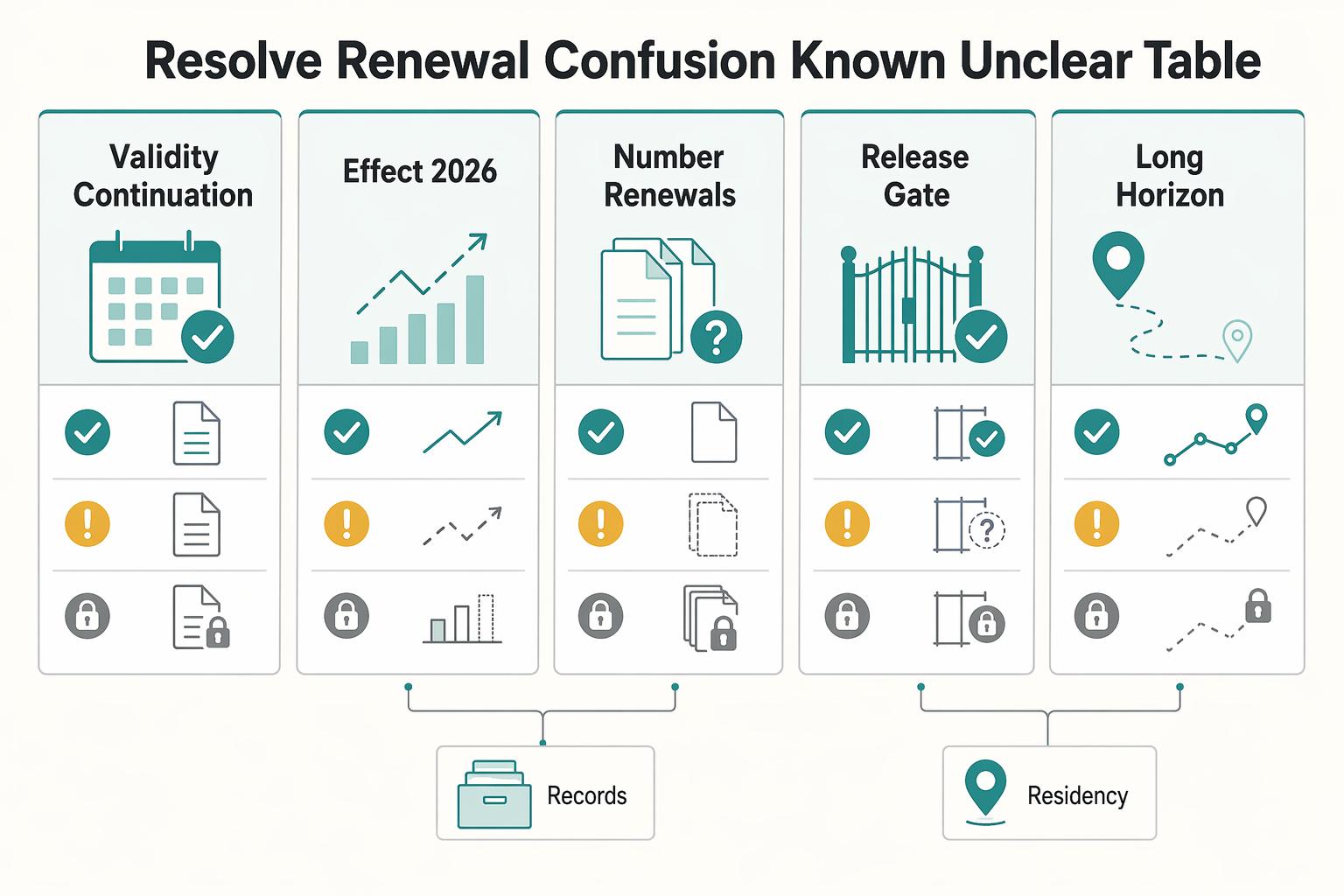
Resolve renewal confusion with a Known vs Unclear table#
Treat renewal as uncertain until the mechanics are confirmed in writing for your case. Planning year two as automatic is how people overcommit on leases, school decisions, or other fixed obligations that depend on a smooth continuation. A cautious planning baseline is not pessimism here. It is just good risk control.
Most of the confusion comes from three things getting blended together: the initial visa, the later permit track, and older guidance that may still be circulating after procedures change. Once you separate those pieces, the issue becomes easier to manage. You may still not have every answer immediately, but you can see which assumptions are safe, which are tentative, and which are still open.
Split decisions into what is known, unclear, and unknown:
| Claim area | Visa track | Residence permit track | Status | What to verify in Greece |
|---|---|---|---|---|
| Validity and continuation | One provided guide says validity is one year with an option to renew. | The same guide lists a separate residence-permit cost line, which suggests a separate administrative track. | Known | Confirm which office handles your next step and which forms apply for your filing date. |
| Effect of 2026 procedural changes | Some renewal guidance may predate February 2026 updates. | Not publicly documented | Unclear | Ask whether Law 5275/2026 changes your sequence, required records, or submission channel. |
| Number of renewals allowed | Not publicly documented | Not publicly documented | Unknown | Request written confirmation of maximum renewals before signing long commitments. |
| Approval certainty and timing | No evidence of guaranteed approval. | No evidence that permit renewal timing matches visa renewal timing. | Unknown | Confirm current processing ranges and what triggers additional document requests. |
| Long-horizon planning | One provided guide mentions permanent residency after five years of legal residency. | Five-year planning may depend on maintaining lawful status through each step. | Known | Verify how your specific status history is counted toward that five-year line. |
If mechanics remain unclear at filing time, use one conservative rule: plan for a one-year horizon and treat confirmed extensions as upside. That default keeps your housing, schooling, shipping, and travel decisions proportional to what is actually verified. It also gives you a clean mental model. Instead of arguing with uncertain public guidance, you operate on the shortest confirmed horizon and update only when the next step is clear.
The common failure mode is treating one static summary as final policy. Greek tax and remote-work rules can change, and second-hand guidance can lag. Verify current requirements directly with a qualified Greek accountant, tax advisor, or the relevant authority before legal or financial commitments. The practical lesson is simple: the older or more generic the guide, the more carefully you should use it.
Start renewal preparation early to lower deadline risk:
- Open a renewal folder as soon as first approval arrives, and store dated copies of approvals and submission receipts.
- Keep a rolling set of core evidence from the initial case, especially remote-work and income continuity documents.
- Set two recurring checks: one mid-year verification and one pre-expiry verification.
- Log each answer with date, office, and requested documents so contradictions are easier to resolve.
- Keep major commitments flexible until renewal path, timing, and document scope are confirmed in writing.
If clear guidance is still unavailable, continue with the one-year planning assumption. It is the safer operating baseline and keeps optimism from outrunning what the file can actually support.
Once you budget on that same conservative basis, the money side gets easier to control too.
Budget with confidence when public fee details are incomplete#
When public fee data is patchy, do not guess harder. Separate confirmed costs from placeholders, document the difference, and update each figure right before you commit. That makes the budget usable even when some inputs are still moving.
This matters because fee confusion rarely comes from one missing number. It usually comes from mixing sources with different purposes and dates. A Schengen explainer, a forum post, and an index page can all be useful for rough planning, but none of them should drive final decisions for your exact route and filing post unless the responsible authority confirms the details.
Use separate buckets for confirmed and unconfirmed costs:
| Cost input | What is currently verifiable | What is still unverified | Planning action |
|---|---|---|---|
| Visa and residence-permit government charges | There are government-evaluated application steps, and pre-filing details should be checked on the relevant embassy or consulate site. | Exact current fee amounts and all-in totals for your path. | Keep separate placeholders for visa-stage and permit-stage charges, then replace them after direct confirmation. |
| Time-linked carrying costs | Processing time is a real planning variable. | Exact duration for your case and delay-related cost impact. | Add buffer for flexible housing and travel instead of assuming fixed timing. |
| Insurance references from Schengen explainers | One provided Schengen source cites EUR 30,000 medical coverage. | Whether that figure applies to this specific route in Greece. | Keep this unverified until the competent authority confirms it for your filing path. |
| Indexes and summary guides | The EY index says it is updated quarterly, may not cover every jurisdiction, and does not guarantee outcomes. | Whether any one guide reflects current local practice at your filing post. | Use guides for planning ranges, then validate details at payment time. |
| Schengen context claims | Provided explainers conflict on Schengen country count, 27 versus 29. | Which secondary source is current on your date. | Treat conflicting context as a warning sign and verify fee-relevant rules directly. |
Avoid this expensive mistake: copying numbers from a Schengen pricing article or forum thread into your Greece budget as if they were confirmed for this route. That shortcut creates false certainty, and false certainty is what leads people to lock housing, flights, or relocation spend too early.
Do not assume:
- A Schengen fee explainer gives the right fee for this remote-work visa path.
- A quoted insurance threshold automatically applies to your filing route.
- A quarterly index update captures changes made this week.
- Any single public summary is complete enough for legal or financial commitment.
Use this cashflow checklist:
- Create four budget buckets: government charges, document and admin costs, relocation spend, and a dedicated contingency line for Greece-specific uncertainty.
- Before each major payment, save dated proof of current requirements from the relevant embassy or consulate page.
- Keep early housing and transport flexible until visa-stage and permit-stage cost items are confirmed.
- Reserve contingency for unclear or changing program costs, and keep it untouched until required filings are accepted.
- Recheck assumptions right before submission and again before non-refundable bookings.
The point is not to predict every cost perfectly. It is to stop uncertain public numbers from driving fixed decisions too early. The same discipline becomes even more important if family members are moving with you, because one unresolved rule can multiply costs and rework fast.
Bring family without creating avoidable legal problems#
Dependent planning should start alongside the principal file, not after it. If you leave family questions until the main application is nearly finished, you often discover that the clean principal narrative was hiding unresolved issues about work rights, filing sequence, or document overlap.
One guide describes this route for non-EU or EEA nationals working remotely for companies or clients outside Greece. That supports principal-applicant scope, but it does not confirm dependent local work rights. If a partner needs local employment rights, pause and compare other immigration paths before committing. This is not a detail to leave for later because it can change whether the move works for the household at all.
Use this table to keep decisions separate:
| Family planning question | Known from current material | What to do now |
|---|---|---|
| Who this route is designed for | One guide presents it for non-EU or EEA nationals working remotely for non-Greek entities. | Keep the principal file aligned to that scope and avoid mixed income narratives. |
| Partner needs local work rights in Greece | Not confirmed: dependent local work rights under this route. | If local work rights are required, assess other immigration paths before proceeding. |
| Whether rules from another program can be reused | Golden Visa family criteria are program-specific and vary by country. | Do not import Golden Visa assumptions into this case. Verify this route on its own terms. |
| Whether Family Reunion is the same path | One services page lists Family Reunion separately from Digital Nomad Visa and Work Visa. | Confirm the correct track first, then keep evidence sets separate if authorities treat them as different paths. |
Also plan for border-stage documentation risk. At external Schengen borders, refusal of entry can happen when entry conditions are not met. Common triggers include incomplete or invalid documents and weak accommodation proof. Refusal is documented on a standardized written form, and the traveler receives a copy. Even where the principal approval is in place, weak family documentation can still create avoidable friction at the border or during follow-up checks.
Tie family documents directly to the principal case:
- Keep one master index linking each dependent document to the principal record.
- Check identity and relationship documents for exact consistency of names, dates, and numbers.
- Keep accommodation proof consistent for every family member on address and stay period.
- Maintain one shared timeline showing who files what, where, and by checkpoint date.
- Prepare a border packet with printed approvals and core accommodation evidence for each traveler.
- Maintain a verification log with office, date, and answer for each dependent-rule question.
Set one hard checkpoint before locking the primary submission window. If any dependent-critical item remains unresolved, either defer dependent filing intentionally or move the overall filing date. What you do not want is an accidental half-plan where the principal file is ready but the family move still depends on assumptions.
Once family timing is clear, the next question is when to hand off from immigration planning to tax planning.
Handle tax residency at the right moment#
Do not wait until after arrival to think about tax residency. The handoff should happen when your move becomes real enough to describe, not when you are already in-country trying to reconstruct facts from memory and old bank entries.
A useful rule of thumb is this: once you can state your expected arrival month, likely stay pattern, and where income is recorded, the tax workstream should start. Changing where you live can change your tax profile even when your employer, role, and client mix stay the same. Visa prep gets you legal entry and stay. Tax planning protects how that stay is reported and documented. If one side is underdeveloped, the other side usually gets harder.
This is also where many applicants drift into avoidable timing mistakes. They treat tax as a later clean-up task because the immigration file feels more urgent. Then the move date firms up, work continues, invoices go out, and they realize they do not have a clean record of where work was performed or which rules may now matter. A modest early handoff prevents that scramble.
Set the handoff trigger early#
Define your trigger early so you do not lose weeks once dates firm up. The key inputs are where you will physically work, who pays you, and whether cross-border telework can create tax or social-security administration issues. This route is often described as allowing up to 12 months, and longer stay patterns can raise tax-residency questions. If these basics are unclear, verify them with a qualified advisor or official authority before legal or financial decisions.
A practical way to do this is to name the handoff in your tracker. Once the move has an expected month and the income trail is stable enough to describe, add tax planning as a live workstream rather than a later reminder. That one step keeps immigration, payroll or invoicing, and recordkeeping in sync.
If you are a US citizen#
Run two tracks in parallel: Greek requirements and US tax compliance. Longer stays can create filing and timing questions on both sides, and visa status alone does not settle tax outcomes. Keep your calendar organized around filing windows, document requests, and review checkpoints so you are not dealing with both regimes in a rush.
In practice, the earlier you define the handoff, the less likely you are to end up doing this work reactively. For many Americans, the operational problem is not a lack of information. It is timing. If the visa file, the move, and tax compliance all peak at once, even simple tasks become harder. Clean records and an early review window help you avoid that pileup.
If you are not a US citizen#
Country-specific analysis is still required, but the details depend on your home-country rules, treaty position, and income setup. Do not assume one online summary applies to everyone. If you see claims about tax reductions, treat them as unconfirmed until a qualified advisor or official authority confirms that they apply to your exact facts.
The discipline is the same as on the immigration side: use public material to frame questions, not to close them. Your residence history, contract structure, and home-country obligations may all change what matters. The goal here is not to become a tax specialist overnight. It is to know when the questions are important enough that you should stop relying on generic guidance.
Escalate when your footprint expands#
Escalate quickly when your footprint grows. Typical triggers are extending your stay, adding client geographies, changing contract structure, or moving to regular invoicing while living in Greece. Rules can change, so recheck figures and requirements before decisions.
Keep this compact record set live from month one:
- Monthly log of where work was performed.
- Invoice and payment records by client country and date.
- Written notes of advisor or authority confirmations, with date and scope.
- A standing check on whether 2026 myDATA B2B e-invoicing rules apply to your setup.
This section is mostly about timing, but timing only helps if the records are there to support it. Once the handoff is set, the next operational choice is where to base yourself so the admin work is easy to maintain.
For deeper scenario planning, read Tax Incentives for Digital Nomads in Greece, then validate current requirements before legal or financial commitments.
Choose your base with operational criteria, not Instagram appeal#
Your first base should make the process easier, not prettier. Pick for operational reliability first, then optimize for lifestyle once the filing rhythm is stable. That is a better month-one strategy than choosing a place mainly because it photographs well or feels aspirational.
For this route, compare bases on three practical checks: admin access, housing reliability, and workday connectivity. Those factors matter more in the first month than scenery or social-media appeal because they directly affect whether you can keep appointments, receive documents, work predictably, and adjust plans if something slips. A place that is harder to handle logistically can turn small administrative issues into real delays.
| Base option | When this can make sense | What to verify before you commit |
|---|---|---|
| Athens | Short initial phase if your personal logistics already anchor you there. | Check current official application and translation rules, then validate appointment access and real work-hour internet performance in your area. |
| Crete | Longer stay if your admin schedule and housing options are already workable. | Confirm lease flexibility, internet consistency, and how you will handle occasional admin travel without missing deadlines. |
| Greek islands | Lifestyle-led plan when your schedule has buffer. | Validate connectivity and transport buffers before locking housing, especially with fixed legal or tax-admin checkpoints. |
This is sequencing, not city ranking. Keep the first base reversible, clear high-friction admin tasks, then commit longer term once routines are predictable. A place that looks ideal on paper is still the wrong first base if it makes simple document or appointment logistics harder than they need to be.
First 30 days relocation checkpoints#
- Recheck official government instructions for process and translation requirements, and save a dated copy.
- Confirm your eligibility narrative still matches remote work for non-Greek employers or clients with income from abroad.
- Test internet quality during real meeting windows before signing a longer lease.
- Keep housing flexible until permit-related steps are clearly scheduled.
- Keep one record set for contracts, invoices, payments, housing documents, and dated notes from advisor or authority conversations.
- Treat online income figures as screening only until official channels confirm what applies to your case.
If your base repeatedly causes missed or rescheduled legal, document, or tax-admin tasks, adjust early. Static guides age quickly, but clean records and predictable deadlines hold up. Those early relocation choices also expose the next layer of risk: the failure modes that cause delays, contradictions, and unnecessary rework.
Avoid the failure modes that cause delays and rework#
Most preventable delays come from contradictions, not from the core facts of the case. A file can be fully honest and still become hard to process if the immigration records, tax records, and general business records are loosely mixed and never reconciled. Small inconsistencies then spread from one document to the next.
The practical fix is simple: separate those records first, then reconcile them at each filing milestone. That discipline prevents most avoidable contradictions and makes it much easier to tell the difference between a missing document and a deeper factual issue. If you skip that step, you end up guessing whether a problem is clerical or structural, and that wastes time fast.
What's confirmed here is limited to EU VAT OSS and CBR mechanics. It does not confirm Greece-specific eligibility, processing times, or renewal mechanics. Treat those points as unverified until official channels confirm them in writing. That is especially important when a VAT concept starts to sneak into the immigration file simply because the same person is handling both.
Red-flag matrix for cross-border filing#
| Red flag | Why it creates rework risk | Operational fix | Verification step tied to follow-up |
|---|---|---|---|
| You treat anecdotal posts as rules | Unverified guidance can conflict with current official process. | Label each rule as official, secondary, or unverified before acting. | Before each filing step, recheck current official instructions and log the check date. |
| Your income narrative changes across documents | Inconsistent payer, service, or date descriptions can trigger clarification cycles. | Keep one monthly reconciliation sheet across contracts, invoices, and payments. | Add the latest reconciliation note to your file before each submission. |
| You skip document QA because the file looks complete | Small identity or date mismatches can trigger follow-up requests. | Run two-pass QA: identity consistency, then claim-to-document matching. | Repeat QA at every filing milestone, not only at first submission. |
| You assume OSS replaces domestic VAT filing | OSS returns are additional and do not replace domestic VAT returns. | If you use OSS, register in one Member State of identification and report all supplies covered by that scheme. | Keep proof of registration and filed returns in your tax folder. |
For cross-border VAT complexity, you can request a CBR advance ruling on VAT treatment in the participating EU country where you are VAT-registered. If multiple companies are involved, one company should file on behalf of the others. OSS filing cadence also differs by scheme: quarterly for Union and non-Union schemes, monthly for the import scheme.
Common failure mode: people see a complete-looking folder and stop checking it. That is usually when old drafts, outdated employer letters, unmatched invoices, or renamed files stay in circulation and later create confusion. A file is not ready because it is large. It is ready because every important claim can be traced cleanly and consistently.
If your records cannot be reconciled cleanly, pause self-directed filing and get specialist review before the next step. It is much cheaper to fix the narrative before submission than after an avoidable clarification cycle starts.
Once those failure modes are under control, the next practical move is building a money trail and document archive that can hold up under review.
Set up your money and records before you move#
Set up a verifiable money trail before relocation. This process is document-driven, and weak records create delay risk even when your core profile fits. If the file depends on showing who pays you, how regularly they pay you, and how that work stays outside Greece, then the record system has to be solid before the move starts.
The goal is not just to collect proof. It is to build a record architecture you can maintain without drama once you are busy, moving, and juggling deadlines. If you do this well before departure, later requests for updated evidence become easier because the underlying structure is already there. If you do it late, every later request feels bigger than it should.
Longer stays can raise tax-residency and US tax-compliance questions, especially for Americans. Treat record quality as a monthly operating habit: keep proof of who pays you, where they are based, what remote work you provide, and how each payment reaches your account. Strong records reduce risk, but they do not guarantee approval. What they do guarantee is that you can answer follow-up questions with something better than memory.
Build your pre-move evidence pack#
Use one folder structure and consistent filenames such as date - payer - document type so each claim can be traced quickly. That sounds basic, but naming discipline saves time once files start multiplying across visa prep, tax questions, housing, and post-arrival admin. Good naming also makes it easier to share the file with an advisor without a long explanation.
- Identity documents and related application records.
- Income evidence aligned to your declared work setup.
- Proof of remote work, such as employer letter, client contracts, or business registration.
- If employed, an employer letter confirming remote permission, role, and salary.
- If self-employed, invoices matched to bank deposits as a clean trail.
- Insurance documents.
- A one-page summary with payer name, payer location, monthly income, and intended stay dates.
Most breakpoints are predictable: irregular income with no supporting contract trail, and screenshots that cannot be independently verified. If income varies, add a short note for each payment source and link it to contract and bank evidence. That extra step usually saves time later because it answers the obvious follow-up question before someone has to ask it.
Where a platform like Gruv can help#
If you use Gruv, it can help with payout-status visibility, audit-ready records and exports, and compliance gates where supported and enabled. Use those features to reduce manual reconciliation time, but do not treat platform data as your only evidence source. Keep source contracts, invoices, and bank records as your primary archive.
The practical way to use a platform here is as an organizer, not a substitute for underlying proof. The strongest file is the one where platform exports, bank records, and contract documents all point to the same story without extra explanation.
Minimum viable monthly documentation routine#
Run this routine once per month:
- Reconcile every invoice to a received payment and flag mismatches.
- Update your payer summary by location, amount, and payment period.
- Save a monthly bank statement and tag inbound payments to invoice IDs.
- File new contracts, amendments, or employer letters in the same folder structure.
- Check for missing proof before your next review checkpoint.
If your income footprint changes or a payment cannot be traced cleanly, escalate to specialist advice early. Good records will not answer every legal question, but they make every later review faster and more defensible.
For deeper tax planning scenarios, see Tax Incentives for Digital Nomads in Greece.
Conclusion#
Treat this route as a series of checkpoints, not a one-time form submission. Verify fit first, build the file second, then verify timing, duration, and renewal mechanics before you commit money or fixed dates. That order is what keeps the process manageable.
Start with scope. The route is described for non-EU nationals working remotely for employers or clients outside Greece, with local Greek employment outside scope. If your work setup does not match that boundary, pause before filing. A clean no-go early is better than an expensive rework later.
Then focus on evidence quality. Keep the file centered on concrete proof of income and remote work, and do not rely on summary posts as final policy. Requirements vary by filing post and can change over time, so confirm current instructions with the authority handling your case. The better your records, the easier everything gets, from the first submission to the permit handoff and any later renewal questions.
Use this final pre-filing check:
- Confirm eligibility against non-EU and non-Greek employer conditions.
- Build a clean file with proof of income and employment.
- Mark each key point as
confirmedorverify. - Verify renewal wording directly, including whether the up to one year plus an additional year pattern applies in your case.
- Keep written notes of official clarifications.
- Hold irreversible bookings until core eligibility and duration assumptions are confirmed.
If you are still comparing options, review The Global Digital Nomad Visa Index: 50+ Countries Compared. Once your Greece timeline is real, move into tax planning with the same rule: verify first, then act, as outlined in Tax Incentives for Digital Nomads in Greece. Before committing, compare practical visa paths side by side so your timeline and paperwork plan match your real options in Visa for Digital Nomads.
Frequently Asked Questions
Who qualifies for the Greece digital nomad visa?
This route is presented for non-EU, non-EEA, and non-Swiss nationals working remotely for employers or clients outside Greece. If you are an EU, EEA, or Swiss citizen, EU free-movement rights generally apply instead of this visa path.
How long can I stay in Greece on this route?
The visa is described as allowing legal residence for up to one year. If you want to stay longer, you can apply for the Digital Nomad Residence Permit, described as valid for up to two years.
Can the visa be renewed, and why do sources disagree?
Available guidance separates two stages: the initial visa and the residence permit that can follow. It does not clearly present the visa itself as directly renewable. The permit is described as renewable every two years for two more years, which is where timelines often get blended.
Can family members come with me, and can they work locally in Greece?
Income rules include spouse or cohabitant and child uplifts, which indicates dependents are part of planning. This guide does not confirm local work rights for dependents, so verify that point directly with the relevant authority. For the main applicant, local work for a Greek company, including freelance work, is described as not allowed during this status period.
What income requirement is commonly cited?
A commonly cited threshold is at least EUR 3,500 per month after taxes for a remote employee or self-employed applicant working with employers outside Greece. The cited amount increases by 20% for a spouse or cohabitant and 15% for each child. Typical proof includes bank statements, invoices, or client and employer contracts.
How long does approval usually take, and what can delay it?
Applications are submitted to the Greek consular authority in your main country of residence, and submission can be by email or registered letter. One official-style FAQ says the consular authority is obliged to respond within 10 days, while a secondary guide cites a typical 10 working days. Treat timing as an estimate and verify current expectations with the consulate handling your file. Specific delay causes are not spelled out.
When should I shift from visa prep to tax residency planning?
Verify current tax-residency timing directly with the relevant authorities before relying on a fixed threshold.
Try a related tool
Researched and edited by the Gruv editorial team. Gruv builds cross-border billing, payouts, and finance-operations software for global businesses.
Sources
Includes 2 external sources outside the trusted-domain allowlist.
- gr.usembassy.gov/greek-visas-and-residency-permits-for-u-s-ci...trusted
- taxation-customs.ec.europa.eu/news/continued-growth-revenue-and-registrati...trusted
- taxation-customs.ec.europa.eu/archives/taxable-persons/vat-cross-border-ru...trusted
- brighttax.com/blog/the-greece-digital-nomad-visa-a-complet...external
- greenbacktaxservices.com/blog/greece-digital-nomad-visaexternal
Educational content only. Not legal, tax, or financial advice.
Related Posts

The 2026 Global Digital Nomad Visa Index for 50+ Countries
Start with legal fit, not lifestyle filters. The practical order is simple: choose a route you can actually document, then decide where you want to live. That single change cuts a lot of wasted comparison work and stops you from falling in love with places that were never a real filing option.
Tax Incentives for Digital Nomads in Greece
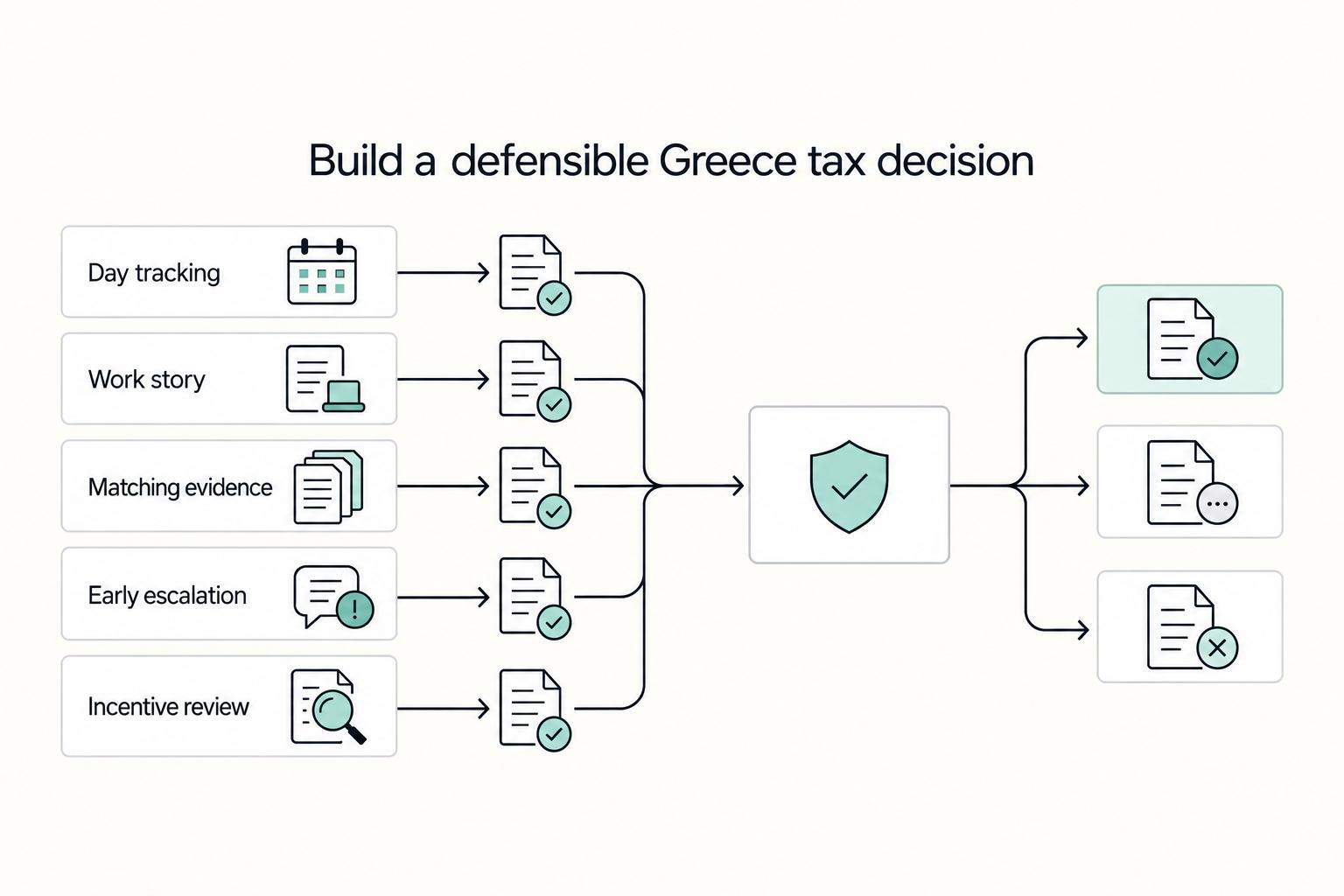
If you searched **greece tax incentives nomads**, take that search as a warning, not a plan. Your real job is to choose a tax position you can explain with evidence, then run your operations so that position stays consistent. The goal is not to find one attractive rule. It is to avoid a year-end scramble where your days, contracts, and filings all point in different directions.

How US Citizens Can Work Remotely in Europe Without Visa Missteps
Start with legal verification, not logistics: confirm your pathway first, assemble matching paperwork second, and book travel last. That order helps reduce avoidable delays.