
Quick Answer
Choose a Golden Visa when your strongest asset is deployable capital and you want a residence route built for longer-term continuity; choose a digital nomad route when your advantage is provable remote income and you need flexibility first. In a golden visa vs digital nomad visa decision, Spain telework conditions, including limits on local self-employed activity, show how work-model rules can determine fit. Run a lawful pilot period first, then commit only after tax-home and renewal checks are documented.
The Core Equation: Investment Capital vs. Verified Income#
Start here. You are choosing between two different qualifying assets. If you can deploy capital, you are likely looking at an investor residence lane. If you can prove stable remote income, you are likely in a telework or digital nomad lane.
That distinction matters because the evidence burden is different. A Golden Visa is an investment-linked residence scheme. You must use a qualifying route in that country and file the residence permit documents tied to that route. A telework visa is income- and work-pattern based. You must prove foreign-linked remote work and show that your setup fits local labor-market limits.
In practice, this is as much a documentation decision as a budget decision. Greece's investor route is explicitly framed as an "Initial permanent residence permit for investors (art. 20B)." It carries formal permit documentation and administrative items, including the €16 residence-permit print fee.
Spain's telework route shows the opposite pattern. It has strict work-model rules and filing mechanics, including employee applicants working for companies outside Spain, self-employed local work capped at 20%, NIE before filing, and document legalization or apostille and translation requirements. It also calls for continuity proof, such as at least 3 months of work history.
| Decision field | Golden Visa | Digital nomad or telework visa |
|---|---|---|
| Qualifying basis | Approved investment route in the target country; verify the current qualifying routes before filing. | Verified remote work or foreign-source professional income; verify the current income threshold before filing. |
| Evidence to prepare | Passport and residence-permit documents, investment-route proof, jurisdiction-specific filings, and family-member documents where relevant. | Income proof, employer or client relationship proof, continuity evidence, identity documents, and often apostille or translation. Spain also requires a NIE before filing. |
| Renewal or permanence profile | Can support longer-term residence, depending on jurisdiction. In some jurisdictions, it is framed as a permanent investor residence category from the start. | Usually time-limited with country-specific renewal rules. Spain includes an in-country residence permit path (for foreigners regularly in Spain) valid for a maximum of three years. |
| Family fit | Often supports dependents, but not automatically. Separate permit steps and documentation are typical. | Often allows dependents, but it is still document-driven. Spain explicitly includes dependent children and certain financially dependent adult children. |
| Operational complexity | Capital deployment plus investment-route and permit-document requirements. | No investment-route capital deployment, but close scrutiny of work model, income evidence, and filing formalities. |
Use this quick lane check before you move to compliance planning:
- Choose investor-first if you already have allocated capital and can manage a heavier permit file, especially where the investor track is permanence-oriented.
- Choose telework-first if your strongest asset is verifiable remote income and your contracts and work pattern fit local limits.
- Pause and verify country rules before filing if you are unclear on work rights, dependent eligibility, or document formalities, because those are common failure points.
If you want a deeper dive, read The Global Digital Nomad Visa Index: 50+ Countries Compared.
The Compliance Minefield: Quantifying Your Tax Residency Risk#
For risk planning, treat visa approval and tax exposure as related but separate checks. In this comparison, the main downside risk is unintended tax residency and possible worldwide-income exposure if your real-life facts point there.
That risk can show up early on the digital nomad side. Eligibility is generally income-based, and approval is only step one. Your tax position can still depend on how long you stay and what local ties you build under local rules. Check the host country's residency test before you file, including day-count rules and other nexus factors tied to housing, family, and where you actually work.
The same documents that help your visa file can also become compliance signals later. Proof of stable income is a common checkpoint, and longer housing, family, and work patterns may matter in a residency analysis. Do not assume visa qualification by itself settles host-country tax outcomes.
Golden Visa holders face a different version of the same problem. Low physical-presence requirements can be real, and some routes are presented as minimal stays, for example 7 days per year. But that alone may not settle your primary tax-home position. If your permit is in one country and your life is mostly in another, review the full fact pattern with qualified counsel.
| Risk lens | Digital nomad route | Golden visa route |
|---|---|---|
| Usual pressure point | Longer lawful stay plus local living ties | False comfort from low required presence |
| Main compliance question | When do stay pattern and local nexus become tax residency under local rules? | Where is your primary tax home if permit-country presence is minimal? |
| Common mistaken assumption | Visa approval automatically settles tax residency questions | Minimal stay automatically preserves tax neutrality |
| Evidence to track early | Presence-day log, lease dates, contracts, income proof, family move dates | Presence-day log across countries, housing records, family location, business-management records |
If treaty tie-breakers are relevant, review the treaty text with counsel#
If two countries may both claim residency, first confirm treaty coverage, then review the exact treaty language with qualified counsel. Treaty outcomes are jurisdiction-specific and fact-driven, so avoid relying on generic assumptions.
- Collect your facts early: Keep records for presence days, housing, family location, and where work or business decisions are made.
- Map those facts to the treaty: Use the specific treaty article that applies to your two countries.
- Document your position before filing: Keep a clear evidence file for the approach you take.
Risk-control checklist#
| Risk-control item | Action |
|---|---|
| Presence days | Track presence days in real time, not from memory at year-end. |
| Treaty coverage | Map treaty coverage between your current country and proposed host country. |
| Ties alignment | Align personal and economic ties so they support one defensible tax home. |
| Counsel review | Confirm your position with qualified cross-border tax counsel before filing. |
In practice, digital nomad routes can create accidental risk through longer, more settled stays. Investor routes may reduce that pressure only if you still maintain one clearly documented primary tax base.
You might also find this useful: Spain vs. Portugal Digital Nomad Visa: A Detailed Tax and Lifestyle Comparison.
Before you commit to one visa path, pressure-test your travel pattern with a clean residency log: Track residency signals.
The 'Test-Then-Invest' Strategy: How to De-Risk a €500k Decision#
Once you have mapped tax risk, do not commit investment capital first. Where available, use a lawful remote-work route as your pilot. Test daily life under real working conditions, then make a written go or no-go decision only after you collect evidence.
Start with a clear hypothesis. Not "I like it here," but "I can live here, work here, manage local admin, and stay within my tax and budget limits." That discipline matters because investor frameworks can change. Spain ended investor residence visas on 3 April 2025. Greece raised investment minimums in some areas from 500.000€ to 800.000€ and in others from 250.000€ to 400.000€.
Run the pilot lawfully#
Do not use short stays as a substitute for a real validation period. Schengen short stay is limited to 90 days in any 180-day period, and longer stays follow each country's national process. If your test needs enough time to run normal workweeks, handle admin tasks, and see non-peak conditions, use the proper permit.
Spain is a useful example. Its telework route is for foreigners working remotely for a company outside Spain, and eligible applicants can apply from inside Spain for a residence permit without a prior visa. That in-country authorization can be valid for up to three years. Process discipline matters here: validate through the real national route, not repeated short stays.
What to validate before you invest#
| Assumption | Test action | Evidence to collect | Decision trigger |
|---|---|---|---|
| Infrastructure is reliable for client work | Work from your target neighborhood during peak hours. Test home internet and mobile backup. | Timestamped speed tests, outage notes, failed call records, coworking receipts, SIM screenshots | If recurring outages disrupt paid work and backup options fail, change location or stop |
| Administration is manageable | Run core setup tasks early: SIM, bank inquiry, registration steps where applicable, lease paperwork, appointment booking | Appointment confirmations, rejection emails, document request lists, completion dates, submitted forms | If basic setup repeatedly stalls because required documents are not realistic to maintain, defer the move |
| Cost of living fits your model | Live on your projected monthly budget, including rent, deposits, utilities, transport, insurance, and workspace | Card statements, rent quotes, receipts, deposit invoices, monthly budget exports | If recurring spend breaks your margin, revise the plan before any investment decision |
| Local professional support is usable | Interview at least two accountants or lawyers with the same questions on residence, filings, and family setup | Fee quotes, scope emails, engagement letters, notes on response time and clarity | If advisers cannot explain basics clearly or will not define scope in writing, do not invest yet |
Build a pilot file you can reuse#
Treat this phase as evidence collection, not lifestyle sampling. Missing documents can suspend a visa application, so keep a dated folder from day one.
| File area | Records to keep |
|---|---|
| Proof of stay pattern | Entry and exit records, boarding passes, accommodation invoices, and your day log |
| Service setup attempts | Bank, SIM, lease, tax or ID registration, utility, and appointment records, including failed attempts |
| Local adviser interviews | Questions asked, written answers, fee quotes, and conflicting guidance |
| Budget tracking artifacts | Rent quotes, receipts, insurance costs, transport spend, and monthly bank or card exports |
If long-term residence is part of your plan, add this check to your file: "Confirm whether lawful stay on this permit counts toward long-term residence milestones in the target country." The EU baseline refers to an uninterrupted period of five years of legal residence, but national laws can differ.
Use the remote-work permit as a decision tool, not a pre-commitment to invest. If the pilot shows stable operations, manageable admin, credible advisers, and a budget that still works, then an investment route may be worth reviewing. If your pilot file is inconsistent or full of red flags, keep your capital liquid.
For related planning context, see Canada Digital Nomad Visa Planning for Visitor Status and Work Permits.
Beyond Residency: Assessing Your Strategic Optionality#
After your pilot, stop choosing by visa label. You are deciding which option gives you more operating flexibility now and stronger long-term security later. If keeping capital liquid while you validate country fit is a priority, evaluate remote-work options country by country. If you want a residence right designed for durability and a possible path over time toward permanent residence or citizenship, a Golden Visa is usually the stronger long-range instrument.
That shift matters because the next decision is less about entry and more about what the permit lets you sustain.
Where the operational risk really sits#
The permit alone does not solve your operating model. Banking, invoicing, and admin burden usually depend on local law, your tax position, and whether you operate personally or through an entity.
| Decision area | Remote-work path | Golden Visa path | What to verify before filing |
|---|---|---|---|
| Personal setup vs entity setup | The permit does not answer this by itself; structure depends on local rules. | Residence rights do not settle the operating structure by themselves. | Get written local advice on whether your intended setup can be personal, company-based, or both |
| Banking access | Do not assume the permit makes account opening easy. | Do not assume residence-by-investment makes account opening easy. | Request account-opening requirements from at least two banks, including business-account rules where relevant |
| Invoicing workflow | Do not assume the permit answers VAT or invoice-format obligations. | Do not assume residence-by-investment answers VAT or invoice-format obligations. | Ask an accountant for invoice treatment tied to your actual client mix |
| Compliance administration | Country-specific and must be checked case by case. | Country-specific and must be checked, plus route-specific investment evidence. | Request renewal steps and a full route-specific document checklist before moving capital |
Your key Golden Visa checkpoint is route matching. In Portugal's 2025 framework, examples include €250,000 for cultural heritage, €500,000 for scientific research, €1.5 million capital transfer, or creation of 10 jobs. A common failure mode is relying on an old property-first assumption when that route is no longer available in the way you expected.
Family planning checklist#
If family relocation is part of your plan, treat it as its own workstream. Use these four lenses before you file:
| Lens | What to confirm |
|---|---|
| Dependent eligibility | Confirm dependent eligibility by country before filing. |
| Dependent document pack | Request the exact dependent document pack early, including any relationship proof and any legalization or translation requirements if applicable. |
| Renewal calendar | Confirm whether renewals run on one family calendar or separate calendars. |
| Relocation friction | Pressure-test relocation friction early: schooling, healthcare access, housing, and appointment availability. |
Optionality framework you can apply#
| Lens | What to ask |
|---|---|
| Short-term flexibility | Can you start quickly and adjust plans without locking capital too early? |
| Long-term permanence | Does this permit type support a durable residence strategy over time? |
| Mobility rights | What mobility permissions are explicit in your permit terms, and what remains restricted? |
| Continuity for dependents | If your plan changes, does this path preserve continuity options for your family over time? |
If your priority is speed, testing one country, and preserving optionality, prioritize tactical mobility first. If your priority is long-horizon residence security, family continuity planning, and documented legal stability, prioritize the residence-by-investment track. For a country-specific example, see A Guide to Getting a Golden Visa in Portugal.
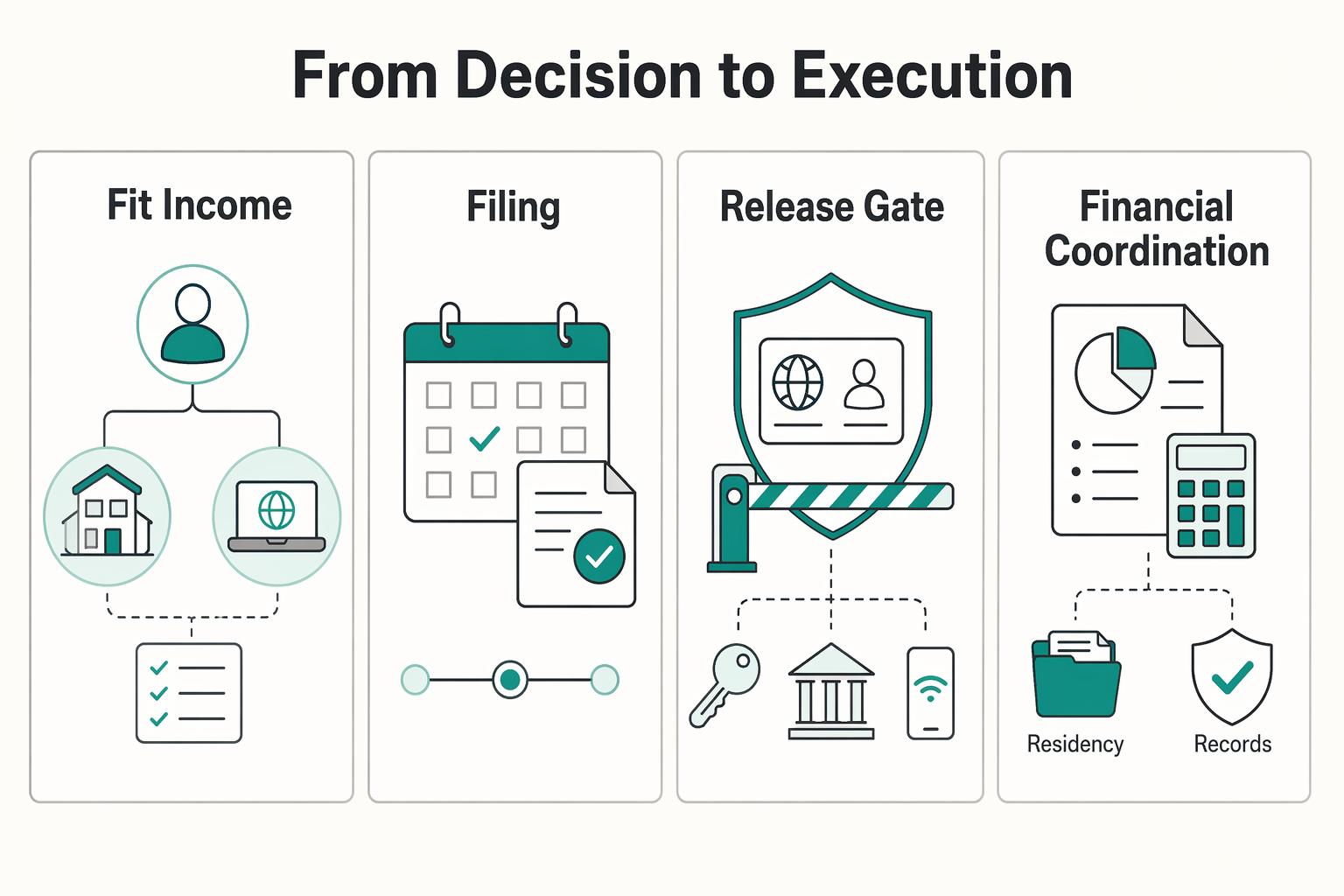
Your Next Move: From Decision to Execution#
Turn this into a four-step plan you can actually run: choose your path, confirm filing timing, set your operating structure, and review compliance every month.
Start by locking your path and filing timeline. Match the path to your income profile, then verify current requirements before you spend, sign, or travel. Confirm what triggers residency-card issuance, because that card can unlock practical setup steps like a lease, bank account, and long-term phone plan.
| Decision area | What to do before filing |
|---|---|
| Fit with income | Confirm the path fits your income profile and long-term plan. |
| Documentation | Verify current evidence and documentation requirements before filing. |
| Ongoing compliance | Plan recurring status and compliance check-ins after approval. |
| Financial coordination | Review tax residency, banking, and cross-border planning impacts early. |
Once the path is clear, sort out the operating side before move logistics get noisy. Decide how you will get paid, what currency covers day-to-day costs, and how you will manage EUR expenses if your income is in USD. Build records from day one so key decisions stay traceable over time. Without stable status, it is easy to fall into repeated short-term decisions like booking another outbound ticket instead of running a durable plan.
Run these four habits every month:
- Financial setup: Keep your payment and account structure clear so reviews are easier to manage.
- Record-keeping: Track travel and keep dated files so you can answer tax or immigration questions with documents, not memory.
- Cross-border planning: Recheck tax and financial assumptions, including healthcare, retirement, and estate planning impacts across jurisdictions.
- Professional counsel: Use immigration and tax advisers early so lease, bank, and entity decisions do not create avoidable cross-border issues.
Finish with one working checklist verified with the relevant authorities and your advisers. Then follow it month by month so your plan still works in year three, not just month one.
For a step-by-step walkthrough, see Digital Nomad Visa Guide for 2026 Moves. When you move from decision to execution, map your invoicing, payout, and compliance workflow with a practical rollout conversation: Talk to Gruv.
Frequently Asked Questions
What are the real tax implications of a digital nomad visa?
Start with the key rule: visa status does not equal tax status. In Portugal, tax residency can be triggered by spending more than 183 days in a 12-month period or by maintaining a home that indicates habitual residence, and residents are typically taxed on worldwide income. If two countries can both treat you as resident, treaty tie-breaker rules may apply, and U.S. dual-resident filers may need Form 8833. Before you apply, confirm filing and registration obligations with both a local tax adviser and your home-country adviser, including timing rules such as Portugal’s 60-day reporting window for residency-status changes.
Can a digital nomad visa lead to permanent residence or citizenship?
It depends on country-specific permit and residence rules, so do not assume it will. Verify three points before relying on this path: whether nomad-visa time counts, whether switching permit types resets the clock, and which absence rules break continuity. Estonia is a useful warning case because the nomad visa is framed as temporary stay up to 1 year. If you cannot confirm credit from official guidance or qualified local advice, treat the route as temporary.
Which visa is better for long-term planning?
If you already know the country is the right fit and the program offers multi-year validity, a Golden Visa can be the stronger long-range option. In the UAE framework, that difference is explicit: Golden Visa validity is 5 or 10 years, while the virtual work visa is 1 year and tied to its issued terms and conditions. If you are still testing fit, use the remote-work route as a pilot phase, then decide with country-specific verification. Confirm renewal continuity, status-switch mechanics, and whether time on the temporary permit is actually credited.
What income level should I expect for a digital nomad visa?
Treat income thresholds as live filing data, not fixed blog data. Build your checklist from official pages and re-check at the time you submit because requirements can change. Track each country separately. Check Spain against the official consular digital nomad visa page, including the outside-Spain work rule and the 20% self-employed local-activity exception; Portugal against the official immigration or consular page, including the current renewal standard, evidence format, and any translation or legalization requirements; Estonia against its official nomad-visa page, including the temporary-stay framing up to 1 year and any linked long-stay visa limits; and UAE virtual work against the official virtual-work page, including one-year validity, current salary-evidence rules, and the latest page update before filing.
Can I work for local companies on a digital nomad visa?
As a starting assumption, no. These visas are generally structured for remote work tied to employers or clients outside the host country. Spain includes a defined exception for self-employed applicants, allowing local work only if it stays within the stated 20% cap. Before accepting local work, confirm your visa terms for client mix, employer location, and any percentage or compliance limits. Keep contracts and invoices organized by client location so you can show compliance if asked.
Try a related tool
Researched and edited by the Gruv editorial team. Gruv builds cross-border billing, payouts, and finance-operations software for global businesses.
Sources
- commission.europa.eu/strategy-and-policy/policies/justice-and-fun...trusted
- cs.arizona.edu/~mercer/Projects/BoggleWordstrusted
- exteriores.gob.es/Consulados/londres/en/ServiciosConsulares/Pa...trusted
- exteriores.gob.es/Consulados/nuevayork/en/ServiciosConsulares/...trusted
- home-affairs.ec.europa.eu/policies/schengen/visa-policy_entrusted
- info.portaldasfinancas.gov.pt/en/tax-information/getting-started-in-portug...trusted
- irs.gov/forms-pubs/about-form-8833trusted
- irs.gov/pub/fatca/int_practice_units/tre_p_016_02_01...trusted
Educational content only. Not legal, tax, or financial advice.
Related Posts

The 2026 Global Digital Nomad Visa Index for 50+ Countries
Start with legal fit, not lifestyle filters. The practical order is simple: choose a route you can actually document, then decide where you want to live. That single change cuts a lot of wasted comparison work and stops you from falling in love with places that were never a real filing option.
Portugal Golden Visa in 2026 for Remote Professionals
Choose the Golden Visa if you want residency flexibility with limited time in Portugal. Choose D7 or D8 if you plan to relocate and use Portugal as your primary base.
Spain vs Portugal Digital Nomad Visa for a Confident 2026 Move
Choose the country where your case is easiest to prove and where the fewest details are still unclear. When you weigh Spain against Portugal for a digital nomad visa, both options can look similar at first, and there is no single best option for everyone. The better outcome usually depends on your situation and on how clearly you can evidence income, family inclusion, minimum stay, and process.