
Quick Answer
For a globally mobile consultant in Germany, decide your tax residency, work classification, and VAT path before you register, invoice, or file. Build a one-page tax map covering residency, whether your work fits Freiberufler or Gewerbebetrieb, client countries, business management location, and open questions. File only when those facts, your documents, and your invoicing setup all match.
What Changes Your German Tax Position#
Set your German tax position first, then register and file. If you are a globally mobile consultant, a lower-risk approach is a clear decision order, not a tax shortcut.
Use the same sequence throughout. Decide your position, document the evidence, then file. Do not let filing outrun unresolved questions on residency, activity type, or VAT. In Germany, that order matters early because a domestic residence, Wohnsitz under § 8 AO, or a habitual abode, gewöhnlicher Aufenthalt under § 9 AO, can trigger unlimited income tax liability.
Your first task is not to get everything perfect. It is to make your current position explicit. Write down what you believe is true, what is still unknown, and which document supports each point. A practical start is a one-page note covering your Germany days, housing access, main work location, client countries, and whether your activity fits closer to freiberufliche work under § 18 EStG or commercial income under § 15 EStG.
A common problem is sequence drift: submitting the Fragebogen zur steuerlichen Erfassung in ELSTER, invoicing, or choosing a VAT path before your facts tell one coherent story. When that happens, your timeline, invoices, and Finanzamt correspondence can stop matching, and routine compliance gets harder than it needs to be.
Before you move ahead, note one checklist action and the escalation trigger if your facts span countries or your evidence is thin. Build your tax map before you touch a filing.
Build your Germany tax map before you file anything#
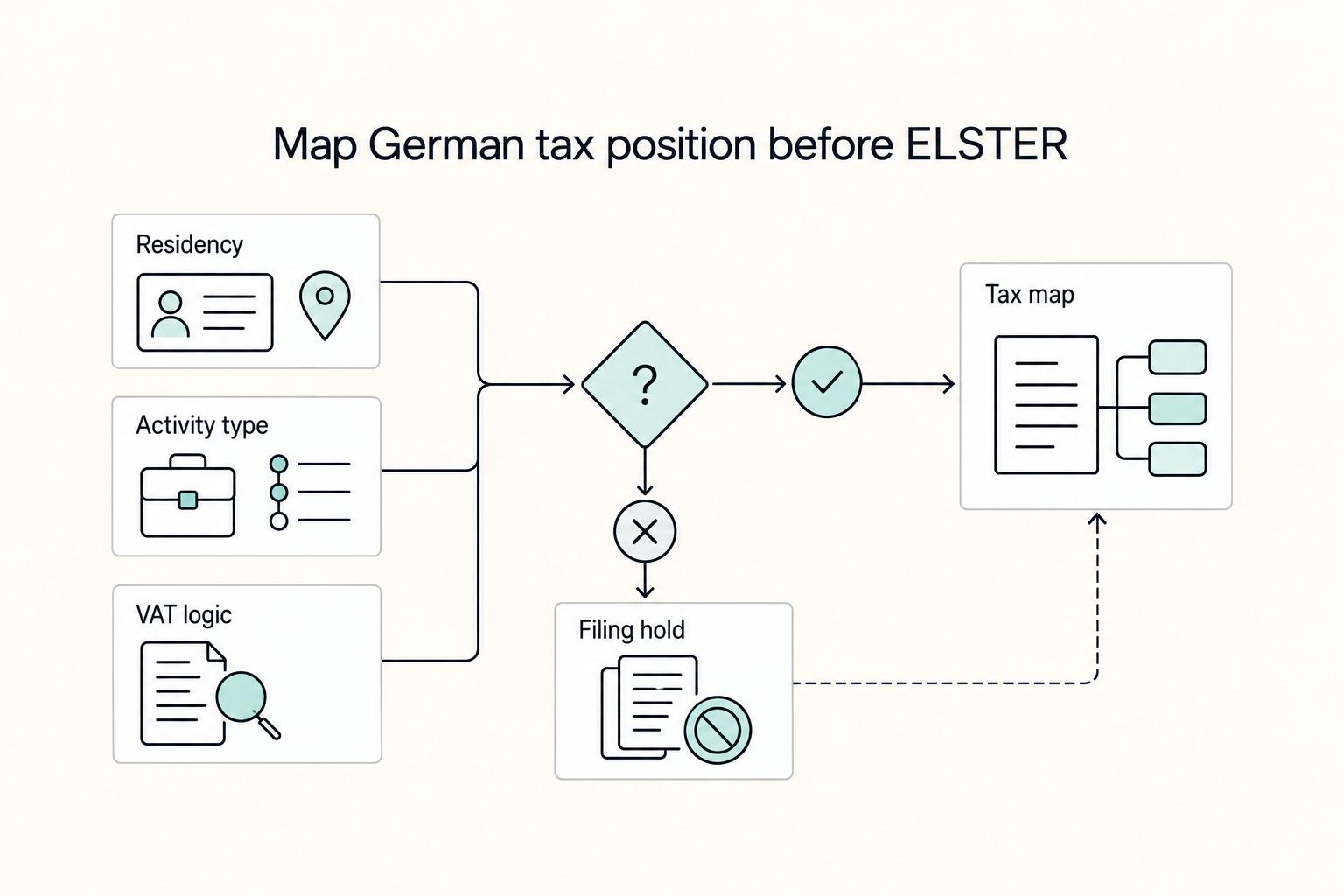
Build a one-page tax map before any ELSTER step or Fragebogen zur steuerlichen Erfassung submission. Legal position comes first, admin comes second. If residency, activity type, or VAT logic is unclear, pause filing until the map is internally consistent.
Write the one-page map in six lines#
Use one page and six labeled lines, each in 1 to 3 sentences:
| Line | What to state | Detail |
|---|---|---|
| Tax Residency position | Your current Germany position in plain English | Treaty residence is for applying the treaty and allocating taxing rights; it does not by itself change personal domestic tax liability. |
| Activity classification | Whether your work currently fits closer to freiberufliche Tätigkeit or Gewerbebetrieb | Freelance professional activity includes independent scientific, artistic, writing, teaching, or educational work, among other listed professions. |
| Tax buckets | Income tax, VAT, and possible trade-tax exposure if the activity is commercial | Do not use one answer to solve all three questions. |
| Client-country footprint | Where clients are established and where you perform services | For B2B services, place of supply is generally where the business customer runs its business, subject to exceptions. |
| Business management location | Where the business is actually managed from now | For new sole proprietors and freelancers, local tax-office jurisdiction follows the place of business management. |
| Open questions | Points you still need to verify | End with the points you still need to verify. |
- Tax Residency position
State your current Germany position in plain English. The key domestic question is whether you may be fully subject to German income tax because you have a domicile or habitual abode in Germany (unbeschränkte Einkommensteuerpflicht). Keep treaty language separate. Treaty residence is for applying the treaty and allocating taxing rights. It does not by itself change personal domestic tax liability.
- Activity classification
State whether your work currently fits closer to freiberufliche Tätigkeit or Gewerbebetrieb. In plain terms, freelance professional activity includes independent scientific, artistic, writing, teaching, or educational work, among other listed professions. A commercial enterprise is the trade-tax concept tied to a business under income tax law.
- Tax buckets
Split issues into separate buckets: income tax, VAT, and possible trade-tax exposure if the activity is commercial. Do not use one answer to solve all three questions.
- Client-country footprint
List where clients are established and where you perform services. For B2B services, place of supply is generally where the business customer runs its business, subject to exceptions, so client location needs to be documented early.
- Business management location
State where the business is actually managed from now. For new sole proprietors and freelancers, local tax-office jurisdiction follows the place of business management.
- Open questions
End with the points you still need to verify.
Separate strategic decisions from admin details#
Ask one practical question for each item. Does this change your tax position, or only how you file?
| Item | Strategic decision or admin detail | Why it matters now |
|---|---|---|
Whether you may have unbeschränkte Einkommensteuerpflicht in Germany | Strategic | Sets your domestic income-tax posture before filing positions are chosen. |
Whether your work fits freiberufliche Tätigkeit or Gewerbebetrieb | Strategic | Can change which tax rules and business obligations may apply. |
| Your VAT path, including whether revised § 19 UStG or the special reporting procedure in § 19a UStG need review | Strategic | Since 1 January 2025, § 19 UStG was revised and § 19a was introduced. Invoice and reporting logic may need adjustment. |
| Which Finanzamt is responsible based on place of management | Admin | Important for registration, but does not resolve residency or classification. |
Your Steuerliche Identifikationsnummer | Admin | A permanent 11-digit personal identifier. Useful, but not status-defining. |
The Fragebogen zur steuerlichen Erfassung submission | Admin | Registration step for freelance or commercial activity. It should reflect decisions already made. |
If you only have the admin items clear, you are not ready to file.
Use a stop/go/escalate rule#
This is your first hard control. Mark each line as known, unknown, or needs review.
- Go now when residency position, activity classification, and client-country footprint are known and consistent.
- Stop filing when any one of those three is unknown.
- Escalate to a professional when cross-border facts require treaty analysis or technical points you have not verified.
Common escalation triggers:
- You may have ended German domicile but still have habitual-abode exposure.
- Your domestic Germany position and treaty-residence story do not align.
Keep a minimum evidence pack beside the map#
Keep enough evidence to support each line:
- Dated housing and location timeline, including Germany days, address access, and work locations
- Client list with client country, contract party, and B2B status
- Short service description plus a sample contract or proposal supporting your classification view
- Existing tax identifiers, including IdNr if available
- One-page assumptions log labeled: known, unknown, needs review
If a line has no supporting document, treat it as unverified.
Version it like an operating document#
At the top of each version, add a dated note with date, decision taken, facts relied on, unresolved items, next review date.
Update your tax map only when a real trigger occurs: a move, new housing access in Germany, a change in management location, a material shift in client countries, or a VAT-method decision under the rules effective from 1 January 2025. For a wider planning baseline, read the digital nomad tax guide.
Decide your tax residency first#
Residency is the first hard gate. Do not register, submit the Fragebogen zur steuerlichen Erfassung, or file until your residency position is defensible on the facts.
Define the filing question correctly#
Your tax residency position is your written view on two points:
- whether Germany can treat you as fully taxable because you have a domicile or habitual residence in Germany
- whether another country could also treat you as resident under its domestic rules
Keep the domestic filing line simple. If you have a domicile or habitual residence in Germany, that points to full tax liability in Germany. Without either, German liability is limited to German-earned income.
Keep the tests tight:
- Residence (Section 8 Fiscal Code): maintaining a dwelling under circumstances indicating ongoing use
- Habitual residence: public guidance states a continuous stay of more than 6 months constitutes habitual residence in Germany
- What does not decide it alone: nationality or tax-office registration by itself
Dual-residency risk means more than one country can treat you as resident under domestic law at the same time. If that happens, treaty residence has to be determined under the specific DTA using successive tie-breaker tests, for example permanent home and then centre of vital interests.
Unresolved means you still cannot state one coherent filing position without a major caveat.
Run this decision flow before any filing#
- Build a dated timeline.
List where you lived and where you worked, with exact move periods where possible.
- Test for multi-country claims.
Check whether your facts support German residence or habitual residence and whether another country also has a plausible domestic claim.
- Draft a provisional position note.
State your current conclusion, the facts supporting it, and any DTA review still pending.
- Apply a hard gate.
Proceed only if timeline, records, and position note are consistent. If not, escalate.
Useful evidence categories include:
- travel trail
- work-location records
- address and life-centre indicators
- tax-office correspondence
Treat admin as supporting evidence, not a final test. Registration with tax authorities can support your file, but it does not settle residency by itself. Keep evidence dated and organized. If needed, supporting PDFs can be sent to the Finanzamt via ELSTER Belegnachreichung.
Escalate now when#
- your timeline, address facts, and work records conflict
- another country has a plausible residence claim and you have not reviewed the specific DTA
- your file depends on memory because records are incomplete
- tie-breaker analysis is still inconclusive
End with a dated position note: decision taken, facts relied on, unresolved items, and next review checkpoint. Update it when material facts change, including moves, housing access, work-location shifts, or new tax-authority correspondence. For a related issue, see Can Digital Nomads Claim the Home Office Deduction?.
Choose your lane Freiberufler or Gewerbetreibender#
Once residence is clear, classify the work itself. Align registration, invoicing, and filing behavior to that lane before you scale.
A Freiberufler performs a tax-recognized free profession and is generally not obliged to pay Gewerbesteuer when that classification is valid. A Gewerbetreibender carries on commercial activity, and commercially active businesses can be subject to Gewerbesteuer, which is separate from income tax and VAT.
| Lane | Decision criteria | Tax exposure | Recordkeeping and filing behavior |
|---|---|---|---|
| Freiberufler | Your actual work genuinely matches freelancing definitions under German tax law (confirm criteria for your case) | Generally no Gewerbesteuer if classification holds | Keep one consistent activity description across contracts, onboarding copy, invoices, and tax records |
| Gewerbetreibender | Your work is commercial or trade activity (confirm scope for your case) | Gewerbesteuer can apply | Use commercial activity wording consistently from registration through invoicing and tax records |
| Mixed activity | You have both professional and commercial income streams (confirm treatment/split for your case) | Gewerbesteuer may apply to the commercial portion | Keep activity descriptions clearly separated and recheck classification before filings |
What changes in practice#
A lane change is not just a label change. It can affect tax exposure. If you are in the commercial lane, Gewerbesteuer is charged by the municipality where the business is registered. The calculation starts from Gewerbeertrag, applies a fixed 3.5% rate, then applies the municipal Hebesatz, which is often 200% to 900%. In practice, lane classification can change whether Gewerbesteuer applies.
Reclassification trigger#
Use a hard trigger. If new services, packaging, or revenue logic no longer fits your documented activity profile, pause and revalidate classification before scaling.
Run a wording control loop#
Keep a short master activity description and check it whenever your offer changes against:
- contracts and proposals
- onboarding or website copy
- invoice line descriptions
- tax records and decision notes
When wording changes materially, add a dated note stating what changed, when it changed, which documents were updated, and whether the change could affect your Freiberufler or Gewerbetreibender position. This pairs well with our guide on Freiberufler vs Gewerbetreibender for German Freelancers.
Set up your identifiers with the Finanzamt#
Treat this as execution, not strategy. Once your residency position and activity lane are set, file the Fragebogen zur steuerlichen Erfassung via ELSTER within one month of starting your activity. Use the electronic route for this questionnaire, not paper, fax, or email.
| Item | Description | Detail |
|---|---|---|
| Steuernummer | Your business tax number | Issued by your Finanzamt after it reviews your questionnaire. |
| Umsatzsteuer-Identifikationsnummer (USt-IdNr.) | A separate VAT ID | Issued by the BZSt and can be requested in the questionnaire. |
| Steuerliche Identifikationsnummer (IdNr) | Your personal, permanent 11-digit tax ID | It is not the same as your business Steuernummer or USt-IdNr. |
Use each identifier for its actual job:
- Steuernummer: your business tax number, issued by your Finanzamt after it reviews your questionnaire
- Umsatzsteuer-Identifikationsnummer (USt-IdNr.): a separate VAT ID issued by the BZSt that you can request in the questionnaire
- Steuerliche Identifikationsnummer (IdNr): your personal, permanent 11-digit tax ID. It is not the same as your business Steuernummer or USt-IdNr.
- Invoices: include either your Steuernummer or your USt-IdNr for invoice identification
In ELSTER, treat "Art des ausgeübten Gewerbes / der Tätigkeit" as your master description, not draft wording. Your zuständiges Finanzamt is determined by the business's place of management, so your address and management facts need to stay consistent.
| Form field | Your source of truth | Mismatch risk | What to save as evidence |
|---|---|---|---|
| Competent Finanzamt / business address | Actual place-of-management records | Competent-office details may not align | Address proof and a dated address/management note |
| Activity description | Your master activity wording used across filings, site copy, and invoices | Inconsistent wording across filings and business records | Dated wording note, sample invoice lines, snapshot of website/service description |
| USt-IdNr request field | Your VAT path decision plus the same core registration details held by Finanzamt | Data mismatch when BZSt compares submitted details with tax-office data | Submitted questionnaire copy and dated VAT decision note |
| Personal vs business IDs | Existing IdNr notice and later Finanzamt/BZSt letters | Wrong identifier used on forms or invoices | Copies of all identifier letters and current invoice template version |
Submit only when your address, activity wording, and VAT path match your filing and invoicing setup. If any of those conflict, pause and reconcile first. If registration facts conflict with prior filings, consider advisor review before submission.
Keep a dated copy of the submission, every Finanzamt reply, and one running note that marks unresolved requirements as pending official German tax guidance, Finanzamt records, or tax-advisor verification before use. For another worked example of cross-border tax analysis, see A Deep Dive into the US-France Tax Treaty for Freelance Performers.
Understand which taxes hit you and when#
Registration alone does not confirm every tax obligation at once. Label each item confirmed, unconfirmed, or not applicable.
Move an item to confirmed only when all three checks are true:
- you have a documented legal basis
- your facts are consistent across ELSTER, invoices, contracts, and address records
- you have a filing or payment process you can run on time
confirmed means you can show why the tax applies, what triggered it, and how you will file or pay. unconfirmed means it may apply, but at least one required check is still missing. not applicable means your current evidence supports non-application for this period.
| Tax type | Why it may apply to your facts | What event starts the obligation | What you must track as evidence | Current status |
|---|---|---|---|---|
Income tax, full liability (Unbeschränkte Einkommensteuerpflicht) | You have a residence or habitual abode in Germany | Your facts establish German residence or habitual abode. If prepayments are set, they are set by Vorauszahlungsbescheid | Address proof, stay/travel record, residency note, prepayment notice, and payment proofs for 10. März, 10. Juni, 10. September, and 10. Dezember if issued | unconfirmed until residency facts and notices align |
Income tax, limited liability (Beschränkte Einkommensteuerpflicht) | You do not have German residence or habitual abode but may have German-source income | Your facts show German-source income | Contracts, client records, work-location evidence, source-income note, Finanzamt correspondence | unconfirmed until nonresidency and source-income treatment are both documented |
VAT (Umsatzsteuer) | You independently carry out commercial or professional activity as an Unternehmer for VAT | You independently carry out activity and your VAT treatment is set; VAT advance return and payment deadlines then run by advance period | Invoice samples, VAT decision note, ELSTER data, assigned advance period, proof of filing and payment by the 10th day after each advance period | unconfirmed until invoice logic and filing workflow match |
Trade tax (Gewerbesteuer) | Your activity is a domestic Gewerbebetrieb | Your facts support a domestic commercial business. If prepayments are assessed, they follow fixed dates | Activity classification memo, registration records, contracts, any trade-tax notice, payment proofs for 15. Februar, 15. Mai, 15. August, and 15. November if prepayments are set, and a note on the 24 500 Euro allowance where relevant | unconfirmed until classification is settled |
Keep an unresolved log until every open item is closed:
| Open question | Working assumption | Evidence on hand | Next review point | Escalation trigger |
|---|---|---|---|---|
| Is my income-tax position full or limited liability? | Still verifying full vs limited liability | Address proof, stay log | Before first annual return | Conflicting non-German residency filing or new travel facts |
| Does trade tax apply to my activity? | Classification pending | Activity wording, invoices, website copy | When classification evidence changes | Finanzamt challenge or mixed freiberufler and commercial facts |
Do not force VAT to confirmed using an old § 19 UStG threshold reference. The rule was recast from 1. Januar 2025, and older official text is still indexed, so keep this open until you verify your current position. If your residency narrative, invoice flow, and tax treatment do not align, pause status changes and verify the current obligation before finalizing filings. For another Germany tax topic, see Church Tax (Kirchensteuer) in Germany for Freelancers.
Make the Umsatzsteuer and Kleinunternehmerregelung call early#
Make your VAT choice before the first invoice. Your invoice wording, ELSTER treatment, and turnover tracking need to tell the same story. If those three do not match, pause new billing and verify first.
This is a two-path decision: regular Umsatzsteuer or Kleinunternehmerregelung under § 19 Abs. 1 UStG.
| Path | Best fit | Compliance load | Invoice wording impact | Switching risk |
|---|---|---|---|---|
Regular Umsatzsteuer from day one | You expect growth, want one stable invoice logic, need Vorsteuerabzug, or may run EU internal-market transactions | Higher: advance VAT filing and payment can be due by the 10th day after each filing period | Show VAT rate and VAT amount, or a valid exemption note where applicable | If you waive Kleinunternehmerregelung, that choice binds for at least five calendar years |
Kleinunternehmerregelung under § 19 Abs. 1 UStG | You are eligible, want lighter VAT admin, and do not need input VAT recovery | Lower in general, with exceptions | Do not show VAT separately. Include the § 19 Abs. 1 UStG exemption note | If you exceed the applicable current-year limit, the switch to regular VAT is immediate, including the crossing transaction |
| Hold and verify before more invoicing | Your turnover test, invoice wording, and tax treatment are inconsistent | Short delay now, less correction work later | Keep drafts only until wording matches the verified path | Usually lower risk than invoicing through contradictions |
If you want one stable setup, regular VAT is often the cleaner choice when your business is growing, your costs include recoverable input VAT, or your client mix may create EU admin. For certain EU transactions, a valid USt-IdNr. is required, and some cases trigger Zusammenfassende Meldung (ZM) duties. Kleinunternehmer in § 19 Abs. 1 status are explicitly exempt from ZM filing, but cross-border work still needs transaction-level checks.
When Kleinunternehmerregelung is the better fit, treat eligibility as a live control, not a one-time assumption. Treat the current threshold as unresolved until official German tax guidance, Finanzamt records, or a tax advisor verifies it for the period you are checking. The eligibility test uses collected net turnover without VAT, so tracking only issued invoices can misstate your position.
Lock your invoice template to your chosen path. Under § 19 Abs. 1 UStG, do not state VAT separately and include the exemption note. For line-item and wording mechanics, use How to Write a Legally Compliant Invoice in Germany.
Use a short quarterly control loop#
Quarterly review is an internal control, not a legal filing deadline.
- Recalculate eligible turnover from collected net turnover using current invoice and payment records.
- Validate your active invoice template against your selected path.
- Save an evidence pack: turnover sheet, invoice export, payment summary, active template, and dated decision note.
- Trigger immediate review if turnover tracking, invoice wording, ELSTER treatment, and contract language no longer match.
Process drift can create VAT errors even without one big event. If the facts change and you keep old invoice logic, correction work can follow quickly. You might also find this useful: A Deep Dive into the German Trade Tax ('Gewerbesteuer') for Freelancers.
Handle foreign clients without creating treaty risk#
Foreign clients do not change the order. Confirm your residency facts first, then test source-of-income facts for each engagement. If two jurisdictions can plausibly claim taxing rights, mark the case escalate now, pause assumptions, and record the treaty position as pending verification from official guidance, Finanzamt records, source records, or a tax advisor before use.
Confirm residency facts before you read the contract#
Start with your own tax position, not the client's address. In Germany, individuals with a domestic residence or habitual abode can be subject to unlimited income tax liability, so you need a dated, fact-based residency position before treaty analysis. A continuous stay of more than six months can be relevant in ordinary-residence guidance, but it is not a shortcut rule by itself.
For each engagement, record the exact residency period you believe applied while the work was performed and keep the supporting evidence with it. If the period is unclear, stop there and resolve that first.
Client location does not prove residency by itself. A foreign client does not by itself make you non-German resident, and a German client does not by itself make you German resident. Payer location tells you who paid and which entity is on the contract, but it does not settle residence status.
Assess source-income facts per engagement#
After residency, test source treatment engagement by engagement. For personal services, source is generally tied to where you physically performed the work, not where the contract was signed, where payment was made, or where the payer is resident.
| Check | What it proves | What it does not prove |
|---|---|---|
| Physical work location and dates | Where personal-service income was generally sourced, including whether work was split across countries | That payer location determines source by itself |
| Payer entity jurisdiction | Who paid you and contract context | That payer location alone determines source treatment |
If work was performed across jurisdictions, do not force a single-country label just because invoicing is simpler. Allocation by workdays is part of the analysis in multi-location service periods.
Keep an engagement tracker that forces the right questions#
Use one row per engagement and update it before filing positions harden.
| Residency period | Where services were physically performed | Payer entity jurisdiction | Potential taxing-right overlap | Status |
|---|---|---|---|---|
| Confirm your residency period from source records or a tax advisor | Confirm the work-location dates from source records | Confirm the payer's jurisdiction from the contract or source records | Confirm the treaty overlap from official guidance or a tax advisor | monitor / review allocation / escalate now |
If Where services were physically performed is vague, your source analysis is not ready. If Residency period is unresolved, your treaty analysis is not ready.
Escalate overlaps before you file on assumptions#
A double taxation agreement (DTA) allocates taxing rights in cross-border income situations. Germany has concluded DTAs with over 90 countries, and the mechanics differ by treaty, so do not import one country's treaty logic into another engagement.
When Germany and another jurisdiction can both plausibly assert taxing rights based on your residency facts and physical work location, set status to escalate now, stop assumptions, and log the treaty position as pending verification from official guidance, Finanzamt records, source records, or a tax advisor before use.
If taxation appears to breach a DTA, a mutual agreement procedure can be requested. Treat that as a remedy, not your default plan.
Keep one dated treaty file per engagement#
Keep one dated treaty file per engagement so the analysis is not scattered across threads. Include at least:
| Treaty file item | What to include |
|---|---|
| Residency evidence | for the relevant period |
| Contract facts | including payer entity jurisdiction and dates |
| Service-location notes | especially for split-country work |
| Filing rationale | by jurisdiction |
| Open questions | for advisor review |
If a foreign authority requests a residence certificate, add the request and the issued document to the same file. This keeps each engagement as a separate fact pattern and stops one client's assumptions from leaking into another. Related reading: A Deep Dive into the UAE's Corporate Tax for Freelancers and LLCs.
Build your documentation stack from day one#
Your filing position is only as strong as the file behind it. Set up your records so another reviewer can trace how you registered, what you invoiced, where you worked, and what you filed without asking for extra context.
Start with a simple fixed folder structure. Put registration first, then invoicing as you trade, then filing confirmations and engagement evidence.
Set up the minimum folder before month one ends#
| Document type | Why you need it | Where to store it | When to update it |
|---|---|---|---|
| Registration records | Shows how you entered the tax system and what you told the Finanzamt. Include the Fragebogen zur steuerlichen Erfassung, ELSTER submission proof, and Steuernummer assignment once issued. | /01 Registration/ | At setup, then whenever the tax office issues or changes a core identifier or registration response |
| Invoice evidence | Supports income records, VAT treatment, and customer-level review. Keep issued invoices, credit notes, and the exact version sent. For domestic B2B turnover, keep in mind the regular E-Rechnung baseline from 1 January 2025. | /02 Invoices/YYYY/MM/ (plus customer subfolders if needed) | Every time you issue, correct, or cancel an invoice |
| Filing confirmations | Shows what you filed and when. Keep ELSTER acknowledgements, payment confirmations, and confirmations for VAT returns, income-tax filings, or RS filings. | /03 Filings/YYYY/period/ | Immediately after each submission |
| Engagement location notes | Supports engagement-level location and tax-residence review. Record where you physically worked, dates, payer entity jurisdiction, and split-country workdays. | /04 Engagements/client-name/ | At contract start, during travel, and before each filing period closes |
Registration records are core evidence, not admin clutter. The initial questionnaire must be submitted via ELSTER. Post, fax, or email is not sufficient. Keep the submitted version and acceptance proof together, then add the Steuernummer assignment once issued.
Define each file by compliance purpose#
Treat each category as evidence with one clear job:
- Registration records: how you registered, when, and on which facts.
- Invoice evidence: what you charged, to whom, and under which VAT logic. Invoices are generally required for most B2B VAT supplies, so missing invoice files are a real gap. For relevant e-invoice cases, keeping the structured part can be sufficient.
- Filing confirmations: what was actually submitted and when. Some returns are electronic-only, and receipts that are not submitted upfront can still need to be retained.
- Engagement location notes: where the work was physically performed. For B2B services, place-of-taxation rules can depend on where the customer is established, while income-tax residence can also depend on where and how long you stay.
Close and lock each month#
Do not call a month closed until all four checks are complete:
- Every issued invoice and credit note for that month is saved in final form.
- Every filing or draft filing has submission proof or a clear open-status note.
- Every live engagement has dated location notes for that month's work.
- Every missing support item is resolved or logged as an open item with owner and date.
Use an amendment note only if the month was complete at lock and later facts changed. Typical triggers are a late receipt, corrected invoice, or corrected recapitulative statement (RS). If an RS is wrong or incomplete, file a separate corrected statement for that reporting period and state exactly what changed.
Escalate when missing evidence could change your filing position, not just folder neatness. If you cannot tie a filing confirmation to the submitted return, or cannot reconstruct work location for split-country work, pause and mark it for review before the next filing.
Run one recurring control. Pick one random filed item and test retrieval. A reviewer should be able to pull the registration basis, invoice, filing confirmation, and engagement note in minutes and reconstruct your position without extra explanation.
Run a monthly and quarterly compliance cadence#
Consider two review loops, not one. A monthly loop can keep the current period clean, and a quarterly loop can test whether your decisions still match how you actually operate. Use this as an internal control rhythm, not a statement of legal filing deadlines. For accountability, treat documentation and ownership handoff as part of the work, not follow-up admin.
| Cadence | Primary objective | Core checks | Output artifact | Escalation trigger |
|---|---|---|---|---|
| Monthly | Keep the current period complete and internally consistent | Reconcile records to source files; make sure key compliance claims are traceable to supporting documentation; review carry-over items from the prior month and assign owner + next action date | Month-close note with status: complete, complete with open items, or not in control | Records do not reconcile, claim traceability is missing, or an open item has no owner or target date |
| Quarterly | Re-test whether your working assumptions still fit current activity | Review repeated judgment calls and open items; confirm your written position still matches how work was done and documented; verify unresolved items have a clear ownership handoff | Dated quarterly decision log, including "no change" where applicable | Facts changed but your written position did not, or unresolved items keep rolling forward without ownership |
Treat documentation and ownership handoff as hard controls, not admin polish. If a claim cannot be traced to supporting documentation, or an unresolved item has no clear owner, mark it unresolved and assign follow-up before calling the cycle complete.
Keep one visible tracker with cycle date, completion status, carry-over items, owner, and next review date. If controls break, pause nonessential work until documentation and ownership links are rebuilt, then resume once the file is back in control.
If your cadence is slipping, use the Tax Residency Tracker as a single review tracker.
Know the red flags that justify professional help now#
Escalate when your facts, your tax position, and your records stop matching, not when you simply feel stressed. If your documents tell different stories, another solo review can add delay instead of clarity.
Use your regular review cadence to lock three definitions before you assess risk signals:
- Residency status: the position you are taking on where you may be taxable, based on your actual timeline and ties
- Source-of-income position: how you explain which country may tax each income stream, based on where work was performed, where clients are, and any treaty position under review
- Filing narrative consistency: your returns, invoices, address history, contracts, and tax-authority correspondence reflect the same facts
For Germany-specific legal triggers, these items do not establish definitive thresholds. Treat these as escalation signals for professional review, not legal tests: move timing conflicts, treaty-position uncertainty, mixed-country workdays with weak records, VAT treatment mismatch, and uncertainty about Freiberufler vs Gewerbetreibender. These do not automatically decide one legal outcome, but cross-border cases can overlap tax, social security, and personal liability.
| Red flag | What evidence to check now | Immediate safe action | Who to involve |
|---|---|---|---|
| Move timing conflicts | Dated address timeline, registrations, travel log, prior filings, tax-authority correspondence | Pause new residency assumptions until one timeline is reconciled | Tax adviser |
| Treaty-position uncertainty | Contracts, work-location notes, client-country list, draft filing narrative, prior advice notes | Stop repeating the same position in new filings or invoices until reviewed | Cross-border specialist |
| Mixed-country workdays with weak records | Calendar, timesheets, delivery records, meeting logs, invoice backup by engagement | Rebuild an engagement-level country work map before the next filing step | Both |
| VAT treatment mismatch | Invoice samples, client status evidence, service descriptions, internal decision notes | Hold template or process changes and review affected invoices for consistency | Tax adviser |
Freiberufler vs Gewerbetreibender uncertainty | Service descriptions, contracts, website copy, invoice wording, registration history | Do not relabel in isolation; compile one classification file first | Tax adviser |
| Records drift across cycles | Quarterly decision log, month-close notes, unresolved-items tracker, key emails | Pause position changes and request professional review | Both |
Hard checkpoint: if the same core ambiguity survives repeated review cycles, or your documents still conflict, stop changing positions on your own and get professional review.
Send a tight adviser packet so review starts quickly:
- Timeline of moves, registrations, and work periods, with each date marked
verifiedorestimated - Client and work-location map by engagement, including mixed-country workdays
- Filing history and positions already taken, including VAT treatment used on invoices
- Key correspondence with the relevant tax authority
- Unresolved questions listed one by one, each with the decision needed
- One cover note stating the practical decision required now, for example: confirm current filing position, review prior invoices, or decide whether specialist treaty review is needed
If you want the full breakdown, read A Deep Dive into the US-Ireland Tax Treaty for Tech Consultants.
Conclusion#
Run this as a repeatable loop: classify the work you actually do, keep Einkommensteuer, Umsatzsteuer, and Gewerbesteuer aligned, then file only positions you can document. Problems start when invoices, returns, and your Finanzamt explanations stop telling the same story.
Classification matters because it drives what follows. Einkommensteuer is your personal income-tax track, Umsatzsteuer follows the entrepreneur test in § 2 UStG, and Gewerbesteuer is a separate question for a standing trade business in Germany. If you use Freiberufler treatment under § 18 EStG, anchor it in the actual work, not your title. If your work mixes freelance and commercial elements, re-check classification, separate billing with distinct invoices or separate line items, and split income correctly in Anlage S and Anlage G. If the line is unclear, align with the Finanzamt before your next filing step.
Your final gate is filing readiness. Every tax position should map to supporting evidence. Under AO § 90, disclose tax-relevant facts completely and truthfully, identify known evidence, and for cross-border facts obtain required proof. Use this pre-file check:
- activity memo supporting freelance or commercial treatment
- relevant
Finanzamtcorrespondence for your classification and filing position - invoice samples showing VAT treatment, including mixed-activity separation where relevant
- cross-border case notes and evidence for the position you are filing
- retention folders that match
AO § 147periods (10 yearsand6 years, depending on record type)
If you cannot explain classification or cross-border treatment as one consistent story, pause filing changes. Resolve the open questions first with the Finanzamt or a qualified professional, then proceed with one aligned position across invoices, returns, and correspondence.
If your Germany setup includes cross-border edge cases you cannot reconcile from your records, Talk to Gruv to confirm the next operational step while you finalize the tax position with your adviser.
Frequently Asked Questions
Which taxes does a freelancer in Germany usually handle first?
Usually start with income tax and VAT, then complete tax registration early. Verify the filing-year § 19 UStG rules before relying on the Kleinunternehmerregelung, because older and newer guidance can both appear. If your activity profile, work-location facts, and invoice treatment do not match, stop and review before billing further.
What is a `Steuernummer`, and how do I get it through the `Fragebogen zur steuerlichen Erfassung`?
A Steuernummer is your business tax number. Submit the Fragebogen zur steuerlichen Erfassung electronically in ELSTER, and your local Finanzamt issues the number after reviewing it. Keep the filed questionnaire, transmission proof, and every Finanzamt reply together.
Can my `Steuernummer` change if I move to a different `Finanzamt` area?
It may change when a different Finanzamt becomes responsible after a move. Ask the newly responsible Finanzamt which identifier you must use before your next return or invoice run. Keep old and new correspondence in one continuity file, especially if the move overlaps open filing periods.
Do all freelancers in Germany pay `Gewerbesteuer`, or does classification matter?
No. Classification matters because Freiberufliche Tätigkeit and Gewerbebetrieb are treated differently, and a Gewerbebetrieb can create Gewerbesteuer exposure. Base the classification on the work you actually do, not your job title alone. If your services mix professional and commercial elements, or your filings and invoices already use mixed labels, get it reviewed.
I live in Germany and bill clients in the `United States`; where should I start?
Start with one engagement note per client. Record where you performed the work, the client's business location, the invoice treatment used, and any treaty-position note. For B2B services, place-of-supply analysis can depend on where the customer runs its business, so keep invoices, returns, and Finanzamt correspondence consistent. Escalate if workdays span countries, treaty treatment is unclear, or similar invoices were handled differently without a documented reason.
What records should I keep from day one for `Einkommensteuererklärung` and VAT?
Keep registrations, invoices, expenses, bank records, and all Finanzamt correspondence in date order from month one. Retain records in line with AO § 147 periods, with ten years for specified records and six years for other listed records. Add a dated note whenever you change invoice treatment or a tax assumption. For EU cross-border work, remember that USt-IdNr. is separate from Steuernummer, and certain services can trigger a Zusammenfassende Meldung due by the 25th day after the reporting period.
When should I stop DIY and hire a cross-border tax professional?
Stop DIY when you cannot explain one consistent position on residence, source-of-income treatment, and VAT using your own documents. Pause new filing assumptions and verify residency treatment first. If facts conflict across countries, treaty treatment is unclear, or the same ambiguity keeps coming back, hand off a pack with your timeline, engagement-level work-location notes, invoice samples, prior filings, and authority letters.
Try a related tool
Researched and edited by the Gruv editorial team. Gruv builds cross-border billing, payouts, and finance-operations software for global businesses.
Sources
- govinfo.gov/content/pkg/CHRG-112shrg74537/html/CHRG-112s...trusted
- irs.gov/individuals/international-taxpayers/source-o...trusted
- irs.gov/businesses/international-businesses/germany-...trusted
- oecd.org/en/publications/local-retail-global-trends_5...trusted
- oecd.org/en/publications/oecd-economic-surveys-german...trusted
- state.gov/report/custom/c848c9b08dtrusted
- taxation-customs.ec.europa.eu/taxation/vat/vat-directive/place-taxation_entrusted
- taxation-customs.ec.europa.eu/taxation/vat/vat-businesses/invoicing_entrusted
Educational content only. Not legal, tax, or financial advice.
Related Posts

Digital Nomad Taxes in 2026 With a Defensible Filing Plan
With digital nomad taxes, the first move is not optimization. It is figuring out where you may be taxable, where filings may be required, and what proof supports that position.

Can Digital Nomads Claim the Home Office Deduction?
Claim the deduction only when your facts and records can carry it. With the home office deduction for digital nomads, the real decision is usually a three-way call: claim it, do not claim it, or pause and get help because your file is not ready.
How to Write a Legally Compliant Invoice in Germany
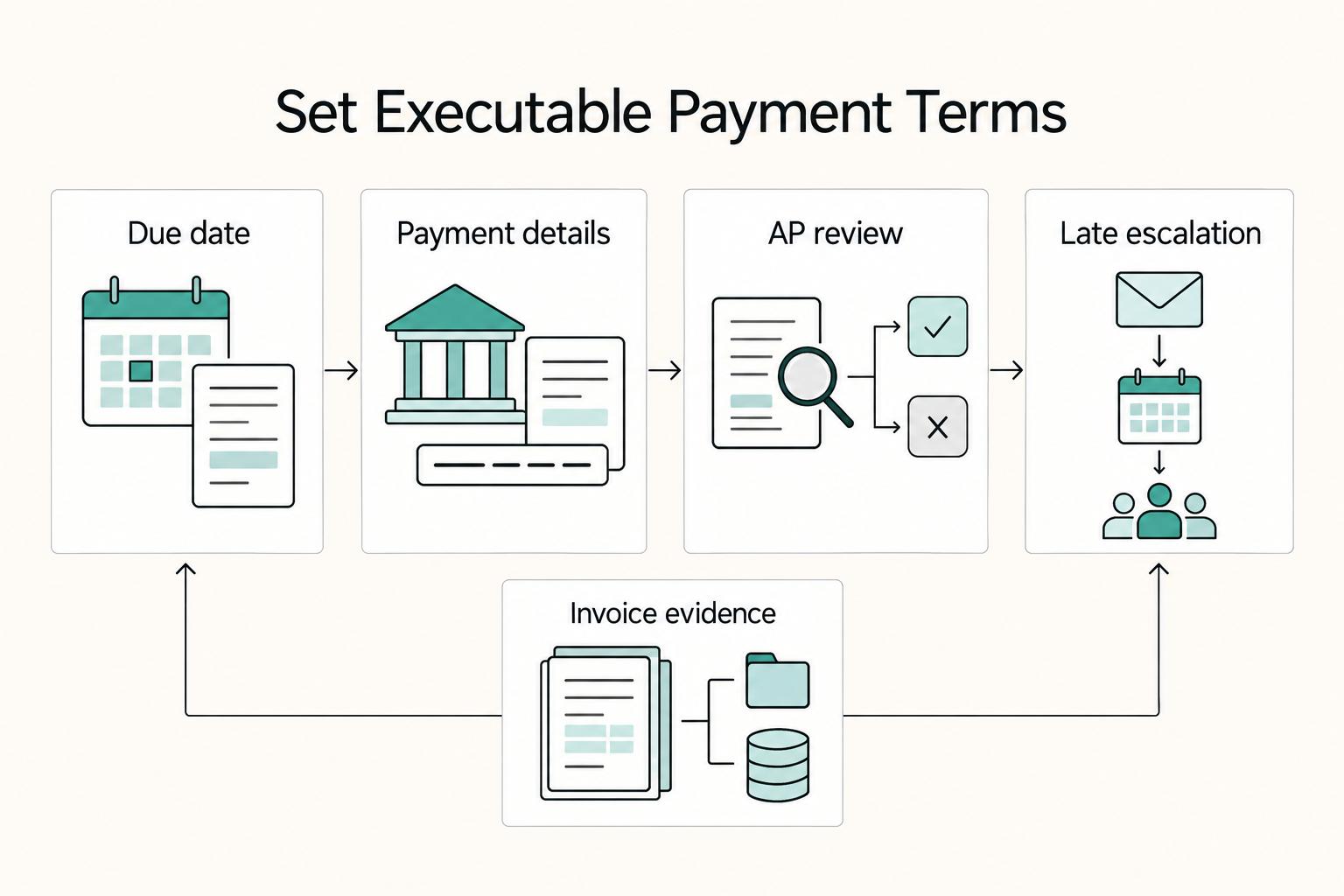
The goal is simple: send a Rechnung that meets German requirements and is easy to review and pay. Use the same order every time: legal minimum fields first, payment terms second, pre-send risk checks third. Treat it as a defensive sequence, not a design template or a complete legal checklist for every case.