
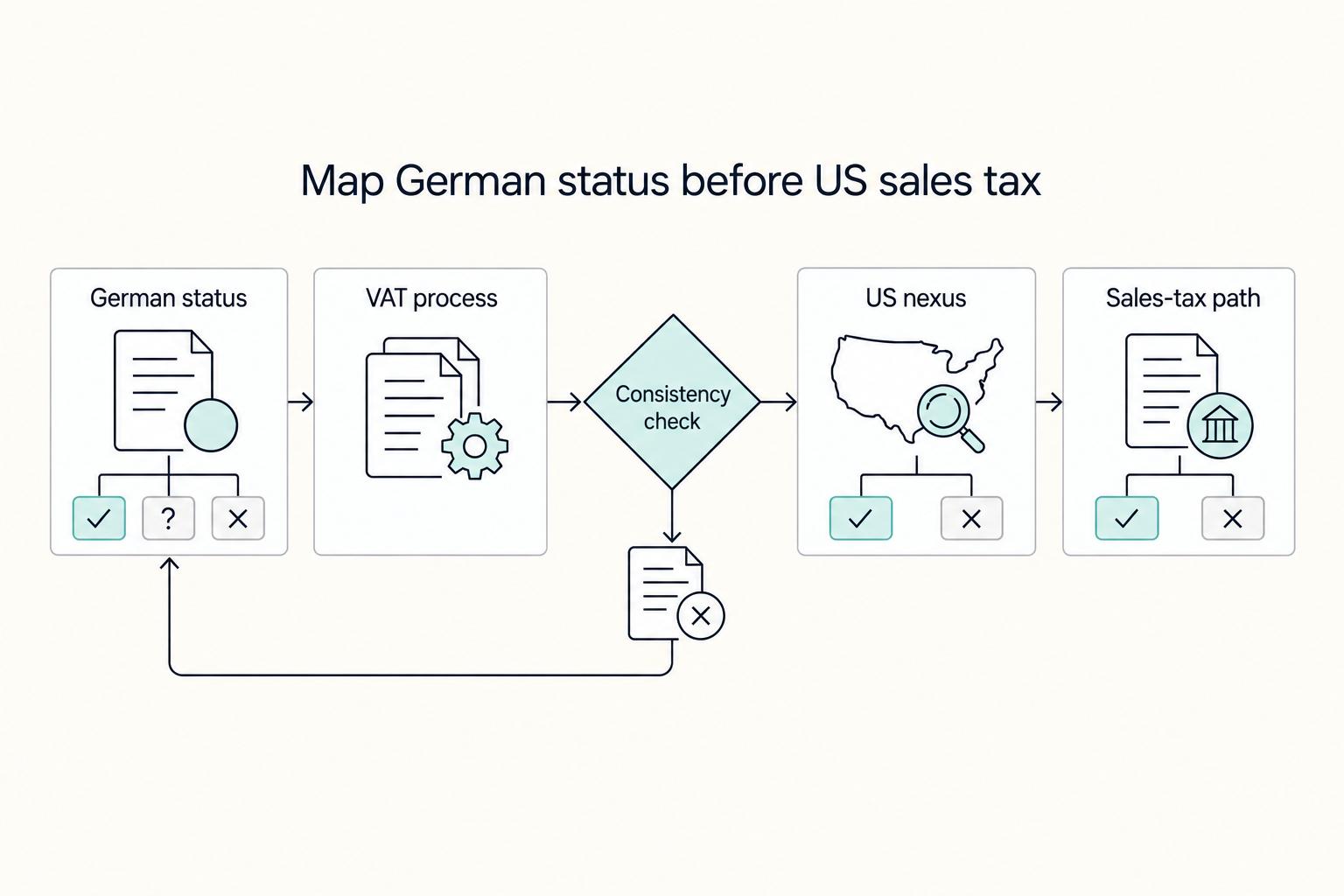
Quick Answer
Identify the actual supplier and the service’s German VAT place of supply. An ordinary service received by a U.S. business at its U.S. establishment is generally outside German VAT scope, subject to exceptions. Separately check state nexus, taxable service or software categories, and sourcing. A U.S. LLC, B2B customer or no-VAT invoice does not settle state sales tax.
German freelancer with a U.S. LLC means two tax systems, not one shortcut#
Use this as your default: a U.S. LLC can change how you operate and document the business, but it does not turn German and U.S. tax questions into one answer.
This guide stays narrow on purpose. It focuses on cross-border services and digital work so you can make usable invoicing decisions. It is not a full corporate filing strategy, payroll guide, or catch-all for every multi-country edge case.
Identify the actual supplier before choosing a tax result: you personally or the LLC, its German establishment or management, and the entity classification used in each country. German income-tax classification of a U.S. LLC uses a legal comparison of its organization and operating agreement. A U.S. disregarded election does not determine the German result. Income-tax entity treatment and the VAT supplier analysis are separate questions.
For each invoice, treat these as two separate questions to verify:
- Germany-side VAT treatment (fact-specific; verify with current guidance)
- U.S. sales and use tax treatment (fact-specific; verify with current guidance)
Keep a log of the service, buyer, receiving establishment, U.S. use location and the two tax conclusions. Resolve a missing fact that changes the tax amount before finalizing that invoice. Unrelated registration questions can be investigated in parallel; a review log does not suspend statutory invoicing or filing deadlines.
Here's a practical sequence: get your facts straight, classify the sale, run the two tax checks separately, and keep enough evidence to support the result later. If you want a deeper dive, read the digital nomad tax guide.
What to prepare before your next invoice#
Before you bill, get the inputs right so your German invoice and VAT treatment rest on the same facts every time.
Gather your status facts first#
Identify the actual supplier and whether it uses ordinary VAT or qualifies for the small-business exemption under §19 UStG. Since 2025, an established eligible German business generally needs prior-year statutory turnover of no more than €25,000 and current-year turnover of no more than €100,000. This is a statutory turnover calculation, not all worldwide receipts. The first-year limit is €25,000. Do not assume that an LLC organized in the United States qualifies merely because its owner is German.
Keep the registration and operating-agreement facts in the file. If they disagree with the invoice seller, reconcile them with your German tax adviser before choosing a VAT treatment; repeating an unsupported assumption across records does not make it valid.
Audit your live invoice template#
Review the template you actually send to clients and check three basics:
| Check | What to verify | Detail |
|---|---|---|
| Tax-number field | Use the supplier’s German Steuernummer or Umsatzsteuer-Identifikationsnummer where §14 requires it | The personal 11-digit Steueridentifikationsnummer is a different identifier. Steuernummer formats vary; a U.S. EIN does not replace the appropriate German identifier. |
| VAT wording | Describe the actual legal basis for the treatment | For a qualifying §19 supply, identify the small-business exemption. For a §3a(2) service supplied at a U.S. business recipient’s establishment, explain that the service is not taxable in Germany; do not call it a §19 exemption. |
| Invoice numbering | Keep a unique sequential invoice number in a documented series | Also include the required seller/buyer details, issue and service dates, service description, consideration and tax treatment. |
If any of these are inconsistent, fix the template before you send the next invoice.
List customer and sale facts for each invoice#
For each pending invoice, note:
- what you sold, using a concrete service label
- who bought it
- where the customer is billed
If one invoice includes mixed services, separate the line items so VAT handling is easier to apply and review.
Create a one-page decision log#
Keep a short written record of each invoice decision. Note the date, the VAT treatment used, the customer location, the service type, and the VAT statement used on the invoice.
This is a practical control, not a legal form. A brief log is much easier to review and defend later than trying to reconstruct decisions years afterward.
Step 1 document the supplier and German VAT position#
Establish the German facts that your VAT decision needs. You can map U.S. customer states at the same time; neither analysis substitutes for the other.
Step 1 confirm how your activity is classified#
Start with the work you actually do. In Germany, freiberufliche Tätigkeit is a defined category under §18 EStG, while other activity can be treated as Gewerbe. Use a registration check, not assumptions:
- Notify the Finanzamt when you begin a liberal-profession activity; commercial businesses use the competent municipal registration route and the relevant tax registration.
- Under §138 AO, submit the required startup notification and tax-registration information within one month of the reportable event. The tax information is submitted electronically, usually through ELSTER, unless an applicable exception is granted.
- If an LLC supplies the work, include its operating agreement, management location and actual contracting arrangements in the registration review.
If your case is borderline, treat the classification as a documented working position. The Finanzamt can decide freiberuflich versus gewerblich case by case, and final classification may be confirmed later in a Betriebsprüfung.
Step 2 document your VAT position and filing path#
Write down your current VAT setup before you look at any U.S. tax question:
- how VAT is handled on your invoices
- which filings you submit
- how you submit them to the Finanzamt, typically via ELSTER
For ordinary VAT, §18 UStG generally uses quarterly advance returns; prior-year VAT exceeding €9,000 makes the period monthly, while the Finanzamt may exempt businesses whose prior-year VAT did not exceed €2,000. Filing and payment are generally due on the tenth day after the period, subject to applicable extensions. For startups in 2021–2026, expected annual VAT replaces the automatic monthly-startup rule; this does not make every startup quarterly. Qualifying §19 businesses generally do not submit ordinary VAT returns, but special liabilities or a tax-office request can still require them.
Step 3 resolve facts that change the tax result#
Ask a German tax adviser to resolve uncertain supplier identity, establishment, LLC treatment or exemption eligibility. Continue gathering U.S. state data while that question is answered. Set a dated action and keep the applicable invoice and return deadlines visible.
Step 4 keep one defensible story across records#
Your contracts, invoices, bookkeeping labels, and Finanzamt records should tell the same story about the activity and VAT position. Include onboarding records such as the Fragebogen zur steuerlichen Erfassung and any Gewerbeanmeldung, where applicable.
That consistency is what makes the position defensible. Once that foundation is stable, you can review what you sell and who buys it without carrying basic status confusion into every invoice.
For a step-by-step walkthrough, see How to Get a Sales Tax Permit as a Freelancer.
Step 2 classify what you sell and who buys it#
If you want later tax decisions to hold up, classify the real offer first. A simple offer matrix is easier to maintain now than to rebuild after volume grows.
Step 2.1 list the real offer, not the marketing label#
Describe what the customer receives: a human-led consultation, a custom website, access to reusable software, support or a combined package. Freiberufler versus Gewerbe affects German business and income-tax treatment; it does not by itself decide the VAT place of supply or U.S. sales-taxability.
Use engagement facts, not labels alone. Contract wording by itself is not enough if your contract, invoice, and day-to-day delivery describe different things.
Keep separate records for personal employment and business sales. Tie the seller named in each contract to the invoice and books; do not switch between your own tax number and the LLC’s identifiers as though they described the same supplier.
Step 2.2 split each offer by buyer type#
Record whether the customer buys for business use or as a consumer, and which establishment actually receives the service. A corporate billing address alone may not identify the receiving branch or where software is used.
For VAT, apply the service-specific place-of-supply rule. For state sales tax, identify the product and the state’s sourcing rule. A B2B customer does not automatically make a U.S. sale exempt.
| Offer and buyer | German VAT starting point | U.S. state review | Evidence |
|---|---|---|---|
| Ordinary consulting for a U.S. business | §3a(2) generally places the service at the receiving business establishment, subject to exceptions | Check nexus and the state’s treatment of the actual consulting service | Business status, receiving establishment, contract and work delivered |
| Listed consulting for a U.S. consumer | §3a(4) can place listed advisory services at the non-EU consumer’s location | Consumer status does not settle state taxability | Exact service category and customer location |
| Electronically supplied service for a U.S. consumer | §3a(5) generally follows the consumer’s location | Classify software/digital access and source use under state rules | Access terms, user locations and automated-service facts |
| Other service for a U.S. consumer | General §3a(1) supplier-location rule may apply; check specific exceptions | Apply the state’s own category and nexus rules | Delivery facts; a U.S. address alone is insufficient |
| Mixed consulting, software and support | Analyze components and whether the package is one supply | Check bundle rules; separate invoice labels alone may not determine tax | Scope, pricing, distinct components and actual use |
Step 2.3 add delivery facts to each row#
For every row, document the same four facts:
- The deliverable and whether software access, rights or human work are supplied.
- The buyer’s business or consumer status and the establishment receiving the service.
- Where work is performed and where customers or users receive or use it.
- The seller, separate component prices, recurring terms and any physical presence in a U.S. state.
These facts do not produce an automatic answer, but they are core inputs for a reliable review.
Step 2.4 escalate gray areas early#
Get a written answer for a bundle that combines software access and consulting, a business with several receiving branches, or a service covered by a special VAT location rule. Record the specific question and supporting terms so the answer can be reused for genuinely comparable sales.
For example, selling reusable software access changes the analysis even if you still market yourself as a consultant. Update the classification when the deliverable changes; keeping the old invoice label will not preserve the old tax treatment.
Keep this matrix with your contracts, invoices, and client records. If a new offer does not fit an existing row, add a new one, document the facts, and escalate before expansion.
For more detail, read The Best Software for Calculating and Remitting Sales Tax.
Step 3 separate German VAT treatment from U.S. sales and use tax#
Determine the German VAT place of supply and any applicable exemption. Separately establish U.S. nexus, taxability and sourcing. Complete both conclusions for the sale; one result does not replace the other.
If the invoice outcome is "no VAT charged in Germany," that answers only the Finanzamt question. It does not answer whether the customer's U.S. state requires a separate sales tax determination.
For an ordinary service to a U.S. business recipient, §3a(2) generally places supply at that recipient’s business establishment. If that place is outside Germany and no exception applies, German VAT is not charged because the service is outside German VAT territorial scope, rather than automatically exempt. A suitable explanatory note is “Leistungsort USA; nicht im Inland steuerbar gemäß §3a Abs.2 UStG,” when those facts apply. Invoice wording records the conclusion; it does not create it or impose an EU reverse-charge mechanism on a U.S. customer.
On the U.S. side, rules vary by state, so exposure has to be reviewed state by state. "No VAT charged in Germany" is not a U.S. tax conclusion.
| Decision point | German side / Finanzamt check | U.S. state tax jurisdiction check |
|---|---|---|
| Main question | Where is this supply located, and is German VAT due or an exemption applicable? | Do nexus, taxability and sourcing create a collection obligation? |
| Location test | Buyer status, receiving establishment and the service-specific §3a rule | State sourcing rules: software user locations may matter more than billing address |
| No German VAT | An outside-Germany supply is different from an exempt German supply | Neither result proves a U.S. sales-tax exemption |
| Evidence | Buyer status, receiving establishment, contract, service records and legal basis | State-attributed sales, user/customer location, footprint, taxability and any exemption evidence |
| Rule owner | German VAT law and applicable administration | Each relevant state and local tax regime |
Example: a German supplier under ordinary VAT bills €3,000 for ordinary consulting received by a U.S. business at its U.S. establishment. Assuming no special rule applies, the §3a(2) place is the United States and German VAT is not added. The same €3,000 net service to a German consumer, if taxable at the standard 19% rate with no exemption, produces €570 VAT and a €3,570 invoice. Neither amount decides U.S. state sales tax. Save buyer and service evidence; goods-export paperwork is not the general proof standard for a remote service.
Step 4 test U.S. state exposure and escalation points#
Build a review for the actual states where customers use or receive your supplies and where you have business activity. Use current state statutes or tax-department guidance for the threshold, taxable category, sourcing and collection start date.
Build a jurisdiction list first#
Start with a working log for every customer state you serve, plus the District of Columbia. The goal is to see where review is needed, not to guess outcomes from memory.
| Field | What to track | Detail |
|---|---|---|
| Jurisdiction | Customer state or District of Columbia | Record the state supported by the applicable sourcing rule, rather than assuming headquarters equals use location. |
| Buyer type | Business or end consumer from Step 2 | Track buyer type with each jurisdiction. |
| What you sold | Consulting, SaaS, or a mixed bundle | Use the offer actually sold in that jurisdiction. |
| Billing pattern | One-time or recurring | Record the billing pattern for that jurisdiction. |
| Volume | State-attributed sales and transaction counts under that state’s definition | Track the correct current/prior-year or other statutory period; distinguish retail sales from all attributed gross receipts. |
| Non-invoice footprint | Travel, contractors, local events, or marketplace use | Log activity beyond invoices. |
| Current status | Nexus result, taxability result and collection action | Use explicit conclusions such as no nexus found, taxable with registration required, or unresolved with a dated action. |
| Review trail | Last review date and reviewer | Update sources and conclusions when facts or rules change. |
Separate uncertainty into two checks#
For each jurisdiction, keep two separate judgments:
- Does physical presence or the state’s economic threshold create nexus? Check them separately; sales below an economic threshold do not negate physical-presence nexus.
- Is the particular service, software or bundle taxable, where is it sourced, and does a supported exemption or marketplace rule apply?
Virginia’s remote retail-sales threshold is more than $100,000 in gross retail sales or at least 200 retail transactions in the previous or current calendar year, with relevant controlled-person aggregation. On those assumptions, 180 sales at $600 total $108,000 and meet the amount test despite fewer than 200 transactions; 200 sales at $10 meet the count test despite only $2,000. Exactly $100,000 with 199 transactions meets neither economic test, but other nexus grounds can still apply. This threshold does not make every consulting receipt a taxable retail sale.
Washington uses more than $100,000 of gross income attributed to the state in the current or immediately preceding calendar year for its substantial-nexus income test; physical presence is a separate route. Its base differs from Virginia’s retail-sales test. Washington’s current retail-sale definition includes listed IT support and custom website development services following the October 1, 2025 changes. Classify the service and exceptions before calculating sales tax; do not apply a future statutory version to a current sale.
Escalate early when ambiguity increases#
If your footprint is spreading across states, recurring digital revenue is growing, or treatment is still unclear, escalate early. These are practical review triggers, not legal thresholds.
| Red flag | Why it triggers re-check | Next action |
|---|---|---|
| Sales concentration rises in one state or D.C. | Exposure may have changed from your prior review | Recalculate the statutory period and sales base; resolve the collection start date if nexus is reached. |
| Offer changes, for example consulting to recurring SaaS, or a mixed bundle | Prior working assumptions may no longer fit | Save updated offer terms and a sample invoice for review |
| Marketplace expansion | Channel setup can change how transactions are documented | Review channel documentation and retain agreement records |
| Repeated unresolved questions in one jurisdiction | Open issues can carry across invoices | Escalate to a U.S. tax professional and attach written guidance to the log |
Keep re-check dates and evidence#
The output of this step is a living log, not a one-time opinion. Each entry should include a re-check date and a small evidence set you can retrieve quickly. Keep the customer location record, contract or order form, offer description, invoice sample, and a short determination note.
If a tax result is unresolved, record the missing fact, owner and deadline, then obtain the answer needed to invoice correctly and on time. Update the jurisdiction log when the result changes rather than repeatedly carrying an unexplained hold.
Step 5 decide invoice language and tax line treatment#
Choose tax lines from the actual German and U.S. determinations. An unresolved question that changes this invoice’s tax amount needs prompt resolution; an unrelated open issue does not justify delaying every invoice indefinitely.
Step 1 make the billing identity and tax note explicit#
Your template should show clearly who billed, who bought, what was sold, and how tax was treated. Keep it simple, but remove ambiguity.
| Invoice element | What to show | Detail |
|---|---|---|
| Seller entity | Seller entity used for billing | Align with the contract party and payout account. |
| Customer details | Customer legal name and billing location details | Use the details used in your jurisdiction review. |
| Service description | What was sold | For example consulting, SaaS subscription, or a mixed bundle. |
| Tax treatment note | Tax treatment note tied to your recorded determination | Keep the tax treatment explicit on the invoice. |
| German registration details | Registration details used in the billing path | Keep them consistent with your actual registration records, including the Steuernummer obtained through the Fragebogen zur steuerlichen Erfassung where relevant. |
Use the fields required for the applicable invoice and keep the full tax reasoning linked internally. The payout account is a reconciliation record, not an additional statutory invoice requirement.
Step 2 tie the German VAT line to a documented VAT determination#
Use one internal rule: show a VAT line only when your documented determination says it applies to that invoice. If it does not apply, omit it deliberately and keep a short linked note showing why.
The supplier’s establishment, buyer status and service category decide the German VAT analysis. A U.S. LLC or customer address does not automatically remove VAT. Use §19 exemption wording only for a qualifying exempt supply; use a territorial-scope explanation for an applicable §3a service located outside Germany.
German domestic B2B e-invoicing rules depend on both parties’ domestic establishment facts, rather than incorporation alone. Receiving structured e-invoices has generally been required since January 2025. Issuing rules have transitions: through 2026, paper remains possible and other electronic formats require recipient consent; businesses with prior-year turnover of no more than €800,000 have an extended transition through 2027. Kleinunternehmer are exempt from the issuing obligation but must be able to receive e-invoices. A U.S. customer does not automatically fall within this domestic B2B mandate.
Step 3 add an internal U.S. sales tax decision field even when tax is not charged#
Treat "not charged" as a recorded decision, not a silent omission. Add an internal template field or linked record for:
- Jurisdiction, statutory nexus base and period, and physical-presence result.
- Taxable category, sourcing result, exemption evidence and collection or registration action.
- Reviewer, source, review date and a dated action for any unresolved material fact.
This is a documentation control, not a claim about legally required customer-facing wording.
Step 4 keep evidence attached to the final billing record#
Each invoice should link back to the evidence behind the tax treatment. Keep a compact pack:
- customer location record
- contract or order form
- freelancer classification note and any Tax Office confirmation
- state review entry
- VAT determination note for the German side
If someone cannot trace the decision quickly, fix the template now by linking the decision log and storing any gray-area memo with the billing record.
Related reading: A Deep Dive into the 'Dividend' Article of the US-Germany Tax Treaty for LLC Owners. Before you send the next invoice, lock in consistent tax-note wording with this free invoice generator.
Build an audit-ready evidence pack for Tax Residency & Compliance#
Your evidence pack should let someone reconstruct each tax decision quickly. A practical approach is one client file for core records, with German VAT notes and U.S. sales-tax notes organized separately for clarity.
Create a client file that mirrors the real transaction. At minimum, keep the contract or order form, final invoice, and tax-classification or jurisdiction notes together so the record is easy to follow.
A compact structure:
| Folder or subfolder | What to keep | Verification point |
|---|---|---|
| Client core | Contract, order form, invoice, customer billing details | Core details and service description align across the record |
| German VAT | VAT reasoning note, VAT return support, relevant Finanzamt correspondence | VAT treatment on the invoice aligns with your VAT notes and return support |
| U.S. sales tax (if applicable) | Jurisdiction review note, tax handling result | Keep U.S. determination notes distinct from German VAT files |
Use consistency as the control. If the contract, invoice, and tax note do not match, fix the record before the next invoice.
Separate German VAT records from U.S. determinations. For organization, keep VAT and U.S. sales-tax notes in different subfolders, even for the same invoice. They both sit under taxes on goods and services, but they are different determinations.
On the German side, keep the VAT reasoning and filing trail together, including relevant Finanzamt letters. Those letters are important, so do not leave them scattered across inboxes or paper files.
On the U.S. side, keep jurisdiction-level determination notes separate from return support for Germany. If one note starts trying to justify both regimes, split it and restate each conclusion clearly.
Write a memo for gray-area cases. When classification is hard, add a short decision memo. Non-cash compensation is one clear trigger to document carefully.
Keep the memo concise: facts reviewed, classification chosen and unresolved questions. If payment includes products, barter or credits, document the terms and valuation separately rather than recording only cash; ask how that consideration enters the applicable VAT and income-tax calculations.
German VAT invoice retention is generally eight years. Preserve structured e-invoice data in its original, unaltered form, not only a printable PDF. Other record categories, open proceedings and U.S. obligations can require different periods. Keep the contract, invoice, tax note and filing support linked so that a later review can reproduce the conclusion.
This pairs well with our guide on How to Get a German Tax ID as a Freelancer Without Mix-Ups.
Run a monthly compliance cadence that catches drift early#
Do this monthly, not as a year-end cleanup. For a Germany-based freelancer dealing with cross-border tax questions, drift often starts with small changes in offers, customer mix, or invoice setup.
Reconcile sales by customer location, customer type, and offer type. At month end, reconcile sales in a simple sheet by customer location, customer type, and offer type. Focus on movement, not just totals: where volume is shifting, whether the B2B and B2C mix is changing, and which offers are becoming dominant.
Make sure the sheet ties back to issued invoices and bookkeeping totals before you make new tax decisions. A monthly cadence keeps visibility current and helps prevent reactive reviews.
Use columns like month, customer location, B2B or B2C, offer name, invoice total, tax charged or not charged, and a link to the determination note.
Re-check offer changes against your original mapping. Treat offer changes as a trigger for review. New tiers, add-ons, bundled setup plus recurring access, or renamed packages can make your earlier mapping stale.
Compare what you sell now against your original classification memo. If your live offer description, proposal wording, and invoice line item no longer match, update the mapping before scaling that offer.
Verify invoice logic against German VAT and your tax determinations. Do a monthly spot check for each offer type. Confirm that the tax line behavior, seller and customer details, and service description still match your current VAT position in Germany and your determination notes.
Keep the checks separate. On the German side, invoice treatment should align with your VAT reasoning and records for the Finanzamt. Where tax is not charged, keep a documented determination rather than relying on a blank default.
Maintain an escalation log for anything that changed. Keep a dated escalation log with what changed, when you reviewed it, what you checked, your conclusion, and whether you obtained a professional opinion. This connects monthly monitoring to the evidence pack.
Use it for tax changes and classification risk signals on the German side as your activity evolves. If an item is still unclear after the first review, mark it open and set a follow-up date so it gets resolved rather than buried.
Common failure modes and how to recover fast#
When this goes sideways, the fastest recovery is to rebuild the documented facts. Do not rely on memory, and do not assume the LLC setup itself fills the gaps.
Separate LLC setup from documentation and tax analysis. LLC formation does not substitute for withholding documentation. Re-check the documentation track and the tax-analysis tracks separately.
For personal services, U.S. income sourcing generally follows where the work is performed, rather than the payer’s location. Work performed wholly in Germany is not automatically U.S.-source service income just because a U.S. client pays. If a foreign individual owns a disregarded entity and an applicable payer form is required, IRS W-8BEN instructions generally identify the owner, not the disregarded entity, subject to exceptions. A foreign tax number can substitute for a U.S. TIN for some treaty claims; an ITIN is not universally required and is not a work permit. Do not apply this personal-services rule to software royalties or other income without a separate analysis.
Replace borrowed advice with a written determination. If your current approach is based on copied advice, replace it with a short written determination tied to your own facts. Document what you sold, who paid, and which records support your conclusion.
Record why the payer requested a form, who the beneficial owner is, the payment category and where services were performed. Entity classification, treaty claims and U.S.-performed work can change the form or treatment. A blanket “W-8BEN plus ITIN or 30% withholding” rule is insufficient.
Rebuild missing evidence before a payer or advisor asks. If past invoices are weakly documented, reconstruct the file now. Pull invoices, contracts or proposals, payment records, customer details, and tax forms exchanged with U.S. payers.
Keep the appropriate payer forms and any TIN correspondence that actually applies. If tax was withheld, retain the payer’s statement and trace the source classification before seeking a correction or refund. U.S. federal filing obligations are a separate analysis from state sales tax and German VAT.
Treat U.S. state sales-tax and German VAT specifics as case by case until you have complete, source-backed facts.
Where Gruv can reduce compliance friction without overpromising#
Gruv is most useful here when your live setup is traceable in practice. Treat it as an operational record layer, not a tax-decision engine.
Check one existing transaction file. Follow its contract, final invoice, payment record and your two tax notes. Confirm that you can retrieve the records and identify any gaps before using the same process for the next invoice.
Repair any gaps in your own archive and keep the missing-item list dated. A readable platform screen alone is not a substitute for records you can retain and produce.
Export and archive evidence on a schedule. Where exports are available in your setup, pull them on a fixed cadence and store them with your own determination notes.
Do this before review pressure hits. Records that are easy to see today can become harder to retrieve later, and missing artifacts turn routine checks into reconstruction work.
Separate platform records from tax conclusions. Even with cleaner records, keep your tax determinations in a separate written decision.
Check which invoice fields, exports and records are available in your Gruv setup. Keep the tax determination in your own notes and retain any required records that the platform does not store.
Your copy-paste next-step checklist#
Document the supplier, German VAT conclusion and U.S. state result for the sale. Keep return and invoice deadlines visible while resolving material uncertainties.
- Step 1 Confirm your German setup first.
Confirm the actual supplier and German VAT registration. For an established eligible German small business, the §19 limits are no more than €25,000 prior-year statutory turnover and €100,000 in the current year; first-year businesses use €25,000. The supply that crosses the applicable current-year limit loses that exemption in full. Track statutory turnover separately from all worldwide receipts, and check whether ordinary returns, special liabilities or a tax-office request apply.
- Step 2 Classify each offer before classifying tax.
List what you sell line by line, for example consulting, SaaS, e-commerce-related services, support, retainers, or bundles, then mark each line as business or consumer buyer. Verification point: every invoice line should map to one offer type and one buyer type.
- Step 3 Run separate determinations for German VAT and U.S. sales and use tax.
For VAT, identify the receiving establishment and relevant service-specific place-of-supply rule; distinguish an outside-Germany supply from an exempt domestic one. For U.S. sales tax, record nexus, taxability and sourcing in separate fields.
- Step 4 check state thresholds and taxability.
Reconcile state-attributed sales with the statutory base and period, then check physical presence, product taxability, exemptions and the collection start date. A recurring software offer or a new state footprint requires a fresh review even if last month’s consulting invoice carried no tax.
- Step 5 Update your invoice template and keep evidence for each decision.
Include the correct supplier identifier, buyer details, unique invoice number, service date, consideration and supported tax treatment. Archive the contract, final invoice, location evidence and two decision notes together. If input VAT recovery applies, retain compliant purchase invoices and the support for that recovery; a displayed VAT rate alone does not establish eligibility.
- Step 6 Set a monthly review date.
Re-check new jurisdictions, offer changes, and escalation triggers once per month. Compare what you billed with what your template and decision log say you intended. Outcome to aim for: one short monthly note with the date, reviewer, what changed, and whether outside advice is needed.
Keep a dated jurisdiction sheet with prior decisions, changed facts, pending actions and the next review date. That sheet helps the monthly review; it does not replace required returns or the supporting invoice archive.
Frequently Asked Questions
If I am in Germany and invoice a U.S. company, do I add VAT?
For ordinary B2B services, §3a(2) generally follows the receiving business establishment, subject to special rules. A qualifying service received at a U.S. establishment is ordinarily outside German VAT scope. For consumers, the general supplier-location rule has important exceptions: listed advisory services to non-EU consumers and electronically supplied services can follow the consumer’s location. Verify the service category, buyer status and receiving location before choosing the tax line.
Does a U.S. LLC automatically create U.S. sales tax liability?
No. U.S. sales tax exposure is determined state by state, not by LLC formation alone. Physical presence is not required in some states, so a non-resident LLC can still have collection duties if it crosses a state threshold or otherwise creates nexus.
Is U.S. sales tax a federal tax like VAT?
No. U.S. sales and use tax is generally administered at the state and local level, while the IRS administers federal tax law. Treating it like one nationwide VAT system can cause missed registration or taxability issues.
Do freelancers owe U.S. sales tax for services, SaaS, or both?
Both can require review, depending on nexus and the state’s definition. New York treats remote access to prewritten software as taxable, while reasonable separately stated qualifying custom programming or consulting charges can receive different treatment. Washington’s current retail-sale definition includes listed IT services and custom website development following its October 2025 changes. A B2B sale is not automatically exempt, and separately naming bundle components does not settle every state’s rules.
What records should I keep for cross-border tax compliance?
Keep the contract, invoice, customer and user-location evidence, service classification, tax determinations and filing support. German VAT invoices are generally retained for eight years; keep structured e-invoice data unaltered. Set retention separately for other German records and each applicable U.S. regime, including any extension for open proceedings. Store a source and review date with each retention rule.
When should a German freelancer hire a U.S. tax advisor?
Get advice when you have multi-state use, physical presence, a mixed software/services offer or an uncertain supplier or LLC classification. Before growth crosses a threshold, verify the actual state base and period. For example, Virginia’s remote retail-sales test is more than $100,000 or at least 200 retail transactions in the previous or current calendar year; it is not a threshold for all worldwide freelance income.
Try a related tool
Researched and edited by the Gruv editorial team. Gruv builds cross-border billing, payouts, and finance-operations software for global businesses.
Sources
Includes 2 external sources outside the trusted-domain allowlist.
- app.leg.wa.gov/RCW/default.aspxtrusted
- app.leg.wa.gov/RCW/default.aspxtrusted
- irs.gov/individuals/international-taxpayers/source-o...trusted
- irs.gov/instructions/iw8bentrusted
- law.lis.virginia.gov/vacode/title58.1/chapter6/section58.1-612trusted
- tax.ny.gov/pubs_and_bulls/tg_bulletins/st/computer_soft...trusted
- bundesfinanzhof.de/de/entscheidung/entscheidungen-online/detail...external
- bundesfinanzministerium.de/Content/DE/FAQ/e-rechnung.htmlexternal
Educational content only. Not legal, tax, or financial advice.
Related Posts

Digital Nomad Taxes in 2026 With a Defensible Filing Plan
With digital nomad taxes, the first move is not optimization. It is figuring out where you may be taxable, where filings may be required, and what proof supports that position.
Moving From Hourly to Project Rates Without Hurting Cashflow
The right pricing model matches uncertainty and cashflow risk. It should fit how clearly the work can be defined, approved, and defended, not just what you are used to selling. Hourly billing gives you room to work while requirements are still moving. Fixed project pricing gives the client stronger budget clarity once deliverables are stable enough to pin down.

The Best Analytics Tools for Your Freelance Website
Start with one sequence and keep it boring. Decide the business question. Choose one primary reporting source. Verify tracking against the origin. Then review it on the same day each week. That order matters more than which tool wins your shortlist.