
Quick Answer
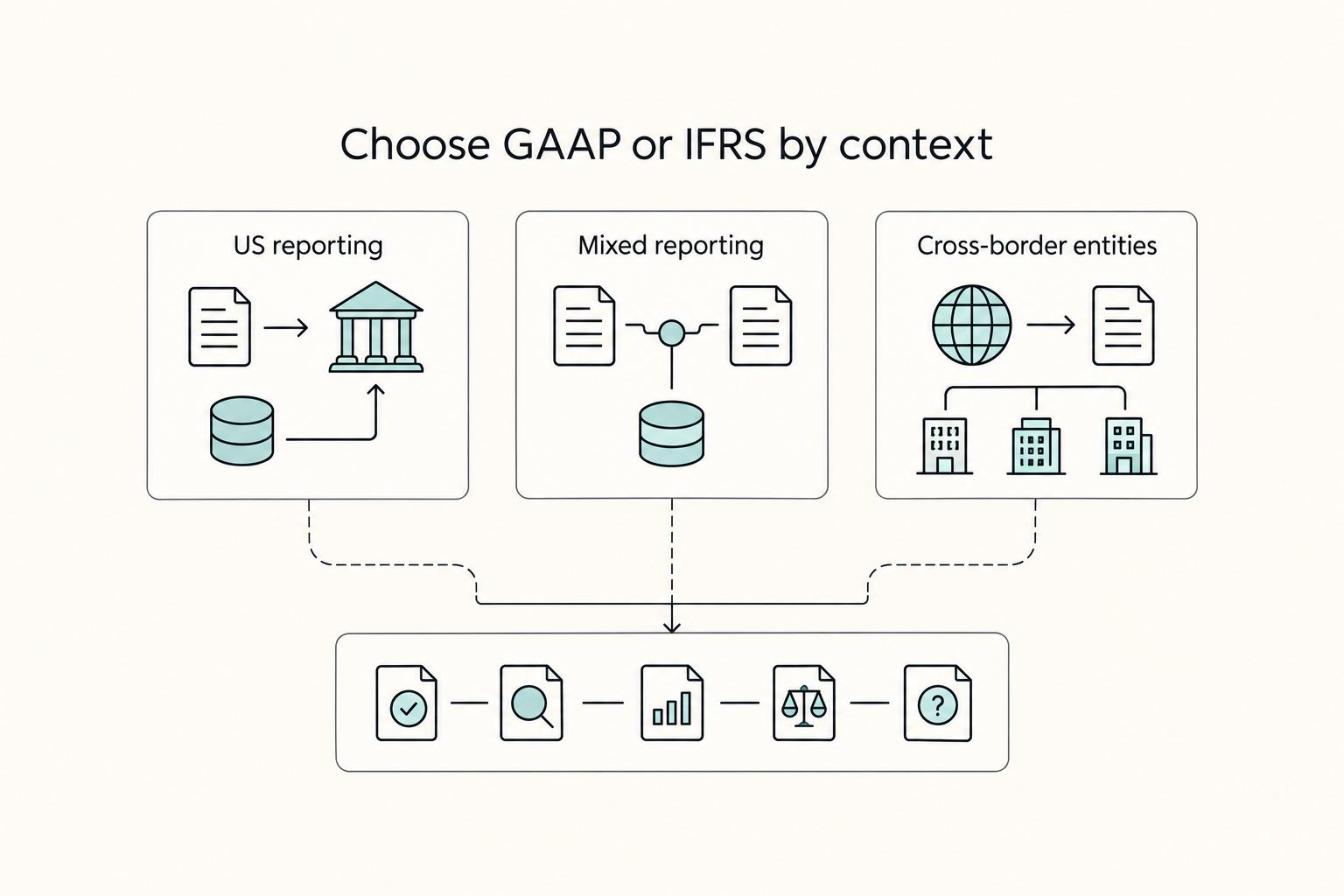
Choose the basis your main reporting reviewer already expects: US GAAP for most U.S.-centered contexts, IFRS when reporting rolls into a non-U.S. parent or group. In gaap vs ifrs decisions, the practical move is to keep one basis across contracts, invoices, and close controls so classifications remain stable. When SEC-linked filing context might apply, confirm issuer status before locking policies because accepted reporting bases differ by issuer type.
Start here if you want fewer payment surprises#
Treat gaap vs ifrs as an operating alignment choice, not a theory debate. For freelancers and small teams, it matters when it changes how your reporting is prepared, reviewed, and kept consistent at month end.
For nongovernmental U.S. entities, authoritative GAAP sits in the FASB Accounting Standards Codification, and FASB has set those standards since 1973. IFRS Standards are developed and published by the IASB under the IFRS Foundation, created in 2001, and IFRS is required for use by more than 140 jurisdictions. That governance split matters because clients, lenders, parent entities, or reviewers may already expect one basis.
The usual "rules based vs principles based" shorthand matters only if it changes real decisions in your workflow. If it does not affect reporting labels, reconciliation notes, or review expectations, it is background noise. If it does, it usually shows up as follow-up questions or rework at close.
Cross-border work is where the differences become operational. U.S. GAAP and IFRS share many similarities, but direct comparison gets harder when statements are prepared under different standards. The gap matters most when one entity is consolidating, reporting to, or negotiating with another that uses a different basis.
Use one quick month-end checkpoint: can each client-facing label map to one consistent reporting label in your books? Verify that transaction labels, ledger labels, and internal reporting labels match in a controlled way so amounts are interpreted consistently throughout review.
One regulatory edge case is worth knowing. The SEC accepts financial statements prepared under IFRS as issued by the IASB for foreign private issuers without reconciliation to U.S. GAAP. That does not mean every small business can freely choose either basis. Reporting obligations still depend on jurisdiction and filing status.
This guide should help you choose a reporting direction that fits your reviewers, tighten client-facing terms, and run a repeatable month-end check that improves reporting consistency. For a related accounting topic, we covered impairment in detail in A Guide to Impairment Testing for Goodwill.
GAAP and IFRS at a glance for cross-border operators#
For cross-border work, start with the reporting basis your key reviewer is required or expected to use, then run your close to that basis.
| Criteria | US GAAP | IFRS |
|---|---|---|
| Governing body | For U.S. public companies, the SEC recognizes the Financial Accounting Standards Board (FASB) as the designated accounting standard setter. | IFRS Accounting Standards are developed and published by the International Accounting Standards Board (IASB) under the IFRS Foundation. |
| Authoritative literature | For nongovernmental U.S. entities, authoritative GAAP is in the FASB Accounting Standards Codification. | IFRS Accounting Standards are issued by the IASB. |
| Jurisdiction tracking | U.S. listing treatment is reflected in the United States jurisdiction profile. | The IFRS Foundation monitors use by jurisdiction and has complete profiles for 169 jurisdictions. |
| U.S. listing treatment | In the U.S. profile, domestic issuers are required to apply US GAAP. | In the U.S. profile, IFRS is permitted for listings by foreign companies. The SEC accepts IFRS as issued by the IASB for foreign private issuers without U.S. GAAP reconciliation. |
| Practical cross-border effect | If counterparties review under a different basis, you may need extra mapping and explanation. | If counterparties review under a different basis, you may need extra mapping and explanation. |
The governance split matters in practice because reviewers often read statements through the source set they already use. When the basis is mismatched, you can get translation questions before anyone gets to the business itself.
As an early control, confirm the expected basis in the documents that govern the relationship, such as contracts, lender requirements, consolidation instructions, or prior reporting packs. If those documents force one standard, start there and build your process around it. If you need the U.S. small business angle first, see A Guide to GAAP for Small Businesses.
What actually changes in reports you use every month#
In practice, the monthly differences you feel first are usually presentation and cash flow classification, not the underlying economics.
| Report area | US GAAP | IFRS | Practical effect |
|---|---|---|---|
| Balance sheet structure | US GAAP has no single required internal line item order, though SEC registrants use a classified balance sheet and many reporters present in liquidity order. | IAS 1 requires current and non-current classification, except when a liquidity-based presentation is more relevant and reliable. | The same accounts can be grouped or sequenced differently, which can change how working capital pressure appears in review. |
| Cash flow statement categories | ASC 230 generally links operating cash flows to items that enter net income. | IAS 7 classifies cash flows into operating, investing, and financing activities. | Operating cash subtotals can read differently even when business activity is the same. |
| Interest and dividend cash flows | Interest and dividend receipts are operating inflows. Interest paid is an operating outflow. Dividends paid are financing outflows. | Interest and dividend classification is a known difference area, and IAS 7 was amended in April 2024, so treatment should be checked for the reporting period used. | Cross-basis comparability can be impaired in external reporting packs. |
| Operating cash flow format | Direct or indirect method allowed. | Direct or indirect method allowed. | Layout can look similar even when classification differs. |
Why the cash story can shift#
The underlying cash generation may be unchanged, but the operating cash story can shift. If your business has recurring interest, dividend, or distribution activity, classification differences can make operating cash look tighter or looser across bases. If you track an internal "cash from core operations" metric, map it explicitly to the external operating subtotal instead of assuming a clean match.
Where not to overreact#
Not every area diverges. For many common transactions, the two frameworks are often similar. Income taxes are a good example of overlap. IAS 12 and ASC 740 are different standards, but they share the same overarching objective.
Use this month-end verification checkpoint#
Before you close, run a quick mapping check so internal and external labels do not drift:
- confirm accounts for interest, dividends, and owner distributions are mapped consistently from period to period
- confirm internal working capital labels still tie to your external balance sheet presentation
- document any manual dashboard relabeling so reviewers can trace it back to statement lines
Choose your standard based on where you sell and who reviews you#
Once you know where differences show up, choose the basis your main reviewers already expect. If your reporting users are mostly U.S.-centered, lean toward US GAAP. If you report into a non-U.S. parent or group that already closes under IFRS, lean toward IFRS.
That is usually more practical than arguing theory. Most U.S. companies follow US GAAP, while IFRS is used widely outside the U.S., including across more than 140 countries. In cross-border setups, both frameworks can come into play, and the differences often surface during close, audit, or investor reporting.
Use this decision table#
| Setup | Starting bias | Why this usually fits | What to verify before you lock it in |
|---|---|---|---|
| U.S.-only client base, U.S.-centered reviewers | US GAAP | It aligns with the framework followed by most U.S. companies and with U.S.-centered review expectations. | Confirm whether any required reporting package calls for a different basis. Check whether your entity type, transaction details, or policy elections make differences material. |
| Mixed U.S. and international client base | Follow the dominant reviewer: if reporting users are U.S.-centered, choose US GAAP. If you report upward to a non-U.S. group, choose IFRS. | Mixed operations are where framework differences often show up in close, audit, and investor reporting. | Identify who actually reviews or signs off on reporting, then test material differences based on entity type, transaction profile, and policy elections. |
| Entity structures dealing with publicly listed entities | Escalate early | Basis choice may be constrained by group reporting and regulatory review context. | Get reporting basis direction from the group and auditor before locking templates and management reporting. |
Focus on the hard constraints that matter#
What usually constrains you is reviewer and jurisdictional expectation, not preference. If your business is primarily reviewed in the United States, US GAAP is generally the cleaner default. If reporting is mainly consumed outside the U.S. or rolled into IFRS group reporting, IFRS is usually the cleaner default.
If SEC review or public company linkage is in scope, treat this as an escalation point. This guide does not provide a full SEC rule summary, so confirm requirements directly with your auditor or securities counsel when SEC review or public company linkage is in scope.
Run a practical checkpoint before you decide#
Before you standardize templates and close notes, run one focused check: entity type, transaction details, and policy elections. Those three factors usually determine whether the differences are actually material.
Keep the check proportionate. The two frameworks are often more similar than different for common transactions, so anchor the decision to real reporting use and your actual transaction mix.
Why early alignment usually beats waiting#
Because differences can surface during close, audit, and investor reporting, delaying a basis decision usually makes execution harder.
Convergence efforts have been slow, so plan as if your initial choice will matter operationally. As a practical default, U.S.-centered reviewers usually point to US GAAP, while non-U.S. parent or group reporting usually points to IFRS. For a related workflow guide, read Hiring Your First Subcontractor: Legal and Financial Steps.
Contract and invoice terms that prevent accounting friction#
Once you pick the basis, make your contract and invoice language map directly to how you close under it. IFRS 15 requires you to consider contract terms and relevant facts and circumstances. Topic 606 centers revenue on the transfer of promised goods or services in an amount that reflects expected consideration. If key terms are vague, close turns into interpretation instead of reconciliation.
Put the economic terms in writing, not in email memory#
Write down the terms that can change amount, timing, or uncertainty in your financial statements: settlement currency, payment timing, dispute windows, and refund handling. The goal is not legal complexity. It is to make outcomes clear enough that a reviewer can trace what happened from the documents.
| Contract term | Why it matters in close | What to make explicit | Common failure mode |
|---|---|---|---|
| Settlement currency | Can affect how cash receipts tie to billed amounts and any FX differences | State the billing currency and settlement currency if they differ | Price agreed in one currency, paid in another, with no documented conversion basis |
| Payment timing | Can influence when receivables are expected and how overdue balances are explained | Define the trigger clearly, such as invoice date, milestone acceptance, or end of service period | Contract says "net terms," but the start of the clock is unclear |
| Dispute window | Can help distinguish open disputes from credits or collection issues | State when the window starts and what counts as valid notice | Client short pays informally while books still show a clean receivable |
| Refund handling | Can affect expected consideration and how credits or reversals are tracked | State whether resolution is a cash refund, credit note, or future service offset | Refund gets posted as a write off because the contract does not define handling |
Keep one clear answer per term. If billing is in euros but settlement is in dollars, say so. If payment depends on acceptance, define acceptance.
Use invoice fields that reconcile without translation#
Neither framework gives you a universal invoice template, so treat invoice fields as operating controls. Useful fields include the contracted legal entity name, service period or milestone reference, tax treatment notes, and a stable payment reference convention.
Those fields help source documents support book entries. At month end, sample an invoice and confirm that the entity name, service period, amount, and payment reference align with the signed agreement, the cash receipt, and the ledger posting.
Keep custom client labels subordinate to your own reporting#
Custom client labels are fine only if they still map back to your core reporting structure. Client-facing labels can vary, but your internal categories should stay stable.
This matters most where classification options exist, such as IAS 7 treatment options for certain interest and dividend cash flows. If a custom label forces you onto a manual side sheet every month, keep that label outside the accounting record or decline it.
Build a simple evidence pack for month end#
For each billed item or adjustment, keep a simple traceable file set:
- signed SOW or contract version used for billing
- invoice record sent to the client
- payment confirmation or receipt detail
- adjustment log for credits, disputes, refunds, or rebills
If an adjustment cannot be traced back to the original invoice and contract term, pause and document it before close. For a deeper walkthrough, read Currency Hedging for Freelancers Without Guessing the Market.
If your team needs a consistent invoice format that maps cleanly into close workflows, use this template. Adapt the fields to your GAAP or IFRS process: Free Invoice Generator.
Month-end sequence that keeps cashflow visible and defensible#
A consistent close sequence keeps the cash story stable. One practical order is to lock the invoice period, reconcile receipts, classify cash movements, validate operating activities, then finalize the financial statements. IAS 7 treats the cash flow statement as an integral part of the financial statements. ASC 230 requires cash receipts and payments to be classified into operating, investing, or financing categories. The point is to stabilize the inputs before presentation.
Use one sequence and keep it boring#
Freeze the population before you explain it. Lock the invoice period so late invoice edits or backdated credits do not change what you are reconciling, then match bank or processor receipts to invoices, credits, and unapplied cash.
Classify movements only after reconciliation. Under ASC 230, classification happens at the discrete cash receipt or payment level and follows the nature of the cash flow. Under IAS 7, cash flows are also classified into operating, investing, and financing, with operating activities tied to main revenue-producing activities and other activities that are not investing or financing. If a movement cannot be traced to a receipt, payout report, bank line, or documented adjustment, hold it as an exception instead of guessing.
Put accountability on named roles, not on the whole team#
Use two named roles: one owner for classification decisions and one reviewer for exceptions. This is a control choice, not a standards mandate, but it fits management responsibility for internal control and separate monitoring.
Keep a short reference for recurring items such as customer receipts, processor payouts, internal transfers, foreign currency settlements, and regular non-operating items. Escalate only the exceptions, such as new payout structures, unusual settlement routing, or transactions with policy-dependent classification.
Where hidden mismatches usually start#
Hidden mismatches often start when client-facing or processor-facing labels get treated as accounting categories. Labels like retainer, true up, settlement, reimbursement, or batched payouts can help operations, but they are not the basis for classifying the cash flow statement.
Because classification differences affect comparability, keep one documented internal mapping and apply it consistently. Client labels can sit on top. Your accounting categories should stay stable underneath.
Use this reusable month-end checklist#
| Step | Pass checkpoint | Common fail signal |
|---|---|---|
| Lock invoice period | Invoice register, credit notes, and service period cutoffs are frozen for the period | Late edits after reconciliation starts |
| Reconcile receipts | Bank and processor receipts tie to invoices, unapplied cash, or documented adjustments | Cash posted to suspense with no aging note |
| Classify cash movements | Every movement has a category and support for operating, investing, or financing | Batch payout booked as one line with no breakout support |
| Validate operating activities | Items in operating clearly fit revenue-producing activity or are clearly excluded as investing or financing | Operating cash includes items no one can explain |
| Finalize financial statements | Statement ties to reconciled cash balances and approved classifications | Statement prepared while exceptions are still open |
Keep an exceptions log next to the checklist with transaction date, amount, currency, source document, provisional classification, reason for exception, decision owner, reviewer, and final resolution date.
Payout and FX activity need one policy before reporting goes out#
Set payout and foreign-currency classification choices before statement assembly. Under ASC 830 and ASC 230, foreign-currency cash flows are translated at rates in effect at the cash flow dates. FX effects on cash are presented separately in the cash reconciliation. IAS 7 requires foreign-currency cash flows to be reported consistently with IAS 21, including use of approximate rates when appropriate.
Pick one rate source or approximation convention for the period, document it, and apply it consistently. Then tie the foreign-currency receipt, any conversion, and the final settled cash amount back to bank or processor reports before external reporting goes out.
Related reading: Accrual vs Cash Basis Accounting for Small Agencies.
Red flags that trigger delays, fee leakage, or audit stress#
Escalate these immediately: classification drift in interest-related cash lines, mixed reporting bases for the same entity, and adjustments that cannot be tied from entry to statements.
| Red flag | Verify now | Why it gets expensive |
|---|---|---|
| Interest-related cash lines move between categories | Compare current classification to prior periods and confirm the written policy was applied consistently | Operating trends become less comparable, and reclassification support requests can arrive late |
| One team treats an entity as U.S. GAAP while another assumes IFRS | Confirm the reporting basis for each legal entity and who consumes that reporting | Reconciliation churn and duplicate mapping work can surface late in the close |
| Manual adjustments lack tie-out support | Trace each adjustment to source documents, affected statement of financial position lines, and cash flow presentation | Audit pressure increases when the entry cannot be evidenced or explained clearly |
Interest cash lines drifting across periods#
This can be easy to miss and costly to unwind. IAS 7 allows policy choices for classifying interest and dividend cash flows, which is why mixed teams can drift if the policy is not applied the same way each period.
Treat unexplained movement as a stop sign. If interest paid was in operating last period and appears in financing this period, do not pass it through without a clear policy basis, comparative treatment, and documentation of the change.
Regional basis drift between entities#
In cross-border work, basis drift creates repeat rework. GAAP for nongovernmental entities is anchored in the FASB Codification. SEC reporting permits different bases by issuer type, such as domestic issuers on U.S. GAAP and foreign private issuers on IFRS as issued by the IASB.
That split is easier to manage when the basis is explicit by entity. Put reporting basis, downstream consumer, and reviewer directly on the close checklist so GAAP or IFRS mapping is decided before statement assembly, not during cleanup.
If anyone cites IFRS 18 for presentation changes, verify period timing and adoption status. It is effective for annual periods beginning on or after 1 January 2027, with earlier application permitted.
Adjustments without tie-out support#
Unsupported adjustments are a common audit-stress trigger. IAS 7 requires reconciliation between cash flow statement amounts and equivalent statement of financial position items, so each adjustment should be traceable end to end.
Require a minimum support pack before final reporting: journal entry ID, dated rationale, source document, affected balance sheet lines, cash versus non-cash treatment, and impacted cash flow line. If that tie-out is missing, the entry is not ready.
This is not theoretical. PCAOB staff continue to report deficiencies around journal entries and other adjustments, and audit standards require sufficient evidence and written documentation of conclusions.
Which option fits your situation right now#
If you need a working answer now, choose based on where your financial statements are used and who reviews them most closely.
If your reporting users are mostly in the United States, start with GAAP. If your reporting feeds an international parent or group across multiple jurisdictions, consider IFRS alignment. If you are in transition, define one external reporting basis and document how internal metrics reconcile to it.
Country and jurisdiction context should drive the call because financial reporting standards are set at the country level. In the U.S., distributing financial statements outside the company is a practical checkpoint that points toward GAAP, and domestic public company filing expectations are tied to U.S. GAAP.
| Your situation | Better starting point | Why it fits | Verify before you lock it |
|---|---|---|---|
| U.S. registered, U.S. client heavy, reviewed mainly in the United States | GAAP | Aligns with U.S.-based review and external-use expectations | Confirm who receives statements outside the company and what basis they expect |
| Reporting into an international group across multiple jurisdictions | IFRS alignment | Supports cross-jurisdiction reporting where IFRS is commonly used | Confirm the consolidation basis used by the parent or group controller |
| Mid transition with mixed internal reporting | One external basis, plus documented reconciliation to internal metrics | Helps reduce avoidable close and review friction while both frameworks are in play | Keep the reconciliation current and usable during close |
Avoid dual-basis drift. When both frameworks are in play, differences surface in close, audit, and investor reporting, and the same economics can still produce different reported patterns.
This pairs well with our guide on Choosing Functional Currency for Your Business.
Where GAAP and IFRS are closer than people think#
The gap is real, but both frameworks are trying to do the same core job: produce decision-useful financial reporting for investors, lenders, and other creditors, not just compliance paperwork.
| Shared area | What the article says |
|---|---|
| Information qualities | Both prioritize comparability, verifiability, timeliness, and understandability. |
| Income taxes | Both treat income taxes as a core accounting area. |
| Support for reporting | Both rely on consistent definitions and reviewable records to support verifiable reporting. |
At the foundation, they are more alike than they first appear. IFRS emphasizes consistent treatment of similar transactions, and FASB notes that key conceptual chapters were developed jointly with the IASB. That helps explain why many outcomes feel familiar across both systems even when the detailed rules differ.
In practice, that overlap shows up in a few steady ways:
- both prioritize useful information qualities such as comparability, verifiability, timeliness, and understandability
- both treat income taxes as a core accounting area
- both rely on consistent definitions and reviewable records to support verifiable reporting
Income taxes are a clear example. IFRS addresses them through IAS 12, including domestic and foreign taxes based on taxable profits. US GAAP sets explicit ASC 740 objectives to recognize current taxes payable or refundable and deferred tax assets and liabilities for future tax consequences. The mechanics are not identical, but tax accounting is central in both frameworks.
To make review under either basis easier, keep labels consistent and document exceptions so each tax-related entry is easier to trace and verify. For a step-by-step walkthrough, see IFRS 9 for Small Businesses and the Reporting Basis Decision.
When to bring in a professional reviewer#
Bring in a professional reviewer early in three cases: when requests reference the SEC, when reporting treatment keeps getting disputed across close, audit, and investor reporting, or before you switch reporting basis between US GAAP and IFRS.
| Trigger | Why review matters | What to prepare |
|---|---|---|
| A contract, lending term, or investor report request mentions the U.S. Securities and Exchange Commission | At that point, this is no longer just an internal preference call. If GAAP/IFRS treatment is involved, differences can show up in close, audit work, and investor reporting. | The exact request language and the reporting materials tied to it |
| The same reporting issue keeps being treated differently across close, audit work, and investor reporting | GAAP/IFRS differences can surface across these workflows, so recurring disagreement is a practical signal to escalate early. | Examples of the issue across close, audit, and investor reporting, plus your current rationale |
| You plan to change reporting basis between US GAAP and IFRS | For international operations, both frameworks can come into play, so an early review helps pressure-test your mapping assumptions. | Your current and target reporting structure, plus the mapping you plan to use |
If SEC-linked language appears, add one more verification step before you act. FederalRegister.gov states that legal research users should verify against an official Federal Register edition, and its XML version is unofficial and does not provide legal or judicial notice. Treat that as a practical checkpoint before you change reporting decisions.
Gruv checkpoints that support cleaner reporting and faster cash visibility#
Cleaner reporting comes from one discipline: make each reported balance traceable from source document to ledger to final statement line before close.
Both frameworks support that discipline. US GAAP reporting is anchored to FASB's authoritative codification. IFRS requires both a statement of financial position and a statement of cash flows, with cash flows classified as operating, investing, and financing. The practical test is simple: can your team trace balances cleanly end to end?
| Checkpoint | What you match | Evidence to keep | What breaks if you skip it |
|---|---|---|---|
| Source document alignment | Invoice and payment records to your reporting categories | Invoice record, proof of payment, and exception support | Revenue or cash items drift into ad hoc labels that do not map cleanly at close |
| Ledger to statement mapping | Ledger balances to balance sheet and cash flow statement lines | Current mapping sheet and period end tie out | Late, inconsistent classification decisions across periods |
| Payout and collection history | Open, cleared, and exception items against recorded balances | Time-stamped collection and payout history with support | Exceptions roll forward and surface near final statements |
| Tax and cross-border support | Tax-sensitive entries to domestic and foreign tax support files | Invoices, receipts, proof of payment, and other support for income, deductions, or credits | Last-minute document hunting during income tax review |
If you tighten only one control, tighten the ledger to statement map. Lock mapping to the balance sheet and cash flow statement before close, then keep it consistent from period to period.
Use a quick verification check each cycle: pick material balances and trace them to the statement line, then back to invoice and payment support. If that chain is unclear, the problem is usually evidence quality, not accounting theory.
Tax files need the same structure. IAS 12 covers domestic and foreign taxes based on taxable profits, so cross-border entries should be review ready. IRS guidance also requires records supporting income, deductions, and credits. Treat the commonly cited 3 year assessment period as general context, not a universal retention rule for every case.
If SEC-linked requirements apply to your filing context, raise the control bar: keep structured statement line reconciliation and clear exceptions before final financial statements circulate.
The takeaway for freelancers and small teams#
Choose the reporting basis your reviewers expect, then run your contracts, invoices, and close process to match it every month. For most small teams, gaap vs ifrs is an operations choice, not a theory debate.
If your reporting context is U.S.-centered, US GAAP is often the expected basis, and the FASB Codification is the official source of authoritative nongovernmental U.S. GAAP. If you report across jurisdictions or into an international group, IFRS may be the expected basis, and that basis should stay consistent across recurring items.
Consistency is the control that protects you from rework. Under IAS 8, policies for similar transactions should be applied consistently unless a standard permits otherwise. In practice, if a recurring cash item moves between classifications from month to month, it can trigger reviewer questions and cleanup.
Cash flow classification is often where drift shows up first. IAS 7 requires operating, investing, and financing classifications, and it allows split treatment in some repayment cases, such as interest and principal. Lock your classification approach early and apply it the same way each close.
Keep evidence aligned to the same basis. For material adjustments, retain support for any reclassification or manual journal. For unusual transactions, document your conclusion carefully. SEC staff guidance is explicit that conclusions are fact dependent and require careful analysis, and authoritative material governs when informal guidance conflicts.
Use this practical decision rule:
- if reviewers, owners, or filings are U.S.-centered, US GAAP is usually the practical default
- if you report to a non-U.S. parent or in IFRS-oriented jurisdictions, IFRS may be the practical default
- if SEC filing status may apply, confirm it early: domestic issuers use US GAAP, while foreign private issuers may file IFRS as issued by the IASB without U.S. GAAP reconciliation
For freelancers and small teams, the goal is simple: choose once, document the policy, and repeat it consistently. If your context is mixed or high stakes, confirm the setup early with a qualified reviewer before you hard-code it into templates and close steps. Related: How to Manage Bookkeeping for Your Freelance Business.
When you're ready to operationalize this with repeatable workflows, pick the tools that match your current process and reporting maturity: Gruv Tools.
Frequently Asked Questions
What is the main difference between GAAP and IFRS for a small business getting paid internationally?
A practical difference is the reporting basis your reviewers expect. If your reporting obligations are U.S.-centered, U.S. GAAP is the baseline in SEC filing contexts. If you report across borders, IFRS may align with counterparty expectations because it is required for use in more than 140 jurisdictions. In practice, state your accounting basis clearly in every reporting package and keep ledger mapping consistent to that basis each close.
Where is GAAP used versus IFRS in day-to-day operations?
In SEC filing contexts, the line is explicit: domestic issuers must follow Regulation S-X and U.S. GAAP, while foreign private issuers may file IFRS as issued by the IASB without U.S. GAAP reconciliation. Outside that context, day-to-day use can be driven by jurisdiction and reporting requirements. Before you finalize internal labels, confirm the required basis in those documents.
Are GAAP and IFRS still converging, and does that reduce my current decision risk?
Do not assume convergence will remove your near-term reporting risk. The bilateral FASB-IASB convergence program that began in 2002 was concluded, and important differences remain. Treat your basis choice as an active policy decision now, especially for recurring presentation items.
Do GAAP and IFRS have important similarities I can rely on when building internal processes?
Yes. Those similarities are operationally useful. The standards share many similarities, and for many common transactions the similarities generally outweigh the differences. Both frameworks also use the same main cash flow sections and allow either the direct or indirect method for operating cash flows.
Which practical differences show up first in reporting: balance sheet layout or cash flow classification?
There is no fixed sequence you can count on. One early pressure point is cash flow classification policy because IAS 7 allows flexibility for certain interest and dividend lines, while U.S. GAAP-oriented guidance examples classify interest expense as operating and principal as financing. Lock that policy early and test recurring lines before close to preserve comparability from period to period.
Is one standard better, or does it depend on clients, jurisdiction, and reporting obligations?
There is no universal winner. The better choice is the one that matches your jurisdiction, filing obligations, and the expectations of the people who rely on your statements. If you are U.S.-centered, anchor GAAP policy to the FASB Accounting Standards Codification. If you report across jurisdictions, verify local IFRS requirements directly rather than assuming one global rule.
Try a related tool
Researched and edited by the Gruv editorial team. Gruv builds cross-border billing, payouts, and finance-operations software for global businesses.
Sources
- ecfr.gov/current/title-17/chapter-II/part-210trusted
- egrove.olemiss.edu/cgi/viewcontent.cgitrusted
- federalregister.gov/documents/2022/09/08/2022-18771/pay-versus-p...trusted
- guides.gaoinnovations.gov/greenbook/2025/principle-16-perform-monitori...trusted
- irs.gov/businesses/small-businesses-self-employed/wh...trusted
- irs.gov/taxtopics/tc305trusted
- online.hbs.edu/blog/post/gaap-vs-ifrstrusted
- sec.gov/rules-regulations/2007/12/acceptance-foreign...trusted
Educational content only. Not legal, tax, or financial advice.
Related Posts

Hiring a Subcontractor for the First Time Without Costly Surprises
**Start with a risk-control sequence, not an ad hoc handoff.** As the Contractor, your goal is simple: deliver cleanly, control scope, and release payment only when the work and file are complete.

Freelance Bookkeeping for Faster, Safer Client Payments
Control over cash starts with records you trust. When entries are current, categorized, and easy to trace, you spot risk earlier and make calmer decisions about follow-up, spending, and month close.
GAAP for Small Businesses Choosing Between Cash and Accrual
Usually not, at least for private solo businesses outside SEC filing contexts. The legal mandate is tied to SEC filings. [Regulation S-X](https://www.sec.gov/about/divisions-offices/division-corporation-finance/rules-regulations-schedules) (17 CFR Part 210) governs financial statements filed with the SEC, and public companies file a 10-K each year. For most private owner-operators, the practical question is whether outside parties still expect formal financial statements.