
Quick Answer
Start by treating freelancer transformation as an operating reset: assess pipeline, pricing, delivery, compliance, and cashflow, then stabilize weak lanes before adding complexity. Build one retrievable chain for signed scope, invoice aging, payout confirmation, and exception notes so decisions are verifiable. Add a weekly CEO review to catch drift early, and confirm GDPR obligations for EU clients before expanding cross-border work.
Start here if you feel busy, booked, and still fragile#
If your calendar is full, but one late payment, one messy handoff, or one compliance question could knock you sideways, the problem is not effort. It is operating fragility.
That distinction matters because the phrase gets used loosely. You may find podcast episodes, social posts, and motivational takes built around the same wording, and some of that can be useful context. This guide is not about inspiration. It is about execution. Discovery is not the same as usable operating detail. A visible Spotify page in this research set, for example, is mostly gated by reCAPTCHA and login UI. It does not give you the substance you need to tighten scope approvals, invoicing trails, or client data handling.
By the end, you should have three things you can use right away:
- decision checkpoints for where your business is actually unstable
- a compliance-first baseline so growth does not outrun your controls
- a 30-day action sequence that cuts avoidable surprises
If you are overloaded, do not try to solve this first with a new offer, a sharper niche statement, or another productivity app. Start with visibility and proof. Can you quickly pull a signed scope, the current invoice status, and the records showing how client information is handled? If not, you do not have a volume problem. You have an evidence problem.
That is the shift this piece is built around. A busy freelancer often runs on memory and inbox search. A business owner runs on decisions that can be repeated and checked. You see the difference in small places that matter: how clients are qualified, how changes are approved, when invoices go out, what gets documented, and what happens when something goes wrong.
One red flag is worth naming early. Being booked is not the same as being durable. If revenue depends on constant improvisation, hidden exceptions, or spreadsheet guesswork, more volume usually makes the weakness louder. The goal here is straightforward: replace fragility with clear checkpoints, cleaner records, and a way to review the business before problems get expensive. For a step-by-step walkthrough, see A freelancer's guide to 'Grit'.
What freelancer transformation actually means in practice#
Freelancer transformation, in practice, means running your work as a business system, not a string of one-off jobs.
| Area | Purpose |
|---|---|
| client qualification | poor-fit work is filtered early |
| offer definition | outcomes, limits, and revisions are clear |
| contracts and signed scope | approvals are documented |
| invoicing routine | issue date, due date, and payment status are visible |
| compliance checks | handling requirements are reviewed instead of improvised |
| weekly review | problems are caught before they compound |
That framing matches the broader Freelance Transformation conversation: build a freelance business that supports the life you want, not the other way around. Mindset matters because it changes decisions, but mindset alone is not enough. The practical standard is simple: business first, services second.
In day-to-day operations, that usually means putting clear rules around the basics:
- client qualification, so poor-fit work is filtered early
- offer definition, so outcomes, limits, and revisions are clear
- contracts and signed scope, so approvals are documented
- invoicing routine, so issue date, due date, and payment status are visible
- compliance checks, so handling requirements are reviewed instead of improvised
- weekly review, so problems are caught before they compound
A useful checkpoint is whether you can pull the current contract, latest scope approval, and invoice status in minutes. If you cannot, the issue is usually missing operating rules, weak records, or both. Fix that before you rebrand, raise rates, or add volume.
You might also find this useful: Freelancer Pain Points and Cross-Border Compliance Risk.
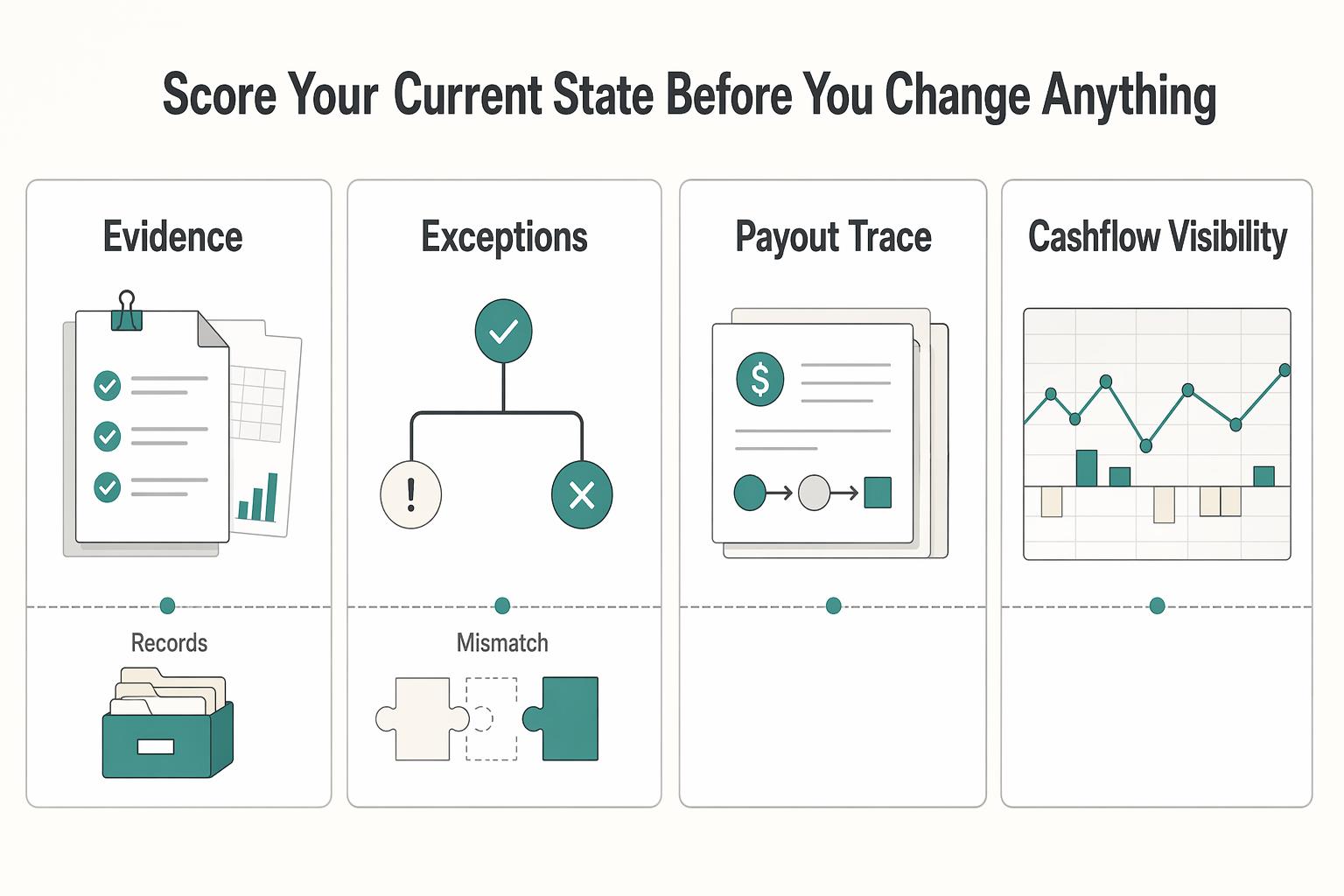
Score your current state before you change anything#
Before you redesign your offer, score your current operation using records you can pull now, not how you feel today.
Freelance Start, Double Your Freelancing, and Matt Inglot's Freelance Transformation are useful context for the transition story. Your baseline still has to come from your own evidence.
| Lane | Evidence to inspect | Stable | Unstable |
|---|---|---|---|
| Pipeline quality | Qualified lead list, proposal records, client-fit notes, source concentration | You can show a current set of real opportunities and why they fit | Pipeline is mostly in memory, depends on one client, or is mostly poor-fit inquiries |
| Pricing control | Written pricing policy, discount log, exception log | Pricing follows a documented policy and exceptions are visible | You quote from scratch each time, discount ad hoc, or cannot explain pricing changes |
| Delivery stability | Signed scope docs, approval trail, change-order records | Active work has signed scope, traceable approvals, and a defined process for changes | Scope changes happen in chat or calls, approvals are unclear, and extra work is not formally handled |
| Compliance hygiene | Current contract template, policy exception log, client-data handling notes | Core documents are current, retrievable, and exceptions are recorded | Terms drift by habit, records are scattered, and exception handling is hard to show |
| Cashflow visibility | Invoice register, due dates, paid status, invoice aging | You can see issued, due, overdue, and paid invoices without rebuilding reports | You rely on memory or bank balance, and aging is unclear until problems surface |
Mark each lane as stable, watch, or unstable. If evidence is partial, treat that lane as not stable yet.
Use the approval trail as a quick stress test: can you pull the latest signed scope, client approval, and later changes in minutes? If not, fix that first. One cited answer on changed requirements recommends including a contract-defined change-order process in work agreements, which gives you a clear path when scope shifts.
Treat pricing the same way: it is risk management, not only rate setting. A written pricing policy plus an exception log helps you see whether discounts are deliberate or reactive.
Use one decision rule for this stage: if two or more lanes are unstable, freeze new experiments and fix operating basics before launching a new offer, rebrand, or added complexity.
Need the full breakdown? Read The Freelancer's Bill of Rights: What You Should Demand from Your Platform.
Choose your offer model with explicit tradeoffs#
Pick the model that matches how repeatable your delivery actually is, not the model that sounds more scalable. Keep custom services when the work is discovery-heavy and varies client to client. Pilot one productized offer only when outcomes, inputs, and steps repeat reliably.
A practical decision rule: if the work is highly variable, stay custom; if you solve the same problem with mostly the same process, test one packaged offer first. There is no universal winner here, only a fit-for-purpose choice.
| Dimension | Custom service model | Productized offer model |
|---|---|---|
| Positioning | Tailored diagnosis and solution design | Defined outcome or fixed block of work |
| Delivery risk | Risk concentrates in discovery and shifting requirements | Risk concentrates in fit screening, exclusions, and boundary enforcement |
| Margin control | Can be strong, but less predictable across projects | Easier to monitor when scope boundaries hold |
| Sales cycle | Usually needs more shaping before agreement | Usually clearer to buy when scope is explicit |
| Revision exposure | Higher when goals evolve mid-project | Lower only when revision limits and change-order rules are documented |
Use the flexibility-versus-stability lens to pressure-test your choice. If you stay custom, coordination, cost framing, and quality control need tighter management. If you package an offer, your speed improves only when intake, scope, and approvals are explicit.
If you pilot a productized slice, do not rebrand everything on day one. Document the guardrails first:
- exact deliverables
- required client inputs before work starts
- included revision rounds
- change-order triggers
- approval definition and where approval is recorded
If those documents are not in place, the offer is still custom work with a fixed-price label. We covered the mindset side in How to Deal with Imposter Syndrome as a Freelancer.
Build the compliance baseline before you scale client volume#
Before you scale client volume, make your compliance trail explainable end to end. If you cannot show what happened from intake to payout, you are not ready for higher transaction volume or cross-border complexity.
Set this baseline in onboarding, not after issues appear:
- confirm client identity
- capture the client tax profile
- define what data you will handle and on what terms
- confirm whether any market, platform, or payout program requires verification before funds move
Keep the evidence pack complete#
Most breakdowns come from missing records and undocumented exceptions, not one dramatic failure. Keep one document set you can pull quickly for any client:
| Document | What it proves | Verification checkpoint |
|---|---|---|
| Contract template | Scope, commercial terms, approval path | Signed copy matches the legal entity on the invoice |
| Data-processing terms | What data is handled and on what terms | Attached or incorporated before client data is shared |
| Invoicing records | What was billed, when, and under which tax treatment | Invoice number, date, amount, and client record all align |
| Payout evidence | What was paid out, when, and to whom | Payment confirmation matches ledger and bank or provider record |
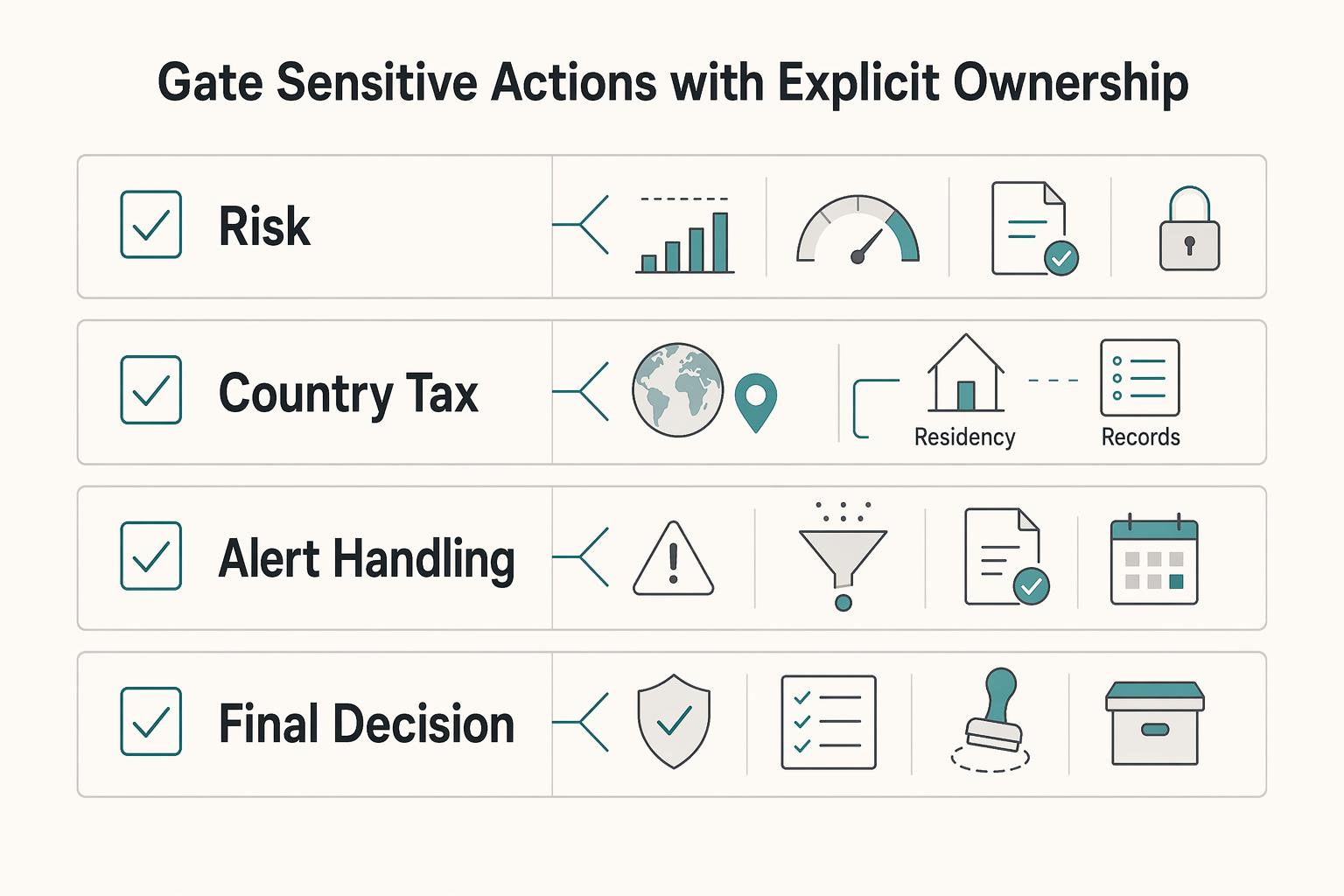
| Policy exceptions log | Where you made a non-standard call | Each exception has owner, date, reason, and approval note |
Treat exceptions as risk signals. If an exception is not logged, you cannot review or defend that decision later.
Name the EU compliance branch early#
For EU work, keep the GDPR caveat explicit: requirements vary by processing role and country context, so confirm obligations before rollout. If you need a deeper checklist, review GDPR for Freelancers: A Step-by-Step Compliance Checklist for EU Clients.
| Item | What the article says | Condition or note |
|---|---|---|
| GDPR caveat | requirements vary by processing role and country context | confirm obligations before rollout |
| OSS guidance | covers registration, declaration and payment, record keeping and audits, and leaving OSS | define your path before volume rises |
| Union scheme | Member State of identification choice binds the current calendar year plus the 2 following calendar years | if the scheme applies and you have multiple fixed establishments |
| Cross-border SME scheme | requires prior notification in the Member State of establishment | one access condition can include turnover not exceeding EUR 100 000 |
| CBR | advance-ruling path | for complex cross-border VAT treatment |
For cross-border VAT, define your path before volume rises:
- OSS guidance covers registration, declaration and payment, record keeping and audits, and leaving OSS.
- If the Union scheme applies and you have multiple fixed establishments, your Member State of identification choice binds the current calendar year plus the 2 following calendar years.
- If the cross-border SME scheme may apply, it requires prior notification in the Member State of establishment, and one access condition can include turnover not exceeding EUR 100 000.
- For complex cross-border VAT treatment, CBR is an advance-ruling path.
Run a quick readiness check on one recent client file: can you show, in one chain, identity, tax treatment decision, signed contract, data terms, invoice, payment confirmation, payout evidence, and any exception note? If not, fix that before scaling.
If you want a deeper dive, read The 'Solopreneur' Economy: A Deep Dive into the Business-of-One.
Fix money operations so growth does not create chaos#
Growth stays manageable when money operations run on systems and process, not memory. Use one repeatable workflow for every transaction, keep decisions visible, and review exceptions before they pile up into month-end surprises.
If a step is unclear, pause and resolve it before moving forward. The goal is consistency: the same flow, the same records, and the same follow-through each time.
Run one repeatable workflow#
- Define the steps your business follows from billing through final reconciliation.
- Use the same order every time so status changes are predictable.
- Log exceptions when you break the flow, including who approved the change and why.
Keep one source of truth#
- Treat your ledger event history as the record for reconciliation.
- Use wallet or dashboard balances as operational views, not final proof on their own.
- When records disagree, resolve the mismatch in the underlying event trail first.
Review exceptions on a weekly cadence#
- Check for unmatched payments, status drift between systems, and manual overrides that bypass your normal flow.
- Keep a weekly reconciliation pack with transaction IDs, payout statuses, and resolution notes.
- Escalate unresolved items in the same week so they do not become silent risk.
The shift is real when cash movement no longer depends on your memory. As volume rises, tighter systems and regular exception review keep growth from turning into chaos.
Related reading: How to apply the 'Jobs-to-be-Done' theory to your freelance services
Run one fixed weekly operating review#
Run one fixed weekly CEO review to reduce reactive decisions and operational drift. A repeatable rhythm keeps you from becoming the bottleneck when clients, decisions, and moving parts increase.
Use the same agenda each week so changes are easier to spot: pipeline, delivery risk, compliance items, cash position, then next-week capacity. Keep it on one page, then pair it with a short Monday alignment and Friday evaluation to confirm what moved and what got stuck.
Set hard-stop rules before the week starts. If active work is above your capacity band, do not accept new custom scope. If unresolved reconciliation or compliance exceptions cross your limit, pause added variation until those exceptions are closed.
Track a small dashboard with stable definitions:
- qualified leads
- effective rate
- aging invoices
- blocked payouts
- open compliance tasks
This gives you both input and output signals, not just revenue. Use outside ideas as prompts, but keep your cadence tied to your real constraints: delivery load, payment friction, and compliance exposure.
Execute a 30-day transition checklist with checkpoints#
Use a focused 30-day sprint to replace reactive scrambling with intentional systems, then review what actually improved.
| Week | Focus | Key actions |
|---|---|---|
| Week 1 | baseline audit and one friction cut | Complete your scorecard with evidence, gather proposals, contracts, invoice-aging view, payout records, and open compliance tasks in one place, then remove one recurring friction point |
| Week 2 | finalize offer boundaries and publish "how we work" | Lock what is included, excluded, and when scope changes need a new quote; publish response times, revision limits, payment timing, approval roles, and what happens when inputs are late |
| Week 3 | test one full money cycle end to end | Run a cycle from invoice to payment to payout to reconciliation; keep an evidence pack with transaction references, dates, statuses, and any exceptions |
| Week 4 | formal review and next 60-day priorities | Compare Week 4 against Week 1, log failures, convert repeat issues into explicit rules, and set the next 60-day priorities (two or three max) |
A common overload pattern is clear: one freelancer described landing five clients in three weeks and missing a deadline for the first time. The lesson is practical, not dramatic: as context switching grows, operating complexity rises fast, so your first month should remove variation before you try to scale.
- Week 1: baseline audit and one friction cut.
Complete your scorecard with evidence, not mood. Gather your current proposals, contracts, invoice-aging view, payout records, and open compliance tasks in one place. Then remove one recurring friction point immediately.
- Week 2: finalize offer boundaries and publish "how we work."
Lock what is included, excluded, and when scope changes need a new quote. Publish one plain document covering response times, revision limits, payment timing, approval roles, and what happens when inputs are late.
- Week 3: test one full money cycle end to end.
Run a deliberate cycle from invoice to payment to payout to reconciliation. Keep a small evidence pack with transaction references, dates, statuses, and any exceptions so you can trace what happened without guesswork.
- Week 4: formal review and next 60-day priorities.
Compare Week 4 against Week 1, log failures, and convert repeat issues into explicit rules. Set the next 60-day priorities (two or three max) so your Business-of-One gets deeper, not busier.
If you serve EU clients, use this checkpoint to align your operating documents with GDPR guidance and confirm your Business-of-One can support that standard in day-to-day execution.
Related: The Hierarchy of Freelancer Pain: From Friction to Financial Ruin.
The shift is real when your decisions become repeatable#
The shift is real when decisions follow documented rules and your records can verify what happened from signed scope to paid invoice. Freelancer transformation is not a branding exercise; it is an system with connected steps, checks, and traceable records.
A Business-of-One is stronger when sales, delivery, invoicing, and compliance run as one chain instead of separate errands. The red flag is not complexity itself; it is any handoff you cannot explain without guessing.
In practice, repeatable decisions look boring in the best way:
- Keep discovery-heavy work custom until scope boundaries and change-order rules are documented.
- Treat "paid" as a checkpoint, not the finish line: confirm the source payment record and reconcile it against your ledger.
- If you handle client data, keep the agreement, handling terms, and audit trail accessible so you can show who did what.
Keep your next move narrow:
- Complete the scorecard with evidence, not feelings. Pull the latest signed scope, current invoice aging, payout confirmations, and open compliance items.
- Make one offer-model decision. Either keep the work custom and tighten terms, or pilot one repeatable offer only after exclusions and delivery steps are documented.
- Run the first 30-day checklist cycle. Review what failed, what drifted, and which rule needs to change, then carry that into the next month.
Use one practical confidence test: explain your client-to-cashflow path out loud in clear steps, then prove each step with records from your recordkeeping system. If you can do that, including resolving reconciliation mismatches instead of ignoring them, you are operating like a strategic CEO.
This pairs well with our guide on The 'Mental Game' of Freelancing Blueprint: From Imposter Syndrome to Confident CEO.
Frequently Asked Questions
Is freelancer transformation a podcast topic or an operating method?
Both, but do not confuse them. Freelance Transformation is a podcast hosted by Matt Inglot, and it is framed around building a freelance business that supports the lifestyle you want. Separately, the freelancer-to-CEO idea is about changing how your business operates, not just changing your title.
What should change first if I feel stuck as a freelancer?
Change one operating constraint before you change your branding, niche, or website. A practical first move is to improve your systems, processes, and project management so you can reduce chaos and see where work is breaking down.
How is a strategic CEO freelancer different from a busy freelancer?
The difference is not the title. A useful way to frame it is that the freelancer-to-CEO journey is about changing how the business operates, because what worked as a freelancer may not hold up once complexity rises. A busy freelancer reacts to everything; a strategic owner runs the business with clearer operating rules.
When should I stay service-based instead of productizing offers?
Productizing is one possible strategy, not a requirement. If your work is still highly custom, staying service-based and improving operating consistency can be the better near-term move.
What are the minimum systems I need before raising rates?
Start with repeatable systems for delivery and project management so the business is not running on ad hoc decisions. The key checkpoint is whether your work runs with less chaos and fewer avoidable breakdowns.
Which compliance checks matter first when serving cross-border clients?
Confirm cross-border requirements with qualified local legal and tax professionals before you standardize your process.
How do I know my weekly operating cadence is actually working?
It is working if your weekly review produces decisions you can verify the next week. Look for fewer recurring blockers, clearer priorities, and fewer repeated operational issues. If the same problems keep returning with no process change, your cadence needs adjustment.
Try a related tool
Researched and edited by the Gruv editorial team. Gruv builds cross-border billing, payouts, and finance-operations software for global businesses.
Sources
Includes 1 external source outside the trusted-domain allowlist.
- cdc.gov/evaluation/php/evaluation-framework/index.htmltrusted
- csrc.nist.gov/glossary/term/audit_trailtrusted
- ecommons.cornell.edu/server/api/core/bitstreams/75e8b1b9-7949-4f1...trusted
- irs.gov/businesses/small-businesses-self-employed/re...trusted
- taxation-customs.ec.europa.eu/archives/taxable-persons/vat-cross-border-ru...trusted
- vat-one-stop-shop.ec.europa.eu/one-stop-shop/register-oss_entrusted
- vat-one-stop-shop.ec.europa.eu/index_entrusted
- beyondthechaos.biz/freelance-transformationexternal
Educational content only. Not legal, tax, or financial advice.
Related Posts

GDPR Compliance Checklist for Freelancers Working With EU Clients
Start by separating the decisions you are actually making. For a workable **GDPR setup**, run three distinct tracks and record each one in writing before the first invoice goes out: VAT treatment, GDPR scope and role, and daily privacy operations.
Running a Durable Business-of-One in the Solopreneur Economy
Treat this as an operating guide, not a trend recap. Here, a solopreneur means one person running the business end to end, not occasional side work.

The Freelance Payment Penalty: A Modeled Audit of Platform Fees, FX Spreads, and Payout Delays
The money rarely disappears through a single, easy-to-spot fee. The real loss is stacked. A marketplace takes its commission, a processor adds a charge for international cards, a bank or payment company converts the currency at a spread, a platform holds the funds before release, and a wire sheds a little to intermediaries on the way in. Each layer looks defensible on its own, but the worker feels the combined result as a smaller deposit and a later payday.