
Quick Answer
Start with provable residency facts, map income classification, and only then test structure choices for a us-germany tax treaty freelancer setup. The article’s core rule is sequence control: residency memo first, treatment logic second, entity decision third, filings last. It also warns that a U.S. LLC can add cross-border friction if your records are not aligned. Use Article 4 as the opening gate and treat treaty summaries as background until your timeline, contracts, and disclosures tell one coherent story.
Start Here if You Freelance Between Germany and the United States#
Start with residency facts you can prove, then choose your filing position, then choose structure. That order helps keep filings consistent and reduces avoidable contradictions.
- Determine residency from your full facts and circumstances.
- Map your filing position to those facts.
- Test structure and compliance tasks only after steps 1 and 2 align.
Residency is determined from facts and circumstances, not by a single bright-line test. In California, part-year and nonresident status can change what is taxed by period, so the timeline drives what follows.
Build that timeline before you make structural moves: where you lived, where work was performed, when contracts started, and where payments were received. If those facts conflict, pause and fix the record before filing decisions.
A useful opening check is simple: can you explain your year in five dated lines, without guessing? If not, your filing position is not ready yet. Tight sequencing matters because each later choice depends on facts you already documented. Skipping this order can leave contradictions to reconcile later.
This guide is for freelancers and consultants, including people considering a U.S. LLC or single-member U.S. LLC. Use it as a sequencing guide, not as a substitute for treaty interpretation, German filing analysis, or entity classification advice. For related travel planning context, see How to Avoid Dynamic Pricing When Booking Travel.
What the Treaty Actually Does and What It Does Not Do#
The treaty can help allocate income-tax rights, but it does not answer every compliance question by itself. Keep treaty analysis separate from U.S. trade-or-business, ECI, worker-classification, and social-security analysis.
Before relying on treaty relief, run this order:
- Confirm where personal services were physically performed and by whom.
- Test whether U.S. activity may be a U.S. trade or business.
- Map connected income and worker-classification facts before assuming treaty language resolves the full position.
U.S. activity is the first pressure test. Foreign persons are generally engaged in a U.S. trade or business when personal services are performed in the United States, and connected income may be treated as Effectively Connected Income. IRS framing also emphasizes business activity that is considerable, continuous, and regular.
German classification is a separate gate. Dependent employment versus self-employment is determined from the full circumstances, not just the contract label. Mandatory social security obligations are also separate and cannot be waived by private agreement.
Keep your notes in two buckets: questions treaty text may answer, and questions it does not answer on its own. That distinction prevents a common mistake where one treaty sentence gets stretched into a full filing position.
Article 23, Article 28, and the Saving Clause are not resolved by this section. Their effect depends on your facts, your status, and the treaty text. Treat one-line summaries from blogs as a warning sign, not as filing authority.
Determine Tax Residency Before You Touch Structure#
Residency comes first. Start with a residency determination before changing invoicing, entity setup, or withdrawals. If your position is unclear across jurisdictions, pause structural changes until residency facts are resolved.
| Evidence item | What to include |
|---|---|
| Address timeline | By month, including move dates and where you actually lived |
| Work-location pattern | Tied to contracts, calendar records, and invoice periods |
| Supporting indicators | Indicators that support the position you are taking |
| One-page memo | Your starting residency position and open questions |
Use residency as a sequence check, not a shortcut. Build the facts file first, then choose structure that fits those facts. If your current approach is structure first and residency later, reverse it.
This facts-first discipline matches published guidance. Residency is based on the full picture, not one label. California guidance reflects the same principle by treating residency as factual and, for California residents, taxing income regardless of source. Use that as a process cue only, not as a treaty tie-breaker.
Use the four items above as your minimum residency evidence file before any structural move.
Then run a consistency check against Internal Revenue Service reporting. IRS guidance says self-employment tax rules are generally the same for a self-employed U.S. citizen or resident living in the United States or abroad, and net earnings of at least $400 require self-employment tax. IRS also states that people who are neither U.S. citizens nor U.S. residents are not subject to U.S. self-employment tax. These are treatment rules, not treaty tie-breakers.
One practical guardrail is to make the timeline your master record, then force each draft filing position to reference that same timeline. If your memo says you moved in one month, but invoices and disclosures imply another period, resolve the mismatch first. Filing with unresolved date conflicts is an avoidable risk.
Before filing, make sure your residency memo, return positions, and disclosures tell one coherent story. If address history, work locations, and tax-status statements do not align, fix that record before changing structure.
Classify Your Income the Right Way Before You Estimate Tax#
Classify each income stream by facts before you estimate tax. Treat your treaty position as a working hypothesis to organize your file, not as an automatic outcome. A practical method is to classify by engagement pattern, then collect the records that support that classification.
| Engagement pattern | Initial treatment to review | Evidence to gather before filing |
|---|---|---|
| Consulting retainer | Start with a provisional treatment, then test for inconsistencies | Contract scope, invoice cadence, where services were performed, year timeline |
| Project-based freelance work | Review treatment project by project and confirm consistency | Statements of work, milestone records, payment trail, location log |
| Quasi-employment relationship | Review employment-like facts before locking in treatment | Contract language, payment structure, practical working arrangement notes |
Decision rule: if the relationship looks employment-like in practice, pause before filing under a single treatment. Do not rely on labels alone. Label-to-fact mismatch is where cross-border filings are more exposed to double-taxation, audit, and penalty risk.
Use a quick checkpoint for each payer:
- Assign a provisional treatment and write one sentence on why it fits the facts.
- Attach documents showing how and where the work was performed.
- Flag contradictory facts for adviser review instead of forcing one label.
The same client can move between patterns during the year. A relationship may begin as project work and later look more employment-like in day-to-day reality. When that happens, split your analysis by period and document when the facts changed. One label for the whole year may look clean, but it can hide risk.
This matters because both countries are commonly described as taxing worldwide income. A recurring issue is how U.S.-source income is reported for German tax purposes. If your file has mixed signals, a focused specialist review, often around $200 to $500 per hour, can cost less than avoidable penalty exposure later. If you want a deeper dive, read our guide to a defensible 2026 filing plan.
Should You Use a U.S. LLC While Living in Germany#
If your only reason to form a U.S. LLC is tax efficiency, pause and test Germany-side classification risk first. An LLC may simplify contracting, but cross-border treatment is usually where preventable problems start. Structure should follow residency and income facts, not override them.
When you test an LLC, keep one consistent story across residency, cross-border tax position, and reporting in both countries. This is not about branding. It is about whether your file stays coherent under review.
| Potential benefit | Practical friction to price in |
|---|---|
| Simpler U.S. contracting and a familiar entity label | Cross-border uncertainty if jurisdictions do not view the entity the same way for tax/reporting |
| Clearer separation of personal and business records | Dual-country compliance complexity across two filing tracks |
| Perceived credibility for larger contracts | Higher documentation burden to keep filings aligned |
A November 2025 EPRS study is a useful reminder of this process risk. Tax policy in the EU remains largely national, and differences in design and enforcement can weaken cross-border consistency. The same study notes that fragmented procedures can create disproportionate compliance costs for cross-border firms. That does not decide your LLC outcome, but it supports a caution-first approach.
Use this pre-formation checkpoint:
- Write a one-page memo linking residency position, planned entity facts, and filing obligations in both jurisdictions.
- List each return or disclosure where entity details and income narrative appear, then remove conflicts.
- Document what changes if a client relationship shifts toward employment-like facts.
- Treat non-peer-reviewed writeups as background, not as the main basis for entity decisions.
Run this checkpoint before formation, not after. A short pre-formation dry run can expose hidden conflicts. One set of documents may name the individual while another implies the LLC is the operating party for the same period. Resolving that mismatch early is easier than repairing it across filed returns.
Red flag: changing legal form before your cross-border tax position, residency, and reporting are aligned. If you cannot explain the structure choice in plain language with supporting records, defer the LLC step and resolve classification risk first.
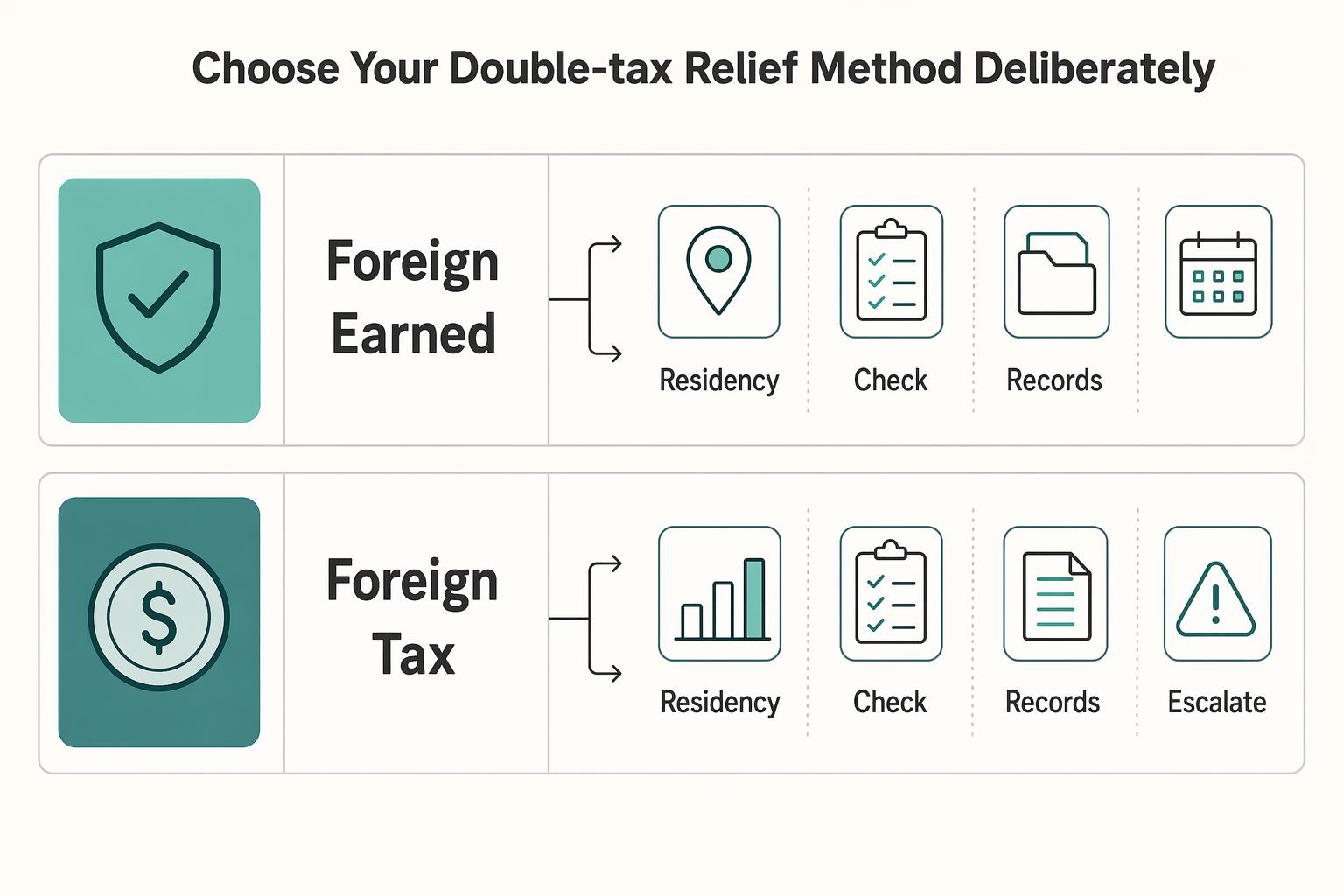
Choose Your Double-Tax Relief Method Deliberately#
Choose relief deliberately. If foreign tax paid is material and recurring, model a credit-led approach first, then compare it with an exclusion-led approach before you file.
Document your treaty position in your notes, and keep U.S. filing mechanics explicit. For many filers, the practical choice is between the Foreign Tax Credit and the Foreign Earned Income Exclusion (FEIE). Neither is automatic.
| Method | Core filing mechanics | Practical friction point |
|---|---|---|
| Foreign Earned Income Exclusion | Available only if you are a qualifying individual with foreign earned income, and you still file a U.S. return reporting that income | The cap changes by tax year and is reduced when only part of the year qualifies |
| Foreign Tax Credit | Claimed on Form 1116, with a separate Form 1116 for each income category and only one category box checked per form | More category-by-category preparation when income is mixed |
Run a scenario contrast before locking your method. In a stable high-tax residence year, recurring foreign tax can support a credit-led model. In a transition year with partial relocation and mixed-source income, FEIE can be limited because the maximum is adjusted by qualifying days.
Keep tax-year limits current while modeling. FEIE is capped at the lesser of foreign earned income or $130,000 per qualifying person for 2025, and $132,900 per person for 2026. Housing limits are generally 30% of the FEIE maximum, with listed limits of $39,000 for 2025 and $39,870 for 2026.
Use this pre-filing checkpoint:
- Confirm whether FEIE qualification applies for the full year or only qualifying days.
- Record the exact tax-year FEIE and housing limits used in your model.
- Group income by Form 1116 category and prepare separate forms where required.
- Check whether either minimum-time exception applies, including adverse country conditions or U.S. travel restrictions.
- Write a short memo linking your chosen method to your treaty position and filing narrative.
A practical way to avoid rework is to run both models from one shared fact base. Keep income categories, periods, and source mapping identical across both calculations. If your FEIE and FTC models use different assumptions, your comparison is not decision-grade. You need one consistent data set before choosing.
Also document why you did not choose the alternative method for that tax year. Two or three lines is enough, but it helps future-year planning and makes adviser review faster when facts change.
Final caution: not all IRS materials carry the same authority. IRS Practice Units are not official pronouncements of law and cannot be relied on as such.
Handle Social Security Separately From Income Tax Treaty Relief#
Income-tax treaty relief may not, by itself, resolve Social Security and Medicare contributions for self-employed U.S. filers. Treat this as a separate decision track, with Schedule SE as the core filing step for self-employment tax.
Schedule SE (Form 1040) is used to figure tax due on net earnings from self-employment, and that information is also used to determine Social Security benefits. It is not just a payment calculation. It also affects the record used for benefit calculations, so document it carefully.
For U.S. citizens or residents who are self-employed, IRS guidance says these self-employment tax rules are generally the same whether you live in the United States or abroad. Claiming FEIE does not automatically remove self-employment tax, so excluded income can still create Schedule SE exposure.
In cross-border cases, keep social-contribution coordination documents separate from your income-tax treaty analysis. If social-coordination documents apply to your situation, align them with what you file.
Use this pre-filing checkpoint:
- Confirm whether net self-employment earnings are at least $400.
- Reconcile
Schedule SEinputs to your books andForm 1040. - Document where you are contributing during the year.
- Keep social-coordination records with your filing support.
- Make sure your income-tax and social-contribution positions do not conflict.
One failure mode is treating FEIE as a full answer and skipping the separate self-employment tax review. Another risk is keeping social-contribution records in a separate folder that never gets reconciled to the return package. Bring both files together before filing so your tax and contribution positions refer to the same periods. If your facts changed mid-year, rerun this check before filing.
Build a Filing and Reporting Checklist You Can Actually Run#
Treat reporting as two separate tracks: Form 8938 under FATCA and FinCEN Form 114 under FBAR. One does not automatically satisfy the other.
| Topic | Detail |
|---|---|
| Reporting tracks | Treat reporting as two separate tracks: Form 8938 under FATCA and FinCEN Form 114 under FBAR |
| Form 8938 scope | Covers specified foreign financial assets above the applicable threshold and is attached to your annual income tax return |
| When Form 8938 is not required | If no income tax return is required for the year, Form 8938 is not required |
| Threshold context | Thresholds vary by filing status and residence context |
| Form relationship | Form 8938 does not replace FinCEN Form 114 when FBAR is otherwise required |
Use this order each year:
- Close your books first.
- Reconcile account records to your ledger.
- Confirm taxpayer and entity facts are consistent across your files.
- Prepare filings last.
For the U.S. reporting stack, keep these rules explicit:
Form 8938covers specified foreign financial assets above the applicable threshold and is attached to your annual income tax return.- If no income tax return is required for the year,
Form 8938is not required. - Thresholds vary by filing status and residence context.
Form 8938does not replaceFinCEN Form 114when FBAR is otherwise required.
If you also have non-U.S. filing obligations, keep that preparation synchronized with your U.S. disclosures so the underlying facts stay consistent.
A practical way to run this each year is to maintain one completion log with two explicit lines for each account reporting track. Mark what was reviewed, what was reported, and why any account was handled differently. That short log can reduce last-minute confusion when filing deadlines are close.
Pre-filing consistency check#
- Residency facts, taxpayer identity, and entity classification align across your return package and account-reporting files.
- The account set reviewed for
Form 8938is cross-checked against yourFinCEN Form 114review. - Any account handled differently across the two tracks has a written reason.
- Your
Form 8938filing decision is documented with the threshold test and context used.
If any item fails, pause and fix the narrative before filing.
Keep an Evidence Pack That Survives an Audit Question#
Keep one proof file that lets you trace each return position quickly. If a reviewer asks why a number appears, you should be able to show the supporting record without rebuilding your logic from memory.
Use the same core record set each year so comparisons stay clean. Keep the documents that support reported income, foreign taxes paid, and filing positions, organized so they can be reviewed quickly. These records are strongest when used together.
Add a short position memo stating which tax treatment you applied and why. If facts changed during the year, note the split period and the fact pattern behind that change.
Keep foreign tax credit support in its own subsection. Individuals generally claim the foreign tax credit on Form 1116. A separate Form 1116 is required for each income category.
For credit eligibility notes, document which foreign taxes were imposed on you by a foreign country or U.S. possession and why they qualify. Also flag any income excluded under foreign earned income rules, because taxes tied to excluded income generally cannot be claimed for the credit. For current filing mechanics, the 2025 Form 1116 instructions state that Part IV lines 25 through 32 must be completed even when filing only one Form 1116.
An evidence pack works best when it is easy to scan. Add a one-page index that lists each claim, the supporting document, and the period covered. You are not adding new facts with this index. You are making existing facts easier to validate under time pressure.
Pre filing trace check#
- One memo line maps each income stream to the tax treatment used, with key assumptions stated once.
- Each claimed Foreign Tax Credit amount links to a payment record and the matching income-category Form 1116.
- Any excluded foreign earned income is flagged so related taxes are not also claimed for credit.
- Relief narrative uses the same taxpayer identity and periods shown across your supporting records.
- One test figure is traceable end to end, from return entry to underlying payment proof.
Escalation Triggers That Mean Talk to a Pro Now#
Escalate immediately when your residency story is not clean, consistent, and supported by documents across the full tax year. This is especially important when your facts changed during the year.
| Trigger | When to escalate |
|---|---|
| Conflicting residency positions | Timeline, income sourcing, and draft return positions do not point to one consistent residency story |
| Residency status is hard to determine | You cannot clearly support whether you were a resident, part-year resident, or nonresident for each period |
| Facts changed mid-year | You moved or changed work patterns during the year, and treatment can split by period |
Immediate trigger when your records point to conflicting residency positions#
If your timeline, income sourcing, and draft return positions do not point to one consistent residency story, stop and hand it off. That split narrative is a practical red flag.
Immediate trigger when residency status is hard to determine#
If you cannot clearly support whether you were a resident, part-year resident, or nonresident for each period, escalate. Residency is a facts-and-circumstances determination, including whether your presence in California was more than temporary or transitory.
Immediate trigger when your facts changed mid-year#
If you moved or changed work patterns during the year, treat that as high risk for self-filing. Residency is facts-and-circumstances based, and treatment can split by period. Part-year residents can be taxed on worldwide income during resident periods and on California-source income during nonresident periods, while nonresidents are taxed on California-source income. For part-year and nonresident cases, California tax is computed with an effective tax rate method.
Practical handoff checklist#
Bring a focused packet so your advisor can make a decision quickly:
- A dated timeline of where you lived and worked during the year.
- Your draft residency position for each period, resident, part-year resident, or nonresident.
- Support for California-source income during nonresident periods.
- Worksheets used for any part-year or nonresident effective tax rate calculations.
- Draft return pages that show where each position appears.
- Core supporting records aligned to the same periods and taxpayer story.
The goal of escalation is not to transfer all responsibility. The goal is to get a decision on the exact points that are unclear. If you bring a complete packet, your adviser can spend time on judgment instead of document cleanup.
The Main Takeaway for a Low-Stress, Compliant Setup#
A cautious internal sequence can reduce errors: residency first, classification next, structure third, filing last. Use this as a consistency control, not as a treaty-interpretation rule.
Use one defensible sequence and do not skip your own control steps:
- Residency first: keep a dated address and work-location timeline, and use the same timeline across filings.
- Classification second: write a short memo explaining how work is performed and why income is classified that way.
- Structure third: set or change your legal structure only after residency and classification are stable.
- Filing last: run a consistency check across contracts, invoices, payment records, and return disclosures before submission.
For Germany-side compliance context, one 2025 creator-tax example says profit-seeking paid or gifted activity is taxable. The same example says this activity should be registered as a business, with compliant invoicing and relevant income, VAT, and where applicable trade-tax filings, and that registration should happen within four weeks of the first paid or gifted collaboration. It also says digital records and receipts should be kept for ten years. That example lists category-specific thresholds around EUR 12,000 annual profit for income tax, EUR 25,000 turnover for VAT, and EUR 24,500 profit for trade tax. Treat this as narrow, single-source context for that category and period, not universal freelancer rules.
A common failure mode is a clever setup with facts that do not match your timeline, invoices, or classification. Escalate early if you have entity complexity, residency transitions, or unclear classification, and document each judgment when it is made. If someone can trace your facts to each filing position quickly, your position is easier to defend.
Take one final execution step before you file: run a short internal review using your own checklists from this article. Confirm that residency facts, classification approach, structure choice, and reporting all reference the same periods and taxpayer story. If any one of those items breaks the narrative, fix it first, then file. For related location context, see Tbilisi Digital Nomad Guide for 2026 Long Stays in Georgia.
Frequently Asked Questions
Does the U.S.-Germany Tax Treaty eliminate double taxation for freelancers?
Treaty relief can help, but it does not remove U.S. filing obligations by itself. U.S. citizens and resident aliens are taxed on worldwide income, so returns still need complete reporting and correctly applied relief. In this scope, the practical levers are FEIE, FTC, or a careful combination that follows filing rules.
If I live in Germany and invoice U.S. clients, what should I decide first?
Set your U.S. filing position first, then test FEIE eligibility. FEIE applies only to qualifying individuals with foreign earned income and still requires a U.S. return that reports that income. If FEIE qualification is weak, move to an FTC-first analysis early.
Does a U.S. LLC automatically reduce taxes for a Germany-based freelancer?
This section does not establish any automatic tax reduction from entity choice alone. In this scope, outcomes still depend on filing mechanics such as accurate income reporting and correctly applied FEIE or FTC rules. If those pieces are not consistent, treat that as a trigger for professional review.
Which treaty articles matter most for independent consulting income?
This article does not provide article-by-article treaty interpretation. What you can control is filing discipline: consistent facts, accurate income reporting, and correctly applied relief rules. If your position depends on clause interpretation, escalate for specialist advice.
Is social security handled by the same rules as income tax under the treaty?
This section does not cover social security or totalization rules. Keep social contribution coordination separate from the income-tax filing mechanics discussed here, especially FEIE and FTC.
When should I use Foreign Tax Credit instead of Foreign Earned Income Exclusion?
Use FTC analysis when foreign taxes are imposed and credit treatment is available, especially for income you are not excluding under FEIE. FEIE is capped per qualifying person at $130,000 for 2025 and $132,900 for 2026, and housing calculations can reduce what remains excludable. FTC claims on Form 1116 require separate handling by income category, with one category per form.
When is it too risky to self-file without professional review?
Escalate when you cannot clearly support FEIE qualification, cannot keep Form 1116 categories separated, or plan to use a time-requirement waiver without confirming IRS-listed countries and dates for adverse conditions. Escalate if your filing logic is hard to follow from your records. If a reviewer cannot trace your facts to your positions quickly, get specialist review before filing.
Try a related tool
Researched and edited by the Gruv editorial team. Gruv builds cross-border billing, payouts, and finance-operations software for global businesses.
Sources
Educational content only. Not legal, tax, or financial advice.
Related Posts

Digital Nomad Taxes in 2026 With a Defensible Filing Plan
With digital nomad taxes, the first move is not optimization. It is figuring out where you may be taxable, where filings may be required, and what proof supports that position.

Tbilisi Digital Nomad Guide for 2026 Long Stays in Georgia
Start with sequence, not excitement. If your income depends on delivering work on schedule, secure your legal footing, assemble your documents, and keep month one reversible before you optimize comfort.
How to Avoid Dynamic Pricing When Booking Travel
Your edge is not predicting airfare. It is using a repeatable process that starts with your deadlines, compares like-for-like offers, and tells you when to book. If you want to avoid pricing mistakes during a move, treat fares as something you manage around, not something you fully control.