
Quick Answer
Start by fixing residency and work-location facts, then compare FEIE and FTC on identical inputs before finalizing forms. For a us-canada tax treaty freelancer case, treaty provisions help coordinate taxing rights but do not replace domestic filing duties in either country. Use Form 2555 only when FEIE eligibility is supported, keep Form 1116 category separation clean when claiming credits, and make sure each major amount traces to contracts, invoices, payout proof, and a dated memo.
Start with residency and treaty eligibility#
If you are working through the us-canada tax treaty freelancer question, lock down the facts before you choose forms. That is a practical way to reduce double-tax risk. Confirm residency and work location first, then test what the treaty can and cannot coordinate. The treaty can help reduce double taxation, but it does not erase domestic filing duties.
Your first checkpoint is not optimization. It is two facts: where you are a tax resident and where you physically performed the work. Those two points drive most outcomes. Canada taxes residents on global income, and if you are living in Canada permanently, you will likely have a Canadian filing obligation. A Canadian resident working for a U.S. employer may also have U.S. federal and state filing obligations, so filing in both countries can be part of the reality.
Use this guide like a decision memo, not a form checklist:
- Residency first
- Income classification second
- Treaty coordination third
- Relief choice after that
- Filing consistency last
If you want the broader cross-border baseline before diving into U.S.-Canada specifics, start with Digital Nomad Taxes in 2026 With a Defensible Filing Plan. Later sections point to more targeted internal links where they help.
The practical failure mode is moving too fast without a stable fact pattern. Cross-border setups can become a tax maze, and mishandled cross-border work relationships can create legal risk. Dual Canadian-U.S. citizens who are Canadian tax residents should be especially careful, since filing in both jurisdictions may still be expected regardless of where the work is done.
Use one operating rule throughout: traceability over speed. If residency or income characterization is unclear, escalate early.
For a parallel example of how freelancer treaty filings change by country, see A Freelancer's Guide to the US-UK Tax Treaty.
Start With the Terms That Actually Drive Outcomes#
Start with labels before you start doing math. In a us-canada tax treaty freelancer file, avoidable mistakes can start when "foreign-earned income," "FEIE-qualified," and "self-employment tax" are treated as the same thing. They are not, and each one changes a different filing decision.
The core guardrail is simple: FEIE and self-employment tax are separate questions. FEIE may let a qualifying person exclude foreign earnings up to the current annual cap, but you still file a U.S. return reporting that income when you claim the exclusion. Schedule SE (Form 1040) is used to figure self-employment tax on net earnings from self-employment, so an income-tax exclusion does not automatically remove that calculation.
Define each term in plain language and tie it to a filing consequence right away. "Foreign-earned income" is pay for personal services you performed, such as wages, salaries, or professional fees. That determines whether the income is even in FEIE scope. "Tax home" is a gate for FEIE-related benefits, so if your facts do not support a foreign tax home, your FEIE position may fail before you run any numbers.
For the physical presence test, treat it as a day-count test, not an intent test: 330 full days in 12 consecutive months, and each full day is 24 consecutive hours from midnight to midnight abroad. Use a dated travel log backed by records, not memory. If you miss 330 full days, the test is not met. Days spent in a country while violating U.S. law also do not count. A waiver path can apply in adverse conditions such as war or civil unrest, but only if current IRS guidance supports your facts.
If you want a broader refresher before you optimize, use the digital nomad tax guide.
Keep a compact term register#
Use one short register for the year and date every update so contract language, bookkeeping labels, and filing positions stay aligned.
| Term | Working definition | Affected forms | Last-updated note |
|---|---|---|---|
| Foreign-earned income | Pay for personal services you performed | U.S. return income reporting when FEIE is claimed | Confirm service-income labeling against contracts/invoices |
| FEIE | Exclusion for qualifying individuals living abroad, up to the annual limit | U.S. return FEIE claim + income reporting | Confirm current threshold before filing |
| Physical presence test | 330 full days in any 12-month window; full day = 24 hours midnight-to-midnight | FEIE qualification support in your return file | Reconcile day count to travel evidence |
| Tax home (FEIE context) | Tax home must be in a foreign country for FEIE-related benefits | FEIE eligibility position | Re-check consistency with work pattern and records |
| Schedule SE (Form 1040) | Form used to compute self-employment tax on net self-employment earnings | Schedule SE (Form 1040) | Check current instructions; correction posted 20-FEB-2026 |
Decide Your Residency Position Before You Touch Any Form#
Choose forms only after residency is clear. If the residency call is fuzzy, every downstream form becomes provisional, and provisional forms are where rework starts.
On the U.S. side, keep federal self-employment rules separate from residency analysis. For self-employed U.S. citizens or residents, the IRS says self-employment tax rules are generally the same whether you are living in the United States or abroad, and you must pay self-employment tax on net profit even if you claimed FEIE. Individuals who are neither U.S. citizens nor U.S. residents generally are not subject to U.S. self-employment tax. On the state side, California treats residency as a facts-and-circumstances determination.
That is why evidence should come before software entry. A dated fact file is more useful than a fast return built on assumptions you may have to unwind later.
Build the file first:
- Month-by-month timeline showing where you lived and worked.
- Travel and status records that support the timeline.
- Contracts and invoices mapped to where the work was performed.
- One-page IRS residency note and one-page relief-eligibility note.
- Short list of unresolved conflicts to clear before filing.
Keep known facts separate from judgment calls. Known facts are dates, locations, payer details, and contract terms. Judgment calls are how those facts support a filing position and relief eligibility. Separating the two makes review much faster if a preparer or advisor joins late, because they can challenge the judgment without having to reconstruct the record.
Use this checkpoint before form prep starts: challenge your own timeline. Ask whether each month is backed by at least one record you can retrieve quickly. If a month cannot be supported, stop and fill that gap before you continue.
Pause when facts conflict. First decide whether a disputed period changes residency analysis, federal self-employment treatment, or only relief eligibility. That one distinction prevents a lot of unnecessary rewrites across Form 1040, Form 2555, and Form 1116.
A common failure mode is making a form-first decision. Form 2555 can look attractive, but it does not by itself resolve the underlying residency analysis, and it does not eliminate self-employment tax on net profit. For California, confirm resident, part-year resident, or nonresident treatment. Nonresidents are taxed on taxable income from California sources, part-year residents are taxed on worldwide income while resident and California-source income while nonresident, and California-source income in nonresident or part-year periods can require Form 540NR.
When ambiguity remains, write the exact question before moving forward. For example: does this disputed period change residency, or does it only affect relief eligibility? One precise question often saves hours of cleanup later.
If you bring in help, send the fact file first and the draft forms second. Advisors can usually resolve targeted questions faster when the evidence and open issues are clear before they review calculations.
Once residency is defensible, the next step is narrower: what can the treaty actually solve, and what does it leave alone?
Related: The Best Tools for Tracking Your Credit Card Points and Miles.
Know What the Treaty Solves and What It Does Not#
Treat the treaty as a coordination tool, not a filing replacement. In a us-canada tax treaty freelancer case, treaty rules can affect foreign tax credit calculations and withholding administration, but domestic filing rules still control what you file and how you claim it.
| Treaty role | Article detail | Related form or records |
|---|---|---|
| Income type mapping | Classify each payment before choosing relief so your credit treatment stays tied to the right income category. | Contracts, invoices, bookkeeping, and return narrative |
| Foreign tax credit coordination | On the U.S. side, foreign taxes are generally claimed on Form 1116, and treaty rules may need to be considered when figuring the credit. | Form 1116 |
| Withholding treatment | Payer-side paperwork can support treaty treatment during the year, including Form W-8BEN treaty claims on Line 10, but that step is not proof by itself that your return-level position is correct. | Form W-8BEN Line 10 |
Used well, the treaty supports three practical jobs:
- Income type mapping: classify each payment before choosing relief, so your credit treatment stays tied to the right income category.
- Foreign tax credit coordination: on the U.S. side, foreign taxes are generally claimed on Form 1116, and treaty rules may need to be considered when figuring the credit.
- Withholding treatment: payer-side paperwork can support treaty treatment during the year, including Form W-8BEN treaty claims on Line 10, but that administrative step is not proof by itself that your return-level position is correct.
Use this operator sequence before filing:
- Align your residency timeline.
- Align income labels across contracts, invoices, bookkeeping, and return narrative.
- Align the relief claim to that same fact pattern.
If you use the U.S. foreign tax credit, keep Form 1116 mechanics consistent: use a separate form for each income category and check only one category box per form.
Your checkpoint is consistency, not speed. Trace one invoice end to end: payer, income label, where tax was paid, and the relief method you plan to claim. Keep a one-page memo that tells the same story across the file. For a broader compliance sequence around this step, see Gruv's digital nomad tax guide.
Escalate before filing if either condition appears: treaty interpretation changes how you compute the credit or withholding treatment, or you are mixing relief methods without checking the boundaries, especially because the IRS states you cannot claim a foreign tax credit on income you exclude.
Classify Income Correctly Before Choosing Relief#
Classification is a hinge decision. Once payment labels drift between contract, invoice, and return, relief analysis gets fragile fast.
Most friction shows up when you are operating in both systems at once. In Canada, obligations are based on residency status, while U.S. citizens still file U.S. returns every year regardless of where they live or work. The U.S.-Canada treaty is designed to reduce double taxation, but it does not turn cross-border filing into an either/or system, so you want one stable income narrative across every document in the file.
Do not treat first-draft labels as final outcomes. Start with plain-language descriptions of what each payment covers, then keep that wording consistent through invoicing, support memos, and return prep. If you change the label in one place but not the others, the relief choice that follows can become harder to defend.
For each material contract, build a short classification file:
- Plain-language description of what you delivered and what each payment covers.
- Contract wording on scope, ownership, and usage rights.
- Invoice lines that mirror contract language, not bundled descriptions.
- Note on where the work was performed and who paid.
- One-page memo showing the same labels in the return narrative.
Before you choose relief, put the contract language and the invoice language side by side. If they describe the same payment differently, fix that mismatch first. Classification problems can show up as document mismatch before they surface as return mismatch.
When a project changes mid-year, update the classification memo at the same time you update invoicing language. That keeps later return prep from leaning on descriptions that no longer fit the deal.
If labels are still unclear, clarify scope and rights before selecting a relief path. Misclassification can create a mismatch between payer records and your filing position, and missed forms, thresholds, or account reporting can make cleanup harder once the package is drafted.
The final test is simple: can a reviewer read the contract, invoice, and return notes in sequence and follow one clean story? If not, classification work is still incomplete.
Once the income story is stable, you can compare FEIE and FTC on the same facts instead of forcing a choice too early.
Choose FEIE or FTC With Explicit Decision Rules#
Run FEIE and FTC as a same-input comparison before you optimize anything. If the facts change between models, you are not comparing methods. You are comparing different stories.
Start with the eligibility gate#
For FEIE, start with eligibility: you need foreign earned income, a foreign tax home, and a qualifying status test. If you use the physical presence test, the rule is 330 full days in foreign country or countries during a 12-month period, and a full day is a 24-hour period from midnight to midnight.
For FTC, the operating rules are in Form 1116: one income category per form, one category box checked per form, and separate country detail where taxes were paid to multiple countries or territories. That category and country separation is an error-prone step.
Compare the methods on the same inputs#
| Decision point | FEIE | FTC |
|---|---|---|
| Core form | FEIE eligibility and exclusion workflow | Form 1116 |
| Qualification scope | Foreign earned income, plus foreign tax home and a qualifying test | Foreign tax credit through category-based reporting |
| Threshold or limit | Annual exclusion cap changes each year. Confirm the current threshold before filing. | No single headline threshold in the provided guidance; category and country separation drive mechanics |
| Documentation burden | Clear day-count support and records showing income was earned abroad | Clear foreign-tax-paid support, category mapping, and country-by-country detail |
| Common practical friction | Missing 330 full days, miscounting days, or assigning income to the wrong earned year | Blending categories on one form or collapsing multiple countries into one line set |
Use one shared fact sheet for both models: residency timeline, tax home position, income totals, country of work, payer list, and income classification. Then run FEIE and FTC from that same sheet without changing inputs.
Keep a strict earned-year check. IRS guidance states foreign earned income is applied to the year earned, not the year received.
Use a short decision sequence#
- Pass the eligibility gate. Confirm FEIE eligibility on your actual facts, including foreign tax home and, if relevant, a counted 330 full days in a valid 12-month window.
- Run a same-input model check. Build FEIE and FTC drafts from one fact sheet only.
- Test documentation strength. Choose the method you can support with records you already have.
- Write a method-selection memo. Save a one-page note with the chosen method, controlling facts, and why the other method was not selected.
That memo keeps your return narrative consistent later. For broader cross-border sequencing around this choice, see the digital nomad tax guide.
Verification steps that actually catch errors#
Most errors here are process failures, so the verification step matters as much as the calculation.
- Consolidate residency and day-count support. Keep your travel and timeline records in one place, then recount full days using the midnight-to-midnight rule if you rely on physical presence.
- Separate income types before forms. FEIE applies to foreign earned income, so resolve mixed payment labels before drafting your FEIE paperwork.
- Pre-draft Form 1116 categories and countries. Confirm one category per Form 1116 and separate country detail where required.
- Document your rationale immediately. Record why FEIE qualified or did not, why FTC categorization is correct, and how income was assigned to the earned year.
The common failures are predictable: missing the 330-day threshold, assuming exceptions when the day count is short, or blending FTC categories and countries into one worksheet. When results are close, the method you can defend with clean records is usually safer than the method that only looks better in theory.
Before locking your relief method, run both paths with the same assumptions and keep the output in your filing memo using the FEIE calculator.
File in the Right Sequence So Your Story Stays Consistent#
Sequence is not cosmetic here. Use one consistent fact pattern across each step so your package does not contradict itself. This is a conservative workflow for consistency, not a treaty-mandated filing order.
| Step | Form or task | Article detail |
|---|---|---|
| 1 | Finalize fact packet | Confirm payer/payee status and collect proof of foreign income, taxes paid, and exchange rates. |
| 2 | Pull treaty references | Save the IRS Canada treaty PDFs and the Technical Explanation you are relying on. |
| 3 | Prepare payer form | Use Form W-8BEN-E only when the payee is a foreign entity claiming treaty treatment. |
| 4 | Deliver to payer | Send Form W-8BEN-E to the U.S. payer/withholding side, not to the IRS. |
| 5 | Withholding checkpoint | Confirm the payer reviewed the form and applied withholding treatment; wrong W-8 handling can trigger maximum automatic withholding, including the 30% default when treaty treatment is not established. |
| 6 | Return-side follow-through | In the cited Canadian workflow, file Form T2209 with the regular return and keep support organized. |
Work in that order for control: lock the evidence, anchor treaty references, handle payer-side documentation, then complete return-side follow-through. When that order slips, cleanup usually follows.
The reason this sequence works is simple. Each step constrains the next. If treaty positioning changes after payer paperwork is sent, withholding treatment may need to be revisited. If proof of income, taxes paid, or exchange rates is incomplete, return-side credits often need rework.
Use a lock rule during prep: do not advance to the next step until the prior step has matching support in your file. If payer paperwork is drafted, entity status and treaty-reference support should already exist. If return-side credit forms are drafted, supporting proof should already be dated and stored.
It also helps to run a short same-day review after each major step. That catches inconsistencies while facts are still fresh and easier to correct.
Common rework drivers are wrong W-8 handling, payer-side withholding mismatches, and incomplete support packets. Late, inconsistent packages create avoidable follow-up, so reconcile first and submit second.
One final operator check is worth the time: read the package in reverse order. Start from each claimed line, then trace back to the worksheet, memo, and source document. Reverse review catches gaps that forward drafting often misses.
That sequence only holds up if the support is organized. So before filing, give the evidence pack its own pass.
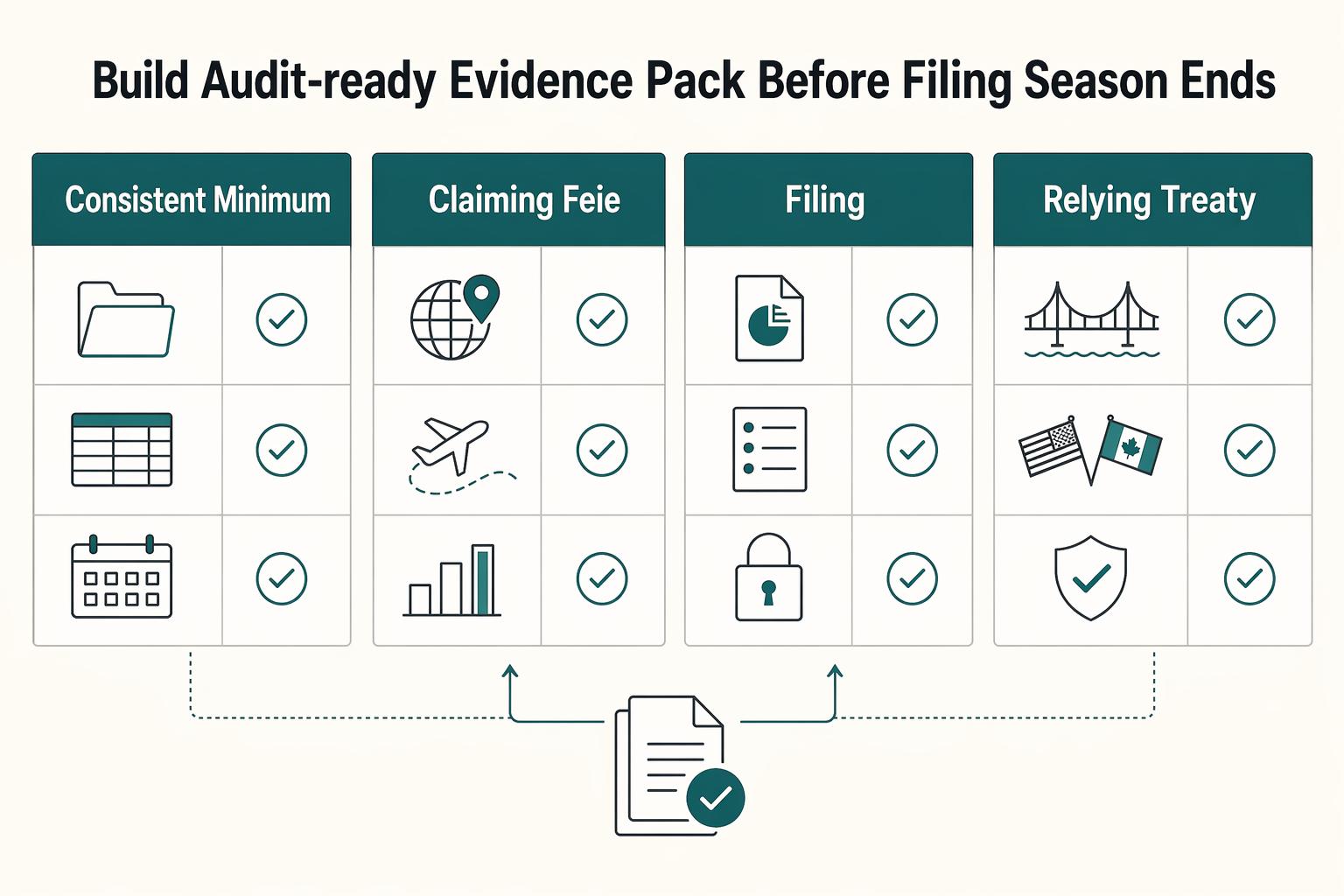
Build an Audit-Ready Evidence Pack Before Filing Season Ends#
An audit-ready file is mostly a retrieval problem. Your position is only as strong as your ability to open the right support quickly, so build the evidence pack before submission, not after.
| Situation | Records to keep | Article detail |
|---|---|---|
| Consistent minimum set | Core filing records, plus tracking for multi-country income, foreign account balances, and days abroad | Add a short note for each material income stream explaining treatment and why Form 2555 was used when it applies. |
| If claiming FEIE | Documentation supporting the FEIE position, foreign earned income records, and related return workpapers | Keep this support when Form 2555 is part of the filing package. |
| If your filing position relies on days-abroad records | Day-count worksheet and travel support | Keep these records together so day tracking is easy to verify later. |
| If relying on treaty positions | The specific U.S.-Canada treaty/protocol and technical explanation documents used | Keep a short memo showing which document informed each position. |
Use the table as a practical build order, not a universal sequence. Start with the consistent minimum set, then add FEIE-specific or treaty-specific support where it applies. The goal is not volume. The goal is that every meaningful choice in the return can be traced without guesswork.
Then run two checks before filing. First, each claimed number should trace to a source document. Second, each narrative claim should match the records in your file and the way the return was prepared.
Close the year with a one-page tie-out listing each claimed position, the affected form line, and the exact document location. That single page often becomes the fastest way to answer later questions.
Use consistent naming so retrieval stays fast under pressure. A practical pattern is tax year, counterparty, document type, and date. Whatever pattern you use, use it across every folder so another reviewer can handle the file without guessing.
One habit makes a bigger difference than it sounds: run a retrieval drill before submission. Pick three material amounts on the draft return and confirm you can quickly open the supporting records and memo. If retrieval is slow, clean up the file structure before filing.
After submission, freeze the evidence pack. If anything changes, log the date, the reason, and the affected forms. That prevents silent edits and gives you a clear timeline if draft and final filings differ.
Even with good records, some situations are not worth forcing on your own. The next step is knowing which fact patterns justify early escalation.
Related reading: US-Australia Tax Treaty Independent Personal Services for Freelancers.
Red Flags That Mean You Should Escalate Early#
Some issues are cheaper to escalate than to fix later. If the filing position depends on a close judgment call, bring in help before submission.
These are the main red flags:
- You cannot tell whether
Form 8938applies to you. - It is unclear whether you must file a U.S. income tax return for the year.
- You are unsure whether foreign financial assets cross the
Form 8938reporting threshold. - Foreign-asset reporting may overlap across
Form 8938andFinCEN Form 114 (FBAR). - Support for foreign-asset reporting is incomplete, and missed reporting can carry serious penalties.
Use a short pre-filing screen for Form 8938: confirm whether Form 8938 applies to you, confirm you must file a U.S. income tax return, then test aggregate asset values against the applicable reporting threshold. Form 8938 is attached to the annual tax return, not filed separately. The baseline threshold is at least $50,000 for certain taxpayers, and some taxpayers have higher thresholds. If no U.S. income tax return is required for the year, Form 8938 is not required under that exception. Filing Form 8938 does not remove any separate FBAR filing requirement.
A practical trigger is simple: if two reasonable professionals could disagree on your position, get cross-border advice before you submit.
Escalate early when support is incomplete, even if the legal answer seems clear. A technically correct position backed by weak records is still a filing risk.
When you do escalate, send structured questions instead of a broad request for review. Include the exact decision point that is uncertain and the facts behind it. Focused questions usually produce faster, clearer guidance.
If advice comes back with conditions, write those conditions into the file before you continue drafting forms. Your final package should reflect the same assumptions used in the professional review.
If you are using a tool to keep all this together, apply the same test: it should make the support easier to trace, not blur the line between recordkeeping and legal judgment.
Use Gruv Records to Make Cross-Border Tax Work Cleaner#
Use Gruv for documentation control, not legal interpretation. The goal is simple: every reported amount should be traceable, reviewable, and versioned.
Set up one packet per material payment#
Use one packet per material payment so support is not scattered across email, drives, and exports.
For each packet, keep core items such as contract or statement of work, invoice, payout or bank proof, payment date, currency, and counterparty. If cash received does not match the invoice because of fees, FX conversion, or partial payment, add a short note in the packet so your books, bank records, and return workpapers stay aligned.
Add the mapping note while the facts are fresh#
A packet is most useful if it also says where the amount goes. Add a short mapping note that states what the payment was for, how you labeled it in your records, and where it flows in your filing package or workpapers.
Keep the note operational, not legal. The point is to trace each number from source document to form line or workpaper reference without rebuilding the year from memory. If your travel and work timeline is still unclear, clean that up first with the digital nomad tax guide.
Freeze the file and record the version used#
When year-end numbers are stable, freeze a year-specific copy of the full file. Before filing, verify the current revision of the forms or instructions you rely on, then record which version you used.
This matters because compliance materials can change after a revision date. Record the revision date, edition, or version identifier shown in the materials, and save that version with your filing packet. If you want a treaty workflow example, see US-Netherlands Tax Treaty Filing Framework for Independent Contractors.
Log changes and finish with a tie-out#
After the freeze, log every change: date, what changed, why, and which packet or workpaper was affected. If income labeling changes late, update the packet note and return mapping together.
Use this checklist monthly and again before submission:
- Monthly mini-close: Confirm each newly closed payment has a packet, complete source documents, and a mapping note with date, currency, counterparty, and any amount explanation.
- Pre-submission map check: Confirm every reported amount traces to a packet, every packet has a mapping note, every mapping note points to a form line or workpaper reference, the frozen year file is saved, and the form or instruction version used is documented.
Finish with a one-page tie-out listing each major reported amount, packet name, mapping note, and file location. It will not answer legal questions, but it gives reviewers a cleaner path to the supporting records.
For a step-by-step walkthrough, see A Freelancer's Guide to the US-Germany Tax Treaty.
Conclusion#
Use this sequence as a working checklist, not a legal filing order: residency decision first, income classification second, relief choice third, then filing. Keeping that order can reduce inconsistency risk because each later step has to match decisions you already documented.
Treat the treaty as a coordination tool for cross-border taxation, not a filing shortcut. Start with your facts and each country's domestic rules, then apply treaty treatment where it fits the same residency and income story. If your conclusion changes from form to form, pause and fix the file before you submit.
Run one pre-filing defensibility test: can an informed reviewer trace your residency position, income classification, and relief logic without extra context? If not, tighten the package first. The 2025 National Taxpayer Advocate Annual Report flags severe compliance burdens for taxpayers living abroad, plus long delays and hardships in IRS international withholding-relief processes and delays or inadequate responses to IRS records requests, so do not assume missing support will be easy to recover later.
- Write a one-page memo that states your residency position, income characterization, relief choice, treaty role, and any current-year items still waiting on verification.
- Tie every reported amount to source support: contract, invoice, payment proof, and the return position it supports.
- List unresolved assumptions in plain language, especially around residency facts, income labeling, and withholding treatment.
- Escalate early if two reasonable readings of the same facts lead to different filing outcomes, or if your records do not support one consistent story.
If you need to rebuild the broader travel and filing timeline, use the digital nomad tax guide. If you need a practical recordkeeping and compliance tie-out model, use US-Netherlands Tax Treaty Filing Framework for Independent Contractors.
If you want this process to stay repeatable each year, keep your travel and tax-home evidence in one place with the tax residency tracker.
Frequently Asked Questions
Do U.S. freelancers living in Canada still have to file a U.S. return?
Yes. If you still have a U.S. filing requirement, living in Canada does not cancel it, and you report the income on the U.S. return before claiming FEIE. Keep one working file that ties each contract, invoice, and payout to the return. If dates are unclear, rebuild your travel timeline first with the digital nomad tax guide.
Does the U.S.-Canada tax treaty eliminate filing in one country?
Usually, no. Start with domestic filing rules in each country, then apply treaty treatment only where your facts and the current treaty text support it. Document both countries' filings so they tell the same residency and income story in a one-page memo, and use US-Netherlands Tax Treaty Filing Framework for Independent Contractors as a process example for consistent mapping.
How do I decide between Form 2555 and Form 1116 as a freelancer?
It depends. Compare Form 2555 and Form 1116 on identical facts, and use FEIE only when the income is foreign earned income, your tax home is in a foreign country, and you meet a qualifying test such as 330 full days in a 12-month period. If you qualify for only part of the year, prorate the exclusion after verifying the current annual limit, then save your comparison memo. If you use Form 1116, file separate forms by income category and check only one category box per form.
What is the minimum form checklist for a U.S. freelancer in Canada?
It depends. Start with the U.S. return that reports the income, then add Form 2555 or Form 1116 based on the method you actually used. Add a short file note explaining why each form is included, and stop to resolve any amount that cannot be traced to a contract, invoice, payment record, and classification note.
When do FBAR, FinCEN, FATCA, and Form 8938 become part of the conversation?
Treat this as a separate screening step, not as part of the treaty decision. Verify current FBAR/FinCEN and Form 8938/FATCA thresholds, deadlines, and treaty interactions each year against your facts. Keep a dated screening memo, including years when no filing is required.
When should I stop self-filing and hire a cross-border tax professional?
It depends. Escalate when your outcome turns on close calls about residency, treaty interpretation, FEIE qualification timing, or inconsistent income labeling across records. Send a compact handoff pack with your residency timeline, contracts, invoices, payment proof, day-count support, and your Form 2555-versus-Form 1116 comparison.
Try a related tool
Researched and edited by the Gruv editorial team. Gruv builds cross-border billing, payouts, and finance-operations software for global businesses.
Sources
- cbp.gov/sites/default/files/2024-11/october_2024_cus...trusted
- congress.gov/115/chrg/CHRG-115shrg30925/CHRG-115shrg30925...trusted
- ftb.ca.gov/file/personal/residency-status/part-year-and...trusted
- ftb.ca.gov/forms/2023/2023-1031-publication.pdftrusted
- irs.gov/businesses/international-businesses/canada-t...trusted
- irs.gov/individuals/international-taxpayers/foreign-...trusted
Educational content only. Not legal, tax, or financial advice.
Related Posts

Digital Nomad Taxes in 2026 With a Defensible Filing Plan
With digital nomad taxes, the first move is not optimization. It is figuring out where you may be taxable, where filings may be required, and what proof supports that position.

Tbilisi Digital Nomad Guide for 2026 Long Stays in Georgia
Start with sequence, not excitement. If your income depends on delivering work on schedule, secure your legal footing, assemble your documents, and keep month one reversible before you optimize comfort.
The Best Tools for Tracking Your Credit Card Points and Miles
**Pick a stack based on your failure mode (choosing the wrong card vs losing visibility), then run a simple recurring check so you can keep rewards visible without turning them into admin work.** If you're a business of one, rewards only matter if the system runs without stealing focus from client work.