
Quick Answer
For freelancers, the statute of limitations IRS audit question is best handled as a tax-year decision system, not a one-line rule. Start with the common three-year baseline, then check for exceptions and unresolved facts before relying on any expiration date. Keep conservative records while uncertainty remains, and escalate early if you get an IRS notice or cannot defend the timeline.
You Need a Clear Audit Window Strategy Not Another Tax Myth#
Treat the statute of limitations question as an operations issue, not a loophole hunt. If you run a freelance business across borders, you do not need tax folklore. You need a repeatable process that keeps compliance clean when facts get messy across tax years.
The statute of limitations is the legal window when the IRS can review and resolve tax issues. An IRS examination (audit) means the Internal Revenue Service reviews return items to verify that you reported income, expenses, and credits accurately. Frame this as a workflow problem, and you can manage it even when some facts are still uncertain.
| What to track now | What it means for your workflow |
|---|---|
| IRS mail is operational input | The IRS often contacts taxpayers by notice or letter, so open every IRS notice, read it fully, and log it the day it arrives. |
| A notice defines scope | The notice tells you the tax year, what action the IRS is taking, and the next step you need to execute. |
| Audit selection is not automatic guilt | If the IRS selects your return for review, respond with organized facts, not defensive guesses. |
| Statute timing has multiple clocks | A statute expiration date depends on which statute clock applies, so never assume one tax audit period fits every case. |
Use this guide as your playbook for the audit window decision:
- Decide which rule you will use for each tax year before you change any retention behavior.
- Separate known facts from unknown facts before you lean on a legal interpretation.
- Run one fast decision pass that ends in one action: monitor, retain longer, or escalate.
- Keep conservative tax records until you remove uncertainty.
Picture a simple scenario. You worked with clients in multiple countries, then an IRS notice arrives for an older return. You pull your ledger, confirm what you can prove, flag what you cannot, and escalate early if uncertainty remains. That is the kind of operator habit that cuts surprises and speeds response.
If global mobility adds complexity, review the digital nomad tax guide. Then apply the same safe-default discipline to your federal tax statute of limitations workflow.
If you want a broader read, see The Best Digital Nomad Cities for Entrepreneurs and Startups.
What Does the Statute of Limitations for an IRS Audit Actually Mean?#
The IRS audit statute of limitations sets the legal window for IRS action, and 3 years is the usual baseline for assessment. Use that baseline, then confirm exceptions before you rely on it. You are tracking clocks, and those clocks drive decisions on compliance, records, and escalation.
The statute of limitations is the legal time window when the IRS can review and resolve tax issues on a return. An IRS audit means the Internal Revenue Service examines books, accounts, and financial records to verify accurate reporting and the correct tax amount. These definitions matter because they turn vague audit anxiety into specific workflow tasks.
For the federal tax statute of limitations, anchor to 26 U.S.C. § 6501(a). The general assessment rule says the IRS usually has 3 years after the return due date (including extensions) to assess tax, with exceptions in the same legal framework. Treat that as your baseline, then confirm whether any exception changes the window for the specific year you are working on.
| Term | What it means in practice | What you do |
|---|---|---|
| Assessment Statute Expiration Date (ASED) | The deadline for IRS assessment actions on a return | Track the date for each tax year and flag uncertainty early |
| Refund Statute Expiration Date (RSED) | The deadline for a refund claim window | Apply the later-of test and log filing and payment dates |
| Statute expiration date | The end of the relevant statute clock, which depends on the statute type | Confirm which clock applies before changing retention decisions |
| Refund claim | A request to recover overpaid tax, generally tied to a 3-year filing clock or 2-year payment clock | Preserve proof of filing and payment facts before you submit |
When the applicable statutory period expires, IRS authority is limited under that statute, including assessment, collection, and refund-claim allowance. Keep your tracking specific to each return and each clock.
Picture a freelance operator with cross-border income who receives an IRS notice while preparing a refund claim. They do not guess. They map the return facts, separate ASED from RSED, and keep tax records until the timeline is clear.
What Is Known and Unknown From Current Guidance?#
Treat the audit-window timeline as a baseline plus exception check, not a fixed promise. The biggest failure mode is treating summary guidance as a taxpayer-specific answer. Your job is to separate what is stable from what depends on case facts.
What you know: the IRS describes a statute of limitations as a legal window to review and resolve tax issues. It also states that once the applicable statutory period expires, it can no longer assess or collect additional tax, or allow a refund claim under that period. Public-facing tax-attorney guidance presents a general three-year baseline audit lookback to start your analysis.
What you do not know from summary guidance alone: not every return has the same fact pattern, and you cannot assume one clock applies identically to assessment, collection, and refund questions. Exception framing exists, including three-year, six-year, or longer windows in specific circumstances, including fraud. High-level pages do not give you a final answer without the underlying filing facts.
One tax-attorney source states the rule plainly:
"a revenue agent must have a clear and compelling reason for reaching beyond the three and six year limits."
Keep that framing in mind whenever you evaluate a statute expiration date.
| What is known now | What remains unknown without case facts | Safe default action |
|---|---|---|
| IRS provides baseline statute rules | A summary page does not resolve every return scenario | Review one tax year at a time |
| General three-year framing appears in guidance | Exceptions can change the practical window | Mark assumptions before you decide |
| Expiration limits IRS authority under the applicable period | Assessment, collection, and refund clocks may differ | Track each clock separately |
| Audit years can expand when substantial error is identified | You cannot confirm a final date from headlines alone | Keep conservative tax records and escalate when uncertain |
Picture a freelance consultant with cross-border filings who receives a new IRS notice on an older return. They log known facts, flag unknown triggers, and ask a qualified advisor to confirm the statute position before changing retention decisions.
Is the Three Year Rule Always Enough for Freelancers?#
No. Treat the three-year rule as a baseline, then test exception risk on every return before you rely on it. Once you accept that the baseline is not a guarantee, the job becomes consistent. Run the same test on each tax year.
| Situation | Timing | What changes |
|---|---|---|
| General assessment rule under 26 U.S.C. § 6501 | Generally 3 years | Baseline tied to return due dates and filing timing |
| Some income reporting situations | 6 years | Assessment window can extend |
| False or fraudulent return | Open at any time | Assessment and collection can remain open |
| No return filed | Open at any time | Assessment and collection can remain open |
| Statutory waiver signed | Assessment time extends | Can change the window for a specific year |
| Deficiency notice | 90 days to respond; 150 days if outside the United States | Response timing matters |
Under 26 U.S.C. § 6501, the federal tax statute of limitations on assessment generally gives the IRS three years, tied to return due dates and filing timing. The IRS refers to this assessment window as the Assessment Statute Expiration Date (ASED). The Internal Revenue Service also states that some income reporting situations can extend that assessment window to six years. In false or fraudulent return cases, or when no return is filed, assessment and collection can remain open at any time. Other exceptions under § 6501 can also apply.
The IRS can also ask you to sign a statutory waiver that extends assessment time. That one step can change your assessment window for a specific year, even when the baseline looked clean. If you receive a deficiency notice, response timing matters as well: you generally have 90 days (150 days if outside the United States) to respond.
Run this gate on each tax year#
| Decision gate | What to verify | Action if unclear |
|---|---|---|
| Filing timeline clarity | Due date, extension status, filing date, and whether you filed early | Keep tax records longer and flag the year |
| Income completeness confidence | Missing income risk, late documents, and reconciliation gaps | Move the year to high-risk review |
| Statute modifiers present | Waiver signed, deficiency process active, or facts that trigger exceptions | Escalate to a tax professional now |
Use a simple rule for freelance tax compliance:
- Start with the three-year baseline.
- Test each return for exception signals.
- If any signal stays unresolved, stop disposal decisions.
- Retain conservative tax records until a qualified advisor confirms your exposure.
Imagine a freelance consultant who filed one year on extension and later finds a missed client payment in another year. They should flag that year as exception risk, preserve records, and get professional review before they change retention rules.
Your 10 Minute Audit Window Decision Framework#
Run one decision pass per tax year, then assign a clear action before you close the file. Start with the general 3-year assessment baseline, then test exceptions and data gaps before you trust any date.
Your goal is not to predict every outcome. It is to make one defensible decision per year based on facts you can prove today.
Use this framework to manage statute timing with discipline, then document the output in your ledger:
| Step | What you capture | Decision output |
|---|---|---|
| Build your one-page ledger | Tax year, tax return filed status, filing date, extension status, and amendment notes | A complete timeline you can defend |
| Score confidence by year | IRS baseline timing, return quality, and evidence quality for each file | High, medium, or low confidence on statute timing |
| Set an action per year | Provisional statute expiration date and current risk level | monitor, retain longer, or escalate now |
| Log advisor questions | Open issues tied to Form 8938, FBAR, and FinCEN reporting where relevant | A clean handoff list for professional review |
| Set review triggers | New IRS notice, filing changes, amended return activity, or new records | Re-check that year |
Keep the gates strict: start with baseline assessment timing, then test for exceptions and data gaps before you trust any audit window. For late-filed returns, timing can run from when the IRS received the return.
If a year includes cross-border reporting, note that FBAR goes to FinCEN and not to the IRS. Keep that workstream separate from your federal return file.
This is the core rule for tax compliance and record retention:
- If facts stay clear, monitor and document.
- If facts turn mixed, retain longer.
- If facts conflict or stay incomplete, escalate now.
Imagine you changed countries and later get an IRS notice about an older return. You pull the ledger, note the tax year and next steps in the notice, mark one year low confidence because records conflict, and route that year for advisor review instead of guessing a disposal date.
If cross-border reporting keeps breaking your process, use our guide to a defensible 2026 filing plan as a companion workflow, not a replacement for year-by-year tracking.
Build a Tax Records System You Can Defend Under Audit#
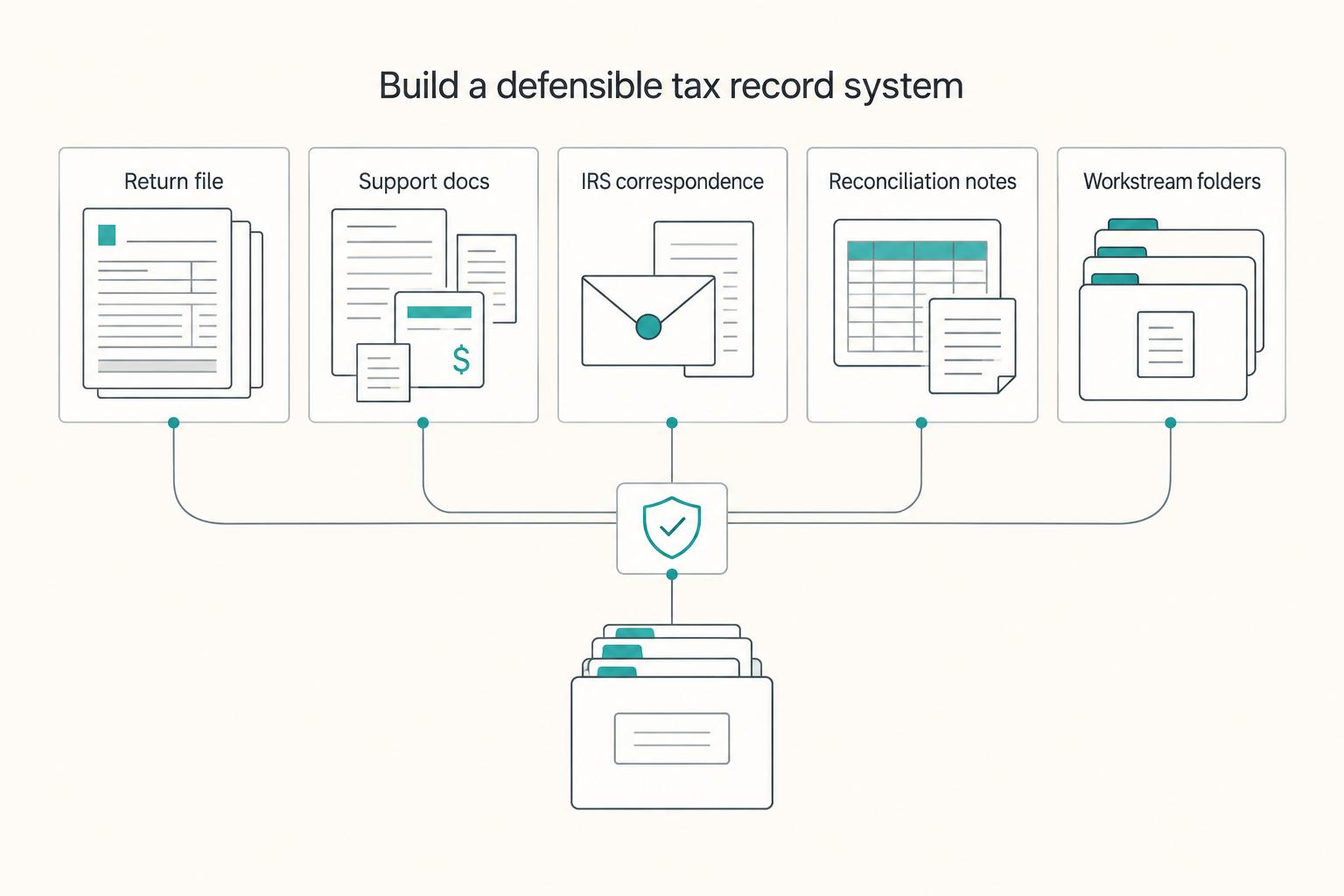
Build tax records by tax year with a conservative retention rule, so you can respond to IRS notices quickly and accurately when needed. A clean audit-window plan still fails if your records are scattered. The fix is simple: standardize the packet.
| Record or scenario | Retention guidance |
|---|---|
| Records that prove income or deductions | Keep as long as needed, generally through the period of limitations |
| Many returns | Use 3 years as a common baseline, but do not treat it as universal |
| Employment tax records | Keep for at least 4 years |
| FBAR account records | Keep for 5 years from the FBAR due date |
| Fraudulent or invalid return scenarios | Treat as open-ended risk, since no assessment limit may apply |
| Facts remain unclear | Retain longer and get professional confirmation before disposal |
Treat each tax year as its own audit packet. Keep the same packet structure every year so you can find answers fast when the Internal Revenue Service asks questions.
| Audit packet part | What to include | Why it protects you |
|---|---|---|
| Return file | Filed tax return, extension records, amendment notes | Confirms what you filed and when |
| Support docs | Income records, deduction support, payment proof | Substantiates income and deductions |
| IRS correspondence | Every IRS notice or letter, response drafts, sent confirmations | Reduces deadline risk and response errors |
| Reconciliation notes | Short explanations that tie totals across documents | Makes audit and notice review easier |
| Workstream folders | Schedule SE support for self-employment income, plus separate Form 8938 and FBAR evidence | Keeps domestic and cross-border obligations clear |
Run retention rules with safe defaults, not guesswork:
- Keep records as long as needed to prove income or deductions on a return, generally through the period of limitations.
- Use three years as a common baseline for many returns, but do not treat it as universal.
- Keep employment tax records for at least four years.
- Keep FBAR account records for five years from the FBAR due date.
- Treat fraudulent or invalid return scenarios as open-ended risk, since no assessment limit may apply.
- If facts remain unclear, retain longer and get professional confirmation before disposal.
For IRS mail, set one non-negotiable rule. Review each notice carefully, log the tax year, action required, due date, and current response status, then keep a copy in the packet. This habit helps reduce deadline risk and avoid response errors.
Imagine you receive an IRS notice while traveling. You open the packet for that tax year, pull the notice log, match records to Schedule SE and cross-border files, and respond on time without scrambling. That is how the limitations rules become operational, not theoretical.
What Should Trigger an Immediate Call to a Tax Professional?#
Call a tax professional immediately when deadlines, statute uncertainty, or cross-border reporting gaps can change your outcome before you can verify facts yourself. The escalation rule is straightforward. If a clock is running and you cannot prove your position from your packet, do not improvise.
| Trigger | Why risk jumps | Immediate action |
|---|---|---|
| Active IRS audit or new IRS notice with a response date | IRS actions run on deadlines, and if you miss one, the IRS can complete the audit and issue proposed changes without your input. | Call the same day, log the deadline, and build a response plan by tax year. |
| CP2000 notice arrives | CP2000 is a proposed-change notice, not a bill, but you still need a timely response. | Escalate before you agree or disagree, so your response matches your records. |
| You cannot define the tax audit period for a specific tax return or tax year | If you cannot defend your assumptions, you can misjudge how long exposure may remain open. | Pause record disposal for that year and get a professional statute review first. |
| Cross-border reporting feels unclear or incomplete | You must test Form 8938 and FBAR separately. You file FBAR with FinCEN, not with the IRS, and Form 8938 issues can keep a statute window open. | Escalate immediately when FATCA, FBAR, FinCEN, or Form 8938 duties are uncertain. |
| Prior audit findings affect current filing decisions | Old findings can point to recurring documentation gaps, but they do not create a universal rule for future years. | Request a filing posture review before your next submission. |
When you make the call, ask for three concrete decisions: deadline strategy, records-gap plan, and statute position by tax year. If an interview starts before you are ready, invoke your right to representation and consult first. For some mail audits, the IRS can ordinarily grant a one-time automatic 30-day extension. Treat that as backup, not your primary plan.
Picture a consultant moving between countries who finds gaps in foreign account files after an IRS notice arrives. They pause disposal decisions, escalate, and align cross-border filings before responding.
For broader cross-border prep, review Digital Nomad Taxes in 2026 With a Defensible Filing Plan. Bring a focused question list to your advisor.
Run a Repeatable System and Keep Conservative Defaults#
Win this by running a repeatable system, not by memorizing legal trivia. The point of this playbook is consistency. When facts are clear, act from your documented timeline. When facts are unclear, keep conservative defaults and escalate.
Turn rules into a tax year operating loop#
| Loop item | What to track | Rule |
|---|---|---|
| One-page tracker | Return due date, filing date, provisional statute expiration date | Build one for each tax year |
| Assessment baseline | Usual three-year baseline under 26 U.S.C. § 6501 | Test for exception signals, including scenarios where the window can extend to six years |
| Filing timing | When the IRS received a late-filed tax return | Treat an early-filed return as filed on the due date |
| IRS notices | Tax year, IRS action, next step | Respond inside the stated window |
| Supporting tax records | Records tied to the return | Keep them until every relevant limitation period closes, and longer if another obligation could still require them |
- Build a one-page tracker for each tax year with return due date, filing date, and a provisional statute expiration date.
- Start with the usual three-year baseline for assessment timing, then test for exception signals under 26 U.S.C. § 6501, including scenarios where the window can extend to six years.
- If you filed late, anchor the clock to when the IRS received the tax return. If you filed early, treat it as filed on the due date.
- Track each IRS notice by tax year, IRS action, and next step so you can respond inside the stated window.
- Keep supporting tax records until every relevant limitation period closes, and keep them longer if another obligation could still require them.
This loop keeps the audit window practical for freelance tax compliance and helps you act instead of guess.
Use a safe escalation rule before you change retention#
Imagine preparing to purge old files after a busy quarter. A new IRS notice arrives for an older return, and one timeline detail still looks uncertain. You pause disposal, call a qualified representative, and update the tracker before taking action. That single pause protects options.
Use this decision rule:
- If the timeline is documented and defensible, execute your plan.
- If the timeline is ambiguous, escalate early to an enrolled agent, CPA, or attorney with IRS representation rights.
- Do not rely on a PTIN-only preparer for IRS audit representation strategy.
If cross-border payment trails are messy, tighten your bookkeeping. Make sure your tools can export the records you would actually need under audit. Then confirm they cover your situation.
Frequently Asked Questions
What is the statute of limitations for an IRS audit?
The statute of limitations sets the legal window the IRS uses to assess tax and resolve return issues. In practice, you track this as an assessment clock for each tax return and tax year, and the IRS refers to this assessment timing as ASED.
Is it always three years?
No. The IRS commonly uses a three-year baseline, but exceptions can extend the timeline. IRS guidance also discusses six-year timing in certain income reporting situations, and it treats no-return or fraudulent-return scenarios as open-ended risk.
How far back can the IRS audit my return?
Start with the three-year baseline, then test each return for exception triggers before you decide your tax audit period. Review one tax year at a time, document your assumptions, and keep the conservative stance if facts conflict. If you cannot defend the timeline from your records, escalate.
When can I safely discard tax records?
Discarding records is a decision, not a date on a calendar. Keep tax records that support income, deductions, or credits through the applicable period of limitations, and only use three years as a default after you confirm exceptions do not apply. Some cases require longer retention, including seven years for certain bad-debt or worthless-securities claims and at least four years for employment tax records. If you have uncertainty, keep records longer and get professional confirmation before disposal.
What should freelancers keep to stay audit-ready?
Keep a tax-year packet with your filed return, support for income and deductions, payment proof, and IRS notices. Add short reconciliation notes so totals tie cleanly across documents. If you operate across borders, keep a separate checklist for cross-border items and use the digital nomad tax guide as a companion workflow.
Does a refund claim change the timeline I should track?
Yes. A refund claim runs on its own statute clock, often called RSED, and you should track it alongside your assessment timeline. The general rule uses the later of three years from filing or two years from payment, and missing that window usually closes the refund or credit path.
When should I talk to a tax professional instead of handling it myself?
Escalate immediately when you get a deadline-based IRS notice, enter an active IRS audit, or cannot defend your timeline. Escalate before you destroy records or lock in a response position you cannot support. If pressure rises, get professional support early.
Try a related tool
Researched and edited by the Gruv editorial team. Gruv builds cross-border billing, payouts, and finance-operations software for global businesses.
Sources
Educational content only. Not legal, tax, or financial advice.
Related Posts

Digital Nomad Taxes in 2026 With a Defensible Filing Plan
With digital nomad taxes, the first move is not optimization. It is figuring out where you may be taxable, where filings may be required, and what proof supports that position.
The Best Digital Nomad Cities for Entrepreneurs and Startups
Choosing a nomad base for your company is an execution decision first. Lifestyle matters, but it belongs in the second round. The costly mistakes usually show up after the city-ranking stage, when a place that looks great online turns into a slow or expensive setup once you start invoicing, signing contracts, and working against real deadlines.

The Freelance Payment Penalty: A Modeled Audit of Platform Fees, FX Spreads, and Payout Delays
The money rarely disappears through a single, easy-to-spot fee. The real loss is stacked. A marketplace takes its commission, a processor adds a charge for international cards, a bank or payment company converts the currency at a spread, a platform holds the funds before release, and a wire sheds a little to intermediaries on the way in. Each layer looks defensible on its own, but the worker feels the combined result as a smaller deposit and a later payday.