

Quick Answer
Define a narrow task, authorized data and tools, a held-out evaluation set and critical pass/fail rules before quoting delivery. Keep prompt/model versions, results and known limits. Agree correction and change boundaries, then invoice on the actual advance, time or acceptance trigger.
Sell a tested prompt workflow with clear boundaries#
Treat this as a service business from day one. Clients pay for clear outcomes, predictable delivery, and records that still hold up when questions come later.
Prompt engineering is the work of giving models strong context and refining instructions when results miss intent. You are selling better task outcomes through testing and iteration, not one-off magic outputs.
Build income forecasts from your own scoped fees, delivery costs and collected payments. A headline about someone else’s monthly earnings does not establish demand, achievable rates or how many unpaid revisions your work will need.
Set operating discipline early:
- Define each engagement in one scope note: business task and required output format.
- Use one delivery standard for every handoff: prompt version, test inputs, and approved output.
- Track payment evidence the same way each time: invoice ID, due date, approval message, and paid date.
- Run one quality checkpoint before handoff: retest with fresh sample inputs and confirm the agreed intent still holds.
A common failure mode is strong outputs with weak business controls. You lose margin when revisions are open-ended, approvals are vague, or invoicing is inconsistent. If the client cannot state the task outcome and reviewer in plain language, start with a small paid diagnostic before full build work.
Early deals can fail even when the prompt draft is decent, especially when the client cannot connect it to a business result or when approval evidence is scattered across chat threads and forgotten messages. Keep the operating loop visible: scope note, test evidence, approval message, invoice, and payment confirmation.
Keep a practical stance. Do not promise that better prompts will fix every weak input, every reviewer conflict, or every policy constraint. Promise that you will improve output quality within clear boundaries and show proof at each checkpoint. That is the position clients can trust and pay for.
Define the service before you pitch it#
Sell a narrow task with inspectable outputs. State the context, instructions, examples, constraints and expected format, then compare results on representative inputs. Prompt techniques and results vary by model; clear wording alone does not guarantee factual accuracy.
| Deliverable | Included detail |
|---|---|
| Prompt library | Mapped to defined tasks |
| Test cases | Sample inputs and expected output characteristics |
| Output rubric | Pass or fail criteria |
| Short handoff note | Final prompts, assumptions, known limits, and retest steps |
Put scope boundaries in writing so the engagement stays focused on prompt work and output quality.
State the use cases you support, such as content operations, support macros, and research tasks. If requests expand beyond prompt ownership, document the change and revisit scope and pricing before continuing.
A clean service definition also protects sales conversations. When someone asks for several outcomes in one call, bring the discussion back to one business task, one reviewer, and one acceptance target. You can still pursue broader work later, but the first project should prove value in a scope that can be inspected.
Keep your offer language practical:
- What task improves.
- What files or artifacts the client receives.
- How quality is checked.
- What is excluded unless added through a scope change.
That clarity reduces mismatched expectations and keeps the project focused. If you want examples, see The Best AI Writing Assistants for Freelance Content Creators.
Pick your client channel based on control and risk#
Pick the channel where you can verify fit and payment risk fastest, then expand after you have your own proof.
Compare a marketplace route, direct outreach and referrals by access to suitable buyers, fees, payment rules and proposal effort. A hiring category shows that listings exist; it does not prove a project will be available, well scoped or paid.
Test one channel with a narrow offer and record qualified conversations, signed work, revision hours and collected fees. Use that evidence when deciding whether to expand.
Check who contracts with you, any platform restrictions, dispute process and when funds can be released. Advertised trials, NDA support or round-the-clock support should be verified against the actual agreement before you price the work.
Use this decision rule:
- Without case studies, test one suitable channel using a narrow demonstration and the same qualification rules.
- With repeat work, compare collected fees, revision load and acquisition effort; offer a retainer only for defined recurring needs.
Run a short checkpoint before committing:
- Count qualified leads, not just inbound volume.
- Track proposal-to-call and call-to-close rates.
- Record revision load from weak briefs.
- Log payment friction such as approvals, disputes, and delays.
The point is control, not platform loyalty. A channel is useful when it gives you enough signal to qualify quickly and enough structure to enforce scope and approvals. If it generates constant renegotiation, it is expensive even when lead volume looks strong.
As your evidence grows, update channel choice with your own numbers. Keep the comparison simple: where do good-fit leads convert with acceptable revision load and cleaner payment behavior. Put more attention there and treat other channels as secondary tests.
Qualify clients before scope to avoid bad-fit projects#
Qualify before you estimate. If outcomes and constraints are unclear, treat the project as high risk and avoid full delivery commitments. Bad-fit work often starts the same way: too much is agreed too early, expectations drift, and later discussions turn into arguments about what good means.
| Intake item | What to capture |
|---|---|
| Business goal | One sentence on the outcome the buyer needs |
| Current process | How work is done now, including who reviews final output |
| Tool stack | ChatGPT, OpenAI API, or no API, plus hard limits |
| Success metric | What result counts as acceptable in production |
| Owner sign-off | The person who can approve scope changes and final delivery |
Miscommunication and mismatched expectations can create difficult client situations, so your intake should force clarity before quoting.
At minimum, capture the items above before you quote.
Require sample inputs and target outputs before pricing. If samples are missing, state higher uncertainty and narrow assumptions or start smaller. In prompt work, clear constraints make quality testable.
Confirm operating constraints before you draft: turnaround expectations, reviewer availability, feedback windows, and documented data restrictions. This helps prevent late blockers and reduce rework from last-minute rule changes.
Keep one hard red-flag rule. If the client cannot define outcomes, offer a paid discovery micro-engagement instead of full delivery. That can align constraints, set evaluation criteria early, and lower unpaid proposal risk.
If outcomes, examples, and reviewer ownership are clear, move to scoped delivery. If any are missing, run paid discovery first and keep estimates provisional until evidence improves.
Treat intake as a risk filter, not a formality. A short call can sound promising while hiding major blockers, such as no reviewer availability, no historical samples, or no decision owner who can approve final output. Surface those gaps before scope is drafted.
You can also reduce conflict by writing assumptions explicitly in your estimate. If the estimate depends on client response timing, sample quality, or reviewer attendance, state that in plain language. That way, delays and rework have a shared reference point instead of turning into blame.
A practical sequence works well:
- Capture intake answers in one document.
- Mark unknowns that affect price or timeline.
- Decide whether the project qualifies for full scope or paid discovery.
- Send the estimate with assumptions and revision boundary attached.
This keeps early sales momentum while protecting you from commitments that cannot be delivered as quoted.
Scope each project with clear deliverables and failure boundaries#
Write scope so delivery can be inspected, not debated. Define what ships, how it is tested, and what done means before you draft prompts.
In the SOW, anchor delivery to a clear artifact set:
- Prompt set mapped to each approved use case.
- Evaluation set built from real or representative samples, including normal and messy inputs.
- Acceptance criteria with plain-language pass/fail rules.
- Revision limit that separates revisions from new scope.
- Handoff documentation with final prompts, assumptions, and retest steps.
Add a failure-mode section on purpose. Call out where outputs can degrade, such as messy inputs, stakeholder changes, and edge cases, then define support handling for each case.
Scope a new use case or integration through an approved change before starting that additional work. Keep existing commitments moving where feasible; a change request is not permission to suspend all contracted delivery.
Flag early when prompting alone is not enough. If the use case needs retrieval, tools, structured outputs, or guardrails, state that in scope and document dependencies before build work starts.
For a deliverable whose acceptance depends on QA, compare it with the agreed criteria and record failures as well as passes. Completion does not mean every future model output is guaranteed. Keep acceptance distinct from any advance or scheduled time invoice.
Ask the reviewer to connect vague feedback to an agreed criterion. A failure against that criterion remains an owed correction; a new task, audience or format can be a change request. A revision cap should not turn your own nonconforming work into a paid extra.
Keep delivery evidence attached to each artifact. For example, if the prompt set is approved, save the prompt version and test IDs that support approval. If handoff is approved, keep the message that confirms acceptance and any limits stated by the approver. This helps reduce confusion if reviewers change mid-project.
A strong closeout packet usually includes:
- Final artifact list tied to scope language.
- Pass or fail evidence for each acceptance criterion.
- Remaining known limits and expected human review points.
- Confirmation that out-of-scope requests were either declined or moved into a change order.
That packet helps protect margin after delivery and gives you a factual record when new requests appear after acceptance.
Choose pricing model with explicit decision rules#
Price against uncertainty first, then against execution effort. Use the scope artifacts above as a practical quoting framework, not a legal contract rule.
- Consider an Hourly Contract when discovery is active and troubleshooting is part of the work. Stay hourly while approaches and problem definition are still moving.
- Consider a Fixed-Price Contract when requirements, real examples, and Acceptance Criteria are stable. Fixed pricing is easier to defend when context is specific enough to test pass/fail outcomes clearly.
- Consider a Retainer Agreement after baseline delivery is working and the client needs ongoing optimization, monitoring, and monthly prompt maintenance. Keep the retainer narrow and inspectable so support does not become open-ended.
| Contract type | Practical fit | Decision checkpoint | Main risk |
|---|---|---|---|
| Hourly Contract | High ambiguity, active diagnosis | Discovery is still changing scope | Client expects fixed outcomes too early |
| Fixed-Price Contract | Stable scope with testable acceptance | Use cases, examples, and pass/fail criteria are locked | Scope growth hidden as revisions |
| Retainer Agreement | Ongoing optimization after handoff | Monthly tasks and review cadence are explicit | Always-on requests without boundaries |
Use one rule consistently: when clarity is low, expand discovery first. When scope is stable and testable, fixed pricing can be safer. When delivery is stable but needs steady tuning, use a retainer with explicit monthly limits.
Pricing discipline matters because unclear boundaries create avoidable disputes. If a buyer expects ongoing experimentation inside a fixed project, margin can disappear even when your rate is correct.
Before each quote, check the same items:
- Are use cases locked?
- Are samples real and usable?
- Are pass or fail criteria agreed?
- Is revision count tied to scope?
If any answer is no, stay in discovery or keep pricing provisional. If all answers are yes, fixed pricing becomes more defensible. If post-handoff work is predictable and recurring, a retainer can work well as long as monthly tasks and limits are visible. If you want a next step, browse Gruv tools.
Build a repeatable QA process clients can trust#
QA belongs in scope from kickoff, not as cleanup at the end. Confirm Acceptance Criteria early and turn them into test artifacts: a test plan, a reviewer checklist, and concrete cases.
Use scenario groups tied to known risks so coverage is visible.
Hypothetical support-email project: generate drafts for three enquiry types from synthetic tickets and an approved policy excerpt. The output must quote only supported policy facts, identify missing information and route requests outside the policy to a human. Exclude sending messages, issuing refunds and changing customer accounts.
Separate examples used to refine the prompt from a held-out evaluation set. Include normal cases, missing fields, conflicting policy, long inputs and attempts to override instructions. Repeat cases where variability matters; retain the model identifier, prompt version and settings with the results.
For an illustrative test, use 30 held-out tickets with three runs each: 90 outputs. Require at least 86 usable drafts out of 90 and no invented policy commitments or exposed secrets. If 87 are usable but one invents a refund entitlement, the critical rule fails despite 96.7% usability. These are negotiated example thresholds, not a universal benchmark.
Make reviewer effort easy by keeping evidence in one place. Put each criterion next to its matching test evidence so decisions are quick and traceable.
When revisions are requested, rerun the affected test set and the regression suite before sending updates. This helps prevent fixes in one case from breaking another that already passed.
A practical QA rhythm looks like this:
- Confirm criteria at kickoff.
- Build tests from real samples.
- Run baseline outputs and log issues.
- Apply prompt edits and rerun tests.
- Deliver evidence pack with pass or fail results.
Record the reviewer’s rubric, each case/result and critical failures so the client can inspect what improved. Sample performance describes the tested setup; it does not establish a production success rate or replace human review of sensitive decisions.
Write contracts that protect your work and your downside#
Use the contract to reduce predictable losses. It should define ownership, payment terms, and how scope changes are handled.
Without a clear contract, the pattern is familiar: scope creep, payment disputes, and legal ambiguity. The goal is not a longer document; the goal is fewer interpretation gaps, so use this practical clause set:
| Clause | What to state clearly |
|---|---|
| Intellectual Property (IP) Ownership Clause | What the client owns, what transfers, and when transfer happens |
| Confidentiality Clause | What is confidential, who may access it, and handling expectations |
| AI-Use Disclosure Clause (if relevant) | Whether AI tools are allowed and the boundaries for their use |
| Payment terms and dispute process | Milestones, invoice timing, and dispute handling |
Inventory client-specific prompts, your existing templates, licensed source material and confidential inputs separately. Define transfer or reuse rights you can actually grant. Do not promise exclusive copyright in every model output; in the US, copyrightability depends on human authorship and the particular work.
Consider a Change-Control Clause so revisions stay tied to scope. Define what counts as a change request, how pricing updates, and who must approve changes before extra work starts.
Treat templates as starting points, not legal certainty. Before reusing terms across jurisdictions, have local counsel review them, ideally counsel familiar with AI and LLM matters.
Keep contract language plain enough that both sides can summarize key terms without legal translation. If a clause cannot be explained in simple words, it is likely to be misunderstood in delivery.
During negotiation, focus on high-impact terms first:
- Scope boundary and change handling.
- Payment timing and approval evidence.
- Ownership transfer trigger.
- Confidential data limits.
Once those are clear, smaller edits are easier to settle. The contract then supports delivery instead of becoming a document no one checks until conflict appears. If you want a deeper dive, read our guide to using AI without scope, compliance, or payment chaos.
Handle sensitive data and compliance without slowing delivery#
Identify the authorized environment, purpose and permitted data before testing. Client permission alone does not override privacy law, confidentiality obligations or vendor terms. Use synthetic or demonstrably anonymized samples when a lawful live-data route is not established.
Remove unnecessary fields, identifiers, secrets and rare combinations that can identify someone. Masked or pseudonymized records may still be personal data, especially if a key or other context can reconnect them to a person; do not treat masking as automatic permission to upload.
| Control area | What to implement | Verification checkpoint | If missing |
|---|---|---|---|
| Input controls | Data leakage and DLP checks for PII, secrets, and regulated fields | Use synthetic markers to test blocking/redaction and inspect logs before any live input | Sensitive fields can pass through unnoticed |
| Output controls | Guardrails for unsafe or policy-breaking responses | Run high-risk prompts and require review sign-off before delivery | Unsafe output reaches client review |
| Observability | Logs, traces, redaction, and retention controls | Confirm redaction is enabled and access is limited to named reviewers | Audit trails can expose more data than needed |
| Stage validation | Built-in checks at each step of multi-stage prompt use | Require pass or fail status at each stage before handoff | Late-stage failures force broader retesting |
Verify the actual tool and account settings: approved data classes, retention, training use, logging, subprocessor access and deletion behavior. Do not assume every ChatGPT plan and API endpoint has identical controls, or that disabling training means nothing is stored.
Confirm applicable privacy roles, lawful processing and any cross-border transfer requirements before live-data validation. If the route is unresolved, stay with synthetic or demonstrably anonymized inputs rather than merely removing names from real records.
Data controls do not need to slow delivery when they are decided early. Problems usually appear when teams rush into testing and then discover restrictions after outputs already contain sensitive details. Early boundaries help prevent that reversal.
An exception request needs an authorized reviewer, lawful purpose, minimum data, approved tool and duration. An internal written approval cannot waive legal obligations. Record the decision and restore normal controls after the permitted test.
A practical pre-test check helps:
- Confirm data class of sample inputs.
- Confirm approved tool list.
- Confirm who can view logs.
- Confirm retention and redaction settings.
If the data class, tool or logging boundary is unclear, resolve it or use synthetic inputs. Keep this pre-test check with the QA plan so a later reviewer can see which environment was approved.
Get paid with clean records and fewer surprises#
For each invoice, use the billing trigger agreed for that fee. A discovery advance may be due before testing, hourly work may bill on a schedule, and a completion fee may require acceptance. Keep scope, actual trigger evidence and invoice details together without making all invoices depend on final sign-off.
| Artifact | What it should match | Verification checkpoint before sending |
|---|---|---|
| Approved scope | Actual fee basis and relevant scope/authorization | Match project and fee identifiers |
| Billing trigger evidence | Advance date, authorized time record or acceptance where required | Use evidence for the contractual trigger, not universal final sign-off |
| Invoice | Fee, amount, currency, due date and payer entity | Reconcile the actual trigger and schedule |
Follow the agreed delivery and payment schedule. Retain a package only where the contract and law permit; net terms may require full delivery before payment. State any lawful release condition before signing, not after the client has approved the work.
Compare the actual route’s fees, currencies, limits, eligibility and bank-availability timing. A provider’s marketing claim about global reach does not confirm that your entity and client can use that route. Keep customer payment, provider hold and available bank cash distinct.
Run monthly reconciliation so records stay clean:
- Match each payment to its invoice and actual advance/time/completion trigger.
- Store payment confirmation under the same job ID as the invoice.
- Flag overdue items for follow-up and escalate on the cadence defined in your agreement.
Hypothetical fixed project fee is 1,500: 600 agreed advance and 900 at accepted completion. If the client pays the 900 and a 27 processor fee is deducted, record 900 against the debt and 873 in the bank plus 27 fee. The fee is not another 27 still owed by the client unless separately agreed.
Use invoice lines that match the actual discovery, time, advance or completion trigger. For acceptance-based fees, link the approval and test report; for a time invoice, link the relevant time record and authorization.
Keep a single job record for each engagement that contains scope, approval evidence, invoice, and payment confirmation. That record can be your best defense when accounting teams ask for proof weeks after delivery.
Before sending any invoice, run a final check:
- Does the fee basis and trigger match the agreement?
- Is the relevant time, advance or acceptance evidence recorded?
- Does the due date follow the agreed schedule?
- Is the payer entity correct?
Small mismatches here can cause large delays later.
Deliver, hand off, and expand without scope creep#
Close projects with a handoff package that another reviewer can run without you. That is a practical way to limit scope drift and decide whether expansion is justified.
| Handoff item | Included detail |
|---|---|
| Final prompt set | Reproducible templates and examples |
| QA notes | Prompt/model versions, rubric and baseline-versus-revised results, including failures |
| Clear failure boundaries | Where outputs degrade or require human review |
| Final Handoff Documentation | Versions, settings and retest instructions; API snippets only when integration is in scope |
The final package should let a new reviewer run the work as documented.
Before closing, run a lightweight enablement session with the day-to-day reviewer using their own inputs. If they cannot reproduce accepted outcomes from the documentation, fix the handoff first and postpone expansion.
Retest after a model, prompt, policy source or integration changes. Text-only evaluation does not establish the behavior of a tool-enabled production system; verify each relevant dependency and require review before consequential actions.
Price expansion after the agreed baseline is usable. First correct failures owed under the original criteria; a genuinely new model, policy source, integration or maintenance need can be a separately scoped engagement.
Set a post-project checkpoint cadence to review drift against the original QA set and log prompt edits. Then decide whether to continue focused optimization or refresh prompts, tests, and Handoff Documentation first.
A strong handoff reduces common failures. The client should be able to run the prompts without live support and confirm whether results stay within accepted quality. Your handoff package should make both tasks clear.
Separate owed stabilization from new work. Correct your own nonconforming delivery under the existing agreement; price new use cases, tools or channels through an approved change. For post-handoff drift, apply the support or warranty terms before assuming a new fee.
Closeout decisions become simpler when you ask a few questions:
- Can another reviewer rerun the documented procedure and assess outputs against the rubric?
- Are known failure boundaries documented and understood.
- Is there evidence that baseline quality remains stable in routine use.
If the answer is yes, expansion can be priced and scoped with confidence.
Build your first reliable month in freelance prompt engineering#
Consistency matters in month one: keep scope tight, repeat a delivery process that works, and protect margin from scope creep.
Start with one narrow service and a repeatable process across projects. For fixed-fee work, include a scope document that defines what is included and what triggers additional paid work. That boundary matters because scope creep is a major profitability risk.
Choose one channel for an initial test and one task you can evaluate. Price from the work and risk involved; a public listing or another freelancer’s fee range does not establish your attainable price or demand.
Set pricing by scope clarity, then tighten as estimates improve:
- Use capped time billing or a fixed diagnostic when scope is uncertain.
- Choose a fixed fee when delivery and evaluation costs are predictable; preserve correction and change rules.
- Define recurring task limits, support windows and charges for a maintenance retainer.
For a hypothetical 20-hour project at a 50 internal delivery-cost rate plus 100 API/testing spend, estimated cost is 1,100. A 1,500 fee leaves 400 contribution before overhead and tax, or 26.7% of revenue. Six more hours add 300 cost and reduce that to 100, or 6.7%; define corrections and additional scope before committing.
For the first month, keep a simple delivery record:
- Qualify carefully.
- Scope tightly.
- Test against agreed criteria.
- Invoice on the agreed advance, time or acceptance trigger.
- Close with complete handoff records.
That pattern can give you better data for pricing, channel choice, and growth decisions in the months that follow.
Frequently Asked Questions
What is freelance prompt engineering in practical terms?
Freelance prompt engineering is the work of structuring inputs so an LLM returns clearer, more accurate, and more useful output for a business task. In practice, prompt quality often decides whether results stay generic or align with the goal. Typical deliverables include prompts, context blocks, examples, and explicit output formats.
How do beginners get first clients without exaggerating results?
Show a small task demonstration with the rubric, inputs you were authorized to use and all limitations. Describe it as a demonstration, not a paid client result or a guaranteed improvement. Offer a scoped diagnostic when the buyer’s task is still unclear.
What should a prompt engineering contract include before work starts?
Define the use case, artifacts, model/tool environment, evaluation rubric, critical failures, change process, correction obligations, billing triggers, IP rights you can grant and data-handling boundaries. Adapt the agreement to the jurisdiction and actual service.
How should freelancers price prompt engineering work for different project types?
Estimate discovery, prompt iteration, evaluation, handoff, model/API charges and support time. Choose capped time billing or a fixed diagnostic for uncertainty, a scoped fee for stable work, and a bounded maintenance retainer where recurring tasks are known. There is no necessary progression from hourly to fixed fees.
What deliverables should a client receive at handoff?
Provide prompt/context versions, model/settings, authorized sample inputs, rubric, results, known limits and retest instructions. API snippets belong only where integration is in scope. A reviewer should reproduce the procedure and evaluate quality, not expect byte-identical model outputs.
When should I use marketplace platforms versus direct clients?
Use a marketplace if its buyer access, fees, restrictions and payment process suit you. Use direct clients where your acquisition effort, contracting and collection process work better. Compare qualified conversions, net collected fees and revision load with your own records.
How do I protect client data when using AI tools?
Agree lawful data use, the approved tool/account, minimum inputs, access, retention and deletion before sharing information. Use synthetic or truly anonymized examples while those conditions are unresolved; removing names alone may not anonymize a record.
Try a related tool
Researched and edited by the Gruv editorial team. Gruv builds cross-border billing, payouts, and finance-operations software for global businesses.
Sources
Includes 3 external sources outside the trusted-domain allowlist.
Educational content only. Not legal, tax, or financial advice.
Related Posts
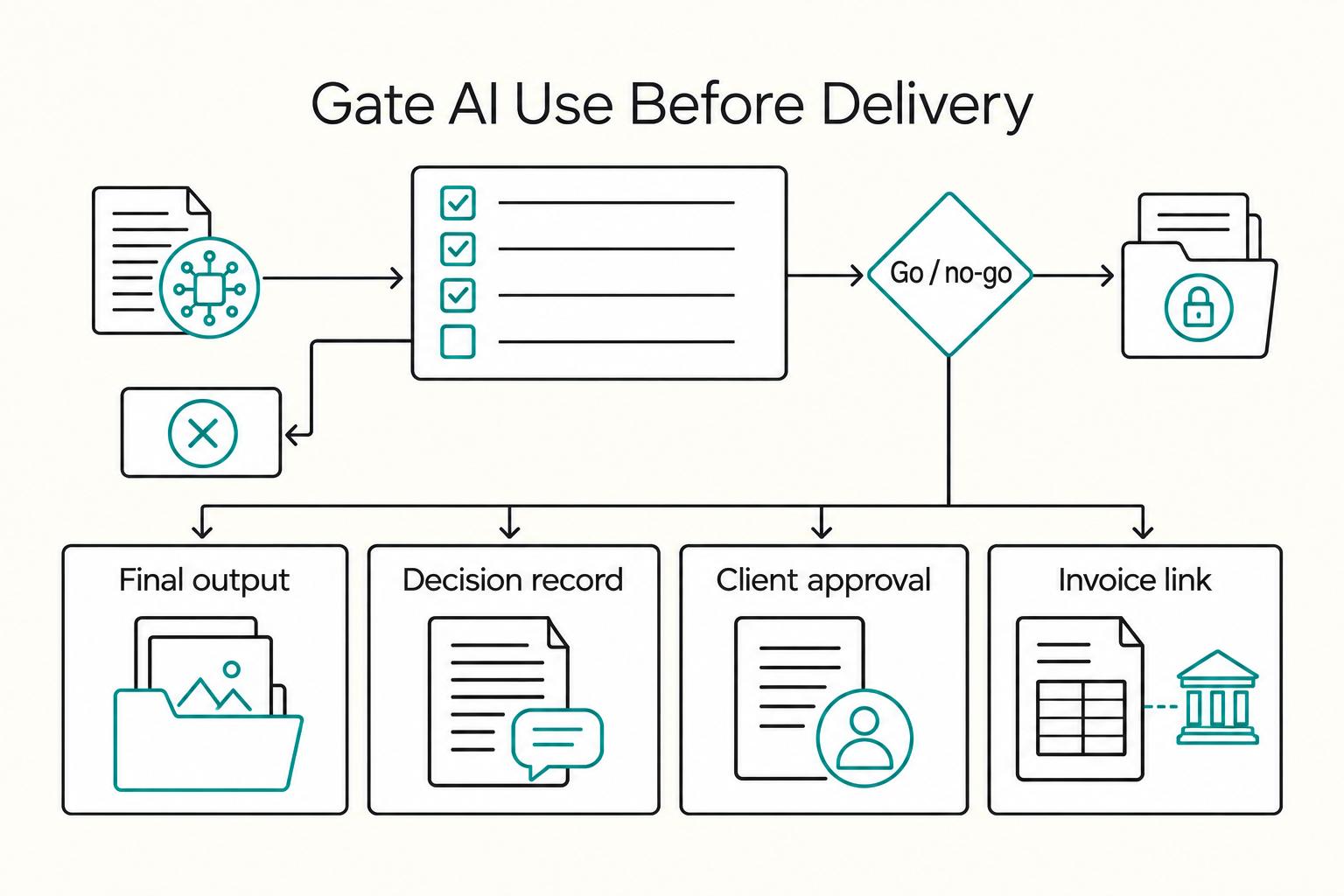
How Freelancers Use AI Without Scope, Compliance, or Payment Chaos
If you are hunting for more **AI tools for freelancers**, stop and put controls in place first. One practical setup is `Acquire -> Deliver -> Collect -> Close-out`, with each AI action checked through `Data`, `Client Policy`, `Quality`, and `Money`. If a tool has no named job, no clear data boundary, and no record you can retrieve later, it probably does not belong in your stack.
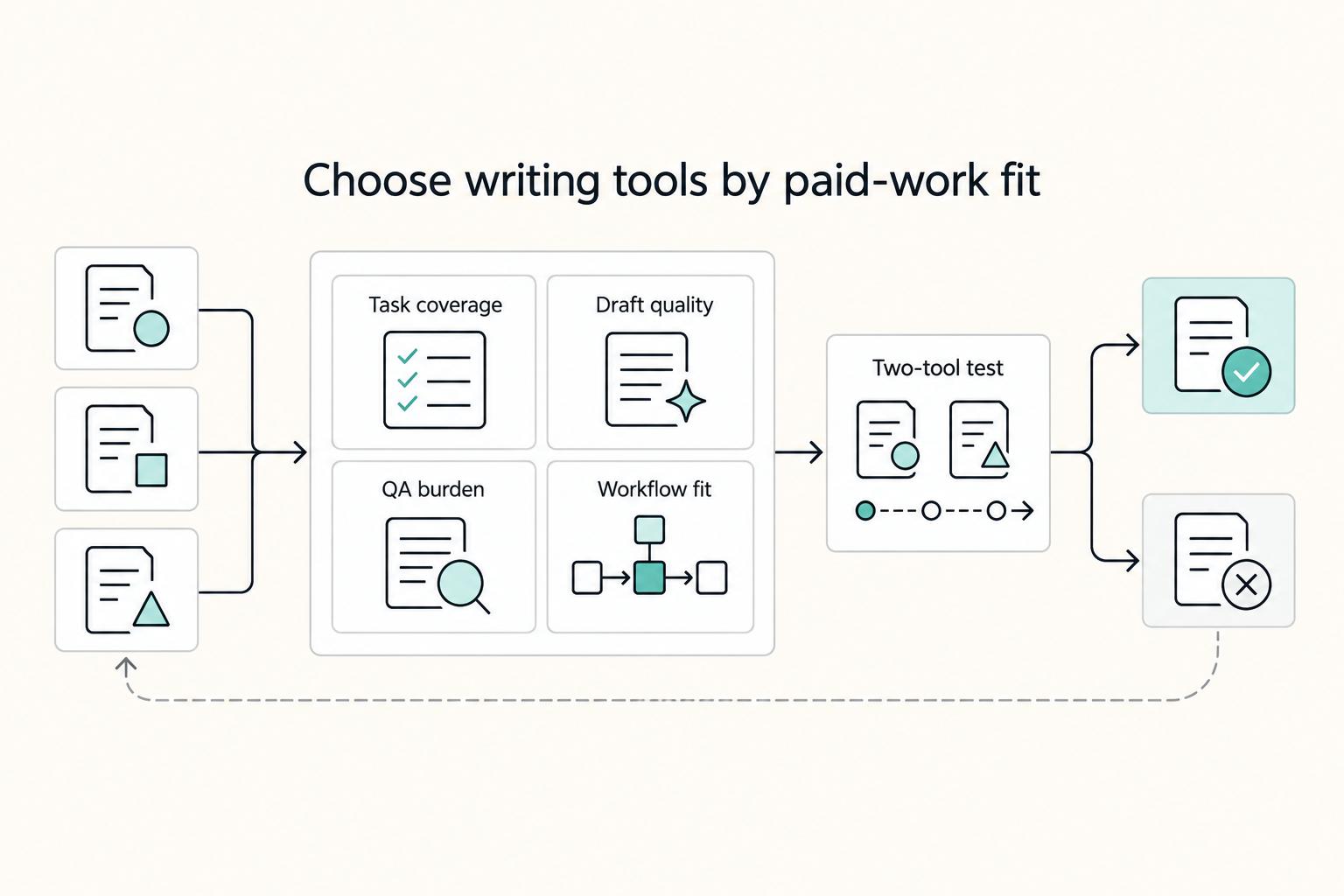
The Best AI Writing Assistants for Freelancers
Pick for fit, not hype. There is no universal winner in AI writing tools for freelancers, and broad roundups do not change that. One review covered 29 tools across six categories. Another listed 27 tools for 2026. Useful context, but your real decision is narrower: which pair helps you deliver paid client work with less rework this month?

The Best Ways to Handle Late-Paying Clients
If you run a business of one, you need a repeatable system you can actually use.