
Quick Answer
Define one narrow buyer problem, then build a personal monopoly by proving how you solve it with inspectable assets and clear operating boundaries. Start with a diagnostic, add a method artifact, and publish a boundary statement so prospects can evaluate fit fast. Pair that with pricing tied to uncertainty, written change approvals, and a consistent kickoff-to-closeout process so your positioning is backed by reliable execution. In 2026, include explicit price anchors and process thresholds so prospects can compare options without guesswork.
Engineer Your Expertise Engine#
Start by defining one narrow buyer problem before you polish your bio. If a buyer cannot tell what you solve, more visibility can just spread ambiguity.
A better starting question is not "How do I stand out?" Ask, "What specific decision-stage problem do I want to be hired to fix?" Buyers often hire against a problem, a risk, or a blocked outcome. Organize your expertise around that job, not around broad descriptors like creative, strategic, or full stack. If you want to be unusually easy to hire, make the problem recognizable in the buyer's own language.
| Positioning style | What the buyer hears | When it helps | When it hurts | Hiring readiness |
|---|---|---|---|---|
| Generic | "You do many things." | Early networking, referrals where someone already knows your fit | The buyer still has to define the job and guess whether you have done it before | Often lower until scope is explicit |
| Interest led | "You care about this space." | Content, audience building, category familiarity | Relevance is visible, but the business problem and deliverable stay fuzzy | Can be medium when problem definition is clear |
| Problem led | "You solve this exact issue." | Shortlisting, proposal review, scoped engagements | Can feel narrow if you have no proof or if the problem is defined too loosely | Often higher when proof is clear |
Use a hard pass/fail test for differentiation. A claim passes only if a buyer can inspect concrete proof tied to the exact problem you name. They should be able to open something and verify it: a diagnostic, a before-and-after sample, a teardown, a case narrative, a checklist, or an annotated deliverable. If your difference depends mostly on adjectives like thoughtful, strategic, multidisciplinary, or senior, it fails.
Make that test practical. Pick one claim, such as "I fix confusing onboarding email sequences for B2B SaaS." Then check whether a buyer can review a sample audit of an onboarding flow, a document showing how you decide what to change, and a short statement of where your work starts and stops. If one of those pieces is missing, your positioning may not be ready for inspection.
Assemble a minimum proof stack#
You do not need a huge portfolio to start. You need a small proof stack a buyer can review quickly. Build it from work you already have, in this order:
| Asset | What it is | Why it helps |
|---|---|---|
| Diagnostic | A short rubric, audit, or set of questions that reveals the problem clearly | Can show judgment |
| Method artifact | A checklist, decision tree, template, or annotated sample that shows how you work | Can show repeatability |
| Boundary statement | A plain document that says what you do not do, what inputs you need, and what falls outside scope | Can cut down bad-fit inquiries and scope confusion |
This sequence turns past work into reusable evidence. The diagnostic shows judgment. The method artifact shows repeatability. The boundary statement cuts down bad-fit inquiries and scope confusion.
One caution: documented methods can improve trust, make your work easier to evaluate, and help you repeat good outcomes. They do not automatically create legal exclusivity over the underlying idea or method. Treat documentation as proof and discipline first, not as a substitute for actual IP protection.
If you are still too broad, narrow by buyer pain before you narrow by industry. That often leads to clearer proof, better conversations, and fewer "can you also..." projects. Once that problem is clear, the next step is to publish in a way that helps a buyer decide. If you need help choosing the starting problem itself, How to Choose a Niche for Your Freelance Business is the next useful step. You might also find this useful: Building a Personal Website That Converts for Freelancers.
Build an Authority Platform, Not a Following#
Stop posting just to stay visible. Publish assets that help a buyer decide whether to hire you by reducing uncertainty about your judgment, your scope, and your role in the work.
Use your platform as decision support, not entertainment. A short post can get attention, but decision-stage buyers still need clear answers: what you fix, how you assess it, what you will not do, and what proof they can inspect now.
Build assets in buyer order#
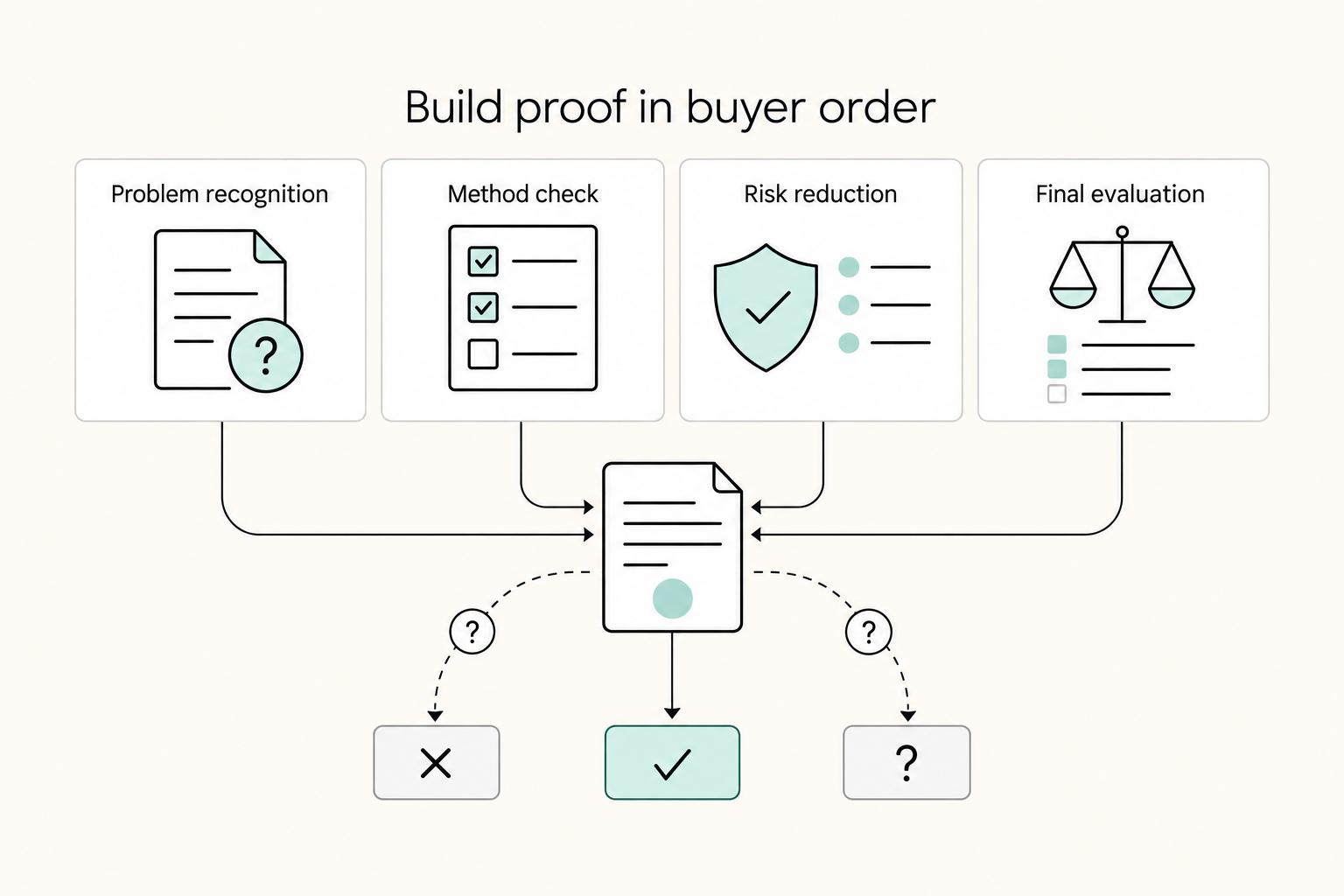
Publish in the same order a serious lead evaluates fit. Give each asset one job, one fit signal, and one next step.
| Buyer stage | Asset to publish | Job of the asset | Fit signal the reader should see | Primary CTA |
|---|---|---|---|---|
| Problem recognition | Diagnostic or teardown | Help the reader name the issue clearly | You identify the problem in plain language and explain what you check | Book an audit or reply with the issue |
| Method check | Annotated sample or walkthrough | Show how you think, not just what you delivered | Your reasoning is visible, specific, and repeatable | Request a sample review or consultation |
| Risk reduction | Case narrative | Clarify context, your contribution, and outcome | You have handled similar constraints before | Ask about a similar project |
| Final evaluation | Service page | Define scope, exclusions, inputs, and start process | The engagement is concrete, bounded, and easy to understand | Inquire, apply, or schedule a call |
If one piece has multiple competing CTAs, tighten it. One asset, one job, one next move.
| Criteria | Short-lived distribution content | Durable authority assets |
|---|---|---|
| Decision support | Usually limited detail for evaluation | Built to show method, boundaries, and inspectable proof |
| Qualification quality | Often attracts broad, mixed-fit interest | Better for self-qualification when the problem match is clear |
| Maintenance burden | Ongoing pressure to keep publishing in feeds | More upfront build effort, then periodic updates |
| Platform risk | Higher dependence on curated feeds and platform rules | Lower when core proof lives on your site or portfolio |
| Best use | Distribution and reminders | Hiring readiness, trust building, and fit screening |
That risk is practical. Feeds are curated, not neutral public squares, and with each abstraction layer, source visibility can fade. If your strongest proof only lives inside feed posts, context and attribution are easier to lose.
Use a real editorial gate before publishing#
Before publishing, check that a buyer can inspect, verify, and contextualize what you share.
| Check | What to verify | Note |
|---|---|---|
| Inspectable evidence | Prefer stable records such as HTTPS .gov pages for official U.S. material, and records with a DOI, permalink, or downloadable PDF | If you reference a PMC entry, treat it as an index record, not institutional endorsement |
| Scope boundaries | State exclusions, assumptions, and where your advice stops | So buyers can assess fit quickly |
| Authorship and contribution context | If work was collaborative, specify what you did | So buyers do not over- or under-attribute your role |
For research, rules, or official guidance, prefer stable records such as HTTPS .gov pages for official U.S. material and records with a DOI, permalink, or downloadable PDF. If you reference a PMC entry, treat it as an index record, not institutional endorsement. State exclusions, assumptions, and where your advice stops so buyers can assess fit quickly. If work was collaborative, specify what you did so buyers do not over- or under-attribute your role.
Choose channels by fit and capacity. Keep to one or two channels you can maintain consistently, then run a message-consistency pass across your site, portfolio, and social profiles so your problem statement, proof, and scope language stay aligned.
When these assets improve lead quality, visibility stops being your main bottleneck. Your delivery process becomes the test: clear scoping, clear approvals, and execution that matches the trust your platform creates.
Related: Use the Mere-Exposure Effect to Build a Personal Brand People Trust.
Fortify Your Monopoly with Operational Rigor#
Your authority converts better when your operations are as inspectable as your ideas. Set up pricing, approvals, and delivery so a client can see exactly how decisions are made before scope pressure starts.
Choose a pricing model that matches uncertainty#
Use pricing as a scope-control choice, not a branding choice. Before you quote, confirm you can name the objective, deliverable, required client inputs, and final approver in a short scoping note.
| Model | When to use it | Risk shifted to you | Signals to pause and change model before quoting |
|---|---|---|---|
| Time based | You can see the problem, but path, volume, or duration is still unclear | Margin is less predictable, but rework is easier to contain when time is tracked cleanly | Inputs are undefined, stakeholders keep changing, decision rights are unclear, or the client wants to "start and see" |
| Outcome linked | You and the client align on the problem and target result, even if method may change | Expectation risk rises if success is vague or depends on factors outside your control | No shared success criteria, no baseline, or effort is treated as unlimited once price is set |
| Fixed package | Scope is repeatable, inputs are standardized, and exclusions are explicit | You carry the most under-scoping and unpaid-iteration risk | "Package" requests become custom, deliverables stay vague, or acceptance criteria are missing |
When ambiguity becomes billable, stop and re-scope. If discovery adds stakeholders, access gaps, or a wider objective, update terms before continuing.
Separate business terms from legal verification#
Keep two lanes: terms you can negotiate, and items you must verify against current official rules for the jurisdictions involved.
| Item | Lane |
|---|---|
| scope | Negotiated business term |
| exclusions | Negotiated business term |
| review process | Negotiated business term |
| change approvals | Negotiated business term |
| payment timing | Negotiated business term |
| pause rights | Negotiated business term |
| timeline | Negotiated business term |
| acceptance criteria | Negotiated business term |
| handling of late client inputs | Negotiated business term |
| legal effect of governing law | Needs jurisdiction-specific confirmation |
| classification language | Needs jurisdiction-specific confirmation |
| invoice and tax treatment | Needs jurisdiction-specific confirmation |
| IP transfer formalities | Needs jurisdiction-specific confirmation |
| privacy/data duties | Needs jurisdiction-specific confirmation |
| any registration or filing thresholds | Needs jurisdiction-specific confirmation |
In practice, negotiate scope, exclusions, review process, change approvals, payment timing, pause rights, timeline, acceptance criteria, and handling of late client inputs. Treat legal effect, classification language, invoice and tax treatment, IP transfer formalities, privacy/data duties, and registration or filing thresholds as jurisdiction-specific items to confirm before you finalize.
Use the same evidence discipline you expect from clients and partners. Archived material can provide context, but it is not your final authority check; the DOJ archive itself warns content may be outdated, while Exhibit 12 points to an official-copy path through the Antitrust Documents Group. Keep the official record you relied on, note the verification date, and save that version in your file.
Keep one auditable file from kickoff to closeout#
Run one complete client file, especially for cross-border work. Keep the signed agreement, quote/version history, statement of work, party details, written scope changes, invoices, payment confirmations, delivery records, acceptance evidence, and your tax/reporting treatment note. For requested forms and threshold-dependent items, record the source checked, the date checked, and any open question instead of guessing a value.
| Stage | What to do | Control point |
|---|---|---|
| Kickoff | Confirm objective, inputs, timeline, and approver | One written kickoff summary approved by the client |
| Planning | Convert scope into tasks, dates, and artifacts | One owner for deadlines and one artifact list |
| Execution | Report against agreed scope, not informal chat drift | Dated update with open decisions |
| Change control | Do not start out-of-scope work before written approval | Approval attached to revised scope or fee terms |
| Closeout | Deliver final files, request acceptance, invoice, and archive | Acceptance evidence plus final invoice status |
Run the same SOP every time: kickoff, planning, execution, change control, and closeout.
This is where positioning becomes trust at buying time: consistent execution, auditable records, and visibly lower delivery risk. If you want a deeper dive, read The 1% Tax Regime for Entrepreneurs in Georgia.
Conclusion: Your Monopoly Isn't Just What You Know - It's How You Operate#
Before you publish a page or send a pitch, run one last check. Is your position specific? Is your proof easy to inspect? Is your buying process easy to trust? If one of those is weak, do not compensate with bigger language. Tighten the claim, upgrade the evidence, or remove friction first.
| Check | Generalist signal | Defensible specialist signal | Buyer-facing outcome |
|---|---|---|---|
| Positioning | "I help with marketing/strategy/design" | One buyer, one problem, one angle | The buyer can tell if you fit without a call to decode you |
| Proof | Nice samples, little context | Annotated sample, case narrative, or diagnostic tied to the offer | The buyer can inspect how you think, not just what you made |
| Operations | Scope, approvals, and next step stay fuzzy | Clear exclusions, approval points, payment terms, and handoff path | The work feels lower risk and easier to buy |
Keep the metaphor in bounds. A personal monopoly means positioning differentiation, not legal exclusivity. In U.S. law, monopoly has an antitrust meaning tied to market power, so treat the phrase as positioning language, not a legal claim.
The compliance check is simple and useful. FTC business guidance says advertising claims must be truthful, not deceptive, and evidence-based, which means you should have substantiation in hand before you publish. If you use testimonials or other endorsements, 16 CFR Part 255 is a practical guardrail. Keep them honest, and if there is an unexpected material connection such as payment or free/discounted products or services, disclose it clearly and conspicuously.
To put that into practice, do three things today:
- Rewrite one positioning line until a stranger could repeat it accurately.
- Upgrade one proof asset so it shows method, context, and limits.
- Remove one buying-friction point, usually vague scope or an unclear next step.
If your next bottleneck is visibility, read How to Manage Your Personal Brand as a Freelancer. If it is operations, fix your proposal, approval, and proof pack. If it is implementation support, get country-specific tax or contract help before you scale the message.
For a step-by-step walkthrough, see How to Build Authority as a Freelancer Without Competing on Price.
2026 Pricing and Positioning Benchmarks#
However, you should validate your offer against current buying behavior in 2024, 2025, and 2026 before scaling outreach. A practical range many freelancers test is $250 for a discovery call, $1,200 for a diagnostic, $3,500 for a focused delivery sprint, and $12,000 per year for retainer support when ongoing reporting is required.
Meanwhile, keep your numbers inspectable: response-rate targets, proposal-to-close targets, revision-cycle limits, and turnaround windows. Therefore, your prospects can compare options with less ambiguity and choose based on evidence instead of broad claims.
- Track baseline reply rate at 5%.
- Aim for 8% to 12% qualified reply rate after tightening positioning.
- Keep proposal acceptance target at 25% to 35%.
- Use a first-response SLA of 24 hours.
- Use a revision turnaround SLA of 48 hours.
- Cap standard revision rounds at 2.
- Set kickoff lead time at 3 to 5 business days.
- Use a minimum project value threshold of USD 1,500.
- Use a priority-queue surcharge of 20% for rush requests.
- Set deposit requirement at 40% before work starts.
- Set final payment due 7 days after delivery.
- Flag change requests above 15% scope delta for repricing.
- Review win-loss notes every 14 days.
- Refresh positioning language every 30 days.
- Audit proof assets every 60 days.
- Archive stale case evidence older than 24 months.
- Track average cycle time from inquiry to signature.
- Track time-to-value in the first 10 days of each project.
- Record utilization range each week.
- Compare planned margin versus actual margin monthly.
Weekly Execution Checklist#
- Review one call recording and capture decision objections.
- Update one positioning sentence with buyer language.
- Publish one diagnostic artifact.
- Publish one method walk-through.
- Refresh one case narrative with measurable outcomes.
- Tighten one exclusion statement on the service page.
- Confirm one change-order template is current.
- Confirm one invoicing template is current.
- Verify one onboarding checklist step for clarity.
- Verify one offboarding checklist step for completeness.
- Re-check one legal clause with jurisdiction counsel.
- Re-check one tax treatment assumption before invoicing.
- Document one delivery risk and mitigation action.
- Document one quality failure and preventive action.
- Identify one low-fit lead pattern and block it early.
- Identify one high-fit lead pattern and replicate it.
- Raise one FAQ answer from calls into site copy.
- Add one external authority link where it improves trust.
- Confirm one testimonial has disclosure context if needed.
- Schedule next week's review window before Friday.
For example, you can validate claims against current guidance on FTC advertising and marketing basics, FTC endorsement disclosures, SBA market research, and IRS estimated taxes.
Frequently Asked Questions
What is the difference between a personal brand and a personal monopoly?
In this guide, your brand is how people recognize you. Here, "personal monopoly" is a practical label for an offer that is distinct enough that the right buyer sees you as unusually well matched for one specific problem. If your positioning could fit many peers, narrow the problem, buyer, and method until the offer is clearly different. You can also revisit How to Choose a Niche for Your Freelance Business.
How do you monetize this?
You monetize it by turning specificity into something a buyer can actually purchase. Define the scope, the shape of the deliverable, and the buying path: what they get first, what is excluded, and what the next approval step is. If a prospect cannot tell whether you are selling diagnosis, delivery, or ongoing support, your positioning is still too loose.
How do you know if your position is defensible?
Run a quick self-audit. Could three competitors use your same headline without changing a word? Can you show proof someone can inspect, such as an annotated sample, a case narrative, or clear before-and-after reasoning? Are you still describing your work with broad labels like "marketing help" or "strategy and execution"? Any yes is a sign to narrow further.
What are the main risks?
One recurring risk is sounding specialized while selling a broad service underneath. Watch for red flags such as copycat language, weak proof, unclear exclusions, and offers that bundle too many stages into one vague promise. If that is your current setup, tighten the offer before you push harder on visibility.
Who popularized the idea?
Attribution is uncertain based on the approved sources here. The word monopoly also has formal legal uses, so if you check that context, use authoritative material such as the Congress.gov CRS report page on antitrust and big tech. It includes a downloadable PDF and version history, and the board-game fundraiser FAQ source is not relevant evidence for freelance positioning. What matters more is whether the idea helps you improve client fit, proof quality, and day-to-day decisions.
How often should you update a personal monopoly offer?
Review and adjust monthly, then do a deeper quarterly audit of positioning, pricing assumptions, and proof assets.
What numbers should be visible on your service page?
Show starting price anchors, delivery window ranges, revision limits, and one clear next step so buyers can self-qualify quickly.
When should you use fixed fees versus time-based billing?
Use fixed fees for bounded scope with stable inputs; use time-based or phased pricing when uncertainty is still high.
How do you reduce scope creep?
Use written change-order rules, explicit exclusions, and approval checkpoints tied to pricing impact before extra work starts.
What proof asset is most useful for first-time buyers?
An annotated sample with context, constraints, and decision rationale usually reduces uncertainty faster than generic portfolio screenshots.
How many proof assets are enough to launch?
A practical minimum is one diagnostic, one annotated sample, and one case narrative tied to the same buyer problem.
How do you keep positioning fresh in 2026?
Keep language tied to current buyer behavior, refresh examples with recent outcomes, and retire stale claims that no longer match market conditions.
Try a related tool
Researched and edited by the Gruv editorial team. Gruv builds cross-border billing, payouts, and finance-operations software for global businesses.
Sources
Includes 1 external source outside the trusted-domain allowlist.
- ftc.gov/business-guidance/advertising-marketingtrusted
- ftc.gov/advice-guidance/competition-guidance/guide-a...trusted
- irs.gov/businesses/small-businesses-self-employed/es...trusted
- justice.gov/atr/exhibit-12-comments-relpromax-antitrust-inctrusted
- justice.gov/archives/atr/predatory-pricing-strategic-the...trusted
- sba.gov/business-guide/plan-your-business/market-res...trusted
- perell.com/note/build-a-personal-monopolyexternal
Educational content only. Not legal, tax, or financial advice.
Related Posts

Georgia 1% Tax for Entrepreneurs Without Filing Surprises
Treat Georgia's 1% tax path as a compliance question first and a rate discussion second. The goal is a setup you can defend under review, not a shortcut that fails at filing time.

How to Manage Your Personal Brand as a Freelancer
Your brand is not a mood board. Think of it as the experience people have of your work: the promise you make, the proof you can show, and the way you present yourself across client touchpoints. Get that clear first, and your fit is easier to read from profile to proposal.
How to Choose a Niche for Your Freelance Business
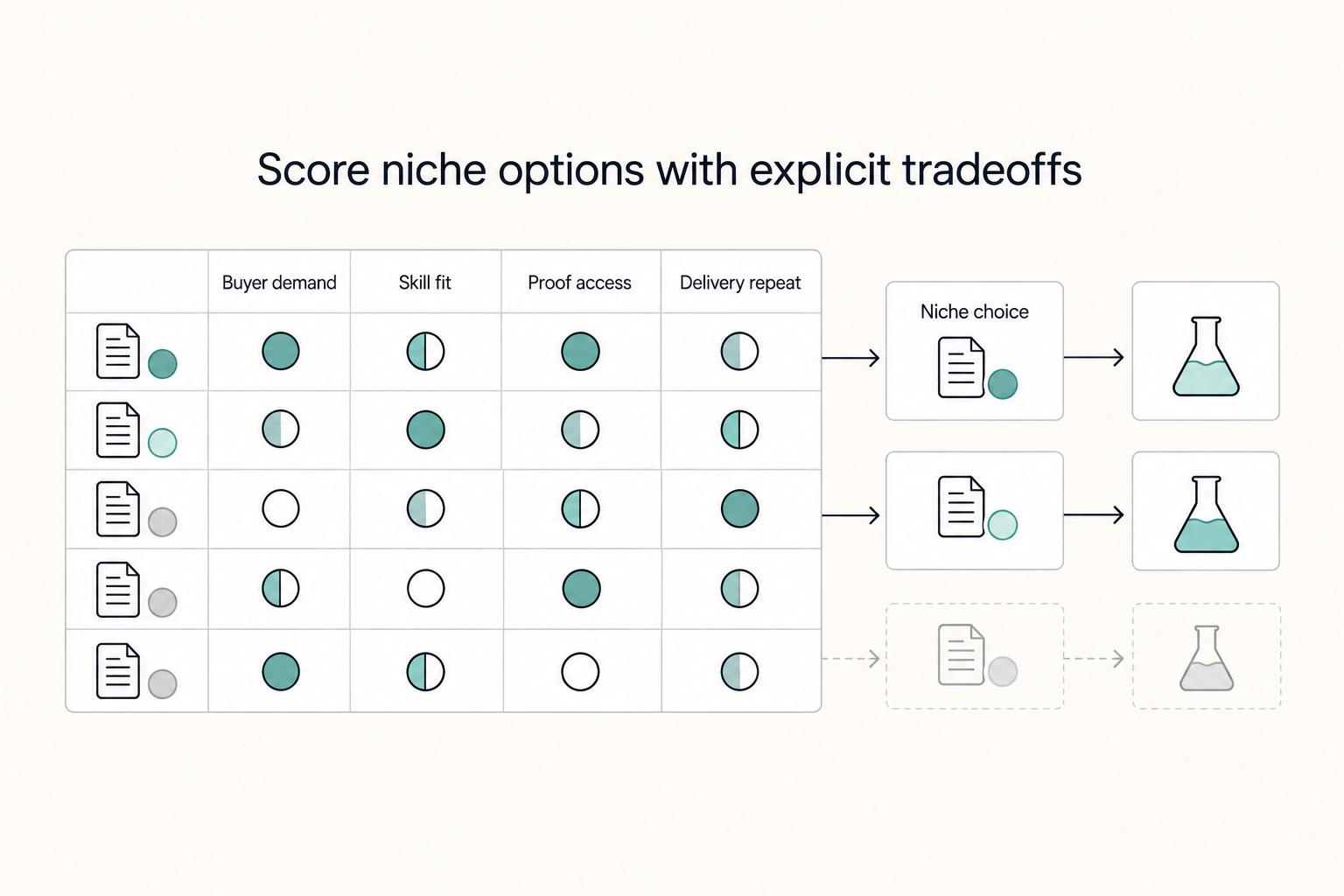
Choosing a freelance niche is a decision about repeatable demand and repeatable delivery, not just personal interest. Passion helps you stay consistent, but durability comes from clear positioning and work you can execute without constant reinvention.