
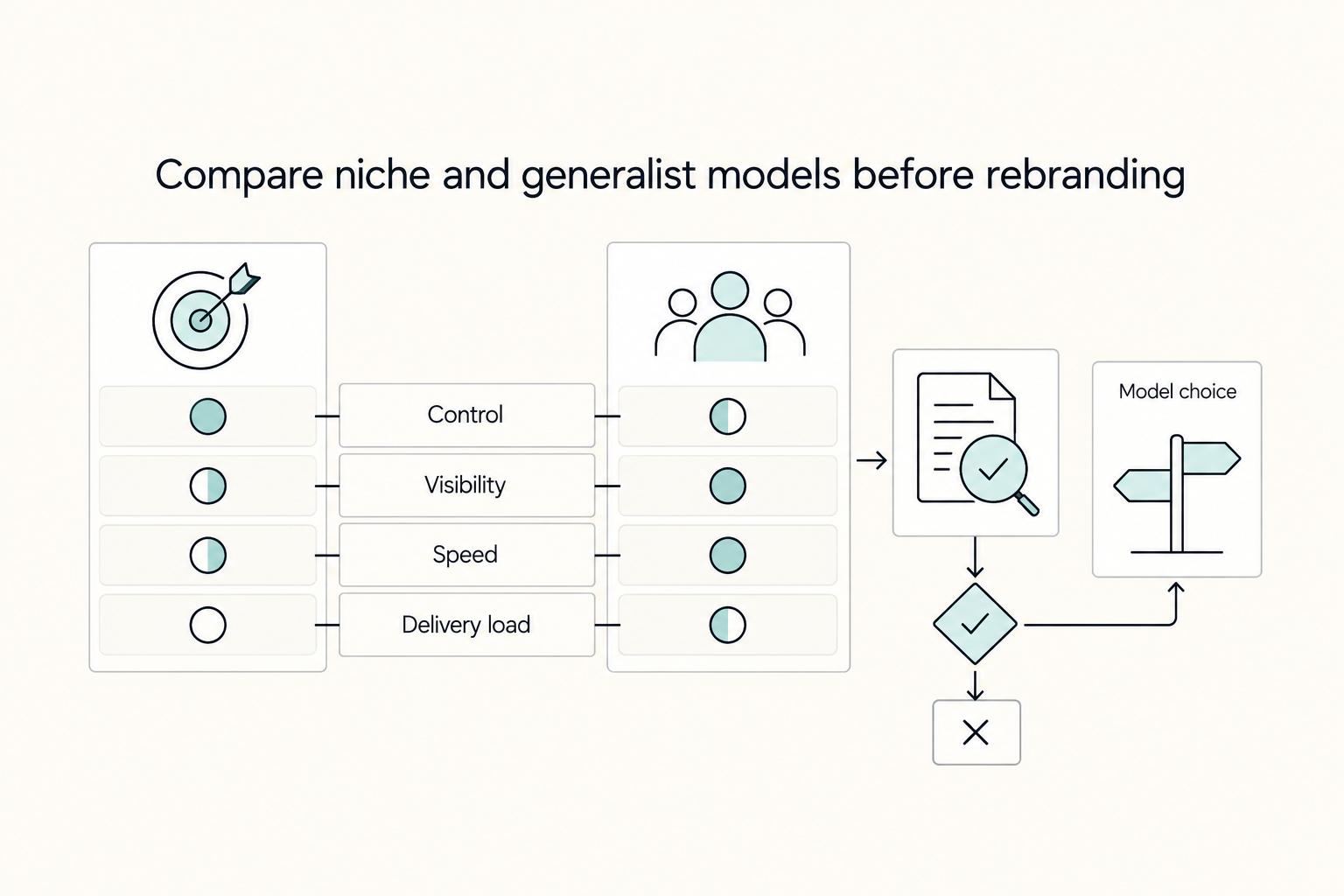
Quick Answer
Start by scoring your last projects in a Decision matrix, then test one positioning shift for 30 days before you rebrand. For freelance niche vs generalist, specialize only if repeat demand and delivery hold up at the same time; otherwise stay broad or run a T-shaped model. Use signed SOWs, revision counts, and lead-fit notes as evidence, and make a Week 4 pass/fail call before changing your core offer.
Niche vs. Generalist Freelancing#
Choose between a Niche freelancer, Generalist freelancer, and a T-shaped model as an operating decision you can test, not a branding guess.
Advice on niching is mixed and often opinion-led. You will find hard claims in every direction: some argue a specialist's efficiency can outweigh a lower upfront generalist price, while others argue freelance writers do not need a niche. Some niche advice is also aimed at internet marketing contexts rather than freelance B2B work. The better move is not to pick a camp early. It is to run one decision method against your own client and delivery evidence.
By the end of this guide, you will have:
- A
Decision matrixto compare options with consistent criteria. - A 30-day
Validation planto test positioning before you commit. - A
Risk-and-controls checklistto manage transition risk.
Treat your first choice as a hypothesis. Use recent project data to decide whether to narrow, stay broad, or run a T shape with clear boundaries.
The aim is decision confidence, not a perfect first answer. Your first pass should be specific enough to act on, then strict enough to review after live testing. That combination keeps you from drifting between identity labels while real delivery signals are still forming.
At-a-Glance Comparison Table for Niche, Generalist, and T-Shaped#
Make this a profit decision, not a permanent identity move. Use Profit = Revenue - Costs as your baseline, then compare each model with your own delivery data.
| Criteria | Specialized freelancer (Niche freelancer) | Generalist freelancer | T-shaped model |
|---|---|---|---|
| Positioning clarity | Clear when your niche, problem, and buyer are explicit. | Broad positioning can bring variety but may also feel interchangeable. | Clear when one specialist core stays primary and adjacent services stay secondary. |
Client acquisition | Validate with your own lead data and repeat demand. | Useful when demand signals are still scattered across different asks. | Works when one capability drives wins and adjacent work still matters. |
| Pricing power | Specialists may command more money and respect, but uplift is not guaranteed. | Generalists can gain variety, but may be perceived as less differentiated. | Keep the core offer and adjacent add-ons priced separately. |
| Delivery complexity | Similar problem types can repeat, which can make delivery easier to package. | A wider mix of services can make messaging and delivery less consistent. | Keep the core process stable and scope adjacent work separately. |
Scope creep exposure | Requests outside the standard offer need separate pricing. | Broad positioning can drift into a "yes to everything" perception. | Risk rises when adjacent work starts to blur the core. |
Client concentration risk | Check whether demand depends too heavily on one channel or one client type. | Check whether broad work is truly diversified or just loosely positioned. | Check whether adjacent work is replacing the core instead of supporting it. |
| Best fit | Repeat demand, common deliverables, and reusable process. | Early-stage testing when signal quality is weak and demand is scattered. | Mixed client types with one standout capability. |
| Watch-out | A niche pivot can be staged without immediately dropping current clients. | Broad positioning can drift into a "yes to everything" perception. | Keep claims modest unless you have operating evidence for your mix. |
Two patterns help keep this precise: horizontal niching means one offer for multiple client types, while vertical niching means broader work for one client type. Use these labels to match how your best projects actually arrive.
Before choosing, review recent projects and log lead source, offer sold, delivery time, revision rounds, and margin. That record helps you judge whether narrowing is likely to improve profit or simply reduce opportunity volume.
Use the table as a living checkpoint, not a one-time read. Fill it out once before testing, then again after your 30-day cycle. If your top choice changes after real market contact, that is useful signal, not failure.
What Each Model Looks Like in Real Operations#
Pick the model you can execute clearly week after week, not the one that sounds best in theory.
| Model | Typical setup | Main caution |
|---|---|---|
| Niche freelancer | Narrower offer set with clearer positioning; similar problem types can repeat | Higher rates are never automatic |
| Generalist freelancer | Wider mix of services and buyer paths; useful while testing demand | Messaging and scoping can become less consistent across very different briefs |
| T-shaped model | One clear specialist core plus a small set of adjacent services | Keep the core primary and scope adjacent work separately |
A Niche freelancer usually runs a narrower offer set with clearer positioning. Similar problem types repeat, which can make delivery easier to package and more consistent. That can support stronger pricing in some markets, but higher rates are never automatic.
A Generalist freelancer usually runs a wider mix of services and buyer paths. This can keep opportunities moving while you test demand, but it can also make messaging and scoping less consistent across very different briefs. If breadth stays too loose for too long, marketing and scoping can slow down.
A T-shaped model is a practical middle path: one clear specialist core plus a small set of adjacent services. It can work when the core remains primary and adjacent work is scoped separately, so buyers can see what is core and what is optional.
Use recent project evidence to choose: note where best-fit work repeats, where scope stays clean, and where delivery remains consistent under load.
A quick weekly review keeps this practical. Review what you sold, what changed after kickoff, and where your time actually went. If selling and delivery keep drifting apart, your current model is not as clear as it looks on paper.
Use This Decision Matrix Before You Rebrand Anything#
Do not rebrand on instinct. Use a Decision matrix to compare models on control, visibility, speed, and output, then check whether delivery is adding process overhead or rework.
| If you see | Test | Check first |
|---|---|---|
| Strong repeatable outcomes and light onboarding | Specialized freelancer positioning | Score from documented work, not memory |
| Scattered demand signals | Generalist freelancer positioning while testing narrower offers | Fix visibility first if tracking is too thin to score cleanly |
| One capability driving most wins, with adjacent work still mattering | T-shaped model | Keep a clearly primary core offer |
| Fit criterion | Weight (set by you) | Specialized freelancer | Generalist freelancer | T-shaped model |
|---|---|---|---|---|
| Demand consistency | High / Medium / Low | Similar problems repeat from similar buyers | Demand is spread across unrelated asks | One core service repeats, with adjacent demand |
| Proof of outcomes | High / Medium / Low | Clear repeat wins in one narrow offer | Clear outcomes across varied work | Strong proof in the core and credible proof in adjacent work |
| Process repeatability | High / Medium / Low | Scope and delivery steps are reused with minor edits | Broad work still runs without constant reinvention | Core process is stable and adjacent work stays bounded |
| Sales friction | High / Medium / Low | Buyers understand value quickly with less clarification | Broad positioning closes only after longer scope loops | Core offer is clear and add-ons do not blur scope |
Score from documented work, not memory. If your tracking is too thin to score cleanly, pause the rebrand and fix visibility first. Treat weights and cutoffs as internal heuristics, not universal benchmarks.
Use this rule:
- If repeatable outcomes are strong and onboarding is light, test
Specialized freelancerpositioning first. - If demand signals are scattered, keep
Generalist freelancerpositioning while testing narrower offers. - If one capability drives most wins and adjacent work still matters, test a
T-shaped modelwith a clearly primary core offer.
Red flags that block a niche move now:
- Weak portfolio evidence for the exact problem you want to own.
- Unclear ICP, where your best-fit buyer still changes project to project.
- Unstable lead flow, where one quiet month forces unfocused selling.
Finish with a pass/fail checkpoint in your first-draft Validation plan. Pass means one model leads clearly and still leads after testing. Fail means scores stay clustered, lead quality drops, or rework rises after positioning changes.
To keep scoring honest, attach simple artifacts to each criterion: recent proposals, signed SOWs, delivery notes, and post-project feedback. When a score is challenged, you can point to evidence instead of revisiting old debates. If you need a practical next step after scoring, Browse Gruv tools.
The Tradeoffs Competitors Gloss Over#
The real tradeoff is operating control and positioning, not labels alone. Similar outsourced offers can hide very different execution standards, and pricing can create pressure when promised outcomes and perceived value are out of sync.
| Risk area | Hidden cost most people miss | When risk tends to show up | Early warning signal | Control to add now |
|---|---|---|---|---|
Poorly vetted white label delivery | Links you cannot defend, plus link-scheme and penalty risk | After placements are delivered and reviewed | Placements come from irrelevant sites or look automated | Set relevance standards, require outreach evidence, and define rejection criteria before delivery |
Similar package labels, different execution | Genuine outreach and automated PBN-style placements can be sold under the same label | During sample review and early fulfillment cycles | Quality varies widely across offers that look the same on paper | Require sample outputs and process proof for relevant outreach plus human editorial review |
Price-positioning mismatch | Weak price-to-value alignment can position the offer as guidance rather than transformation | During evaluation and negotiation | Outcome questions increase while confidence drops | Tighten deliverables, acceptance criteria, and expected outcomes before changing rates |
Packaging is often where this shows up first. In one sample pricing report, a 3-month ecommerce consulting offer priced at $6,000 scored 6/10 for price-to-value alignment and was framed closer to consultant guidance than growth transformation. When promise, price, and outcomes are misaligned, conversion and margin pressure can increase.
Fulfillment quality is another blind spot, especially with outsourced work. Similar labels can hide very different execution standards. Keep a short proof pack for partner-supported delivery: sample outputs, quality checks, and clear rejection criteria.
Run this checklist before expanding either path:
- Review recent outsourced placements and flag any you could not defend in a manual review.
- Ask partners to show evidence of relevant outreach and human editorial decisions.
- Define rejection criteria for irrelevant sites or low-quality placements before work starts.
- Re-check packaging so promise, effort, and expected outcomes stay aligned.
If outsourced delivery is scaling, strengthen vetting before increasing volume. If pricing conversations keep framing your offer as low-impact guidance, tighten offer framing and outcome definitions before adjusting price.
A practical way to reduce surprises is to assign each risk a single owner. One person tracks price-to-value alignment, one tracks partner vetting quality, and one tracks rejection decisions, even if that person is still you. Named ownership keeps known issues from sitting in a notes doc without action.
Scenario Recommendations for Different Freelancer Profiles#
Use signal quality to choose direction. There is no universal winner between broad and niche positioning, so match the move to your own demand patterns. Stay broad when evidence is weak, specialize when demand repeats, and use a T shape when one core capability appears to drive buying decisions across mixed client types.
| Profile signal | Creative services | Technical services | Advisory services | Positioning move | Verification checkpoint | Red flag |
|---|---|---|---|---|---|---|
| Early stage, weak signal quality | Mixed asks across logos, social assets, and landing pages | Scattered requests across bug fixes, automations, and builds | Broad strategy calls with unclear scope | Stay a Generalist freelancer and run one narrow test in a time-boxed Validation plan | Track lead source, proposal-to-sign time, and SOW revision count before and after each test | You change audience, promise, and deliverable at once, so results are not comparable |
| Repeat demand, common deliverables | Similar brand refresh packages close repeatedly | The same audit-plus-implementation pattern keeps selling | Clients repeatedly buy the same advisory package with similar goals | Move to Niche freelancer and standardize into a Productized service | Reuse one SOW structure, timeline, and acceptance criteria across paid projects with minor edits | Most new deals come from one channel or one client type, increasing concentration risk |
| Mixed client types, one standout capability | Core is conversion copy, with optional brand support | Core is analytics instrumentation, with optional dashboard cleanup | Core is pricing strategy, with optional team enablement | Use a T-shaped model and anchor messaging on the specialist spine | Put the core offer first in every proposal, with adjacent work as separately priced add-ons | Adjacent requests replace core work, and buyers compare mainly on price |
When feedback is inconsistent, staying broad can help you keep work moving while you test. Keep tests controlled: change one variable at a time, and keep pricing logic and SOW boundaries stable.
When repeat demand is clear, specialization can improve differentiation and trust. Turn that into fixed deliverables, clear exclusions, and defined handoff steps. If you are ready for that shift, read How to Create a Productized Service for Your Freelance Business.
If one capability consistently earns trust but client needs still vary, keep the T shape and protect the specialist spine in your SOW and change-order terms. Keep add-ons optional and separately scoped so your core promise stays clear.
When your evidence sits between rows, avoid a full jump. Keep your current positioning for one more cycle, tighten scope language, and retest with cleaner offers. That helps protect current work while still moving your decision forward.
How to Package, Price, and Sell Under Each Model#
Package first, then price. If packaging is fuzzy, pricing and positioning usually get challenged.
| Model | Packaging format | Pricing anchor | Retainer stance | Required sales assets | Common failure mode |
|---|---|---|---|---|---|
Generalist freelancer | Custom menu grouped by client problem, with optional modules | Project fee first; use hourly internally to pressure-test scope | Wait on retainers until requests are predictable month to month | Broad offer page, sample Statement of Work (SOW), proof stack from varied projects | Scope creep from vague boundaries and too many custom exceptions |
Specialized freelancer | Productized service with fixed deliverables, timeline, and acceptance criteria | Project fee tied to value delivered, not time spent | Add a Retainer after delivery patterns are stable across repeat engagements | Focused offer page, package-specific SOW, before-and-after proof in one niche | Standardizing too early and missing edge cases that break delivery |
T-shaped model | One core package plus clearly priced add-ons | Core fee for the specialist offer, separate fees for adjacent add-ons | Use retainers for the core only when scope is stable; keep add-ons outside the monthly base | Core-offer page, add-on menu, SOW change-order section for adjacencies | Core promise gets diluted when add-ons become the main sell |
Favor project fees while you are still testing scope stability. Introduce a Retainer when recurring demand is clear and SOW boundaries, revision limits, and acceptance criteria are already holding. Avoid retainers when requests keep shifting, because unstable scope can turn monthly fees into hidden extra work.
As deal size grows, confirm your legal setup matches the risk you are carrying. A sole proprietorship does not separate owner and business liability, while an LLC creates a separate legal entity and generally shields personal assets if the business faces debt or legal action. Setup effort and costs vary by state (one comparison shows roughly $50 - $500+), so confirm local requirements before changing structure.
Run a packaging checkpoint before changing positioning. Review recent proposals and discovery calls, tag repeated objections, and fix packaging first. If objections cluster around unclear deliverables or custom-scope confusion, update the offer page, SOW structure, and proof stack before you reposition.
Keep proposal structure consistent across models: problem statement, included deliverables, exclusions, acceptance criteria, and change-order terms. Buyers can compare options faster when this order stays stable, and internal review is usually easier because every deal can be checked against the same structure.
Contract and Scope Controls That Prevent Expensive Surprises#
Preventing expensive surprises starts with one rule: if deliverables, timeline, dependencies, or approval flow change, update the written agreement before work continues.
Use this scope checklist before kickoff, and match change-control mechanics to your model:
Boundaries: what the engagement includes and excludes.Assumptions: required client inputs, response timing, and decision ownership.Change path: how new requests are documented and priced.
| Model | Trigger for change request | Documentation step | Commercial step | Risk if skipped |
|---|---|---|---|---|
Generalist freelancer | New request changes outputs, stakeholders, or dependencies | Record the scope delta and update the written agreement before execution | Re-scope as add-on or separate workstream | Margin loss from unpriced additions |
Niche freelancer | Request falls outside the current offer or agreed workflow | Mark it as an exception and confirm revised scope in writing | Keep the base offer intact and price the exception separately | Higher risk of delivery inconsistency from off-pattern custom work |
T-shaped model | Adjacent work starts to blur the core offer or monthly base | Separate the core scope from the add-on scope in writing | Price adjacent work as add-ons or a separate workstream | Core promise gets diluted and scope control weakens |
Use a no-go list to protect reliability:
- No work starts from informal approval when scope language is unresolved.
- No mixing personal and business payments.
- No dependency on a single vendor platform without a backup option.
- No promise of immediate complex delivery based on timelines from simpler cases.
- No assumption that headline platform pricing captures vetting and management overhead.
If repeated deal friction comes from unclear scope, tighten contract discipline before changing positioning. That can resolve issues that get mislabeled as model problems.
Before kickoff, compare your SOW and proposal side by side. If the offer language promises more than the contract includes, fix it before signature. Avoidable delivery disputes often start in that gap.
A 30-Day Validation Plan You Can Execute Immediately#
Treat this as a controlled 30-day sprint, not a full rebrand. Keep current revenue work running while you test two positioning variants, then decide from market feedback and delivery consistency.
| Week | Primary goal | What to produce | Channel action | Checkpoint to pass | Failure signal |
|---|---|---|---|---|---|
| Week 1 | Build your baseline | One Decision matrix and two positioning drafts: Specialized freelancer and Generalist freelancer | No promotion yet; prep only | You can explain each offer in one sentence and map each to recent wins and losses | Positioning stays vague or depends on broad, catch-all requests |
| Week 2 | Test message-market fit | Two short profiles, two outreach scripts, and one offer summary per variant | Run live tests in your primary outreach channels | Compare response quality and lead fit against your baseline | Replies increase but fit is weak, or sales conversations stall |
| Week 3 | Test delivery repeatability | One narrowed offer, a clear scope document, and a delivery template | Pilot the narrowed offer with a limited set of best-fit leads | Delivery stays consistent and feedback is easier to evaluate | Custom exceptions dominate and quality becomes inconsistent |
| Week 4 | Decide keep, adjust, or commit | Validation scorecard and decision note | Continue with the stronger variant | One model is clearly stronger on fit, clarity, and repeatability | Results are mixed or depend too heavily on one client type or one channel |
Use the same criteria each week so comparisons stay fair. In Week 2, change positioning language without changing every other variable, and log objections and buying questions after each call. In Week 3, treat tiered proposals as packaging structure, not outcome promises.
Use this stop rule throughout:
- Pause niche expansion if delivery quality drops, even when interest rises.
- Pause if opportunities are coming mostly from one channel or one buyer type.
- Rebalance the pipeline with broader outreach while tightening offer clarity, proof, or delivery consistency.
Final decision rule: commit to a Niche freelancer direction only when demand signal and delivery repeatability improve together. If only one improves, adjust and rerun. If neither improves, keep Generalist freelancer positioning and continue focused testing.
Keep one running log during the month with the same fields for every conversation and project touchpoint. Consistent logs reduce hindsight bias and make your Week 4 decision cleaner, especially when two options look close.
Transition Without Revenue Shock#
If your initial tests show real pull toward specialization, do not switch overnight. A staged shift can help protect revenue: keep cash-flow work active, increase specialized work in controlled increments, and review capacity before each expansion.
| Stage | Active positioning | Revenue protection move | Buyer-facing boundary | What to monitor |
|---|---|---|---|---|
| Stage 1 | Generalist freelancer stays primary | Keep current core services active; do not remove legacy offers yet | Present the niche offer as an add-on, not the only path | Revenue stability, delivery load, proposal quality |
| Stage 2 | Dual-positioning window | Route best-fit new leads to the specialist offer while honoring current agreements | Keep one specialist spine in messaging; label legacy services as limited support | Lead mix, handoff friction, custom-request volume |
| Stage 3 | Niche freelancer becomes default | Keep only profitable legacy exceptions; stop broad new sales | Lead with the specialized offer across sales assets and discovery calls | Margin trend, quality consistency, client concentration |
Treat Stage 2 as boundary management. A documented hyper-niche pivot showed this can work without burning the existing client base when communication and marketing changes are handled deliberately.
Set pace with capacity-first decisions. Small teams can test and adjust quickly, but use that speed for controlled experiments, not overcommitment.
Keep retention selective. Offer a Retainer only where request patterns, review cycles, and scope boundaries are predictable, and define support levels before signing.
When a client no longer fits your direction, offboard with a short script:
- Confirm notice timing and complete only currently agreed deliverables.
- Offer one transition option: referral, handoff summary, or a short paid overlap.
- Restate the new scope boundary in writing to prevent ad hoc restart requests.
Close each month with the same decision criteria used in validation. If specialized demand rises and quality plus client mix stay healthy, keep shifting. If quality drops or Client concentration risk rises, pause expansion and rebalance first.
Write stage-exit criteria before you begin the transition. When the criteria are written early, you can move forward or pause based on evidence rather than momentum from recent wins.
Risk-and-Controls Checklist for a Durable Freelance Business#
A durable freelance business is one you can review monthly without guesswork. Keep Client concentration risk, Scope creep, delivery quality, and admin and security basics visible in one place.
| Status | What it looks like | Action |
|---|---|---|
| Green | Dependency is within your written limit, SOW changes are signed before delivery, invoices are current, and key accounts meet your security standard | Keep the checklist visible and review monthly |
| Yellow | One client is becoming dominant, Scope creep repeats, or documentation gaps create month-end cleanup | Tighten controls before expanding |
| Red | A single client pause would disrupt operations, work ships outside agreed scope, or compliance and security responsibilities are unclear | Pause growth moves and close the control gap first |
| Control area | What to do | What to check monthly |
|---|---|---|
| Concentration controls | Set a written dependency limit and review it consistently. | Client concentration risk across revenue share, pipeline exposure, and calendar load |
| Delivery controls | Enforce SOW discipline on every project: scope boundaries, exclusions, acceptance criteria, SLA-style response targets, and named owners for incident handling | Scope creep incidents, signed change orders, and whether standard QA and handoff steps were followed |
| Financial and admin controls | Keep invoicing and documentation routines explicit and consistent | Invoice timeliness, follow-up consistency, and completeness of each client file: SOW, approved changes, acceptance notes, invoice trail, and compliance records |
| Security and continuity controls | Treat critical tools and partners as control points, with clear ownership and lifecycle management | Access ownership, partner and tool register hygiene, and account security coverage |
Attach SLA-style response and acceptance targets to SOW milestones and incident categories to reduce ambiguity in delivery and handoffs. If the same Scope creep pattern repeats, fix the template instead of solving each case ad hoc.
Set a clear account-security standard for critical accounts and client portals tied to sensitive data. If 2FA is part of your standard, see What is Two-Factor Authentication (2FA) and Why You Need It.
Use the same green, yellow, and red definitions from the table in your monthly review. If yellow persists across reviews, tighten controls before expanding. If you hit red, pause growth moves and close the control gap first.
Keep the checklist in one shared location with your SOW templates and proposal notes. Central visibility helps reduce missed handoffs and keeps monthly reviews faster during growth phases.
Conclusion#
Choose with evidence, not labels. Both paths are viable, and the better choice is the one that performs under your Decision matrix, 30-day Validation plan, and Risk-and-controls checklist.
The core tradeoff stays consistent: niche work can support higher value per project, while generalist positioning can open a wider volume of opportunities. Each path has costs, so decide from measured outcomes, not identity preference.
Take the next step now:
- Complete your matrix today using one scoring logic across options.
- Run the 30-day test without disrupting current paying work.
- Commit only after repeatable proof from real client response and delivery quality.
Avoid absolute advice and keep iterating from observed results. For practical follow-through, deepen your offer design with How to Create a Productized Service for Your Freelance Business. Then tighten your controls as complexity grows.
The article gives you a sequence you can repeat as your business changes. Reuse the same matrix criteria, validation structure, and control checks each cycle so decisions stay comparable over time. If you want help applying the framework to your situation, Talk to Gruv.
Frequently Asked Questions
Should I choose niche or generalist if I need income stability right now?
If stability is the priority, keep work that is already paying and avoid a sudden positioning switch. This guide does not establish one model as always more stable. Many freelancers start as generalists, and some stay that way for years, so delaying specialization can be a rational move while you test one narrower offer gradually.
Can I be both a specialist and a generalist with a `T-shaped model`?
Possibly. One source explicitly suggests doing both can work. Since this guide does not define a formal T-shaped model, treat it as a practical mix: keep one core offer primary and position adjacent services as secondary.
When should a `Generalist freelancer` commit to specialization?
Commit when you can clearly narrow both what you do and who you do it for. Niche selection can be framed by industry or by writing specialty, and either path can work. If that clarity is still missing, keep refining before a full rebrand.
When should a `Niche freelancer` broaden services again?
Broaden when your current niche no longer matches the clients or outcomes you want. Expand in adjacent steps so your positioning remains understandable, and avoid changing everything at once.
How do I choose in 30 days without hurting current revenue?
Use 30 days as a personal decision window, not a guaranteed transformation deadline. Keep delivery stable for paying clients, test positioning in a controlled way, and review results before choosing a direction.
What are the biggest risks of each model and how do I control them?
Broad positioning can make differentiation harder. Very narrow positioning may reduce flexibility if demand shifts. Control both with clear offer language, explicit SOW boundaries, and regular reviews of where your work is coming from.
Try a related tool
Researched and edited by the Gruv editorial team. Gruv builds cross-border billing, payouts, and finance-operations software for global businesses.
Sources
Includes 5 external sources outside the trusted-domain allowlist.
- aiready.theimpactspace.org/articles/work-careers/niche-vs-generalist-tr...external
- entrepreneur.com/growing-a-business/should-freelancers-niche-...external
- interaction-design.org/literature/article/how-to-choose-your-specia...external
- interaction-design.org/literature/article/how-to-choose-your-specia...external
- oboe.com/learn/freelance-copywriting-business-mastery...external
Educational content only. Not legal, tax, or financial advice.
Related Posts

How to Create a Productized Service for Your Freelance Business
If your recent client work produces similar results from similar inputs, you may be ready to turn it into a defined offer. The shift is operational, not cosmetic. You are deciding what you sell, what the client gets, what it costs, and how delivery happens, instead of rebuilding every job from scratch.
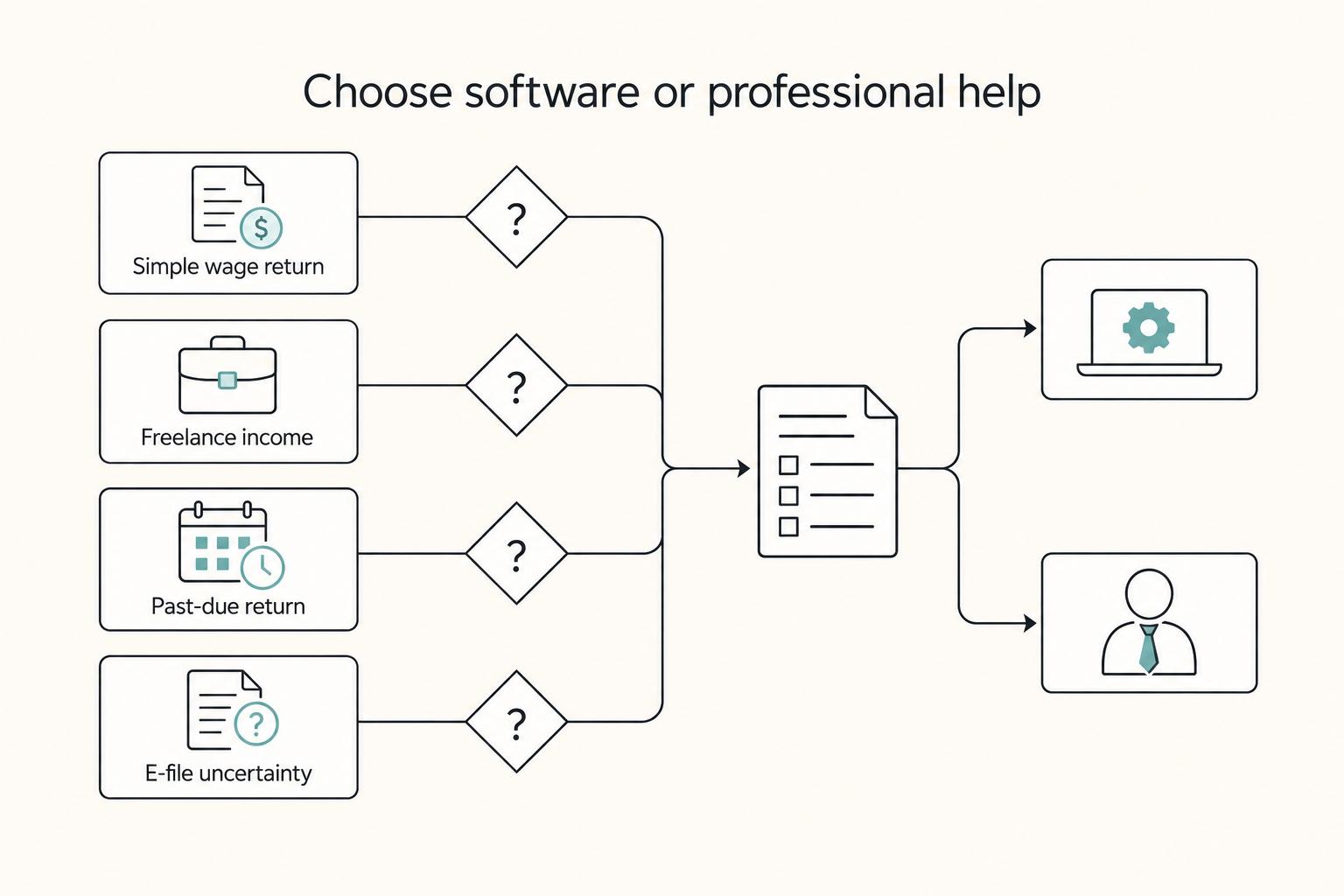
The Best Tax Software for US Expats
Pick by filing complexity, not brand familiarity. For many U.S. citizens living overseas, the right choice is the one that matches your form load, filing history, and tolerance for correction risk with the Internal Revenue Service (IRS).
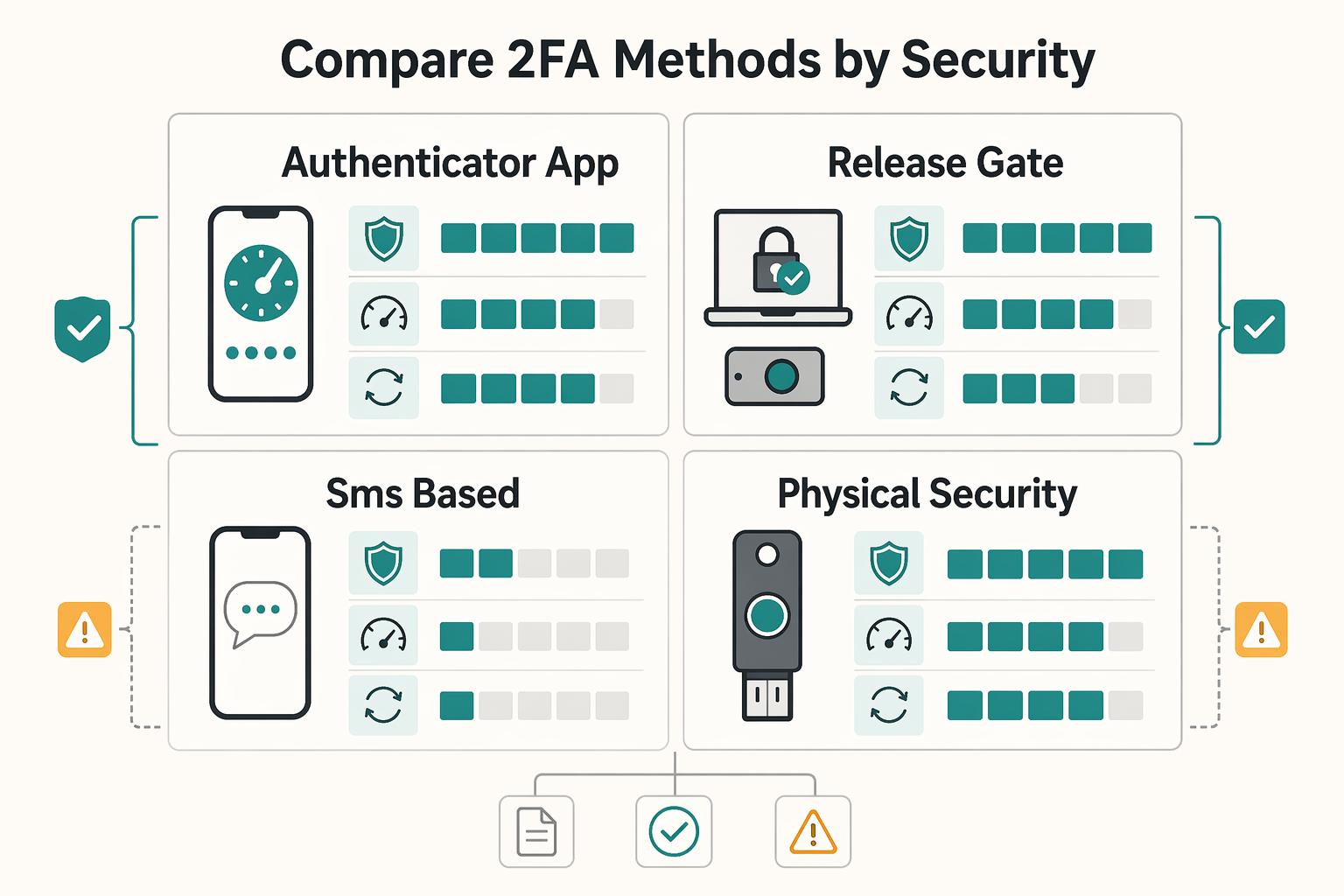
What is Two-Factor Authentication (2FA) and Why You Need It
Two-Factor Authentication (2FA) is a practical way to reduce avoidable account risk. It adds a second identity check, so a stolen password is less likely to lead to unauthorized access to billing, payouts, or client delivery.