
Quick Answer
First verify relevant account eligibility and critical payment controls, then compare fit, all-in cost and operating effort. Request normal and exception records in a secure, appropriately redacted form. Use safe simulated failures, test ambiguous payments and duplicate retries, and move to a bounded live pilot only when authorized.
Choose a payment stack for the work you actually do#
Your client has paid, but the provider shows a hold and no one can explain the next step. That is a more useful selection test than a long feature list. Choose a fintech stack that supports your markets, makes payment states traceable, and gives you a usable escalation path when money stalls.
The regulatory examples below were checked on 5 October 2026. They are examples of why scope matters, not a complete legal assessment of every country. Check current applicability again before signing or launching.
This lens works for three buyer types:
- If you are a freelancer, prioritize reliability and clear ownership without heavy procurement overhead.
- If you run a small team, prioritize fewer operational surprises and explicit support accountability.
- If you run embedded finance, evaluate both customer experience and underlying controls.
Work through three decisions:
- Filter signals: keep recurring 2026 patterns and ignore one-off feature hype.
- Test checkpoints: request evidence across strategy, sourcing, diligence, integration, and separation execution.
- Gate rollout by proof: advance only when outputs are demonstrated, not just promised.
When you ask for proof, ask for artifacts that show how the capability is executed and who owns outcomes when something fails. Failure often is not about bad intent. A compelling opportunity can still stall when conviction weakens under cost and risk pressure.
Start a lightweight diligence log on the first call:
| Demonstrated capability | Unverified claim | Promised follow-up artifact |
|---|---|---|
| A returned payout remains linked to the original invoice and provider reference | Whether the same trail survives a provider outage | Redacted failed-payout export, responsible role and follow-up date |
| The provider states which countries and customer types are supported | Whether your intended client and recipient qualify | Account eligibility terms and written corridor confirmation |
That one page keeps your shortlist honest and makes every later comparison faster.
Build the Mental Model Before You Compare Vendors#
Do this first: write your own scope and decision rules before you score any vendor. If you skip it, you can end up grading narrative quality instead of operating capability, and ownership gaps can stay hidden until later.
Trend coverage is useful context, but it is not proof. A practical reading for 2026 is simple: innovation can rise with risk, and automation can still underperform when service quality is weak. Treat polished claims as incomplete until scope, ownership, and exception handling are explicit.
Force terminology into written scope#
Do not debate Open Banking, Open Finance, or embedded finance in the abstract. Ask each vendor to define the term it is using in writing, then map that claim to concrete scope in your environment.
A simple one-page capability map can include three fields:
- Data boundary
- Payment action
- Ownership line
Mark a missing field as unknown, assign a follow-up date, and keep it out of the score until verified. A minor documentation gap can be remediated; unsupported eligibility or unclear control of money is a reason to block the affected launch.
Compare in layers, not one blended score#
Use the same comparison structure for every vendor so a strong UI demo is less likely to hide weak controls.
| Layer | Example artifact to request | Likely internal owner | Possible failure mode |
|---|---|---|---|
| Customer experience | Flow walkthrough for key actions, including exception paths | Product or operations | Happy-path demo only and exception handling is unclear |
| Policy | Written decision logic and escalation path | Finance, risk, or compliance | Rules are informal and outcomes vary by person |
| Money movement | End-to-end transaction lifecycle with status changes and handoffs | Finance ops or payments owner | Initiation is clear, but exception ownership is not |
| Evidence | Exportable records tied to a transaction outcome | Controller, ops, or audit-facing owner | Records are partial or hard to reconcile |
Use one evidence pack and check completeness#
Ask for a bounded diligence pack relevant to your scope. Use redacted cases or realistic test records where privacy or reporting confidentiality limits access. You need evidence you can assess, rather than unrestricted access to another customer’s financial information.
Minimum pack:
- Current capability map
- Sample policy decision trail
- Reconciliation output tied to a real or realistic transaction outcome
Distinguish missing critical proof from a documented minor gap. Keep final approval blocked where eligibility, control ownership or reconciliation cannot be demonstrated; record a remediation owner and date for issues that can reasonably be resolved.
Validate rails with scenarios, not promises#
For cross-border or multi-rail scope, test scenario behavior, not feature claims. Run concrete exception cases and require named ownership for detection, communication, resolution, and decision-trail export.
This is where the automation-versus-service tradeoff becomes visible in practice. Use 2026 trend coverage as a pressure test, not a shortcut: written scope first, layered evidence second, scenario validation third.
Set minimum controls for your payment flow#
Before you spend time on a pilot, set a hard gate. If a vendor cannot prove baseline trust controls, named ownership, and audit-ready evidence, do not advance it. The goal is not to score roadmap slides. It is to confirm that cross-functional reviewers can assess the same artifacts and clearly see who owns approvals, exceptions, and incident evidence.
The U.S. interagency third-party guidance describes a lifecycle for banking organizations: planning, due diligence and selection, contracting, ongoing monitoring and termination. A freelancer can borrow that structure at a smaller scale without assuming the bank’s regulatory duties. Write down which party controls collection, custody, payout, disputes and support for your actual account.
| Requirement | Evidence artifact | Disqualifying gap |
|---|---|---|
| Onboarding and identity-check controls are documented before financial services are turned on | Current onboarding policy, a sample review path, and a dated description of what is checked and when | The vendor says checks exist but cannot show the decision path or when controls apply |
| Compliance ownership is named, not implied | Owner list with role names, approval authority, and escalation contacts | Ownership sits with a generic team label or shifts depending on the issue |
| Third-party risk management covers external dependencies | Responsibility map across involved parties for approvals, exceptions, and incident handling | The vendor cannot show who acts first when a partner blocks, delays, or rejects activity |
| Escalation accountability produces usable records | Sample case record with alert, reviewer action, outcome, and exportable evidence | Exceptions are handled informally, or records cannot be tied back to a transaction outcome |
Before advancement, compile one diligence packet for cross-functional review. For example, include the control artifacts above, a clear decision trail, and one sample escalation record.
Confirm that evidence is current, identifies an accountable role and includes a failure case. A small freelancer account may have a named support channel rather than an individually assigned compliance officer. Require a usable route to the party authorized to act, with the response commitments your business needs.
Test AI on decisions and errors you can inspect#
Before using AI in a payment workflow, define the decision it assists, the consequences of an error and the evidence required to review it. Explainability and exportable logs help, but they do not by themselves prove accuracy, security or suitability for production.
NIST’s AI Risk Management Framework treats reliability, safety, resilience, accountability, explainability, privacy and fairness as connected characteristics. Use that as a context-dependent assessment, not a product certification or a guarantee that a human reviewer makes every output correct.
Split use cases into two risk tiers before you pilot:
- Low-impact assistive tasks: draft summaries, document classification, queue sorting, analyst recommendations.
- Higher-impact decisioning: approvals, holds, limits, or any output that changes money movement, compliance outcomes, or customer outcomes.
For higher-impact decisions, require an accountable policy owner, tested limits and timely human escalation or override where permitted. Some mandatory restrictions cannot be overridden, and safe authorized automation need not wait for a manual approval on every routine payment.
| Failure mode | What breaks in operations | Buyer evidence to require |
|---|---|---|
| AI appears in dashboards but not in the real workflow | Teams report usage, but decisions and handoffs still happen outside the product | Decision logs tied to real cases, plus records showing where reviewers used or rejected the output |
| Model behavior is opaque | Reviewers cannot explain why a case was flagged, cleared, or prioritized | Case-level decision logs, reviewable reason traces, and exportable records for audit review |
| No override or escalation path | Incorrect outputs persist, exceptions stall, and ownership becomes unclear | A documented override path, a sample escalation trail, named approvers, and exportable case history |
Keep a manual review lane open through the pilot, then gate expansion on explicit acceptance criteria:
- Compare AI outputs with independently reviewed case outcomes; assess disagreement, false alarms and missed risks, not only agreement with a human.
- Trace overrides and exceptions to source records, with access controls and an authorized escalation path.
- Define material-error or drift limits before the pilot; block the affected expansion when those limits fail and record the correction and retest.
Treat an AI recommendation as one input. Check whether it can trigger a real payment action, what authorization limits apply and what happens when the model or data feed is unavailable.
Test fraud and compliance controls in the payment flow#
Fraud and compliance should be tested as product behavior, not treated as legal text sitting outside the product. Evaluate how controls work across onboarding, transaction checks, payout release, and post-settlement review.
In practice, that means verifying how controls run in the workflow, not how policies read on paper. Compliance in 2026 is broader than identity and fraud checks alone, and key features such as onboarding and dispute handling are expected to follow strict rules from the start. If a vendor cannot show that code enforces limits, logs actions, and adapts to regional requirements, treat it as an operating gap.
Use this table to judge evidence quality by stage:
| Stage | Documented ownership | Traceable decision trail | Exception handling | Audit readiness |
|---|---|---|---|---|
| Onboarding | Named role owns KYC reviews and unresolved identity cases | Record shows trigger, reviewer, and final disposition | Failed or incomplete verification has a defined manual path | Exportable logs include country-specific settings used |
| Transaction checks | Named owner for AML and suspicious-activity triage | Alert history ties trigger, actions, and outcome to the case | Triggered cases and duplicate alerts have a clear escalation route | Logs show limits or rules applied and actions taken |
| Payout release | Named approver or policy owner for holds and releases | Release decision links to prior checks, overrides, and timestamps | Escalate a hold through an authorized process; reroute only when legally permitted and the original payment status is known | Approval records remain reviewable after settlement |
| Post-settlement review | Named owner for disputes, reversals, and retrospectives | Full history is preserved from first event to closure | Reopened cases and corrections keep attribution | Retained trail is exportable for review |
Confirm who can act on each type of hold and whether an override is legally and contractually permitted. Routine support must not promise to bypass a sanctions block or another mandatory restriction. Record the escalation route and its expected response time.
Run a short failure drill during diligence#
Use a short drill to see whether the operating story holds up when something goes wrong.
- Request redacted or realistic case walkthroughs for identity review, suspicious-activity escalation and a payout hold, within lawful confidentiality limits.
- Follow escalation end to end: who touched the case, what triggered review, and where each decision was recorded.
- Confirm attribution fields are visible: reviewer, timestamp, trigger or rule, manual override if used, and outcome.
- Verify recovery after a mistaken clearance or hold, including when a settled payment cannot simply be undone; preserve the original event and any separate correction.
You are not testing model internals. You are testing whether exceptions stay visible, attributable, and recoverable.
For cross-border scope, ask how applicable country or program rules affect product behavior. Request a normal resolution, an escalated test case and the export format. Redaction or restricted access can be legitimate; an inability to demonstrate essential controls through any suitable evidence is the material gap.
Evaluate a stablecoin route only when it serves your use case#
Make stablecoin readiness optional unless it solves a measured need. Verify legal and account eligibility before moving live funds, test in a simulation or approved sandbox first, then use a bounded live pilot only where authorized. Compare total costs, bank-arrived cash and recovery effort with the existing route.
The FSB’s stablecoin recommendations address oversight, governance, risk and redemption; they are recommendations for authorities, not a license for your business. Ask for current applicable legal scope and contracted responsibilities for the actual issuer, custodian, provider and off-ramp before a live pilot.
Map issuers, wallets, custody, compliance services and bank off-ramps as separate dependencies. A transfer confirmed on a blockchain is not proof that your recipient has bank cash, and a token’s stated peg does not eliminate issuer, redemption, custody or network risk.
Require a named responsibility map before any pilot#
Before rollout, require a market-by-market map naming ownership for vendor operations, issuer relationship, custody or wallet control, sanctions and AML review, transaction monitoring, incident response, reconciliation, and off-ramp settlement. If you hear "that sits with our partner," ask who handles exceptions, who approves holds or releases, and where those decisions are logged.
| Responsibility area | Map requirement |
|---|---|
| Vendor operations | Authorized entities, product scope, support route and incident owner |
| Issuer relationship | Token/network, reserve and redemption terms, eligibility and issuer dependency |
| Custody or wallet control | Who controls keys, access recovery and approval limits |
| Sanctions and AML review | Responsible regulated party, applicable controls and permitted escalation |
| Transaction monitoring | Trigger, case owner and action authority |
| Incident response | Detection, communication, containment and recovery owners |
| Reconciliation | Invoice/transfer/chain/payout identifiers, fees and accounting treatment |
| Off-ramp settlement | Conversion, redemption, bank-arrival evidence and failure response |
Ask for concrete proof: one corridor diagram, one exception case history, one reconciliation output tied to a settled transaction, and one escalation path with named owners. A fast happy-path demo is not enough if accountability disappears when transfers stall or must return to a fallback rail.
| Check | Evidence artifact to request | Disqualifier rule |
|---|---|---|
| Cost outcome | Live corridor pilot showing all-in current-rail vs stablecoin-path cost, including fees, treasury handling, off-ramp charges, and manual review effort | No-go if savings disappear after compliance work and exception handling are included |
| Settlement reliability | Timestamped pilot records from initiation to final settlement, with exception counts, retries, and unresolved cases | No-go if performance improves only on the happy path or exception recovery is unstable |
| Compliance burden | Market-specific control matrix for onboarding, sanctions screening, monitoring, reporting, case ownership, and audit-log export | No-go if control ownership is unclear by market or decision trails cannot be exported |
Keep authorized production scope to a bounded corridor and customer group, with exposure limits and a tested recovery plan. A blockchain transfer may be irreversible. Before using a fallback bank rail, establish whether the original transfer completed or remains pending; never bypass a legal hold or pay twice merely because a status update is late.
Compare Money Movement Architecture, Not Just Dashboard Screenshots#
Compare money movement whether you use conventional rails or digital assets. Require records showing how amounts, state and ownership move between provider events, accounting entries and final bank settlement.
Test interoperability at the actual boundaries you depend on. A connector list is incomplete proof if returns or disputed payments still require records you cannot retrieve or interpret.
Use buyer-grade pass or fail checks#
Focus the test on the points where state changes, exceptions appear, and accountability can blur. Treat the checks below as buyer-defined diligence criteria, not universal standards.
| Architecture area | Buyer pass/fail check | Example evidence | Disqualifier |
|---|---|---|---|
| Collection to recorded balance | Show how incoming funds move from receipt to balance or payable state, including holds, retries, and rejections when applicable | Event trail | Balances change in the UI, but there is no clear event path for why or when |
| Event delivery and exceptions | Show what happens when events succeed, stall, retry, or fail, and who owns the next action | Failure handling record | Only happy-path proof is available, or failed events disappear into support queues |
| Commercial and operating boundary | Clarify ownership for tax, invoicing, liability, and market-specific handling across partners and transaction types | Responsibility matrix | Ownership shifts across documents or defaults to "our partner handles that" |
| Accounting and operational truth | Tie sample accounting records to movement outcomes and resulting balance impact | Reconciliation artifact | Finance cannot explain differences between accounting records and movement outcomes |
Test interoperability where teams usually lose visibility#
Do not accept "we integrate with everything" as proof. Ask how data and state move across four boundaries: ledger, payments execution, risk or compliance review, and reporting. Confirm which identifier survives each handoff, which state changes write back, and whether holds, releases, returns, or reversals are visible outside the originating tool.
If risk review stops a payout, can operations and reporting see the hold and its owner? Which accounting event is posted, if any? Holds need not all create a financial journal entry, but the status and eventual balance impact must be explainable. Preserve intermediate events, returns and manual actions under linked identifiers.
For agent-assisted execution, check who grants authority, amount and destination limits, independent confirmation of changes, cancellation windows and escalation. A generated instruction is not evidence of customer consent or provider execution.
Review a successful trace and a failed trace using source records. Several tools can legitimately share the work if identifiers and ownership survive the handoffs. Treat missing or contradictory links as the gap, rather than requiring every stage to appear on one screen.
Finish with finance-led validation. Have your team attempt to reconcile a sample record set to final movement outcomes, and document where vendor guidance is still required. If matching depends heavily on vendor intervention, translated fields, or special exports, flag implementation risk.
Score Vendors by Persona So Tradeoffs Stay Honest#
Set minimum controls for the personas and workflows actually involved. A freelancer may cover finance and operations themselves, with provider support for regulated decisions. Score only relevant requirements; do not disqualify a suitable account because it lacks enterprise developer features you will not use.
That keeps tradeoffs honest. Finance leaders focus on cost per transaction, cash timing, and hidden manual work. Risk teams track fraud, disputes, and policy drift. Technology leaders focus on outages and brittle integrations. A blended score too early can hide real operating risk.
Use one scorecard with pass/fail first, then scoring#
Use the same evidence standard for every vendor: successful and failed workflow traces with clear ownership and final disposition.
| Persona | Must-have control (pass/fail gate) | Business impact lens | Required proof | Disqualifier signal |
|---|---|---|---|---|
| Freelancer | Clear in-product payout status changes and a named owner for holds, returns, or corrections | Cash timing, trust, support burden | A real payout completion path and an exception path, including who acts and where status changes appear | No usable status evidence or accountable escalation path |
| Finance/AP | Records that reconcile movement outcomes to balances, payables, and exceptions | Margin, cash flow, close effort, hidden manual work | Sample records finance can match to final outcomes without vendor intervention, plus clear ownership for exceptions | Finance cannot reliably reconcile records or understand documented fields at acceptable effort |
| Ops/developer | Observable integrations with modular orchestration and clear outage or retry behavior | Integration durability, migration effort, outage exposure, provider flexibility | An automated path and a failed path showing surviving identifiers, retries, write-backs, and recovery ownership | Required integration paths lack surviving identifiers or safe retry/recovery behavior |
After a vendor passes the gate, scoring differences are expected. Keep them evidence-based, not demo-based.
AI claims should meet the same bar. If a vendor claims agentic AI value for compliance, AML, fraud, identity, or analytics, score that only after it shows clean data pipelines, shared metrics, and a consistent operating model in real workflows.
Verify digital-asset tax readiness as an operational workflow#
If digital-asset tax workflows are in scope, run a dedicated product walkthrough from transaction capture to draft tax record, then test incomplete, disputed, and correction scenarios. If Form 1099-DA matters for your program, verify status visibility, correction handling, and accountable ownership in product, not as a future partner promise.
A documented spreadsheet or email handoff may be acceptable at low volume if ownership, access control, records and deadlines are reliable. Unowned corrections or missing source records are the problem. Confirm which entity actually prepares and files any required Form 1099-DA; its presence in a dashboard does not settle your own tax reporting.
Keep the decision sequence short#
Keep the process tight:
- Set persona minimum controls and eliminate any vendor that fails one.
- Score only remaining vendors using the same evidence session.
- Recheck premium claims, especially AI and digital-asset tax workflows, only where workflow proof and ownership are visible.
- If scores are close, choose the vendor with stronger cross-persona evidence quality and failure-path proof.
When scores are nearly even, pick the platform whose bad day is easier to understand and operate.
Use Red Flags to Eliminate Risky Platforms Early#
Eliminate vendors that cannot resolve a critical scope, control or evidence gap by the decision deadline. Record lower-impact issues with remediation or a justified acceptance decision rather than treating every unknown as equally disqualifying.
The bar is not paper compliance alone. Diligence should test whether issues can be caught and stopped earlier, with real-time accountability and clear human escalation when automation fails.
Start with control boundaries, not product polish#
Run a boundary-and-ownership test first. Before a vendor advances, require a written verification pack and explicit control ownership that shows who owns onboarding checks, ongoing monitoring, exception review, and when to pause work or expand validation.
Do not accept this verbally. Onboarding alone is not enough for ongoing risk control. If ownership is vague or undocumented, treat it as a red flag until resolved.
Request source records and the reconciliation method in a suitable secure format. A vendor may lawfully restrict production access or confidential case details. Accept redacted or test evidence if it demonstrates the control; investigate rounded totals or incomplete fields when they prevent reconciliation.
| Red flag | Required proof | Elimination trigger |
|---|---|---|
| Unclear ownership of onboarding and ongoing monitoring controls | Written control map with a named owner and escalation point | Ownership is verbal, vague, or changes based on who answers |
| Evidence cannot demonstrate essential controls | Secure redacted/test records and documented reconciliation method | No suitable evidence is available by the decision deadline |
| Automation claims without exception proof | One real example showing alert, review, human intervention, and final decision | Only happy-path automation is shown, or no accountable manual intervention is demonstrated |
| Repeated issues framed as one-off customer behavior | Evidence of earlier detection thresholds and earlier manual intervention when patterns repeat | Incidents keep repeating without control-framework changes |
For repeated incidents, ask what changed and whether the retest improved the outcome. Distinguish a provider control failure from a documented external cause, while checking that recovery and communication still meet your requirements.
Use a short review protocol and cut fast#
Use a short protocol with three outcomes: pass, remediation required, or no-go. Keep critical unresolved requirements out of weighted scoring.
- Collect the scope and verification pack plus a suitable redacted or test exception record.
- Review with the people covering finance, risk and operations for this scope; one freelancer may cover several roles.
- Log the finding, severity, evidence, owner and due date; distinguish lawful access limits from absent proof.
- Disqualify on unresolved critical requirements; accept or remediate minor issues explicitly without scoring an unknown as proven.
This keeps polished demos from outranking control evidence and gives you a safer shortlist faster.
Execute in the First 90 Days Without Breaking Finance Ops#
Use the first 90 days as an example rollout window, adapted to volume and risk. Record the initial scope, budget, owners and promotion criteria before the pilot. Keep existing payment obligations supported while you test a replacement.
Before expanding volume, have a cross-functional team review the same three checkpoints together:
- Launch readiness for the product path in scope, including how exceptions and risk signals are handled.
- Budget and priority alignment for current operating goals, with clear owners for open issues.
- Fraud and risk readiness across teams, since fraud pressure can move earlier in transaction flows.
If regulated products are in scope, make compliance and reporting readiness an early checkpoint, not a cleanup task. Treat vendor claims as unverified until your team confirms them in your own operating context.
| Rollout stage | What must be true | Who signs off | What blocks promotion |
|---|---|---|---|
| Limited pilot | Documented checkpoints are complete, controls are active, and key risks are understood on initial scope | Cross-functional reviewers confirm readiness together | Missing checkpoint evidence, unresolved risk, or unclear ownership |
| Broader production use | Results stay consistent as usage grows, with issues logged and tracked to resolution | Same reviewers reassess readiness together | Repeated unresolved issues or new risks without a mitigation plan |
| Higher-volume expansion | The operating model remains stable under higher demand and regulatory expectations | Joint approval is recorded in the gate log | Any disputed checkpoint, open critical risk, or unresolved compliance question |
Block only the expansion affected by a failed material gate, document remediation and retest. Preserve valid existing billing and settlement; a missing pilot artifact does not authorize freezing unrelated customer money.
Handle Country and Program Variance Without Guesswork#
Do not sign until you can show, in writing, how variance is handled for each market and launch program. Use this as a working diligence frame, not a legal taxonomy. This frame supports documented scope, precision, and ROI checks; it does not, on its own, validate country-by-country legal or regulatory requirements.
Before signature, run more than one scenario per market and per program, then treat any mismatch across product, legal, and support as unresolved risk until it is resolved in writing. This protects you from broad demos and generalized claims that may not hold up in your specific operating path.
| Check area | What you should request before signing | How you verify this | Red flag that should pause signature |
|---|---|---|---|
| Market scope | A market sheet that lists included, excluded, and conditional markets for your exact product path | Compare the market matrix to the signed order form or contract scope exhibit | Sales claims broad coverage, but signed scope is still generic |
| Program fit | A written description of supported customer types, use cases, and policy constraints for your first launch program | Match product docs and sandbox or pilot output to your real onboarding and exception scenarios | Demo works for one path, but your customer type or edge cases are not confirmed in writing |
| Operational ownership | Written support and escalation ownership for normal and exception flows | Check the support plan or support exhibit, plus named owners and handoff rules | Commitments live in email or marketing copy, not executable documents |
| Evidence and ROI | Proof of reviewable output for outcomes, plus ROI evidence for the proposed setup | Review pilot output, sample reports, reconciliation artifacts, and a short ROI case tied to the same path | AI efficiency or margin-scale claims appear without evidence tied to your program |
Compare measurable benefit with total implementation and operating cost: provider fees, FX, support, reconciliation, dispute work and exit effort. You do not need an AI margin claim if the workflow does not use AI.
Use a short pre-sign checklist#
Use a short checklist and make every item produce a document you can review later. Treat it as an internal operating control, not a substitute for legal advice:
| Checklist item | Documented output |
|---|---|
| Create one market sheet per target market | Scope, constraints, enabled product path, and your named owner |
| Create one program sheet per launch use case | Customer type, transaction pattern, internal risk-policy notes, and required evidence |
| Run at least two scenarios for each market-program pair | Sandbox or pilot output for one normal case and one exception case |
| Log every contradiction across product, legal, and support | A contradiction log entry with mismatch, source document, named owner, and due date |
| Make a written go or no-go decision | A decision note that accepts documented variance or blocks signature until resolved |
A reference customer is useful context, not proof of your eligibility or workflow fit. Ask for your market and program scope, then resolve material contradictions in writing.
Choose the Safer 2026 Stack and Next Step#
Choose the vendor that proves control quality under stress, not the one with the longest feature list. The safer call is evidence quality over feature volume, because outsourcing execution does not outsource your accountability when money movement, data access, or exception handling fails.
That standard should hold even when the product looks modern and the demo is smooth. Third-party use can reduce your direct control and introduce new risk, so ownership, fallback behavior, and monitoring cadence should be explicit in writing. For critical activities, monitoring should be more frequent and more complete. Your selection standard should follow a full third-party risk lifecycle: planning, due diligence and selection, contracting, ongoing monitoring, and termination.
Use three buyer tests before you pick#
Before final selection, require clear answers to three questions: can this vendor keep your operation running through disruption, can you trace decisions and payments after the fact, and can it prove where your exact program is live today.
| Buyer test | What you should require in the walkthrough | What should make you pause |
|---|---|---|
| Continuity readiness | One severe-but-plausible disruption scenario using your real flow, plus stated tolerance for disruption, fallback route, retry behavior, and named escalation owner | No written fallback path, no owner for manual recovery, or vague answers about rail, partner, or data-source outages |
| Control traceability | One end-to-end example with raw event trail, timestamps, status changes, manual override record if used, and reconciliation evidence tied to final ledger or export | Screenshot-only demos, no exception log, no way to explain decision changes, or AI outputs that are not reviewable for reliability, accountability, and explainability |
| Market and program scope proof | Written scope confirmation showing where the feature is live now, for which customer type or program, with exclusions, dependencies, and fallback behavior by jurisdiction | One market offered as proof for all markets, or international standards treated as already operative local law |
Continuity readiness can be under-tested. The vendor should walk you through a severe-but-plausible disruption and show mitigation, not just promise resilience. If it cannot name who owns recovery, you still have a sales answer, not an operating answer.
For U.S. consumer-authorized data sharing, the CFPB compliance page states that the 2024 rule’s compliance dates were stayed by a court on 29 October 2025. Do not present the original 2026–2030 schedule as currently operative. Confirm the current rule and litigation status for your use case. EU DORA requirements likewise need entity- and service-specific applicability review rather than a generic global Open Banking claim.
FATF revised Recommendation 16 in June 2025, with the changes to come into effect by the end of 2030. FATF standards require jurisdictional implementation; they are not a universal new 2026 product mandate. Check the law and provider rules currently applicable to each corridor.
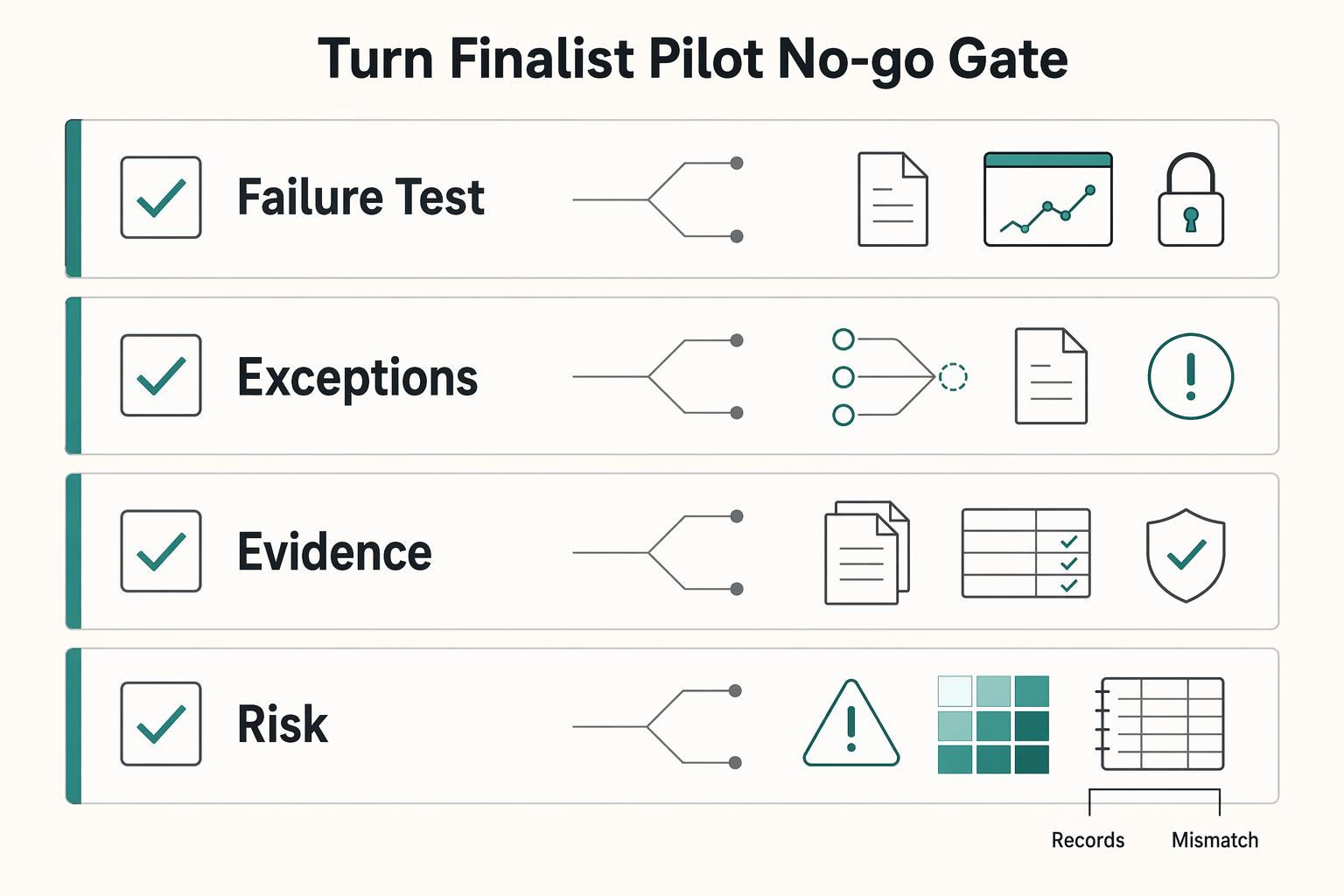
Turn the finalist pilot into a go or no-go gate#
When two vendors remain, run a short pilot designed to expose ownership gaps early. Do not let it become a soft launch with undefined success criteria.
| Required output | What it must show |
|---|---|
| Failure test result | A safely simulated failure in an approved test environment, observed behavior, original-payment status, recovery trigger and result within the agreed tolerance |
| Escalation owner | A named role, response path, and contact method for payment delay, return, screening hold, and data-feed failure |
| Reconciliation evidence | One normal transaction and one exception transaction tied to status history, ledger movement, and exported records your finance lead can review |
| Unresolved-risk log | Each open issue, owner, workaround, acceptance decision, and target closure date |
Watch for a failed or pending payment being retried as a new collection without checking its original status. Test duplicate-event delivery and a timeout after the provider has accepted a request: the records should prevent duplicate money movement and identify the owner who resolves an ambiguous outcome. Do not manufacture a live customer outage or compliance violation to test the vendor.
Make your next step operational#
Start with a scenario walkthrough of payout, refund, hold and outage handling. Obtain written scope for the exact market, program and customer type before final approval. Simulate failures safely, then move to a bounded authorized live pilot only after eligibility and controls are confirmed.
If ownership is still unclear, or fallback behavior is still verbal instead of documented, pause selection. The safer stack is not the one that promises the most. It is the one that proves, in writing and in test evidence, how your operation keeps working when the normal path fails.
If your shortlist is down to finalists, request a market-and-program coverage review for your exact payout corridors via Gruv.
Frequently Asked Questions
What are the most important fintech trends in 2026 for small teams and freelancers?
Evaluate bank-data access where your workflow needs it, AI where it demonstrably improves a task, and stablecoins only where an eligible route offers measured benefit. None is a universal purchase requirement. First verify your markets, payment methods, control ownership and reconciliation evidence.
Is AI in fintech a must-have now, or should you wait?
Buy AI for a measured task rather than because it is expected. Test independently reviewed outcomes, errors, source data, authorization limits and permitted human escalation. Ask for an approved case, a false alert and a correction trail; logs alone do not establish accuracy or safe deployment.
How do you evaluate whether stablecoin-ready features are actually usable for your business?
Start with your real corridor, customer type, and fallback path, not the demo path. Stablecoins may help in specific flows, but cross-border friction can remain because AML and KYC expectations differ by jurisdiction, and stablecoins do not remove all operating friction. For programs involving permitted payment stablecoin issuers, confirm AML program ownership, then treat each jurisdiction's requirements as pending until they are verified against current regulatory, vendor, and program records before use. Require written ownership for monitoring, screening, returns, and outages.
What capabilities are table stakes in a modern fintech platform in 2026?
Require eligible account and market coverage, traceable payment and bank-settlement records, an accountable support path and recovery processes for the flow you need. Open Banking is relevant when you depend on bank-data access or supported initiation; it is not a universal requirement for every invoicing or payout account.
Which trends are hype for your use case and which are worth immediate budget?
Treat claims as hype when they are not tied to your jurisdiction, program, and first operating phase. Fund capabilities that remove current manual work or risk in your live flow, and treat stablecoin readiness as conditional on corridor-level validation. Ask each vendor to map every claimed benefit to one measurable operating step and disqualify claims that stay generic.
How can you compare vendors quickly without missing compliance and operational risk?
Use two passes: verify relevant eligibility and critical controls first, then compare fit, all-in cost and operating effort. Request a concise pack with scope, responsibilities and normal/exception records. Use sanitized data and safe simulated failures before any authorized live test; assign remediation dates for minor gaps.
What should you verify first if you plan to support cross-border payouts this year?
Verify live corridor coverage first, then confirm compliance boundaries, return handling, delay handling, and fallback behavior for your exact program. Do not assume one setup works across all markets. Request one market sheet per target corridor plus tests for one normal payout and one exception payout with reconciliation output.
What is the fastest disqualifier when a vendor sounds promising but still feels risky?
An unresolved critical gap in eligibility, custody/control, reconciliation or recovery is a no-go for the affected scope. Legitimate confidentiality restrictions are not automatically a failure if suitable alternative evidence is available. Record the exact missing proof and decision deadline.
Try a related tool
Researched and edited by the Gruv editorial team. Gruv builds cross-border billing, payouts, and finance-operations software for global businesses.
Sources
Includes 2 external sources outside the trusted-domain allowlist.
- airc.nist.gov/airmf-resources/airmf/3-sec-characteristicstrusted
- consumerfinance.gov/compliance/compliance-resources/other-applic...trusted
- irs.gov/forms-pubs/about-form-1099-datrusted
- occ.treas.gov/news-issuances/news-releases/2023/nr-ia-2023...trusted
- fatf-gafi.org/en/publications/Fatfrecommendations/update-R...external
- fsb.org/2023/07/high-level-recommendations-for-the-r...external
Educational content only. Not legal, tax, or financial advice.
Related Posts

The Freelance Payment Penalty: A Modeled Audit of Platform Fees, FX Spreads, and Payout Delays
The money rarely disappears through a single, easy-to-spot fee. The real loss is stacked. A marketplace takes its commission, a processor adds a charge for international cards, a bank or payment company converts the currency at a spread, a platform holds the funds before release, and a wire sheds a little to intermediaries on the way in. Each layer looks defensible on its own, but the worker feels the combined result as a smaller deposit and a later payday.

How to Respond to a Subpoena for Business Records
Move fast, but do not produce records on instinct. If you need to **respond to a subpoena for business records**, your immediate job is to control deadlines, preserve records, and make any later production defensible.

A US Expat's Guide to Investing in UCITS ETFs to Avoid PFIC Issues
The real problem is a two-system conflict. U.S. tax treatment can punish the wrong fund choice, while local product-access constraints can block the funds you want to buy in the first place. For **us expat ucits etfs**, the practical question is not "Which product is best?" It is "What can I access, report, and keep doing every year without guessing?" Use this four-part filter before any trade: