
Quick Answer
Yes, many expats may need both fbar and fatca filings, because FinCEN Form 114 and Form 8938 are separate obligations. Start by confirming filer type, then test each form independently instead of stopping after one result. File FBAR through the FinCEN BSA E-Filing System, and attach Form 8938 to the income tax return when required. Keep a line-item evidence file with balances, ownership or authority notes, and final treatment so your decisions are defensible.
Start Here With the One Decision That Matters#
The first decision drives everything that follows: do your facts point to FBAR, Form 8938, or both? Do not open the forms or start entering data until you answer that. The most common early mistake is treating these as one task before you confirm which rules actually apply.
If you are a U.S. citizen, U.S. resident, or globally mobile freelancer with non-U.S. accounts or assets, start with scope rather than paperwork. FBAR is the Report of Foreign Bank and Financial Accounts filed on FinCEN Form 114. Form 8938 is the Statement of Specified Foreign Financial Assets attached to your tax return when required. The facts can overlap, but one filing never satisfies the other, which is why the initial triage matters.
Use this quick screen before you prepare anything:
- For FBAR, check account exposure first. If aggregate foreign account value exceeded $10,000 at any time in the calendar year, review FinCEN Form 114 requirements.
- For Form 8938, start with the return itself. If no income tax return is required for the year, Form 8938 is not required.
- For thresholds, use the right context. A $50,000 benchmark appears for certain taxpayers, but some filers have higher thresholds.
- For control questions, look beyond title. FBAR review includes financial interest and signature or other authority.
Two mistakes show up again and again. The first is stopping after one form because the facts feel close enough. The second is ignoring signature authority because ownership appears limited. Both usually start with a rushed first pass.
A short evidence file will keep you out of trouble here. Keep an account list, highest annual balances, ownership or authority notes, and a one-line reason for each yes or no call. That one page of notes does more for accuracy than jumping straight into data entry.
If residency status, filing status, or asset classification is unclear, pause and verify before you file. A short verification step now is much easier than trying to unwind a wrong submission later. If you want a deeper dive, read Filing Back Taxes as a US Expat: A Guide to the Streamlined Procedures. For a fast next step, Try the FBAR calculator. Once you know which filing may apply, the next step is to keep the two obligations separate in your head.
Build the Mental Model Before You File Anything#
Think about it this way: these are separate reporting obligations that can both apply, and each one has to be tested under its own rules. Once people blend them into one project, the mistakes become predictable.
FBAR is FinCEN Form 114, filed with Financial Crimes Enforcement Network (FinCEN), a bureau of the U.S. Department of the Treasury that is separate from the IRS. Form 8938 goes through the IRS by attachment to your annual income tax return. Filing Form 8938 does not satisfy the FinCEN filing, and sending Form 114 does not take the place of Form 8938 when that form is required.
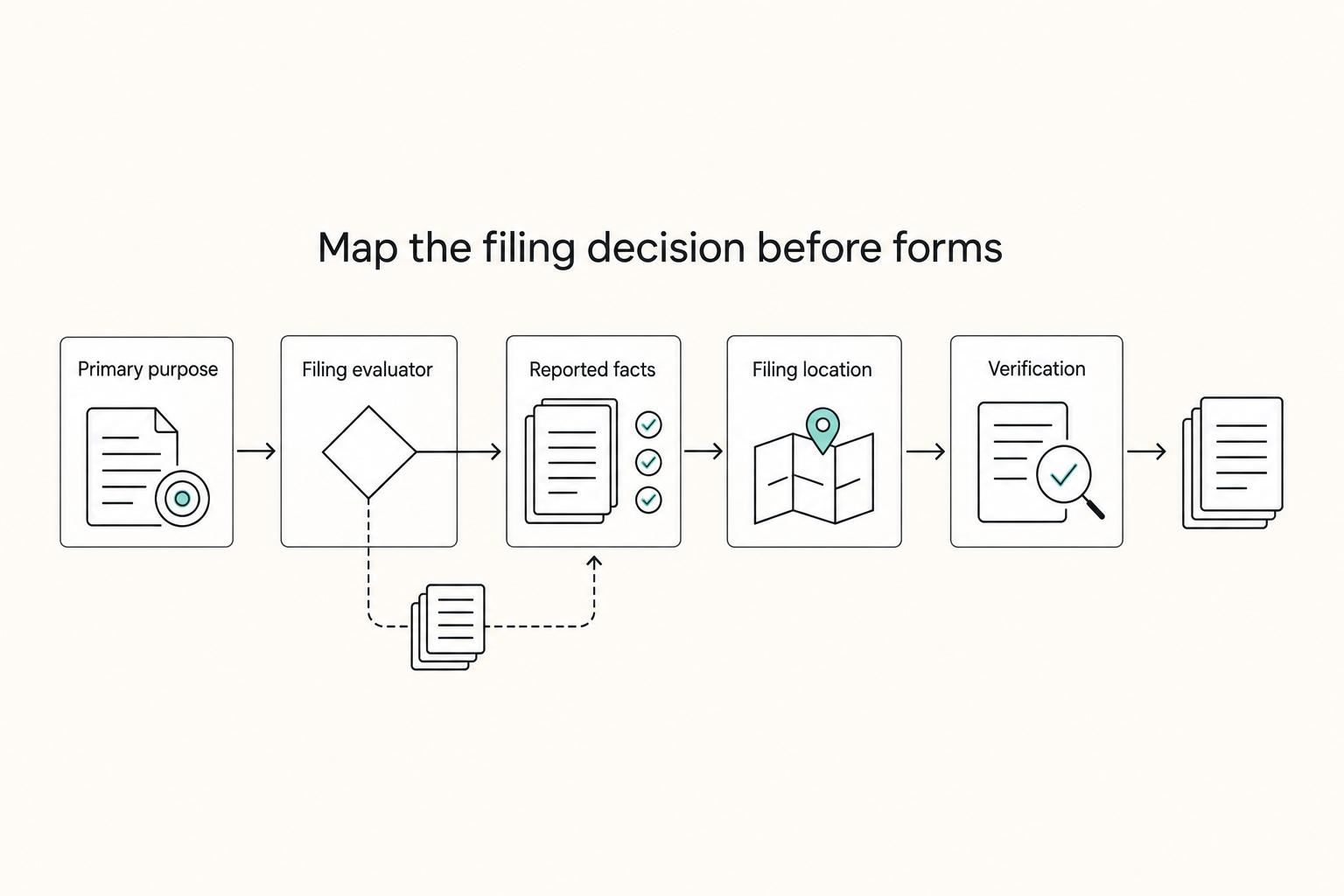
| Item | FBAR (FinCEN Form 114) | Form 8938 |
|---|---|---|
| Primary purpose | Report foreign financial accounts | Report specified foreign financial assets |
| Who should evaluate filing | U.S. persons, including domestic entities | Specified individuals and specified domestic entities |
| What gets reported | Reportable foreign accounts | Specified foreign financial assets above applicable threshold |
| Where it is filed | Directly with FinCEN (not with the IRS) | Attached to the annual income tax return through the IRS process |
| What to verify next | Confirm the FinCEN filing path and that it is not being sent to the IRS | Confirm return-filing requirement, then apply the correct threshold set |
That distinction is practical, not academic. The filing channel is different, the reporting category is different, and the threshold analysis is different. The same facts can show up in both reviews, but not for the same reason. If you do not keep those reasons separate, you can end up with a filing set that looks tidy on the surface but is still wrong underneath.
Threshold selection is where many otherwise careful filing processes fail. The IRS cites a $50,000 benchmark for certain Form 8938 filers, but that is not universal. For specified domestic entities, the instructions include a $50,000 year-end and $75,000 any-time test. If you apply the wrong threshold set, the rest of the process can look organized and still rest on the wrong premise.
A simple fix is to write two lines in your notes before you move on, one for FBAR and one for Form 8938. For each line, record the filing channel, filer category, and threshold test used. If any of those fields is still unknown, stop and resolve it first. Related: Digital Nomad Taxes in 2026 With a Defensible Filing Plan. Once that mental model is in place, the yes or no filing decision gets much cleaner.
Use a Yes No Filing Path for FBAR, FATCA, or Both#
Run two separate yes or no tests, and do not close either one too early. That keeps you from saying no on one side just because the other side looks straightforward.
Use this sequence:
- Start with filer type (Yes/No): Confirm how you are treated for the year and whether that puts you in a category that should evaluate either filing.
- Form 8938 path (Yes/No): Based on filer type, confirm you are in a Form 8938 filer category, then test whether your specified foreign financial assets exceed the applicable reporting threshold.
- FBAR path (Yes/No): Evaluate FBAR independently for your facts and filer status.
- Dual-trigger rule: If your facts show both foreign financial accounts and specified foreign financial assets, assume
both may applyand keep both checks open until each path is confirmed. - No-FBAR checkpoint: Before you finalize
no FBAR, explicitly review signature authority and financial interest. - Finalize outcome: Record one result only after both paths are complete:
Form 8938 only,FBAR only, orboth.
The final answer matters, but so does the discipline behind it. In practice, one plain sentence explaining each yes or no call is enough to prevent a lot of second-guessing later. If you cannot write that sentence, you probably are not done with the review.
This is also where people accidentally substitute one filing for the other. Do not do that. A clean no on Form 8938 does not answer the FinCEN question, and a clean no on the FinCEN side does not resolve the IRS side. Treat them as parallel decisions until both are closed.
Before you move to item mapping, do one more verification pass with the IRS comparison chart for Form 8938 and FBAR requirements. Then confirm the filing channel again: Form 8938 rides with your tax return, and FinCEN Form 114 goes through FinCEN, not through the IRS return process. Once both paths are framed correctly, you can map the actual accounts and assets without forcing them into the wrong bucket.
Map Your Real Accounts and Assets Without Guessing#
Most rework starts with bad classification, so slow down here. Map each item into the right bucket before you draft anything: foreign financial accounts for the FinCEN side and specified foreign financial assets for Form 8938. If you guess now, you will pay for it later when values do not reconcile or an item shows up in the wrong place.
Work both buckets at the same time, but do not collapse them into one list with vague labels. Form 8938 itself separates this process into Part I (Foreign Deposit and Custodial Accounts Summary) and Part II (Other Foreign Assets Summary), and some accounts are excluded. That means foreign by itself is not enough to classify an item. You need a row-by-row review.
Pull statements, account-opening records, and entity documents before you start tagging rows. Memory is not a reliable filing tool, especially once you are dealing with authority issues, ownership structures, or account changes during the year. A simple inventory usually works better than making category calls in your head.
Use a worksheet that captures the facts you actually need:
- Create one row per item with owner, account-holder name, institution or issuer, country, year-end value, and highest in-year value if available.
- Tag each row as
foreign financial account,specified foreign financial asset, orreview needed. - For account rows, note FBAR review status and whether Form 8938 Part I may also apply.
- For non-account holdings, note possible Form 8938 Part II treatment and the document supporting your classification.
- Check Form 8938 exclusions before finalizing any
includedecision. - Add an evidence note to each row:
include,exclude, orescalate.
This is what makes later reconciliation possible. If an item may belong in more than one bucket, your row should show why. If an item is excluded, the row should show why too. That way, when you review the file later or hand it to a tax pro, the logic is visible without rebuilding the whole story from scratch.
In practice, the contrast is often clear. Personal foreign bank accounts are usually straightforward to map. Once you add ownership structures tied to those accounts, including possible foreign partnership interests, the review can stop being simple very quickly. When that happens, do not force a quick answer just to keep momentum. Mark the item for review and keep moving through the rest of the file.
If anything remains unclear, document the assumption, mark it pending, and get professional review before submission. A short note that says why you included, excluded, or escalated an item is far more useful than an unmarked spreadsheet. Once the map is clean, filing becomes much more mechanical.
File in the Right Place and in the Right Order#
Channel mistakes are easy to avoid and annoying to fix. The clean order is to classify items first, decide each filing separately, submit FinCEN Form 114 in the FinCEN BSA E-Filing System, and then complete Form 8938 with your IRS return.
That order matters because it forces you to work from one inventory and one set of documented decisions. It also reduces a common deadline problem: inconsistent treatment of the same item across the two filings. When people reverse the order or build each filing from scratch, overlap items often drift.
Use this order:
- Reconfirm each mapped item as
foreign financial account,specified foreign financial asset, or both. - Decide the outcome for each filing independently: FBAR,
Form 8938, or both. - Build the FBAR package from the account-side items.
- Submit
FinCEN Form 114through theFinCEN BSA E-Filing System. - Build
Form 8938from the specified-asset items and attach it to your tax return. - Reconcile overlap items so treatment is consistent across both filings.
The last step deserves more attention than it usually gets. If your map says an item belongs in both places, your records should show consistent values, ownership notes, and classification logic. A clean inventory makes that possible because you are reconciling one list instead of rebuilding two competing versions of the same facts.
Use this execution checkpoint before you close the cycle:
- Save the FinCEN submission confirmation and filing date.
- Keep a copy of filed
Form 8938with that year's return records. - Maintain reconciliation notes by account or asset class: reported, excluded, or escalated.
- Keep unresolved classification items marked open until reviewed.
If you cannot show where each mapped item landed, the job is not finished. That is the real finish line, not the moment you click submit on one form. Once you have one clean cycle, make it repeatable instead of rebuilding it from scratch every year.
Run an Annual Compliance Cadence Instead of a Year End Scramble#
A little maintenance during the year is much easier than reconstructing everything under deadline pressure. The goal is simple: keep the facts current as changes happen, then make year-end decisions from evidence instead of memory.
| Timing | Primary focus | Key actions |
|---|---|---|
| Monthly | Update inventory and retain records | Update your inventory of foreign financial accounts and specified foreign financial assets; track ownership or control changes; retain records as they arrive; include opened and closed accounts; capture maximum values for the tax year |
| Quarterly | Review entity changes | Review entity changes that can affect reporting, including domestic entities, trusts, and partnerships; some domestic corporations, partnerships, and trusts may be treated as specified domestic entities for Form 8938 |
| Year-end close | Clear open items and test both filings | Separate resolved and unresolved classification items; clear missing evidence; then test Form 8938 and FBAR requirements and thresholds independently |
The cadence does not need to be complicated. It just needs to catch the changes that usually get lost, especially opened or closed accounts, changes in authority, and shifts in entity status. When you handle those as they arise, the year-end review becomes a decision exercise instead of a forensic project.
Monthly: update your inventory, track ownership or control changes, and retain records as they arrive. Include opened and closed accounts, and capture maximum values for the tax year. This step is not about perfect formatting. It is about preserving facts while they are still obvious.
Quarterly: review entity changes that can affect reporting, including domestic entities, trusts, and partnerships. Some domestic corporations, partnerships, and trusts may be treated as specified domestic entities for Form 8938. This is where those issues surface before they become deadline problems.
Year-end close: separate resolved and unresolved classification items, clear missing evidence, then test Form 8938 and FBAR requirements and thresholds independently. By this point, you should already know which rows are clean, which need follow-up, and which need professional review.
This cadence works because it protects the details people otherwise lose. It also gives you time to verify unclear items before the filing window narrows. A year-end scramble usually turns small unknowns into rushed assumptions.
Finish the cycle with a two-track final check:
- Form 8938 track: confirm whether an income tax return is required for the year, then determine whether Form 8938 applies and attach it to the return when required.
- FBAR track: make the FBAR decision separately and file FinCEN Form 114 outside the IRS return process.
For each line item, keep an audit-ready evidence pack that includes the source record, classification rationale, threshold or requirement note, and filing outcome (Form 8938, FinCEN Form 114, both, or pending review). Good records do not just support this year's filing. They make next year's decisions faster, cleaner, and much less stressful. If routine maintenance still leaves major uncertainty, that is your signal to escalate, not to guess.
Know When to Escalate to a Tax Pro Immediately#
Some facts are not minor cleanup issues. They are stop signs. If you cannot confidently classify your items for these filings as separate decisions, involve a tax pro before you submit anything.
A short list of red flags catches most of the situations that deserve immediate escalation:
- Your status involves U.S. territories and filing scope is unclear.
- Residency facts are mixed, so Form 8938 treatment is uncertain.
- Reporting treatment is unclear for an item, including foreign partnership interests.
- You are implicitly treating one filing as a substitute for the other.
Use this judgment rule: if you cannot explain in one plain sentence per item why it belongs on FinCEN Form 114, Form 8938, both, or neither, stop and escalate. In practice, that one-sentence test catches a lot of shaky assumptions before they become actual filings.
Before submission, run one more verification checkpoint. Confirm whether an income tax return is required. No required return means no Form 8938 for that year. Then evaluate the FinCEN filing separately, and remember that it is sent through FinCEN, not through the IRS return process.
If prior-year obligations may have been missed, do not improvise a correction path. Ask a tax professional to evaluate whether Streamlined Filing Procedures should be considered for your facts.
Bring a clean evidence pack to that conversation:
- Year-by-year list of foreign accounts and assets, with ownership or authority notes.
- Prior filing history showing what was filed, where it was filed, and what was not filed.
- Threshold notes and unresolved classification questions.
That package shortens the review because the open questions are visible, not buried in a pile of statements. Many of the hardest judgment calls show up in expat situations where status or structure changed during the year, which is exactly where simple checklists start to break.
Handle Expat Edge Cases That Break Simple Checklists#
Expat edge cases usually break simple checklists because status, control, or structure changed during the tax year. What makes them hard is not complexity for its own sake. It is that one year can contain more than one status story. The fix is a year-specific review, not a longer checklist.
| Edge case | What to review | Key point |
|---|---|---|
| Residency classification changed during the year | Reassess whether you are a specified individual for any part of that year, then evaluate Form 8938 from that status | Do not carry forward last year's answer just because the account list looks familiar |
| Year does not require an income tax return | Check return dependency before you spend time on the form itself | If the year does not require an income tax return, you do not file Form 8938 |
| Domestic corporation, partnership, or trust | Separate personal exposure from entity exposure | A personal answer does not automatically resolve the entity answer, and an entity answer does not automatically resolve the personal one |
| Ownership and signature authority diverge | Flag the item for explicit classification before filing | Do not assume ownership and signature authority lead to the same reporting result |
| Schedule SE and other return items | Review Schedule SE and other return items alongside foreign reporting, but decide them independently | Decide them independently so one issue does not distort the other |
Start with mobility. If residency classification changed during the year, reassess whether you are a specified individual for any part of that year, then evaluate Form 8938 from that status. Do not carry forward last year's answer just because the account list looks familiar. A familiar account list can sit inside a very different filing year.
Next, check return dependency before you spend time on the form itself. If the year does not require an income tax return, you do not file Form 8938. That is a simple checkpoint, but it prevents a surprising amount of wasted work and keeps the review tied to the right starting question.
If you operate through a domestic corporation, partnership, or trust, separate personal exposure from entity exposure. Certain domestic entities may have Form 8938 obligations, including year-end and any-time-in-year value tests. A personal answer does not automatically resolve the entity answer, and an entity answer does not automatically resolve the personal one. Keep those tracks separate from the beginning.
Control questions also deserve their own pass. Do not assume ownership and signature authority lead to the same reporting result. When those facts diverge, flag the item for explicit classification before filing. This is one of the easiest ways to miss a reporting issue while still feeling confident that you reviewed the file.
Finally, keep other return work in the same compliance cycle without blending it all together. Review Schedule SE and other return items alongside foreign reporting, but decide them independently so one issue does not distort the other. That gives you one coordinated review process without turning every tax issue into one giant mixed file.
Before submission, keep one evidence file that shows:
- tax-year status timeline with residency notes;
- personal-versus-entity asset mapping with threshold notes;
- a short memo for each unclear classification; and
- confirmation that return items and foreign reporting were reviewed together but decided independently.
That file turns an edge case from a vague concern into a specific, reviewable issue. It also makes it much easier to explain why you reached a conclusion, or why you stopped and escalated before filing. That same discipline carries into the questions people ask most often at the end of the process.
Take the Low Stress Path and Execute Early#
The low-stress path is not complicated: separate the filings, map the items carefully, use the right channel, and finish before deadline pressure pushes you into shortcuts. What you want at the end is simple: every item mapped, every threshold note visible, and every filing decision easy to explain.
That starts with a split review at year-end:
- For Form 8938, confirm whether specified foreign financial assets exceed the applicable threshold, then attach the form to your tax return.
- For FBAR, run a separate test and file FinCEN Form 114 directly with FinCEN.
- Do not treat one filing as a substitute for the other.
Then use one final checkpoint before you close the file:
- Verify the Form 8938 threshold used matches filer type.
- Keep threshold notes visible, including the $50,000 benchmark for certain taxpayers and the $75,000 any-time test for certain domestic entities.
- Confirm filing path in writing: Form 8938 with the return, FinCEN Form 114 with FinCEN.
- Record final treatment for each line item: Form 8938, FBAR, both, or not reportable this year.
If status, residency, or entity facts are ambiguous, verify against official IRS and FinCEN guidance and escalate early. If you use outside help, prioritize traceable decisions, submission confirmations, and documentation you can still follow a year later. To confirm what is supported for your specific country or program, Talk to Gruv.
Frequently Asked Questions
Is FBAR the same thing as FATCA reporting?
No. FBAR is the Report of Foreign Bank and Financial Accounts filed on FinCEN Form 114. In this guide, FATCA reporting refers to Form 8938. They are separate filings with separate tests.
Can I be required to file both FinCEN Form 114 and Form 8938?
Yes. Form 8938 does not replace FBAR. If your facts touch both foreign financial accounts and specified foreign financial assets, run both checks before filing.
Is FBAR filed with the Internal Revenue Service (IRS)?
No. FBAR is filed with FinCEN on Form 114. Form 8938 is attached to your annual income tax return.
Does signature authority alone trigger FBAR consideration?
Yes, it triggers review even without clear direct ownership. Filing is not automatic from authority alone because the value test still matters. The key threshold is whether aggregate foreign account value exceeded $10,000 at any time during the calendar year.
What is the difference between foreign financial accounts and specified foreign financial assets?
Foreign financial accounts are central to FBAR review. Specified foreign financial assets are the Form 8938 category, reported when value exceeds the applicable threshold. The IRS notes a $50,000 baseline for certain taxpayers, but higher thresholds can apply by filer profile.
If I missed prior filings, when should I consider Streamlined Filing Procedures?
If you suspect a prior-year filing gap, review your options with a tax professional who can evaluate your facts and filing history.
Try a related tool
Researched and edited by the Gruv editorial team. Gruv builds cross-border billing, payouts, and finance-operations software for global businesses.
Sources
Educational content only. Not legal, tax, or financial advice.
Related Posts
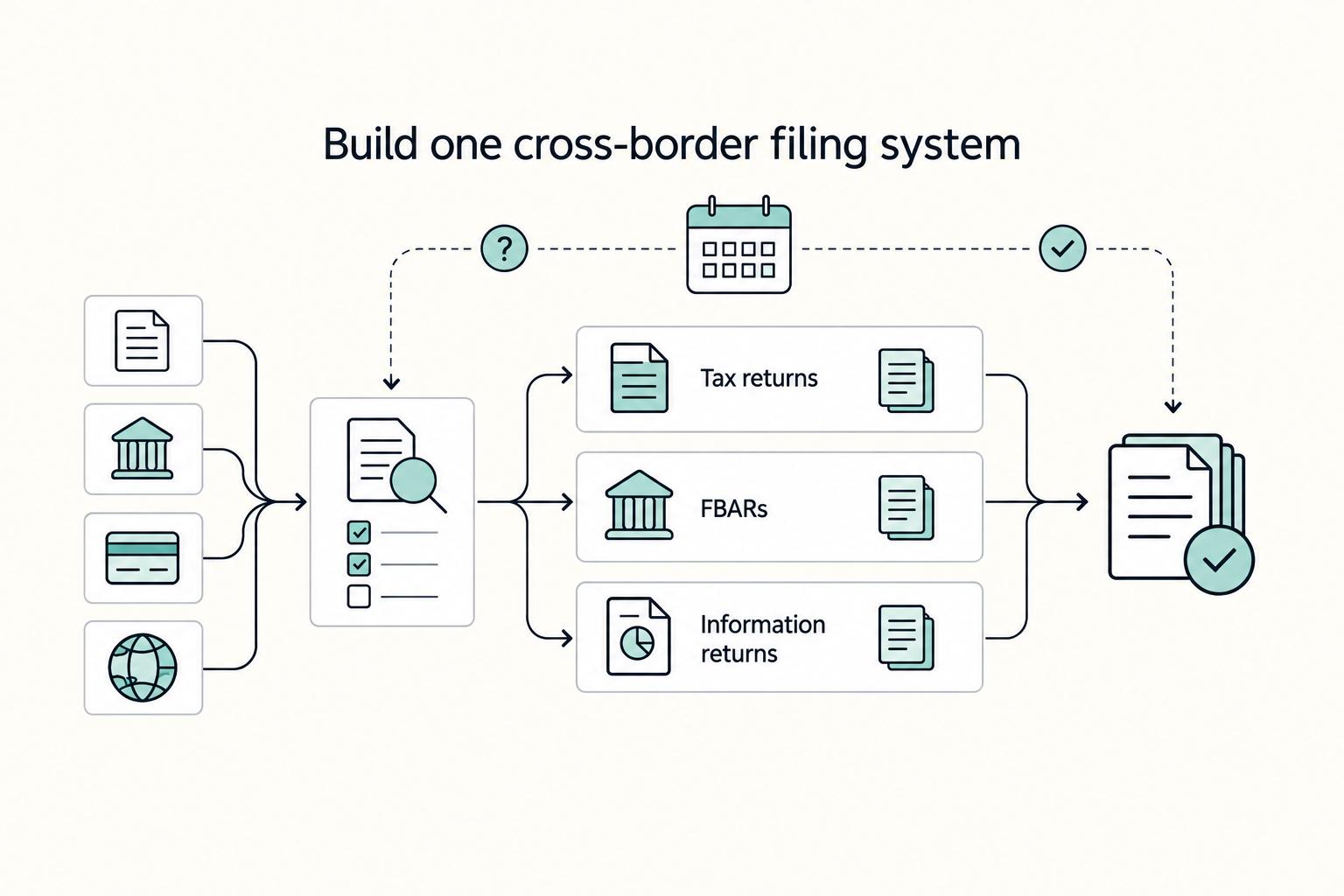
US Expat Back Taxes Through the IRS Streamlined Filing Path
Run streamlined the way you would run any other critical compliance project: define scope, set gates, and submit one clean package. The fastest way to create new risk is to improvise halfway through. The safer move is to close historical gaps, document why they happened, and put controls in place so the problem does not come back next year.

Digital Nomad Taxes in 2026 With a Defensible Filing Plan
With digital nomad taxes, the first move is not optimization. It is figuring out where you may be taxable, where filings may be required, and what proof supports that position.

The Freelance Payment Penalty: A Modeled Audit of Platform Fees, FX Spreads, and Payout Delays
The money rarely disappears through a single, easy-to-spot fee. The real loss is stacked. A marketplace takes its commission, a processor adds a charge for international cards, a bank or payment company converts the currency at a spread, a platform holds the funds before release, and a wire sheds a little to intermediaries on the way in. Each layer looks defensible on its own, but the worker feels the combined result as a smaller deposit and a later payday.