
Quick Answer
Use AI only within the agreed task and lawful input boundaries. Verify claims and rights, review representation and audience harm, and describe material AI use honestly. Client approval cannot waive third-party rights or mandatory disclosure. Keep a proportionate record of sources, human decisions and publication approval.
What ethical AI use looks like in creative freelance work#
The ethics of AI in creative work shows up in delivery choices, not theory. Decide AI boundaries, disclosure expectations, and contract terms before work starts.
For freelancers and consultants, the challenge is trust and governance in day-to-day delivery. In client work, AI raises ownership and approval questions long before handoff.
Creative AI work raises questions about factual reliability, privacy, intellectual property, biased representation and misleading synthetic media. The NIST generative AI risk profile provides a useful risk checklist. Apply it to the actual audience and deliverable rather than assuming a polished output is safe.
Use this guide to make both ethical and contractual decisions: protect people whose data or likeness appears, review stereotypes and unsupported claims, respect creators’ rights, and explain material AI use honestly. Put project boundaries and review responsibilities in the statement of work. Client approval records a decision; it does not remove harm or override someone else’s rights.
Before kickoff, align in writing on three points:
- where AI is allowed
- what disclosure is required
- who approves exceptions
Then keep a compact record during delivery so you can explain provenance, rights assumptions, and review steps before handoff. If scope or risk changes mid-project, update those written decisions before you continue.
Define ethical AI use in freelance client work#
Ethical AI use combines human judgment, honest explanations, lawful handling of inputs and attention to affected people. You should be able to explain what the tool contributed, what you verified and which decisions you made yourself.
| Stage | What to do |
|---|---|
| Before drafting | Confirm lane selection and disclosure language |
| During drafting | Log major changes that alter meaning, risk, or rights assumptions |
| Before handoff | Run a final read focused on ownership wording, factual support, and confidentiality boundaries |
Use one clear distinction:
Assistance: AI supports ideation, wording, or visual exploration while you make the material decisions.Substitution: AI output passes through with light editing and no meaningful verification.
Clients ask about this directly, and many are buying your judgment, not just output volume. A defensible answer should appear in the contract and your records, not just in a kickoff call. You should be able to point to one approved scope line, one review checkpoint, and one acceptance note that reflects the final deliverable.
Defensible delivery comes from proof, not intent:
statement of work: where AI is allowed and where it is prohibitedconfidentiality clause: what may never be entered into promptsreview record: human edits, checks, and final approval notes
Keep a compact proof set at each milestone. Include:
- SOW excerpt naming allowed AI use by task
- confidentiality check confirming no restricted material was prompted
- draft log with prompt intent, major edits, and why those edits changed meaning or risk
- pre-delivery check confirming provenance and rights assumptions can be explained
Under deadline pressure, keep the same sequence: confirm lane selection and disclosure language before drafting, log major changes that alter meaning, risk, or rights assumptions during drafting, and run a final read focused on ownership wording, factual support, and confidentiality boundaries before handoff.
Polished writing can conceal invented facts, weak reasoning or copied expression. Review the substance: compare claims with reliable sources, check whether the argument answers the brief, and explain why the final choices fit the audience. Readability alone cannot establish accuracy or authorship.
Set one hard rule and enforce it every time: if you cannot explain provenance or rights, do not ship. If scope and pricing need to shift when you tighten controls, use A Guide to Tiered Pricing Models for Freelance Services.
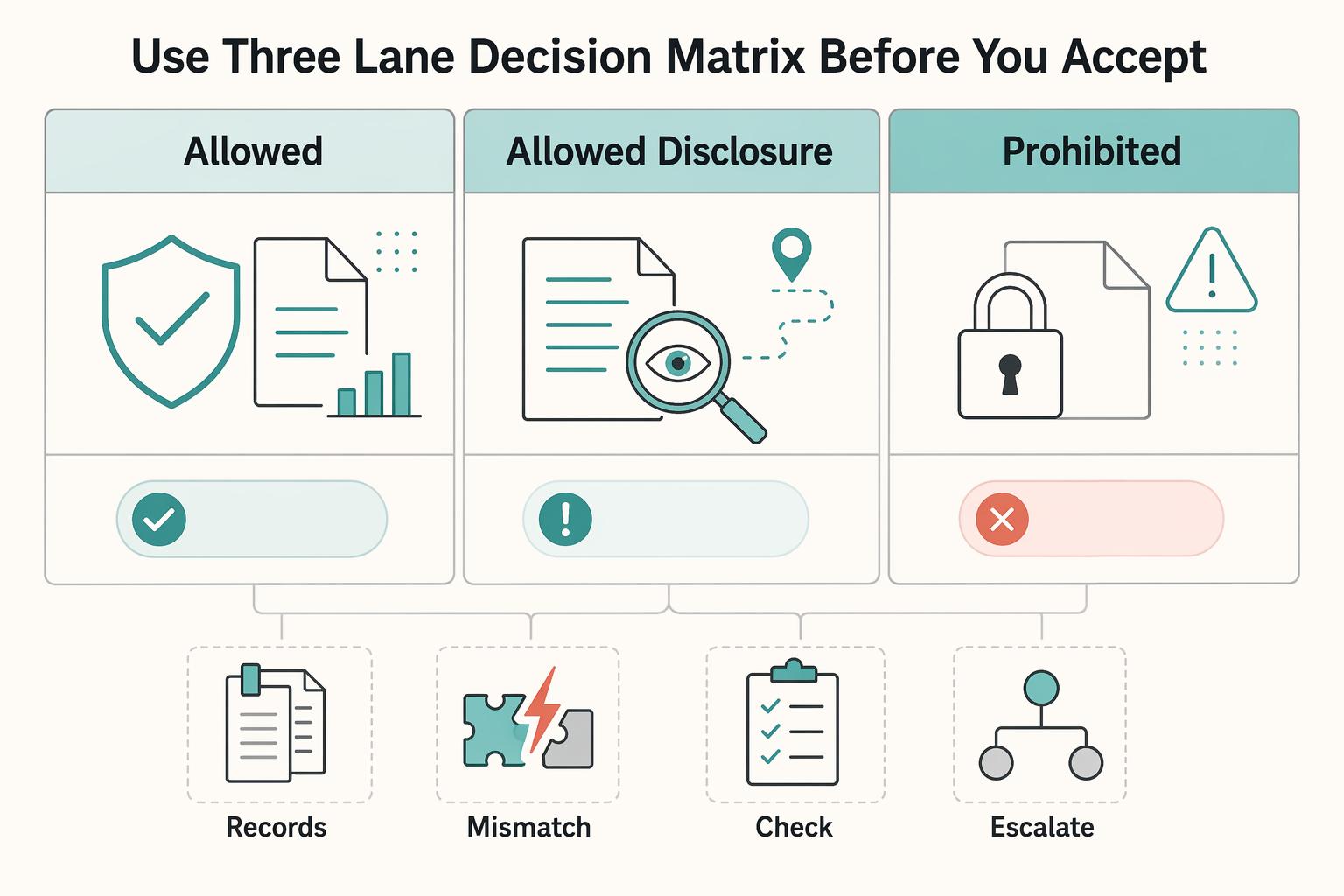
Use a three lane decision matrix before you accept the project#
Choose the lane before you quote. Written sign-off on the lane aligns scope, risk, and approvals before production pressure starts.
Keep the decision proportionate to the project. A short written permission note may be enough for public, low-risk copy; sensitive media may need named reviewers and specific permissions. Record the actual tool and task boundaries so a new stakeholder can understand them.
| Lane | Typical fit | Required pre-start evidence |
|---|---|---|
AI allowed | Lower-sensitivity work where AI support is unlikely to create material rights or trust risk | Written lane confirmation and allowed use in the statement of work |
AI allowed with disclosure | Work involving brand claims, named individuals, or mixed-format deliverables | Written disclosure terms, named reviewer, and documented approval checkpoint |
AI prohibited | Deliverables where rights certainty or reputational risk cannot tolerate ambiguity | Written prohibition, agreed non-AI method, and updated acceptance criteria |
Use one escalation rule. If the work includes sensitive brand claims, named individuals, or potentially high legal exposure, move from AI allowed to AI allowed with disclosure or AI prohibited.
Common pre-contract red flags to escalate before kickoff:
- unclear ownership demands, especially reuse or derivative rights
- absolute originality warranties before scope is defined
- broad indemnity language before responsibilities are defined
Document lane selection as a specific decision, not a vague note. Record who approved it, which deliverables it covers, and what triggers a lane change. That record can save time when procurement, legal, or a new stakeholder asks for revised terms after work has started.
Agree the AI lane before production and attach the decision to the scope record. If it changes, stop the affected AI step and continue permitted work where practical. Assess any genuine added work, price and timing through agreed change control; correcting a breach of existing confidentiality or review duties is not automatically a paid change. Confirm the revised method before resuming that step. Use the SOW generator to record the decision.
Set AI boundaries in the statement of work before drafting starts#
Write AI boundaries into the statement of work before drafting starts, in plain language. Clear wording reduces mismatched expectations and late revisions.
Treat AI use as a continuum and list approved uses by task. You can allow support for research, outlining, ideation, title brainstorming, or limited first-draft assistance, but only where stated. If the client wants no AI use, say that directly.
| Statement of work field | What to define |
|---|---|
| Allowed AI use | Which stages are permitted, such as research support, outlining, ideation, and limited first-draft assistance |
| Prohibited AI use | Inputs prohibited by the agreement or law; identify any narrow authorized processing separately, including tool, purpose and safeguards |
| Human responsibility | What must be reviewed, edited, and verified by a human before delivery |
| Acceptance checkpoints | What the client must confirm before production and at final review |
Use acceptance checkpoints to remove ambiguity:
- Method transparency: confirm approved AI-use scope and disclosure language.
- Rights assumptions: confirm how originality and ownership will be handled for this deliverable.
- Final human verification: confirm the review standard for factual, brand, and quality checks.
Add one change-control sentence so everyone knows what happens if assumptions shift after kickoff. State that any change to AI permissions, disclosure expectations, or rights position requires a written update before continued production. This keeps scope and delivery expectations synchronized.
Use one disclosure script in kickoff and procurement threads, then reuse it without rewriting it each time. State allowed tasks, banned inputs, and that final deliverables receive human review before submission. Repetition matters here because consistent phrasing reduces interpretation drift across email, chat, and contract comments.
Handle ownership and authorship in the contract text#
Identify which rights exist and who holds them before selecting a transfer model. In the US, work made for hire applies to employee work within employment or certain commissioned categories with the required signed written agreement. A client’s wish for immediate ownership does not make every freelance deliverable qualify. An assignment can transfer the rights you actually hold, on the agreed trigger; neither clause creates copyright in unprotectable AI output.
| Asset or right | What to define |
|---|---|
| Pre-existing materials | Define whether pre-existing materials are included in transfer |
| Drafts and prompt logs | State whether drafts and prompt logs are in or out of transfer |
| Final approved deliverables | Final approved deliverables transfer only under the selected model and trigger |
| Reuse rights after payment | Any reuse rights after payment, such as portfolio use, should be narrow and explicit |
| Model | When it can protect a freelancer better | Main friction to settle early |
|---|---|---|
work made for hire | Only where the applicable statutory requirements are met | In the US, employee scope or specified commissioned categories and required signed writing; not every freelance task qualifies |
assignment of rights | Transfers the rights actually held, with defined assets and timing | Scope can drift unless drafts, prompts, and reusable methods are addressed explicitly |
The US Copyright Office’s 2025 copyrightability report distinguishes machine-generated expression from human-authored contributions. Prompts alone generally do not supply the human control needed for authorship. Original human selection, arrangement or modifications may be protected, depending on the facts, without protecting every generated element. Keep evidence of that work and avoid promising exclusive copyright in an entirely generated asset. Other jurisdictions require their own analysis.
Define ownership by asset class so disputes do not spread. Use this split:
- define whether pre-existing materials are included in transfer
- state whether drafts and prompt logs are in or out of transfer
- final approved deliverables transfer only under the selected model and trigger
- any reuse rights after payment, such as portfolio use, should be narrow and explicit
Spell out the trigger in contract language that is hard to misread. Trigger options can include acceptance, payment, or acceptance plus payment. Once you pick one, align invoice timing and acceptance mechanics to match it so no one claims transfer happened earlier than intended.
If the parties need an interim licence before assignment, negotiate its uses, duration and payment terms explicitly, and grant only rights you hold. Payment does not resolve unknown third-party rights or create copyright. Where ownership is disputed, resolve the affected rights or replace the asset before promising a transfer. Confirm the model, trigger and AI-use disclosure terms in the same agreement.
Use the same ownership logic in the statement of work, main agreement, and acceptance notes. Consistency across those records makes later interpretation far easier. For deeper contract language, see Work for Hire vs. Assignment of Rights: A Freelancer's Guide to Owning Your IP.
Prevent copyright and publicity rights failures before delivery#
Run a pre-delivery rights gate before release. This is where ethics turns into execution: keep what you can defend, fix what you cannot, and hold anything still unclear.
| Pre-delivery check | What to verify | Evidence to save in the project file |
|---|---|---|
| Copyright conflict scan | Review distinctive expression and relevant licences; a similarity scan alone does not establish clearance | Scan notes, revision decisions, and reviewer sign-off |
| Publicity rights review | Verify lawful permissions and context for identifiable people, including endorsements; client approval alone may be insufficient | Risk note, client instruction, and written clearance decision |
| Trademark sensitivity check | Whether logos, slogans, or brand-like elements create confusion risk | Marked-up draft and approved edits |
| Human oversight gate | Final human review for transparency, originality claims, and factual accuracy | Reviewer initials, date, and final approval record |
Use stricter provenance notes for image-heavy outputs than for light text polishing. For image-heavy AI work, keep a short record of tool use, prompt intent, client-provided assets, major edits, and reviewer decision. For AI-polished text, keep the record lighter, but still include fact-checking and originality review.
Treat training-data concerns as trust and risk issues, not certainty claims. Ownership, originality, and protection of AI-generated material remain unsettled in many contexts, so avoid absolute promises in contract language or delivery notes.
If a client raises training-data concerns, record what is known about the selected tool and what remains unknown. Do not claim all training material was licensed without evidence. Consider a different tool, licensed source material or human production when assurance is essential. Client acceptance of residual uncertainty cannot authorize infringement or waive third-party rights.
One avoidable failure point is post-approval drift: one asset changes and nobody reruns checks. Prevent that drift with one rule: if any asset changes after approval, rerun copyright, publicity rights, and trademark checks before release. This protects both your rights position and your invoice position.
Protect confidentiality in tools and project records#
Confidentiality is a hard stop. If content is secret, regulated, or unreleased, do not put it into public or unapproved tools.
Prompt inputs can expose personal data, confidential facts or licensed material to another service. Check the tool’s current retention, training, access and security terms for the account you actually use. Approval to use a tool does not by itself authorize every input.
| Control area | Minimum rule | Verification checkpoint |
|---|---|---|
| Input authorization | Use restricted inputs only where lawful, contractually permitted and approved for that service | Check the actual account terms and permissions before sharing |
| Minimum context | Remove unnecessary details; masking may still leave re-identifiable data | Review the remaining input, not just removed names |
| Output and evidence | Separate shareable deliverables from restricted prompt/provenance records | Check recipients and retain needed evidence securely |
| Escalation | Use a permitted manual method if the AI step cannot be made compliant | Agree any actual scope or timeline change; do not expose data to meet a deadline |
Use a consistent sequence every time:
- Confirm lawful input authorization and the tool/account safeguards.
- Minimize and redact the context before prompting.
- Verify the output and its intended use.
- Separate shareable excerpts from necessary evidence retained securely.
Before sharing deliverables, remove restricted prompt excerpts, screenshots and chat exports from files and spaces accessible to unauthorized recipients. Preserve necessary approval and provenance records in a secure project location under the applicable retention policy. Do not erase the evidence needed to explain the work merely to make the delivery folder look clean.
If speed conflicts with this control, stop AI use for that asset and continue manually. It is better to deliver later with clean handling than to deliver fast with preventable confidentiality exposure.
If you want a deeper dive, read AI and Copyright: Legal Implications of Using AI Content in Client Work.
Add verification gates for misinformation, deepfakes, and quality drift#
Polished text is not a pass condition. Verify factual claims against reliable sources. If evidence genuinely supports uncertainty, describe its limits accurately; adding “may” to an unsupported or harmful allegation does not make it acceptable. Remove claims you cannot substantiate.
Use three practical gates before delivery. Define trigger conditions and escalation paths for each, and end each gate with an audit record you can retrieve later:
| Gate | Pass condition before delivery | Evidence to retain |
|---|---|---|
| Claim verification gate | Claims have reliable support, with supported uncertainty stated accurately; remove unsupported claims | Claim log with pass, revise, or remove decisions |
| Manipulated-media gate | Visual and audio assets have clear provenance and approved synthetic elements | Source notes, edit history, and approval record |
| Final harm-review gate | Human reviewer checks brand risk, legal risk, and audience harm before release | Reviewer sign-off and final decision notes |
Assign an owner for each gate at kickoff. The same person can own more than one gate on small projects, but ownership must be explicit. That reduces handoff risk when high-risk claims need confirmation.
For visual and audio assets, retain source, edit history, permissions and the decision about synthetic disclosure. If provenance is missing, investigate or replace the asset; an “illustrative” label cannot clear infringement or false endorsement. Do not present synthetic media as an authentic event or statement.
Finish with a final human pass focused on risk, not grammar alone. Use this short decision check:
- Brand risk: could a reasonable reader interpret this as a factual promise you cannot prove?
- Legal risk: does any line imply ownership, originality, or clearance beyond what your contract and records support?
- Audience harm: could a manipulated asset or overstated claim cause practical harm if treated as true?
If a late edit adds factual certainty, reopen claim and media checks before handoff. Keep the review log with your evidence pack. That log makes it easier to explain decisions if questions arise later.
Work through a brochure example#
Suppose a client permits AI outlines for a recruitment brochure using approved public facts, but prohibits uploading candidate or employee records. You generate an outline without those records, then write the copy from verified source material. A generated portrait shows only men in leadership and women in support roles: replace or redesign it and check the whole set for repeated stereotypes, rather than treating a single diverse image as a pass. Review local-language meaning and accessibility with someone who understands the audience.
The tool also proposes a fictional employee quote. Remove it from the testimonial section; it cannot stand in for a real person’s experience. Use an approved authentic quote with the necessary permission, or a clearly framed illustration that does not claim an endorsement. Record the rejected quote, the evidence for each retained claim and the human layout/copy decisions. The client receives a reviewed draft and an accurate method note, then approves publication under the agreed workflow.
Ask about creator impacts as well: can a commissioned illustrator or licensed asset meet the brief more appropriately? Review available tool and source licence information, compensate contributors under their terms and avoid inventing assurances about training-data permission. A cheap output is not a complete assessment of who benefits or bears the cost.
For EU-facing publication, the Commission’s Article 50 guidance distinguishes deepfake disclosure from labelling generated or manipulated public-interest text. The text exception depends on substantive human review or editorial control and editorial responsibility; spell-checking alone is insufficient. Artistic or fictional deepfake works have a tailored disclosure rule, not a blanket exemption. Identify the responsible publisher/deployer and applicable requirements before release.
Negotiate Indemnification, Limitation of Liability, and Termination terms#
As a negotiating position, allocate responsibility to the party able to prevent the relevant problem and define indemnity triggers clearly. Contract limits may be subject to mandatory law and do not eliminate duties to third parties. Using a model also does not excuse your own publication, input-sharing or review decisions.
Use the verification records to support promises you can substantiate. Distinguish your supplied material and editing decisions from client-provided assets and provider conduct. Specify claim notification, cooperation and defence arrangements alongside the scope of indemnity, rather than relying on a general assurance that AI work is safe.
| Clause | Preferred position | Red flag to push back on |
|---|---|---|
| Indemnification | Limited to your own breach, misconduct, and rights violations in materials you control | You indemnify for third-party model behavior or platform conduct outside your control |
| Limitation of Liability | A clearly bounded liability limit, with narrow carve-outs for intentional misconduct | Unlimited liability, or carve-outs so broad the limit has little practical effect |
| Termination | Clear stop-work trigger, payment handling for completed milestones, and treatment of partially AI-assisted drafts | Client keeps usable partial work while avoiding amounts due under the actual termination/payment terms |
Before you sign, run a clause-to-evidence check. For each indemnity trigger, map one record: scope in the statement of work, approvals, verification notes, and acceptance history. If a trigger has no matching record, narrow the clause or add the missing proof step.
Keep fallback positions ready so the deal does not stall. Use three levels:
- Preferred term: indemnity limited to controllable breaches, a bounded liability limit, and clear payment terms for completed milestones on termination.
- Acceptable compromise: specified carve-outs while the limit still governs ordinary claims, with clear treatment of amounts due for authorized work in progress.
- Walk-away condition: open-ended indemnity for third-party model outcomes, or termination terms that let the client keep partial drafts without clear payment terms.
When a client asks for broader protection, trade scope for scope. If they want wider indemnity, narrow deliverables, tighten acceptance standards, and increase proof requirements in the same contract revision. That keeps risk, pricing, and delivery obligations in balance instead of shifting only one side of the equation.
Choose Governing Law, Jurisdiction, and Dispute Resolution for cross-border deals#
Put Governing Law, Jurisdiction, and the dispute path in writing early, or your protections may be hard to use once a dispute starts.
Compare dispute routes against the contract value, likely claim and enforcement locations. Arbitration can offer a defined process, but its institution, tribunal and legal fees may exceed the value of a small project. Check the proposed rules and interim-relief options before agreeing.
| Dispute path | When it fits | Main tradeoff |
|---|---|---|
| Negotiation window, then arbitration | Cross-border work where both sides want a defined endpoint after a settlement attempt | Compare actual arbitration fees, seat, rules, appeal limits and enforceability; savings are not guaranteed |
| Negotiation window, then court | Matters where formal court process is worth the extra burden | Transaction costs can rise through uncertainty, time, legal spend, and cross-border complexity |
| Court only, no staged step | Narrow cases with a clear reason to escalate immediately | You may take on process costs earlier, before settlement is tested |
Price in transaction costs upfront. Uncertainty, delay, fees, and power imbalance can make viable claims impractical to pursue. Also check for hidden process limits, including forced arbitration language in clickwrap terms.
Use one pre-signature checkpoint to keep forum terms usable. Confirm:
- Governing Law and Jurisdiction are explicit, with no placeholders
- the agreed dispute sequence and any urgent interim-relief exceptions are explicit
- payment triggers and acceptance criteria tie to records you already keep
- termination language covers completed milestones and partial drafts
When procurement sends a template with unresolved forum placeholders, treat it as incomplete rather than assuming it will be fixed later. Resolve that gap before production starts. A clean forum clause paired with clear acceptance records can make enforcement more practical if a dispute appears.
For smaller projects, simplify forum complexity and put precision into payment triggers, acceptance criteria, and documentary proof so process cost does not outweigh deal value. For larger or multi-deliverable work, spend more effort on dispute sequencing and enforceability because transaction costs can rise with scope.
Keep an evidence pack that survives a client challenge#
If a client challenges authorship or rights, your position depends on what you can retrieve quickly, not what anyone remembers. Treat the evidence pack as part of delivery so your decisions, approvals, and acceptance are easy to show.
| Evidence item | What to keep |
|---|---|
| Scope and deliverable notes | Scope and deliverable notes for the milestone |
| AI-use disclosure decisions | Written AI-use disclosure decisions |
| Final acceptance notes | Final acceptance notes tied to the delivered version |
| Version history | What was checked, changed, or removed after review |
| Content Authenticity Statement | A truthful description of human and AI contributions when needed; a method statement does not certify copyright or clearance |
Keep a core record set for each milestone. Include:
- scope and deliverable notes for the milestone
- written AI-use disclosure decisions
- final acceptance notes tied to the delivered version
Maintain version history showing what you checked, changed or removed. When needed, add a short method statement describing the actual human and AI contributions. Use “fully human-generated” only when true. This statement explains production; it is not a copyright or clearance certificate.
Store delivery and acceptance records under the same milestone label so key questions are easier to resolve. If client or legal feedback changes scope or disclosure language, log the change so the decision trail is retrievable.
Store sensitive evidence in the agreed secure project system with appropriate access permissions. Verify recipients and the upload destination before sending documents; a secure connection alone does not establish that the recipient may receive them.
Use audit-ready habits from day one: consistent filenames, dated approvals, and one index that points to each milestone record. Keep naming simple and predictable so anyone reviewing the file set can follow the sequence without extra explanation.
Do a quick retrieval check before final delivery. Open the index, pull one milestone at random, and confirm you can find scope, approval, version history, and acceptance status quickly. If retrieval is hard during calm conditions, it is more likely to fail when a dispute appears.
Conclusion and next actions this week#
Ethical AI practice means making honest choices about method, rights, privacy and foreseeable harm, then checking that the final work reflects those choices.
AI can accelerate output, but privacy, bias, and transparency risks still sit with you, and no universal method resolves every edge case. The practical safeguard is a repeatable set of checkpoints with documented decisions and clear ownership.
Use this short plan this week. Start with these five moves:
- finalize your decision matrix for new leads:
AI allowed,AI allowed with disclosure, orAI prohibited - update kickoff documents before work begins so allowed use, prohibited use, and review duties are explicit
- add review and verification gates so standards and acceptance expectations are clear before delivery
- set escalation and dispute routes, including any urgent relief, before pressure rises
- document approvals and decisions as you execute so you can defend the work if questions appear later
Then apply the checklist to the next live proposal instead of waiting for a perfect future process. A single completed run through this sequence is more valuable than another planning discussion. You will quickly see where guardrails are vague, where records are thin, and where approval points need tightening.
Apply this checklist to your next proposal before generating the first AI-assisted draft. That supports transparency, keeps momentum, and lowers avoidable legal and reputational risk. If you want a country-specific check of what is supported in your case, Talk to Gruv.
Frequently Asked Questions
Is it ethical to use AI in freelance creative work?
AI use can be ethical when the method is honestly described, inputs are handled lawfully, human review is meaningful and foreseeable harm is addressed. Consider the people represented, the audience relying on the work and creators whose material may be involved. Client approval is useful, but it cannot make biased, deceptive or infringing work acceptable.
What are the main ethical risks I should flag before signing?
Start with ownership uncertainty, then review privacy, bias, and misinformation risk. Deepfakes and voice-cloning scams raise the verification bar for identity-related content. Treat absolute originality promises as high risk unless review duties and limits are written into the contract. Also check whether indemnity language asks you to absorb risks that sit outside your direct control.
Do I need to disclose AI use to every client?
Check the client agreement and applicable publication rules, and answer questions about material AI use honestly. Some disclosures are legally required: EU rules cover certain deepfakes and public-interest text, with defined exceptions. A client cannot waive those duties. For other work, agree the tasks and disclosure expectations before production and avoid implying a human-only method when that is untrue.
Who owns AI-assisted deliverables under work for hire or assignment of rights terms?
Start with the protectable rights in the actual deliverable. US work-made-for-hire rules have specific employment or commissioned-work requirements; a label in any freelance contract is insufficient. An assignment transfers only rights the assignor holds on the agreed terms. Human-authored contributions may be protected while generated elements are not. Check the relevant jurisdiction and separate background assets, third-party licences and final work.
What should I include in an AI contract clause to reduce risk?
State what AI use is allowed, what is prohibited, and what review checks are required before acceptance. Clarify ownership and transfer terms in the same clause so rights expectations stay aligned. Tie those terms to dated approvals and final acceptance records. Add a change-control line that requires written updates if AI permissions or rights assumptions shift after kickoff.
When should I avoid AI entirely even if it would save time?
Avoid AI when the client prohibits it, when critical claims cannot be verified, or when provenance is too weak to defend. Use extra caution for identity-sensitive media because manipulated content can be hard to detect. If potential harm is high and your evidence trail is thin, switch to human-only production for that deliverable. Speed gains are not worth a delivery you cannot defend.
How can I stay ethical without slowing down client approvals?
Agree AI permissions and any necessary disclosure before the affected production step. Complete substantive human review before delivering the client draft, and obtain publication approval where the contract requires it. Acceptance normally follows delivery under the agreed process; it is not a universal prerequisite to sending a draft. Keep version and decision records ready for review.
Try a related tool
Researched and edited by the Gruv editorial team. Gruv builds cross-border billing, payouts, and finance-operations software for global businesses.
Sources
Educational content only. Not legal, tax, or financial advice.
Related Posts

Work for Hire vs Assignment of Rights for Freelancers
A freelance agreement is not just about price and scope. It decides who controls the rights in the work. If the ownership language is loose, rights can move earlier than you expect, cutting down your control once the work is delivered or used.

AI Content Copyright Issues in Client Work Contracts
Before using generative AI for client work, establish whether the client permits it, which materials may enter the tool, and what rights the final files must carry. A contract cannot create copyright in expression that does not qualify for protection, and a version history does not by itself establish authorship or freedom from infringement.
Tiered Pricing for Freelancers That Protects Cashflow
If you use freelance tiers well, you are not giving clients random price points. You are giving them policy bundles that help control scope, payment risk, and decision speed. That matters because a common margin leak is undercharging, over-delivering, and then trying to negotiate boundaries after the work has already moved.