
Quick Answer
Yes, the dubai virtual working program can be a practical option if your work relationship is outside the UAE and your file matches current criteria at submission time. The article’s core advice is to separate confirmed rules from assumptions, then verify route-specific details in your active GDRFA or ICP channel before paying. It also highlights disputed guidance in the ecosystem, including different stated income thresholds, so you should lock a dated eligibility snapshot and proceed only when your document pack and fee lines are fully reconciled.
Start Here With What Is Confirmed and What You Must Verify#
Treat this as an execution guide, not a travel blog. Start by separating what is clearly stated from what still needs official confirmation before you pay, travel, or commit to housing dates.
Naming creates early confusion. You will see "Dubai Virtual Working Programme" and "Dubai Digital Nomad Visa" across guide sites, plus nearby wording variations. For planning, treat these as labels for the same core route: live in the UAE while your work relationship remains outside the UAE.
A few planning anchors recur in the material you have. One guide describes a one-year residence visa, mentions a USD 5,000 monthly threshold, and gives a two to four week estimate. Another says renewal is possible. Treat those only as working assumptions until you match them to current official service wording. Before any commitment, run this filter:
- Confirmed enough to plan around now: guide sources describe this route for people working for companies abroad and as time-bound residence (one year in one guide), not guaranteed long-term status.
- Plausible but must be verified before payment: income threshold wording, case-specific processing time, and current renewal conditions.
- Not confirmed in your current capture: final official fee totals and complete fee components.
- Baseline authority when pages conflict: current official service wording from GDRFA/ICP pages for this route.
- Immediate checkpoint: freeze one eligibility snapshot on your planned filing date, then reconcile guide claims against that snapshot.
- Red flag: booking flights or signing a lease based on guide timelines alone.
Expect stale or partial page captures. The Invest in Dubai page often lacks usable policy detail, so it cannot settle disputes on criteria or price. When non-official pages disagree, verify against official GDRFA/ICP service pages first. That habit prevents the most expensive failure mode: paying and planning on outdated assumptions.
With those boundaries set, the next step is building a document pack that matches official wording on filing day. If you want a broader comparison context, see the 2026 Global Digital Nomad Visa Index.
What the Program Is and What It Is Not#
The Dubai Virtual Working Program is a remote-work residence route: you live in Dubai while working for a company outside the UAE. It is not authorization to work locally in the UAE.
| Decision test | Answer |
|---|---|
| Your work relationship is outside the UAE, and you can document it clearly. | Yes |
| Your file includes proof of work outside the UAE, health insurance, medical fitness readiness, and salary evidence that matches current wording. | Yes |
| Your near-term goal is local UAE employment under this same permit. | No |
| Your primary objective is permanent residency. | No |
You will see different labels, including UAE Virtual Working Programme, Virtual Work Visa, Remote Work Visa, and Dubai Digital Nomad Visa. Treat these as naming variations unless an official page shows a material difference.
Plan around this as a time-bound residence permit, not permanent status. Renewal may be possible, but you should confirm current renewal terms before committing to dates or long-term obligations.
One item needs clear verification before payment: income-threshold wording. The official UAE excerpt lists a minimum salary certificate of 3,500 US dollars, while one third-party guide cites 5,000 dollars. Confirm the active threshold in your filing channel (GDRFA Dubai or ICP) and keep a dated copy of that requirement.
Use the table above as your quick filing check. If your goal includes local employment or business setup, pause and compare other UAE permit types first. For broader context, see Dubai Digital Nomad Guide 2026 for a Practical Move Plan.
Eligibility and Document Pack You Should Prepare Before You Apply#
Prepare one complete file pack before payment, and make sure it matches the Visa Issuance (Virtual Work) requirements exactly.
| Document | Requirement | Submission check |
|---|---|---|
| Passport copy | Valid for at least 6 months | Passport validity is at least 6 months on the submission date. |
| Photo | Recent personal photo in color with a white background | Photo format is recent, color, and white background. |
| Work evidence | Evidence that you work for an entity outside the UAE and do that work remotely | Work evidence clearly shows non-UAE entity plus remote delivery. |
| Income evidence | Proof of monthly income of at least 3,500 US dollars (or equivalent) | Income evidence clearly meets the monthly 3,500 USD threshold. |
| Health insurance | Valid health insurance document | Health insurance document is valid. |
Use the table as your submission gate. If any item is borderline on validity, wording, or format, fix it before you submit instead of trying to repair the file later.
If you plan to apply digitally, confirm smart-services access through UAE Pass (or username) before submission day, and make sure your identity details match your passport. If you apply through an Amer Service Center, bring the same finalized pack for document review before fee payment.
The service page lists 48 Hour(s) timing, but do not treat that as an approval guarantee. Keep your own timeline anchored to the stated 60-day post-entry window and the one-year, extendable residence period from issuance.
Cost Breakdown You Can Actually Budget#
Budget this step as a verification exercise, not a fixed price list. Confirm each charge in your exact filing path before you commit.
Split costs into two buckets:
Mandatory: the core virtual-work application charge and VAT shown in your route.Situational: extra lines that may appear by channel or location, such as Knowledge Dirham, Innovation Dirham, or Amer Service Center handling when applicable.
Do not borrow numbers from adjacent topics. Freelance visa pricing is for a different permit type, and employer hiring-cost ranges (including AED 9,000-40,000 entity setup, AED 5,500+ monthly PRO costs, and AED 3,070-6,270 per-employee government fees) belong to hiring context, not a fee table for this route.
Use two scenarios, then verify both against your actual checkout flow:
| Scenario | Usually in scope | Verify before payment |
|---|---|---|
| Applying from outside UAE | Core application and tax lines for your route | Any additional service charges in your submission channel |
| Already inside Dubai | Core application and tax lines, plus possible in-country handling | Whether Amer handling and named add-ons are triggered in your case |
Use a one-page worksheet before you book flights, housing, or dependent moves:
Line item: core charge, VAT, Knowledge Dirham, Innovation Dirham, service-center handling, and any extra lines shown at checkout.Status: confirmed, estimated, or unknown.Source check date: when you last verified the amount.Channel: digital route or Amer path.Commitment gate: keep major commitments provisional until unknown lines are resolved.
Application Paths and Timeline From Submission to Residence Permit#
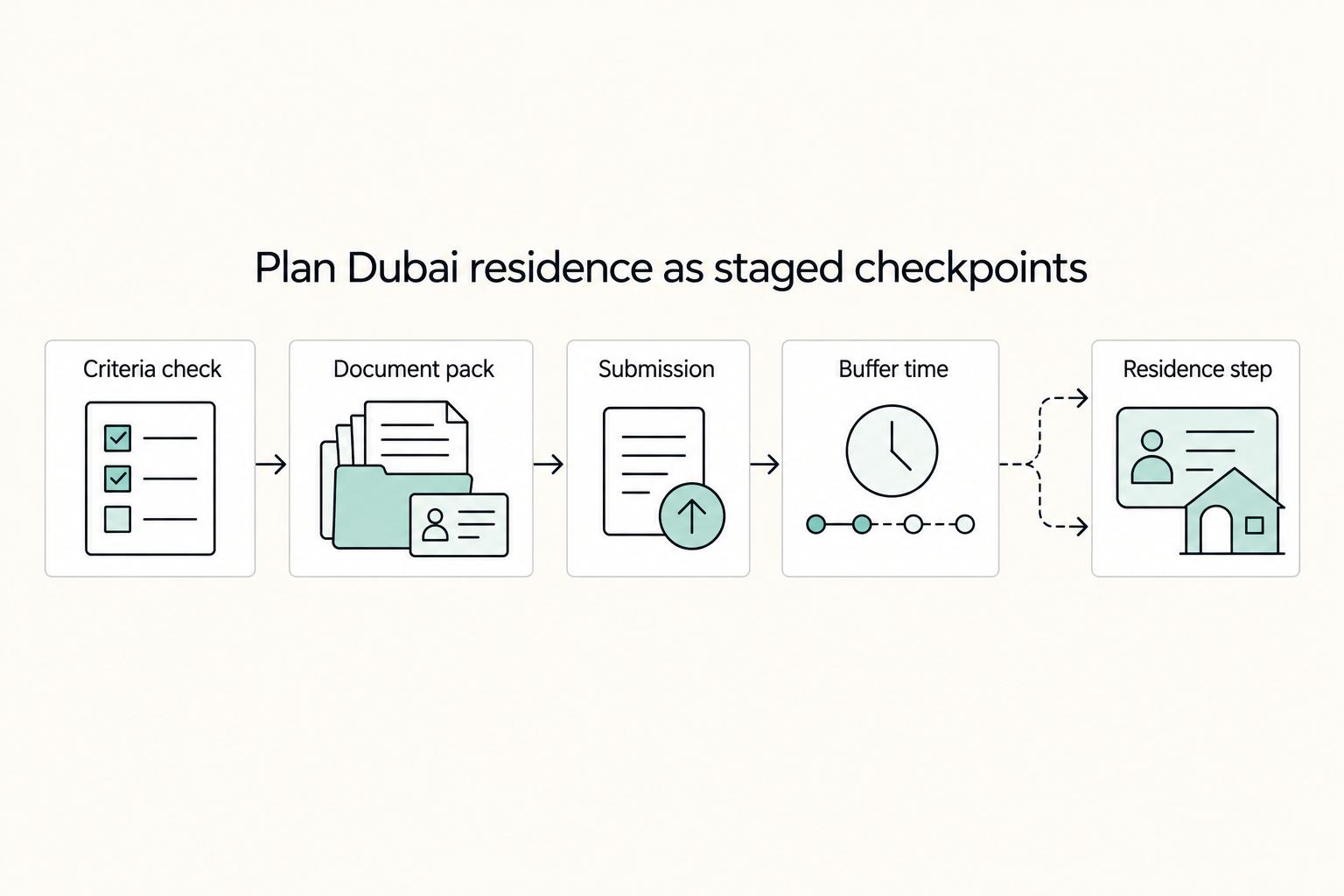
Treat this as a staged process with buffer time, not a single promised approval date. A service-level timeline for this exact route is not confirmed.
Use two submission paths in your plan: digital and in-person (Amer Service Center or Customer Happiness Center). Then verify the exact flow on filing day. In practice, both paths still run through the same control points: document check, submission, payment, initial decision, and post-entry completion steps.
| Stage | What to do | Main delay risk |
|---|---|---|
| Pre-submit | Recheck passport, remote-work proof, income proof, insurance, and photo quality | Document mismatch or validity issues |
| Submission | File through your chosen channel and ensure every form field matches uploaded documents | Form-to-document data mismatch |
| Payment | Pay only after final review of details and line items | Rework after payment if errors remain |
| Initial decision window | Monitor status and keep contact details reachable | Missed follow-up requests |
| Post-entry completion | Book required local steps quickly after arrival | Appointment delays |
For timeline expectations, use external UAE visa timing references only as buffer inputs, not as promises for this permit. General UAE visa benchmarks include tourist visa processing (3-4 working days), employment-visa progression from entry permit to residence stamping (about 2 weeks), and medical test results (1-2 working days).
One source says Dubai GDRFA is typically faster than some smaller emirates, but that is directional only. If your move dates are fixed, submit earlier than you think you need to. Document completeness and medical-step timing are common points where timelines slip.
This route is framed as a one-year residence option for people employed outside the UAE, with renewal possible, so you should plan around full post-entry completion rather than initial approval alone.
Inside UAE vs Outside UAE Decision Checkpoint#
Choose this path as a risk-management decision, not a price shortcut. If your deadline is tight, take the route with fewer moving parts, even if the estimated cost looks higher.
Current evidence does not confirm route-specific inside-vs-outside fee mechanics or timeline guarantees for this visa route. Use a simple comparison sheet, and treat all unverified line items as unknown until your official filing channel shows them for your case.
| Filing position | Fee exposure to map before payment | Timing pressure |
|---|---|---|
| Already in UAE | Confirm whether any in-country handling lines appear, including Knowledge Dirham and Innovation Dirham, or if they do not apply | You can act sooner, but only if fee and document assumptions are tested before paying |
| Outside UAE | Confirm whether the same add-ons appear for your path and entry plan | You get more prep time, but travel booking pressure rises if you commit too early |
Use one decision rule: when timing is fixed, pick the option that removes the most dependencies first.
Set a personal go/no-go gate before booking travel:
Goonly if each fee line is labeledconfirmed,estimated, orunknown(including Knowledge Dirham and Innovation Dirham).Goonly if unknown costs fit your contingency budget.Goonly if your document pack has no unresolved edge cases.No-goif your plan depends on one unofficial total.No-goif your timeline has no correction buffer.No-goif you cannot explain, in one page, why this filing location is lower risk for your case.
This checkpoint is about avoiding surprises, not chasing the lowest headline number.
Tax Free Income Claim What Is Known and What Needs Tax Advice#
"Tax-free" in Dubai is not a complete tax answer for you. Keep visa planning and tax planning on separate tracks.
What is known from current guide material:
- The Virtual Working Programme is described as a way to live in the UAE while working for non-UAE companies.
- One guide describes a one-year residence visa, a stated USD 5,000 monthly threshold, and a two to four week processing estimate.
What still needs tax advice:
- Those visa mechanics do not, by themselves, resolve home-country tax obligations.
- "No federal personal income tax" is a local framing, not proof of a universal 0% outcome.
- Cross-border and home-country rules can still apply, especially if you have US or multi-country filing exposure.
Use this rule before big commitments: treat "tax-free income" as a working hypothesis until a qualified advisor reviews your specific facts. Pair your visa plan with a tax-residency checklist before long-term lease or family move decisions. For a US-focused deep dive, see Living in a No-Tax Country: Is it Really Tax-Free for a US Citizen?.
Common Delay Triggers and How to De Risk Your Case#
The biggest delay risk is relying on unsupported guidance rather than identifying a clearly missing visa document. Verify virtual-work requirements, insurance acceptance rules, identity-mismatch handling, and channel-specific process steps directly against official GDRFA/ICP sources before submission.
Use a strict pre-submission gate before you pay or file anything:
- Keep one canonical document set and one owner for submission tracking.
- Run one final consistency check across repeated fields in every file.
- Mark each requirement as
confirmedonly when it matches current Visa Issuance (Virtual Work) service wording; label the restunverified. - Split post-arrival planning into two tracks: confirmed steps vs user-reported but unverified steps.
- Avoid non-refundable commitments tied to anything still unverified.
Red flag: relying on polished summaries that do not match current service language. Use general guides for orientation, then verify each decision point against current official wording before you proceed.
Your Next Steps This Week#
This week, focus on a controlled submission: confirm current official criteria first, then submit only when every required line is verified in your chosen channel.
| Checkpoint | Item | Requirement |
|---|---|---|
| Pre-payment | Documents | Required documents are complete. |
| Pre-payment | Identity fields | Identity fields match across files. |
| Pre-payment | Income evidence | Income evidence matches the latest confirmed threshold for your channel. |
| Pre-payment | Cost lines | Each cost line is marked confirmed or unverified. |
| Post-entry | Remaining residence steps | Tracked with deadlines, owner, and proof of completion. |
| Post-entry | Medical-related actions | Tracked with deadlines, owner, and proof of completion. |
| Post-entry | Status updates | Tracked with deadlines, owner, and proof of completion. |
Start with the official u.ae baseline (updated 03 Mar 2026) and match your packet to it. Grounded requirements include proof of work outside the UAE, a salary certificate, health insurance, and a medical fitness test result. Keep one canonical document set so repeated fields stay consistent before payment.
Resolve conflicts before you pay. The official excerpt shows a 3,500 USD salary-certificate minimum, while a non-official guide states USD 5,000 and a two to four week timeline. Treat the income threshold and processing time as unconfirmed until your active filing path confirms them.
ICP and GDRFA Dubai are established application routes. If you plan to use UAE Pass or an Amer Service Center touchpoint, verify that they follow the same current criteria before you submit payment.
Set two checkpoints:
- Pre-payment checkpoint: required documents are complete, identity fields match across files, income evidence matches the latest confirmed threshold for your channel, and each cost line is marked confirmed or unverified.
- Post-entry checkpoint: remaining residence steps, medical-related actions, and status updates are tracked with deadlines, owner, and proof of completion.
If any critical requirement is still unverified, pause and close the gap before payment. Once both checkpoints are green, you can move forward with fewer avoidable delays.
Frequently Asked Questions
What is the difference between the Dubai Virtual Working Program and a standard residence visa in the UAE?
It is described as a temporary remote-work residence route, usually up to 12 months. It is designed for people working for an employer or business outside the UAE while living in Dubai. It is also framed as different from a tourist visa, which is for short stays.
Which documents are mandatory for Visa Issuance (Virtual Work), and which ones are commonly mishandled?
Supported basics include proof of employment or self-employment outside the UAE, income evidence, and health insurance. This section does not confirm specific commonly mishandled document patterns. Keep one canonical file set and verify repeated fields before submission.
How should I budget the full cost once Value Added Tax (VAT), Knowledge Dirham, and Innovation Dirham are included?
Treat those as potential line items, not fixed amounts from this section. Build your worksheet with base application costs plus VAT and both dirham add-ons as separate lines. Finalize totals only when your live payment flow shows the exact line items.
What changes if I apply from inside Dubai versus outside the UAE?
Use a two-column comparison sheet and mark each row as confirmed or unverified before payment. If any critical row is unverified, pause and resolve it first.
How long does the process usually take from application to finalized residence permit?
The source guidance confirms a one-year visa-validity concept, not a guaranteed end-to-end timeline for every step. Duration can vary by case details and channel. Keep a buffer and avoid non-refundable commitments until approvals are in place.
Can I bring dependents under family sponsorship on this route?
This section does not confirm a dependable rule for dependent sponsorship. Treat it as an open item that requires direct confirmation in current official criteria for your profile. Do not assume eligibility until verified.
What does tax-free realistically mean if I still have filing obligations in another country?
This section does not establish cross-border tax treatment or country-specific filing outcomes. Treat tax impact as an open item and get country-specific advice before long-term commitments.
Try a related tool
Researched and edited by the Gruv editorial team. Gruv builds cross-border billing, payouts, and finance-operations software for global businesses.
Sources
Includes 4 external sources outside the trusted-domain allowlist.
- niccs.cisa.gov/sites/default/files/documents/pdf/intro%20to...trusted
- globalwealthprotection.com/should-you-consider-the-dubai-virtual-workin...external
- middleeastbriefing.com/news/uaes-virtual-work-visa-working-remotely...external
- u.ae/en/information-and-services/visa-and-emirate...external
- y-axis.com/blog/can-i-get-0-tax-on-my-foreign-source-in...external
Educational content only. Not legal, tax, or financial advice.
Related Posts
Dubai Digital Nomad Guide 2026 for a Practical Move Plan
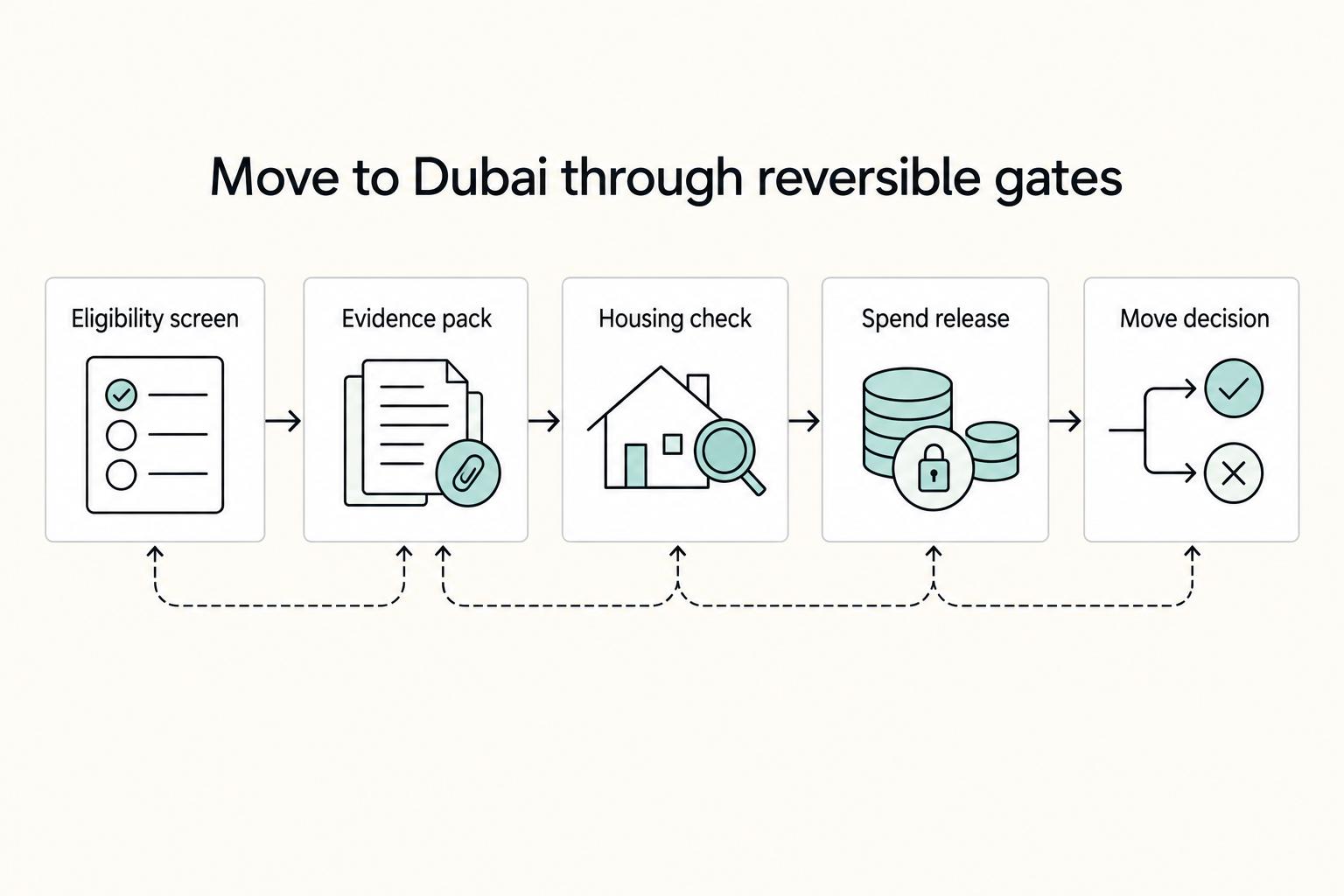
If this move works for you, it will work because you sequence decisions well and keep risk reversible until your status is clear. Treat this route as a chain of checkpoints, not one giant yes or no decision made under time pressure.

The 2026 Global Digital Nomad Visa Index for 50+ Countries
Start with legal fit, not lifestyle filters. The practical order is simple: choose a route you can actually document, then decide where you want to live. That single change cuts a lot of wasted comparison work and stops you from falling in love with places that were never a real filing option.

Is a No-Tax Country Really Tax-Free for a US Citizen?
A no-tax destination can lower local income tax, but it does not end U.S. filing and reporting duties. U.S. citizens abroad are still taxed on worldwide income, and tools like the FEIE or Foreign Tax Credit are tied to filing a U.S. return.