
Quick Answer
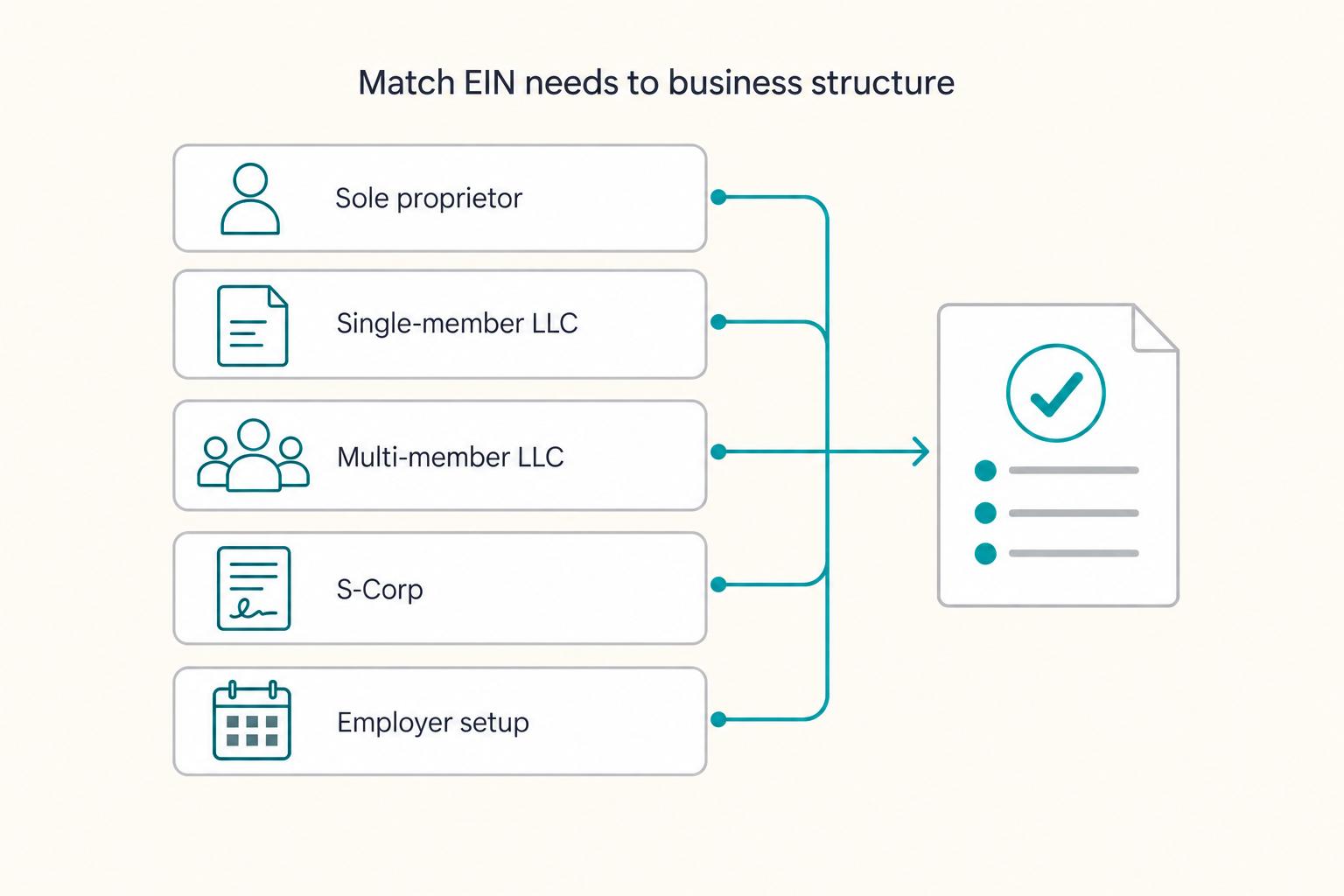
A US sole proprietor without employees or other EIN-triggering obligations generally can use an SSN. Partnerships, corporations, employers and specified other cases need an EIN. For a disregarded single-member LLC’s income-tax W-9, generally use the owner’s name and SSN or owner EIN, not the LLC’s own EIN.
Decide from your tax classification and filing obligations#
An Employer Identification Number is a nine-digit federal tax identifier issued by the IRS. A solo US freelancer operating as a sole proprietor often can use an SSN without obtaining an EIN. Employees, corporate or partnership tax classification, certain excise-tax filings and other specific obligations can change that answer. A bank’s account-opening requirement is a separate reason to obtain one.
The useful question is which taxpayer and which form the number identifies. An EIN does not create an LLC, elect corporate tax treatment or reduce self-employment tax. It also does not replace your SSN or ITIN everywhere. In particular, a disregarded single-member LLC’s own EIN is generally not the number used on its income-tax W-9.
If you are still choosing your contracting structure, see the sole proprietorship versus LLC guide. State formation, federal tax classification and an EIN application are related setup tasks, but each has its own role.
When an EIN is required, optional or requested by a bank#
| Your setup | Federal EIN position | Practical next step |
|---|---|---|
| Sole proprietor, no employees or other EIN-triggering obligations | Generally optional | Use your valid SSN for the relevant forms, or consider an owner EIN for business use |
| Sole proprietor hiring employees | An EIN is needed for employment-tax reporting | Obtain it before running payroll and complete applicable employer registrations |
| Domestic single-member LLC, disregarded for income tax, no employees/excise liability | Generally no separate LLC EIN needed solely for ordinary income-tax reporting | Use owner name/TIN for that reporting; obtain an LLC EIN if a bank or applicable state requirement needs one |
| Disregarded LLC with employees or covered excise-tax filings | The LLC needs its own EIN for those separate obligations | Use the LLC name/EIN for the relevant employment or excise filings |
| Partnership or corporation, including an LLC taxed as one | An entity EIN is generally required | Confirm the actual classification and entity details before applying |
These are common freelancer cases, not every EIN trigger. The Form SS-4 instructions also cover qualified plans and other filing situations. A wholly foreign-owned US disregarded entity has separate information-reporting rules, including Form 5472; do not use the ordinary domestic solo-freelancer row to conclude that it needs no EIN or filings.
An LLC label alone does not settle its federal tax treatment. The IRS single-member LLC guidance distinguishes income-tax treatment from employment and certain excise taxes. Domestic multi-member LLCs are ordinarily partnerships unless they elect corporate treatment, with specific exceptions such as qualifying community-property spouse arrangements.
Ask the bank or provider which taxpayer, entity and purpose its tax-ID field represents. An account-opening requirement for an LLC EIN can be valid while its contractor-income W-9 still uses the owner’s TIN. Keeping both records clear is more useful than trying to force one number into every system.
Fill out the W-9 for the taxpayer who reports the income#
Form W-9 documents a US person’s name, taxpayer identification number and relevant certifications. Read the IRS W-9 instructions and the current form. The name and TIN must identify the appropriate taxpayer; the business name a client sees on an invoice may belong on a different line.
| US payee situation | Line 1 | Line 2 when different | Part I TIN |
|---|---|---|---|
| Individual sole proprietor | Individual owner’s name as shown on their income-tax return | Trade/DBA name | Owner’s SSN or EIN, if the owner has one |
| Disregarded single-member LLC owned by a US individual | Individual owner’s name | LLC name | Owner’s SSN or owner EIN; generally not the LLC’s own EIN |
| LLC taxed as a partnership or corporation | Entity name used for its tax return | Trade/DBA name if applicable | Entity EIN |
For the disregarded LLC, line 3a follows the owner’s federal tax classification. It is not automatically the LLC box merely because the state entity is an LLC. If the owner is another entity, identify the relevant owner and apply the form instructions rather than using the individual-owner example unchanged.
Consider Maya, a US individual operating Maya Design LLC as a disregarded entity. The LLC has an EIN used for its bank account. On the income-tax W-9, Maya enters her individual name on line 1 and Maya Design LLC on line 2, then supplies her SSN or an EIN belonging to her as owner. The LLC’s bank EIN does not become the correct income-reporting TIN simply because it is available.
If Maya later hires an employee, the disregarded LLC uses its own name and EIN for employment-tax reporting. That change does not by itself change the LLC’s income-tax classification or turn the employee-reporting EIN into its owner’s W-9 TIN. An actual corporate election would require reviewing the form and reporting position again.
Use an optional EIN where it provides a clear benefit#
For a sole proprietor who can provide an owner EIN on the relevant W-9, using that EIN can reduce the circulation of an SSN in client vendor records. It remains a tax identifier and should be shared securely. A bank or payment provider may still need personal identification; an EIN is not a promise that you will never disclose your SSN during verification.
You can continue with an eligible SSN-based sole-proprietor setup when no EIN obligation applies and it meets your practical needs. If you obtain an EIN, record who it was issued to and why. For a disregarded LLC, do not promise W-9 privacy from obtaining an LLC EIN alone: the owner-TIN rule still applies.
Invoices need enough detail for customers to identify the contracting business and pay it correctly. Do not add a personal SSN to invoice templates. A client’s tax-form request should use its secure intake channel rather than placing sensitive identifiers in every invoice email.
Apply through the IRS using the right route#
The IRS issues EINs free of charge. If you are forming an LLC, partnership or corporation, form the entity first so the application identifies an existing entity. For a sole proprietor, use the applicable individual legal name and trade-name fields instead of inventing a corporation or LLC because it sounds more formal.
The current online EIN eligibility page requires a domestic organization formed or created in the US or its territories, a principal place of business there, an authorized applicant and the responsible party’s SSN or ITIN. A responsible-party EIN is generally not accepted for this route, with the stated government-entity exception.
The responsible party is the individual who ultimately owns or controls the entity, under the SS-4 instructions. An incorporation service or nominee is not a substitute for identifying that person. An authorized third-party designee needs the required authorization. Prepare the actual owner/control information before starting.
- Confirm the applicant and tax classification, the reason for applying, and whether an EIN already exists.
- Gather legal/trade names, address, formation details if applicable, responsible-party name and TIN, and the SS-4 information relevant to your situation.
- Use the official IRS application only if you meet its current online criteria; otherwise choose the applicable SS-4 fax, mail or international telephone route.
- Complete the online session without leaving it idle. It cannot be saved for later and expires after 15 minutes of inactivity.
- Save or print the EIN assignment confirmation and record exactly which taxpayer received the number.
The limit is one EIN per responsible party per day, across application methods. Use one method for the same entity rather than filing online and faxing a second application because a response is slow. A second EIN is not the remedy for a missing confirmation letter or a newly changed mailing address.
If you cannot use the online application#
The SS-4 instructions provide fax and mail routes. The IRS describes fax issuance as generally about four business days when a return fax number is supplied, and mail processing as approximately four weeks; inventory and processing conditions can cause delays. Use the current IRS instructions for the correct address or fax destination rather than relying on an old saved number.
The telephone application route is for eligible international applicants, not domestic callers who want to avoid the online form. The location and eligibility tests in the SS-4 instructions determine that route. A foreign responsible party who has no SSN or ITIN and is ineligible to obtain one may enter “foreign” or “N/A” on SS-4 line 7b as instructed. That paper-form rule does not make the online tool accept an arbitrary substitute TIN.
An EIN does not establish US tax residence. A foreign person should use the appropriate W-8 form or Form 8233 where applicable, rather than signing a W-9 solely because a US EIN has been issued. Likewise, a US disregarded LLC with a foreign owner needs the owner’s applicable documentation and its specific reporting review.
Allow for new-number activation and update the correct records#
An approved online application issues the number immediately, but every downstream use is not immediate. IRS EIN guidance says it can be used at once for most business needs, including opening a bank account, applying for business licenses and mailing a tax return. It says to allow up to two weeks for TIN matching, electronic return filing and electronic tax deposits/payments.
If a new number fails a matching check, compare the taxpayer name, number and issue date before applying again. A client’s vendor portal may need to distinguish legal payee, tax-reporting owner and banking entity. Send the appropriate updated W-9 through the secure channel and ask the payer to correct the relevant record; do not replace prior issued information-return details indiscriminately.
Retain the assignment notice with permanent business records. Use the taxpayer’s applicable identifier for each return, payroll record, bank account or vendor form. Keep the individual SSN/ITIN fields on personal tax returns where required rather than replacing them with an EIN.
For changes to the responsible party, address or location, follow Form 8822-B; responsible-party changes must be reported within 60 days. A new entity or changed ownership may require a new EIN, while a name or address change alone generally does not. Check the IRS’s new-EIN rules before changing the number. State tax, employer and other registrations remain separate from the federal EIN.
Make the number fit the record#
Confirm your current structure and any EIN obligation first. Then identify the taxpayer on each form, apply through the correct IRS route if needed, and save the assignment record. The useful outcome is a consistent name-and-number pair for the right purpose, especially when an LLC’s owner and the LLC have different identifiers.
Frequently Asked Questions
Does a solo freelancer with no employees need an EIN?
A US sole proprietor generally does not need an EIN solely for ordinary freelance income when no other EIN-triggering obligation applies. Employees, certain excise filings, retirement-plan or other specific requirements can change that answer. An eligible owner EIN can also be obtained for business use.
Can a disregarded LLC use its own EIN on its income-tax W-9?
Generally no. For an LLC disregarded as separate from its US individual owner, use the owner’s name on line 1, the LLC name on line 2 and the owner’s SSN or owner EIN in Part I. The LLC’s own EIN may be used for its employment/excise obligations and requested banking records.
Can a foreign responsible party apply without an SSN or ITIN?
The SS-4 instructions allow “foreign” or “N/A” on line 7b when that person has no SSN or ITIN and is ineligible to obtain one. Use an applicable non-online application route and the correct applicant details. This exception does not remove the online tool’s responsible-party TIN requirements.
Is a new EIN usable immediately everywhere?
No. The IRS says most business uses can begin immediately, but TIN matching, e-filing and electronic deposits/payments can require up to two weeks. Save the assignment notice and verify the taxpayer name and number before requesting another EIN.
Try a related tool
Researched and edited by the Gruv editorial team. Gruv builds cross-border billing, payouts, and finance-operations software for global businesses.
Sources
Educational content only. Not legal, tax, or financial advice.
Related Posts

Sole Proprietorship vs LLC for Global Freelancers in 2026
For most freelancers in 2026, the practical default is still simple: use the simplest structure you can run cleanly, then formalize when risk actually rises. If your work is still in validation mode and the downside is contained, a sole proprietorship is often the practical starting point. When contract exposure, delivery stakes, or dispute risk starts climbing, forming an LLC deserves earlier attention.

The Freelance Payment Penalty: A Modeled Audit of Platform Fees, FX Spreads, and Payout Delays
The money rarely disappears through a single, easy-to-spot fee. The real loss is stacked. A marketplace takes its commission, a processor adds a charge for international cards, a bank or payment company converts the currency at a spread, a platform holds the funds before release, and a wire sheds a little to intermediaries on the way in. Each layer looks defensible on its own, but the worker feels the combined result as a smaller deposit and a later payday.

How to Respond to a Subpoena for Business Records
Move fast, but do not produce records on instinct. If you need to **respond to a subpoena for business records**, your immediate job is to control deadlines, preserve records, and make any later production defensible.