
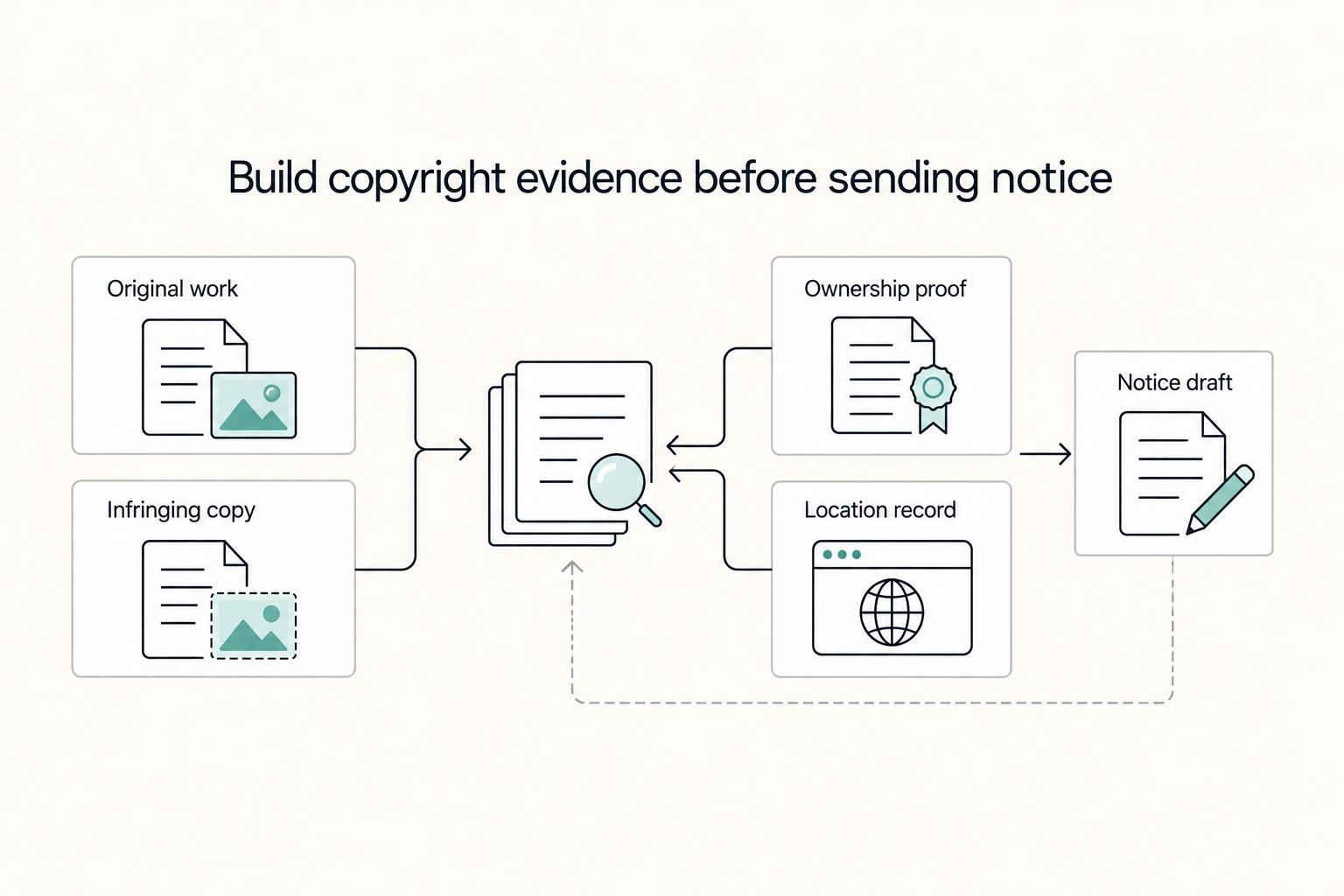
Quick Answer
File through the service’s copyright intake route first, then submit one complete packet with the original asset, exact infringing URL, your authority to act, and the required good-faith and perjury statements. Under Section 512(c), this is a takedown workflow, not a final ownership ruling, so intake clarity is critical. If your content was removed, send a counter-notification only after matching the platform ticket or case reference to the correct item.
How the DMCA Applies in a Client Content Dispute#
Use the DMCA as a containment tool. The immediate goal is to get copied material removed through a platform process, not to resolve every ownership dispute in one step.
For freelancers, outcomes often depend on following the platform or service intake path exactly. The notice-and-takedown model has been in law since 1998. Services seeking safe-harbor protection publish a designated DMCA agent or intake channel for these requests. If you miss that intake path, a claim can stall, so treat each filing as an evidence-first submission, not an argument thread.
The process can also run the other way. If content is removed, the uploader can respond with a counter-notice. Weak or vague notices create more friction instead of faster relief. A clear, complete filing matters from the start.
Focus on the pressure points freelancers actually face: repeat reposts after takedowns, notice-driven platform enforcement, and cross-border uncertainty. One notice may reduce immediate harm, but it may not end the issue. A stronger approach is to treat each filing as part of a repeatable sequence you can run again under stress.
This article gives you reusable assets:
- A filing checklist for sending a complete notice through the right channel.
- A decision path for notice versus DMCA Counter-Notification when facts are disputed.
- Contract clauses to help reduce repeat ownership fights before the next project ships.
What DMCA actually does and does not do#
The DMCA is a targeted notice-and-takedown process for online services, not a full copyright case resolution. Under DMCA Section 512(c), you ask a platform to remove or disable access to specific allegedly infringing content so you can contain harm quickly.
| Situation | Recommended step |
|---|---|
| Copied content is on a platform with a clear DMCA channel or designated agent | Start with a complete notice |
| Harm is high or key facts are disputed | Prepare to involve counsel early |
| Your content was removed and your position is factually supportable | Prepare a structured counter-notice |
A notice is most likely to move when you use the platform's designated form or agent route and include the required elements. It should identify your original work, identify the allegedly infringing material, and include sworn good-faith statements that the use is unauthorized. When a notice is valid, providers are expected to act quickly, and removals are often processed within days.
A takedown is still an interim platform action. It does not award damages or deliver a final ownership ruling. The uploader can respond with a counter-notice, so the dispute may continue after initial removal. That is why filing quality matters as much as filing speed.
Before every submission, do one practical check. Ask whether a reviewer can identify the original work, the copied location, and your authority in less than a minute from your filing. If not, tighten the packet before submitting. Clarity at intake can influence whether the request moves cleanly or gets parked for follow-up.
One final checkpoint: confirm every required notice element before filing. Incomplete notices may be ignored. Non-U.S. freelancers may still be able to use U.S.-platform channels, but outcomes remain platform-specific and jurisdiction-specific.
When timing is tight, prioritize one complete submission over multiple partial updates.
Before filing prove you still own enforceable rights#
Confirm the chain of rights before you file. Fast removal does not help if you no longer control the rights you are asserting.
If you created the work as an independent contractor, ownership usually starts with you unless the contract changes that. Review the rights language line by line, because a work-for-hire clause or assignment clause can shift ownership to the client. When rights language is spread across a master agreement, statement of work, and amendments, read them together rather than in isolation.
Treat work-for-hire labels carefully. For contractor work, the label only works with the right written terms and the right category fit. Even when work-for-hire does not apply, an assignment can still transfer ownership after creation. The practical point is simple: a label is not enough without matching written terms.
Before you draft any notice, keep one proof folder with:
- Signed contracts and amendments that address ownership, assignment, license scope, or transfer timing.
- Final deliverable files that match what the client received, with dates where available.
- Any publication history you already have.
- Drafts, notes, and saved versions that support originality.
Give this folder a fixed structure and keep it consistent across projects. That way, if a claim appears months later, you are not rebuilding the chain of rights from memory. Consistent records can also reduce confusion about who holds what rights.
If rights language is unclear, pause and clarify it in writing before you file. Confirm who currently holds the rights, then proceed. Filing before that check may feel faster, but it can create avoidable ownership disputes.
If you want a deeper dive, read Work for Hire vs. Assignment of Rights: A Freelancer's Guide to Owning Your IP.
Build your evidence pack before contacting any Copyright Agent#
Build the evidence pack first. It makes your notice specific and easier to review.
Start with the core record:
- The copyrighted work you are asserting.
- The exact location of the allegedly infringing content, down to URL level.
- A short good-faith statement.
- The claimant contact information you will use in the filing.
Then add a clean comparison sheet:
- Original work reference, including file or project name from your retained records.
- Copied location, including each exact URL.
- Element mapping that shows what was copied and where it appears in your original.
- Rights-holder identity that explains who is filing and why that party is authorized.
Keep the comparison sheet plain and objective. Avoid emotional wording, and avoid arguing conclusions in the evidence section. A reviewer should be able to compare original and copied material quickly without guessing which asset is being discussed.
Make the authority line explicit. The creator and claimant are not always the same party, so if the filing name differs from the byline, add a short authority note to your records.
Before you submit, confirm which contact details you are prepared to share and can monitor for replies.
Finish with an internal submission record: timestamp, destination form or email, submitted text, and attachments. That helps you resend or clarify the claim later without rebuilding facts under pressure.
Use one failure-mode check: if someone else on your team opened your file tomorrow, could they understand the claim and resend it accurately? If not, the pack still needs cleanup.
Submit a DMCA Notification of Alleged Infringement that survives review#
Submit through the platform's copyright complaint path and follow its instructions exactly. That is usually the cleanest way to get a notice reviewed.
The DMCA, enacted in 1998, sets the framework for handling online copyright issues and ties ISP liability protection to how services respond to copyright-owner requests. In practice, services may route reports to a designated agent or another documented copyright channel, so where you file matters.
Use this pre-send check:
- File through the service's copyright process, not generic support.
- Follow the stated submission method for that service.
- Include the details the service asks for about the work and the allegedly infringing material.
- Complete every field the service marks as required.
- Use contact details you actively monitor for follow-up.
After filing, monitor the same channel in case the service sends confirmation or asks for clarification. When you respond, keep your notice details consistent with the original submission.
Keep each claim narrow and tied to material you can describe clearly. Outcomes still vary by platform, and DMCA interpretation can favor ISPs, which can make it harder for copyright owners to halt illicit use. If a platform asks for more detail, provide that specific detail instead of rewriting the whole claim.
Choose platform form, host notice, or lawyer escalation#
Use the platform copyright form first when it exists. That usually routes your notice to the platform's designated DMCA channel.
That routing matters. Service providers are expected to act expeditiously on valid notices, so using the stated form or designated agent helps align your filing with the expected channel.
Use this sequence:
- File through the platform copyright form first and complete required fields exactly.
- Include the exact location of the allegedly infringing material, such as the specific URL.
- If the platform path is unclear or nonresponsive, consider a host or operator notice through its stated complaint channel.
- Keep a case log with submission time, channel used, and response history.
Use a host or operator notice when the platform route is unclear or not responsive. The tradeoff is speed versus depth of review: access may be disabled quickly, sometimes before a full review. That can reduce immediate exposure, but it may also leave ownership arguments unresolved.
Treat lawyer escalation as a risk decision, not an automatic second step. If stakes are high, ownership is disputed, or repeated notices are not resolving the issue, get counsel review before you refile. If impact is limited and your evidence is strong, a careful self-filed resubmission may still be reasonable.
If you keep refiling on similar facts and still get inconsistent outcomes, move from ad hoc filing to formal escalation with a consolidated case history.
Keep each claim specific. Vague descriptions can make a notice look incomplete, and mistaken or abusive claims do occur. Verify what was copied and where before each submission, and preserve records in case a counter-notice follows.
Respond to a takedown with a DMCA Counter-Notification#
Use a DMCA counter-notification when your content was removed and you believe the takedown was mistaken or unjustified. Treat it as a legal response, not a support complaint. The goal is to present accurate details, clear facts, and evidence of lawful use or ownership.
A counter-notification can increase escalation risk because it may give the claimant a chance to take the dispute to court. If your facts are unclear, pause and tighten your documentation before filing. Speed matters, but a rushed filing with mismatched facts can create bigger problems than a short delay for cleanup.
Build a counter package that is easy to verify#
- Identify the exact removed item and removal event, including the platform ticket or case reference if one is provided.
- State your factual basis plainly: what was removed, what rights you hold, and why you believe the infringement claim is wrong.
- Include records you can stand behind, such as license terms, written permission, or relevant contract language.
- Include the required attestations, including good-faith and perjury statements, and submit in the platform's required format.
Before you submit, verify that your identifiers match the actual removal notice so your response is reviewed against the correct content. If your account has multiple takedowns, this checkpoint helps prevent linking the wrong asset to the wrong notice.
Use a clear decision rule, not ad hoc replies#
If a claim looks false or baseless, preserve all communications and timestamps, then file a structured counter through the formal channel instead of arguing in scattered messages. If your records are clean, file promptly and keep your language narrow. If key facts are disputed or documents conflict, get legal review before filing.
Keep your response focused on verifiable facts. Do not add side arguments about reputation, intent, or platform fairness unless the form specifically asks for them. Precision improves review quality and keeps your position consistent if the dispute escalates.
Protect your identity and personal data during a counter-claim#
Protect your data before you file. Confirm what the channel may disclose, submit one consistent response, and share only what is required for that process.
False takedowns happen, and automated moderation can remove legitimate content before meaningful human review. Restoration can take days or weeks, so rushed or fragmented replies can make the process harder to resolve. The better approach is controlled, complete, and traceable communication.
Pre-filing privacy checkpoint#
- Verify the exact removal event and case reference so your response is tied to the right item.
- Review the form first, then provide only required identifying and contact details.
- Keep your statement narrow and consistent: what was removed, why you believe the claim is wrong, and what rights or permission you can support.
- Recheck your legal basis before filing, including whether the use may be covered by exceptions such as fair use or free speech, so your position reflects a good-faith review of the facts.
- Save a complete copy of your submission, timestamps, and platform responses.
Use one contact identity per case and avoid mixing personal and business contact channels midstream. Switching addresses or names during the same dispute may create avoidable follow-up.
If the dispute looks personal or retaliatory rather than a straightforward rights issue, treat it as higher risk and use a more controlled formal process. That may mean fewer off-platform conversations and tighter recordkeeping from the first response onward.
Handle repeat abuse, fraudulent claims, and account-level risk#
Treat repeat claims as an account-risk issue, not a one-off nuisance. A single report can be handled on its own, but repeated copyright allegations can increase the risk of account penalties, including suspension or termination. Track patterns early and escalate before the impact spreads.
Major marketplaces often move quickly on takedown requests to preserve safe-harbor protection. In practice, they may first check whether a notice appears compliant and remove content while the dispute continues, without deciding final ownership at that stage. If content is removed, it can remain inaccessible during the dispute, which can disrupt revenue and trust.
Use an incident ladder with clear triggers#
Do not treat each incident as a new fire drill. Use a fixed escalation ladder so your response stays consistent as pressure rises.
| Trigger | Level | Action |
|---|---|---|
| First event | Targeted filing | Submit a clean, platform-appropriate DMCA notice or response tied to one asset set, one URL set, and one claimant event. Record whether the notice passed compliance review and triggered removal. |
| Second event | Formal escalation | Escalate through the platform's available legal, trust, or support channel with your prior case file attached, and request review of repeat allegations tied to the same asset family. |
| Repeated event | Counsel plus account protection | Involve counsel and escalate with a full pattern record showing account-level risk, not just single-post disputes. |
Use the same checkpoint each time: did the notice pass compliance review, and did that action remove content? If yes, keep the identifiers tight and escalate faster on the next filing. If no, keep the record anyway so repeat patterns stay documented.
When you escalate, present trend data rather than frustration. Show dates, case IDs, affected assets, and whether each filing was accepted, rejected, or unresolved. Lead with pattern evidence instead of a long narrative.
Keep a reusable evidence archive ready#
Repeat disputes benefit from consistency, not volume. Keep one archive ready so each new filing is faster and cleaner.
- Ownership or authorization records for each asset group.
- Source files and publication history with dates and version notes.
- Prior notices, responses, and platform case references.
- A claimant pattern log with timestamps and allegation themes.
- Reusable statement blocks you can adapt without changing core facts.
Escalation speed should match the risk. A one-off repost by a small account may justify standard follow-up. Coordinated repeat claims against income-driving listings, portfolio pages, or ad creative should trigger immediate escalation and counsel review.
Contract clauses that reduce DMCA fights before they start#
A practical way to reduce DMCA fights is to lock ownership terms and records in writing before delivery.
Start with ownership language that cannot be read two ways. The creator typically owns the work unless a written agreement changes that. State clearly whether each deliverable is treated as work made for hire or transferred through an assignment of rights. Do not rely on labels alone. Work made for hire has limited scope and is not automatic for every contractor project.
Address client-provided assets directly. If the client provides photos, video, music, copy, or brand files, identify those inputs in writing and keep a record of what is client-provided versus freelancer-created. Pair that record with the signed agreement.
| Clause | What it should do | Red flag if missing |
|---|---|---|
| Written ownership terms | Document who owns the work instead of leaving ownership to default rules | The contractor usually keeps ownership if terms are not clearly written |
| Written transfer language | Explicitly transfer rights when the client needs them | Without a written transfer, the contractor can later refuse use |
| Asset ownership record | Track what was client-provided versus freelancer-created | Reuse conflicts or added licensing fees can appear later |
| DMCA notice channel | Confirm notices go through a platform's designated agent or online form | Takedown requests can stall if sent through the wrong channel |
These clauses also make later DMCA steps cleaner. If a dispute reaches a DMCA Notification of Alleged Infringement, clear ownership records matter. Notices go through a platform's designated agent or online form, and valid notices can lead to removal or disabled access quickly, often within days. Contract language does not guarantee outcomes, but it reduces avoidable ambiguity when speed matters.
Use one negotiation rule: if a client wants broad usage rights, require precise written transfer language in the same draft. If the client refuses clear written ownership and transfer terms, treat that as a pricing or acceptance decision, not a wording tweak.
Mirror contract terms in your delivery process. If the contract distinguishes client-provided and freelancer-created assets, your project files should use that same split. Consistency between contract language and project records makes later disputes easier to resolve. Before your next client kickoff, turn these ownership and dispute terms into usable language with the Freelance Contract Generator.
Conclusion#
Treat the DMCA as a repeatable risk-control process: verify your rights, file complete notices through the platform's designated agent or online form, and escalate only when facts or exposure require it.
A workable notice clearly identifies the original work and the allegedly infringing material, and includes a good-faith statement that the use is unauthorized. Platforms have safe-harbor incentives to act quickly after valid complaints, but timing varies, and a takedown is not the end of the process.
Keep a filing packet ready before incidents happen. Preserve copies of each submission, track platform responses, and avoid broad claims that do not map clearly to specific assets. If the other side responds after removal, use the counter-notice path as the formal channel and keep records tight. Consistency across evidence files and filing language helps keep repeat disputes manageable.
Use this checklist before the next incident:
- Finalize one evidence template with original work details and infringing locations.
- Prewrite a notice draft and a counter-notice draft.
- Record each platform's designated legal intake route.
- Maintain an incident log with timestamps, ticket IDs, and outcomes.
- Confirm you can make a documented good-faith statement for each filing.
If you do those five steps before the next conflict, you can reduce avoidable delay, improve filing quality, and make escalation decisions from evidence instead of urgency.
If you run cross-border client work and want cleaner payment operations, see how Gruv for freelancers is structured.
Frequently Asked Questions
What must a DMCA notice include to be valid?
A valid notice should identify the copyrighted work and the location of the allegedly infringing material, such as a URL or IP address. It should also include your contact details, a good-faith statement, a penalty-of-perjury accuracy and authority statement, and a physical or electronic signature from an authorized person. If required details are missing, or you do not answer follow-up requests, the platform may not move the complaint forward. Before filing, do one final read as if you were the reviewer seeing the case for the first time.
What is a DMCA counter-notice and when should a freelancer file one?
A counter-notice is the formal response path when your content was removed and you believe you have rights to keep using it. Because required elements can vary by platform, check that platform’s DMCA or copyright policy before filing. Treat it as a legal submission, not a casual support message. If your documents conflict, resolve those conflicts before you submit.
Where should freelancers send a DMCA notice if the platform has no obvious legal form?
Use the platform’s designated DMCA intake route listed in its legal or copyright policy. If it provides a linked DMCA form, use that form to avoid delays. Sending notices through general support channels can slow handling. If no clear route appears, document what you checked and ask for the correct DMCA channel before escalating.
What personal information is typically required in a counter-claim?
There is no universal field list across platforms. Requirements can vary, so check the platform DMCA or copyright policy before filing. Do not assume another site’s checklist will match. The safe practice is to provide required details only and keep a copy of exactly what you shared.
Does DMCA protection apply if I am not based in the United States?
There is no blanket rule for non-U.S. freelancers. DMCA notices are a notice-and-takedown process, not a final ruling on ownership across jurisdictions. Treat platform notice channels as a removal process step, and evaluate escalation options early if outcomes are high impact.
Should I file myself or hire a lawyer for a disputed takedown?
There is no one-size-fits-all rule. Self-filing may be workable when facts are clear and you can complete required statements accurately. If ownership is contested or business impact is high, legal counsel can be the safer path. A practical dividing line is repeat complexity: one clear incident may be manageable, while repeated disputed incidents may not be.
What should I do in the first hours after receiving a wrongful takedown?
Preserve the takedown message and the key details about what was removed. Review the platform counter-notice process and prepare supporting records before you submit anything. If you respond, use the designated channel and watch for follow-up requests. Keep your first response concise and fully aligned with the case identifiers shown in the takedown notice.
Try a related tool
Researched and edited by the Gruv editorial team. Gruv builds cross-border billing, payouts, and finance-operations software for global businesses.
Sources
Educational content only. Not legal, tax, or financial advice.
Related Posts

Work for Hire vs Assignment of Rights for Freelancers
A freelance agreement is not just about price and scope. It decides who controls the rights in the work. If the ownership language is loose, rights can move earlier than you expect, cutting down your control once the work is delivered or used.
Best Digital Nomad Cities for Safety and Stability in 2026
Treat this as a relocation decision, not a travel mood. The fastest way to make a good call is to run every city through the same three checks in the same order: shortlist signal, stay feasibility, and day-to-day work readiness. Stick to that order and you avoid most expensive mistakes before money leaves your account.
How Freelancer LLCs Should Decide BOI Filing Under the CTA
Conflicting answers on BOI are not your fault. The rules changed, and some freelancer content online still reflects older assumptions.