
Quick Answer
Start with filing, not optimization: confirm local residency, then your U.S. return duty, then test FEIE against the Foreign Tax Credit. Keep a monthly evidence pack with a day log, account maximums, contracts, and payment records so Form 1116 and foreign account reporting can be traced to source files. Reconcile quarterly and at year-end, and escalate before filing if California ties, state day-count exposure, or mismatched records make your position hard to defend.
Start With One Honest Assumption About Filing While Abroad#
For many nomads, a preventable risk is not exotic planning. It is letting filing and reporting fall behind while travel, contracts, and banking move faster than your records.
Start with one honest assumption: if you are a U.S. citizen or Green Card holder, living abroad does not automatically remove U.S. obligations. U.S. citizens and Green Card holders are generally expected to file a U.S. tax return each year, including while abroad. That baseline filters out shortcut advice built only on recent travel patterns.
The practical goal is to reduce uncertainty through decisions, documentation, and clear escalation rules, not tax hacks. A simple way to do that is to write down what you are assuming now, then update it when the facts change.
Use this posture before you optimize anything:
- Treat filing requirements and potential tax due as separate questions.
- Keep a living assumptions note with dates, country moves, account changes, and why your position looked reasonable at the time.
- Run a regular foreign account check for opened or closed accounts and the combined maximum balance across accounts, including temporary spikes.
- Treat FBAR and FATCA as reporting work tied to account values and reporting rules, not direct taxation of foreign accounts.
Country rules vary, and edge cases are real. If your facts are split across countries or advisors conflict, escalate early to a qualified cross-border professional. The next sections turn that principle into a sequence you can actually run.
For a step-by-step walkthrough, see Colombia Digital Nomad Visa Tax Planning Around the 183-Day Rule.
Build a Clear Mental Model Before You Optimize#
Use this sequence: determine local residency, confirm U.S. filing duty, then choose a relief path. Running it in reverse is how tax anxiety grows, because you optimize before you know which rules apply.
If you want the broader framework, keep this digital nomad tax guide nearby, then make these four calls first.
Step 1 Map residency under local rules first#
Map residency under local rules first. This is a country-level question, separate from your U.S. return position, and the answer may be clear, mixed, or unresolved for part of the year.
Write a one-line output: Resident in Country A from Month X or Residency unclear due to split-year facts.
Step 2 Confirm U.S. filing duty next#
Confirm U.S. filing duty next. Keep filing duty and potential tax due as separate decisions.
If FEIE is in play, remember that the exclusion applies only for qualifying individuals with foreign earned income who still file a return reporting that income. Write a plain output: U.S. return required or Need advice on filing status before proceeding.
Step 3 Test FEIE versus the Foreign Tax Credit#
Only after Steps 1 and 2 are documented should you test FEIE versus the Foreign Tax Credit.
For FEIE, verify mechanics before outcomes: the physical presence test is based on day count, including 330 full days in a 12 consecutive months window. Missing required days fails the test even for illness, family issues, vacation, or employer orders. Confirm tax home separately as well, since intent and purpose of stay can matter there. Before using an exclusion cap, verify the current amount from official tax records or advisor records.
For FTC, treat Form 1116 as an evidence process. Use a separate Form 1116 for each income category and check one category box per form. If you may claim a foreign housing exclusion, compute it first because it reduces income available for FEIE.
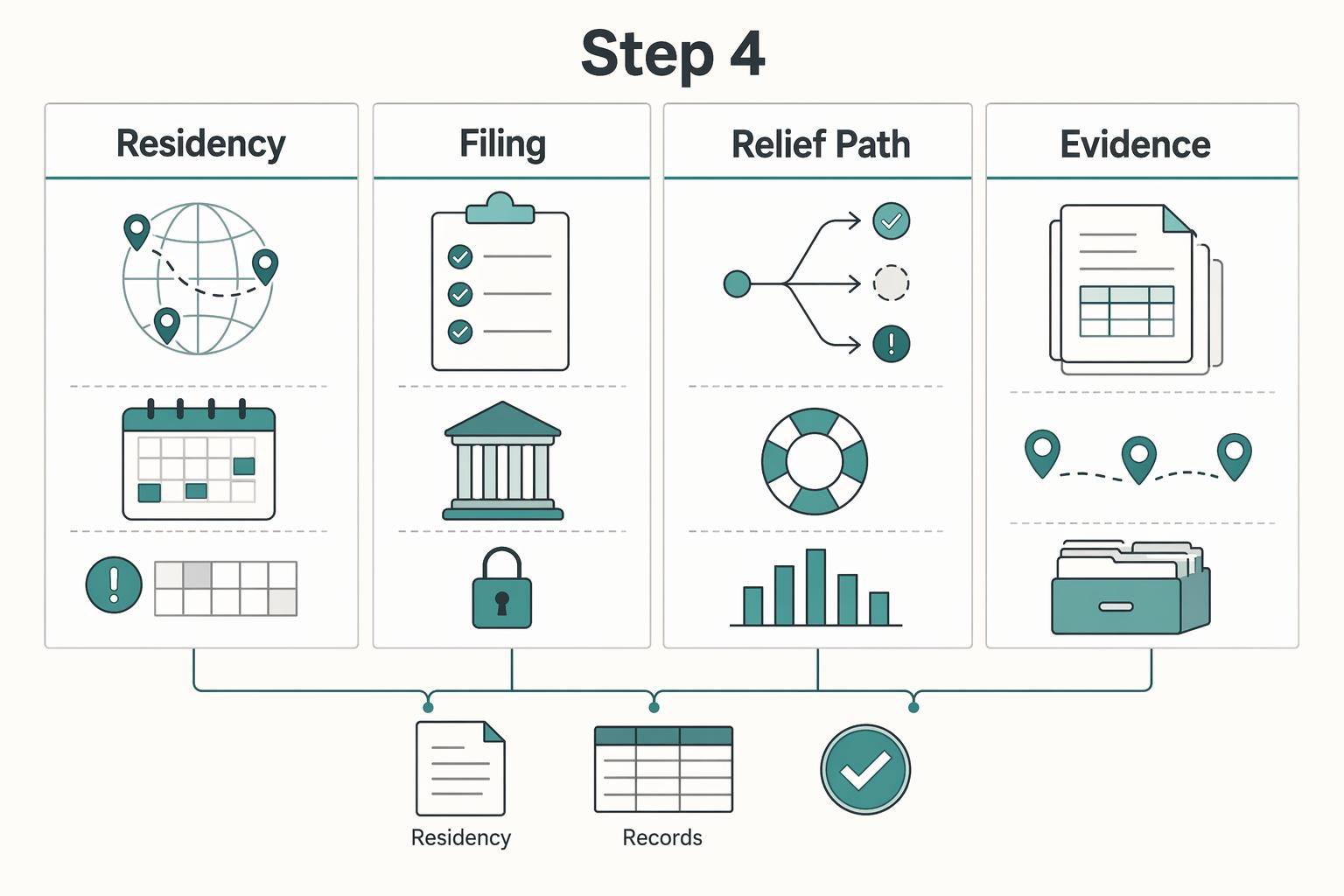
Step 4 Run the checklist and record one output per lane#
Run this checklist and record one output per lane:
| Decision lane | Action | One-line output |
|---|---|---|
| Residency | Identify which country can credibly treat you as taxable under local rules | Resident in X or split year / unclear |
| U.S. filing duty | Confirm whether your U.S. status requires a return reporting income | U.S. return required |
| Relief path | Test FEIE qualification facts and/or FTC categorization needs | FEIE possible, FTC likely, or needs comparison |
| Documentation readiness | Confirm you can prove day counts, tax home facts, foreign taxes paid, and Form 1116 categories | Ready, missing records, or do not file yet |
If facts change midyear, the day-count window breaks, or multiple jurisdictions have credible residency claims, escalate before filing. Document first, optimize second.
We covered this in detail in Digital Nomad Tax Residency Across Multiple Countries.
Start With a Default Filing Posture You Can Defend#
Use a filing-first default you can explain, then optimize only after your facts are clear. This is a conservative planning posture, not a legal conclusion.
This section is risk-control workflow rather than rule-setting advice, so verify tax positions against authoritative sources or a qualified advisor before filing.
If you are a U.S. citizen living abroad, treat any filing posture as a temporary working assumption while you confirm your facts with authoritative sources or a qualified advisor.
Keep these decisions separate:
- Filing posture: your current working assumption while facts are still being verified.
- Tax due: what you may owe after the rules are confirmed.
Before you choose a filing approach, document that posture in plain language:
- One short note on your current assumption and open questions.
- A forms-and-timing checklist you can update.
- An evidence folder with travel dates, income records, and local residency notes.
If you moved abroad midyear, treat that year as its own scenario in your notes and record assumptions before you act. At minimum, log move dates, where work was performed before and after the move, and what changed in contracts or banking.
If your facts conflict across jurisdictions, or your position depends on an exception you cannot document clearly, escalate before you act.
Treat Residency Risk as a Trigger, Not a Guess#
When residency status is in play, treat it as a verification trigger, not a guess based on passport stamps. Frequent movement can blur where you live versus where you work, while U.S. filing duties may still apply.
Use changes in your travel pattern as an early warning signal, not a final answer. For U.S. tax residency questions, the substantial presence test is based on day counts, not visa intent.
Keep travel assumptions separate from tax conclusions until they have been reviewed.
Run this checkpoint when travel patterns change and before year-end:
- Stay length: Are you nearing at least 31 days in the current year and 183 weighted days over three years, including prior-year days at reduced weight, such as 1/3 for the previous year?
- Income sourcing: Did you earn income in the U.S. that means filing Form 1040-NR, even if you remain a nonresident?
- Reporting scope: If you cross the substantial presence line, are you prepared for worldwide income reporting to the IRS?
- Filing impact: Are your return assumptions still consistent with your day counts and records?
If any answer is yes, escalate for a residency review before year-end. Filing can also help avoid a common nonresident failure mode: overpaying U.S. taxes by not filing returns to claim refunds. Review this checkpoint regularly so year-end becomes a confirmation step, not a discovery step.
Keep a residency log tied to evidence, not memory. Track entry and exit dates, where work was performed, invoice timing, and payment records. Store travel and housing documents in the same folder.
Related reading: Australia Tax Residency for Digital Nomads With GST and ABN Checkpoints.
Pick FEIE or Foreign Tax Credit Based on Facts, Not Forum Advice#
Choose the path you can document on your U.S. return, not the one that sounds easiest in a forum post.
FEIE can fit when you have foreign earned income, your tax home is in a foreign country, you qualify as a qualifying individual, including under the Physical Presence Test, and you file a U.S. return reporting that income. Under the Physical Presence Test, that means at least 330 full days in a 12-month period, and a full day is a 24-hour period from midnight to midnight. Those 330 days do not have to be consecutive. FEIE can reduce current U.S. taxable earned income, but only within the annual cap and only for qualifying income. For 2026, the maximum is $132,900 per qualifying person. If you claim a foreign housing exclusion, calculate that first because it reduces available FEIE room. The housing limit is generally 30% of the FEIE maximum, or $39,870 for 2026.
The Foreign Tax Credit is a separate path documented on Form 1116. Form 1116 is handled by income category, one category box is checked per form, and taxes paid to multiple countries or territories are separated by country or territory.
| Choice | Near-term benefit | Constraint to manage |
|---|---|---|
| FEIE via Physical Presence Test | Can reduce current U.S. taxable earned income within annual limits | You must meet the 330-full-day test in a 12-month period; housing exclusion is calculated first and can limit FEIE room |
| Foreign Tax Credit | Separate path documented on Form 1116 when foreign taxes are paid | Form 1116 requires separate handling by income category and by country or territory |
Before you file, write a short checkpoint memo and revisit it next year:
- Why this year's facts support FEIE or the Foreign Tax Credit.
- Which records support that choice.
- What would trigger a switch next year.
- Which Form 1116 categories and countries applied, if you used credits.
Keep the memo brief but specific. A one-page note with your choice, your evidence list, and your switch trigger is usually enough to keep next year from starting at zero.
Handle Self-Employment Exposure Before It Becomes Expensive#
Do not assume self-employment exposure is settled just because your income tax path is settled. Income tax treatment and Social Security coverage often require separate checks, and mismatches can create errors.
For cross-border cases, check whether a Totalization agreement exists and applies. These agreements assign coverage to one country and are meant to prevent the same earnings from being taxed by both countries' Social Security systems.
Self-employed workers are part of this framework. When U.S. coverage applies under an agreement, a U.S. Certificate of Coverage is used as proof for exemption in the other country, and self-employed individuals can request certificates online through SSA.
The practical risk is relying on income tax planning that ignores Social Security coordination. If your U.S. filing position, local contribution position, and Certificate of Coverage evidence do not align, you can carry mismatch risk across U.S. and local filings.
Before you file, keep a short verification packet:
- U.S. filing workpapers that support your position.
- A yes or no determination on whether a Totalization agreement applies.
- A Certificate of Coverage copy when you rely on U.S. coverage.
- Local contribution or exemption records that match your U.S. filing position.
Decision rule: if your business structure, client geography, or agreement assumptions changed, get a professional review before filing. Keep these records next to your return working papers so each position can be checked quickly.
Need the full breakdown? Read Tax Free Digital Nomad Visas and the Tax Outcome You Can Defend.
Eliminate State Tax Surprises Before You Leave the U.S.#
Before you focus on foreign relief, close your U.S. loose ends in writing. Leaving the U.S. does not end U.S. filing obligations for U.S. citizens or Green Card holders. Treat your move date as the start of a documentation process, not proof that your tax obligations are over.
A common checkpoint is local tax residency. In many countries, crossing the 183-day mark in a tax year can trigger residency and require worldwide income reporting. Digital nomad visa incentives do not automatically remove local tax obligations.
You may owe little or no U.S. tax and still need to file a U.S. return to claim expat tax benefits. If you freelance or run a business, U.S. self-employment rules can still apply, including the $400 net-earnings filing threshold and the stated 15.3% self-employment tax.
State-specific residency tests and thresholds are not covered by the evidence here, so avoid assuming that departure alone ends state tax obligations.
Before you rely on a nonresident position, keep written evidence such as:
- In-country day-count records to monitor 183-day exposure.
- Travel and stay records by location and date.
- Documents used to file U.S. returns and claim expat tax benefits.
- Self-employment income records, including when net earnings approach $400.
- Local tax registration or notice records from countries where you stayed.
Close loose ends before filing. If your timing is close to a residency threshold or obligations are unclear, get professional review before you file to reduce the risk of unexpected tax bills or penalties.
Keep Foreign Account Reporting Clean and Boring#
Keep this part simple. For U.S. citizens, Green Card holders, and resident aliens, FBAR has a clear trigger: if the combined balance of foreign financial accounts exceeds $10,000 at any point during the calendar year, you must file an FBAR, FinCEN Form 114. FBAR is filed electronically through FinCEN's BSA E-Filing System.
| What it is | FBAR |
|---|---|
| Filing form | FinCEN Form 114 |
| Filed with | FinCEN via the BSA E-Filing System |
| Trigger style | Combined foreign account balances exceed $10,000 at any point during the calendar year |
| Balance checkpoint | Use the in-year high point, not just year-end balances |
If you remember one rule, use this one: run the FBAR test against the highest combined balance reached during the year.
When this goes wrong, it is often a process issue: checking balances too late or losing track of accounts as they open and close. Keep accounts separate in your records, then run the combined-balance test so the filing decision is traceable.
Use a short account inventory routine every time an account opens or closes:
- Update the account record when status changes.
- Track each foreign financial account separately.
- Keep each account's highest in-year balance so your combined check is accurate.
- Review the full list before filing FinCEN Form 114.
Before filing, reconcile this inventory against your records. If an account appears in your records but not in your inventory, pause and fix it first. This helps keep account reporting routine and can lower penalty risk.
Maintain a Monthly Evidence Pack That Defends Your Position#
Your monthly evidence pack should make filing decisions defensible without last-minute reconstruction. Keep one pack per month for your account records so you can verify facts quickly when tax anxiety starts creeping in.
Before you start#
Use one pack per month, not separate piles for FBAR, Form 8938, and your return. One pack should support multiple decisions, which matters because Form 8938 and FinCEN Form 114 are separate obligations, and one does not replace the other. If you need the broader filing sequence around this habit, see the digital nomad tax guide. For the filing distinction itself, use the IRS comparison page: Form 8938 vs. FBAR.
Step 1 Capture the month's raw evidence#
At month-end, collect these five artifacts for each foreign account:
| Artifact | What to capture | Article detail |
|---|---|---|
| statement file | One statement file for each foreign account for that month | Every account in your inventory should have one statement file for that same month |
| max-value record | An explicit max-value entry for the month | Form 8938 asks for maximum value information, so do not wait until year-end to infer highs |
| FX conversion note | Currency, rate source used, and converted U.S. dollar figure | Record the currency, the rate source used, and the converted U.S. dollar figure |
| account status log | Account status changes for the month | Every closed account is logged in status |
| reconciliation note | A note that supports the account reconciliation | Every ledger value ties back to a source file |
- statement file
- max-value record
- FX conversion note
- account status log
- reconciliation note
Make the max-value record explicit. Form 8938 asks for maximum value information, so do not wait until year-end to infer highs from scattered files. In the FX conversion note, record the currency, the rate source used, and the converted U.S. dollar figure.
Verification check: every account in your inventory should have one statement file and one max-value entry for that same month. If either is missing, the pack is incomplete.
Step 2 Organize the pack so someone else can read it#
Store by month first, then by evidence type. A workable structure is /Tax/2026/2026-04 Evidence Pack/Accounts, /FX, /Status, /Reconciliation, and optionally /Gruv Exports. Use one naming pattern across files, such as 2026-04_BankName_Last4_statement.pdf and 2026-04_BankName_Last4_fx-note.pdf.
Keep a one-page monthly summary at the top of the folder and include: Form 8938 threshold: Current threshold pending official tax verification. This avoids hardcoding the wrong threshold for your filing profile and keeps the distinction clear: Form 8938 is threshold-based and attached to your annual return, while FBAR is a separate reporting track.
Step 3 Reconcile the ledger against reality#
Reconcile the monthly folder to your account ledger. Confirm every open account has a statement, every closed account is logged in status, and every ledger value ties back to a source file. Because Form 8938 asks whether foreign deposit or custodial accounts were closed during the tax year, closures should have their own clear log entry.
The common failure mode is drift. Accounts open or close, or an FX note disappears, while the ledger still looks complete. If an account appears in statements but not in the ledger, stop and fix the mismatch before moving on.
Step 4 Review the pack for filing readiness#
End each month with a short reviewer test: could an advisor open this folder and quickly confirm what accounts existed, each account's maximum values, and what changed? If not, add the missing reconciliation note now while details are fresh.
If you use Gruv, where supported, export monthly transaction records and reconciliation artifacts into /Gruv Exports with the same YYYY-MM_Account_DocumentType pattern. Keep one retrieval rule: when an advisor asks about one account for one month, that single monthly folder should provide the full decision trail without renaming files or searching across apps.
Run a Quarterly and Year-End Compliance Calendar#
Once your monthly evidence pack exists, run the same four checkpoints every year so filing stays a review process, not a reconstruction exercise.
Step 1 Put each checkpoint on the calendar#
Use one owner and one expected outcome for each review.
| Checkpoint | Timing | Outcome | Owner action |
|---|---|---|---|
| Quarterly review | Every quarter | Position is still current | Update estimates and log any new country, account, or income category |
| Facts-changed review | When travel, work, or tax treatment changes | Treatment conflicts are caught early | Apply one rule: if treatment changed, review credit-vs-deduction consistency across the return |
| Year-end close | Year-end | Return inputs are frozen from complete records | Finalize country list, foreign tax totals, account inventory, max values, and USD conversions |
| Pre-filing Form 1116 check | Before filing | Credit claim is structurally ready | Confirm taxes are creditable, Form 1116 categories match current income (separate form per income category), amounts are in U.S. dollars where required, and current form checks are verified from official tax records before filing |
If you need the broader filing workflow around this cadence, see the digital nomad tax guide.
Step 2 Review consistency when facts change#
Use this as a hard trigger: if your foreign-tax treatment changed, review the whole return. You may be able to take either a foreign tax credit or an itemized deduction for qualifying foreign taxes, and that choice changes whether those taxes reduce U.S. tax liability or U.S. taxable income.
Also check for election conflicts before filing. If you excluded foreign earned income or housing costs, you cannot claim a foreign tax credit on taxes tied to that excluded income. If both elections are in play, escalate before filing because one or both elections may be treated as revoked.
Step 3 Freeze year-end inputs before drafting#
Before drafting, lock the Form 1116 inputs that affect credit treatment. Verify that foreign taxes are creditable, income is grouped into the right category, and amounts are reported in U.S. dollars except where the form instructions allow otherwise.
If you are considering the no-Form-1116 route because your credit is not more than $300, or $600 if filing jointly, and other eligibility requirements are met, record the tradeoff: unused foreign tax cannot be carried back or carried over under that election.
Step 4 Reconcile the evidence pack to the return before filing#
Before filing, reconcile return inputs back to the monthly folders: foreign tax totals, country list, account counts, maximum values, and USD conversions. An advisor should be able to trace each number to a source file without guessing.
If records do not align, log unresolved mismatches and escalate before filing. This close-out rule matters more than speed.
If your travel and filing facts keep drifting quarter to quarter, use the Tax Residency Tracker to maintain one defensible timeline before year-end cleanup.
Set Clear Escalation Rules for When to Call a Pro#
A calendar tells you when to review. Escalation rules tell you when to stop making DIY calls. Use them before filing whenever remote-work location choices could change state tax exposure for you or your employer and you cannot defend the position from your records.
Use these triggers:
- You worked from another state and are unsure whether you went over a state day-count threshold (guidance here only specifies "X days a year").
- You are unsure whether your days in a state could mean both you and your employer owe that state taxes.
- Your location pattern could create business nexus for your employer, with additional tax complications.
- Your employer requires work-from-home to happen at your actual home, and your work locations no longer match that policy.
- You cannot consistently meet policy checkpoints such as being reachable during normal office hours and online in Teams.
- Security and tax-compliance concerns are both in play, and you cannot clearly map the tax effect of your location choices.
State location risk deserves its own trigger. The exact day-count number is not specified here, so treat "over X days a year" as a warning sign, not a planning target. If your day log, work locations, and tax position do not align cleanly, escalate early and ask a qualified tax professional to review.
Final rule: if the issue could materially change your state position or create employer nexus risk and you cannot explain it in a short written memo backed by records, call a pro before filing. When you escalate, hand over your memo, timeline, and work-location log so the advice starts from facts, not guesswork.
Notice Changes, Test Your Position, Escalate When Records Stop Reconciling#
Tax anxiety can drop when your position is defensible from records, not memory. The goal is simple: notice changes, test your last position against current documents, and escalate when the records stop reconciling. Confidence usually comes from traceability, not aggressive assumptions.
Before you start#
Build one living evidence pack and update it on a regular cadence: day log, income documents, account statements or ledger, and a short decision memo for gray areas. This is not a legal requirement. It is a practical habit that can turn year-end from reconstruction into verification.
If your records are spread across apps and devices, treat them like any other critical process and keep redundant copies. The same continuity mindset from How to Create a Business Continuity Plan for a Natural Disaster applies here.
Step 1 Notice changes early#
Log facts, not interpretations. A new country stay, client, bank account, payment platform, work pattern, or travel-billing mismatch is a changed fact worth recording.
Your regular check is straightforward: each material change should map to a document you can produce now. If you cannot point to supporting records, flag it for cleanup immediately.
Step 2 Test your prior position against the pack#
Ask one question: does your last documented conclusion still reconcile to current records? If yes, keep it. If no, document the gap before it compounds.
Use this reconciliation checklist:
- Day log: Verify travel dates align with your calendar and entry or exit evidence; flag gaps, overlaps, or dates filled from memory.
- Income file: Verify contracts, invoices, and receipts tell the same timing story; flag unpaired payments or timing mismatches.
- Account ledger: Verify names, account numbers, and balances match statements; flag new accounts, unexplained transfers, or missing months.
- Decision memo: Verify each gray area states the assumption, supporting records, and what would overturn it; flag conclusions with no document trail.
If core records conflict, resolve that first. A clean narrative with conflicting documentation is a risk signal, not an admin detail.
Step 3 Decide whether to escalate#
Escalate when your conclusion depends on unreconciled records or materially changed facts. If the records still align and nothing material changed, keep your prior position and note why.
If you are still debating after running this sequence, use that as your escalation trigger before filing. For the broader filing workflow, use the digital nomad tax guide, then use the FAQ guardrails above to decide where DIY ends.
Keep one final habit in place: use secure official portals for document uploads and save submission copies. These low-drama routines help make compliance repeatable.
Related: How to Get a Tax Residency Certificate as a Digital Nomad.
If your records still leave unresolved residency or reporting conflicts, talk to Gruv to map a safer next-step compliance workflow.
Frequently Asked Questions
Do digital nomads still need to file a U.S. tax return if they live abroad?
Short answer: Usually yes, if you are a U.S. citizen or resident alien with a filing obligation, because living abroad does not remove worldwide income reporting and FEIE does not remove the need to file. What to do next: Use a filing-first posture, then decide whether exclusions or credits change what you owe. For a broader filing workflow, use the digital nomad tax guide.
Can I owe tax in both the U.S. and another country under worldwide income taxation rules?
Short answer: Yes, overlap can happen, so the practical question is whether your relief path is supportable. What to do next: Map each income stream to the form you can defend. FEIE requires qualifying status, foreign earned income, and a foreign tax home, while the Foreign Tax Credit requires category-by-category Form 1116 reporting. If you may claim the foreign housing exclusion, calculate it first because it can limit available FEIE.
Does moving constantly mean I avoid tax residency everywhere?
Short answer: No. Frequent movement alone does not establish FEIE eligibility or remove U.S. filing duties. What to do next: Keep a day log with entry and exit evidence, and if your FEIE position depends on day counts, verify the IRS timing rules directly.
How does the 183-day rule actually affect local tax residency decisions?
Short answer: This guide does not support a universal 183-day outcome. What to do next: Keep local residency analysis separate from the IRS physical presence test, then verify FEIE timing against the IRS standard of 330 full days in a 12-month period, with full days counted as 24 consecutive hours from midnight to midnight.
If I am freelance, when does self-employment tax become a priority issue?
Short answer: It usually becomes a priority as soon as your filing position includes self-employment income. What to do next: Review Schedule SE, check whether local social contributions create a separate issue, and escalate if any Totalization question cannot be defended with records. If your operations are spread across locations, document continuity steps alongside tax records in a simple operating plan, see /blog/how-to-create-business-continuity-plan-natural-disaster.
What is the difference between FBAR (FinCEN Form 114) and Form 8938 under FATCA reporting?
Short answer: Treat them as separate checklists and verify current requirements for each before filing. What to do next: Verify each current reporting threshold from official filing instructions before use, then build both filings from one monthly account ledger so names, numbers, and values reconcile before filing.
When should I stop DIY filing and hire a cross-border tax professional?
Short answer: Stop when your conclusion depends on assumptions you cannot defend from records, or when fact changes could materially alter FEIE eligibility, Form 1116 treatment, or foreign account reporting. What to do next: Hand over a concise evidence pack with your timeline, day log, account ledger, income summary, foreign tax documents, and decision memo. If your FEIE position depends on tight day counts, remember that missed days are not excused for routine disruptions, while adverse-condition cases may need separate waiver review.
Try a related tool
Researched and edited by the Gruv editorial team. Gruv builds cross-border billing, payouts, and finance-operations software for global businesses.
Sources
- congress.gov/event/119th-congress/house-event/118726/texttrusted
- dlcp.dc.gov/sites/default/files/dc/sites/DLCP/publicatio...trusted
- etp.ca.gov/wp-content/uploads/sites/70/2019/12/ETP_Pane...trusted
- fincen.gov/report-foreign-bank-and-financial-accountstrusted
- irs.gov/individuals/international-taxpayers/foreign-...trusted
- irs.gov/individuals/international-taxpayers/figuring...trusted
- ssa.gov/international/agreements_overview.htmltrusted
- ssa.gov/international/CoC_link.htmltrusted
Educational content only. Not legal, tax, or financial advice.
Related Posts

Digital Nomad Taxes in 2026 With a Defensible Filing Plan
With digital nomad taxes, the first move is not optimization. It is figuring out where you may be taxable, where filings may be required, and what proof supports that position.
Build a One-Page Business Continuity Plan for a Natural Disaster
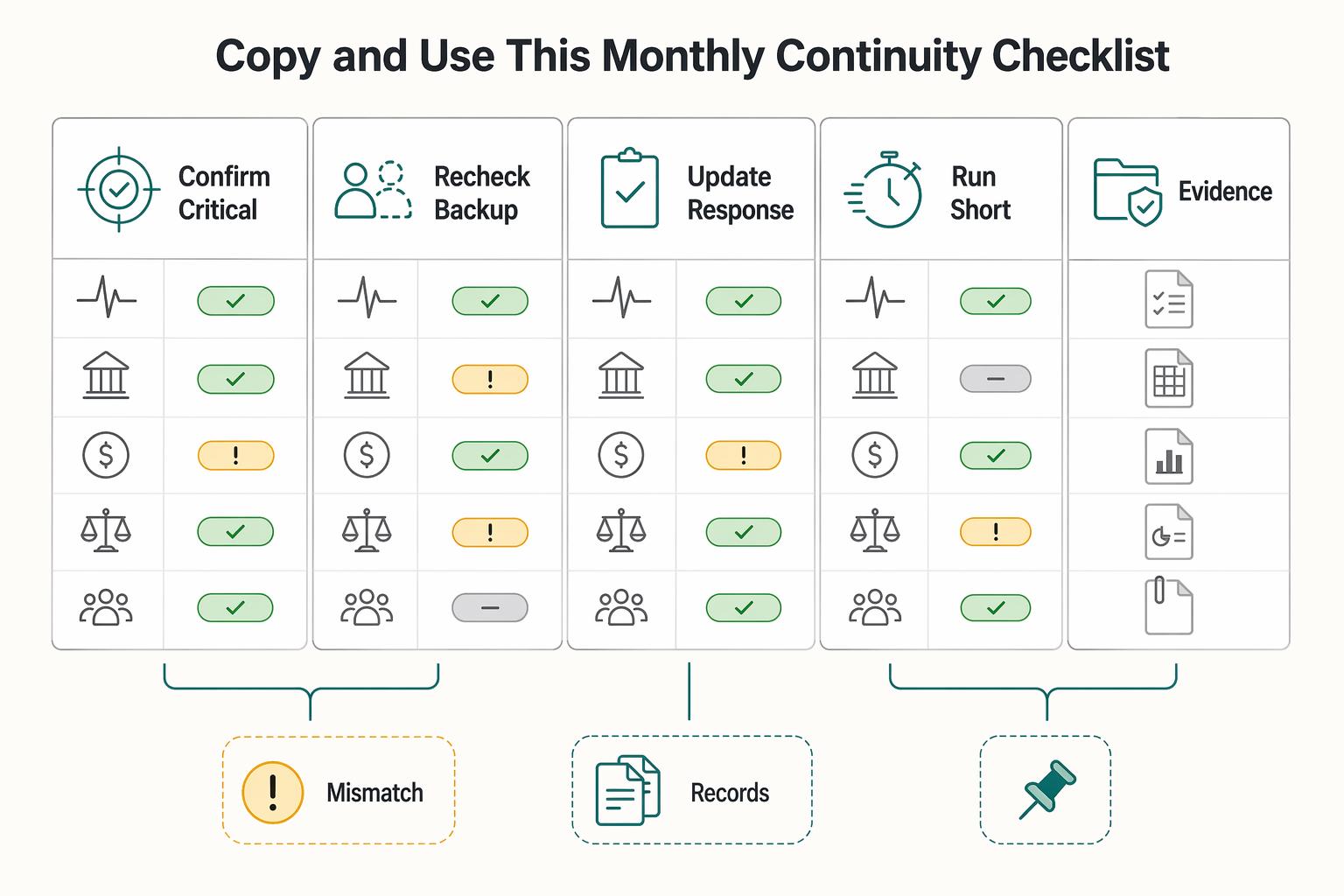
Use this afternoon to produce a practical first draft: a one-page continuity plan for a natural disaster and a short tabletop test. This is not a regulator requirement; it is a practical way for an independent professional or small team to protect critical functions, keep client commitments visible, and make better decisions under stress.

The Freelance Payment Penalty: A Modeled Audit of Platform Fees, FX Spreads, and Payout Delays
The money rarely disappears through a single, easy-to-spot fee. The real loss is stacked. A marketplace takes its commission, a processor adds a charge for international cards, a bank or payment company converts the currency at a spread, a platform holds the funds before release, and a wire sheds a little to intermediaries on the way in. Each layer looks defensible on its own, but the worker feels the combined result as a smaller deposit and a later payday.