
Quick Answer
Treat the us-switzerland tax treaty as a coordination tool, not a U.S. tax escape hatch. For consulting income, confirm payer classification first, then document how Article 1(2), Article 14, and Article 23 apply before you sign forms or invoice. Keep contracts, AP emails, tax forms, and Swiss tax-paid evidence aligned so Form 1116 category decisions are supportable. Run FBAR and Form 8938 as separate checks, and escalate early when ownership facts or prior filings are unclear.
As a U.S. financial consultant in Switzerland, your biggest risk may not be a market downturn. It may be one misunderstood treaty line that costs you thousands. Building a successful business around your expertise is hard enough. Cross-border compliance adds a steady layer of uncertainty.
Start with the rule that matters most: the United States taxes its citizens on worldwide income, no matter where they live. Many professionals assume a tax treaty creates an exemption. It does not. The main job of the US-Switzerland tax treaty is to prevent the same income from being taxed twice, once by each country.
That mindset shift matters. The goal is not to avoid U.S. tax. It is to manage both systems well, keep the right records, and use the relief tools that actually apply. This guide covers three practical steps: secure your consulting income, keep your Swiss accounts and assets fully supportable, and use the right method to address double taxation.
Step 1: Secure Your Consulting Income#
Start by confirming how each payer classifies you before you send any tax form. If classification is unclear, withholding treatment and follow-up corrections can get harder later.
Use this decision rule: Article 14 helps analyze independent personal services, but it is not an automatic exemption. In the Convention text, the saving clause is in Article 1, paragraph 2, and double-tax relief is addressed in Article 23. Treaty benefits are not unconditional, and Article 22 covers limitation on benefits. Where interpretation is disputed, use the treaty package (Convention, Protocol, and attached Memorandum of Understanding) plus the Technical Explanation before signing.
Confirm payer classification first#
Before you respond to a form request, ask AP in writing how they have classified you and why the form is required. If they cannot explain the basis at the article level, treat that as an escalation trigger.
| Request that comes up | What AP should be able to explain | Fast action |
|---|---|---|
| U.S. payee onboarding request | Why they are treating you as a U.S. payee for this payment flow | Verify the classification in writing before you sign |
| Foreign payee onboarding request | Why they are treating you as a foreign payee in a U.S. withholding flow | Verify the classification in writing before you sign |
| Treaty-exemption request | Which treaty article they rely on, and how Article 1(2), Article 14, Article 22, and Article 23 were considered | Escalate for article-level reasoning before you sign |
Send the form, then complete onboarding details#
Once classification is clear, send the form that matches that classification, then keep your contract, invoicing, and tax records aligned.
Run this pre-invoice check before client one, and again when a payer moves you to a new portal or AP team:
- Confirm the payer legal entity and country, and ask whether they expect source-country taxation or withholding.
- Ask AP to name the exact form they want and the treaty or non-treaty basis.
- If a treaty benefit is referenced, ask for the article-level path in writing rather than a blanket "treaty exemption" statement.
- Keep one consistent legal identity profile across contract, invoice, and tax records.
Before the first invoice, aim to have one written AP explanation, one completed form decision, and one consistent onboarding profile.
| Payment blocker | What can trigger it | Immediate fix | Prevention next time |
|---|---|---|---|
| Wrong payee classification | Payer setup does not match the intended withholding track | Verify status in writing and resubmit corrected records | Add an article-level treaty check before form submission |
| Treaty-exemption assumption | Article 14 is treated as if it settles all withholding questions | Escalate and request article-level reasoning in writing | Keep a standard internal note on Article 14, Article 1(2), Article 22, and Article 23 |
| Unclear withholding basis | Withholding is applied without a stated legal basis | Verify the legal basis in writing before relying on the setup | Do not accept a withholding setup you cannot document |
| Documentation gaps | Key tax-treatment decisions are not captured in writing | Collect missing records while the engagement is active | Keep a standard record packet for each payer |
Store evidence as you go: signed contract, invoices, payment advices, AP classification emails, and treaty-position notes. That turns later double-tax relief work under Article 23 into a documented process instead of a reconstruction exercise. If you operate across multiple countries, our digital nomad tax guide is a practical companion for keeping that documentation rhythm.
Step 2: Fortify Your Assets: The Swiss Compliance Checklist#
Once payments are flowing, shift to a documentation-first process for your accounts and assets. Confirm ownership, test filing thresholds, and keep filing duties separate before you take any treaty position. The treaty can affect some income items, but it does not replace Form 8938 or FBAR analysis.
Verify the article before you claim anything#
Use treaty treatment only after article-level verification, and only when legal-owner and beneficial-owner facts are clear. If an asset sits in a joint account, entity account, or custody setup you cannot clearly classify, pause and verify before claiming reduced treatment.
| Income type | Treaty article | What to check before claiming |
|---|---|---|
| Dividends | Relevant treaty article | Confirm it is dividend income, confirm ownership facts, then verify current treaty treatment before relying on it |
| Interest | Relevant treaty article | Confirm it is interest income, confirm beneficial-owner treatment, then verify current treaty treatment before relying on it |
| Royalties | Relevant treaty article | Confirm it is royalty income, not service income, then verify current treaty treatment before relying on it |
Use article labels to narrow the question, not to skip analysis. Keep a short evidence pack for each income stream: account or broker statement, payer statement showing income type, withholding record, and your note on why the article fits.
Keep FATCA context in the right place#
For individuals, FATCA here is mainly a reporting framework tied to Form 8938 when filing rules apply. IRS guidance states that certain U.S. taxpayers with foreign financial assets must report to the IRS, generally using Form 8938, and the Form 8938 page currently shows no recent developments.
Use current IRS instructions for your filing decision, not stale rollout commentary. Form 8938 and FBAR filing duties are separate, and neither replaces article-level treaty analysis. If you need a broader record-keeping cadence across countries, use the digital nomad tax guide as a practical companion.
Work the account lifecycle#
Treat compliance as a year-round process, not a tax-season reconstruction. Watch for unclear ownership, authority, or entity linkage in ordinary accounts.
| Stage | Main task | Key detail |
|---|---|---|
| At account opening | Capture the account holder name, institution, account number, country, opening date, and your status | Save opening and ownership records together |
| During the year | Maintain a highest-balance tracker for every foreign financial account | FBAR is triggered when aggregate account value exceeds $10,000 at any point in the year |
| When filing prep starts | Treat FBAR and Form 8938 as separate jobs | FBAR is filed directly with FinCEN; Form 8938 is attached to your annual return |
| Before filing | Tie statements, income records, and closed-account confirmations back to your account inventory | Check whether any specified foreign financial assets sit outside account structures |
| By filing season | Be able to produce one account inventory, one highest-balance tracker, and one evidence set | Show ownership or authority for each account |
Use the table as a year-round checklist. At opening, capture the account holder name, institution, account number, country, opening date, and your status, whether that is financial interest, joint ownership, or signature or other authority. During the year, maintain a highest-balance tracker for every foreign financial account so you are not rebuilding it later.
When prep starts, handle FBAR and Form 8938 as separate jobs. FBAR, FinCEN Form 114, is filed directly with FinCEN. Form 8938 is attached to your annual return and filed by that return's due date, including extensions. Before you file, tie statements, income records, closed-account confirmations, and any specified foreign financial assets outside account structures back to one account inventory.
By filing season, you should be able to produce one account inventory, one highest-balance tracker, and one evidence set showing ownership or authority for each account.
| Reporting regime | What is filed | Where it is filed | What to check before filing | Common mistake |
|---|---|---|---|---|
| FBAR | FinCEN Form 114 | Filed with FinCEN, separate from the IRS | Confirm aggregate foreign account balances exceeded $10,000 at any time; include financial-interest and signature or other-authority accounts | Using only year-end balances or omitting joint or signatory accounts |
| Form 8938 | Statement of Specified Foreign Financial Assets | Attached to your U.S. income tax return | Confirm you are a covered filer (for example, a specified individual or specified domestic entity) and verify the current threshold before relying on it | Assuming it replaces FBAR or applying one universal threshold |
Escalate when the facts are no longer clean#
Escalate early when ownership or control facts are unclear, especially with beneficial-ownership ambiguity, mixed personal and entity authority, or entity-linked accounts that you use in practice. Also escalate if prior FBAR or Form 8938 filings were missed, or if you plan to claim treaty treatment on investment income without clear article mapping and ownership proof.
IRS guidance states you may need to file both forms, with separate penalties for each failure. Form 8938 non-filing can trigger a $10,000 penalty. Continued-failure penalties can reach $50,000 after IRS notice, and there can be a 40 percent penalty on certain underpayments tied to non-disclosed foreign financial assets.
The standard is not perfect records. It is a defensible file showing who owned what, who controlled what, which threshold you tested, and why FBAR and Form 8938 were handled separately.
Before filing season, organize your travel days and residency evidence in the Tax Residency Tracker so your treaty position is easier to defend.
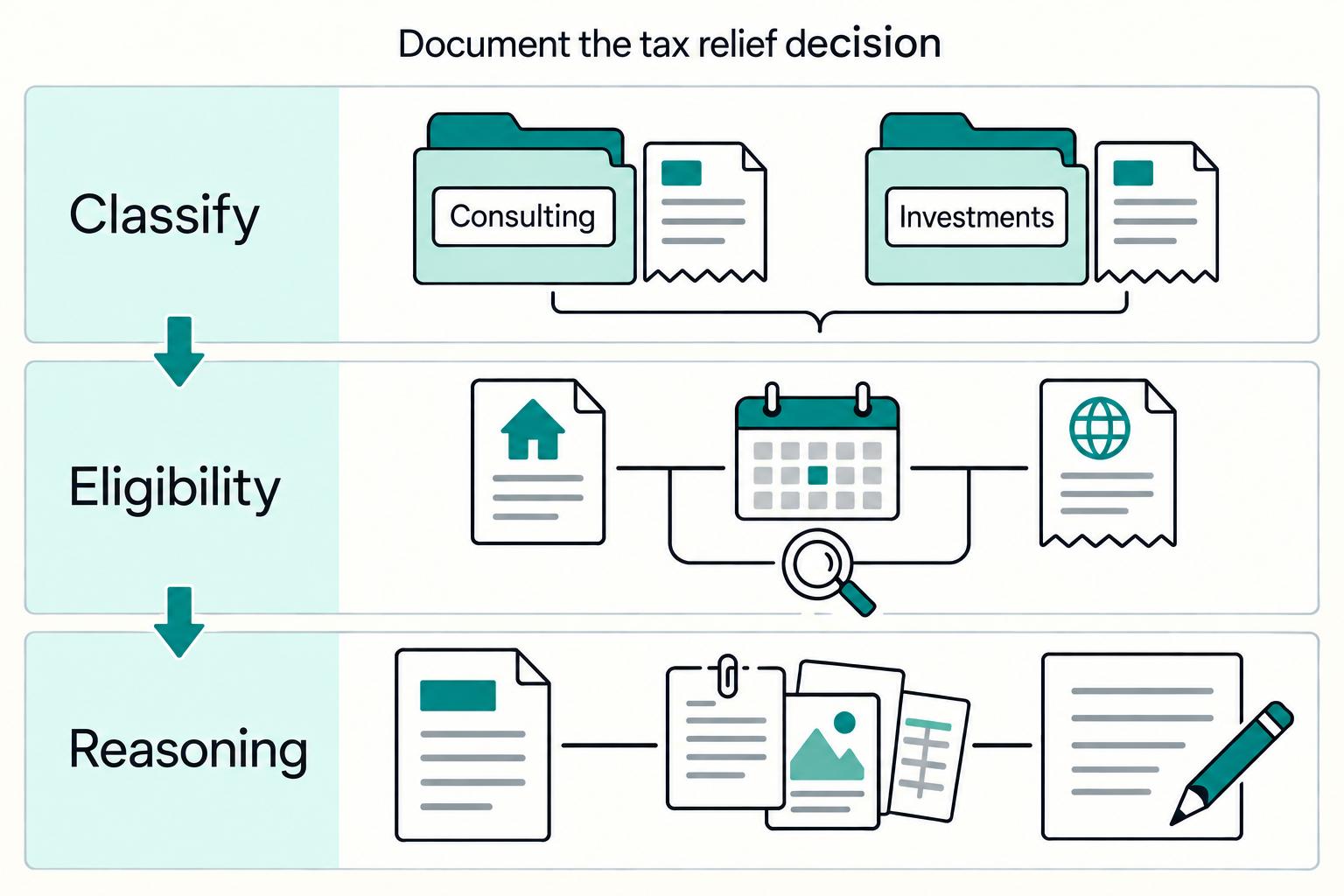
Step 3: Classify income, choose relief, then document your logic#
At this stage, think in filing order, not exemption language: classify income first, choose relief second, and document your logic third. In cross-border filing, relief can help reduce double-tax exposure, while U.S. citizens and resident aliens abroad still report worldwide income.
First, classify each income stream before you compute relief#
Start by separating consulting income from investment income, because category mistakes become filing mistakes. The IRS states you are taxed on worldwide income. Form 1116 requires a separate form for each income category, with only one box checked per form.
Tie each income line to supporting records before you calculate anything. For consulting income, that can include contracts, invoices, payment records, and matching Swiss tax records. For dividends or interest, you can use payer or broker statements plus withholding or tax-paid evidence. If one Swiss assessment covers multiple income types, make and document your allocation before running the credit.
Then run the FTC as a filing sequence#
If you paid Swiss tax and want U.S. relief on the same income, test the Foreign Tax Credit route first, with category-by-category support.
| Action | Do this now | What to verify |
|---|---|---|
| Collect foreign tax proof | Pull Swiss assessments, withholding statements, and payment confirmations for each income stream | Each amount claimed traces to a dated document |
| Separate categories | Group income before preparing Form 1116 | Each Form 1116 has only one category checked |
| Prepare return support | Complete one Form 1116 per applicable category and reconcile to the U.S. return | Totals match income records and foreign tax records |
| Track unused credit | Record any unused amount by year and category | Verify current carryback and carryforward rules before relying on them |
Keep one worksheet per category showing income type, the foreign tax tied to that type, and where it appears on the return. If that mapping is not clear, pause before filing.
Next, choose FTC or FEIE with a real eligibility check#
Use the foreign earned income exclusion only after an eligibility check. You must have foreign earned income, your tax home must be in a foreign country, and you still file a U.S. return reporting the income. If you use the physical presence test, you need 330 full days in foreign countries during a 12-month period. Those days do not need to be consecutive, but each full day is 24 consecutive hours from midnight to midnight. Missing 330 days fails the test regardless of reason, and days in a foreign country while in violation of U.S. law do not count.
| Approach | Usually fits when | Key tradeoff | Escalate when |
|---|---|---|---|
| FTC first | You have clear Swiss tax-paid records and mixed earned or investment income | More record-heavy, but can address income FEIE does not | Income categories are unclear or Swiss tax records do not align with U.S. reporting |
| FEIE first | You have qualifying foreign earned income, a foreign tax home, and support for eligibility; for 2026, max exclusion is $132,900 per person | Applies only to qualifying foreign earned income, not every cross-border item | Travel logs are incomplete, day count is close to 330, or eligibility support is uncertain |
| Mixed or changed approach | Facts changed during the year or you are coordinating more than one relief method | Complexity rises and documentation standards tighten | You have mixed income, uncertain disclosures, or are considering an election change |
Finally, document your filing-position logic before filing#
Finish with a short memo: what each income stream is, why you used FTC or FEIE, and how you handled double-tax coordination while still filing U.S. worldwide income. This becomes your control document for next year, especially when facts or filings change.
If you are using the physical presence test, keep a travel log with entry date, exit date, and location at midnight. For a practical record-keeping process across countries, use the digital nomad tax guide.
Conclusion: Work from a repeatable process and primary sources#
Your edge comes from a repeatable process, not a year-end scramble. Keep your records organized and support any double-tax-relief position as you go.
For treaty-dependent positions, use a support-first standard. Confirm your position against the current U.S.-Switzerland Convention text and its Technical Explanation before you file. Treat summaries or older materials as background until they are confirmed against those primary sources.
| Area | Reactive filing | System-based compliance |
|---|---|---|
| Income setup | You wait and try to fix documentation late. | You confirm residency facts, needed documentation, and records early. |
| Account reporting | You reconstruct core account facts at year end. | You maintain account ownership and balance records throughout the cycle. |
| Double-tax relief support | You choose an approach during return prep without complete support. | You track taxes paid, income categories, and treaty-dependent questions as they arise. |
Use this checklist to close the loop:
- Confirm residency facts and current treaty materials before filing.
- Capture filing checkpoints from the Convention and Technical Explanation, not summaries or memory.
- Check whether treaty access could be limited by anti-treaty-shopping rules.
- Monitor source quality each cycle. If a source is a synopsis or clearly outdated, pause and verify primary authority.
Escalate before filing when residency status is unclear, treaty-benefit limits may apply, or you cannot support a treaty-dependent position from current authoritative text. That is the point to stop and bring in a cross-border tax professional.
If your treaty claim, reporting history, or account ownership is complex, contact Gruv to map a compliance-first money flow with clearer documentation and payout controls.
Frequently Asked Questions
Can the us-switzerland tax treaty wipe out your U.S. tax on consulting income?
This guide does not support a blanket treaty-based zero-tax outcome. Treat that as uncertain, document your Step 3 income classification and relief logic before filing, and escalate before relying on article-level treaty language to change your normal U.S. result.
Should you just send whatever payer tax form a Swiss client asks for?
This guide does not provide definitive payer-form selection rules for your scenario. Confirm how the client classifies you and what their onboarding team is documenting before you send any form, and escalate if the requested form and your facts do not align cleanly.
Is FTC usually better than FEIE for a U.S. consultant in Switzerland?
No single answer fits everyone. FTC is a category-by-category filing process on Form 1116, and each Form 1116 should have only one income-category box checked. FEIE depends on eligibility checks, including having a foreign tax home and meeting the physical-presence timing test. Escalate if your income is mixed, your records do not map cleanly by category, or your travel log is close to the line. Tighten records using the digital nomad tax guide.
Do FBAR and Form 8938 go away if you already report the income on your tax return?
Do not assume income reporting alone resolves foreign-account reporting duties. FBAR and Form 8938 filing rules, thresholds, and deadlines require separate verification, so escalate and verify current instructions before filing if account ownership or control is not straightforward.
If you claim FEIE, do you still report that income on a U.S. return?
Yes. The IRS states you still file a return reporting the income even when you may qualify to exclude foreign earnings. Earned income is generally tied to the year the work is performed. Escalate if payment timing and work timing fall in different tax years.
What if you missed prior international filings or your records are incomplete?
Treat it as a potential risk issue, not routine cleanup. First assemble prior returns, tax assessments, account statements, payment records, and travel evidence so you can see what is missing and what is inconsistent. Escalate early if you cannot tell whether this is only a missing form or a broader classification problem.
Try a related tool
Researched and edited by the Gruv editorial team. Gruv builds cross-border billing, payouts, and finance-operations software for global businesses.
Sources
- acquisition.gov/sites/default/files/archives/loose_leaf/FAC_...trusted
- bis.gov/search/resultstrusted
- federalreserve.gov/supervisionreg/files/cbem.pdftrusted
- home.treasury.gov/system/files/131/Treaty-Switzerland-TE-10-2-...trusted
- irs.gov/pub/irs-trty/swiss.pdftrusted
- irs.gov/individuals/international-taxpayers/foreign-...trusted
- taxpayeradvocate.irs.gov/wp-content/uploads/2020/07/ARC18_Volume1_Mos...trusted
- texastech.edu/board-of-regents/may-2017/Agenda%20Book-May1...trusted
Educational content only. Not legal, tax, or financial advice.
Related Posts

Digital Nomad Taxes in 2026 With a Defensible Filing Plan
With digital nomad taxes, the first move is not optimization. It is figuring out where you may be taxable, where filings may be required, and what proof supports that position.

Tbilisi Digital Nomad Guide for 2026 Long Stays in Georgia
Start with sequence, not excitement. If your income depends on delivering work on schedule, secure your legal footing, assemble your documents, and keep month one reversible before you optimize comfort.
Should Freelancers Choose Germany’s Kleinunternehmerregelung?
Kleinunternehmerregelung is a VAT decision with operational consequences. For eligible low-turnover businesses, it can remove VAT collection on invoices and reduce recurring filing effort. That benefit is usually strongest when your setup, client mix, and invoice language stay consistent.