
Quick Answer
Confirm domestic residency on both sides before claiming treaty help. Then run a gate check for saving-clause limits and withholding mechanics (Form W-8BEN for non-personal-service income or Form 8233 for personal services) before drafting return language. Apply Article 4 as a documented comparison, pick one filing theory, and keep all forms consistent with that theory. Build a single evidence file for account inventories, maximum values, and closures so Form 8938 and FBAR support matches. Escalate early when facts remain conflicted.
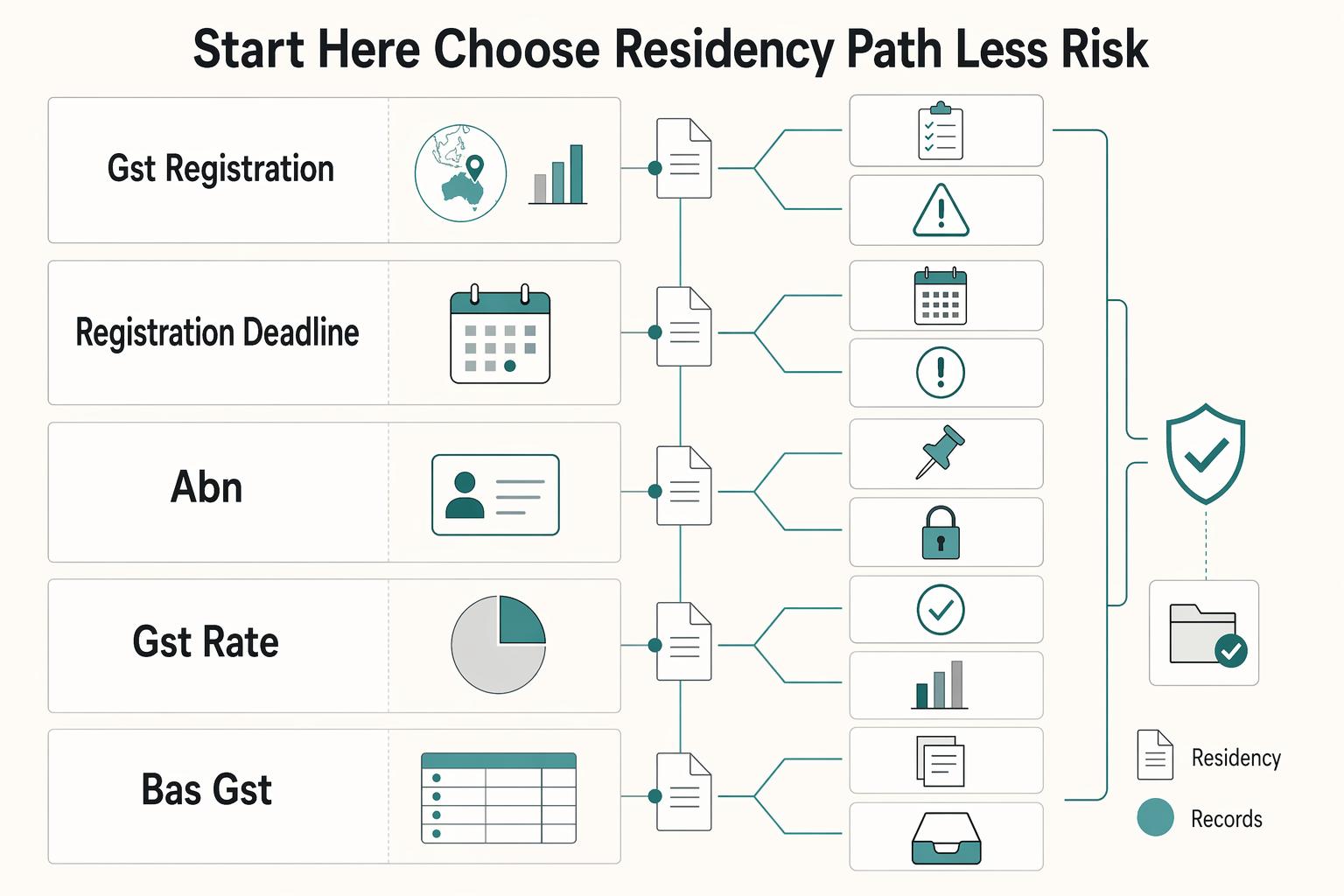
Start here and choose your residency path with less risk#
Start by building a position you can document and file consistently, not by trying to force a gray-area outcome. Keep the treaty question separate from admin compliance tasks, then line up the filing steps behind the same factual record.
| Australian admin point | Article detail | Timing/amount |
|---|---|---|
| GST registration threshold | Non-residents may need GST registration where sales are connected with Australia | A$75,000 turnover threshold; A$150,000 for non-profits |
| Registration deadline | If registration is required, penalties may apply for failing to register | 21 days |
| ABN | Confirm ABN status first; it is required before GST registration | Before GST registration |
| GST rate | For non-resident Australian GST under standard registration | 10% |
| BAS and GST cycle | Ongoing BAS lodgment and GST payments may be monthly or quarterly | Monthly or quarterly |
| ABN identity proof | Non-residents need extra identity proof for ABN processing | May increase processing time |
| Lodgment constraint | You generally cannot lodge electronically from outside Australia | May need an Australian registered tax agent |
- Keep the treaty question separate from admin compliance tasks.
Treat your treaty-residency analysis as one track, and Australian GST and U.S. certification processes as separate tracks. On the GST track, check early whether you may need to register. Non-residents may need GST registration depending on business activities, and the turnover threshold is A$75,000 (A$150,000 for non-profits) where sales are connected with Australia. If registration is required, the deadline is 21 days, and penalties may apply for failing to register.
- Lock down documents and dates before you pick filing positions.
Build one consistent file with dated records and a clear timeline, then map filings to that record. If GST may apply, confirm your ABN status first, since it is required before GST registration. Keep your GST submission records, and retain the ATO written notice showing your effective registration date. If U.S. treaty-rate certification is relevant, note Form 8802 as part of that same file.
- Use this order to reduce rework: treaty analysis, filing mechanics, then escalation.
Resolve your residency position first, then handle the filing steps that follow from those facts, and escalate only if the record still does not line up. For non-resident Australian GST under standard registration, ongoing BAS lodgment and GST payments may be monthly or quarterly, and GST is 10%. Plan for practical friction early too. Non-residents need extra identity proof for ABN processing, and you generally cannot lodge electronically from outside Australia, so you may need an Australian registered tax agent.
Selection criteria and who this list is built for#
This list is for solo software developers, freelancers, and consultants with U.S.-Australia cross-border income who want a defensible, low-drama compliance position. It is not for aggressive tax minimization.
- Business-of-one, cross-border facts you can document
Use this when your income, residence pattern, or filing story spans both countries and changed during the year. Good triggers are dated fact changes you can prove, like time in each country, home-base changes, payer mix, or entity changes, but these facts do not automatically determine treaty residency. The goal is practical defensibility under review, not clever positioning.
- Conservative treaty use grounded in primary materials
This framework assumes you verify positions against official treaty documents rather than commentary alone. Treaty residency can differ from Internal Revenue Code residency, and the saving clause is a real constraint. For U.S.-Australia, the IRS treaty materials include the 1982 treaty text and the 2001 protocol documents.
- Steps ranked by legal relevance, documentation load, and error cost
Each step is here only if it materially affects treaty-residency or saving-clause analysis. Then it is filtered by documentation burden and by the cost of getting it wrong later in filings or review. That keeps the list focused on decisions that change risk in practice.
- Use this framework when facts change, not only at filing time
Re-run the analysis when your facts shift instead of waiting for return deadlines. If your U.S. tax-year status may now be dual-status, treat that as a filing checkpoint. IRS guidance states a dual-status individual must file a dual-status return, and dual status refers to U.S. tax residency timing, not citizenship.
Item 1 confirm whether you are actually dual resident#
Confirm domestic residency first, then assess treaty relief. Before you take a treaty position, check whether your domestic residency status is supportable from your facts in each relevant jurisdiction. If one side does not hold, the dual-resident analysis can be narrower than it first appears. Treat residency as a fact-pattern call, not a label. Gather the facts first, because filing treatment depends on getting residency status right.
Why this step saves trouble later#
This step prevents premature treaty claims. IRS treaty-claim mechanics require the claimant to be a resident of a treaty country, and if ineligibility is known or suspected, the payor must not apply treaty-rate treatment. So if you submit Form W-8BEN for non-personal-service income or Form 8233 for personal-service income before your residency facts are clear, you create avoidable risk.
It also prevents internal contradictions. If domestic status is still unsettled, your withholding forms, return positions, and advisor write-up can drift out of sync, usually because of timing gaps rather than intent.
What to verify before you label yourself dual resident#
Build a clean factual base before you decide. At minimum, keep the records below.
| Record | What to collect | Why it matters |
|---|---|---|
| Travel log | Entries, exits, and where you were physically present | Supports a dated presence record |
| Home-use facts | Lease or ownership periods and when you actually used the dwelling | Documents housing facts by location |
| Work-location record | Where services were physically performed | Shows the location of performed services |
| Fact-change timeline | Moves, client shifts, and housing changes | Shows when relevant facts changed |
| California checkpoint (if relevant) | Part-year treatment and California-source service income tied to where work was physically performed | Consistency check against time and billing records |
If California is part of your fact pattern, keep that checkpoint in the same file. Part-year treatment may apply when you lived inside and outside California during the year, and California-source service income is tied to where work was physically performed. The workday allocation concept (CA Workdays / Total Workdays = % Ratio) is a useful consistency check against your time and billing records.
The common failure mode is assuming dual residence because life feels split. Crossing into possible residency in one jurisdiction while keeping a base elsewhere may matter, but it does not complete the analysis by itself.
The opposite error is rushing treaty paperwork first, then discovering your domestic status is still uncertain or, in a California fact pattern, part-year. The early fact gathering is tedious, but it is usually cheaper than unwinding a weak first position later. If your facts changed midyear, write a one-page dated memo now covering travel, dwellings, and work locations, then move to treaty steps only if that memo supports a dual-resident fact pattern. For a broader relocation read, see the Tbilisi digital nomad guide.
Item 2 decide whether treaty tie-breaker is even available to you#
Before you spend time on residence tie-breaker arguments, confirm that treaty benefits are actually available for your fact pattern. This is a gate check, not a cleanup step after drafting your filing position. Treat this as two separate questions:
- Can you run a residence tie-breaker analysis?
- Even if you can, are there treaty limits or status rules that still block reduced withholding or exemption in practice?
Run this availability check first#
| Issue | What to verify | Form/effect |
|---|---|---|
| Saving clause | Whether any saving-clause limits could apply and whether any exception is relevant | May limit treaty access |
| Limitation on benefits | Whether limitation-on-benefits rules could block treaty access | May block treaty benefits |
| Nonresident-spouse election | Whether foreign-resident treaty reduction or exemption claims should be treated as potentially blocked until reviewed | Pause before claiming reduction or exemption |
| Non-personal-service income | Which withholding form applies | Form W-8BEN or W-8BEN-E for entities |
| Personal-service income | Which withholding form applies | Form 8233 |
| TIN requirement | Whether reduced treaty withholding can be supported | Generally requires a U.S. or foreign TIN, with limited exceptions |
| Payor knowledge rule | Whether ineligibility is known or should be known | The withholding agent, or payor, must not apply treaty rates |
At minimum, review saving-clause limits, any limitation-on-benefits issue, and whether a nonresident-spouse election changes the analysis before you claim reduced withholding or exemption.
Before you draft filing language, test your position against withholding mechanics early:
- Non-personal-service income:
Form W-8BEN(orW-8BEN-Efor entities). - Personal-service income:
Form 8233. - Reduced treaty withholding generally requires a U.S. or foreign
TIN, with limited exceptions. - The withholding agent, or payor, must not apply treaty rates if ineligibility is known or should be known.
If this check is unclear, pause and resolve eligibility first. A common failure mode is building a strong tie-breaker narrative, then discovering your withholding paperwork and eligibility rules do not support it. You might also find A Deep Dive into the US-Canada 'Tie-Breaker' Rules for Tax Residency useful.
Item 3 apply the Article 4 tests in the right order#
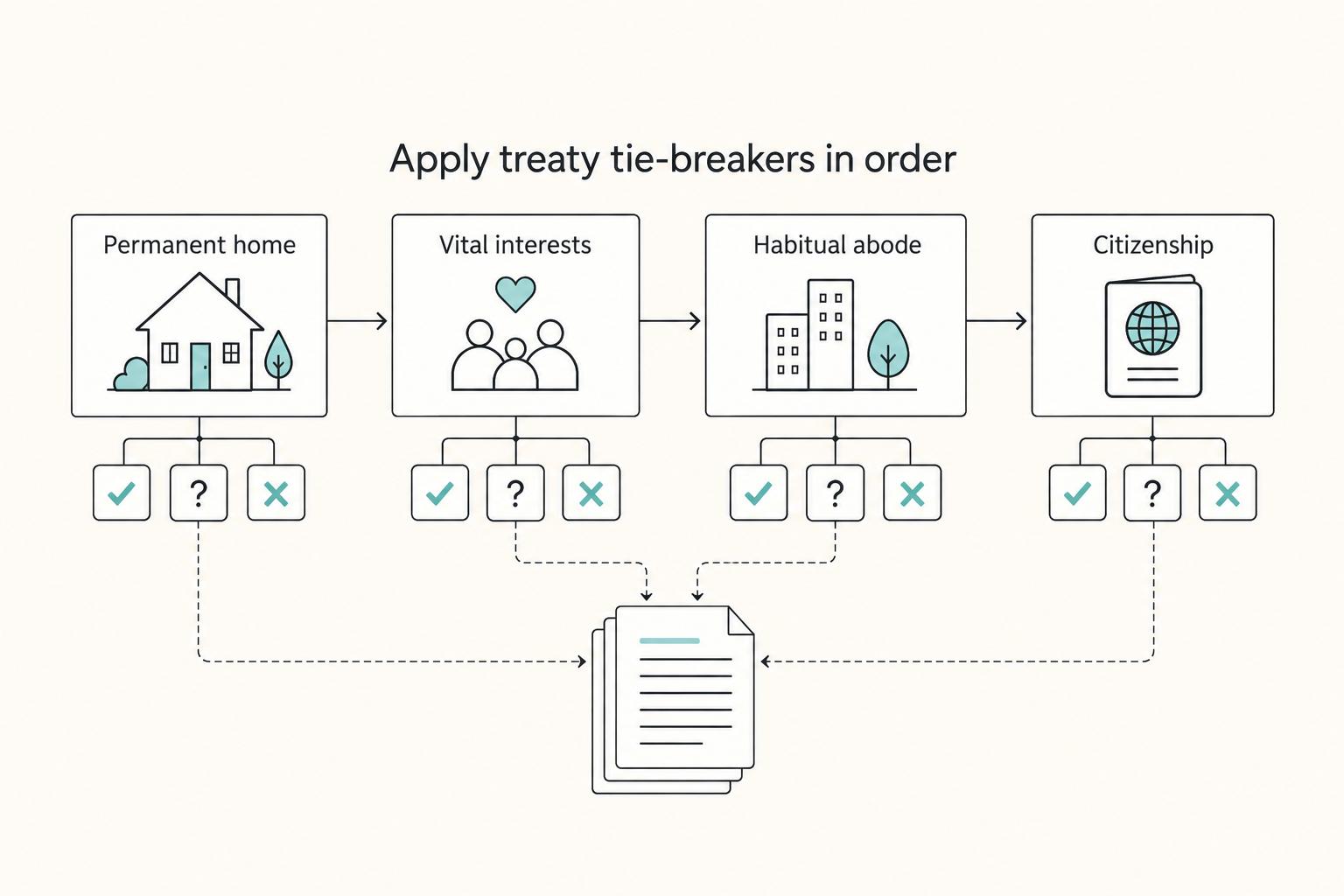
Once you clear treaty availability, use one consistent memo structure and stick to it. If you use the labels Permanent home, Habitual abode, and Closer personal and economic relations, treat them as internal working labels unless and until you verify the full operative text of Article 4.
That discipline reduces cherry-picking and makes your file easier to defend later. The confirmed treaty articles relevant here are Article 4 (Residence) and Article 24 (Mutual Agreement Procedure).
| Working label (internal) | Evidence needed | Common failure mode | What to do if inconclusive |
|---|---|---|---|
| Permanent home | Dated records relevant to housing facts | Treating one data point as decisive | Record both sides neutrally and continue |
| Habitual abode | Dated timeline records | Relying on rough estimates when records conflict | Reconcile dates and continue if still mixed |
| Closer personal and economic relations | Dated records on personal and economic ties | Overweighting one strong fact and ignoring the full pattern | Write both sides clearly and escalate if conflict remains |
Keep each label separate in your file#
Do not blend all facts into one story too early. Keep separate sections for housing facts, timeline pattern, and personal and economic ties so one strong fact does not distort another category.
In a U.S.-Australia dual-resident fact pattern, conflicting signals can appear across those labels. If the signals conflict, carry that conflict forward explicitly instead of rewriting earlier facts to fit a preferred conclusion.
Before you escalate, check the metadata. A third party should be able to trace each conclusion back to dated records. Keep the treaty metadata straight too. This convention was signed on August 6, 1982 and entered into force on October 31, 1983, with general effective date 1 December 1983.
If you still cannot reach a clean conclusion without recharacterizing facts, stop and escalate. At that point, Article 24 or specialist support is safer than forcing certainty. If you want a deeper dive, read our guide to a defensible 2026 filing plan.
Item 4 choose the filing position before you file anything#
Choose your filing theory before you draft the return package: either a domestic closer-connection position or a treaty-resident position. Do not mix them and try to reconcile later.
Pick one lane:
- Use a domestic closer-connection position when your nonresident result stands on the IRS closer-connection exception to the substantial presence test.
- Use a treaty-resident position when your result depends on treaty language.
If you are in the domestic closer-connection lane, make sure the domestic conditions are doing the work. You need to be present in the United States less than 183 days during the year, have a foreign tax home for the entire year, have a closer connection to that foreign country, and have taken no steps toward lawful permanent resident status, with no pending application.
If your result works only because of treaty residence reasoning, switch to the treaty lane. Draft the treaty claim against the same facts-and-circumstances record you already built. Check the IRS-hosted Australia treaty set so you are working from official documents, including the 1982 treaty text and 2001 protocol materials.
Consistency across documents is the practical control point here. IRS closer-connection review is facts-and-circumstances based and considers the country of residence shown on forms and documents, plus the types of forms filed, for example Form W-9, Form W-8BEN, and Form W-8ECI. If those documents tell different country stories, you create avoidable follow-up risk.
If you started with a closer-connection plan but your memo now depends on treaty reasoning, change lanes before filing and align the full package to one theory.
This pairs well with our guide on A Deep Dive into the 'Dividend' Article of the US-Germany Tax Treaty for LLC Owners.
Item 5 build an evidence pack before year-end, not after#
Build the evidence pack before filing season, not after. This is a control step, and it reduces contradictions across FBAR (FinCEN Form 114) and Form 8938.
In practice, it means faster prep, fewer revision loops, and a cleaner filing story, at the cost of steady recordkeeping and PII-safe storage.
Minimum pack#
Use one working pack for foreign-account and asset reporting details, so the same facts carry across your filings.
| Pack item | Why keep it | Pre-filing check |
|---|---|---|
| Master account and asset inventory | Supports consistent reporting across filings | Confirm the same inventory appears in your FBAR worksheet and Form 8938 draft |
| Maximum-value support | Form 8938 asks for maximum values for reportable foreign accounts/assets | Keep value support for each listed account or asset in one place |
| Account and asset lifecycle log (acquired, sold, closed) | Form 8938 includes lifecycle checkpoints for the tax year | Verify lifecycle events are recorded the same way across working files |
| Filing applicability notes | Helps confirm whether Form 8938 applies before you build full schedules | Check specified-person status, applicable thresholds, and whether an income tax return is required |
Where detail matters for Form 8938 and FBAR. Form 8938 is attached to your annual return and filed by that return's due date, including extensions. It asks for concrete account and asset details, including maximum values and whether foreign assets were acquired or sold during the year.
Also, filing Form 8938 does not replace FBAR when FBAR is otherwise required. If you use multiple banks or payment rails, keep one master account list so both filings reconcile to the same inventory.
Red flags that create rework. Before filing, check for these mismatches in one pass:
- account counts differ between your
FBARworksheet,Form 8938draft, and master list - acquisitions, sales, or closures are recorded differently across working documents
- maximum-value support is complete for one filing but missing for the other
Final gate: confirm whether Form 8938 applies to you before building full schedules. IRS materials describe it for specified persons with specified foreign financial assets above applicable thresholds. That includes an aggregate value over $50,000 for certain taxpayers. They also state that if you do not have to file an income tax return for the year, you do not need to file Form 8938.
Before you finalize FBAR and Form 8938 support files, keep your account inventory and value support in one place with the Tax Residency Tracker.
Item 6 handle double-tax relief without creating new exposure#
If you rely on treaty-based double-tax relief (including Article 22 (Relief from Double Taxation)), treat it as one part of the analysis, not the finish line. Keep two separate questions in your file: any potential U.S. income-tax relief, and U.S. self-employment tax. Paying Australian tax does not by itself resolve both layers.
For freelance or consulting income, run a separate Schedule SE check before you call relief complete. The IRS says Schedule SE (Form 1040) is used to figure tax due on net earnings from self-employment, and that self-employment tax is Social Security and Medicare taxes only.
Start with category thinking, not blanket thinking. Use category-by-category logic: which tax, on which income, and what still must be computed. If your residence position is already documented, do not stop there. Run the separate self-employment tax test as its own step.
The concrete check that catches missed liability#
| Checkpoint | What to verify | Why it matters |
|---|---|---|
| Net earnings threshold | Whether net earnings from self-employment are $400 or more | You usually must pay self-employment tax at that level |
| Tax base | Whether you applied the general 92.35% rule to net earnings | That is generally the amount subject to self-employment tax |
| Rate components | Whether your calc reflects 15.3% total, split into 12.4% Social Security and 2.9% Medicare | Confirms what part of U.S. liability you are testing |
| Wage interaction | For 2024, whether combined wages, tips, and net earnings approach $168,600 | Affects the Social Security side of the calculation |
The failure mode to avoid is treating treaty relief as if every U.S. tax layer moves together. It may not. Another preventable error is using draft instructions as filing authority. IRS draft Schedule SE instructions are marked DRAFT, NOT FOR FILING, so use current filing-year instructions and note the version date in your workpapers.
A practical recommendation for Australian-taxed freelance income. Keep two short memos: one for your treaty/residence analysis, and one for the self-employment tax check, including the $400 threshold, 92.35% base, and Schedule SE result. If Schedule SE shows tax, the IRS states you can deduct the employer-equivalent portion when calculating adjusted gross income. Also, receiving Social Security benefits does not by itself remove possible self-employment tax liability.
Use treaty-based relief where it applies, and always run the separate U.S. self-employment tax check so relief planning does not leave residual exposure unnoticed.
We covered this in detail in A Deep Dive into the US-Australia Tax Treaty's 'Independent Personal Services' Article.
Item 7 use a compliance system that keeps the story consistent#
Use one master record so your annual return, Form 8938 support, and any FBAR filing do not conflict. The goal is simple: if those records are reviewed side by side, they should tell the same timeline.
Keep one chronology#
Keep one reference trail for each payment flow and account movement, then reuse it across filings and support files. A practical four-point log for internal consistency is:
- payment date and amount, in source currency
- account that first received funds
- ledger or statement reference
- later transfer, closure, or account-status change during the year
This matters because Form 8938 is attached to your annual return and filed by that return's due date, including extensions. It is not a standalone filing, and filing Form 8938 does not remove a separate FinCEN Form 114 requirement when FBAR rules otherwise apply.
Use tools that reduce rekeying. If your stack has features that reduce manual re-entry, use them. Those features are optional, but they can make it easier to support Form 8938 fields like account counts, maximum values, and whether foreign deposit or custodial accounts were closed during the tax year.
Also record which threshold rule you applied for your case. IRS materials reference a $50,000 aggregate-value trigger for certain taxpayers, so do not rely on memory.
Watch the failure points. Inconsistent operations data can create contradictions, especially when first-receipt details or account classifications are logged differently across worksheets.
Add two explicit checks in your file:
- whether an account is excluded from Form 8938, for example an account maintained by a U.S. payer
- whether you were required to file an income tax return for the year, because if not, you do not file Form 8938 even if assets exceed a threshold
Need the full breakdown? Read A Deep Dive into the US-Ireland Tax Treaty for Tech Consultants.
Item 8 escalate early when facts are mixed or unresolved#
If your memo still tells two different residency stories, escalate before you file. When your first-pass analysis stays conflicted and your position depends on assumptions instead of documents, hand it off early.
Escalate when your file is internally inconsistent#
You do not need to escalate because the case feels stressful. You escalate when the facts do not resolve cleanly after your own review.
Common triggers include:
- two plausible fact patterns across countries that both look defensible
- travel and living patterns that are hard to explain in one clear timeline
- income, client, banking, or contract records that point in a different direction from your housing timeline
- a draft filing position with one or more sentences you cannot defend cleanly from your documents
Do not let unresolved facts run into active deadlines. This gets riskier when Australian compliance tasks are already moving. If your sales are connected with Australia and turnover is at or above A$75,000 (or A$150,000 for non-profit organisations), ATO guidance indicates GST registration is required, and once required you need to register within 21 days.
For non-residents, ATO also says extra proof of identity may increase processing time. If you are outside Australia, ATO guidance says you cannot lodge electronically under standard GST registration. You may need an Australian registered tax agent. If residency facts are still unsettled while ABN, GST, or BAS work is underway, escalate before filings diverge.
Hand off a usable pack, not a vague request. Give the specialist a compact file they can act on:
- your memo, with the exact conflicts and assumptions marked
- your chronology of payments, account movements, and status changes
- ABN and GST materials, plus any ATO written registration notice showing the effective date
- your draft filing language, with the specific line you are least confident about
The practical goal is to avoid cleanup later. IRS taxpayer-advocate reporting has described amended-return processing as glacial, and weak first filings can turn rework into a long cycle.
For a step-by-step walkthrough, see A Deep Dive into Australia's 'Temporary Resident' Tax Rules.
Item 9 avoid the mistakes that force amendments#
One amendment risk here is self-inflicted contradictions, not missing one more citation. If your facts are ready, your treaty references, memo language, and filing posture should tell the same story.
Mistake 1 citing treaty PDFs without tying them to your actual facts#
Do not cite "Tax Treaty Documents" as a shortcut. Use the IRS-listed Australia set directly. Work from the Income Tax Treaty PDF (1982), Technical Explanation PDF (1982), and Protocol PDF (2001), then map your position to Article 4 (Residence) and your actual timeline and records.
The red flag is simple: treaty language in your memo, but no clear match to the Technical Explanation and your evidence file. If you cannot trace each key sentence to treaty text and then to your documents, your file is not ready.
Mistake 2 mixing treaty-resident language with a different domestic story#
Keep one consistent residency story across the whole file. IRS guidance says treaty residency can differ from Internal Revenue Code residency. In a dual-status year, treaty provisions generally apply only to the nonresident part of the year, with an exception noted.
This is where contradictions show up: one part of the file uses treaty-resident language while another implies a different domestic posture. Keep the terms precise too. Dual status is about U.S. tax residency status, not citizenship.
Mistake 3 treating commentary like authority#
Use commentary as background, not as controlling authority. Anchor your position in the official U.S.-Australia treaty materials on IRS.gov, including the protocol listed there and the page currently reviewed as of 08-Aug-2025.
Before filing, pressure-test for one more failure mode: ignoring the saving clause. IRS treaty guidance notes most treaties include one, and treaty reliance can be limited when trying to avoid U.S. tax on U.S.-source income.
Related reading: A Deep Dive into the US-Japan Tax Treaty for Remote Workers.
Conclusion and your next move#
Your safest next move is to separate the legal residence question from the Australian compliance facts you can prove today. If your treaty-residence position is still unclear, do not treat GST registration, an ABN, or customer location as a shortcut to a treaty-residence answer.
1. Lock the Australian GST facts first#
Confirm whether you are making sales connected with Australia, including digital products like software sold to Australian consumers. If your turnover reaches A$75,000 or A$150,000 for non-profits, GST registration is required, and you must register within 21 days. Penalties may apply if you do not register when required.
If you are a sole trader, treat this as personal liability, not admin cleanup. Keep the records that support your turnover test and registration decision.
2. Plan for non-resident admin constraints early#
Before GST registration, you need an ABN. For non-residents, ABN processing can take longer because additional identity documentation may be required.
If standard non-resident GST registration applies, plan around the operational limits. You cannot lodge electronically from outside Australia, you may need an Australian registered tax agent, and BAS and GST obligations run monthly or quarterly. Build your bookkeeping cadence around that timeline before deadlines arrive.
3. Re-run the same checks each year#
Use this as an annual checklist: sales connected with Australia, digital or software supplies to Australian consumers, turnover against the threshold, and GST tracking at 10% (1/11th of the amount charged). Your invoices, ledger, ABN and GST status, and BAS timing should all align.
4. Escalate when the legal issue remains unresolved#
If the core issue is still treaty residence, and your file only contains GST and ABN-style admin facts, escalate before filing. Those facts matter for Australian GST compliance, but they do not resolve treaty residence on their own.
If your residence analysis is still mixed after this checklist, contact Gruv to confirm whether your workflow and records are set up for compliant cross-border operations.
Frequently Asked Questions
What does dual resident mean under the `U.S.-Australia Income Tax Treaty` in practical filing terms?
In practical terms, your facts may point to residence in both countries. The approved sources here confirm where to find the official treaty documents, but they do not provide a one-size-fits-all filing conclusion for dual-resident cases. Use the IRS-hosted Australia treaty set as your base, including the Income Tax Treaty PDF (1982) and Protocol PDF (2001), and keep your return materials consistent.
When do the `Residence tie-breaker rules` under `Article 4 (Residence)` actually apply?
The treaty text is available on the IRS Australia treaty documents page. The approved sources for this section do not establish a blanket rule for when Article 4 (Residence) controls in every fact pattern, so treat this as a facts-and-advice issue rather than a one-line rule.
Can a dual U.S.-Australian citizen rely on the tie-breaker, given the `Article 1(3) Saving Clause`?
Do not assume yes. The approved sources for this section do not support a legal conclusion on tie-breaker reliance when Article 1(3) Saving Clause is involved. If citizenship is part of your facts, treat it as a specialist-review issue before filing.
How do `Form 8833` and `Form 8840` differ when your facts involve both countries?
The approved sources for this section do not support specific eligibility, difference, or strategic-choice rules between Form 8833 and Form 8840. If your file mixes treaty-resident language with a different domestic theory, stop and get specialist advice before filing.
What records should I keep before claiming treaty residency and filing `FBAR` or `Form 8938`?
Keep records that support your foreign-asset reporting values and account status. Form 8938 asks whether foreign deposit or custodial accounts were closed during the tax year and asks for the maximum value of all deposit accounts, so keep documents that let you answer both clearly. If you are a specified person and your total value is above the applicable threshold, attach Form 8938 to your annual return and file by that return’s due date, including extensions. Filing Form 8938 does not remove any separate FinCEN Form 114 (FBAR) requirement.
When should I escalate to a specialist or `competent authority` instead of filing on my own?
Escalate when official materials still leave contradictions, especially around Article 4 (Residence), the saving clause, or citizenship. The approved sources here do not provide competent-authority process rules, timelines, or outcomes, so get specialist advice before filing if that path may be relevant.
Try a related tool
Researched and edited by the Gruv editorial team. Gruv builds cross-border billing, payouts, and finance-operations software for global businesses.
Sources
- ato.gov.au/businesses-and-organisations/international-t...trusted
- ato.gov.au/businesses-and-organisations/international-t...trusted
- ftb.ca.gov/file/personal/residency-status/part-year-and...trusted
- irs.gov/businesses/international-businesses/australi...trusted
- irs.gov/individuals/international-taxpayers/claiming...trusted
- taxpayeradvocate.irs.gov/wp-content/uploads/2024/12/ARC24_MSP.pdftrusted
Educational content only. Not legal, tax, or financial advice.
Related Posts

Digital Nomad Taxes in 2026 With a Defensible Filing Plan
With digital nomad taxes, the first move is not optimization. It is figuring out where you may be taxable, where filings may be required, and what proof supports that position.

Tbilisi Digital Nomad Guide for 2026 Long Stays in Georgia
Start with sequence, not excitement. If your income depends on delivering work on schedule, secure your legal footing, assemble your documents, and keep month one reversible before you optimize comfort.
US-Canada Tie-Breaker Rules for Defensible Tax Residency Calls
If you split life and work between the United States and Canada, start with a defensible residency position, not a guess. In practice, that usually means confirming your domestic-law status first, then using treaty analysis when both countries can plausibly treat you as resident. The job of a **us-canada tax treaty tie-breaker** review is to choose a supportable position, document it, and file consistently.