
Quick Answer
Start by locking your residency position before claiming any treaty benefit. For independent contractors using the us-netherlands tax treaty, the defensible lane is to confirm residence status, classify each income stream under the right article, and only then choose double-tax relief, including Foreign Tax Credit treatment and Form 1116 where applicable. Keep Social Security totalization questions in a separate track, and maintain written support with the exact treaty text, contracts, invoices, and proof of tax paid.
Filing lane before optimization: primary treaty documents and your evidence baseline#
If you are an independent contractor with U.S. and Dutch tax exposure, the safest goal is a filing position you can explain, document, and defend, not a clever exemption.
Use this guide to do three things:
- Decide your filing lane before return prep starts.
- Write down why that lane fits your facts.
- Escalate early when the facts get mixed or unclear.
The primary authorities for that decision are the U.S.-Netherlands Convention, signed December 18, 1992, the Protocol, signed October 13, 1993, the Technical Explanation, and the Exchange of Notes. Use the treaty text and that official guide as your working documents, not secondary summaries.
That matters because IRS materials state that the Convention replaced the prior Convention. If a blog post, forum thread, or older memo conflicts with the treaty documents or with the additional treaty-document context IRS points to at Treasury, treat the primary documents as controlling. Only depart from them if a qualified adviser supports a different position.
This article takes a conservative approach. It covers high-level treaty mechanics, residency and compliance decision points, and documentation habits, but it does not give personalized outcomes or replace cross-border tax advice.
A practical default is to keep a small evidence file while the year is still fresh. Save key work and payment records, plus a short note on which treaty article you are relying on and which primary text you checked. If your facts change mid-year, you appear resident in both countries, or your position depends on a close reading of that guide, escalate before filing season.
Treaty Basics You Actually Need#
When sources conflict, use the primary treaty documents and treat blog summaries, including this one, as secondary. Use terms precisely:
| Term | Meaning |
|---|---|
| U.S.-Netherlands Income Tax Treaty | The bilateral income tax agreement |
| Tax Convention with the Netherlands | The formal title on the treaty text |
| Double Taxation Avoidance Agreement (DTAA) | The double-tax relief concept the Convention serves, not a separate U.S. document in this context |
For authority, rely on IRS treaty materials and the U.S. Department of the Treasury treaty documents page the IRS references. The IRS Netherlands Tax Treaty Documents page hosts the full PDFs, including the core interpretive documents.
Read them in this order:
- Convention text
- Technical Explanation (official guide to the Convention and Protocol, including policy intent)
- Protocol (amendments)
- Exchange of Notes (accompanying interpretive context)
Keep these dates straight: the Convention was signed December 18, 1992; the Protocol was signed October 13, 1993; and the general effective date under Article 37 is 1 January 1994.
Use one simple checkpoint throughout: tie your position to the exact article you are using. For example, Article 15 is Independent Personal Services in the official guide. If income is not covered by treaty terms, normal U.S. return rules apply, and some U.S. states do not honor treaty provisions.
For related context, see A Deep Dive into the US-Japan Tax Treaty for Remote Workers.
Decide Your Filing Lane Before You Optimize Anything#
The order matters. Start with residency, then treaty analysis, then the double-tax relief method. If you optimize before that, the return can stop making sense as a whole.
- Residency first: confirm whether only one country treats you as resident, or both might. Start with domestic-law residency in each country, then move to treaty analysis under Article 4 (Resident) if needed.
- Treaty analysis second: if both countries may claim residency, do not infer a tie-breaker from summaries. Check the treaty text before taking a treaty residency position.
- Relief method third: once residency is clear, choose the double-tax relief lane. The treaty includes Article 25 (Methods of Elimination of Double Taxation), and IRS foreign tax credit mechanics, including Form 1116, become the practical filing checkpoint when the same income is taxed in both places.
If facts are mixed, changed mid-year, or are still being reconstructed, file conservatively first and leave aggressive treaty claims for later review.
| Fact pattern | PE (Article 5) | Saving Clause (Article 24, paragraph 1) | Foreign Tax Credit (Article 25 / Form 1116) | Likely risk | First action |
|---|---|---|---|---|---|
| One-country residency is clear; the other country has source-based taxing rights | Usually not the main issue | Usually secondary at this stage | Often central for double-tax relief | Assuming exemption when relief is actually via credit | Map the same income across both returns and test Form 1116 need |
| Both countries may treat you as resident in the same year | May matter later based on work pattern | Can limit expected treaty outcomes | Relief method may be chosen too early | Contradictory residency positions | Pause optimization and document treaty position before claiming benefits |
| Work pattern in the Netherlands looks substantial | Core check | Secondary check | May still apply, but after classification is clear | Understating Netherlands taxing rights | Review contracts, location and work records, and authority patterns before filing position |
| Counting on treaty protection without checking how Article 24 could affect your position | May or may not drive the result | Core check | Can be misapplied if treaty limits are ignored | Overreading treaty relief | Confirm Article 24, paragraph 1 before relying on treaty outcome |
| Planning FTC while also excluding foreign earned income or housing costs | Not the main issue | Not the main issue | Core mechanics issue | Disallowed credit on excluded income; possible election consequences | Reconcile exclusions before preparing Form 1116 |
Relief method comes after residency, not before. The IRS says you may be able to use a credit or an itemized deduction when the same income is taxed by the U.S. and a foreign country, and Form 1116 is the filing mechanism for individuals, estates, and trusts claiming the credit. Form 1116 must be separated by income category, and you cannot claim FTC on income you exclude.
Before return prep, run one final check against the treaty document stack. Make sure your logic matches the article you are relying on: Article 4, Article 5, Article 24 paragraph 1, and Article 25 as applicable. If those checks still point in different directions, stop and use a conservative filing position until someone reviews it.
Classify Your Income Correctly Before Applying Treaty Benefits#
Classification comes before relief. In this treaty, service income, portfolio income, and narrow exemption contexts are not interchangeable.
Use the IRS guide as your first checkpoint. It is the official guide to the Convention and Protocol. Its TABLE OF ARTICLES is a practical place to map income before you make withholding assumptions, file exemption forms, or set a return position.
Start with the service bucket, not the tax outcome#
For contractor work, do not treat all earned income as one pool. In the guide, these categories are listed separately, and you should map each service payment before deciding your treaty position:
- Article 7: Business Profits
- Article 15: Independent Personal Services
- Article 16: Dependent Personal Services
A practical baseline is to map each income stream to one primary article family at a time and keep a clear document trail. If facts are mixed, use the more conservative classification until your records support a different one.
Keep investment income separate from service revenue#
Do not blend service revenue with other income types. The guide separately lists Dividends under Article 10, Interest under Article 12, and Royalties under Article 13.
A specific red flag is Article 22(1) in the provided payroll statement. It is explicitly for students or trainees. It refers to personal-services exemption language up to $2,000 per taxable year and for up to five taxable years from arrival. Do not treat that as a general contractor shortcut.
| Income type | Article family | Common misclassification risk | Evidence to retain |
|---|---|---|---|
| Client project fees for your own consulting work | Article 7 Business Profits or Article 15 Independent Personal Services (depending on the facts) | Treating all self-billed revenue as automatically exempt or using the wrong service article | Signed contract, invoices, payment receipts, scope of work, classification memo |
| Salary or payroll compensation | Article 16 Dependent Personal Services | Recasting employee-type pay as freelance income | Employment contract, payslips, withholding statements, payroll records |
| Dividends | Article 10 | Folding investment income into business revenue | Broker statements, dividend notices, account statements |
| Interest | Article 12 | Treating bank or investment interest like operating income | Bank statements, annual interest statements, account records |
| Royalties | Article 13 | Calling license or IP payments "services" without support | License agreement, royalty statements, payment advices |
| Student or trainee personal-services claim | Article 22(1) special context | Applying a narrow student or trainee exemption to ordinary contractor income | Visa or status support, school or training records, treaty statement, arrival-date support |
If classification is arguable, do not begin with the most favorable interpretation. Begin with the position that is easiest to defend on review, then relax only when your documentation clearly supports the article you want to use. For a step-by-step walkthrough, see A deep dive into the 'limitation on benefits' clause of the US-Netherlands tax treaty.
What the Saving Clause Changes for U.S. Citizens#
If you are a U.S. citizen, treat favorable treaty language as a starting point, not an automatic result. The safest approach is procedural: verify your reading against the IRS Netherlands Technical Explanation, then build any relief claim from documents.
What usually still helps#
A common documented path for double-tax relief is the Foreign Tax Credit. The IRS says the credit is meant to reduce double taxation, including when the same income is taxed abroad and by the United States.
Use this filing sequence:
- Decide whether you are taking a credit or deduction for foreign taxes. A credit reduces U.S. tax liability; a deduction reduces taxable income.
- File Form 1116 to claim the credit.
- Use a separate Form 1116 for each income category.
Where people get tripped up#
Common issues come from combining rules that do not work together:
| Issue | Rule |
|---|---|
| Exclude foreign earned income or housing costs | You cannot claim a credit for taxes on that excluded income |
| Some foreign taxes | Still non-creditable even when general qualifying tests are met |
| Mixing income categories | Can conflict with the requirement to use a separate Form 1116 for each category |
Keep records that support each income category and the foreign taxes paid. If you later identify additional creditable foreign taxes, the IRS says individuals generally have ten (10) years to file a refund claim.
Same facts, careful filing posture#
For U.S. citizens, the practical takeaway is consistent: plan around evidence and Form 1116 mechanics first, then apply treaty relief where it is supportable.
Permanent Establishment and LOB Red Flags for Contractors#
PE and LOB are not assumptions to make on a contractor return. They are treaty-text checks to run before you claim benefits. For solo consultants, that usually means escalating once your facts start to look like an ongoing local business presence or once you claim through an entity rather than directly.
What to treat as a PE warning sign#
Treat this as a treaty-text exercise, not a template exercise. If a neutral reviewer could describe your arrangement as a real local business footprint, pause and review the applicable treaty language before you file. Permanent establishment provisions are common in treaties, but each treaty is separately negotiated, so generic PE summaries are not enough for a filing position.
Treaty-specific PE tests differ, so do not assume any single fact pattern is automatically decisive without checking the treaty text.
Why LOB can block an otherwise plausible claim#
LOB is an additional gate that can apply after basic residence is established. Its job is anti-treaty-shopping: it can limit benefits where an entity is not controlled by residents of the contracting state.
For contractors, this matters most when you invoice through a company, holding structure, or hybrid setup. A paper residence story alone does not settle treaty access, and entity-based claims deserve extra review before you rely on them.
If this starts to look local, escalate before filing#
Once contract scope, team setup, or local footprint starts resembling a fixed presence, specialist review is usually worth it before you claim no PE or claim treaty benefits through an entity.
Document and review these red flags before filing:
- Treaty-language gap: you are relying on a generic PE summary instead of the specific treaty text.
- Residence-only assumption: you are treating basic residence as enough without a separate LOB check.
- Structure risk: treaty benefits are claimed through an entity before LOB eligibility is analyzed.
Document first, argue second. Keep contracts, work-location logs, travel records, invoicing trails, and ownership/control records so your filing position can be tested against the treaty text.
Keep Tax Treaty and Social Security Rules Separate#
Use two lanes: the income tax treaty for income tax questions, and the Social Security agreement for Social Security and Medicare coverage questions. Mixing them can create avoidable filing errors.
Use the right document for the right problem#
The U.S.-Netherlands Technical Explanation is tied to the convention with respect to taxes on income. Use it for income tax treaty analysis.
Social Security coordination is separate. The U.S.-Netherlands totalization agreement must be considered when determining Social Security and Medicare tax exposure. That analysis does not replace income tax treaty analysis.
A quick reality check is timing. SSA lists the Social Security agreement entry into force as November 1, 1990, while the income tax convention guide shows a general effective date under Article 37 of 1 January 1994. Different instrument, different purpose.
| Question you are answering | Use this authority | What it decides | Proof to keep |
|---|---|---|---|
| How does the income tax treaty apply to my income? | Income tax convention + Technical Explanation | Income tax treatment | Treaty analysis notes and return support |
| Which country's Social Security and Medicare rules apply? | U.S.-Netherlands totalization agreement | Social Security coverage assignment | Certificate of Coverage (when applicable) |
| Do benefits references settle an income tax treaty claim? | Neither one by itself | Not by themselves | Separate benefits notes and tax analysis |
Know the checkpoint that actually matters#
For Social Security exemptions, the key document is the Certificate of Coverage. Totalization rules assign coverage to one country and exempt Social Security taxes in the other, and the certificate is the proof point.
This is not just technical. Without proper totalization treatment, workers can end up paying Social Security taxes to both countries on the same earnings. If a U.S. Social Security and Medicare exemption is being claimed, secure the Certificate of Coverage from the home-country social security agency and provide it to the U.S. employer.
Ignore the false shortcuts#
References to the U.S. Medicare program do not answer income tax treaty questions. They simply put you in the Social Security coordination lane.
The same goes for Supplemental Security Income (SSI) references. Benefits language does not establish an income tax treaty filing position, so keep the analyses separate before filing.
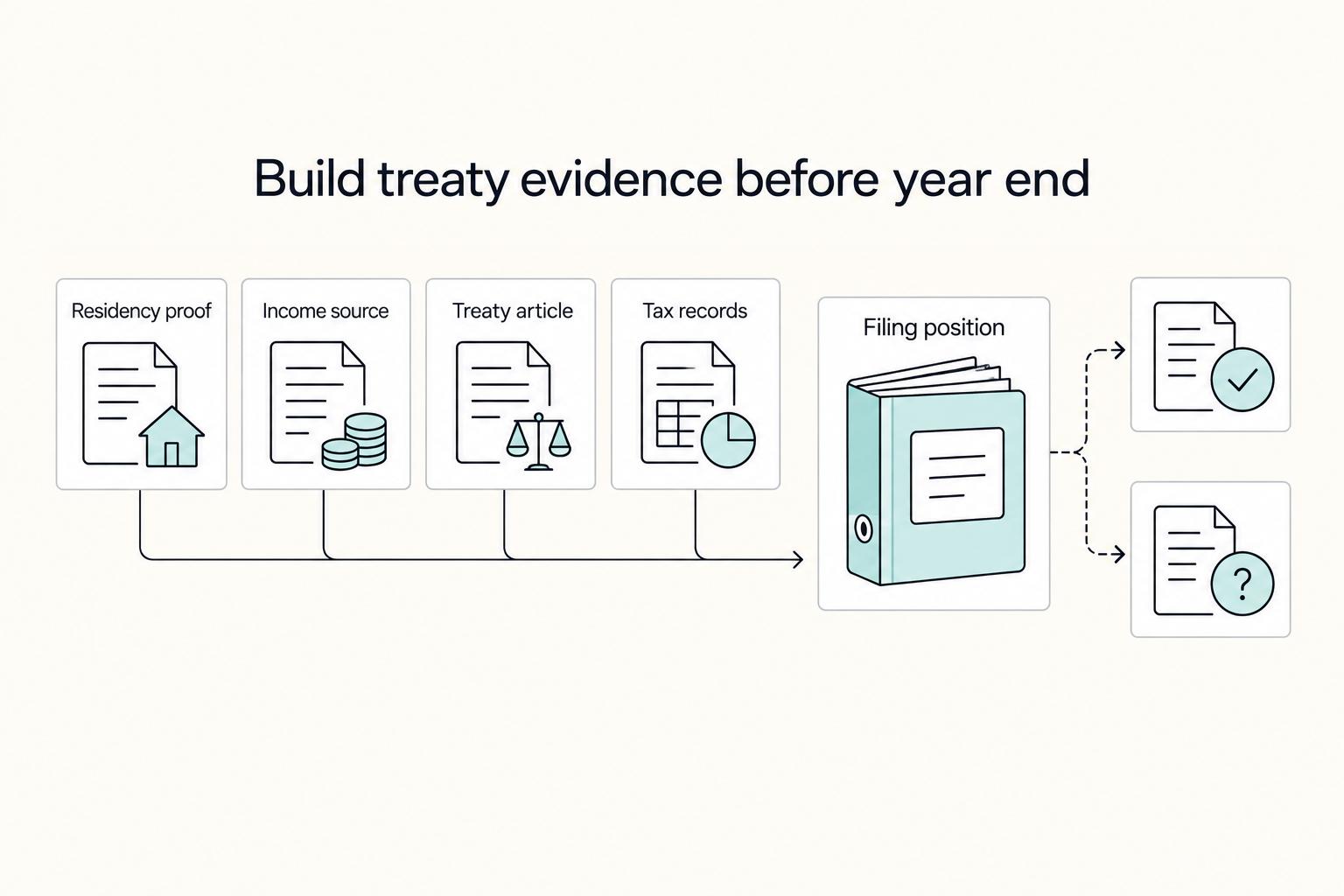
Build Your Evidence Pack Before Year End#
The best time to build your evidence pack is before year end, while the facts are still easy to prove. Put it together in a set order so your filing position rests on records instead of memory.
Build it in sequence#
- Form 8938 filing check
Confirm whether you are a specified person and whether the total value of specified foreign financial assets is above the applicable reporting threshold.
- Annual-return filing checkpoint
If Form 8938 is required, attach it to your annual return and file by that return's due date, including extensions.
- Form 8938 support file
Keep records that support what Form 8938 asks you to report, including asset values, the number of foreign deposit accounts, and whether any foreign assets were acquired or sold during the tax year.
- FBAR tracking file
Track FBAR (FinCEN Form 114) separately. Filing Form 8938 does not replace FBAR when FBAR is otherwise required.
- Treaty text packet and summary
Keep the convention pages you relied on, plus any protocol language you relied on, and maintain a one-page filing-position summary that maps your position to those documents.
Keep treaty notes review-ready#
Write treaty notes so a third party can follow them. The convention includes Article 30 (Exchange of Information), so your facts, dates, legal names, and amounts should match across your records.
If you rely on treaty text, keep the convention pages you used and any protocol language you relied on, not just a conclusion label.
Track compliance attachments separately#
Keep a separate compliance folder for foreign-asset reporting and account reporting. For Form 8938, use it to report specified foreign financial assets when the applicable threshold is exceeded, and attach it to your annual return by that return's due date, including extensions. If you are not required to file an income tax return for the year, Form 8938 is not required.
IRS materials cite a $50,000 baseline for certain taxpayers. For specified domestic entities, they cite $50,000 on the last day of the year or $75,000 at any time during the year.
For FBAR (FinCEN Form 114), track it separately. Filing Form 8938 does not replace FBAR when FBAR is otherwise required.
For FATCA support, keep Form 8938 materials and account statements together.
| Document | Why it matters | Who asks for it | Retention habit |
|---|---|---|---|
| Form 8938 filing-threshold worksheet | Shows how you evaluated whether a filing trigger was met | You and your preparer | Update at year end and keep with return workpapers |
| Annual return + Form 8938 filing checklist | Confirms attachment and due-date handling (including extensions) | You and your preparer | Keep with filing calendar and final return package |
| Form 8938 support file | Substantiates asset values, account counts, and account changes | IRS (if reviewed) | Keep year-end statements and account event records |
| FBAR tracking file | Keeps account reporting separate from return attachments | You and your preparer | Maintain an annual account list and snapshot |
| Treaty pages, protocol pages, and filing-position summary | Shows the treaty text you relied on and how your position maps to it | You and your preparer | Store summary with the exact treaty and protocol pages used |
If you do one thing before year end, finish the one-page filing-position summary and make every document map back to it.
Filing Season Execution Checklist for Independent Contractors#
In filing season, the goal is simple: produce a return position a reviewer can retrace quickly from documents, not memory. For independent contractors with cross-border income, that means your filing logic, Foreign Tax Credit support, and country-level records all need to line up.
Work the return in phases#
| Phase | What to do | What to verify before moving on |
|---|---|---|
| Pre-filing validation | Recheck residency facts, work-location log, contract archive, tax-paid proofs, and your one-page filing-position summary | Legal names, dates, income amounts, and country labels match across your files |
| Return preparation | Prepare the return position, including Form 1116 if you are claiming a Foreign Tax Credit | Your filing-position memo still matches the income classification, and excluded income is not also used for a credit |
| Reconciliation | Compare the U.S. position to the foreign-country position, tax paid, and supporting statements | Same income stream, same country treatment, U.S.-dollar reporting where required, and no missing tax-paid support |
| Post-filing archive | Save the filed return set, workpapers, final memos, and exact supporting documents used | A third party can reproduce your filing logic without undocumented assumptions |
Pre-filing validation#
Start by confirming your facts did not drift late in the year. If your residency timeline, work-location log, invoicing history, or contract facts changed, recheck whether your filing-position memo still fits.
Before drafting the return, pressure-test FTC eligibility. IRS guidance says foreign taxes must meet four tests to qualify for the credit, and some foreign taxes are still noncreditable even when those tests are met.
Return preparation#
If you claim a Foreign Tax Credit, treat Form 1116 as a core control workpaper. Use a separate Form 1116 for each income category, check only one category box per form, and enter separate country or territory details as required on the form.
Keep amounts in U.S. dollars where Form 1116 requires it. Also check the overlap rules: if you excluded foreign earned income or foreign housing costs, you cannot claim a credit for taxes on that excluded income. If you choose a credit instead of an itemized deduction for the same foreign tax, keep that decision note in the file.
Reconciliation before filing#
Reconcile the U.S. and foreign-country positions line by line before filing. A practical failure mode is mismatched positions or missing evidence, which can lead to rework.
Use this checkpoint to decide whether specialist review is needed. If both countries appear to tax the same income and your filed positions do not reconcile cleanly, flag the file for advice before filing.
Post-filing archive#
After filing, save an audit-ready archive: filed return, Form 1116 workpapers, tax-paid proofs, final filing-position memo, and notes on later changes. The 2025 Instructions for Form 1116 include Foreign Tax Redeterminations, so keep a separate note when foreign tax amounts are still provisional.
Keep enough traceability for future amendments. IRS guidance generally gives individual taxpayers ten years to file a refund claim for additional creditable foreign taxes. Related reading: A Deep Dive into the US-Switzerland Tax Treaty for Financial Consultants.
When to Escalate to a Specialist Instead of Self-Filing#
Once your case moves beyond a clean, single interpretation, escalate instead of self-filing. In this context, that usually means conflicting interpretations, inconsistent documentation, or contradictions between adviser summaries and primary agreement or SSA materials.
If two reasonable interpretations lead to different filing positions, treat that as filing risk, not as a research project you should finish on your own. Escalating early can be cheaper than defending a position you cannot clearly support from your documents.
Social Security conflicts are a separate escalation trigger#
Income tax analysis and Social Security coverage should be handled as separate tracks. Totalization agreements are designed to assign coverage to one country, prevent dual Social Security taxation, and for the United States coordinate Social Security and Medicare taxes.
If your income tax treatment and Social Security coverage position do not line up, escalate. A Certificate of Coverage is often a key control point. It can be requested online and tracked by control number, and SSA asks you to allow 90 business days before follow-up, plus up to two weeks for mailing if issued. Treat the request process as high-stakes administrative work, because incomplete required fields can block submission and missing information can delay or prevent an accurate SSA decision.
Dispute posture means you are past self-filing#
If you are preparing a formal dispute position or cannot reconcile conflicting cross-border guidance, bring in a credentialed return preparer or cross-border specialist.
For a clean handoff, send one packet:
| Packet item | Include |
|---|---|
| Fact timeline | By country and date |
| Coverage and filing assumptions | Your coverage and filing assumptions |
| Document index | Returns, contracts, work-location logs, tax-paid records, and any Certificate of Coverage request details |
| Unresolved questions | Unresolved questions and contradictory statements you need reconciled |
Conclusion#
The safest outcome comes from correct classification, conservative checkpoints, and complete evidence, not from a clever reading of one treaty sentence. Under this treaty, favor the position you can explain from primary materials and defend with documents.
Before return prep starts, complete your filing-lane decision and evidence-pack checklist. Capture, in writing, which country treated you as resident, where each income stream was taxed, which treaty article you are using for each stream, and what support backs that choice.
At a practical minimum, your file should include:
- a dated fact timeline
- an article note for each income stream, for example, Article 15 Independent Personal Services when applicable
- the exact IRS Technical Explanation passage you relied on
- relevant companion documents the article-by-article discussion points to, including exchange notes, the Memorandum of Understanding, or Agreed Minutes
- matching proof such as contracts, invoices, payment records, and proof of tax paid where relevant
Use one final checkpoint: test your reading against the IRS guide, not only the Convention text. The IRS presents the Technical Explanation as an official guide to the Convention and Protocol, and it explains that the Convention and Protocol were accompanied by companion interpretive documents discussed article by article.
Keep one guardrail at the end: risk management has limits, especially with mixed or fast-changing facts. If your case is mixed, changing, or high-stakes, get specialist review before you file.
Frequently Asked Questions
Does the U.S.-Netherlands tax treaty stop U.S. citizens from paying U.S. tax?
No. You should not assume the treaty eliminates U.S. tax just because the Netherlands also taxes the same income. In many cases, relief is handled through Foreign Tax Credit mechanics instead of a broad exemption assumption.
What is the first step if I might be tax resident in both countries?
Start by building a dated fact file: where you lived, where you worked, when you moved, and which country treated you as resident. Then read the treaty text with the Netherlands Technical Explanation, which the IRS describes as an official guide to the Convention and Protocol. If your facts are mixed or changed during the year, treat that as a signal to get specialist review before filing.
Is social security handled by the tax treaty or by a separate agreement?
Do not assume income tax treaty relief also covers Social Security or Medicare treatment. Treat coverage as a separate analysis from income tax treaty relief, and verify it through official agency process for your case.
How do freelancers usually get double-tax relief in practice?
A common starting point is Foreign Tax Credit relief when the same income is taxed by both countries. The IRS says you may be able to claim either a credit or an itemized deduction for foreign taxes, and in most cases the credit is more advantageous. For individuals, that generally means Form 1116, with a separate Form 1116 for each income category and only one category box checked per form.
When should I rely on Foreign Tax Credit instead of treaty exemption assumptions?
Use FTC analysis early when both countries are taxing the same income and your exemption theory is not clean and well documented. This matters especially when adviser summaries are broader than what the treaty text clearly supports. Also, if you exclude foreign earned income or housing costs, you cannot claim FTC on that excluded income, and mishandling that can put one or both elections at risk.
What documents should I keep to defend my treaty position?
Keep records that let someone reproduce your position: a residency timeline, filed returns, foreign tax assessments or payment proof, Form 1116 workpapers, and your treaty-article rationale. Save the exact Netherlands Technical Explanation passage you relied on, not just secondary summaries. If you claim FTC, keep support showing the tax is the kind that can qualify and that your claim meets the required tests.
When does MAP become relevant for a contractor?
MAP trigger rules, timelines, and contractor-specific eligibility details are not established at this level of generality. If you are deciding whether MAP is needed, treat that as specialist territory and get cross-border advice before positions harden.
Try a related tool
Researched and edited by the Gruv editorial team. Gruv builds cross-border billing, payouts, and finance-operations software for global businesses.
Sources
Educational content only. Not legal, tax, or financial advice.
Related Posts

Digital Nomad Taxes in 2026 With a Defensible Filing Plan
With digital nomad taxes, the first move is not optimization. It is figuring out where you may be taxable, where filings may be required, and what proof supports that position.

Tbilisi Digital Nomad Guide for 2026 Long Stays in Georgia
Start with sequence, not excitement. If your income depends on delivering work on schedule, secure your legal footing, assemble your documents, and keep month one reversible before you optimize comfort.
A Deep Dive into the Netherlands' 30% Ruling for Skilled Migrants
Treat this as a managed compliance asset, not a payroll perk. Official pages now refer to the expat scheme, formerly the 30% ruling. The key operational change is that from 1 January 2025 you can no longer elect partial foreign tax liability in your return. Transition relief still runs through 2026 for some people who were already using the scheme before 2024. That makes your cohort, filing timing, and asset profile worth checking early.