
Quick Answer
Fix the legal billing party first, then classify the payment, then send the matching W-8 to the U.S. payer. If you invoice through an Irish limited company, use Form W-8BEN-E; personal billing uses Form W-8BEN. Keep the contract name, invoice party, and vendor file aligned, and check contract authority before invoice one so the payer does not pause or apply withholding while your file is being corrected.
How Should You Structure an Irish Business for 0% US Withholding Tax?#
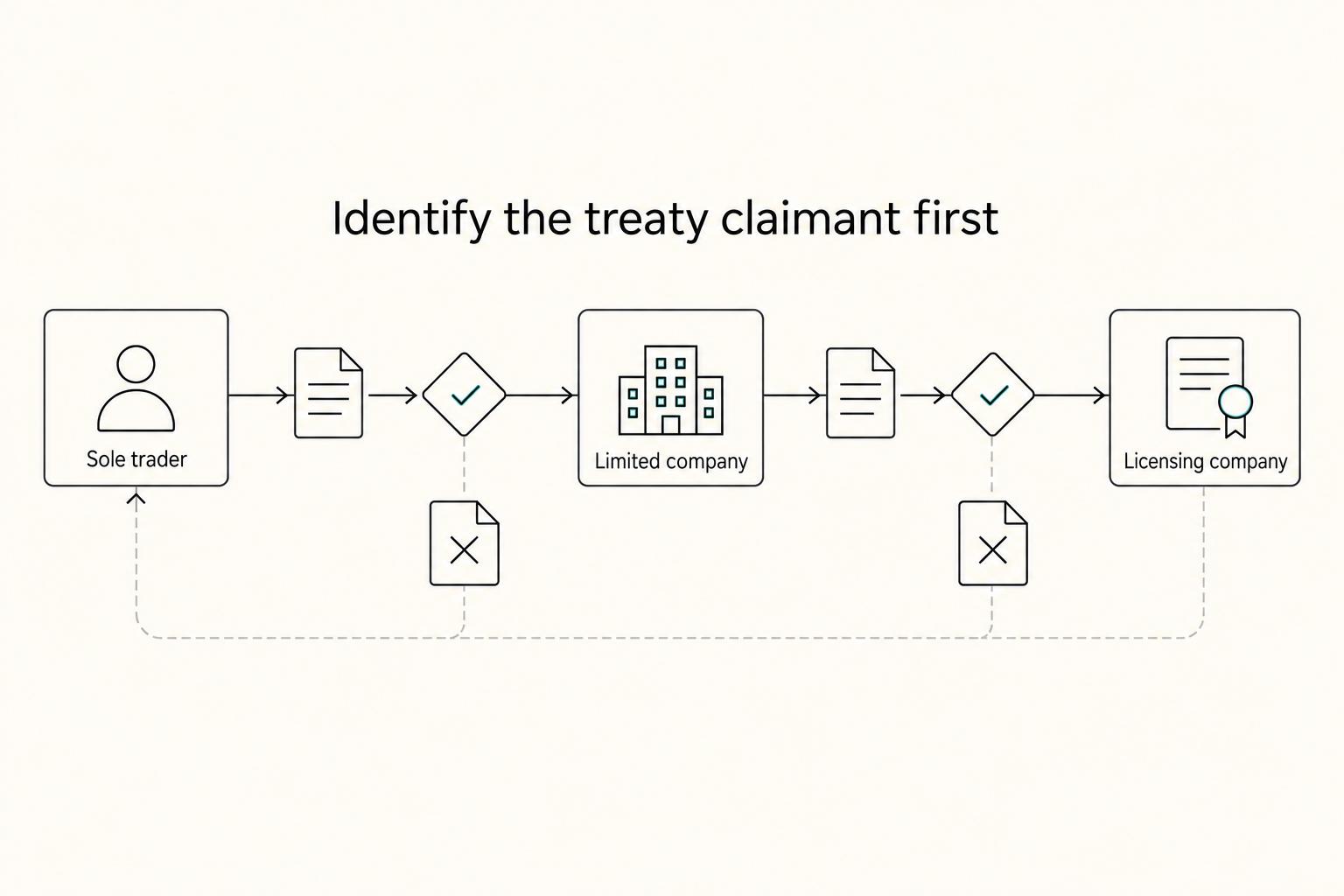
Use this pre-invoice sequence: decide who is claiming treaty benefits, classify the payment type, send the right W-8 to the U.S. payer, then run an operational risk check. A common failure mode is sending a form before the income classification and working facts are clear.
If an Irish limited company is the contracting and invoicing party, Form W-8BEN-E is the matching entity form from the payer's side. That does not create treaty eligibility by itself.
The practical point is consistency: the legal party named in the contract should match the party shown on the invoice, the party identified in the payer's vendor file, and the party making the treaty claim. If those pieces point in different directions, the payer may request follow-up and pause or withhold processing until the file is clarified.
Treat the sequence as a control process rather than a paperwork exercise:
- fix the billing party,
- define what the payment actually is,
- send the matching form,
- stress-test the operating facts behind that position before invoice one.
That order matters because each later step depends on the earlier one. If you start with the form, you risk locking yourself into a position that your contract, invoice wording, or day-to-day working pattern does not support.
Choose who is making the treaty claim#
Start with the legal party that is billing. If you bill personally, the claim is personal. If the company contracts and invoices, the company makes the claim. The form has to match that setup, and your contract and invoice trail need to point the same way.
| Your setup | Typical payment type | IRS form to give payer | Best use case | Documentation burden | Common failure mode |
|---|---|---|---|---|---|
| Irish sole trader / individual | Personal consulting or freelance fees | Form W-8BEN | You bill in your own name with no company entity | Moderate: form plus clear foreign-status and treaty-position support | Contract and invoicing facts look like a company engagement, but filing is personal |
| Irish limited company | Service fees paid to the company | Form W-8BEN-E | You contract and invoice through an Irish company | Higher: entity details and treaty classification usually need to be clean | Submitting W-8BEN instead of W-8BEN-E, or leaving treaty sections incomplete |
| Irish limited company licensing IP | Royalties or software licensing income | Form W-8BEN-E | You license software or other qualifying IP through the company | Higher: contract language must match income characterization | Labeling licensing revenue as generic "consulting" |
Two points are non-negotiable. Give the W-8 to the payer or withholding agent, not directly to the IRS. Make sure your contract, invoice language, and onboarding file all match the form.
In practice, this is where avoidable mismatch shows up. A founder signs the agreement personally, invoices through a company, fills in a personal form, and then tells the payer that the company is the real supplier. Or the company is the contracting party, but the statement of work reads as if the payer hired a named individual directly. None of that determines the tax result by itself, but it can make payer review harder because the file no longer tells one coherent story.
A cleaner process is to decide the billing party before the contract is signed and then keep that identity stable through the whole chain:
- contract party,
- statement of work party,
- invoicing party,
- form signer,
- supplier onboarding profile.
If you are using an Irish limited company, the company should appear as the supplier in the commercial documents. The payer should receive Form W-8BEN-E from that company. If you are billing personally, the contract and invoices should not read as if the company is the real provider while the individual makes the treaty claim.
This sounds basic, but it matters because onboarding teams usually work from the documents in front of them. They compare names, addresses, payment descriptions, and signature blocks. If one document says the supplier is an individual and another says the supplier is a company, the tax form may be kicked back for revision. Before you send anything, do a quick alignment check:
- Does the legal name on the form match the legal name on the contract?
- Does the invoice describe the same party as the one claiming treaty benefits?
- Does the payer's onboarding file identify the same supplier type that your form assumes?
- Do the signature blocks support the same story as the billing setup?
If the answer to any of those is no, fix the paper trail first. It is easier to correct one contract draft or one onboarding profile before payment starts than to unwind withholding after the payer has already coded the vendor a different way.
Classify the payment before you cite treaty relief#
This is where withholding risk often sits. For relevant U.S.-source FDAP income, the default is 30% gross withholding unless a lower treaty rate applies, so payment classification comes before form submission.
Use a simple rule: describe the payment exactly as sold. If you are being paid for services, treat it as services first. If you are licensing software or other IP, treat it as licensing first. Then check the current treaty article and PE attribution conditions against current treaty materials before onboarding.
Use treaty relief to manage payment-stage cash flow, but keep domestic filing obligations separate. That matters especially where saving-clause logic still preserves taxing rights.
Also track form validity. Form W-8BEN is generally valid from signature through the last day of the third succeeding calendar year. Confirm the current validity rules for the form you are using and whether any changes require an update.
Once the payment type and form line up, ask the next question: do your day-to-day operating facts actually support that position?
The main operational discipline here is not to let shorthand wording on the invoice override the actual deal you sold. If the work is a services engagement, a vague label like "software fee" can trigger unnecessary review. The payer may wonder whether the payment is really a licence or another form of IP income. If the deal is a licence, calling it "consulting" creates the opposite problem. The payer is not reading just for style. It is reading for withholding classification.
A practical way to control this is to compare three things side by side before the first invoice is issued:
- the signed contract,
- the statement of work or scope description,
- the invoice line items.
Those three should describe the same payment type in the same commercial terms. If they do not, the safest move is usually to fix the wording before the payer books the invoice.
This matters most where the relationship includes more than one element. For example, the commercial file may include development work, support work, and some right to use software or other IP. If you collapse all of that into one loose invoice label, you make it harder for the payer to determine what it is paying for. You do not need abstraction here. You need accurate characterization. The invoice should track the real commercial arrangement, and the form should track that same arrangement.
Another common failure mode is reaching for treaty language too early. Teams sometimes start with the desired withholding outcome and only later ask what the payment actually is. That reverses the process. The better order is:
- identify the legal payer and legal payee,
- identify the payment type,
- confirm the form that fits that payee,
- confirm that the treaty position you want to claim actually fits the payment and the facts.
That sequence helps you avoid sending the wrong form for the wrong party and reduces the chance that the payer applies an incorrect withholding code because the first documents used casual or inconsistent language.
You should also separate the payment-stage question from the later filing-stage question. Treaty relief may affect whether withholding is taken at payment, but it does not remove the need to keep your wider tax analysis coherent. That is why the article's sequence puts classification before relief and keeps domestic obligations separate. A clean payment file is useful, but it is not a substitute for a sound overall position.
On validity, do not treat the W-8 as permanent. Even where a form is valid through the stated period, the facts in the file need to stay true. If the contracting party changes, the business model changes, the income type changes, or other relevant facts change, review the form package again before the next payment cycle.
How should you run a PE risk check before invoice one?#
Treat PE as an operating-facts screen, not a box-ticking legal exercise. Ask whether the way you actually work matches the treaty position you want the payer to rely on. In practice, contract authority is the clearest high-signal fact; the other items below are operational consistency checks, not standalone treaty legal tests.
| Check item | What to document |
|---|---|
| Contract authority | A high-signal risk fact is a dependent agent who habitually concludes contracts that are binding on the foreign enterprise in the United States |
| Workspace control | Document where work is actually performed so your operating facts are clear and consistent across the file |
| Tools and email | Document whether you mainly operate through your own business systems or the client's internal stack or identity |
| Client concentration | Document the commercial pattern over time so the file reflects the relationship as it actually operates |
Keep an evidence file that matches your story. That usually means the signed services agreement, SOWs, signature-authority limits, invoice descriptions, and records showing who controls your workspace and tools.
After the payer-side position is stable, you can turn to the Irish side and test which reliefs are actually worth pursuing.
The useful way to run this check is to compare paper terms with lived reality. Many files look fine on the contract but weaken in operation. A services agreement may say you are independent, but the actual workflow can still raise follow-up questions if it does not match that narrative.
That is why this review should happen before invoice one, not after several payment cycles. Once a payer has onboarded you one way and finance has started processing invoices, correcting the story becomes harder. It is better to identify risk signals early and either adjust the operating model or make sure the file clearly reflects the real facts.
Use the checkpoints as a working review, not as slogans.
Contract authority. Read the service agreement and actual workflow together. Who sends commercial offers? Who approves price changes? Who can commit the client to deliverables or timing? If your role in practice looks like regular authority to bind the client, that is a different operating fact from a contractor who provides input but does not conclude contracts.
Workspace control. Ask where the work is actually done and on what terms, and keep that record aligned with the rest of the file.
Tools and email. Review the systems you use day to day and keep the operating record consistent with the contractual description of the engagement.
Client concentration. Document the client mix over time so the file reflects the relationship as it actually operates.
This is also the stage to build the evidence file while records are fresh. Do not leave it until a payer question or later filing review forces a reconstruction exercise. A practical evidence pack usually works best when it is organized around the same checkpoints:
- agreement and SOWs for scope,
- any documented limits on signature or authority,
- invoice wording that matches the agreed service,
- records showing where you work,
- records showing whose tools and business identity you mainly use.
The aim is simple: if someone reviews the file later, the documents should support the same story that the W-8 and invoice treatment assume. If the evidence points in several directions, pause and resolve that before more invoices go out.
When should you screen Irish reliefs?#
Do this after the U.S. withholding path is clean, not before. Irish reliefs matter, but they do not fix a weak payer-side classification or a form package that does not match the facts. Once the payer-side position is stable, use Irish reliefs as a qualification screen. If you also need to pressure-test where you are taxed day to day, pair this step with Tax Residency in Ireland for Digital Nomads and Tech Contractors:
| Relief | Current guidance | Screening note |
|---|---|---|
| Corporation tax profile | 12.5% for trading income; 25% for certain non-trading income | Confirm your income characterization before filing |
| KDB | 20% deduction from 1 October 2023; relief extended for accounting periods commencing before 1 January 2027 | Screen eligibility based on qualifying assets and profits, and keep supporting evidence |
| R&D tax credit | 30% for accounting periods commencing on or after 1 January 2024 | Screen eligibility against current Revenue criteria before filing |
Verify current article references, rates, and thresholds at filing time.
The sequencing here is deliberate. If the U.S. payer-side file is weak, an Irish relief analysis does not repair it. You still need the contract, payment classification, form package, and operating facts to stand on their own. Once that is stable, ask the next question: given the income you actually earned and the way it should be characterized, which Irish positions are genuinely available and worth the effort?
That means using the same discipline on the Irish side that you used on the payer side: start with facts, then screen reliefs. Do not start with a preferred rate or incentive and work backwards.
For the corporation tax profile, the key practical step is to keep the characterization of the income coherent across the file. If your commercial documents and invoice treatment point to one type of activity, your Irish analysis should not drift into another without a reasoned basis. This is especially important where the same business does a mix of services, licensing, and product-related work. The characterization work should be done carefully before filing, because the headline rate only matters once the underlying income bucket is right.
For KDB, the draft already gives the core screening points: qualifying assets, qualifying profits, and supporting evidence. The practical lesson is to screen early enough that you know what records to keep, but not so early that you let the relief shape the commercial description of the work. Keep the documentation trail tied to what was actually created, how it was exploited, and how the relevant profits were identified within the file you already use for tax and finance.
For the R&D tax credit, the important operational filter is to separate work that meets the claim criteria from work that does not. That screen should happen at project level, not just at company level. If your files bundle all technical work together under one broad label, you make the later review harder.
A good internal check at this stage is consistency across four places:
- commercial documents,
- invoice descriptions,
- accounting treatment,
- filing position.
If those four do not broadly agree on what the company was paid for, the filing analysis becomes harder than it needs to be. You are not trying to create new facts here. You are trying to make sure the tax position follows the same facts already reflected in the business records.
This is also why the draft ends with a reminder to verify current article references, rates, and thresholds at filing time. The article gives the screening framework, but the final filing position should always be checked against current materials when you actually file, not assumed from an earlier onboarding review.
Escalate to a cross-border tax professional when: your facts span multiple jurisdictions, income characterization is unclear (services vs royalties), or residency indicators conflict. These are high-cleanup-risk cases if you rely on a form-only fix.
For a deeper dive, read the digital nomad tax guide. Before you send your first US invoice, prepare the treaty paperwork with the W-8 Form Generator. If your travel pattern changes during the year, keep your records decision-ready with the Tax Residency Tracker.
Frequently Asked Questions
How should you run a PE risk check before invoice one?
Treat PE as an operating-facts screen, not a box-ticking legal exercise. Ask whether the way you actually work matches the treaty position you want the payer to rely on. In practice, contract authority is the clearest high-signal fact; the other items below are operational consistency checks, not standalone treaty legal tests. Check item; What to document Check item: Contract authority; What to document: A high-signal risk fact is a dependent agent who habitually concludes contracts that are binding on the foreign enterprise in the United States Check item: Workspace control; What to document: Document where work is actually performed so your operating facts are clear and consistent across the file Check item: Tools and email; What to document: Document whether you mainly operate through your own business systems or the client's internal stack or identity Check item: Client concentration; What to document: Document the commercial pattern over time so the file reflects the relationship as it actually operates Keep an evidence file that matches your story. That usually means the signed services agreement, SOWs, signature-authority limits, invoice descriptions, and records showing who controls your workspace and tools. After the payer-side position is stable, you can turn to the Irish side and test which reliefs are actually worth pursuing. The useful way to run this check is to compare paper terms with lived reality. Many files look fine on the contract but weaken in operation. A services agreement may say you are independent, but the actual workflow can still raise follow-up questions if it does not match that narrative. That is why this review should happen before invoice one, not after several payment cycles. Once a payer has onboarded you one way and finance has started processing invoices, correcting the story becomes harder. It is better to identify risk signals early and either adjust the operating model or make sure the file clearly reflects the real facts. Use the checkpoints as a working review, not as slogans. Contract authority. Read the service agreement and actual workflow together. Who sends commercial offers? Who approves price changes? Who can commit the client to deliverables or timing? If your role in practice looks like regular authority to bind the client, that is a different operating fact from a contractor who provides input but does not conclude contracts. Workspace control. Ask where the work is actually done and on what terms, and keep that record aligned with the rest of the file. Tools and email. Review the systems you use day to day and keep the operating record consistent with the contractual description of the engagement. Client concentration. Document the client mix over time so the file reflects the relationship as it actually operates. This is also the stage to build the evidence file while records are fresh. Do not leave it until a payer question or later filing review forces a reconstruction exercise. A practical evidence pack usually works best when it is organized around the same checkpoints: agreement and SOWs for scope, any documented limits on signature or authority, invoice wording that matches the agreed service, records showing where you work, records showing whose tools and business identity you mainly use. The aim is simple: if someone reviews the file later, the documents should support the same story that the W-8 and invoice treatment assume. If the evidence points in several directions, pause and resolve that before more invoices go out.
When should you screen Irish reliefs?
Do this after the U.S. withholding path is clean, not before. Irish reliefs matter, but they do not fix a weak payer-side classification or a form package that does not match the facts. Once the payer-side position is stable, use Irish reliefs as a qualification screen. If you also need to pressure-test where you are taxed day to day, pair this step with Tax Residency in Ireland for Digital Nomads and Tech Contractors: Relief; Current guidance; Screening note Relief: Corporation tax profile; Current guidance: 12.5% for trading income; 25% for certain non-trading income; Screening note: Confirm your income characterization before filing Relief: KDB; Current guidance: 20% deduction from 1 October 2023; relief extended for accounting periods commencing before 1 January 2027; Screening note: Screen eligibility based on qualifying assets and profits, and keep supporting evidence Relief: R&D tax credit; Current guidance: 30% for accounting periods commencing on or after 1 January 2024; Screening note: Screen eligibility against current Revenue criteria before filing Verify current article references, rates, and thresholds at filing time. The sequencing here is deliberate. If the U.S. payer-side file is weak, an Irish relief analysis does not repair it. You still need the contract, payment classification, form package, and operating facts to stand on their own. Once that is stable, ask the next question: given the income you actually earned and the way it should be characterized, which Irish positions are genuinely available and worth the effort? That means using the same discipline on the Irish side that you used on the payer side: start with facts, then screen reliefs. Do not start with a preferred rate or incentive and work backwards. For the corporation tax profile, the key practical step is to keep the characterization of the income coherent across the file. If your commercial documents and invoice treatment point to one type of activity, your Irish analysis should not drift into another without a reasoned basis. This is especially important where the same business does a mix of services, licensing, and product-related work. The characterization work should be done carefully before filing, because the headline rate only matters once the underlying income bucket is right. For KDB, the draft already gives the core screening points: qualifying assets, qualifying profits, and supporting evidence. The practical lesson is to screen early enough that you know what records to keep, but not so early that you let the relief shape the commercial description of the work. Keep the documentation trail tied to what was actually created, how it was exploited, and how the relevant profits were identified within the file you already use for tax and finance. For the R&D tax credit, the important operational filter is to separate work that meets the claim criteria from work that does not. That screen should happen at project level, not just at company level. If your files bundle all technical work together under one broad label, you make the later review harder. A good internal check at this stage is consistency across four places: commercial documents, invoice descriptions, accounting treatment, filing position. If those four do not broadly agree on what the company was paid for, the filing analysis becomes harder than it needs to be. You are not trying to create new facts here. You are trying to make sure the tax position follows the same facts already reflected in the business records. This is also why the draft ends with a reminder to verify current article references, rates, and thresholds at filing time. The article gives the screening framework, but the final filing position should always be checked against current materials when you actually file, not assumed from an earlier onboarding review. Escalate to a cross-border tax professional when: your facts span multiple jurisdictions, income characterization is unclear (services vs royalties), or residency indicators conflict. These are high-cleanup-risk cases if you rely on a form-only fix. For a deeper dive, read The Ultimate Digital Nomad Tax Survival Guide for 2025. Before you send your first US invoice, prepare the treaty paperwork with the W-8 Form Generator. If your travel pattern changes during the year, keep your records decision-ready with the Tax Residency Tracker.
Try a related tool
Researched and edited by the Gruv editorial team. Gruv builds cross-border billing, payouts, and finance-operations software for global businesses.
Sources
Educational content only. Not legal, tax, or financial advice.
Related Posts

Digital Nomad Taxes in 2026 With a Defensible Filing Plan
With digital nomad taxes, the first move is not optimization. It is figuring out where you may be taxable, where filings may be required, and what proof supports that position.

Tbilisi Digital Nomad Guide for 2026 Long Stays in Georgia
Start with sequence, not excitement. If your income depends on delivering work on schedule, secure your legal footing, assemble your documents, and keep month one reversible before you optimize comfort.
Tax Residency in Ireland for Digital Nomads and Tech Contractors
Pick one status for the current year in Ireland, then document it so you can defend it. The goal is a position built on records you can prove now, not a perfect answer to every edge case.