
Quick Answer
Begin with domestic residency determinations in each country, and invoke the us-canada tax treaty tie-breaker only when both systems still treat you as resident. Use Article IV (Residence) to test permanent home, vital interests, habitual abode, citizenship, and then mutual agreement. Keep a dated file for travel, housing, family, and work records, and do not submit returns until your treaty memo and forms tell the same story.
Confirm domestic residency status in each country before invoking Article IV tie-breaker analysis#
If you split life and work between the United States and Canada, start with a defensible residency position, not a guess. In practice, that usually means confirming your domestic-law status first, then using treaty analysis when both countries can plausibly treat you as resident. The job of a us-canada tax treaty tie-breaker review is to choose a supportable position, document it, and file consistently.
For this article, the anchor is the U.S.-Canada Convention, with Article IV (Residence) as the core checkpoint. If your position may be reviewed, ground it in the treaty text and official guidance.
This matters directly for freelancers and consultants. IRS Publication 597 has separate dual-resident branches for taxpayers who are Canadian residents under a tie-breaker rule and those who are not. It also addresses income from self-employment (Article VII).
A key risk is relying on legacy summaries instead of current treaty materials. The technical explanation itself says it is not a complete comparison to the 1942 Convention, so older shortcuts are not enough on their own.
A practical sequence is to map domestic status, decide whether treaty residence is needed, build a defensible evidence file, and pressure-test your filing position for consistency. As a safe default, do not file faster than you can document.
Start with the right mental model of treaty residency#
Start with domestic-law facts and determine status first.
That is how filing systems work in practice. California treats residency as a facts-and-circumstances determination, and New York's filing guidance also starts with classification first, then return mechanics.
Domestic classification and sourcing still drive real outcomes. For example, California nonresident or part-year treatment can require Form 540NR, and sourcing in the remote-work example depends on where services were physically performed.
Your checkpoint is consistency across facts, position, and filings. Keep one dated timeline for travel, work location, housing, and filing posture, then make sure every return position matches that same record.
Map your domestic status before invoking treaty relief#
Treaty relief comes after the baseline is clear. First confirm whether each country has a domestic-law basis to treat you as resident. If either baseline is wrong or unclear, your treaty position is weak from the start.
Begin with Canada by mapping your facts before labeling outcomes. Build one dated record for travel, where you lived and worked, and how you identified your residence on official paperwork. If that record is inconsistent, pause and fix it before moving into treaty analysis.
Establish the Canadian baseline first#
Your goal here is a defensible timeline, not an early treaty argument. Residency determinations are fact-intensive and depend on the full circumstances, so your baseline position should be explainable through a clean chronology using the same facts you will rely on everywhere else. If you cannot state that position consistently from your documents, stop and resolve it first.
Check U.S. exposure before assuming the treaty will rescue you#
Screen for U.S. exposure under the Substantial Presence Test before assuming you need tie-breaker relief.
Even if you meet substantial presence, you may still be treated as a nonresident if the Closer Connection Exception fits your facts. A key condition is being in the United States less than 183 days during the year. Another screen is immigration intent, because steps toward lawful permanent resident status can break this path.
Test closer connection before you reach for treaty language#
If your day count is under 183, test whether your significant contacts are stronger with a foreign country than with the United States. Use document-level evidence, especially:
| Checkpoint | Detail |
|---|---|
| Day count | A key condition is being in the United States less than 183 days during the year. |
| Significant contacts | Test whether your significant contacts are stronger with a foreign country than with the United States. |
| Residence on official paperwork | Use the country of residence you designate on official forms and documents. |
| Official forms filed | Check the types of official forms you file, for example Form W-9. |
| Potential filing form | If closer connection may apply, consider whether Form 8840 is relevant to your filing posture. |
| Foreign-country limit | The IRS two-country variant is limited to no more than 2 foreign countries. |
If your paperwork conflicts with your narrative, fix that gap before making treaty arguments.
Decision rule: if domestic status is unresolved in either country, stop there and resolve it first. The treaty is a resolver, not a replacement for domestic analysis.
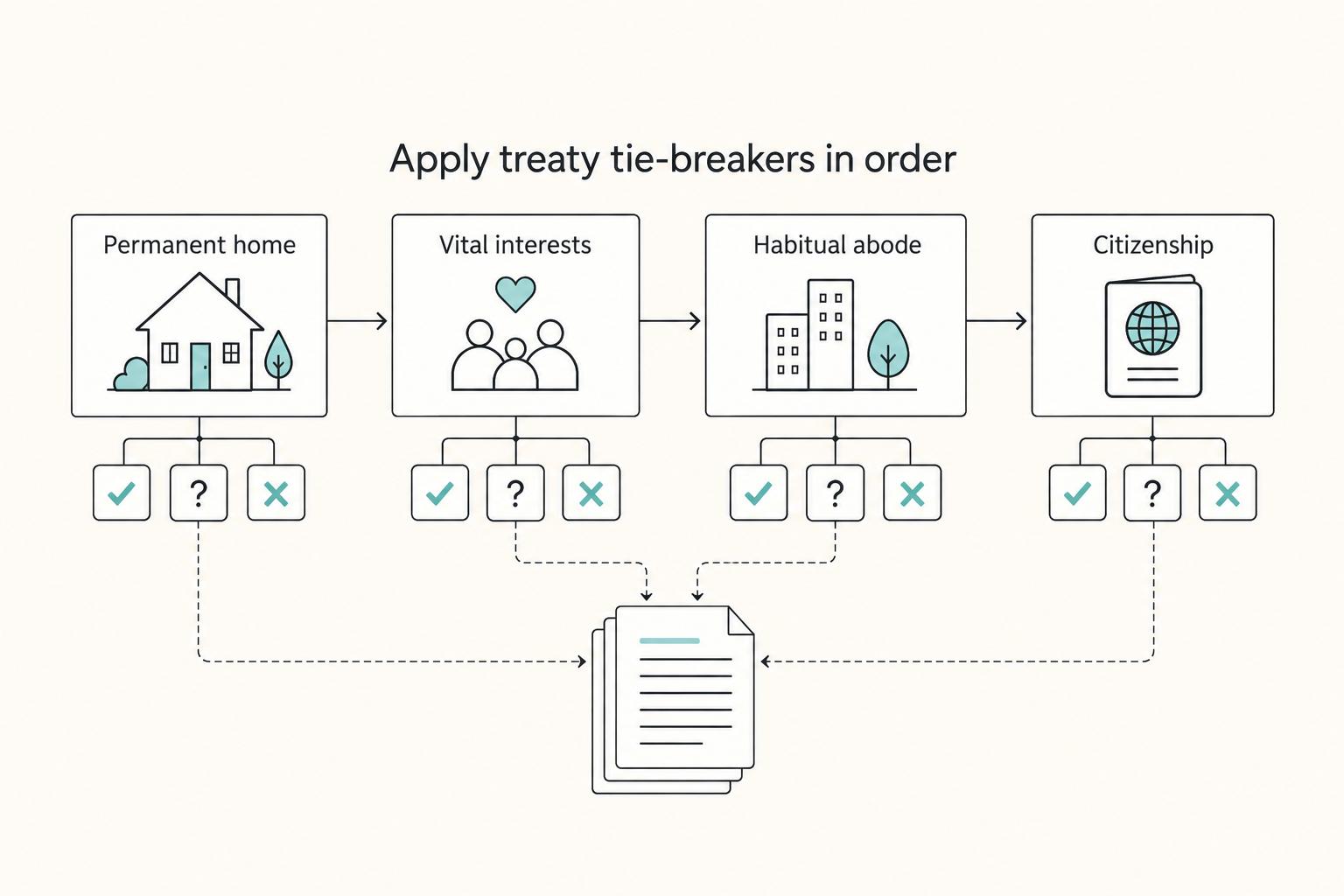
Apply the tie-breaker sequence in order, not by gut feel#
When both countries can treat you as resident under domestic law, the treaty tie-breaker only works if you apply the steps in order. This is not a pick-your-best-fact exercise. Use the fixed sequence, and stop only when one step clearly settles residency.
Know what each step is really asking#
Start with Permanent Home. This asks whether you have a durable dwelling available to you, not just a temporary place you happened to stay.
If that does not settle it, move to Center of Vital Interests. Here, document which country is your primary tax home based on your overall ties, not just one standout fact.
If that still does not resolve the issue, test Habitual Abode. This is the pattern question: where you usually stay over time.
Use Citizenship only after those earlier steps fail to resolve the issue. If it is still unresolved, the sequence moves to Mutual Agreement.
Apply each step, then document why it did or did not resolve#
Do not skip ahead to the factor you like best. Work the list in order, mark each step as either settled or not settled, and record why.
A simple five-line memo can help keep this consistent: Permanent Home, Vital Interests, Habitual Abode, Citizenship, Mutual Agreement. For each line, tie your conclusion to dated records where available. If a point is not supported by records, treat it as weak. That discipline matters because unclear tie-breaker analysis can leave you treated as resident in both countries, with double-taxation risk.
| Factor | What it asks | Stronger support | Weak support on its own |
|---|---|---|---|
| Permanent Home | Is a durable dwelling available to you in one country or both? | Clear evidence of durable home availability | Temporary or occasional stays alone |
| Center of Vital Interests | Which country is your primary tax home when ties are viewed together? | A consistent record supporting your overall conclusion | One favorable fact taken in isolation |
| Habitual Abode | Where do you usually stay over time? | A dated, consistent pattern of where you stayed | Memory-based or inconsistent reconstructions |
| Citizenship | If earlier tests fail, which country are you a citizen of? | Citizenship records | Preferences or future plans |
How the sequence behaves in messy freelancer cases#
Mixed facts are common, and the sequence is built to handle them.
With two leases, do not assume Permanent Home decides the case by itself. Apply the test, record your reasoning, and continue in order if needed.
With frequent travel, evaluate Habitual Abode from a dated timeline rather than memory alone, then continue if the step is not decisive.
With split family ties, document both sides before deciding whether Vital Interests settles the issue.
If one rule is worth keeping in view, it is this: when a factor is not decisive, say so, document it, and move to the next step.
Use decision checkpoints when your facts are mixed#
Mixed facts do not mean your analysis has failed. They mean you need clearer checkpoints. Treat each treaty point as a checkpoint, not a verdict. Mark it settled or not settled, then keep moving without forcing a conclusion the record cannot support.
| Mixed-fact checkpoint | What to do next | Common failure mode |
|---|---|---|
| A residency checkpoint appears to point to both countries | Mark this checkpoint unresolved and continue the tie-breaker analysis | Forcing a one-country answer too early |
| A key checkpoint is unclear because travel is heavy | Rebuild a reconciled timeline from dated records and prioritize stable facts over memory | Backfilling a conclusion from rough estimates |
| You are relying on a treaty residence conclusion in a dual-resident case | Verify which Publication 597 dual-resident path applies to your case | Assuming one residence conclusion answers every filing question |
| Key checkpoints remain evenly split after an honest review | Stop and escalate | Stretching mixed facts into a neat but weak position |
Anchor the file to primary authority. Article IV is the residence article, and Article XXVI identifies the Mutual Agreement Procedure for cases that stay unresolved. The Treasury technical explanation is an official guide to the Convention and reflects interpretive understandings for its application.
Use IRS international FAQs carefully. They can help frame questions, but they are general responses and not citable legal authority. Your core memo should rest on the Convention, the technical explanation, Publication 597, and your dated facts. Use a hard stop rule: if your written analysis still reads like a tie after checkpointing, escalate instead of improvising.
Build an evidence file before filing season#
A treaty position is only as good as the file behind it. Build the evidence file before deadlines, and organize it around the tie-breaker factors you rely on so the position is easy to verify.
| File item | Detail |
|---|---|
| Factor-based folders | Split your file under clear tie-breaker headings and group supporting records under housing, family location, work patterns, and travel history. |
| Canadian tie evidence | Grounded examples include owning or renting a home in Canada, and having a spouse or dependents who live in Canada. |
| Master chronology | Keep one master chronology. |
| Travel log | Keep one travel log built from dated records. |
| Claim index | Keep one index linking each major claim to supporting documents. |
| Traceability check | Pressure-test the file so every concrete claim traces to at least one document. |
Organize by factor, not by document type#
For mixed facts, one catch-all folder is not enough. Before applying tie-breaker rules, confirm how dual residency arises in your case. Then split your file under clear tie-breaker headings and group supporting records under housing, family location, work patterns, and travel history.
Use concrete tie evidence where available. Grounded examples include owning or renting a home in Canada, and having a spouse or dependents who live in Canada. If you make comparable claims for the United States, apply the same date discipline and proof standard.
Make the file review-ready#
Assume your packet may need third-party review. Keep dated proof, consistent labels, and one reconciled timeline so your facts do not shift from one review to the next.
A practical structure is:
- one master chronology
- one travel log built from dated records
- one index linking each major claim to supporting documents
Heavy travel can make a residence position harder to support, so avoid relying on memory-based day counts alone when dated records are available.
Add supporting records selectively. When personal facts are split, additional dated records may help clarify where your life was centered. Use only what supports the claim. A narrower, well-labeled set is usually stronger than a full document dump.
Keep the legal anchor and run a traceability check. Once the file is assembled, pressure-test it. Keep your memo anchored to primary authority: Article IV is the residence article, and the IRS technical explanation is an official guide to the Convention. Then test your position line by line so every concrete claim traces to at least one document in the file.
If a claim does not trace, rewrite it as uncertainty or remove it. That is the core quality check for a defensible treaty-residency position.
Related reading: A Deep Dive into the US-Japan Tax Treaty for Remote Workers.
File in a sequence that avoids contradictory positions#
Once your evidence file is traceable, the main risk shifts to inconsistency across filings. A practical way to reduce that risk is to set your domestic position first, document your treaty position second, and add relief items like the Foreign Tax Credit only after those two pieces are stable.
Use a sequence that starts with facts, then forms#
This is a practical filing order, not a stated IRS or CRA mandate.
| Stage | Detail | Form |
|---|---|---|
| Domestic posture | Be clear on what you are filing under domestic law before adding treaty relief positions. | Domestic law |
| Treaty memo | Anchor it to the treaty text and the Technical Explanation, then map each concrete claim to your evidence file. | Treaty text; Technical Explanation |
| Double-tax relief | For U.S. double-tax relief, the Foreign Tax Credit is intended to reduce double taxation, and individuals, estates, and trusts claim it on Form 1116. | Form 1116 |
| Income categories | File a separate Form 1116 for each income category. | Form 1116 |
| Category box | Check only one income-category box per form. | Form 1116 |
| Multiple countries or territories | If taxes were paid to multiple countries or territories, use separate country lines or columns. | Form 1116 |
- Lock your domestic posture first. Be clear on what you are filing under domestic law before adding treaty relief positions.
- Write your treaty position as a short memo. Anchor it to the treaty text and the official Technical Explanation to the Convention, then map each concrete claim to your evidence file.
- Layer in relief items after the position is stable. For U.S. double-tax relief, the Foreign Tax Credit is intended to reduce double taxation, and individuals, estates, and trusts claim it on Form 1116.
For Form 1116, treat the mechanics as a consistency check:
- file a separate Form 1116 for each income category
- check only one income-category box per form
- if taxes were paid to multiple countries or territories, use separate country lines or columns
If those entries do not match your treaty narrative, pause and reconcile before filing.
Keep common disclosures in one alignment view#
If these forms or reporting items apply, review them together for consistency.
| Form or reporting item | Alignment check |
|---|---|
| Form 8840 | Confirm facts stated there do not conflict with your treaty memo and domestic posture. |
| FBAR | Confirm account and country facts are consistent with the rest of your filing package. |
| Form 8938 | Confirm foreign asset or account disclosures do not contradict your broader residency narrative. |
| FinCEN reporting | Treat this as a separate reporting lane and verify it aligns with your tax-return facts. |
Check Foreign Tax Credit elections for contradictions#
Do not treat Foreign Tax Credit claims as cleanup. The IRS says you cannot claim a credit for taxes on income you exclude, and doing both can create election consequences. Also, some foreign taxes are non-creditable even when baseline tests are met, including taxes you do not legally owe. If your credit claim conflicts with your own legal position, fix that before submission.
Run one pre-filing alignment pass#
Before filing, read the package once as a whole. Check that:
- the domestic posture and treaty memo tell the same story
- form-level facts, including country, account, address, and income category, are consistent
- Form 1116 categories and country entries match income actually taxed abroad
- no credit is claimed on excluded income
Decision rule: if one form forces a fact pattern that conflicts with your treaty claim, treat that as a professional-review trigger, then stop and reconcile before filing.
Understand the Saving Clause before assuming treaty protection#
Treaty protection is not a full U.S. off-ramp. Even with a treaty-residency result, some U.S. taxing rights and filing obligations can remain in play.
What it means in practice. Use this as your working assumption: a treaty-residency determination can change treaty treatment, but it does not by itself replace domestic-law analysis. In cross-border cases, one country can still assert residence or limited taxing rights under its own rules, so treaty residency and full domestic filing relief are not the same outcome.
That is why your filing narrative needs both halves: your treaty position and the domestic-law items you still must handle. If those two parts drift apart across forms or years, you create avoidable compliance risk.
The two articles to keep in view#
- Article XXIV (Elimination of Double Taxation): the treaty article on double-taxation relief when both systems still assert tax exposure on overlapping income.
- Article XXVI (Mutual Agreement Procedure): the escalation lane when ordinary filing positions do not resolve a cross-border mismatch. The 2007 protocol added paragraphs 6 and 7 for binding arbitration in certain disputes.
Other treaty articles worth flagging early.
- Article XVIII: Pensions and Annuities
- Article XIX: Government Service
- Article XXI: Exempt Organizations
- Article XXV: Non-Discrimination
If your facts touch any of these categories, review the article text with the Technical Explanation. The Technical Explanation is treated as the official guide to the Convention, and where the 2007 protocol did not amend a provision, prior technical explanations remain the official explanations.
Avoid the mistakes that create expensive rework#
The costliest problems usually come from inconsistency, not complexity. If your domestic-law position points one way and your exception claim points another, you create a record that is hard to defend and expensive to fix.
Keep domestic status and exception claims in separate lanes#
Start with domestic status, then layer exception analysis on top. If you may have met substantial presence, resolve that first. If you are relying on the closer connection exception, confirm the actual conditions before describing yourself as a nonresident elsewhere.
For closer connection, the IRS ties the position to specific facts. These include presence in the United States for less than 183 days during the year, a foreign tax home for the full year, and stronger contacts with that foreign country than with the United States. The IRS also looks at practical tie indicators such as where your permanent home and family are located. A useful checkpoint is consistency across forms and documents, including the country of residence you designate.
Do not make tie-strength claims with thin proof#
A claim that your non-U.S. ties were stronger needs dated evidence, not broad statements. When facts are mixed, your file should show which ties were stronger and when.
Your evidence packet should usually include:
- housing records, family-location records, and travel logs that align by date
- contracts, invoices, and payment records that support where your work was performed during the year
A good standard is simple: each material claim should map to contemporaneous documents.
Do not ignore state-source facts while building a nonresident narrative#
A federal nonresident position does not erase state-source analysis. California guidance states that even during a nonresident period, you can still have California-source income to the extent you physically performed services in California. The scenario guidance points to Form 540NR for that reporting.
File when the packet is coherent, not just early#
Filing early is not helpful if the record is still misaligned. If your closer-connection support is missing core documents or your forms conflict with each other, speed only increases rework risk.
Use one pre-filing check:
- domestic-law analysis matches the facts shown on your forms
- country of residence is consistent across documents
- if you rely on closer connection, your under-183-day and tax-home facts are documented
- if you assert stronger non-U.S. ties, those ties are supported by dated records
Treat generic summaries as prompts, not final answers#
Generic explainers are useful for orientation, but they often collapse separate tests into one simplified rule. Residency determinations are fact-specific, so mixed fact patterns need a fact-by-fact review before you file.
For a related walkthrough, see A deep dive into the US-Australia 'tie-breaker' rules for a dual-resident software developer.
Know when to bring in a cross-border specialist#
Bring in a specialist when your filing position is not internally coherent before submission, especially if your U.S. reporting decisions are pulling in different directions.
Escalate when your records conflict across years#
If prior-year returns and your current draft point to different foreign-asset reporting treatment, treat that as a stop signal. Do not rely on a quick narrative patch when the record itself is inconsistent.
Escalate when your filing-threshold analysis is still split. If you still cannot reach one defensible position after working through your facts, you are outside safe DIY territory. IRS thresholds for Form 8938 can differ by filing context, so get formal support before filing if your threshold analysis is unresolved.
Escalate when Form 8938 and FBAR logic is not fully reconciled#
For U.S. citizens, you still need to test U.S. reporting duties. The IRS treats a U.S. citizen as a specified individual for Form 8938, and Form 8938 must be attached to your annual return and filed by that return's due date, including extensions. If no income tax return is required for the year, Form 8938 is not required.
Filing Form 8938 does not replace any required FinCEN Form 114 (FBAR) filing. If you cannot reconcile these rules with confidence, hand the file to a specialist before you submit.
Your next move this week#
If even one factor is still unresolved, consider pausing filing. This week, run your facts through the tie-breaker sequence, build your evidence packet, and escalate early if the result is mixed.
Run the sequence once, end to end#
Use tie-breaker rules only after confirming both countries treat you as resident under domestic rules. Then apply the sequence in order: permanent home, vital interests, habitual abode, citizenship, then mutual agreement. Stop when one step clearly resolves residency. If it does not, mark it unresolved and keep going.
Use a one-page grid with:
- Factor
- Result
- Facts and dated documents
- What is still unresolved
For permanent home, treat it as a durable dwelling, not a temporary rental. If you appear to have durable homes in both countries, move to vital interests and document that analysis.
Build your evidence packet before filing week#
Create one folder now, organized by tie-breaker factor, with dated records behind each claim. Then run three checks:
- Match each factor to supporting documents and flag gaps.
- Reconcile dates, addresses, and timelines across records.
- Check planned filings and statements for consistency with the same residency story.
If your analysis stays unclear, you can be treated as resident in both countries, with double-taxation risk.
Escalate mixed or high-stakes files early#
If your facts do not produce one coherent result, get a cross-border review before filing. Treat U.S. citizenship as its own escalation trigger: U.S. citizens still have U.S. return-filing obligations regardless of where they live or work. As a conservative default, if key factors are still split after documentation, pause and get the file reviewed before submission.
If your facts are split across both countries or prior-year filings conflict, use contact us to review the safest next step before you file.
Frequently Asked Questions
What is the U.S.-Canada tie-breaker rule in one sentence?
It is the treaty framework used when both countries treat you as a resident under their own domestic rules. Its job is to resolve that overlap into one residency position, not to skip domestic residency analysis.
If both countries treat me as resident, which factor is tested first?
The sequence starts with permanent home, then vital interests, habitual abode, citizenship, and mutual agreement. Use that order step by step and document why each step did or did not resolve your case. Treat this ordering as practitioner guidance, not as an IRS- or CRA-published hierarchy.
Can I meet the Substantial Presence Test and still be treated as a U.S. non-resident under treaty rules?
Possibly. The IRS says someone who meets substantial presence may still be treated as a U.S. nonresident if closer-connection conditions are met, including being in the United States for less than 183 days during the year. That closer-connection path is a domestic rule, and treaty tie-breaker analysis is a separate step when both countries treat you as resident.
Does the treaty let a U.S. citizen stop filing U.S. tax returns?
Do not assume that from this material. A treaty residency position and full U.S. filing relief are separate questions, and this guide does not establish blanket return-filing relief for U.S. citizens. If you are in that position, treat filing obligations as a separate decision item before you file.
What records best prove stronger ties to Canada?
There is no single document that settles it on its own. CRA says residency status depends on all relevant facts, including ties plus the length, purpose, intent, and continuity of your stays. Keep dated records that support one consistent story, and make sure forms you file elsewhere, such as W-9, W-8BEN, or W-8ECI, do not contradict that story.
What should a freelancer do before claiming a treaty position?
Start by determining residency under each country’s domestic rules, because CRA states residency status comes first for tax responsibilities and filing requirements. Then check whether a domestic exception such as the IRS closer-connection path applies before relying on treaty tie-breaker arguments. If you want CRA’s opinion on deemed non-resident status, CRA points to Form NR74.
When is this too risky to handle without a cross-border tax professional?
Escalate when your file does not produce one coherent result after you work through the tie-breaker steps. Also escalate when your prior filings, day counts, ties, and filed forms point in different directions. If your record is internally inconsistent before submission, stop and get cross-border support.
Try a related tool
Researched and edited by the Gruv editorial team. Gruv builds cross-border billing, payouts, and finance-operations software for global businesses.
Sources
- academia.edu/31503595/_The_application_of_Tie_breaker_rul...trusted
- fincen.gov/report-foreign-bank-and-financial-accountstrusted
- ftb.ca.gov/file/personal/residency-status/part-year-and...trusted
- ftb.ca.gov/forms/2023/2023-1031-publication.pdftrusted
- home.treasury.gov/system/files/131/Treaty-Canada-Pr2-TE-9-21-2...trusted
- irs.gov/individuals/international-taxpayers/closer-c...trusted
- irs.gov/individuals/international-taxpayers/frequent...trusted
- uscourts.gov/sites/default/files/document/2025-11_evidenc...trusted
Educational content only. Not legal, tax, or financial advice.
Related Posts

Digital Nomad Taxes in 2026 With a Defensible Filing Plan
With digital nomad taxes, the first move is not optimization. It is figuring out where you may be taxable, where filings may be required, and what proof supports that position.

Tbilisi Digital Nomad Guide for 2026 Long Stays in Georgia
Start with sequence, not excitement. If your income depends on delivering work on schedule, secure your legal footing, assemble your documents, and keep month one reversible before you optimize comfort.
The Best Tools for Tracking Your Credit Card Points and Miles
**Pick a stack based on your failure mode (choosing the wrong card vs losing visibility), then run a simple recurring check so you can keep rewards visible without turning them into admin work.** If you're a business of one, rewards only matter if the system runs without stealing focus from client work.