
Quick Answer
Start by treating the uk high potential individual visa as a verify-first route: confirm your award-period Global Universities List match, then clear Ecctis, then submit only when identity and supporting records align. Use published decision windows as planning ranges, not guarantees, and avoid non-refundable commitments before approval. Because the route is one-time, fixed-term, and does not count toward settlement, set your switch path early rather than near expiry.
You're Moving to the UK on an HPI Visa and Need a Real Plan#
Use this as a pre-spend check, not a motivation boost. Before you pay for optional services, commit to move dates, or lock flights, check current official visa guidance and treat route fit and core eligibility as unverified until you have clearly confirmed them.
Split the plan into two buckets: unknown vs verified. Unknown items are visa-route checks that need live confirmation. Verified items here are UK business-structure admin facts.
| Item to check | Type | What you do now | Verification source |
|---|---|---|---|
| Route fit and core eligibility | Unknown until verified | Verify current requirements before any paid steps | Current official GOV.UK visa-route guidance, with the date checked |
| Required evidence and document format | Unknown until verified | Build your document list from the exact live guidance you will apply under | Current official GOV.UK evidence guidance, with the date checked |
| Fees, optional services, and payment totals | Unknown until verified | Budget from live numbers only and save a dated copy | Official GOV.UK fee pages, with the date checked |
| Processing expectations and appointment availability | Unknown until verified | Do not anchor housing, notice periods, or flights to assumed timing | Official GOV.UK processing-time guidance, with the date checked |
| How you will operate if self-employed in the UK | Verified admin facts | Decide after route fit is verified, because admin load and risk differ | current official business-structure guidance |
In practice, if route fit is still unverified, pause spend. Move forward only after you have saved the exact pages you relied on, with the date checked, in one evidence folder.
Keep visa eligibility checks separate from post-arrival business setup. If you expect to work for yourself in the UK, choose structure only after route fit is verified.
- A sole trader is owned and run by one person. You can be personally responsible for business debts, and you must register for Self Assessment and file a Self Assessment tax return each year.
- A private limited company is a separate legal entity. You are not personally responsible for company debts. You must register with Companies House, file annual accounts and statements published online, and follow stricter operating and record-keeping rules.
Work through four passes, each with one outcome:
- Confirm route fit status. Outcome: eligibility is verified or explicitly marked unknown before spending.
- Test route fit against your real plan. Outcome: you know which assumptions still need official confirmation.
- Build evidence and budget. Outcome: you know what to collect, what to recheck, and what to budget from live pages.
- Execute in order. Outcome: application timing and UK admin happen only after verification.
This order helps you avoid two expensive mistakes: paying early for an unverified route, and doing UK admin before you know you need it.
Related: A Guide to the Global Talent Visa in the UK.
What the HPI Visa Gives You and What It Does Not#
Use HPI only if current GOV.UK guidance matches how you actually plan to work and live. Do not assume it covers your full timeline. If you may stay beyond HPI, map your next visa route now and add the current validity period only after you verify it.
Treat key terms as live checks, not assumptions. unsponsored, switch, and settlement all need to be confirmed from the current route wording before you act.
| What you can do on HPI | What HPI does not provide |
|---|---|
| Use HPI only where the live rules fit how you plan to work and live. Confirm the current rule before you act. | Certainty about your longer-term plan. If your timeline extends past HPI, define your next route early. |
If live rules permit self-employment, choose an operating structure that fits your risk and admin tolerance. A sole trader is a business owned and run by one person. | Any exemption from UK tax admin. HMRC says to check whether you need to send a tax return before registering for Self Assessment. |
| If you operate as a sole trader, register for Self Assessment and complete a Self Assessment tax return each year. | Protection from late-notice risk. In HMRC's example year ending 5 April 2025, notifying after 5 October 2025 could trigger a penalty. |
If you set up a limited company, it is a separate legal entity and requires Companies House registration plus annual accounts and statements published online. | A low-admin default. A limited company may not suit you if you want to avoid complex paperwork, and sole trader status may be a poor fit if you want outside investment. |
If you plan to freelance soon after arrival, do not leave tax setup until after your first invoice. Self Assessment registration can include waiting for a Unique Taxpayer Reference (UTR), so build that delay into your first-month plan.
Verify before you commit#
- Eligibility: Confirm directly from current HPI guidance how eligibility is determined in your case.
- Qualification assessment: Confirm whether a separate qualification assessment is required, who issues it, and what document format is accepted.
- Permissions and limits: Confirm current wording on work, self-employment, switching, and longer-term route implications before you book around assumptions.
Is HPI the Right Route for You Right Now#
Choose HPI if you need to move without waiting for a job offer and can treat it as a temporary entry route. Choose another route if you do not clear the eligibility gates, already have a sponsored job offer, or want stronger settlement continuity from the start.
- Choose HPI if you need mobility now, your degree-awarding institution matches the correct Global Universities List (GUL) for your award period, and you accept follow-on planning pressure.
- Choose Graduate if you are already in the UK on eligible student status and want an unsponsored route from inside the UK.
- Choose Skilled Worker if you already have a confirmed sponsored job offer and want a stronger long-term pathway from day one.
Start with the hard stop#
Your first decision gate is the GUL check, not your CV or job prospects. Run it before anything else:
- Match your degree-awarding institution to the correct award-period GUL. The check is tied to your award month and year.
- Confirm recency against the live rule: your qualification must have been awarded in the last 5 years.
Check the hard fails early too. UK university degrees are not eligible for HPI, and you are also ineligible if you have already held a Graduate visa or previously came to the UK as a Doctorate Extension Scheme student. Ineligible cases should not spend on HPI costs like Ecctis checks or application fees.
Compare routes by decision criteria#
| Route | Entry requirements | Flexibility after arrival | Long-term pathway strength | Switching pressure |
|---|---|---|---|---|
| HPI | No job offer required. Degree-awarding institution must be on the correct GUL for your award period. Qualification must have been awarded in the last 5 years. One-time use only. Prior Graduate visa or Doctorate Extension Scheme history blocks eligibility. | High, because it is unsponsored and you can work or look for work. | Weak on its own. It cannot be extended, and time does not count toward settlement. | High if you plan to stay beyond the initial grant. |
| Graduate | Must be in the UK when you apply and meet live Graduate route conditions. | High, because it is unsponsored. | Weak on its own. It is not a settlement route. | Medium to high if long-term stay is your goal. |
| Skilled Worker | Confirmed sponsored job offer before applying, plus live route requirements. | Lower, because permission is tied to sponsored employment. | Stronger. After 5 years, you may be able to apply to settle permanently in the UK. | Lower after entry if sponsorship is stable, higher before entry because sponsorship is required first. |
Run this pre-spend screen#
- Award-period list match: Confirm your institution appears on the exact GUL for your award month and year.
- Recency and institution type: Confirm your qualification was awarded in the last 5 years and that your degree is not from a UK university.
- Visa-history conflicts: Confirm you have not already held a Graduate visa and did not previously come under the Doctorate Extension Scheme.
- One-time-use decision: Confirm you want to use your one HPI application now.
Make the call with three inputs#
Use three questions to decide: Do you need UK mobility immediately? Are you sponsorship-ready now? Is settlement a primary objective? If mobility is immediate and sponsorship is not ready, HPI can be the practical entry route if you pass the gates. If sponsorship is already lined up and settlement is a priority, Skilled Worker is usually the cleaner path.
Before you commit, verify the live position on the annual cap or allocation when you apply. This route is capped, and you are told at application if the limit has been reached. Once the route choice is clear, the next job is building a file that proves it cleanly.
Build Your Eligibility Evidence Pack Before You Apply#
Build your evidence pack before any non-refundable spend, and build it in order: Route basis -> Identity -> Supporting records.
Work in dependency order#
Start with Route basis. This is the file that shows why you believe you qualify under current official guidance. Minimum acceptable proof is an official record you can use to verify core eligibility facts.
Then collect Identity. This anchors the application to one legal identity. Minimum acceptable proof is the government-issued identity record you will submit, with matching name order, spelling, and date details.
Then add Supporting records. These reconcile gaps, mismatches, or extra points raised by current instructions. Minimum acceptable proof is a document tied to a specific issue, for example linking two name formats or explaining a discrepancy.
Separate the verification gates#
Run these as two distinct gates so failures are obvious:
- List-based eligibility check (if applicable)
If your route uses a list or period-specific rule, verify it against current official guidance. If unresolved, pause the file.
- Third-party qualification check (if required)
Track this separately so you can see whether the blocker is route eligibility or external verification.
Until the current required verification step is confirmed in live guidance, mark Route basis as blocked and stop.
Mirror this tracker#
| Document | What it proves | Issuer | Name format shown | Status | Blocker |
|---|---|---|---|---|---|
| Route-basis record | Route basis | Relevant authority or institution | Full legal name as shown | ready / requested / not applicable | blank or short note |
| Identity document | Identity | Government authority | Exact name format used in the application | ready / requested / not applicable | blank or short note |
| Linking or explanatory record | Supporting records | Relevant authority or institution | Variant name if applicable | ready / requested / not applicable | blank or short note |
Flag any row where the name format differs from the application draft, the issuer is unclear, or the blocker is not blank. Treat unresolved mismatches as submission blockers.
Run the reconciliation pass#
Before filing, mark each critical item as ready, requested, or not applicable:
- Route basis verified against current official guidance
- Third-party qualification step completed if required
- Identity record matches application data exactly
- Supporting records included for every mismatch or name variation
- No provisional, draft, or internally inconsistent record remains
Hard stop: do not submit until every critical item is ready and the pack is internally consistent.
Keep a separate admin folder for post-arrival UK setup, not the visa file. Keep only records that may materially help later HMRC and Self Assessment steps, for example bank statements and receipts. HMRC says you can tell them by registering for Self Assessment, and you may need to reactivate an existing account. Filing without reactivation may delay a return. Check live dates, including whether you must notify HMRC by 5 October if you need to complete a return for the previous tax year.
After the pack is clean, plan the move around dependencies, not guesswork.
Before you spend more time on paperwork, sanity-check your route options with the Digital Nomad Visa Cheatsheet.
Timeline From Today to UK Arrival#
Once your evidence pack is consistent, run your move as a sequence, not a week-by-week plan: Eligibility check -> Qualification assessment -> Application submission -> Identity step -> Decision -> Pre-arrival prep. Most avoidable delays start when a later phase begins before an earlier dependency is complete.
| Phase | Trigger to start | What must be complete | Common blocker | Low-risk tasks while waiting |
|---|---|---|---|---|
| Eligibility check | You have your award details and passport details | You can confirm award recency (last 5 years), qualification level, and the correct Global Universities List year for your award date | Using the wrong list year for the award window | Reconcile name formats across records, set up your document tracker, draft your funds evidence plan |
| Qualification assessment | Eligibility is confirmed | Ecctis is complete, or you already hold a valid Ecctis assessment | Treating Ecctis as a university-eligibility check, which it is not | Prepare degree records, passport copy, and any name-linking documents |
| Application submission | Qualification assessment is ready | Online form, documents, and required evidence are fully aligned at time of submission | Submitting with unresolved evidence gaps or date-sensitive funds evidence | Do refundable-only planning, such as housing research and flexible options |
| Identity step | Online application is submitted | Identity is completed through the app or appointment route, and documents are submitted as instructed | Delayed ID completion or missed appointment, or running into the 240-day limit | Keep plans flexible, monitor messages, keep documents accessible |
| Pre-arrival prep | Decision is issued | You have approval and can move from planning to execution | Non-refundable bookings made before approval | Book travel and housing with your confirmed approval status in hand |
Eligibility check#
Start here, even if you are ready to book travel. Confirm your qualification was awarded within the last 5 years. Then confirm it is at UK bachelor's, postgraduate, or doctorate level, and that your awarding institution is on the correct Global Universities List for your award period.
Use your qualification award date to match the list year. For example, the published 2025 list covers awards from 1 November 2025 to 31 October 2026.
Also recheck live readiness requirements that can block submission later, including English language evidence. Caseworker guidance version 8.0, published 8 January 2026, reflects a B2 requirement.
Qualification assessment#
Once eligibility is clean, complete the Ecctis step unless you were already assessed. This is a pre-application requirement. Keep this gate separate in your tracker. Ecctis validates the qualification, but it does not confirm whether the university is on the eligible list. You need both gates clear before you move on.
Application submission#
Submit only when all upstream dependencies are complete and internally consistent. If your file includes maintenance funds evidence, recheck that it is valid on submission day.
For timing, use the published windows as planning inputs, not promises:
- Outside UK: usually about 3 weeks
- Inside UK: usually about 8 weeks
Processing starts after required identity and document steps are completed, and published times can shift with volume.
If you are applying from inside the UK, do not travel outside the UK, Ireland, the Channel Islands, or the Isle of Man while the application is pending. Doing so withdraws the application.
Identity step and pre-arrival prep#
After submitting online, clear identity promptly through the app or appointment path assigned to you. This is a processing dependency, not admin cleanup.
There is a hard cutoff: if identity is not completed within 240 days of online submission, you must start a new application.
Use simple go/no-go spend controls:
- Refundable planning: Go after eligibility is verified.
- Non-refundable commitments: No-go until approval is issued.
- Travel booking: Go only after approval or only if fully cancellable and you accept the risk.
If one phase slips, fix that phase first. Do not try to catch up by forcing the next one early.
How to Apply Without Triggering Avoidable Delays#
Avoidable delays usually come from sequence mistakes, not from moving too slowly. For the admin steps in this guide, treat each task as a gate flow and do not move to the next gate until the current one is fully closed.
Move only when the current gate is closed#
Use this order in your tracker for HMRC setup. Move forward only when each gate passes:
| Gate | What to confirm | Proceed only when |
|---|---|---|
| Need-to-file check | Check whether you need to send a tax return before starting registration. | You have confirmed you need to file for the relevant tax year. |
| Account status check | Confirm whether you are a first-time filer or already registered and may need to reactivate your Self Assessment account. | Your account status is clear, because filing without reactivating an existing account can delay your return. |
| Registration readiness | Complete registration requirements before using the online filing service. | You have the details needed to register, including your National Insurance number, and first-time filers are registered. |
| Filing route check | Confirm how you will submit: HMRC online service where available, or an alternative route if online filing is not available for your case. | You know your submission route and have the details needed to sign in, including your UTR for online filing. |
| Deadline plan | Build your timeline around HMRC deadlines for your tax year. | You have verified live GOV.UK dates for telling HMRC, filing after the tax year ends, and paying by 31 January. |
- Need-to-file check: Check whether you need to send a tax return before registering. Stop here until that answer is clear for the relevant tax year.
- Account status check: Confirm whether you are a first-time filer or already registered and may need to reactivate your Self Assessment account. Do not file until that status is clear.
- Registration readiness: Complete registration requirements before using the online filing service. Make sure you have the details needed to register, including your National Insurance number.
- Filing route check: Confirm whether you can use HMRC online filing or need an alternative route. Do not assume the standard online path applies to your case.
- Deadline plan: Build your timeline around HMRC deadlines for your tax year, using live GOV.UK dates for telling HMRC, filing, and paying.
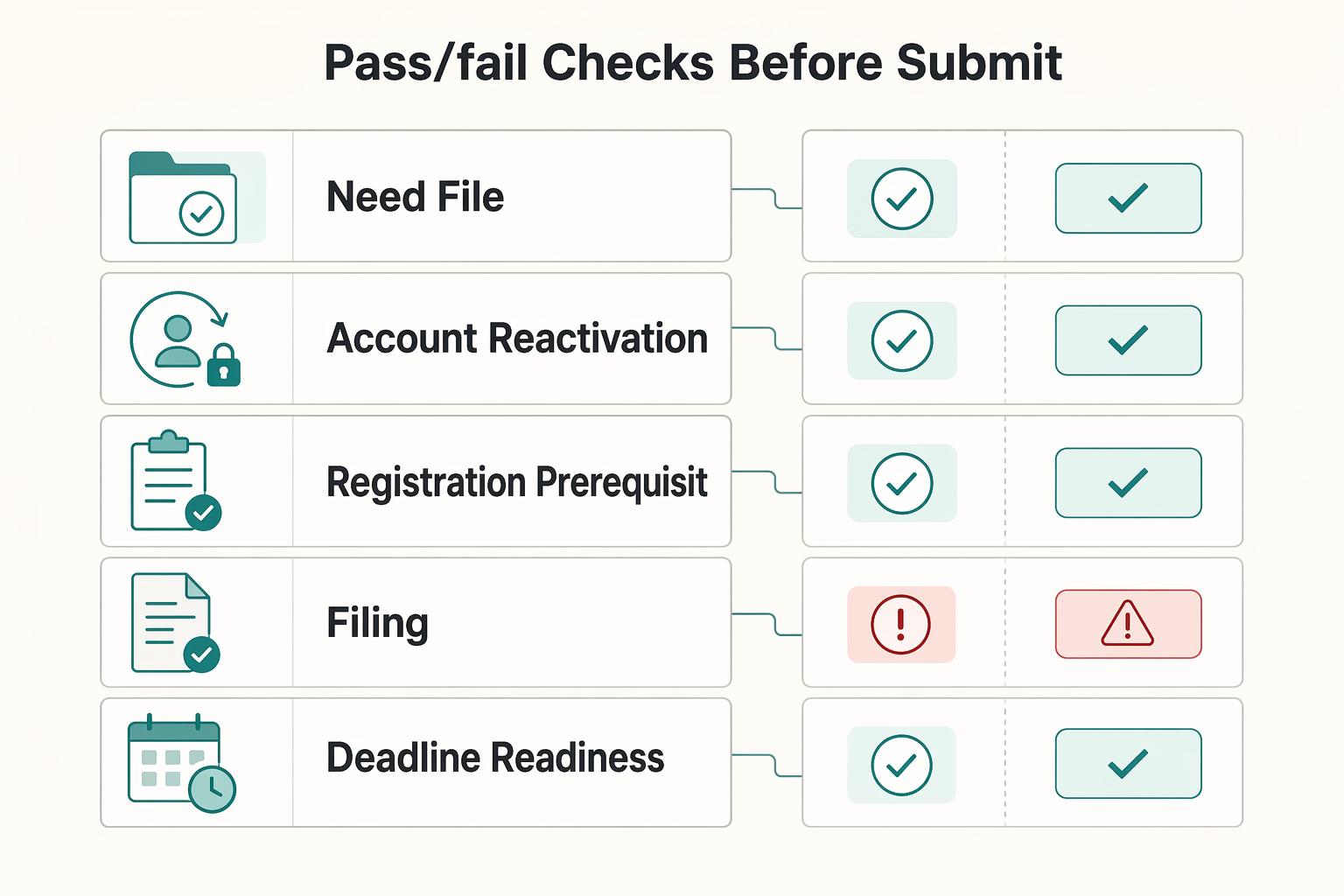
Use pass/fail checks before submit#
| Check | Pass if | Fail if | How to fix before submitting |
|---|---|---|---|
| Need-to-file decision | You confirmed you need to send a tax return before registering | You started registration without confirming the requirement | Check HMRC guidance first, then continue only if filing is required |
| Account reactivation | Existing account is active, or first-time status is confirmed | You have an existing account but did not reactivate it | Reactivate the account before filing to reduce delay risk |
| Registration prerequisites | You can complete registration with required details, including NI number | Required registration details are missing | Gather missing details and complete registration first |
| Filing route readiness | You know whether you can use HMRC online filing or need software/forms | You assumed online filing without checking route limits | Switch to the correct route before submission |
| Deadline readiness | Your plan uses verified live GOV.UK deadlines | You are relying on unverified or outdated dates | Recheck current HMRC dates for your tax year and update the plan |
Once timing and sequence are under control, you reduce avoidable delays and lower the risk of penalties from late registration.
Budget the Move Before You Click Submit#
Submit only when you can do all three at once: pay required charges, still meet the savings evidence requirement, and keep a reserve for timing-related extras.
For the HPI route, a common budget mistake is mixing up money you pay with money you still need to show in your account. If you spend maintenance funds on last-minute admin, you can create an eligibility issue right before submission.
Separate what you pay from what you must prove#
| Paid charges | Funds you must evidence |
|---|---|
| Amounts you actually pay during the process, such as the application fee, Ecctis check, healthcare surcharge, and route-specific identity or document costs. | Savings you must show, not spend. For the main applicant, this is at least £1,270, usually held for 28 days in a row, with day 28 within 31 days of applying. Dependants can add extra maintenance requirements. |
Keep these as separate lines in your budget. If translation, travel, or appointment extras reduce your balance during the holding window, you may fall below the required evidence threshold.
Build your five-bucket budget first#
Fill this in with live figures right before payment.
| Cost bucket | What can change at payment time |
|---|---|
| Application fee | Official fee updates |
| Ecctis qualification check | Service pricing when ordered |
| Healthcare surcharge | Visa length and current yearly rate |
| Document and identity services | Translation needs, identity route, appointment charges, optional services, priority availability |
| Maintenance funds | Exemptions and dependant composition |
If family members are applying, budget for them from the start. Their payments and maintenance evidence can materially change your total.
Run a pre-submit variable-cost check#
- Translations: If any document is not in English or Welsh, include certified translation costs before final upload prep.
- Health documentation: Check early whether tuberculosis evidence applies to your case.
- Identity route and appointments: Confirm whether you are app-based or appointment-based, and budget standard and optional appointment services accordingly. Optional services do not increase approval odds.
- Travel for biometrics: If the nearest visa application centre is not local, include travel costs in your plan.
Use one go/no-go checkpoint#
Before you submit, recheck the official fee pages, recheck maintenance evidence rules, and confirm identity-route costs for your location. Then make one decision: after required payments, do you still have compliant maintenance evidence and a reserve for timing or travel extras? If not, wait and submit when the budget is stable.
Planning for Partner and Children Without Losing Momentum#
Decide your family filing pattern before you submit. Apply together when you need one arrival date and everyone's file is ready. Stagger when one person's timing would delay the whole plan.
Eligible partners and children can apply as dependants on the HPI route if they meet the rules. Your partner must fit a qualifying category, for example a UK-recognised marriage or civil partnership, or an unmarried partnership with at least 2 years of living together. If you are not living together, you must show ongoing commitment. A child must meet dependant rules and must not be married or in a civil partnership.
Choose the filing pattern#
| Strategy | Best when | Main risk | How to reduce delay |
|---|---|---|---|
| Apply together | You want a shared move date and all documents are ready now | One weak file slows the whole family plan | Complete every evidence pack before the first submission |
| Stagger after the main applicant | You need the main applicant approved first, and family can join later | Temporary separation and repeated admin | Pre-build dependant packs and file before current visas expire |
| Stagger around an in-UK switch | One or more family members are already in the UK on current permission | Visa-switch timing mistakes | Map each person's location, visa expiry, and filing route before submission |
Use this filing sequence:
- If a family member is outside the UK, they apply as your dependant to join you.
- If a family member is inside the UK, their visa does not switch automatically if you switch to HPI.
- For in-UK cases, they can apply at the same time as you or later, but before their current visa expires.
- For an in-UK switch application, do not travel outside the UK, Ireland, the Channel Islands, or the Isle of Man before a decision.
Use a pass/fail family dossier check#
Treat the family pack as one synchronized record, even if filing dates differ.
- Identity consistency: Names, dates of birth, passport details, and address history match across forms and uploads.
- Relationship proof: Partner evidence matches the route claimed, and any period living apart is explained consistently.
- Child living arrangement: Each child meets dependant conditions and normally lives with you, unless living away in full-time education.
- Money and timing: Confirm maintenance funds (£285 for a partner, £315 for one child, £200 for each additional child), held for at least 28 days in a row with day 28 within 31 days of applying; treat decisions as usually around 3 weeks outside the UK or 8 weeks inside the UK.
Final go/no-go: are all family members eligible, on the correct inside-UK or outside-UK path, and supported by one clean evidence set? If not, pause and fix the weak file before submitting.
Once the filing pattern is set, the first month in the UK is about making your records usable later.
For a step-by-step walkthrough, see A Guide to Greece's Digital Nomad Visa and Its 50% Tax Break.
Your First 30 Days in the UK#
In your first month, focus on one outcome: keep your records consistent across work setup, tax admin, and travel history. That baseline helps when you need to show when income started, what records support your return, and which filing route applies.
Use this window to set habits early: mismatched details, missing dates, and scattered records are harder to fix later.
Lock your records trail in week one#
Set one consistent version of your personal details and reuse it across early records. Keep dated documents in one place so your timeline is easier to evidence later.
Use this pass/fail checklist before each new form:
- One consistent profile: Keep your name, date of birth, and address details consistent across records.
- Dated proof: Save dated documents as you go.
- Single storage location: Keep records in one folder with clear dates in filenames.
Get work and tax setup straight before income starts#
Before money starts moving, confirm your filing path and required IDs. The core items here are Self Assessment, your National Insurance number, and your Unique Taxpayer Reference (UTR) if you need to file online.
Start with this rule: check whether you need to send a tax return before registering. If you expect self-employed income, do not leave this until late, because late registration can lead to penalties.
| Checkpoint | What to do |
|---|---|
| National Insurance number | If you need to register for Self Assessment as a sole trader, you need a National Insurance number first. |
| First-time Self Assessment | If this is your first filing, register for Self Assessment before using the online filing service. |
| Sole trader earnings trigger | If you earn more than £1,000 from self-employment in a tax year, register as a sole trader by registering for Self Assessment. |
| Unique Taxpayer Reference | You need a UTR to sign in and file a Self Assessment return online. |
| Existing Self Assessment account | If you previously had Self Assessment, check whether reactivation is required. Filing without reactivating can delay your return. |
| Filing timeline | Tell HMRC by 5 October if you need to complete a return for the previous tax year. You can file on or after 6 April after the tax year ends, and you need to pay your tax bill by 31 January. |
Also confirm your filing route, not just your deadline. Some cases cannot use the standard online filing service, including non-resident situations.
Start residence tracking on day one#
If UK tax residence may matter for your filing route, keep a simple dated travel log from day one.
Track three things:
- What happened: Arrival and departure dates, and where you were based.
- What proves it: Tickets, booking confirmations, and dated accommodation records.
- When you review: Review regularly so records stay current.
Store the log and supporting evidence together. For deeper SRT rules and edge cases, use Understanding the UK's Statutory Residence Test (SRT).
Run one ongoing evidence pack#
Keep one rolling evidence pack for the rest of the year and update it as events happen. HMRC requires recordkeeping, for example bank statements or receipts, so build this before you need it.
Use one folder with:
- Income records: Payslips, invoices, payment confirmations.
- Work basis: Contracts, engagement letters, role-change documents.
- Money trail: Bank statements tied to salary or client payments.
- Relocation records: Travel receipts, temporary stay records, tenancy documents, and related move costs.
Go/no-go reminder: before you register, file, or pay, verify the live HMRC deadline and route for your current facts.
Switch Before Expiry Instead of Waiting for a Deadline Crisis#
Choose your post-HPI route before time pressure chooses it for you. Build your switch plan in this order: route selection -> eligibility and documents -> submission timing -> travel and work continuity checks. Use the pathway types below as planning buckets, then verify the current official route rules.
| Likely pathway type | When this route fits | Main evidence needed | Common delay risk |
|---|---|---|---|
| Employer-linked route | You plan to stay based on one job or employer | Current permission details, identity documents, employment paperwork, verified employer-side documents | Employer paperwork is incomplete or details do not match across documents |
| Independent or achievement-led route | Your case depends more on your own track record than one employer | Identity documents, dated portfolio, references, achievement evidence, current permission records | Evidence is strong but not mapped clearly to live criteria |
| Partner or family-linked route | Your longer stay depends mainly on a qualifying relationship | Identity documents, relationship evidence, address history, current permission records | Date gaps or inconsistent relationship or cohabitation records |
| Business or self-employment-led route | You expect to contract, freelance, or run a business | Contracts, invoices, bank statements, tax setup records, identity and permission documents | Tax admin is treated as immigration eligibility, or early admin steps are missed |
Pick one primary route and one fallback, then fully build both files.
If self-employment is part of your plan, keep HMRC admin separate from immigration rules. A sole trader is a business owned and run by one person, and your structure affects tax, control, and business debts. If your self-employed income is above £1,000 in a tax year, register as a sole trader by registering for Self Assessment. You need a National Insurance number first. If you are filing for the first time, register before using the online filing service. You also need a UTR to sign in, and an existing account may need reactivation to avoid return delays.
Use this verification checklist before submission:
- Confirm the current route requirement from official GOV.UK guidance.
- Confirm current evidence-format and document-validity rules from official GOV.UK guidance.
- Confirm the current submission cutoff from official GOV.UK guidance.
- Confirm the current travel rule for pending applications from official GOV.UK guidance.
- Confirm the current work-continuity rule for pending applications from official GOV.UK guidance.
Run a regular review cadence, then move to weekly checks in your final planning window. Proceed only when route criteria, document pack, and live GOV.UK requirements are all confirmed. If any one is unclear, treat it as no-go and keep verifying.
Final Checklist Before You Start Your HPI Move#
If any item fails, pause before you pay and fix it first.
Route fit#
- Pass: You need an unsponsored route and do not have a sponsor lined up. HPI does not require a job offer.
Fail/compare first: You already have a confirmed sponsored role. Check Skilled Worker first, because it requires a confirmed job offer and a Certificate of Sponsorship (CoS), which is an electronic record with a unique number, not a paper certificate.
- Pass: Your qualification was awarded in the last 5 years, and your university appears on the Global Universities List (GUL) for the exact month and year of your award.
Fail: Either gate is not met. Stop and choose a different route.
- Pass: You treat Ecctis as a qualification-level check only. Ecctis confirms your qualification is valid and at the right level for HPI. It does not confirm GUL eligibility.
Fail: You are relying on Ecctis to prove university eligibility.
- Pass: HPI can fit a near-term goal of entering the UK without sponsorship.
Fail/reassess: Your main goal is settlement and sponsorship is already realistic, because HPI is one-time, cannot be extended, and does not count toward settlement time.
Evidence pack#
- Follow dependency order:
GUL award-period check -> Ecctis result -> full document pack -> application form.
-
Build your core file before drafting the form: valid passport or travel document, Ecctis outcome, English evidence at B2 CEFR, and certified translations for any non-English or Welsh documents.
-
Run one consistency check across all records: name, date of birth, award date, and institution details should match across identity, qualification, and English-language evidence.
-
Do a live-policy check immediately before payment: confirm the current processing window, live payable amount in the application flow, and any officially published route-cap update if relevant. Use current GOV.UK pages or the application flow, not saved notes.
Whole journey plan#
-
Treat approval as day zero, not the finish line: map your first-weeks setup in order: housing, bank access, employer onboarding, right-to-work proof, then National Insurance follow-up.
-
Prepare right-to-work proof for employer checks: use your eVisa share code when asked (a share code lasts 90 days), and generate a fresh code when needed instead of relying on an older one.
-
Keep work start and NINO separate in your plan: you can start work before your National Insurance number arrives if you can prove your right to work. For the admin flow, use How to Get a National Insurance Number (NINO) in the UK.
-
Set your switch-path decision early: because HPI is fixed-term and not a settlement route, decide early whether you are moving to Skilled Worker or another eligible route before expiry. If family members switch later, plan their applications separately, since their visas do not switch automatically when yours does.
Related reading: Portugal Golden Visa in 2026 for Remote Professionals.
As you finalize your move plan, keep your UK day-count and residency signals organized with the Tax Residency Tracker.
Frequently Asked Questions
Who is actually eligible for the UK high potential individual visa?
Start with these key gates. Your qualification must have been awarded in the last 5 years, your university must be on the correct Global Universities List for your award period, Ecctis must confirm your qualification level, and you must meet B2 CEFR English. You must also not already have had a Graduate visa or entered under the Doctorate Extension Scheme. Run that self-check in that order, because Ecctis does not confirm whether your university is on the Global Universities List.
How long does the visa last if you have a doctorate?
If you have a PhD or other doctoral qualification, the grant is 3 years. Otherwise it is 2 years.
Can you work in the UK without sponsorship on this route?
Yes. This is an unsponsored route, and you do not need a job offer to apply. The real next step is deciding whether short-term flexibility is your actual goal or whether you should compare a route that matches long-term settlement plans better.
Can you extend it later?
No. You cannot extend this route, and you can only apply for it once. Plan your switch early if you want to stay longer, instead of treating HPI as something you can renew.
How long does a decision take?
It depends. You’ll usually get a decision within 3 weeks if you apply from outside the UK, or 8 weeks if you apply from inside the UK. These are typical timelines, not guarantees, so check live GOV.UK before submission and add buffer time before travel, move-out, and job start commitments.
What if the annual cap is a concern?
It depends. The route is capped at 8,000 applications a year, and the allocation year runs from 1 November to 31 October. Confirm the live position on GOV.UK right before you apply, and keep a fallback route ready if timing risk is high.
Does time on HPI count toward settlement?
No. Time on HPI does not count toward settlement, and HPI is not a settlement route. Use it for entry and flexibility, then move to a settlement-capable route early if long-term residence is your goal.
Try a related tool
Researched and edited by the Gruv editorial team. Gruv builds cross-border billing, payouts, and finance-operations software for global businesses.
Sources
Includes 2 external sources outside the trusted-domain allowlist.
Educational content only. Not legal, tax, or financial advice.
Related Posts

The 2026 Global Digital Nomad Visa Index for 50+ Countries
Start with legal fit, not lifestyle filters. The practical order is simple: choose a route you can actually document, then decide where you want to live. That single change cuts a lot of wasted comparison work and stops you from falling in love with places that were never a real filing option.

Understanding the UK's Statutory Residence Test (SRT)
Treat SRT like ops, not folklore. You want a repeatable workflow you can run monthly so your tax-year answer is boring, documented, and easy to defend.

How to Get a National Insurance Number (NINO) in the UK
Start with a simple sequence: check whether you already have a National Insurance number, submit one first application only if you need it, then keep your NINO, UTR, and share code in separate lanes. Many setup problems come from document mix-ups rather than difficult legal edge cases.