
Quick Answer
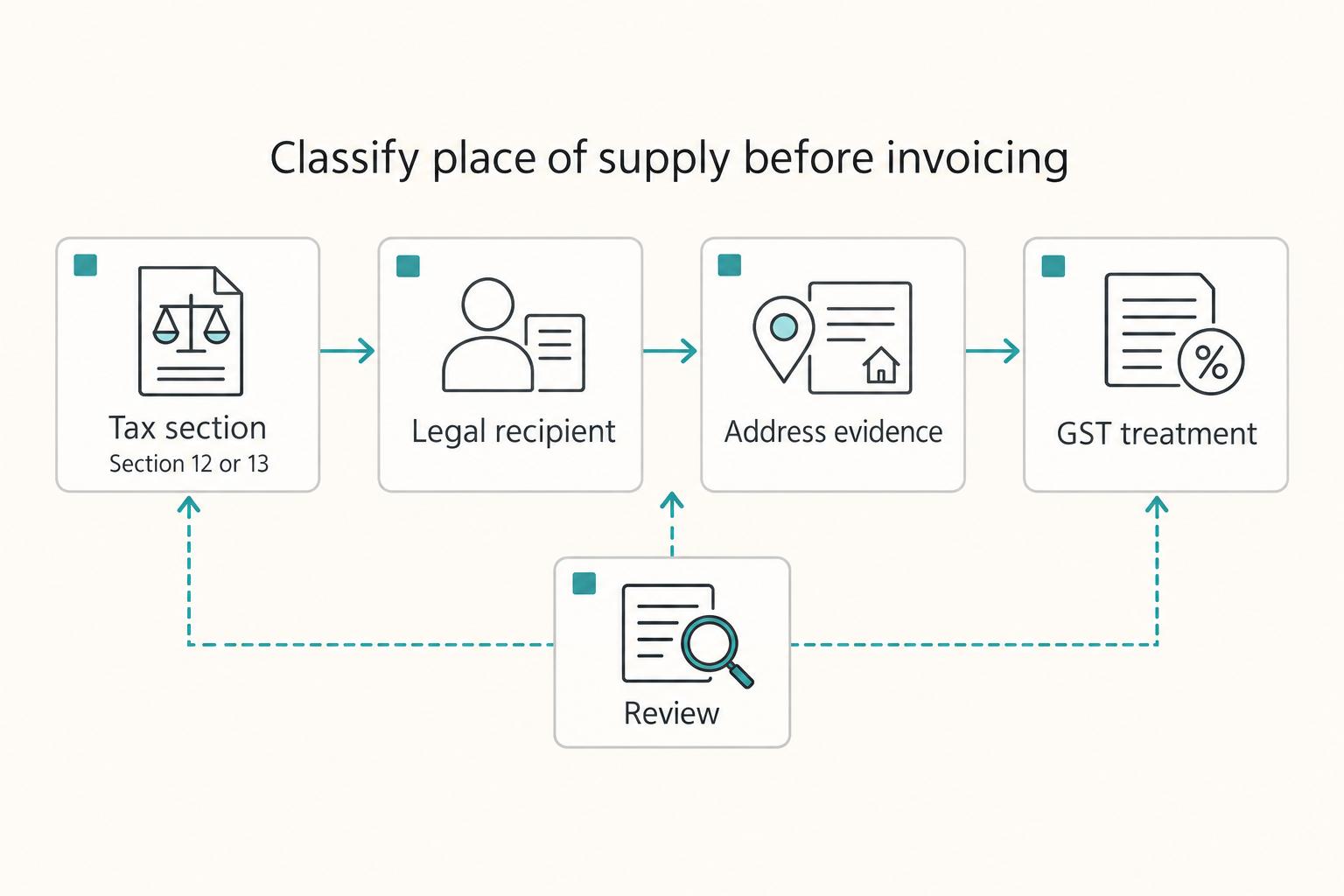
Start by classifying the invoice under Section 12 or Section 13, then set GST from recipient status and location evidence. Under Section 12(2), a registered Indian client points to recipient location; an unregistered client needs address on record, and without that the fallback is supplier location. For cross-border work, Section 13(2) is only the default, so test exceptions before marking export of services or applying LUT without IGST.
How Do Global Professionals Master GST Place of Supply?#
Use this sequence before you draft an invoice. Classify the transaction under Section 12 or Section 13, identify the legal recipient, confirm your address-on-record evidence, then finalize GST treatment. That order reduces classification mistakes and gives you a position you can defend if the facts are later questioned.
A decision flow to use before every invoice#
| Decision point | Condition | Result |
|---|---|---|
| Service supply split | Both supplier and recipient are in India | Section 12 applies |
| Service supply split | Either supplier or recipient is outside India | Section 13 applies |
| Recipient | Consideration is payable | Recipient is the person liable to pay it |
| Section 12(2) domestic | Recipient is registered | Place of supply is the recipient's location |
| Section 12(2) domestic | Recipient is unregistered and address on record is available | Use the recipient address on record |
| Section 12(2) domestic | No address on record exists | Fallback is the supplier location |
| Section 13(2) cross-border | Start with the default, then test exceptions | The default is the recipient location, but exceptions can override it |
- Confirm this is a service supply.
For services, the core split is straightforward. Section 12 applies when both supplier and recipient are in India. Section 13 applies when either one is outside India.
- Identify the recipient in the legal sense.
Where consideration is payable, the recipient is the person liable to pay it. The business beneficiary and the legal recipient are not always the same, and mixing them up can cause errors.
- Apply Section 12(2) correctly for domestic cases.
If the recipient is registered, the place of supply is the recipient's location. If the recipient is unregistered, use the recipient address on record. If no address on record exists, the fallback is the supplier location.
- For cross-border cases, start with Section 13(2), then test exceptions.
The default is the recipient location, but exceptions can override it. Do not assume every foreign-client engagement automatically qualifies as an export of services.
Common freelancer scenarios#
| Scenario | Rule trigger | Likely GST treatment | Invoice implication | Risk if misclassified |
|---|---|---|---|---|
| Indian registered company hires you | Section 12(2), registered recipient | Place of supply is recipient location | For inter-State supply, include place of supply with state name and code | Wrong tax treatment creates downstream reconciliation friction |
| Indian unregistered customer, address on record available | Section 12(2), unregistered with address | Place of supply is recipient address on record | Keep address evidence aligned with invoice treatment | Weak address records undermine your position |
| Indian unregistered customer, no address on record | Section 12(2) fallback | Place of supply defaults to supplier location | Do not invoice as if recipient location were established | Control failures can happen in fast-turn work |
| Foreign client contracts and pays | Section 13(2) default + Section 2(6) test | May qualify as export only if all export conditions are met | If using LUT/bond route, use prescribed export endorsement | Export treatment without full condition and evidence support can create significant risk |
| You arrange or facilitate between two parties | Intermediary analysis (Section 13(8) published text) | Supplier-location outcome may apply under current published text | Do not assume export position | Requires professional review, plus law-change tracking |
Intermediary classification needs extra caution. If your role is arranging or facilitating between parties rather than supplying on your own account, stop and review the position before you apply export treatment. There is an official recommendation to omit Section 13(8)(b), but treat this area as unsettled until the enacted text and effective date are verified.
Build the export evidence file, not just the invoice#
If you are taking an export position, the invoice alone will not support it. Build your file against each Section 2(6) condition so the contract, recipient details, payment trail, and invoice wording all tell the same story.
| Evidence item | Details |
|---|---|
| Agreement file | Full legal name, foreign address, contracting entity, billing entity, and signature details |
| Recipient evidence | Onboarding records showing the foreign recipient details you rely on |
| Remittance evidence | Bank advice and invoice-to-receipt mapping; include FIRC/BRC where issued |
| Invoice wording | SUPPLY MEANT FOR EXPORT UNDER BOND OR LETTER OF UNDERTAKING WITHOUT PAYMENT OF IGST. |
| LUT workflow | Maintain proof of filing through FORM GST RFD-11 |
| Carve-out check | Published carve-out language references prosecution for tax evasion exceeding two hundred and fifty lakh rupees |
| Final export checks | Confirm whether RBI-permitted INR receipt applies to your facts; confirm no Section 13 exception changes the default; confirm intermediary characterization does not apply |
At a minimum, keep the following in that file:
- Agreement file: keep the full legal name, foreign address, contracting entity, billing entity, and signature details together.
- Recipient evidence: retain the onboarding records that show the foreign recipient details you rely on.
- Remittance evidence: map bank advice to the invoice and receipt trail. Include FIRC/BRC where issued.
- Invoice wording: if supplying under LUT/bond without payment of IGST, include exactly: "SUPPLY MEANT FOR EXPORT UNDER BOND OR LETTER OF UNDERTAKING WITHOUT PAYMENT OF IGST."
- LUT workflow: maintain proof of filing through FORM GST RFD-11.
- Carve-out check: LUT availability is broad, but published carve-out language references prosecution for tax evasion exceeding two hundred and fifty lakh rupees.
- Final export checks: before you finalize export treatment, confirm whether RBI-permitted INR receipt is relevant to your facts, confirm no Section 13 exception changes the default rule you are using, and confirm intermediary characterization does not apply.
Pre-send invoice quality control#
A short check before you send the invoice helps catch avoidable rework. Focus on whether the legal analysis, the records, and the invoice fields actually match.
| Check | What to confirm |
|---|---|
| Liable entity match | The invoice customer matches the entity liable to pay consideration |
| Place-of-supply logic match | The place-of-supply entry reflects your legal analysis, not just where services were consumed |
| Inter-State fields complete | Include place of supply with state name and code where required |
| Export endorsement exactness | If claiming LUT/bond export without IGST, use the prescribed endorsement text exactly |
Run that check in this order:
- Liable entity match: make sure the invoice customer matches the entity liable to pay consideration.
- Place-of-supply logic match: confirm the place-of-supply entry reflects your legal analysis, not just where the services were consumed.
- Inter-State fields complete: include place of supply with state name and code where required.
- Export endorsement exactness: if you are claiming LUT/bond export without IGST, use the prescribed endorsement text exactly.
Edge cases that need extra caution#
These fact patterns deserve a slower review because they often look simple at first and then break once you trace the contract and payment facts.
| Fact pattern | Primary test | Action |
|---|---|---|
| Bill-to entity differs from service beneficiary | Who is liable to pay consideration? | Anchor recipient analysis to payment liability first |
| Foreign client, India-facing advertising output | Recipient determination in that fact pattern | Apply clarified recipient logic carefully to your contract/payment facts |
| Online services to unregistered recipients | Address-on-record quality | Treat recorded state/address data as a control point, not an afterthought |
If the facts involve multiple entities, agency or commission language, or unclear address records, get professional review before you lock in the treatment. If you want a deeper dive, read our guide to a defensible 2026 filing plan and A Guide to GST Registration for Indian Freelancers. Before you issue the next invoice, run your final field check in the free invoice generator.
Conclusion: Invoice Any Client, Anywhere, with Absolute Confidence#
Before each invoice cycle, run the same sequence: classify the transaction, validate export or domestic treatment, and complete a final invoice check. That keeps your GST position tied to records you can defend, not assumptions you have to explain later.
Use the facts you can prove. For domestic services, the default rule changes with the recipient's status. For a registered recipient, the place of supply is the recipient location. For an unregistered recipient, use the address on record. If no address is available, use the supplier location. For cross-border services, the general rule often points to recipient location, but service-specific carve-outs can still change the answer.
Then validate the treatment before you finalize the tax lines. If you are treating a supply as an export of services, confirm the statutory conditions in your file. That includes recipient-location support, the payment condition, and the distinct-person test. If you are supplying export services without payment of IGST, confirm the LUT is furnished before that supply.
Use this checklist when anything is unclear, and keep it tied to the records in your file:
- Confirm B2B or B2C status.
- Reconcile the contract, client record, invoice draft, and payment trail to one recipient location.
- Validate export conditions before applying export treatment.
- Use the current prescribed LUT or bond endorsement from your validated compliance file.
- Verify the place-of-supply field before issuing the invoice.
- Confirm return reporting aligns with the invoiced jurisdiction, including place-of-supply-wise disclosure where applicable.
Pause and seek professional advice if records conflict or the recipient location is unclear in the ordinary course. Do the same if the client may be a related establishment or you are relying on a service-specific exception you have not verified. A wrong place-of-supply declaration can push revenue to the wrong State in covered cases, and fixing that after filing is avoidable rework.
Apply this checklist to your next client engagement, and retain contract, address, invoice, and payment support from day one. Related: Do I Have to Pay State Taxes While Living Abroad as a Digital Nomad?. If your engagement structure is cross-border and ambiguous, get a practical workflow review through contact.
Frequently Asked Questions
What is the first thing you should decide before applying place-of-supply rules?
Start by sorting the transaction into the right factual bucket. A common first step is to classify the supply as B2B or B2C, then apply the place-of-supply logic for the service facts in front of you. That split helps identify the taxable jurisdiction before you finalize invoice treatment. | Client setup | What you verify first | Place-of-supply direction (starting point) | Invoice impact | | --- | --- | --- | --- | | B2B in India | Customer business status and core location records | For services, often starts with recipient location, subject to service facts | Can change whether treatment is inter-state or intra-state | | B2C in India | Whether you have usable address-on-record evidence | May depend on customer location evidence or another reasonable proxy | Weak location records make treatment harder to defend | | Service cases with mixed location signals | Whether recipient-location and performance-location records are consistent | Can depend on recipient location or where the service is performed | Do not finalize treatment until records align |
Does recipient location always control services?
No. For services, the answer depends on the nature of the supply. Recipient location is a common starting point, but in some cases the rule turns on where the service is performed or on another service-specific rule. Start with the default that fits your facts, then check whether a more specific provision changes the result.
How do you verify place of supply before sending the invoice?
Run a quick consistency check across records such as the customer name, address on record, contract or SOW, invoice draft, and payment or onboarding details. If you are billing an Indian GST-registered client, one practical check is to cross-check supplier place details using the GST search tool. If those records point to different places, pause and resolve the mismatch before invoicing.
What documents should you keep as proof?
Keep a practical file that supports one consistent story about who bought the service and where that recipient is located. A workable internal checklist can include records like the contract or SOW, client master or onboarding record, invoice copy, address-on-record support, and payment mapping. Where evidence is unclear, resolve the mismatch before finalizing invoice treatment.
What happens if you mention the wrong place of supply?
You can push the supply into the wrong GST jurisdiction. That can flip the invoice treatment between inter-state and intra-state, which means IGST instead of CGST+SGST, or the reverse. Services can leave a thinner trail than goods, and billing locations can change quickly, so rushed entries create avoidable risk.
What should you do if the contract address, invoice address, and payment records do not match?
Pause before issuing the invoice. Work out which record supports the recipient location you are using and which one is stale, clerical, or unrelated before you choose the treatment. If you cannot reconcile the mismatch cleanly, get advisor review before invoicing.
Is there a simple rule for IGST versus CGST plus SGST?
Yes. The place-of-supply outcome drives that split. Inter-state treatment leads to IGST, while intra-state treatment leads to CGST+SGST. That is why the classification step and evidence check should happen before every invoice.
Try a related tool
Researched and edited by the Gruv editorial team. Gruv builds cross-border billing, payouts, and finance-operations software for global businesses.
Sources
Includes 3 external sources outside the trusted-domain allowlist.
- cbic-gst.gov.in/pdf/circularno-37-cgst.pdftrusted
- cbic-gst.gov.in/gst-invoice-rules.htmltrusted
- gstcouncil.gov.in/sites/default/files/2025-01/circular-no-242-...trusted
- tutorial.gst.gov.in/userguide/refund/Furnishing_of_Letter_of_Und...trusted
- tutorial.gst.gov.in/userguide/refund/Furnishing_of_Letter_of_Und...trusted
- cleartax.in/s/place-of-supply-of-goodsexternal
- gstindiaonline.com/pages/gstlegislation/GST%20FAQ/cbec%20faq-20...external
- indiacode.nic.in/bitstream/123456789/2251/1/A201713.pdfexternal
Educational content only. Not legal, tax, or financial advice.
Related Posts

Digital Nomad Taxes in 2026 With a Defensible Filing Plan
With digital nomad taxes, the first move is not optimization. It is figuring out where you may be taxable, where filings may be required, and what proof supports that position.

Do I Have to Pay State Taxes While Living Abroad as a Digital Nomad?
Living abroad does not end `state income tax` exposure by itself. The first decision is practical: choose a filing position your facts can support, then build records that support the same story all year.
GST Registration Decisions for Indian Freelancers
This guide is for solo freelancers and independent consultants working from India, whether you bill Indian clients, foreign clients, or both. It focuses on practical GST registration decisions, not large-company structures, multi-entity planning, or product-heavy GST setups.